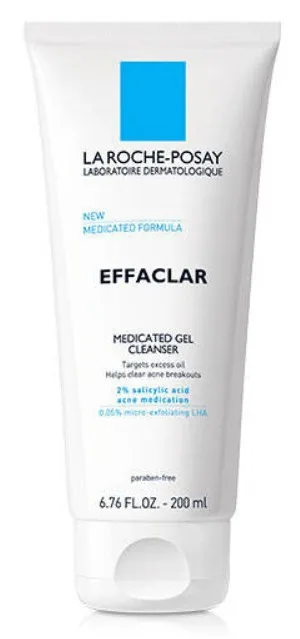
Most 2% salicylic acid cleansers stop at the salicylic acid. LRP adds LHA (capryloyl salicylic acid) for deeper follicular penetration — a meaningful upgrade over single-BHA alternatives.
A genuinely clinical acne cleanser at a drugstore price. It carries 2 percent salicylic acid, the FDA OTC maximum, plus LHA for deeper follicular reach, and glycerin to soften the post-rinse feel. For oily and acne-prone skin it visibly clears blackheads within a few weeks. The honest catch: it is too active and too detergent-forward for dry, sensitive, or pregnant users.
Good choicefor AcneIn your profileYou chose · Salicylic Acid is an approved or monograph active for acne; this rinse-off gel carries it at 2% — short contact still counts for this active, but a leave-on does more.Moderate evidenceGentle85% report improvement · n = 101
The case for it
Salicylic Acid is a first-line active — approved, monograph-listed or named in current guidelines — for this concern.
It is present at an effective concentration, declared or high in the ingredient list.
The formula carries none of the triggers this concern is sensitive to.
Same rule for everyone. “Good choice” is the verdict on 9,564 of 45,024 concern verdicts across the catalog; rule R2r decided 408 of them.
Unchanged since September 5, 2026, engine 5.1.1.
R2r — Rinse-off exceptions (BPO wash, salicylic acid cleanser) deliver a real but smaller effect than the leave-on form; they cap at 'good choice'. Medicated shampoos for scalp concerns are exempt — the shampoo is the treatment form. Editorial decision 2 Sep 2026, pending advisory review. · the full register
Carrying active
Salicylic Acid
Standing
first line — a regulator recognises it for this use; trials support it · per § 333.310 Acne active ingredients. (U.S. Food and Drug Administration — 21 CFR Part 333 Subpart D (Topical Acne Drug Products), Code of Federal Regulations via GovInfo), opened July 27, 2026
Form
adequate (declared 2%) — studied range 0.5–2%, from the OTC monograph or label; judge it after ~6 weeks
Tolerability
gentle
Row checked
against its sources on July 27, 2026 (evidence table ev-2026.09-r228)
Good choicefor BlackheadsIn your profileYou chose · Salicylic Acid is an approved or monograph active for blackheads; this rinse-off gel carries it at 2% — short contact still counts for this active, but a leave-on does more.Moderate evidenceGentle250 reviews collected
The case for it
Salicylic Acid is a first-line active — approved, monograph-listed or named in current guidelines — for this concern.
It is present at an effective concentration, declared or high in the ingredient list.
The formula carries none of the triggers this concern is sensitive to.
Same rule for everyone. “Good choice” is the verdict on 9,564 of 45,024 concern verdicts across the catalog; rule R2r decided 408 of them.
Unchanged since September 5, 2026, engine 5.1.1.
R2r — Rinse-off exceptions (BPO wash, salicylic acid cleanser) deliver a real but smaller effect than the leave-on form; they cap at 'good choice'. Medicated shampoos for scalp concerns are exempt — the shampoo is the treatment form. Editorial decision 2 Sep 2026, pending advisory review. · the full register
Carrying active
Salicylic Acid
Standing
first line — a regulator recognises it for this use; trials support it · per 21 CFR § 333.350 - Labeling of acne drug products. (US Code of Federal Regulations (Legal Information Institute, Cornell Law School)), opened July 27, 2026
Form
adequate (declared 2%) — studied range 0.5–2%, from the OTC monograph or label; judge it after ~6 weeks
Tolerability
gentle
Row checked
against its sources on July 27, 2026 (evidence table ev-2026.09-r228)
The studies behind the evidence row
OTC monograph, Topical Acne Drug Products — salicylic acid 0.5–2% recognized as an acne treatment active — US Food and Drug Administration
Supporting rolefor Large PoresIn your profileYou chose · Rinse-off gel: Salicylic Acid gets seconds of contact, so this supports a routine for large pores rather than treating it.Not yet assessedGentle250 reviews collected
The case for it
Salicylic Acid has been researched for this concern and the evidence does not support it.
It is in a rinse-off product, so it gets seconds of contact rather than the leave-on exposure the evidence assumes.
The formula carries none of the triggers this concern is sensitive to.
What would change this: The same active in a leave-on form would be judged on its evidence rather than its contact time.
Same rule for everyone. “Supporting role” is the verdict on 8,197 of 45,024 concern verdicts across the catalog; rule R6 decided 2,017 of them.
Unchanged since September 5, 2026, engine 5.1.1.
R6 — Contact time cannot deliver a leave-on claim; the product is judged on its job (cleansing without aggravating). Explicit exceptions (BPO wash, SA cleanser, medicated shampoos) never reach this rule because their rows set rinse_off_ok. · the full register
Carrying active
Salicylic Acid
Standing
none
Form
contact limited — studied range 0.5–2%, from the OTC monograph or label; needs leave-on contact; judge it after ~6 weeks
Supporting rolefor Excess OilinessIn your profileYou chose · Rinse-off gel: Salicylic Acid gets seconds of contact, so this supports a routine for excess oiliness rather than treating it.Moderate evidenceGentle250 reviews collected
The case for it
Salicylic Acid has early or mechanistic evidence for this concern, not trial-backed standing.
It is in a rinse-off product, so it gets seconds of contact rather than the leave-on exposure the evidence assumes.
The formula carries none of the triggers this concern is sensitive to.
What would change this: The same active in a leave-on form would be judged on its evidence rather than its contact time.
Same rule for everyone. “Supporting role” is the verdict on 8,197 of 45,024 concern verdicts across the catalog; rule R6 decided 2,017 of them.
Unchanged since September 5, 2026, engine 5.1.1.
R6 — Contact time cannot deliver a leave-on claim; the product is judged on its job (cleansing without aggravating). Explicit exceptions (BPO wash, SA cleanser, medicated shampoos) never reach this rule because their rows set rinse_off_ok. · the full register
Carrying active
Salicylic Acid
Standing
plausible — trials support it
Form
contact limited — studied range 30%, from the trials on the row; needs leave-on contact; judge it after ~6 weeks
Tolerability
gentle
Row checked
against its sources on July 17, 2026 (evidence table ev-2026.09-r228)
Does the jobDoes what a cleanser is for: puts something back, surfactant mildness. Not measured from the label: pH match to skin.
A verdict is DermApproved’s assessment of how well a product’s ingredients fit a concern — never a claim about what the product treats. Evidence dots and collected reviews sit beside it and are never blended in.
Rules 0.5.1 · evidence table ev-2026.09-r228 · how we decide
Assessment
Pros & Cons
Pros
✓ Carries 2 percent salicylic acid, the FDA OTC maximum
✓ Visible blackhead reduction within one to two weeks
✓ Glycerin counterbalances the typical stripped post-rinse feel
✓ Fragrance-free, vegan, and fungal-acne safe
✓ Excellent value at under 16 dollars for the size
✓ Backed by a legacy pharmacy brand's acne expertise
Cons
✗ Too drying and active for dry or sensitive skin
✗ Sulfate-based detergent system can feel aggressive
✗ Salicylic acid content rules out pregnancy and breastfeeding
✗ Can over-exfoliate if paired with strong same-night actives
✗ SLS leads the cleansing base, disliked by clean-beauty users
Review
Full Review
There is a quiet category of skincare products that look unremarkable on the shelf but punch well above their price, and this is one of them. The Effaclar Medicated Gel Cleanser sells for under 16 dollars, comes in a plain pump bottle, and does not announce itself. But it carries 2 percent salicylic acid, which is the FDA over-the-counter maximum for acne treatment, the same concentration found in prescription-adjacent medicated washes. That is not a marketing rounding-up; 2 percent is the legal ceiling, and a lot of acne cleansers settle for half that or less. For oily and acne-prone skin, getting the maximum permitted dose at this price is the entire appeal, and it is a real one.
Salicylic acid is the right active for the job because it is lipid-soluble, which means it can penetrate into the oil-filled sebaceous follicle rather than just working on the skin surface. Inside the follicle it dissolves the keratin-and-sebum plugs that become blackheads and comedonal acne. La Roche-Posay does not stop at salicylic acid, though. The formula also includes capryloyl salicylic acid, the lipo-hydroxy acid known as LHA, a salicylic acid derivative developed by L'Oreal's research arm. LHA is more lipophilic than standard salicylic acid, giving it deeper follicular penetration and a slower, more gradual release, and it tends to be gentler on tolerance. There is also salicyloyl phytosphingosine in the supporting cast, another salicylic-derived ingredient. The dual-BHA approach, standard salicylic acid plus LHA, is a meaningful step up over single-acid cleansers, because the two derivatives work at slightly different depths and rates. Glycerin is included as a humectant counterweight, which matters: strong salicylic cleansers are notorious for that tight, stripped post-rinse feeling, and the glycerin softens it.
In use, this is a clear gel that works up a medium foam, rinses clean, and leaves a non-greasy finish. It is essentially scentless and fragrance-free. There is often a slight tingle on the first several uses that settles within a week or two as the skin adjusts. The results, for the right skin type, are the selling point: most users report a visible reduction in blackheads and active breakouts within one to two weeks, with cumulative pore-refining and acne control building over four to eight weeks of consistent twice-daily use. It is also fungal-acne safe and vegan, which adds to the appeal for the oily, congestion-prone audience it targets.
Now The limitations, because this cleanser is not for everyone and pretending otherwise would be a disservice. The audience is genuinely narrow. For dry or sensitive skin, the combination of a 2 percent salicylic load and a sulfate-based detergent system can be over-drying and irritating, and the data flags it as not ideal for those types. The cleansing base leads with sodium laureth sulfate, an effective but assertive surfactant; clean-beauty-oriented shoppers will not love seeing SLS at the top of the INCI list, and some users simply find the sulfate cleansing too aggressive for daily use. It is also not pregnancy-safe: 2 percent salicylic acid is generally contraindicated during pregnancy and breastfeeding, and that is a hard rule, not a preference. And because it is an active cleanser, pairing it the same evening with strong leave-on AHAs or a high-strength retinoid can tip skin into over-exfoliation, so it needs to be used with a little routine discipline.
Value, for the right user, is excellent. Under 16 dollars for a 200 ml bottle of an FDA-max-strength acne cleanser with an LHA upgrade is a strong deal, and larger sizes are available for even better per-ml economy. At twice-daily use a bottle lasts roughly three to four months. La Roche-Posay, founded in 1975, is a legacy pharmacy brand with genuine clinical credibility and 15-plus years of dermatology recommendation behind its acne franchise, so this is formulation substance at a fair price, not a name premium. With a 4.5 average across thousands of reviews, the track record holds up.
A useful way to think about this cleanser is as the foundational, low-effort layer of an acne routine rather than the whole strategy. A medicated wash delivers a proven active through a step you already perform daily, which makes it a reliable baseline, but for moderate or stubborn acne it works best alongside targeted leave-on treatments such as a niacinamide serum, azelaic acid, or, under guidance, benzoyl peroxide or a retinoid on alternating evenings. Used as that dependable base, it does steady, unglamorous work, and that consistency is exactly what comedonal acne responds to.
The recommendation is straightforward: if you have oily or acne-prone skin and want a clinical-strength salicylic cleanser without paying a clinical-strength price, this is one of the best picks available. If your skin runs dry, sensitive, or reactive, or if you are pregnant, this is the wrong tool, and a gentler cleanser paired with a targeted leave-on treatment will serve you far better.
Formula
Key Ingredients
The hero actives that drive this product's performance.
FDA OTC maximum concentration for acne treatment. Lipid-soluble BHA penetrates sebaceous follicles to dissolve comedonal acne and blackhead congestion. The 2% level is genuinely clinical — same concentration as prescription acne washes.
Salicylic acid derivative developed by L'Oreal research with deeper follicular penetration and slower release. Capryloyl salicylic acid provides BHA chemistry with gentler skin tolerance — a meaningful upgrade over standard salicylic acid alone.
The active core here is salicylic acid at 2 percent, the FDA-recognized over-the-counter maximum for acne treatment, supported by capryloyl salicylic acid (LHA). Salicylic acid is a beta-hydroxy acid, and its defining property is lipid solubility: unlike water-soluble alpha-hydroxy acids, it partitions into the sebum-rich environment of the pilosebaceous follicle, where it loosens the corneocyte-and-sebum plugs central to comedonal acne. It also has mild anti-inflammatory activity. The published evidence base supports topical salicylic acid for comedonal and mild inflammatory acne, and it remains a long-standing dermatology recommendation for oily, congestion-prone skin. The formula's more distinctive element is the inclusion of LHA, capryloyl salicylic acid, a derivative engineered to be more lipophilic than salicylic acid itself, which gives it deeper follicular penetration and a slower, more sustained release that tends to be better tolerated. Combining the two means the formula acts at slightly different depths and release profiles rather than relying on a single mechanism. A reasonable question with any cleanser is whether contact time is long enough for actives to work, since a wash is rinsed off; the practical answer, supported by clinical use, is that consistent twice-daily application of a 2 percent salicylic cleanser delivers measurable comedonal improvement over four to eight weeks, with the actives having affinity for follicular lipids that supports retention beyond the brief rinse window. Glycerin is included as a well-validated humectant to offset the drying tendency of the active and surfactant load.
Dermatologist Perspective
Salicylic acid is one of the most established over-the-counter acne ingredients, and dermatologists routinely recommend 2 percent salicylic acid cleansers as a foundational step for oily and comedonal acne-prone skin. Many dermatologists highlight that a medicated cleanser is a low-effort way to deliver a proven active, since it slots into a step patients already perform, and the addition of LHA is generally regarded as a worthwhile refinement for deeper follicular action and tolerability. Dermatologists also consistently caution that salicylic acid is contraindicated in pregnancy and breastfeeding, that dry and sensitive skin can be over-stripped by active sulfate cleansers, and that combining a salicylic cleanser with strong leave-on exfoliants or retinoids in the same routine raises the risk of barrier irritation. For the right patient, however, this type of product is a commonly recommended workhorse.
Guidance
Usage & Recommendations
How to Use
Use AM and PM on damp skin, working a small amount into a light foam, massaging gently for 20 to 30 seconds, then rinsing with lukewarm water. Sensitive or first-time users should start once daily, ideally in the evening, and build up to twice daily over a week or two as the skin adjusts; a mild initial tingle is normal and usually fades. Always follow with a moisturizer, and apply a broad-spectrum SPF every morning, since salicylic acid can increase sun sensitivity. Avoid pairing it the same evening with strong leave-on AHAs or high-strength retinoids to prevent over-exfoliation.
Value Assessment
At under 16 dollars for a 200 ml bottle, this is excellent value: an FDA-maximum 2 percent salicylic acid cleanser with an LHA upgrade at a price well below medicated alternatives. Larger sizes are available, improving the per-milliliter cost further, and at twice-daily use a standard bottle lasts roughly three to four months. Coming from a legacy pharmacy brand with 15-plus years in the acne category and genuine clinical credibility, the price reflects formulation quality rather than a brand premium. For oily and acne-prone users, the value-to-performance ratio is among the best in the category.
Who Should Buy
This is a strong, affordable choice for oily and acne-prone skin dealing with blackheads, congestion, and recurrent breakouts who want a clinical-strength salicylic acid cleanser. It suits combination skin too, and anyone who prefers delivering a proven acne active through a step they already do.
Who Should Skip
Dry, sensitive, or reactive skin should skip this, since the 2 percent salicylic acid plus sulfate base can over-strip and irritate. It is also not suitable during pregnancy or breastfeeding, and anyone with rosacea or a compromised barrier should approach it with caution or choose a gentler cleanser.
Ready to try La Roche-Posay Effaclar Medicated Gel Cleanser?
Long-running La Roche-Posay acne franchise staple, widely recommended in US dermatology practice.
About La Roche-Posay Legacy Brand (20+ years)
La Roche-Posay was founded in 1975 in the French town of La Roche-Posay, known for its thermal spring water. The brand is part of L'Oreal's Active Cosmetics Division and is one of the most extensively studied and dermatologist-recommended pharmacy brands in the world. Distributed through US drugstores, Sephora, Ulta, and dermatology offices with strong clinical research backing.
Brand founded: 1975 · Product launched: 2018
Myth vs. Reality
Common Myths
Myth
2% salicylic acid in a cleanser doesn't work because contact time is too short.
Reality
Published research supports clinical efficacy of 2% salicylic acid in rinse-off cleansers for comedonal acne control over 4-8 weeks of consistent use.
FAQ
Frequently Asked Questions
Can I use it daily?
Yes — designed for AM and PM daily use. Sensitive users may want to start once daily and build up.
Is Effaclar Medicated Gel Cleanser pregnancy-safe?
No — 2% salicylic acid is contraindicated during pregnancy and breastfeeding.
Reviews
What Reviewers Tend to Say
Recurring themes our editors read across retailer reviews of this product — summaries in our words, not quotations, and not a substitute for your own patch test.
Common Praise
2% salicylic acid is clinical strength
LHA addition provides deeper penetration
Strong value at under $16
Visible blackhead reduction within 2-3 weeks
Fragrance-free formulation
Common Complaints
Salicylic acid content limits pregnancy use
Can over-dry sensitive or dry skin
SLS detergent at top INCI position not loved by clean-beauty users
Strong sulfate-based cleansing too aggressive for some users
Four sub-brands, a spring in central France, and sunscreens whose best chemistry Americans still can't buy — a working map of which parts of the lineup are worth the premium and which are a commodity.
The whole case for salicylic acid rests on one unglamorous fact of chemistry: it dissolves in oil. Understand that, and you know exactly when it beats a glycolic acid — and when it's overkill.
Those tiny dots on your nose are almost certainly not blackheads — they're normal, functional plumbing you will never 'clear,' and the extraction obsession is quietly wrecking the skin around them.
Jun 6, 2026· 6 min
Questions people ask about Acne
Verified answers from our questions library — the nuance a product page cannot carry.
Products, answers, therapy guides, tools and articles in one search. Brand names,
slang and abbreviations all work — accutane finds isotretinoin, bacne finds truncal acne.