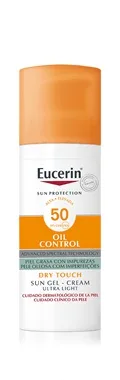
Eucerin Sun Gel-Cream Oil Control SPF 50+ pairs the European UV filter complex (avobenzone plus four supporting filters at high SPF 50+) with the distinctive L-carnitine oil-control technology that targets sebum production at the mechanism level rather than just absorbing oil on the surface. The dry-touch matte finish from silica and tapioca starch is genuinely different from typical sunscreens — for oily and acne-prone skin where most sunscreens feel heavy or greasy, this addresses both the protection and finish problems simultaneously.
Eucerin's flagship European sunscreen for oily and acne-prone skin — SPF 50+ broad-spectrum protection in a matte gel-cream finish with the distinctive L-carnitine oil-control technology that targets sebum production rather than just absorbing surface oil. One of the better-engineered options for the specific oily-skin SPF problem; less ideal for very dry or pregnancy-cautious shoppers given the chemical filters and alcohol content.
Supporting rolefor AcneIn your profileYou chose · Nothing here targets acne directly; photoprotection for post-inflammatory marks is the recognised companion to treating it, and this gel cream does that without known triggers.Not yet assessedGentleNo reviews collected yet
The case for it
UV Filter Complex has no evidence row yet for this concern — it is in the research queue.
The formula carries none of the triggers this concern is sensitive to.
What would change this: A researched evidence row for the lead active would replace this with a verdict.
Same rule for everyone. “Supporting role” is the verdict on 8,197 of 45,024 concern verdicts across the catalog; rule R8 decided 4,250 of them.
Unchanged since September 5, 2026, engine 5.1.1.
R8 — The category's job (barrier care, humectant hydration, gentle cleansing, photoprotection) is the documented supportive role for this concern. This is the honest verdict for a moisturizer on an acne page. · the full register
Full protectionfor Sun DamageIn your profileYou chose · Broad-spectrum SPF 50 with avobenzone: the protection sun damage calls for.Moderate evidenceGentleNo reviews collected yet
The case for it
UV Filter Complex is a first-line active — approved, monograph-listed or named in current guidelines — for this concern.
It is plausibly present at a working level, though the concentration is not declared.
The formula carries none of the triggers this concern is sensitive to.
What would change this: A declared concentration would move this to a firmer reading of the dose.
Same rule for everyone. “Full protection” is the verdict on 2,288 of 45,024 concern verdicts across the catalog; rule P1 decided 2,232 of them.
Unchanged since September 5, 2026, engine 5.1.1.
P1 — Photoprotection standing is regulatory (M020 / Annex VI filters; 21 CFR 201.327 attaches the early-skin-aging claim to tested broad-spectrum SPF 15+). SPF 30 is the AAD daily-use bar. · the full register
Carrying active
UV Filter Complex
Standing
first line — a regulator recognises it for this use; trials support it · per 21 CFR § 352.10 Sunscreen active ingredients (US FDA — 21 CFR Part 352 (Sunscreen Drug Products for Over-the-Counter Human Use), via Cornell Legal Information Institute; part heading marked [STAYED INDEFINITELY], effective date stayed at 66 FR 67485), opened September 1, 2026
Form
plausible — studied range up to 10%, from the OTC monograph or label; needs leave-on contact
Tolerability
gentle
Row checked
against its sources on September 1, 2026 (evidence table ev-2026.09-r228)
21 CFR § 352.10 Sunscreen active ingredients — US FDA — 21 CFR Part 352 (Sunscreen Drug Products for Over-the-Counter Human Use), via Cornell Legal Information Institute; part heading marked [STAYED INDEFINITELY], effective date stayed at 66 FR 67485, opened September 1, 2026
Also listed for Excess Oiliness and Large Pores — the actives here (Octocrylene, Silica, Licorice Root Extract, Amino Acids) are in our research queue for those concerns; there is no verdict until their evidence rows are written. That is a gap in our table, not a mark against the product.
Does the jobDoes what a sunscreen is for: UVA coverage, kind to the skin wearing it. Not measured from the label: pleasant enough to actually use.
A verdict is DermApproved’s assessment of how well a product’s ingredients fit a concern — never a claim about what the product treats. Evidence dots and collected reviews sit beside it and are never blended in.
Rules 0.5.1 · evidence table ev-2026.09-r228 · how we decide
Assessment
Pros & Cons
Pros
✓ Genuine SPF 50+ broad-spectrum protection in a matte gel-cream finish
✓ L-carnitine oil-control mechanism more sophisticated than silica-only mattifiers
✓ Lightweight texture appropriate for oily and acne-prone skin
✓ Anti-inflammatory licorice extracts support acne-prone skin chemistry
✓ European pharmacy formulation quality with established track record
✓ Holds up under makeup without pilling or sliding
Cons
✗ Alcohol denat content may dry or irritate very sensitive skin
✗ Chemical filter system not pregnancy-preferred for cautious patients
✗ Octocrylene restricted in some marine-protected areas
✗ US distribution via specialty international retailers adds cost
✗ Smaller 50ml size at premium price-per-ounce due to import
✗ Not officially distributed by Eucerin USA
Review
Full Review
Sunscreen recommendations for oily and acne-prone patients have a usability problem. The clinical-grade sunscreens dermatologists prescribe are typically heavy creams or moisturizers with SPF — formulations that feel oppressive on already-oily skin, may exacerbate breakouts, and slide off under sebum production over the course of a day. The result is that oily and acne-prone patients often skip daily SPF or use inappropriate products, which contributes to the photoaging and pigmentation concerns they're typically trying to manage. Eucerin's Sun Gel-Cream Oil Control SPF 50+, available in European pharmacies and accessible to US shoppers through international retailers, is one of the more thoughtful attempts to solve this category problem. The formulation choices reflect a deliberate engineering for the oily-skin use case rather than a basic sunscreen with marketing claims about oil control. The active filter system stacks five chemical UV filters: homosalate (the dominant UVB filter, at second position), avobenzone (UVA1), ethylhexyl salicylate and octocrylene (UVB plus avobenzone stabilization), and ensulizole (water-soluble UVB). This combination achieves SPF 50+ broad-spectrum protection in a thin, fast-absorbing gel-cream texture that pure-mineral formulations struggle to match. The European-formulated filter mix benefits from the regulatory access to Tinosorb and Uvinul filters in some related Eucerin products, though this specific SKU uses primarily filters also available in US sunscreens (with octocrylene and homosalate being the main ones common to US formulations as well). The oil-control architecture is the formulation's distinguishing feature. L-carnitine (carnitine) appears in the inactive ingredient list at a meaningful position — an amino acid derivative naturally present in skin that's involved in lipid metabolism. Topical research suggests carnitine may influence sebum production at the sebaceous gland level by affecting lipid synthesis pathways. The brand cites studies claiming up to 86% sebum reduction with consistent use, though independent dermatological validation at the supplied concentrations is more limited. As a mechanism-targeted approach rather than surface absorption alone, it's more sophisticated than the silica-only oil control most competing products use. The matte finish is delivered through silica dimethyl silylate, tapioca starch, and polymethylsilsesquioxane. Silica absorbs surface sebum and provides a soft-focus optical effect. Tapioca starch adds a subtle blurring effect. The polymethylsilsesquioxane (a silicone resin) provides immediate matte performance and helps anchor the sunscreen film to skin. Together these ingredients create the distinctive dry-touch finish that's the product's hallmark. Glycyrrhetinic acid and glycyrrhiza inflata root extract provide anti-inflammatory support — relevant for acne-prone skin where chronic low-grade inflammation contributes to flares. Glycerin provides humectant hydration to offset the matte-finish ingredients' tendency toward dryness. The architecture is layered: chemical UV filters for protection, L-carnitine for oil regulation, silica plus starch for immediate matte effect, licorice extracts for anti-inflammatory support, and humectants for moisture balance. The wear in actual use is what the marketing claims. The gel-cream dispenses as a slightly thicker, opaque white gel. It spreads easily across face and absorbs within 30-60 seconds into a notable matte dry-touch finish that contrasts sharply with typical sunscreens. Skin feels immediately less shiny, pores look refined, and the matte effect holds through several hours of normal daily wear. For oily-skin users, the contrast with previous sunscreens is often immediately noticeable. Foundation applies cleanly over the dry-touch finish without sliding or pilling. Where the formula has limits worth naming: the alcohol denat content (seventh position in the ingredient list) may bother very sensitive or rosacea-prone skin. The chemical filter system means this isn't a pregnancy-preferred or strictly reef-safe option — for pregnant or reef-cautious oily-skin shoppers, EltaMD UV Clear (a US-available hybrid sunscreen designed for acne-prone skin with niacinamide) is the better choice within accessible options. The US distribution via international retailers adds inconvenience and cost relative to US-formulated alternatives. The 50ml size at $25 is reasonable for the formulation quality but the per-ounce cost reflects the import distribution. Price comparison helps the value framing. Compared to La Roche-Posay Anthelios Mat SPF 50 (the most direct competitor, also European pharmacy at roughly $40 US import), Eucerin offers comparable matte-finish oil-control SPF at lower cost. Compared to US-available EltaMD UV Clear ($45 for 1.7 oz), Eucerin offers comparable formulation quality at meaningfully lower price, though EltaMD has niacinamide that Eucerin lacks. For oily-skin shoppers specifically seeking the L-carnitine mechanism and the European matte gel-cream finish, Eucerin is the right choice. For oily-skin shoppers who want US-distribution convenience and niacinamide content, EltaMD UV Clear is the alternative. For shoppers who want US-distribution and lower cost, CeraVe Hydrating Mineral Sunscreen Face SPF 50 ($18 for 2.5 oz) provides adequate SPF without the matte finish or L-carnitine. The Eucerin specifically suits the niche use case where matte oil-control matters most. The product reflects what European pharmacy formulation can accomplish when targeting a specific clinical use case — oily, acne-prone skin needing SPF 50+ that actually wears well and doesn't exacerbate the underlying skin issues. For US shoppers willing to navigate import distribution, it's one of the better-engineered sunscreens accessible at this performance level.
Formula
Key Ingredients
The hero actives that drive this product's performance.
Stacks five chemical UV filters to achieve SPF 50+ broad-spectrum protection — homosalate as the dominant UVB filter (at second position in the ingredient list), avobenzone for UVA1, ethylhexyl salicylate and octocrylene as supporting filters that also stabilize avobenzone, and ensulizole adding water-soluble UVB coverage. The combination is engineered for the oil-control gel-cream texture.
Regulator-approvedfor Sun Damage · limited certainty
Eucerin's signature oil-control active. Carnitine is an amino acid derivative that supports lipid metabolism — topical research suggests it influences sebum production at the sebaceous gland level, with brand-cited studies claiming up to 86% reduction in skin oil. The mechanism makes this distinctive among oil-control sunscreens that typically rely on silica absorbers alone.
Mattifying particulates that absorb surface sebum and provide the dry-touch finish characteristic of this gel-cream — silica is dermatologically inert and well-tolerated, while tapioca starch adds a soft-focus optical effect that helps blur shine. Together they provide immediate matte performance while the L-carnitine works on longer-term oil regulation.
Licorice-derived anti-inflammatory complex providing soothing support for acne-prone skin that's prone to inflammation — glycyrrhetinic acid inhibits 11β-HSD enzyme to prolong endogenous cortisol activity for mild anti-inflammatory effect, while the inflata extract adds licochalcone A polyphenols.
Not yet assessed
Ingredient standings describe the active at treatment-level doses and
vehicles; this product's own condition grades weigh its actual formula.
Save this for the last step in your AM routine, after serums and any oil-free moisturizer. Allow 60-90 seconds to set into the dry-touch matte finish before applying makeup. Reapply every 2 hours if outdoors. For acne-prone skin, the fragrance-free oil-free formulation is unlikely to trigger breakouts.
Results Timeline
Immediate matte finish and visibly reduced shine. UV protection effective after 15 minutes. Oil reduction effects from L-carnitine accumulate over 2-4 weeks of consistent daily use. Long-term photoaging prevention with daily SPF protection.
The chemical filter system in this formula combines several well-validated UV blockers. Homosalate at second position is a UVB filter common in both US and European sunscreens. Avobenzone provides UVA1 coverage but degrades quickly in sunlight without photostabilizers — octocrylene and ethylhexyl salicylate in this formula serve dual roles as UVB filters and avobenzone stabilizers. Ensulizole (phenylbenzimidazole sulfonic acid) is a water-soluble UVB filter that helps the formula maintain efficacy through sweating. Together these produce SPF 50+ broad-spectrum protection validated by EU and US FDA testing protocols. L-carnitine's role in sebum regulation is supported by a smaller but growing research base. Carnitine is an amino acid derivative involved in mitochondrial fatty acid transport — the same mechanism that allows skin cells to metabolize fatty acids for energy production. A study published in dermatological journals has suggested that topical carnitine may influence sebaceous gland lipid production through related mechanisms, though the specifics at typical cosmetic concentrations are still being characterized. The brand-cited studies showing 86% sebum reduction are likely from supplier-led research; independent validation is more limited. The mechanism is plausible, and the inclusion alongside surface-absorbent silica provides a layered approach to oil control. Silica research as a mattifier is well-established. Silica dimethyl silylate is a hydrophobic surface-treated silica that absorbs sebum without binding water, making it more effective than untreated silica at controlling shine without drying the skin. Polymethylsilsesquioxane is a silicone resin polymer with film-forming and matte-finish properties. Tapioca starch contributes additional optical blurring through light-scattering properties. Glycyrrhetinic acid research as an anti-inflammatory is well-supported — the mechanism involves 11β-HSD inhibition, prolonging endogenous cortisol activity. For acne-prone skin where inflammation contributes to lesion formation, the inclusion is mechanistically reasonable. The architecture is layered: chemical filters for protection, L-carnitine for sebum regulation, silica and silicone resins for immediate matte effect, licorice extracts for anti-inflammatory support, humectants for moisture balance. It's a more sophisticated approach than typical oil-control sunscreens.
References
Sunscreens: an update — American Journal of Clinical Dermatology (2017)
Dermatologist Perspective
Dermatologists familiar with European pharmacy skincare recommend Eucerin Sun Gel-Cream Oil Control SPF 50+ for patients with oily, acne-prone skin who need daily SPF 50+ protection but find standard creamy sunscreens too heavy or comedogenic. The L-carnitine mechanism is a distinctive feature that dermatologists note as more sophisticated than silica-only oil control. The matte gel-cream finish suits the oily-skin use case far better than typical sunscreens. Dermatologists treating melasma or hyperpigmentation in oily-skin patients often suggest this product for the broad-spectrum protection. Pregnant patients are typically directed to mineral-only alternatives. For US patients without specific reasons to import European pharmacy products, dermatologists may recommend EltaMD UV Clear (US-available, hybrid mineral-chemical with niacinamide for acne-prone skin) as the alternative. La Roche-Posay Anthelios Mat SPF 50 is another option in the same European-pharmacy matte-SPF category.
Guidance
Usage & Recommendations
How to Use
Apply a generous pea-sized to nickel-sized amount to face and neck as the final step in your AM routine, after serums and any oil-free moisturizer. Allow 60-90 seconds for the gel-cream to set into the matte dry-touch finish before applying makeup. The fast-absorbing texture means you don't need to wait long before adding subsequent layers. Reapply every 2 hours if outdoors; for midday touch-ups over makeup, use a powder SPF or stick rather than re-applying the lotion. Avoid the eye area; if it gets in your eyes, rinse thoroughly.
Value Assessment
At $25 for 50ml in US import pricing (roughly $15/oz), this sunscreen sits in the mid-range for European pharmacy sunscreens. Direct competitor La Roche-Posay Anthelios Mat SPF 50 prices around $40 for 50ml in US import; US-available EltaMD UV Clear is $45 for 1.7 oz. Compared to these, Eucerin offers good per-ounce value with the distinctive L-carnitine mechanism. For oily-skin shoppers specifically wanting matte SPF 50+ at sub-$30 import pricing, the value is genuinely strong. The 50ml size lasts 2-3 months of daily face use. For shoppers prioritizing US distribution and brand recognition over the L-carnitine mechanism, US alternatives may be more practical.
Who Should Buy
This sunscreen suits anyone with oily, combination-oily, or acne-prone skin needing daily SPF 50+ protection without the heaviness of typical cream sunscreens. It's especially well-matched to patients who've struggled with sunscreens that feel too greasy, exacerbate breakouts, or slide off during the day. The L-carnitine mechanism may be particularly interesting for shoppers wanting active oil regulation alongside immediate matte finish. It works well as a daily SPF under makeup.
Who Should Skip
Look elsewhere if you have very dry, sensitive, or rosacea-prone skin where alcohol denat may cause irritation; if you're pregnancy-cautious about chemical UV filters; if you're traveling to strict reef-safe destinations where octocrylene is restricted; or if you prefer US-domestic distribution and brand recognition. EltaMD UV Clear is the US-available alternative with similar oily-skin positioning.
Ready to try Eucerin Oil Control Sun Gel-Cream SPF 50+?
Lightweight gel-cream that dispenses as a fluid white gel and absorbs into a notable matte, dry-touch finish — distinctly different from typical cream sunscreens
Scent
Effectively unscented
Packaging
Squeeze tube with flip cap; opaque packaging protects the formula.
Finish
mattenon-greasylightweight
What to Expect on First Use
Dispenses as a slightly thicker gel-cream. Spreads easily and absorbs within 30-60 seconds, leaving a noticeable matte dry-touch finish that contrasts sharply with the dewy/glowy finish of typical sunscreens. Skin feels immediately less shiny and pores look refined. No stinging or burning. The matte finish holds through several hours of normal daily wear.
Eucerin developed the Sun Gel-Cream Oil Control SPF 50+ in the late 2010s as part of the brand's Sun line for oily, acne-prone skin in European markets. The L-carnitine inclusion reflects Beiersdorf's research into sebum regulation at the cellular level — a more mechanism-targeted approach than the silica-only absorbents most competing products use. The formula was designed to serve patients who needed daily SPF 50+ protection but couldn't tolerate the heavy or greasy finish of typical sunscreens. It's been a consistent recommendation for oily skin in European dermatology and esthetics for nearly a decade.
About Eucerin Legacy Brand (20+ years)
Eucerin was founded in 1900 by Beiersdorf in Germany. The Sun Gel-Cream Oil Control SPF 50+ is one of the brand's flagship European sunscreens for oily and acne-prone skin, with the L-Carnitine oil-control technology being a distinctive formulation choice. Available in the US through specialty international retailers.
Brand founded: 1900 · Product launched: 2017
Myth vs. Reality
Common Myths
Myth
Oily skin doesn't need moisturizer or sunscreen.
Reality
Oily skin needs sunscreen as much as any other skin type — UV exposure damages all skin equally, and avoiding sunscreen accelerates photoaging regardless of sebum production. The challenge for oily skin is finding non-comedogenic, mattifying sunscreens that don't trigger breakouts or feel heavy. This is one of the better-engineered options for that exact problem.
Myth
Matte sunscreens always dry out skin.
Reality
The matte finish in this formula comes from silica, tapioca starch, and the gel-cream base — not from drying agents. The formula does contain alcohol denat at a moderate concentration, but the overall hydration architecture (glycerin, silicones) provides reasonable moisture support. The matte effect is about controlling surface shine, not about stripping moisture.
FAQ
Frequently Asked Questions
Is Eucerin Oil Control Sun Gel-Cream good for acne-prone skin?
Yes — it's specifically formulated for oily and acne-prone skin. The formula is oil-free, fragrance-free, and non-comedogenic, with L-carnitine for sebum regulation and licorice extract for anti-inflammatory support. The matte gel-cream texture is far better suited to acne-prone skin than typical cream sunscreens.
How does L-carnitine work for oil control?
L-carnitine is an amino acid derivative naturally present in skin that's involved in lipid metabolism. Topical research suggests it influences sebum production at the sebaceous gland level, potentially reducing oil output over consistent use. The brand cites studies showing up to 86% sebum reduction, though clinical magnitude varies. It's a more mechanism-targeted approach than silica-only mattifiers.
Is this sunscreen safe during pregnancy?
The formula contains chemical UV filters (homosalate, avobenzone, octocrylene, etc.) and alcohol denat. Some pregnancy-cautious dermatologists prefer mineral-only sunscreens during pregnancy. For pregnant patients wanting oil-control with mineral SPF, EltaMD UV Clear (hybrid with niacinamide for oily skin) or pure-mineral alternatives are safer choices. Always confirm with your OB.
Does this work under makeup?
Yes — the dry-touch matte finish is engineered to support makeup application without pilling or sliding. Apply, allow 60-90 seconds to set, then apply foundation. Many oily-skin users report that this sunscreen helps makeup wear longer and reduces midday shine more effectively than standard sunscreens.
Is the alcohol denat content drying?
Alcohol denat sits at a moderate position (seventh) in the ingredient list, suggesting a meaningful concentration. For very dry or sensitive skin, this may cause dryness or irritation. For oily and combination skin, the alcohol contributes to the fast-absorbing matte finish without typically causing problems.
How does this compare to La Roche-Posay Anthelios Mat SPF 50?
Both are European pharmacy mattifying SPFs for oily skin. La Roche-Posay Anthelios Mat uses similar chemical filters plus Airlicium for mattifying. Eucerin adds L-carnitine for mechanism-targeted oil reduction. Both are well-regarded; Eucerin's L-carnitine inclusion is the distinguishing feature. Pricing and availability vary by market.
Is this lotion fragrance-free?
Yes — the formula contains no added fragrance. This makes it appropriate for fragrance-sensitive shoppers who still want oil-control SPF performance.
Reviews
What Reviewers Tend to Say
Recurring themes our editors read across retailer reviews of this product — summaries in our words, not quotations, and not a substitute for your own patch test.
Common Praise
Genuinely matte finish that lasts hours
L-carnitine noticeable as oil reduction over weeks
Lightweight gel-cream texture for SPF 50+
Works well under makeup without pilling
European pharmacy formulation credibility
Common Complaints
Alcohol denat may dry or irritate sensitive skin
Octocrylene not ideal for strict reef-safe travel
US distribution via international retailers
Smaller 50ml size at premium price
Not US-available through standard retailers
Notable Endorsements
European pharmacy distributionBoots UKAllure International
Heat measurably reprograms your skin's oil glands — which is why the routine that thrives in July is lighter on top and far more serious about sun than the one that carried you through winter.
IPL is a filtered flashlamp, a true vascular laser is one wavelength aimed at haemoglobin, and the choice between them turns on a distinction almost no consult makes: whether your redness is vessels or a state.
Cutting a beard hair takes about a twentieth of a newton. You press with two and stretch your skin by a fifth — which is why almost every shaving problem is a technique problem wearing a hardware costume.
The dewy-layering marketing reads as a warning if you are congested — and it is hiding the strongest mass-market lineup anywhere for exactly that skin.
Aug 28, 2026· 8 min
Questions people ask about Acne
Verified answers from our questions library — the nuance a product page cannot carry.
Products, answers, therapy guides, tools and articles in one search. Brand names,
slang and abbreviations all work — accutane finds isotretinoin, bacne finds truncal acne.