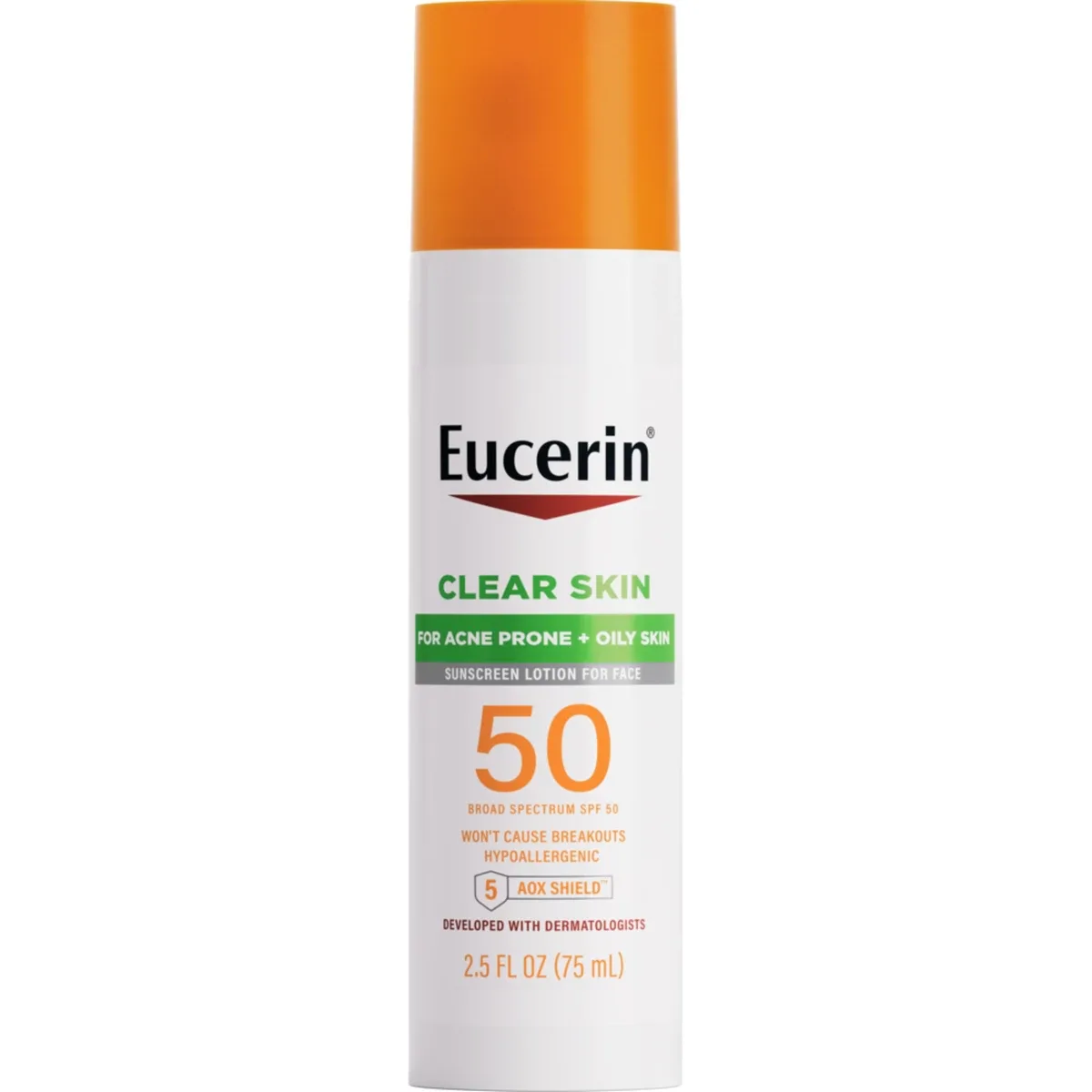
It targets the specific friction point oily, acne-prone people have with sunscreen, the dreaded midday slick, by loading the formula with oil-absorbing silica and going fully oil-free while keeping a non-comedogenic claim. The antioxidant complex and a stable vitamin C derivative add acne-relevant extras on top of the matte finish.
A genuinely matte, oil-free, non-comedogenic SPF 50 built for the oily and acne-prone crowd who hate how most sunscreens turn to grease by lunch. Silica handles shine, the filters handle protection, and a vitamin C derivative adds an acne-relevant bonus. The alcohol base can feel tight on dehydrated skin, and the bottle is small, but for matte daily protection it delivers.
Supporting rolefor AcneIn your profileYou chose · Nothing here targets acne directly; photoprotection for post-inflammatory marks is the recognised companion to treating it, and this lotion does that without known triggers.Not yet assessedStandard tolerabilityNo reviews collected yet
The case for it
Avobenzone, Homosalate, Octisalate, Octocrylene has no evidence row yet for this concern — it is in the research queue.
The formula carries no trigger this concern is sensitive to, with the cautions noted.
Cautions: fungal-acne triggers.
What would change this: A researched evidence row for the lead active would replace this with a verdict.
Same rule for everyone. “Supporting role” is the verdict on 8,197 of 45,024 concern verdicts across the catalog; rule R8 decided 4,250 of them.
Unchanged since September 5, 2026, engine 5.1.1.
R8 — The category's job (barrier care, humectant hydration, gentle cleansing, photoprotection) is the documented supportive role for this concern. This is the honest verdict for a moisturizer on an acne page. · the full register
Full protectionfor Sun DamageIn your profileYou chose · Broad-spectrum SPF 50 with avobenzone: the protection sun damage calls for.Moderate evidenceGentleNo reviews collected yet
The case for it
Avobenzone, Homosalate, Octisalate, Octocrylene is a first-line active — approved, monograph-listed or named in current guidelines — for this concern.
It is present at an effective concentration, declared or high in the ingredient list.
The formula carries none of the triggers this concern is sensitive to.
Same rule for everyone. “Full protection” is the verdict on 2,288 of 45,024 concern verdicts across the catalog; rule P1 decided 2,232 of them.
Unchanged since September 5, 2026, engine 5.1.1.
P1 — Photoprotection standing is regulatory (M020 / Annex VI filters; 21 CFR 201.327 attaches the early-skin-aging claim to tested broad-spectrum SPF 15+). SPF 30 is the AAD daily-use bar. · the full register
Carrying active
Avobenzone, Homosalate, Octisalate, Octocrylene
Standing
first line — a regulator recognises it for this use; trials support it · per 21 CFR § 352.10 Sunscreen active ingredients (US FDA — 21 CFR Part 352 (Sunscreen Drug Products for Over-the-Counter Human Use), via Cornell Legal Information Institute; part heading marked [STAYED INDEFINITELY], effective date stayed at 66 FR 67485), opened September 1, 2026
Form
adequate (declared 3%) — studied range up to 3%, from the OTC monograph or label; needs leave-on contact
Tolerability
gentle
Row checked
against its sources on September 1, 2026 (evidence table ev-2026.09-r228)
21 CFR § 352.10 Sunscreen active ingredients — US FDA — 21 CFR Part 352 (Sunscreen Drug Products for Over-the-Counter Human Use), via Cornell Legal Information Institute; part heading marked [STAYED INDEFINITELY], effective date stayed at 66 FR 67485, opened September 1, 2026
Also listed for Excess Oiliness and Large Pores — the actives here (Avobenzone, Silica, Vitamin C, Licorice Root Extract) are in our research queue for those concerns; there is no verdict until their evidence rows are written. That is a gap in our table, not a mark against the product.
Does the jobDoes what a sunscreen is for: UVA coverage, kind to the skin wearing it. Not measured from the label: pleasant enough to actually use.
A verdict is DermApproved’s assessment of how well a product’s ingredients fit a concern — never a claim about what the product treats. Evidence dots and collected reviews sit beside it and are never blended in.
Rules 0.5.1 · evidence table ev-2026.09-r228 · how we decide
Assessment
Pros & Cons
Pros
✓ Genuinely matte, shine-controlling finish from oil-absorbing silica
✓ Oil-free and non-comedogenic with a won't-break-you-out record
✓ Reliable photostable SPF 50 chemical filter system
✓ Vitamin C derivative adds acne-relevant antioxidant support
✓ No white cast and sits well under makeup
✓ Most affordable option in Eucerin's facial sun line
✓ Licochalcone A brings mild soothing for inflamed skin
Cons
✗ Alcohol base can feel tight on dehydrated skin
✗ Not fungal-acne safe due to certain fatty alcohols
✗ Small 2.5 oz bottle empties fast with generous use
✗ Faint alcohol scent on initial application
Review
Full Review
If you have oily, breakout-prone skin, you already know the specific betrayal: you do the responsible thing, apply sunscreen every morning, and by lunchtime your face has become a slip-n-slide that makes you regret the whole endeavor. That experience is the reason a lot of acne-prone people quietly stop wearing SPF, which is a genuine dermatological problem because oily skin burns and photoages just like everyone else's, and plenty of acne treatments make skin more sun-sensitive on top of it. Eucerin's Sun Clear Skin formula is essentially engineered backward from that lunchtime-slick complaint, and judging it fairly means judging it on whether it actually solves the problem it set out to solve.
It largely does. The mechanism is a heavy load of oil-absorbing silica, present in two forms including a treated silylate, sitting high in the ingredient list and doing the obvious thing: mopping up surface sebum so the skin reads matte instead of shiny. Paired with a fully oil-free base and a carnauba wax matrix, the result is a sunscreen that absorbs quickly, sets to a soft powdery matte, and holds that finish for hours rather than melting into a sheen. For the target user this is the headline feature, and it's a real one. It also wears well under makeup, with no white cast and no greasy interference, which removes another common excuse.
The protection underneath is Eucerin's familiar face-filter system: avobenzone for UVA, plus homosalate, octisalate, and octocrylene for UVB, with octocrylene keeping the avobenzone photo-stable so the UVA coverage holds through the day. It's a conventional, well-understood SPF 50, and there's nothing to fault about it. What lifts this above a plain matte sunscreen is the supporting cast aimed squarely at blemish-prone skin. Sodium ascorbyl phosphate, a stable vitamin C derivative, is in here as an antioxidant, and it happens to have acne-relevant research behind it as a form of vitamin C that's gentle and well-tolerated on oily skin. Licochalcone A, the brand's licorice antioxidant, adds free-radical scavenging plus a mild soothing effect, which is welcome on skin that's frequently inflamed or already running a gauntlet of drying actives.
The formula is, importantly, non-comedogenic and oil-free, and it carries Eucerin's won't-cause-breakouts positioning. In practice, users overwhelmingly report it doesn't trigger congestion, which is the make-or-break test for this category. It's worth noting it is not fungal-acne safe due to certain fatty alcohols in the base, so if your breakouts are actually malassezia-driven rather than typical acne, this isn't the pick. But for conventional inflammatory and comedonal acne, the formula behaves itself.
There's a subtler benefit worth calling out for the acne-prone specifically. People on retinoids, benzoyl peroxide, or acid exfoliants often have skin that is simultaneously oily and compromised, shiny in the T-zone but tight and easily irritated everywhere a treatment has touched. A pure mattifying sunscreen can make that worse by emphasizing dry patches, but the inclusion of Licochalcone A's soothing action and a gentle vitamin C derivative means this one controls oil without feeling punishing on the irritated areas. That balance, shine control that doesn't read as harsh, is harder to formulate than it sounds and is a meaningful part of why this works for skin in active treatment rather than just generically oily skin.
The honest limitations come down to the same alcohol trade-off that runs through this whole face line. The matte finish leans partly on denatured alcohol, a fast-evaporating solvent, and while that's a feature for oily skin, it means dehydrated or combination-leaning-dry skin can find the base reads tight, especially in winter. The fix is simple, a light oil-free hydrating layer underneath, which doesn't compromise the matte effect, but it's worth knowing going in. There's a faint alcohol scent on application that clears as it dries, and as with the rest of the range, the 2.5-ounce bottle is small for a product meant to be applied generously and reapplied through the day. Sensitive and rosacea-prone skin should also patch test given the alcohol and dense filter load.
Value is where this one genuinely shines, no pun intended. It's the most affordable of Eucerin's face sunscreens, and you're getting a thoughtfully targeted formula, oil-absorbing minerals, a vitamin C derivative, and the brand's antioxidant complex, at a price that undercuts most dedicated mattifying facial SPFs from skincare-focused brands. For a legacy dermatologist-recommended label, the cost reflects formulation substance rather than hype, and the per-bottle price is easy to swallow even if the small size means repurchasing more often than you'd like.
Who should buy it? Oily and acne-prone skin that wants daily broad-spectrum protection with a real matte finish and no breakout anxiety, plus the bonus of acne-relevant antioxidants. Combination skin that gets shiny through the T-zone will likely love it too. Dry, dehydrated, or easily irritated skin will find the matte alcohol base less comfortable and should either buffer it with hydration or look to a creamier sunscreen, and anyone whose breakouts are fungal should steer clear. For the oily majority chronically frustrated by greasy sunscreen, though, this is one of the easier daily SPFs to actually keep using, which is the whole point.
Formula
Key Ingredients
The hero actives that drive this product's performance.
Two forms of silica, including a treated silylate, sit high in this formula to absorb surface sebum and deliver the shine-control matte finish that defines the Clear Skin positioning, keeping oily skin from going slick over the filters during the day.
The same broad-spectrum chemical filter quartet used across Eucerin's face line provides SPF 50 coverage, with octocrylene photo-stabilizing the avobenzone; the oil-free, silica-heavy base keeps these filters wearable on acne-prone skin.
Regulator-approvedfor Sun Damage · emerging certainty
A stable, water-friendly vitamin C derivative that doubles as an antioxidant and has acne-relevant data of its own, a useful inclusion in a sunscreen aimed at blemish-prone skin where post-inflammatory marks linger.
Eucerin's licorice antioxidant calms UV-induced free radicals and brings mild soothing properties, which pairs sensibly with acne-prone skin that's often already inflamed and reactive to actives.
Not yet assessed
Ingredient standings describe the active at treatment-level doses and
vehicles; this product's own condition grades weigh its actual formula.
Lay it down last in the morning over a light, oil-free moisturizer and any treatment serum; it sets matte, so apply before makeup and avoid stacking heavy creams beneath it that would defeat the oil-control finish.
Results Timeline
UV protection and shine control are immediate. Acne-relevant benefits are supportive rather than curative; consistent daily use protects healing blemishes and dark marks from UV-driven worsening over weeks.
Pairs Well With
NiacinamideSalicylic acid (in PM)Lightweight gel moisturizers
The shine-control claim rests on well-understood material science: silica, particularly in its porous and silylate-treated forms, is a documented sebum absorber widely used in mattifying cosmetics, and the dual-silica load here is positioned high enough in the formula to meaningfully manage surface oil. That is the functional core of the Clear Skin proposition. The UV protection is the same conventional, well-characterized system used across the range, with octocrylene photo-stabilizing avobenzone to address avobenzone's documented tendency to degrade under irradiation. The more interesting acne-relevant ingredient is sodium ascorbyl phosphate, a stable phosphate ester of vitamin C; beyond its antioxidant role, it has been studied directly in acne, with controlled work reporting reductions in inflammatory and non-inflammatory lesions, which makes its presence in a sunscreen for blemish-prone skin more than incidental. Licochalcone A contributes additional antioxidant and anti-inflammatory activity, having been studied for scavenging UV-induced reactive oxygen species and calming irritation, both relevant to acne-prone skin that is frequently inflamed and treated with drying actives. Tocopherol rounds out the antioxidant layer. The formulation logic is coherent: protect with a standard filter system, control oil with silica so the product is actually worn, and add antioxidants that double as gentle support for the specific concerns of acne-prone skin, rather than promising the sunscreen itself will treat acne.
Dermatologist Perspective
Daily sunscreen is consistently emphasized for acne-prone patients, both because oily skin is no less vulnerable to UV damage and because common acne treatments such as retinoids and certain exfoliants increase photosensitivity. An oil-free, non-comedogenic, mattifying formula like this addresses the practical adherence barrier dermatologists see most often: patients abandoning sunscreen because it feels greasy or seems to worsen breakouts. The inclusion of a vitamin C derivative with acne data and the antioxidant Licochalcone A is regarded as a reasonable adjunct rather than a treatment claim. Clinicians typically caution that alcohol-containing mattifying formats suit oily and combination skin best, while dry, dehydrated, or sensitive skin may find them uncomfortable, and that fungal acne is a separate condition for which this is not appropriate. Adequate quantity and reapplication remain the key to achieving the labeled protection.
Guidance
Usage & Recommendations
How to Use
Make this the closing step of your morning skincare, applied after a light oil-free moisturizer and any treatment serum. Dispense roughly a quarter teaspoon for the face and neck, smooth it on evenly, and let it set to its matte finish before applying makeup. Wear it every morning, since UVA penetrates cloud and glass, and reapply every two hours during sustained sun exposure, blotting first if needed. If your skin feels tight, add a thin hydrating layer underneath rather than reducing the sunscreen amount, which preserves both protection and the matte effect.
Value Assessment
This is the budget standout of Eucerin's facial sun range and arguably its best value. For a low drugstore price you get oil-absorbing silica, a vitamin C derivative with acne research behind it, and the brand's antioxidant complex, a more considered formula than dedicated mattifying facial sunscreens from skincare brands that often cost two to three times as much. The recurring catch is the 2.5 fluid ounce bottle, which empties quickly with the generous, reapplied use SPF 50 demands, and there's no larger size. Coming from a legacy dermatologist-recommended brand, the price reflects real formulation rather than marketing, making it an easy recommendation for budget-conscious oily skin.
Who Should Buy
Reach for this if you have oily or combination skin and want daily protection with a real matte finish and no breakout worry. It's a strong fit for acne-prone skin using photosensitizing treatments, offering shine control plus acne-relevant antioxidants at a budget-friendly price.
Who Should Skip
Those with dry, dehydrated, or easily irritated skin may find the matte alcohol base tight and uncomfortable without a hydrating layer underneath. Anyone whose breakouts are fungal (malassezia-driven) should avoid it, since the fatty alcohols make it unsuitable for fungal acne.
Ready to try Eucerin Sun Clear Skin Face Sunscreen Lotion SPF 50?
Thin, oil-free lotion that absorbs quickly and sets to a powdery matte thanks to a high silica load and the carnauba wax base.
Scent
Fragrance-free; a faint alcohol whiff on application that vanishes as it dries down.
Packaging
Opaque 2.5 fl oz bottle that protects the photoreactive filters from light.
Finish
mattenon-greasylightweight
What to Expect on First Use
Sets matte fast and feels weightless, with no shine for hours. There's no purge, but if your skin runs dehydrated the silica-and-alcohol base can read as a little tight at first; a light hydrating layer underneath fixes that without bringing back the shine.
How Long It Lasts
About 6-8 weeks of daily face-only use at the proper amount, less with midday reapplication.
Eucerin built this around the reality that the people most likely to skip sunscreen are those whose skin turns greasy and breaks out under it. By pairing its standard face-filter system with a heavy oil-absorbing mineral load and an oil-free base, the Clear Skin formula aims to make daily SPF actually tolerable for blemish-prone skin.
About Eucerin Legacy Brand (20+ years)
Eucerin, founded in 1900 under Beiersdorf, develops its products with dermatologists and anchors its sun range in research on the licorice-derived antioxidant Licochalcone A, lending its acne-oriented sunscreen a credible formulation pedigree.
Brand founded: 1900 · Product launched: 2021
Myth vs. Reality
Common Myths
Myth
People with oily, acne-prone skin don't need daily sunscreen.
Reality
Oily skin is just as susceptible to UV damage, and many acne treatments increase sun sensitivity; this oil-free, non-comedogenic formula is designed precisely so that shine and breakout fears stop being an excuse to skip protection.
Myth
A matte sunscreen will dry out and damage my skin.
Reality
The matte finish here comes from oil-absorbing silica plus a quick-evaporating alcohol, not from stripping the barrier; on oily skin it controls shine, while dehydrated skin can simply add a hydrating layer underneath without losing the effect.
FAQ
Frequently Asked Questions
Is Eucerin Sun Clear Skin good for acne-prone skin?
Yes. It's oil-free, non-comedogenic, and carries a won't-cause-breakouts claim, and it includes a vitamin C derivative with acne research behind it. Note it isn't fungal-acne safe, so it suits conventional acne rather than malassezia-driven breakouts.
Does Eucerin Sun Clear Skin have a matte finish?
Yes. A high load of oil-absorbing silica plus an oil-free base sets the formula to a soft, powdery matte that controls shine for hours, which is the whole point of the Clear Skin positioning for oily skin.
Will Eucerin Sun Clear Skin break me out?
It's formulated to be non-comedogenic and oil-free, and most users report it doesn't cause congestion. It is not fungal-acne safe, however, so if your breakouts are caused by malassezia, it isn't the right choice.
Why does Eucerin Sun Clear Skin contain alcohol?
The denatured alcohol is a fast-evaporating solvent that helps create the lightweight matte finish. It flashes off as the product sets, though dehydrated skin may want a thin hydrating layer underneath to avoid feeling tight.
Is Eucerin Sun Clear Skin good under makeup?
Yes. It absorbs to a matte, oil-free finish with no white cast, so it sits well under foundation without greasiness or pilling, as long as you let it set before applying makeup.
How is Clear Skin different from other Eucerin face sunscreens?
It shares the same SPF 50 filters but swaps in a heavier oil-absorbing silica load and an oil-free, non-comedogenic base aimed at oily and acne-prone skin, where the Age Defense versions lean toward hydration and anti-aging instead.
Reviews
What Reviewers Tend to Say
Recurring themes our editors read across retailer reviews of this product — summaries in our words, not quotations, and not a substitute for your own patch test.
Common Praise
Genuinely matte all-day finish
Doesn't break me out
No white cast
Lightweight under makeup
Common Complaints
Can feel drying on dehydrated skin
Small bottle
Faint alcohol smell on application
Notable Endorsements
Non-comedogenic, won't cause breakouts positioningFree of oxybenzone and octinoxate
IPL is a filtered flashlamp, a true vascular laser is one wavelength aimed at haemoglobin, and the choice between them turns on a distinction almost no consult makes: whether your redness is vessels or a state.
Cutting a beard hair takes about a twentieth of a newton. You press with two and stretch your skin by a fifth — which is why almost every shaving problem is a technique problem wearing a hardware costume.
The dewy-layering marketing reads as a warning if you are congested — and it is hiding the strongest mass-market lineup anywhere for exactly that skin.
Pore size is mostly genetic and you can't permanently shrink it — but you can dramatically change how visible pores look, and the products that do it aren't the ones labeled 'pore-minimizing.'
Jun 3, 2026· 5 min
Questions people ask about Acne
Verified answers from our questions library — the nuance a product page cannot carry.
Products, answers, therapy guides, tools and articles in one search. Brand names,
slang and abbreviations all work — accutane finds isotretinoin, bacne finds truncal acne.