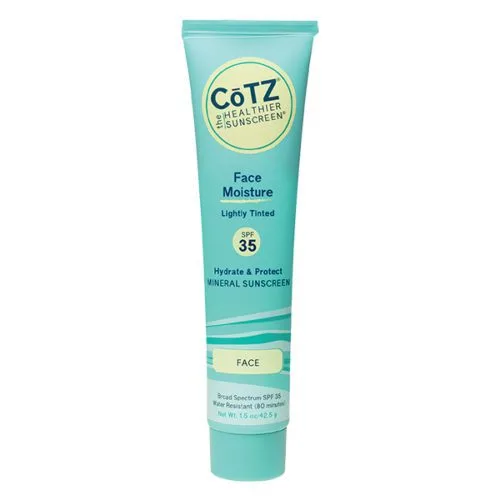
The critical difference from the untinted version is iron oxides, which absorb visible light in the blue wavelengths that have been shown to worsen melasma and post-inflammatory pigmentation. For any patient working on pigmentation, this version is clinically superior to the untinted formula — even if the tint isn't necessary for cosmetic reasons.
This is the version of Cotz Face Moisture that dermatologists now recommend first for anyone working on pigmentation, because the iron oxide content provides visible-light protection that untinted formulas simply don't deliver. Same 9.1% zinc and 2.9% titanium filter load as the untinted version, plus a universal tint that neutralizes cast and shields skin from the blue-light wavelengths documented to worsen melasma. For light to medium skin tones, this is a meaningful upgrade over the untinted original.
Full protectionfor MelasmaIn your profileYou chose · Broad-spectrum SPF 35 with iron oxides for visible light — what melasma needs from a sunscreen.Not yet assessedGentleNo reviews collected yet
The case for it
Zinc Oxide has no evidence row yet for this concern — it is in the research queue.
The formula carries none of the triggers this concern is sensitive to.
What would change this: A researched evidence row for the lead active would replace this with a verdict.
Same rule for everyone. “Full protection” is the verdict on 2,288 of 45,024 concern verdicts across the catalog; rule P2 decided 56 of them.
Unchanged since September 5, 2026, engine 5.1.1.
Full protectionfor HyperpigmentationIn your profileYou chose · Broad-spectrum SPF 35 with zinc oxide, titanium dioxide: the protection hyperpigmentation calls for.Not yet assessedGentleNo reviews collected yet
The case for it
Zinc Oxide has no evidence row yet for this concern — it is in the research queue.
The formula carries none of the triggers this concern is sensitive to.
What would change this: A researched evidence row for the lead active would replace this with a verdict.
Same rule for everyone. “Full protection” is the verdict on 2,288 of 45,024 concern verdicts across the catalog; rule P1 decided 2,232 of them.
Unchanged since September 5, 2026, engine 5.1.1.
P1 — Photoprotection standing is regulatory (M020 / Annex VI filters; 21 CFR 201.327 attaches the early-skin-aging claim to tested broad-spectrum SPF 15+). SPF 30 is the AAD daily-use bar. · the full register
Supporting rolefor RosaceaIn your profileYou chose · Nothing here targets rosacea directly; photoprotection against a known trigger is the recognised companion to treating it, and this lotion does that without known triggers.Not yet assessedGentleNo reviews collected yet
The case for it
Zinc Oxide has no evidence row yet for this concern — it is in the research queue.
The formula carries none of the triggers this concern is sensitive to.
What would change this: A researched evidence row for the lead active would replace this with a verdict.
Same rule for everyone. “Supporting role” is the verdict on 8,197 of 45,024 concern verdicts across the catalog; rule R8 decided 4,250 of them.
Unchanged since September 5, 2026, engine 5.1.1.
R8 — The category's job (barrier care, humectant hydration, gentle cleansing, photoprotection) is the documented supportive role for this concern. This is the honest verdict for a moisturizer on an acne page. · the full register
Good choicefor SensitivityIn your profileYou chose · No fragrance, drying alcohol, declarable allergens or sensitising preservatives in this lotion — the profile sensitive skin looks for.Not yet assessedGentleNo reviews collected yet
The case for it
Zinc Oxide has no evidence row yet for this concern — it is in the research queue.
The formula carries none of the triggers this concern is sensitive to.
What would change this: A researched evidence row for the lead active would replace this with a verdict.
Same rule for everyone. “Good choice” is the verdict on 1,938 of 45,024 concern verdicts across the catalog; rule F2 decided 1,938 of them.
Unchanged since September 5, 2026, engine 5.1.1.
Full protectionfor Post-ProcedureIn your profileYou chose · Broad-spectrum SPF 35 with zinc oxide, titanium dioxide: the protection post procedure calls for.Not yet assessedGentleNo reviews collected yet
The case for it
Zinc Oxide has no evidence row yet for this concern — it is in the research queue.
The formula carries none of the triggers this concern is sensitive to.
What would change this: A researched evidence row for the lead active would replace this with a verdict.
Same rule for everyone. “Full protection” is the verdict on 2,288 of 45,024 concern verdicts across the catalog; rule P1 decided 2,232 of them.
Unchanged since September 5, 2026, engine 5.1.1.
P1 — Photoprotection standing is regulatory (M020 / Annex VI filters; 21 CFR 201.327 attaches the early-skin-aging claim to tested broad-spectrum SPF 15+). SPF 30 is the AAD daily-use bar. · the full register
Full protectionfor Sun DamageIn your profileYou chose · Broad-spectrum SPF 35 with zinc oxide, titanium dioxide: the protection sun damage calls for.Moderate evidenceGentleNo reviews collected yet
The case for it
Titanium Dioxide is a first-line active — approved, monograph-listed or named in current guidelines — for this concern.
It is present at an effective concentration, declared or high in the ingredient list.
The formula carries none of the triggers this concern is sensitive to.
Same rule for everyone. “Full protection” is the verdict on 2,288 of 45,024 concern verdicts across the catalog; rule P1 decided 2,232 of them.
Unchanged since September 5, 2026, engine 5.1.1.
P1 — Photoprotection standing is regulatory (M020 / Annex VI filters; 21 CFR 201.327 attaches the early-skin-aging claim to tested broad-spectrum SPF 15+). SPF 30 is the AAD daily-use bar. · the full register
Carrying active
Titanium Dioxide
Standing
first line — a regulator recognises it for this use; trials support it · per § 352.10 Sunscreen active ingredients. (U.S. Food and Drug Administration — 21 CFR Part 352 (Sunscreen Drug Products for Over-the-Counter Human Use), Code of Federal Regulations via GovInfo), opened July 27, 2026
Form
adequate (declared 2.9%) — studied range up to 25%, from the OTC monograph or label; needs leave-on contact
Tolerability
gentle
Row checked
against its sources on July 27, 2026 (evidence table ev-2026.09-r228)
21 CFR 352.10 — Sunscreen active ingredients — US Food and Drug Administration / Electronic Code of Federal Regulations (retrieved 2026-07-16; note stayed effective date), opened July 16, 2026
Does the jobDoes what a sunscreen is for: UVA coverage, kind to the skin wearing it. Not measured from the label: pleasant enough to actually use.
A verdict is DermApproved’s assessment of how well a product’s ingredients fit a concern — never a claim about what the product treats. Evidence dots and collected reviews sit beside it and are never blended in.
Rules 0.5.1 · evidence table ev-2026.09-r228 · how we decide
Assessment
Pros & Cons
Pros
✓ Adds iron oxides for visible-light protection critical for melasma
✓ Clinically preferred over untinted version for pigmentation-prone users
✓ Same 9.1% zinc / 2.9% titanium dioxide filter load as untinted formula
✓ Clean inactive deck with no fragrance or essential oils
✓ Tint neutralizes white cast on light to medium skin tones
✓ Provides light coverage that can reduce need for foundation
✓ Pregnancy safe and appropriate for reactive skin
Cons
✗ Universal tint is too light for deep skin tones
✗ Texture is behind the newest generation of tinted mineral sunscreens
✗ Not water-resistant enough for swimming or heavy sweating
✗ Limited shade offering — only one universal tint available
Review
Full Review
For about twenty years, the dermatology world recommended mineral sunscreens for melasma patients for one simple reason: chemical UV filters are more likely to trigger reactions in pigmentation-prone skin, and the gold standard treatment for melasma is rigorous daily sun protection with a sunscreen you can actually tolerate. Then, in the last decade, something interesting happened. Research started accumulating that visible light — specifically the blue-light wavelengths around 400–500 nanometers — was a meaningful trigger for melasma independent of UV exposure. Patients could wear a broad-spectrum SPF 50 perfectly, never get a sunburn, and still watch their melasma progress. The culprit, the research suggested, was the visible light that sailed right through their zinc-oxide sunscreen because zinc oxide doesn't absorb in the visible range.
The solution, almost embarrassingly simple, was iron oxides. The same pigments that cosmetic chemists had been using for decades to tint sunscreens for cosmetic purposes turned out to absorb visible light exactly in the wavelengths that worsen melasma. A tinted mineral sunscreen — the kind dermatologists had been recommending to cover the white cast of zinc — was accidentally delivering clinically meaningful protection that its untinted equivalent couldn't. The recommendation quietly shifted. Tinted mineral sunscreens are now the first-line daily sunscreen in most melasma treatment protocols, not because dermatologists suddenly cared about cosmetic elegance, but because the iron oxide tint is functional protection.
Cotz Face Moisture SPF 35 Lightly Tinted sits at the intersection of all of this. The active filter profile is identical to the untinted version — 9.1% zinc oxide and 2.9% titanium dioxide, the same dermatologist-office-friendly mineral combination that's been on shelves for nearly two decades. The inactive ingredient deck is similarly restrained: fragrance-free, essential-oil-free, no plant extracts, no chemical filters, nothing that reactive and post-procedure skin has to worry about. What's added is iron oxides — the yellow, red, and black varieties, which combine into the universal tint that blends into light and medium skin tones. That addition alone elevates the tinted version from a cosmetic preference to a clinically preferred choice for any user with melasma, post-inflammatory hyperpigmentation, or a history of photoaggravated pigmentation.
The cosmetic experience is noticeably better than the untinted version, which is not a high bar but is worth acknowledging. The white cast that visibly settles on lighter skin tones from untinted Cotz is substantially reduced here. On light and medium skin tones, the tint blends down to a natural, mostly-invisible finish within thirty to sixty seconds of application. The finish sits between satin and matte — not shiny, not chalky — and plays reasonably well under foundation or a tinted moisturizer for users who want extra coverage on top. The tint provides enough light coverage that some users find they can skip foundation entirely on low-makeup days, which is a practical bonus.
The limitations are the same ones that every universal-tint sunscreen carries. On deep skin tones, the tint is too light and leans ashy or pink-gray rather than blending away. Users with deep skin tones should look for a more heavily pigmented tinted formula or a specifically shaded mineral sunscreen — the protection principles of iron oxides apply regardless of brand, but the aesthetic fit matters in a product you'll wear every day. The texture is also still noticeably a generation behind the newest ultra-refined tinted formulas from brands like EltaMD UV Clear, ISDIN Eryfotona Ageless, or Colorescience — the dimethicone base is functional, but newer silicone technology has produced lighter, smoother, more invisible tinted options. Cotz's advantage is the clean inactive deck, not the texture refinement.
Application dose matters as much for the tinted version as for the untinted. A quarter-teaspoon for the face delivers the labeled SPF 35 and deposits enough iron oxide to provide meaningful visible-light protection. Underapplication reduces both effects proportionally — and crucially, underapplication of a tinted sunscreen looks better cosmetically (less cast, lighter finish) while providing worse protection. This is the trap of tinted mineral sunscreens: the instinct to 'use less so it doesn't look heavy' actively undermines the clinical value. If you're buying this for melasma protection, commit to the full quarter-teaspoon and accept the slight increase in visibility as the cost of the protection you came for.
Reapplication every two hours during meaningful sun exposure remains important, and — as with all sunscreens — consistency matters more than perfection. For daily office and commute use, a single morning application with touch-ups through the day is adequate. For extended outdoor time, plan for reapplication. For beach and pool use, Cotz makes a separate water-resistant formula that's a better fit.
For the user working on melasma, for the post-procedure patient, for the rosacea patient who also wants to improve tone, for anyone who has tried the untinted Cotz and wants a more cosmetically elegant option, this tinted version is the clear pick within the Cotz lineup. It's also a reasonable general-purpose mineral sunscreen for users without specific pigmentation concerns who simply prefer a tinted finish.
Formula
Key Ingredients
The hero actives that drive this product's performance.
The primary broad-spectrum filter, providing UVA1 through UVB coverage through physical reflection and absorption. Carries the bulk of the SPF rating and most of the photoaging protection.
Regulator-approvedfor Sun Damage · limited certainty
Reinforces UVB coverage where zinc is slightly weaker. The zinc-titanium pairing is one of the best-validated broad-spectrum mineral combinations in sunscreen formulation.
Regulator-approvedfor Sun Damage · limited certainty
This is the ingredient that makes this version clinically different from the untinted formula — iron oxides absorb visible light, particularly the blue-light wavelengths that have been shown to worsen melasma and post-inflammatory hyperpigmentation. This is why tinted mineral sunscreens are now dermatology's first-line recommendation for melasma patients.
Silicone base that carries the mineral filters into a smooth, uniform film and dramatically improves the spread compared to traditional zinc-based formulas. Also helps the product set quickly after application.
Not yet assessed
Ingredient standings describe the active at treatment-level doses and
vehicles; this product's own condition grades weigh its actual formula.
Make this the final step of your morning routine. A quarter-teaspoon for the face is the correct dose for the labeled SPF. The tint blends into light to medium skin tones; users with deep skin tones may need a more heavily tinted alternative.
Results Timeline
Immediate UV and visible-light protection. For melasma patients, visible pigmentation benefit over 8–16 weeks when paired with active brightening treatments and consistent sun protection.
The role of visible light in pigmentation has become one of the more important recent developments in melasma research. Published studies have shown that visible light, particularly the high-energy blue-light wavelengths in the 400–500 nanometer range, can induce pigmentation in melanocompetent skin through mechanisms independent of UV-driven melanogenesis. This has significant clinical implications: a sunscreen that blocks UVA and UVB perfectly can still allow visible-light-driven pigmentation to progress if it doesn't address visible light. Iron oxides, commonly used as cosmetic colorants, absorb in the visible range and have been shown in clinical research to reduce visible-light-induced pigmentation when added to mineral sunscreen formulations. Several published studies have compared tinted and untinted mineral sunscreens in melasma patients and shown improved outcomes with the tinted version. Cotz's tinted formula pairs this visible-light protection with the same 9.1% zinc oxide and 2.9% titanium dioxide UV filter system used in the untinted version, giving broad-spectrum protection across the UV and visible-light ranges. What isn't resolved in the literature is the exact iron oxide concentration needed for meaningful visible-light protection — the research has generally focused on comparing tinted versus untinted rather than optimizing tint density, so different tinted products may deliver different levels of visible-light protection depending on their formulation. The clinical consensus is nonetheless clear: for melasma patients, a tinted mineral sunscreen is the preferred choice.
Dermatologist Perspective
Dermatologists treating melasma, post-inflammatory hyperpigmentation, and photo-aggravated conditions routinely recommend tinted mineral sunscreens as the first-line daily sun protection, specifically because of the visible-light protection provided by iron oxides. Clinical treatment protocols often pair a tinted mineral sunscreen with topical brightening actives like tranexamic acid, azelaic acid, and niacinamide, reinforcing the importance of comprehensive UV plus visible-light protection throughout treatment. Practitioners generally note that no topical brightening regimen will deliver its potential without consistent tinted sunscreen use, and that patients who switch from untinted to tinted mineral sunscreen during melasma treatment often see faster visible progress. Cotz's tinted formulation is well-regarded in this context for its combination of clean filter profile and reliable tolerability on sensitized skin.
Guidance
Usage & Recommendations
How to Use
Apply as the final morning step after moisturizer. Use a quarter-teaspoon for the face to deliver labeled SPF 35 and meaningful iron oxide deposition. Blend gently for 30–60 seconds until the tint settles into a uniform finish. Wait 2–3 minutes before layering foundation or additional makeup to avoid pilling. Reapply every two hours during meaningful sun exposure. For melasma treatment, pair with a brightening serum in your routine and commit to daily use every morning regardless of weather or season.
Value Assessment
At twenty-seven dollars for 1.5 ounces, the tinted version carries a small premium over the untinted Cotz formula — a reasonable price for the added iron oxide content and the clinically meaningful visible-light protection. Comparable tinted mineral sunscreens with iron oxides from EltaMD, ISDIN, and Colorescience exist at similar or higher price points. For users working on pigmentation specifically, this is one of the most cost-effective tinted mineral options with a clean ingredient deck, though newer-generation competitors offer more refined textures for users willing to pay a premium.
Who Should Buy
People with melasma, post-inflammatory hyperpigmentation, or any pigmentation concern requiring visible-light protection. Rosacea patients who also want to address tone. Post-procedure patients. Users who found the untinted Cotz too chalky and want the same clean filter system with a tinted finish.
Who Should Skip
People with deep skin tones who can't accept a universal-tint cast — look for a shaded tinted mineral sunscreen instead. Users wanting the newest-generation ultra-light texture. Swimmers and heavy-sweat athletes needing water-resistant formulas.
Ready to try Cotz Face Moisture SPF 35 Lightly Tinted?
Medium-weight mineral lotion with a light universal tint
Scent
Fragrance-free
Packaging
Squeeze tube — simple functional format that limits light and air exposure
Finish
naturalsatin
What to Expect on First Use
First application blends to a natural finish on light to medium skin tones within 30–60 seconds. The universal tint successfully neutralizes most of the zinc cast visible in the untinted version.
How Long It Lasts
Approximately 6–8 weeks of daily face use at proper dose
The tinted version of Cotz Face Moisture was introduced to address the white cast complaint that the original formula generated, but dermatology has since caught up with a better reason to recommend it — the iron oxide content provides visible light protection that pure zinc-and-titanium sunscreens don't. This makes the tinted version the preferred choice in melasma treatment protocols regardless of the cosmetic benefits.
About Cotz Established Brand (5–20 years)
Cotz has been producing 100% mineral sunscreens since 2005, specializing in formulations for rosacea, post-procedure, and reactive-skin patients. The tinted version of Face Moisture is widely used in dermatology offices as the cast-neutralizing alternative for patients who can't tolerate the white cast of the untinted formula.
Brand founded: 2005
Myth vs. Reality
Common Myths
Myth
Tinted sunscreens are purely cosmetic.
Reality
Tinted sunscreens contain iron oxides, which provide visible-light protection that chemical and mineral UV filters don't. This protection matters for melasma, post-inflammatory hyperpigmentation, and photo-aggravated conditions where visible light is a documented trigger.
Myth
A universal tint works for all skin tones.
Reality
Universal tints are formulated to blend into light to medium skin tones. Deeper skin tones usually need a more pigmented formulation or a specifically-shaded alternative to avoid ashy cast.
FAQ
Frequently Asked Questions
Is Cotz Lightly Tinted good for melasma?
Yes — this is the specific use case that drives its dermatologist recommendations. The iron oxide content provides visible-light protection that untinted mineral and chemical sunscreens lack, and visible light is a documented trigger for melasma. For anyone working on pigmentation, this version is clinically preferred over the untinted formula.
What's the difference between tinted and untinted Cotz Face Moisture?
Both use the same 9.1% zinc oxide and 2.9% titanium dioxide UV filters. The tinted version adds iron oxides, which provide visible-light protection and neutralize the white cast of the untinted formula. For pigmentation-prone users, the tinted version is meaningfully more protective.
Will this tint work for deep skin tones?
The universal tint is formulated for light to medium skin tones. Deeper skin tones will likely see an ashy or too-light finish. Users with deeper tones should look for a more heavily pigmented tinted mineral sunscreen or a shaded alternative.
Can I wear makeup over Cotz Lightly Tinted?
Yes. The tint provides light coverage that reduces the need for foundation for some users. If you do layer foundation on top, wait 2–3 minutes for the sunscreen to set to avoid pilling.
Is this tinted sunscreen safe during pregnancy?
Yes. Zinc oxide, titanium dioxide, and iron oxides are all considered safe during pregnancy and breastfeeding, and the formula contains no chemical UV filters or retinoids.
How is Cotz Lightly Tinted different from a tinted moisturizer with SPF?
This is a sunscreen first, tinted second. Tinted moisturizers with SPF often use lower filter concentrations and provide less reliable protection. Cotz uses a full 12% total mineral filter load and delivers true SPF 35, with the tint as a bonus.
Reviews
What Reviewers Tend to Say
Recurring themes our editors read across retailer reviews of this product — summaries in our words, not quotations, and not a substitute for your own patch test.
Common Praise
Tint neutralizes cast better than untinted version
Blends into a natural finish
Well-tolerated on reactive skin
Common Complaints
Tint is too light for deep skin tones
Still a slightly older-generation texture
Limited shade coverage
Notable Endorsements
Dermatologist-recommended for melasma patientsWidely used in post-procedure protocols
Every pigment-fading active runs against a re-pigmenting stimulus, and for melasma part of that stimulus is visible light — which broad-spectrum sunscreen does essentially nothing about unless you can see it on your face.
IPL is a filtered flashlamp, a true vascular laser is one wavelength aimed at haemoglobin, and the choice between them turns on a distinction almost no consult makes: whether your redness is vessels or a state.
Sep 2, 2026· 9 min
Questions people ask about Melasma
Verified answers from our questions library — the nuance a product page cannot carry.
Products, answers, therapy guides, tools and articles in one search. Brand names,
slang and abbreviations all work — accutane finds isotretinoin, bacne finds truncal acne.