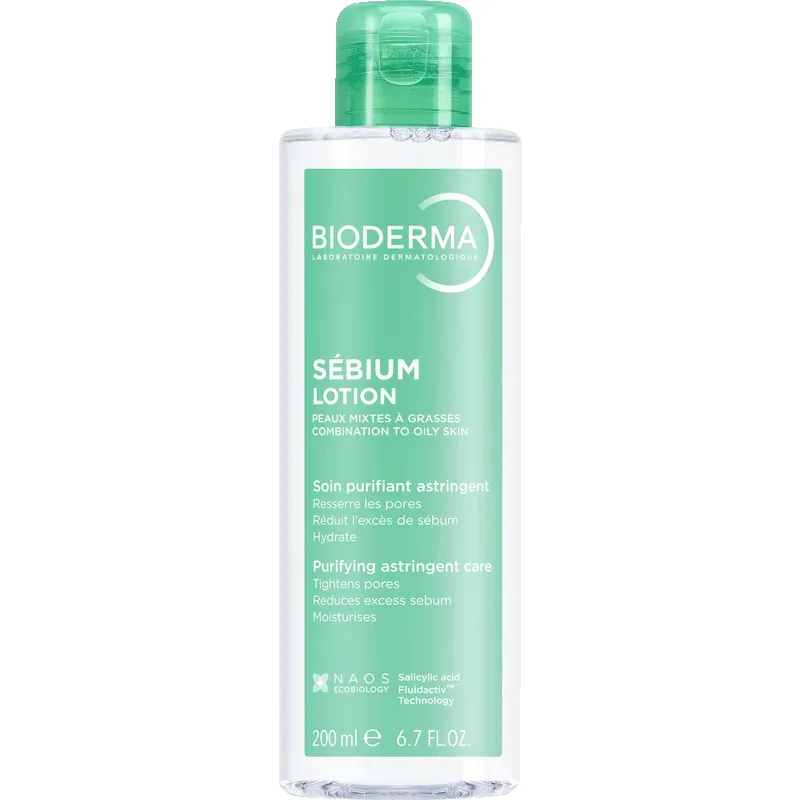
Most pharmacy salicylic acid toners stop at the BHA — Sébium pairs it with zinc gluconate, capryloyl glycine, and Bioderma's patented Fluidactiv polyol complex, layering four different mechanisms of action on the same oily-skin problem. The Fluidactiv approach to modifying sebum composition (not just reducing volume) is genuinely distinctive in the category.
Bioderma's Sébium Toner is the daily-driver salicylic-acid toner that French pharmacy aisles got right fifteen years before the K-beauty wave figured it out. Salicylic acid, zinc gluconate, capryloyl glycine, and the patented Fluidactiv polyol complex layer four mechanisms of oily-skin management into a single bottle that combination skin can tolerate twice daily without rebound dryness.
Strong choicefor AcneIn your profileYou chose · Salicylic Acid is an approved or monograph active for acne; this liquid carries it, though the concentration is not declared.Moderate evidenceStandard tolerabilityNo reviews collected yet
The case for it
Salicylic Acid is a first-line active — approved, monograph-listed or named in current guidelines — for this concern.
It is plausibly present at a working level, though the concentration is not declared.
The formula carries no trigger this concern is sensitive to, with the cautions noted.
Cautions: fragrance; fungal-acne triggers.
What would change this: A declared concentration would move this to a firmer reading of the dose.
Same rule for everyone. “Strong choice” is the verdict on 1,459 of 45,024 concern verdicts across the catalog; rule R3 decided 567 of them.
Unchanged since September 5, 2026, engine 5.1.1.
R3 — Undeclared but plausibly dosed (top-third INCI position, or a potent sub-1% active) — the verdict stands, and the sentence says what disclosure would add. A declared figure below range would have been sub-threshold. · the full register
Carrying active
Salicylic Acid
Standing
first line — a regulator recognises it for this use; trials support it · per § 333.310 Acne active ingredients. (U.S. Food and Drug Administration — 21 CFR Part 333 Subpart D (Topical Acne Drug Products), Code of Federal Regulations via GovInfo), opened July 27, 2026
Form
plausible — studied range 0.5–2%, from the OTC monograph or label; judge it after ~6 weeks
Tolerability
standard — fragrance load, fungal triggers
Row checked
against its sources on July 27, 2026 (evidence table ev-2026.09-r228)
Strong choicefor BlackheadsIn your profileYou chose · Salicylic Acid is an approved or monograph active for blackheads; this liquid carries it, though the concentration is not declared.Moderate evidenceStandard tolerabilityNo reviews collected yet
The case for it
Salicylic Acid is a first-line active — approved, monograph-listed or named in current guidelines — for this concern.
It is plausibly present at a working level, though the concentration is not declared.
The formula carries no trigger this concern is sensitive to, with the cautions noted.
Cautions: fungal-acne triggers.
What would change this: A declared concentration would move this to a firmer reading of the dose.
Same rule for everyone. “Strong choice” is the verdict on 1,459 of 45,024 concern verdicts across the catalog; rule R3 decided 567 of them.
Unchanged since September 5, 2026, engine 5.1.1.
R3 — Undeclared but plausibly dosed (top-third INCI position, or a potent sub-1% active) — the verdict stands, and the sentence says what disclosure would add. A declared figure below range would have been sub-threshold. · the full register
Carrying active
Salicylic Acid
Standing
first line — a regulator recognises it for this use; trials support it · per 21 CFR § 333.350 - Labeling of acne drug products. (US Code of Federal Regulations (Legal Information Institute, Cornell Law School)), opened July 27, 2026
Form
plausible — studied range 0.5–2%, from the OTC monograph or label; judge it after ~6 weeks
Tolerability
standard — fungal triggers
Row checked
against its sources on July 27, 2026 (evidence table ev-2026.09-r228)
The studies behind the evidence row
OTC monograph, Topical Acne Drug Products — salicylic acid 0.5–2% recognized as an acne treatment active — US Food and Drug Administration
Promisingfor Excess OilinessIn your profileYou chose · Zinc has trial-level evidence for excess oiliness but no guideline or regulatory standing yet — promising, short of a recommendation; the other actives here are not yet assessed for it.Moderate evidenceStandard tolerabilityNo reviews collected yet
The case for it
Zinc Gluconate has trial-level evidence for this concern but no guideline or regulatory standing yet.
It is plausibly present at a working level, though the concentration is not declared.
The formula carries no trigger this concern is sensitive to, with the cautions noted.
Cautions: fungal-acne triggers.
What would change this: A declared concentration would move this to a firmer reading of the dose.
Same rule for everyone. “Promising” is the verdict on 7,858 of 45,024 concern verdicts across the catalog; rule R9p decided 7,858 of them.
Unchanged since September 5, 2026, engine 5.1.1.
R9p — 0.5.0: 'Unproven' beside three filled dots read as one question answered twice with opposite words (7,018 rows). The chip measures standing, the dots measure trial volume; where the row carries at least one RCT or a tier-2 source (moderate dots) and the active is present at a working level, the honest word is Promising. Unproven is reserved for plausible-standing rows with limited or weak evidence, or an under-dosed form. Same rank as Unproven — a bet either way; the dots order them. · the full register
Carrying active
Zinc Gluconate
Standing
plausible — trials support it
Form
plausible — studied range 1%, from the OTC monograph or label; needs leave-on contact
Tolerability
standard — fungal triggers
Row checked
against its sources on July 17, 2026 (evidence table ev-2026.09-r228)
Not for thisfor Large PoresIn your profileYou chose · The actives here have been researched for large pores and the evidence does not support the claim.Not yet assessedStandard tolerabilityNo reviews collected yet
The case for it
Salicylic Acid has been researched for this concern and the evidence does not support it.
It is plausibly present at a working level, though the concentration is not declared.
The formula carries no trigger this concern is sensitive to, with the cautions noted.
What would change this: A declared concentration would move this to a firmer reading of the dose.
Same rule for everyone. “Not for this” is the verdict on 488 of 45,024 concern verdicts across the catalog; rule R10 decided 488 of them.
Unchanged since September 5, 2026, engine 5.1.1.
Good choicefor Rough TextureIn your profileYou chose · Salicylic Acid is a reference standard by mechanism for rough texture; this liquid carries it.Moderate evidenceStandard tolerabilityNo reviews collected yet
The case for it
Salicylic Acid has trial-supported standing for this concern.
It is plausibly present at a working level, though the concentration is not declared.
The formula carries no trigger this concern is sensitive to, with the cautions noted.
What would change this: A declared concentration would move this to a firmer reading of the dose.
Same rule for everyone. “Good choice” is the verdict on 9,564 of 45,024 concern verdicts across the catalog; rule R5 decided 9,072 of them.
Unchanged since September 5, 2026, engine 5.1.1.
Does the jobDoes what a toner is for: adds something real, not alcohol-driven. Not measured from the label: restores skin pH, plays well with what follows.
A verdict is DermApproved’s assessment of how well a product’s ingredients fit a concern — never a claim about what the product treats. Evidence dots and collected reviews sit beside it and are never blended in.
Rules 0.5.1 · evidence table ev-2026.09-r228 · how we decide
✓ Patented Fluidactiv complex addresses sebum composition, not just volume
✓ Gentle enough for twice-daily long-term use without rebound dryness
✓ Glycerin pairing keeps combination skin's drier zones tolerated
✓ Fungal-acne safe — no fatty acids or esters that feed malassezia
✓ Fifteen-plus year track record at the French pharmacy counter
✓ Genuinely competitive per-milliliter value in the BHA toner category
Cons
✗ Fragrance addition is out of step with the brand's sensitive-skin discipline
✗ Flip-top cap dispenses too much liquid per cotton pad use
✗ Not strong enough for severe acne — moderate BHA concentration
✗ Salicylic acid means pregnancy use should be cleared with a doctor
✗ Initial 1-week dryness or purging period for some users
Review
Full Review
Long before Reddit subreddits started arguing about 'sebum composition' and skinfluencers explained why your blackheads keep coming back, Bioderma's Sébium range was quietly modifying sebum chemistry at the French pharmacy counter. The Sébium Toner — labeled Sébium Lotion everywhere outside the U.S. — has been on shelves for over fifteen years, and it's still one of the more thoughtfully-engineered daily BHA toners in the entire pharmacy-brand category.
What makes this toner different from the dozens of other 'salicylic acid for oily skin' bottles isn't the salicylic acid itself. That part is conventional and well-supported — moderate-concentration BHA dissolved into the pore lining, dislodging the keratin and oil that block follicular openings and reducing the surface roughness that combination skin accumulates. The single-active strategy, maximum exfoliating force from 2% BHA and very little else, works well for people who want brute exfoliation. Bioderma's approach is deliberately not that.
The salicylic acid is the headline active, but it's the second-tier ingredients that do the long-term work: zinc gluconate (water-soluble zinc that's both modestly antibacterial against C. acnes and sebum-regulating on its own); capryloyl glycine (an amino-acid surfactant that contributes mild antimicrobial activity and additional sebum-tuning effects); an agarikon mushroom (Fomes officinalis) extract for further oil control; and the Fluidactiv complex — a patented blend of mannitol, xylitol, rhamnose, and fructooligosaccharides that the brand's R&D specifically designed to influence sebum composition rather than just sebum volume. The mechanism is genuine. Oily skin doesn't just produce more sebum; it often produces sebum with altered fatty-acid composition that's more inherently comedogenic. Fluidactiv is positioned to nudge that composition toward something less prone to forming plugs, and cosmetic-chemistry literature gives the mechanism real plausibility even if the clinical magnitude is hard to quantify. A little pyridoxine (vitamin B6) and a PEG-silicone glide agent round the formula out, buffered to a pH of about 4.5.
The formula's restraint with the salicylic acid concentration is what makes it sustainable, and it answers two persistent myths at once. The first is that salicylic acid toners always strip oily skin and cause rebound oil. Properly formulated BHA with humectant support does the opposite — the Sébium Toner pairs its acid with glycerin and the Fluidactiv sugars, preventing the dehydration that actually triggers rebound sebum. The second is that a BHA toner should be reserved for active breakouts. It shouldn't: this is engineered for ongoing daily use, where continuous low-dose exfoliation prevents clogs from forming rather than chasing them after they appear, and stopping and restarting only cycles the skin through repeated irritation and adjustment. Combination skin — oily T-zone, normal-to-dry cheeks — tends to find it particularly well-matched, because the layered chemistry doesn't overwhelm the drier zones the way a pure 2% BHA can. It's also fungal-acne safe, a genuine plus for the congested-and-Malassezia-prone.
The Fluidactiv idea deserves a moment on its own, because it's the genuinely forward-thinking part and the reason this toner reads as more than a competent BHA. Most oil-control products treat sebum as a volume problem — make less of it, blot away what's there. Bioderma's premise, unusual when the range launched, was that the composition of sebum matters as much as the amount: skin that breaks out often produces oil richer in the fatty acids and squalene-oxidation products that irritate the follicle and harden into plugs. A polyol-and-sugar complex aimed at rebalancing that profile is a subtler lever than a stronger acid, and while the effect is hard to put a clinical number on, the thinking behind it is exactly the sort of thing the wider skincare conversation only caught up to years later.
What you feel on the skin is a clear, slightly viscous liquid that absorbs without residue, with a faint perfume note characteristic of French pharmacy products. The first few days may produce mild surface tingling as the BHA action begins; this fades quickly. Some users with existing congestion notice a brief purging phase around days 5–10 as dormant clogs surface with accelerated turnover, resolving within 2–3 weeks of continued use.
The limitations are honest. The fragrance inclusion is a real consideration for sensitive or rosacea-prone users, and it's the one decision in this formula that feels at odds with the brand's broader pharmacy-discipline aesthetic. The flip-top dispenser tends to release more liquid than a cotton pad needs, leading to either waste or accidental over-application. The formula isn't strong enough for severe cystic acne that needs a more aggressive percentage or prescription intervention, and because it contains salicylic acid, pregnancy use should be cleared with a doctor.
The right buyer is combination and oily skin that wants ongoing maintenance rather than acute breakout treatment — particularly people in their twenties through forties managing the low-grade oiliness, blackhead formation, and uneven texture that defines combination skin, or anyone stepping down from a stronger BHA toner that became too aggressive for daily use. Dry, mature, or sensitive skin will be happier with a hydrating toner and spot-BHA as needed; anyone with severe or cystic acne needs more; and confirmed fragrance-reactive users should choose a fragrance-free BHA instead.
Value is excellent. At $17.99 for 200ml on Bioderma's U.S. site, the per-milliliter cost is genuinely competitive with the most accessible drugstore BHA toners while delivering meaningfully more engineered chemistry, and a bottle lasts 2–3 months at twice-daily use — roughly $6–9 a month. Against higher-priced boutique BHA toners, Bioderma offers comparable daily-driver performance plus the Fluidactiv complex at a lower monthly spend. Its roughly 920 reviews averaging 4.4, alongside nearly fifty years of brand history and fifteen-plus years of formulation discipline on this specific product, give the price real credibility.
Formula
Key Ingredients
The hero actives that drive this product's performance.
The oil-soluble BHA that defines this toner's exfoliating action. At the moderate concentration used here, salicylic acid migrates into the sebum-filled pore, dissolves the keratin-and-oil plugs that drive blackheads and closed comedones, and reduces the surface roughness combination skin tends to develop. Paired with this formula's lower pH and the Fluidactiv complex, the salicylic acid works on both the pore lining and the broader skin surface.
Established mechanismfor Rough Texture · established mechanism
A water-soluble zinc salt that contributes both antibacterial activity (relevant for the C. acnes population that drives breakouts) and a modest sebum-regulating effect on its own. The zinc gluconate here works in tandem with the salicylic acid — one tackles existing plugs while the other tunes the conditions that produce them.
Bioderma's patented sugar-based complex specifically engineered for the Sébium range, designed to support the rebalancing of sebum quality (not just quantity). Oily-prone skin often produces sebum with altered fatty-acid composition that's more comedogenic; Fluidactiv is positioned to nudge that composition toward a less-clogging profile, a mechanism with cosmetic-chemistry literature support.
A naturally-derived amino-acid surfactant that contributes mild antimicrobial and sebum-regulating activity. Its inclusion alongside the salicylic acid and zinc gluconate creates a layered approach to oily-skin management — three different mechanisms working on the same problem rather than relying on a single hero ingredient.
Listed prominently in the top portion of the INCI, glycerin balances the slightly stripping action of the salicylic acid and prevents the dehydration that aggressive oil-control products often cause. This is a key reason the Sébium Toner is tolerated by combination skin without leaving it tight or rebound-oily.
Not yet assessed
Ingredient standings describe the active at treatment-level doses and
vehicles; this product's own condition grades weigh its actual formula.
Apply after cleansing on a cotton pad and let absorb fully before layering serums. If you're already using a retinoid or another exfoliant, alternate the Sébium Toner to PM-only or every other day to avoid stacking actives. Always follow with moisturizer — the BHA action benefits from a humectant-and-emollient finish.
Results Timeline
Surface smoothness and reduced visible pore size show up within 5–10 days. Blackhead reduction becomes noticeable around the 2–3 week mark with twice-daily use. Sebum balance and a clearer overall complexion follow at 4–6 weeks of consistent use.
The Sébium Toner's design rests on three distinct evidence bases. The salicylic acid mechanism is the most exhaustively documented: as a beta-hydroxy acid with oil-solubility, it penetrates the sebum-filled follicular opening to dissolve the keratin-and-lipid plugs that initiate comedone formation. The clinical evidence for topical salicylic acid in comedonal acne management spans decades of dermatology literature, including comparative work establishing its superior pore-penetration compared to alpha-hydroxy acids at equivalent concentrations.
The zinc gluconate inclusion is supported by a more recent but substantial body of work. Topical zinc salts have demonstrated both modest antibacterial activity against Cutibacterium acnes (the bacterial species implicated in inflammatory acne) and direct sebum-suppressive effects via inhibition of 5-alpha reductase activity in the sebaceous gland. Multiple randomized trials have established topical zinc as a meaningful adjunct in acne management protocols, particularly for users who can't tolerate more aggressive interventions.
The Fluidactiv complex is the most distinctive and least-established element. Bioderma's patent literature describes the mannitol-xylitol-rhamnose blend as a sebum-quality modulator, with proposed mechanisms involving modification of the sebaceous gland's lipid output profile. Independent published cosmetic-chemistry work on these specific polyols supports their role in skin-surface microbiome modulation and humectant function, but the specific 'sebum composition change' claim that Bioderma markets is primarily supported by the brand's own internal research. Treat the Fluidactiv as a credible additive with mechanistic plausibility rather than a clinically-proven discrete intervention — the salicylic acid and zinc are doing the more rigorously-validated work.
From a dermatological standpoint, the Sébium Toner sits in the category of daily-maintenance BHA toners that dermatologists frequently recommend for patients with combination or oily skin who don't yet require prescription topical retinoids or oral antibiotics. The four-mechanism approach — salicylic acid, zinc, capryloyl glycine, and the polyol complex — gives the formula a margin of forgiveness that single-active high-concentration BHA products lack. Clinical guidance frequently emphasizes that the right BHA product is the one a patient will actually use consistently for months and years, and the Sébium Toner's tolerability profile supports that adherence. The standard cautions still apply: pregnancy and breastfeeding patients should avoid salicylic acid as a precaution, fragrance-reactive patients should be steered toward a fragrance-free alternative, and patients on prescription retinoids should space the BHA application to a different time of day. The product is widely available across European pharmacies and U.S. specialty retailers and has been a consistent recommendation across more than a decade of dermatology forum discussion.
Guidance
Usage & Recommendations
How to Use
After cleansing, dispense a small amount onto a cotton pad and sweep across the entire face, avoiding the immediate eye area and lips. Allow 30 seconds for absorption before layering serums or moisturizer. Use morning and evening for active acne or visible blackheads; once daily (PM) for maintenance. If you're already using retinol or another exfoliating acid, alternate days rather than stacking. Always follow with moisturizer — even oily skin needs hydration support when using daily BHA, and the Sébium Toner's chemistry is engineered to work alongside a moisturizing step.
Value Assessment
At $17.99 for 200ml on Bioderma's U.S. site, the per-milliliter math sits squarely in accessible-pharmacy territory and undercuts higher-profile BHA toners like Paula's Choice 2% BHA Liquid ($35 for 118ml) by a substantial margin on a per-milliliter basis. The 200ml bottle lasts 2–3 months at twice-daily use, putting monthly cost in the $6–9 range — competitive with drugstore options that offer dramatically less engineered chemistry. Bioderma's broader catalog discipline and the fifteen-plus-year track record of this specific formulation give the pricing real credibility. The brand's pharmacy-aisle positioning means the price reflects formulation depth rather than packaging or marketing premium, which is increasingly rare in the category.
Who Should Buy
Combination and oily skin types managing blackheads, low-grade breakouts, enlarged pores, or texture issues who want a daily-driver BHA toner rather than spot treatment. Particularly recommended for users in their twenties through forties who need sustainable long-term acne maintenance.
Who Should Skip
Dry, mature, or sensitive skin will find this too active for daily use — try a hydrating toner with occasional BHA spot treatment instead. Confirmed fragrance-reactive users should avoid this formula. Pregnant or breastfeeding users should consult their doctor about salicylic acid exposure before use.
Clear, slightly viscous water-like liquid that absorbs quickly without sticky residue
Scent
Faintly perfumed in the typical French pharmacy register — present but not aggressive
Packaging
Standard Bioderma blue-and-white plastic bottle with a flip-top cap — functional but not designed for measured dispensing
Finish
non-greasymattefast-absorbing
What to Expect on First Use
First few uses may produce mild surface tingling as the salicylic acid begins exfoliating; this fades within the first week. Some users notice a brief 'purging' phase around day 5–10 where dormant clogs surface; this is normal and resolves with continued use.
How Long It Lasts
Approximately 2–3 months applied morning and evening face use with a cotton pad
The Sébium range emerged from Bioderma's Lyon research labs in the 1990s as the brand's answer to oily and acne-prone skin, built around the proprietary Fluidactiv complex that the company spent years developing as an alternative to drying alcohol-based pore products. The Toner (still called Sébium Lotion in European markets) has been one of the brand's most consistently-selling individual products for over fifteen years.
About Bioderma Legacy Brand (20+ years)
Bioderma's Sébium range, launched in the mid-1990s and expanded through the 2000s, is the brand's flagship oily/acne-prone line — anchored by the patented Fluidactiv complex (a sebum-regulating sugar matrix) developed at the brand's Lyon research labs. The Sébium Toner (sold as Sébium Lotion in international markets) has been a French pharmacy staple for over fifteen years and remains one of the most consistently recommended pharmacy salicylic-acid toners by European dermatologists.
Brand founded: 1977 · Product launched: 2010
Myth vs. Reality
Common Myths
Myth
Salicylic acid toners always strip oily skin and cause rebound oil production.
Reality
Properly formulated BHA toners with humectant support reduce oil over time rather than provoking it. The Sébium Toner pairs its salicylic acid with glycerin, the Fluidactiv polyol complex, and silicone-based glide agents — preventing the dehydration that triggers rebound sebum.
Myth
You should use this toner only during breakouts, not as a daily product.
Reality
The Sébium Toner is engineered for ongoing daily use. The continuous low-dose BHA action prevents clog formation rather than chasing breakouts after they occur. Stopping and restarting it cycles your skin through irritation and adjustment repeatedly.
FAQ
Frequently Asked Questions
Is the Bioderma Sébium Toner the same as Sébium Lotion?
Yes — Bioderma sells the same formula under different names in different markets. In Europe and most international markets it's labeled Sébium Lotion; in the U.S. market the brand uses Sébium Toner, which more clearly communicates the product category to American consumers. The INCI and packaging size are identical.
How does Bioderma Sébium Toner compare to Paula's Choice 2% BHA?
Paula's Choice 2% BHA Liquid Exfoliant uses 2% salicylic acid as its single active. Bioderma's formula sits at a lower BHA concentration but layers in zinc gluconate, capryloyl glycine, and the Fluidactiv polyol complex for a multi-mechanism approach. Paula's Choice is more aggressive for stubborn blackheads; Bioderma is more sustainable for daily long-term use on combination skin.
Can you use Bioderma Sébium Toner with retinol?
Yes, but space them apart rather than stacking in the same routine. Use the toner in your AM routine and retinol at night, or alternate days. Stacking salicylic acid and retinol in the same application increases irritation risk without meaningfully improving results.
Is the Bioderma Sébium Toner safe during pregnancy?
Salicylic acid in leave-on cosmetic products at this concentration is generally considered low-risk in pregnancy but is typically advised against by obstetricians out of caution. The brand also doesn't make pregnancy-safety claims for this product. Consult your doctor; if avoiding salicylic acid is the goal, switch to Bioderma's Sensibio range during pregnancy and breastfeeding.
Will Bioderma Sébium Toner cause purging?
Mild purging is possible during the first 5–10 days of use, particularly for users with existing congestion. This is dormant clogs surfacing as the BHA accelerates cell turnover, not new breakouts caused by the product. It resolves with continued daily use within 2–3 weeks.
Is the Bioderma Sébium Toner fungal acne safe?
Yes — the formula contains no fatty acids, plant oils, or esters that feed malassezia. The salicylic acid is itself a mild anti-fungal, making this toner one of the safer BHA choices for users dealing with both fungal acne and bacterial acne in combination.
Reviews
What Reviewers Tend to Say
Recurring themes our editors read across retailer reviews of this product — summaries in our words, not quotations, and not a substitute for your own patch test.
Common Praise
Users consistently note real reduction in blackheads after 2–3 weeks
The whole case for salicylic acid rests on one unglamorous fact of chemistry: it dissolves in oil. Understand that, and you know exactly when it beats a glycolic acid — and when it's overkill.
Those tiny dots on your nose are almost certainly not blackheads — they're normal, functional plumbing you will never 'clear,' and the extraction obsession is quietly wrecking the skin around them.
Adult hormonal acne and teenage acne are different beasts, yet grown women keep drying out deep jawline cysts with teenage products and wondering why it spreads.
May 30, 2026· 5 min
Questions people ask about Acne
Verified answers from our questions library — the nuance a product page cannot carry.
Products, answers, therapy guides, tools and articles in one search. Brand names,
slang and abbreviations all work — accutane finds isotretinoin, bacne finds truncal acne.