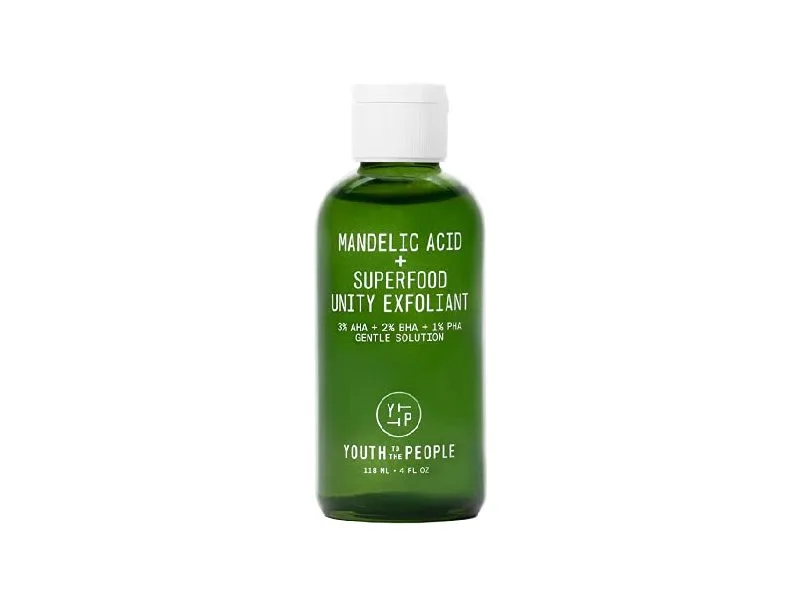


Mandelic Acid: The Gentle AHA Built for Sensitive and Deeper Skin
Its molecule is roughly twice the size of glycolic's — and that single fact is why it's the exfoliating acid dermatologists reach for when irritation could cost you pigment.

Most beginner exfoliants either undershoot the concentration (at unhelpful 2% AHAs that don't really work) or pair glycolic acid — the most irritating AHA — with high salicylic. This uses mandelic acid, which has the largest molecular size of mainstream AHAs and therefore the gentlest penetration profile, combined with a low-strength salicylic for pore support. Plus a sugar-humectant complex that keeps the product comfortable instead of drying.
A thoughtfully formulated beginner AHA/BHA exfoliant that uses mandelic acid — the gentlest mainstream AHA — in combination with low-strength salicylic, plus a sugar-humectant complex for comfort. At 100mL for around $12, the value is excellent, and the formulation choices reflect the kind of cosmetic-chemist thinking that separates this brand from typical indie exfoliants. Ideal for exfoliant newcomers and sensitive skin.
Available since 2021, this mandelic-plus-salicylic exfoliant has seen wide community adoption (around 1,800 reviews) at a 4.5 average. Confidence rests on analysis of its gentle larger-molecule AHA, low-strength BHA, and sugar-humectant comfort system plus consistent positive reports; independent clinical validation of the specific formula is not yet extensive.
The case for it
Same rule for everyone. “Strong choice” is the verdict on 1,459 of 45,024 concern verdicts across the catalog; rule R2 decided 892 of them. Unchanged since September 5, 2026, engine 5.1.1.
Brand or formulator? Disclose a concentration or correct a fact →
The studies behind the evidence row
The case for it
Same rule for everyone. “Strong choice” is the verdict on 1,459 of 45,024 concern verdicts across the catalog; rule R2 decided 892 of them. Unchanged since September 5, 2026, engine 5.1.1.
Brand or formulator? Disclose a concentration or correct a fact →
The studies behind the evidence row
The case for it
Same rule for everyone. “Not for this” is the verdict on 488 of 45,024 concern verdicts across the catalog; rule R10 decided 488 of them. Unchanged since September 5, 2026, engine 5.1.1.
Brand or formulator? Disclose a concentration or correct a fact →
The studies behind the evidence row
The case for it
Same rule for everyone. “Good choice” is the verdict on 9,564 of 45,024 concern verdicts across the catalog; rule R5 decided 9,072 of them. Unchanged since September 5, 2026, engine 5.1.1.
Brand or formulator? Disclose a concentration or correct a fact →
The studies behind the evidence row
The case for it
What would change this: A concentration inside the studied range would raise this a step.
Same rule for everyone. “Unproven” is the verdict on 1,111 of 45,024 concern verdicts across the catalog; rule R9 decided 1,111 of them. Unchanged since September 5, 2026, engine 5.1.1.
Brand or formulator? Disclose a concentration or correct a fact →
The studies behind the evidence row
Also listed for Hyperpigmentation and Dullness — the actives here (Mandelic Acid, Salicylic Acid, Probiotics & Prebiotics, Amino Acids) are in our research queue for those concerns; there is no verdict until their evidence rows are written. That is a gap in our table, not a mark against the product.
A verdict is DermApproved’s assessment of how well a product’s ingredients fit a concern — never a claim about what the product treats. Evidence dots and collected reviews sit beside it and are never blended in. Rules 0.5.1 · evidence table ev-2026.09-r228 · how we decide
Mandelic acid is the quiet underdog of the AHA category, and most beginner exfoliants ignore it in favor of the louder, more recognizable glycolic acid. This is a pity, because if you were designing an exfoliant specifically for people new to chemical exfoliation or for users with sensitive skin, mandelic would be the obvious starting point. The reason comes down to simple molecular kinetics: mandelic acid has the largest molecular size of any common alpha-hydroxy acid, which means it penetrates more slowly into the skin than glycolic, which has the smallest molecular size. Slower penetration translates to gentler exfoliation, less stinging, less flushing, and significantly less adaptation irritation. For the beginner user, this is almost entirely upside.
Geek & Gorgeous understood this when they formulated Cheer Up, and the choice to lead with mandelic acid at 5% rather than glycolic is the single most important decision in the product's design. The supporting cast is equally thoughtful. Salicylic acid at 1% adds BHA activity — the lipid-solubility that lets it penetrate into pores and address sebum-related congestion and blackheads, something AHAs can't do as effectively because of their water-solubility. The combination of a surface-acting AHA and a pore-acting BHA covers both the texture-refining and the anti-congestion goals that most users are chasing when they buy a chemical exfoliant. And 1% salicylic is gentle enough that it doesn't amplify the overall irritation ceiling — it complements the mandelic without turning the product into a harsh peel.
The other formulation detail worth noting is the humectant system. Most chemical exfoliants on the budget market rely on propylene glycol and water as their vehicle, which is functional but doesn't do anything to offset the drying tendency of the acids. Cheer Up uses a sugar-based humectant complex (Aquaxyl, the combination of xylitylglucoside, anhydroxylitol, and xylitol) that provides deep surface hydration and helps the product feel comfortable rather than stripping. Sarcosine adds amino-acid-based sebum modulation that complements the salicylic acid's pore activity. Glycerin and pentylene glycol round out the hydration layer. The pH sits around 3.4, which is in the effective range for AHA activity without going into more aggressive peeling territory.
The experience of actually using it is quiet. You apply the product to clean dry skin with a cotton pad or fingertips at night, there's a brief tingling sensation that subsides within a minute — this is normal for low-pH acid products and is not a sign of irritation — and then you continue with your routine. No redness, no peeling, no flaking for most users. The gentle profile means you can apply the product and immediately follow with hydrating steps without waiting for a rest period. For users starting their first chemical exfoliant, this is the kind of experience that builds confidence rather than triggering the panicked abandonment that harsher products sometimes cause.
Results follow a gentle timeline. In the first 2-3 weeks, surface texture becomes noticeably smoother and congestion around the nose and chin starts to reduce. By 6-8 weeks, users with post-acne marks will often see visible softening of pigmentation as cell turnover accelerates. Overall skin clarity and brightness improve over the same period. These results are subtle compared to what a stronger AHA or retinoid would produce, but they're also achievable without the adaptation cost, and for many users that trade-off is exactly right. Users who want faster or more dramatic exfoliation can step up to higher-strength products from the same brand or move to a retinoid routine once their skin is well-adapted to active ingredients.
The honest audience for this product is clear. It's ideal for users starting their first chemical exfoliant, for sensitive and reactive skin types who can't tolerate glycolic acid, for users with combination-to-oily skin targeting mild congestion and post-acne marks, and for anyone building a budget-conscious routine that still includes real actives. It's also a strong choice as a gentler alternative to keep in rotation alongside a stronger exfoliant or retinoid — for nights when your skin needs some pore support without another full round of aggressive active ingredient exposure. What it's not is a product for users already adapted to 10% glycolic or prescription-strength retinoids who want the strongest exfoliation available — those users should step up to a higher-concentration option.
Pregnancy users should note that salicylic acid in leave-on products is generally advised against during pregnancy due to theoretical systemic absorption concerns, so this isn't a pregnancy-safe exfoliant. For those users, a lactic-acid-only alternative or gentle physical exfoliation is the safer path until after breastfeeding.
At around $12 for 100mL, the value is exceptional. The large bottle size is genuinely unusual in the exfoliant category — most competitors sell 30-50mL at similar or higher prices — and a bottle lasts 4-6 months with every-other-night use. The per-use cost works out to cents rather than dollars, which makes consistent long-term use economically trivial. Combined with the thoughtful formulation and gentle profile, this is one of the most sensible entry points to chemical exfoliation in the budget skincare tier, and one of the better arguments for the Geek & Gorgeous brand's overall pricing philosophy.
The hero actives that drive this product's performance.
| Ingredient | Function | Evidence |
|---|---|---|
| Mandelic Acid 5% (5%) | The primary AHA in this exfoliant, chosen specifically for its larger molecular size compared to glycolic acid — the larger molecule penetrates more slowly, which translates to gentler exfoliation with significantly less irritation risk. This makes mandelic the preferred AHA for sensitive skin and users new to chemical exfoliation. | Limited for Acne |
| Salicylic Acid 1% (1%) | A lipid-soluble BHA that penetrates into pores to address sebum, congestion, and blackheads — paired with mandelic acid to create a combined surface-plus-pore exfoliation profile. 1% is a relatively gentle BHA concentration, appropriate for the beginner positioning of this product. | Established mechanism for Rough Texture · established mechanism |
| Xylitylglucoside + Anhydroxylitol + Xylitol | A sugar-based humectant complex (Aquaxyl) that provides deep surface hydration to offset any drying tendency from the acid combination — one of the reasons this exfoliant feels comfortable rather than stripping. | Not yet assessed |
| Sarcosine | An amino acid derivative included for its reported sebum-regulating activity — stacks with the salicylic acid to provide additional pore-clarifying and oil-control support. | Not yet assessed |
Ingredient standings describe the active at treatment-level doses and vehicles; this product's own condition grades weigh its actual formula.
Aqua, Propanediol, Mandelic Acid, Salicylic Acid, Xylitylglucoside, Anhydroxylitol, Xylitol, Sarcosine, Butylene Glycol, Pentylene Glycol, Glucose, Xanthan Gum, Sodium Hydroxide, Phenoxyethanol
treatment
PM
Use at night after cleansing, before serums and moisturizer. Start with 2-3 times per week and build up. Don't combine with retinoids, vitamin C, or benzoyl peroxide in the same routine — alternate nights. Always use SPF the next morning.
Immediate: slight tingling on application. Short-term (2-4 weeks): smoother texture, reduced congestion around nose and chin. Full benefits (8-12 weeks): visible improvement in clarity, post-acne marks, and overall skin brightness.
Mandelic acid has a substantial body of published research supporting its role as a gentler alternative to glycolic acid. Studies have shown mandelic acid at 5-10% produces comparable improvements in skin texture, pigmentation, and acne as glycolic acid at similar concentrations, with significantly less irritation due to mandelic's larger molecular size (approximately 152 g/mol vs glycolic's 76 g/mol). This molecular size difference is mechanistically important: larger molecules penetrate the stratum corneum more slowly, producing more gradual keratinocyte turnover and less acute disruption. Salicylic acid at 1-2% has extensive clinical evidence for anti-comedogenic and anti-inflammatory effects in acne-prone skin. The pairing of AHAs and BHAs in a single formulation is well-supported as a strategy for addressing both surface texture and pore congestion simultaneously. The pH of 3.2-3.6 falls within the effective range for chemical exfoliation — below 4.0 is required for mandelic to maintain its protonated, active form, and this product's pH is appropriately calibrated. The Aquaxyl humectant complex (xylitylglucoside, anhydroxylitol, xylitol) has published evidence supporting its role in improving stratum corneum hydration and reducing transepidermal water loss. Sarcosine's sebum-modulating evidence is more limited than the other actives. Overall, the formulation reflects evidence-based exfoliant design with conservative, well-validated choices.
Dermatologists commonly recommend chemical exfoliants for patients with texture irregularities, mild acne, post-inflammatory pigmentation, and dullness. Most dermatologists have long observed that mandelic acid is preferred for sensitive skin, rosacea-prone patients, and users starting their first acid routine because of its gentler penetration profile compared to glycolic. The combination of AHA and BHA in a single product is consistent with dermatological advice for addressing both surface and pore-related concerns. Dermatologists typically advise starting with 2-3 times weekly application and building to every other night, and emphasize the importance of daily broad-spectrum SPF 30+ when using any chemical exfoliant.
Use at night after cleansing. Apply a few drops with clean fingertips or a cotton pad across the face and neck, avoiding the immediate eye area. Start with twice weekly for 2-3 weeks, then build to every other night as tolerated. Follow with hydrating serums and moisturizer. Always apply broad-spectrum SPF 30+ the next morning. Do not combine with retinoids, high-strength vitamin C, or benzoyl peroxide in the same routine — alternate nights instead.
At approximately $12 for 100 mL, this is genuinely exceptional value — most beginner exfoliants in this category sell 30-50 mL at comparable or higher prices. A bottle lasts 4-6 months with every-other-night use, making the per-application cost pennies. Compared to premium exfoliants at $30-80, this delivers comparable formulation quality without the premium markup. The combination of size, price, and thoughtful formulation makes this one of the best value plays in the chemical exfoliant category.
Users starting their first chemical exfoliant, sensitive or reactive skin types who need gentle introduction to AHAs, combination/oily skin with mild congestion and post-acne marks, and budget-conscious shoppers who want thoughtful formulation without premium pricing.
Users already adapted to stronger AHAs who want maximum potency, pregnant or breastfeeding users (salicylic acid contraindicated), severe rosacea or compromised-barrier skin, and users not committed to daily SPF — exfoliants increase photosensitivity.
Ready to try Geek & Gorgeous Cheer Up Mandelic + Salicylic Exfoliant?
Buy at Amazon ♥A thin, water-like clear liquid that applies easily with a cotton pad or fingertips.
Fragrance-free with only the faint tang of the acid system itself.
Glass bottle with a screw-top dispenser, standard for the 101 line exfoliants.
Expect a brief tingling sensation on application that subsides within a minute — this is normal for low-pH acid products and not a sign of irritation. No peeling or flaking typically required during adaptation at this gentle strength.
About 4-6 months with use every other night.
All Year
Geek & Gorgeous positioned Cheer Up as the entry point to their exfoliation ladder — a gentle enough product that beginners can start with, but properly dosed enough that it delivers real results rather than placebo-strength exfoliation. The mandelic acid choice reflects the brand's preference for less-popular but gentler actives when they make formulation sense.
Geek & Gorgeous is a 2020-founded Hungarian indie brand of cosmetic chemists with a transparent, direct-to-consumer pricing model. Cheer Up is the brand's entry-level AHA/BHA exfoliant, positioned for beginners and gentler than most mid-tier chemical exfoliants.
Mandelic acid is weaker than glycolic and not worth using.
Mandelic acid produces comparable results to glycolic at equivalent concentrations, just over a slightly longer timeline, with significantly less irritation. For sensitive skin or users new to AHAs, mandelic is often the better choice — it delivers the benefits without the adaptation punishment.
A 5% AHA won't do anything if you're used to 10% glycolic.
Mandelic at 5% is biologically comparable to a lower-concentration glycolic because of the different molecular kinetics. Users adapted to higher-strength glycolic might find it gentler, but it still delivers real exfoliation — and paired with salicylic acid, the overall effect is more balanced.
For users already adapted to higher-strength glycolic acid (8-10%), this 5% mandelic will feel gentler. However, the mandelic + salicylic combination delivers different benefits than pure glycolic, so it's not a straight substitution. Many experienced exfoliant users add this as a gentler alternative for nights when they want pore support without aggressive AHA action.
Start with 2-3 times per week for the first 2-3 weeks, then build up to every other night as tolerated. Daily use is possible for well-adapted skin but not necessary — most users see optimal results from every-other-night application. Don't combine with retinoids, vitamin C, or benzoyl peroxide in the same routine.
Yes, relatively. Mandelic acid has the largest molecular size of mainstream AHAs and penetrates more slowly, which makes it the gentlest option for reactive skin. The sugar-humectant complex in this formula further reduces drying potential. Sensitive users should still start with twice weekly and build up gradually.
No. Salicylic acid in leave-on products is generally advised against during pregnancy due to theoretical systemic absorption concerns. Switch to alternative exfoliants like gentle physical exfoliation or lactic acid-only products during pregnancy, or consult your provider.
Some users experience an initial breakout phase in the first 2-3 weeks as cellular turnover accelerates and underlying congestion surfaces. This is distinct from an allergic reaction. If breakouts appear in unusual areas or with significant irritation, discontinue use.
Technically yes, but nighttime use is preferred because exfoliated skin is more photosensitive. If you use it in the morning, sunscreen is non-negotiable — rigorous broad-spectrum SPF 30+ is required.
Recurring themes our editors read across retailer reviews of this product — summaries in our words, not quotations, and not a substitute for your own patch test.
Gentle enough for sensitive skin beginners
Mandelic + salicylic combination addresses both surface and pore concerns
Large 100mL bottle delivers exceptional value per use
Sugar-humectant base prevents the drying feeling common with acid exfoliants
Not strong enough for users adapted to higher-strength exfoliants
Slight acid tingle on application
Glass bottle is fragile for travel
Verified answers from our questions library — the nuance a product page cannot carry.