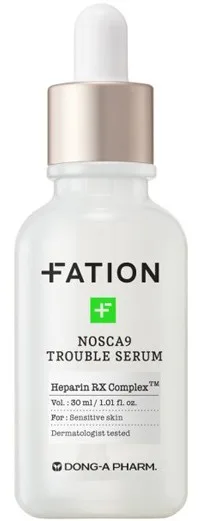
It leads with a high dose of mugwort and pairs it with the brand's signature sodium heparin, centella and a touch of ceramide in a fully fragrance-free base — a calming, redness-focused serum that buffers acne-active irritation rather than attacking blemishes, unusually clinical for the price.
A genuinely soothing, fragrance-free calming serum for troubled skin: it leads with a high dose of mugwort and adds the brand's signature sodium heparin, centella, panthenol and a touch of ceramide. Rather than attacking blemishes, it quiets the redness and irritation that worsen them — making it an excellent calming and buffering step for acne-prone and sensitive skin, with only fungal-acne incompatibility as a real caveat.
As a popular Nosca9 product, Fation's serum is a, well-reviewed product with a dermatological positioning, so the medium-confidence rating blends that solid feedback with a transparent, fragrance-free ingredient list led by genuine soothing actives. The mugwort and centella are well-evidenced; the sodium heparin is brand-distinctive but less documented in cosmetic use, so its specific contribution is the main open question.
Verdicts
How well it fits each concern
Verdict by concern tap a concern for the case
Good choicefor SensitivityIn your profileYou chose · No fragrance, drying alcohol, declarable allergens or sensitising preservatives in this serum — the profile sensitive skin looks for.Not yet assessedGentleNo reviews collected yet
The case for it
Centella, Panthenol & Allantoin has been researched for this concern and the evidence does not support it.
It is plausibly present at a working level, though the concentration is not declared.
The formula carries none of the triggers this concern is sensitive to.
What would change this: A declared concentration would move this to a firmer reading of the dose.
Same rule for everyone. “Good choice” is the verdict on 1,938 of 45,024 concern verdicts across the catalog; rule F2 decided 1,938 of them.
Unchanged since September 5, 2026, engine 5.1.1.
Promisingfor RosaceaIn your profileYou chose · Centella Asiatica has trial-level evidence for rosacea but no guideline or regulatory standing yet — promising, short of a recommendation; the other actives here are not yet assessed for it.Moderate evidenceGentleNo reviews collected yet
The case for it
Centella, Panthenol & Allantoin has trial-level evidence for this concern but no guideline or regulatory standing yet.
It is plausibly present at a working level, though the concentration is not declared.
The formula carries none of the triggers this concern is sensitive to.
What would change this: A declared concentration would move this to a firmer reading of the dose.
Same rule for everyone. “Promising” is the verdict on 7,858 of 45,024 concern verdicts across the catalog; rule R9p decided 7,858 of them.
Unchanged since September 5, 2026, engine 5.1.1.
R9p — 0.5.0: 'Unproven' beside three filled dots read as one question answered twice with opposite words (7,018 rows). The chip measures standing, the dots measure trial volume; where the row carries at least one RCT or a tier-2 source (moderate dots) and the active is present at a working level, the honest word is Promising. Unproven is reserved for plausible-standing rows with limited or weak evidence, or an under-dosed form. Same rank as Unproven — a bet either way; the dots order them. · the full register
Carrying active
Centella, Panthenol & Allantoin
Standing
plausible — trials support it
Form
plausible
Tolerability
gentle
Row checked
against its sources on July 17, 2026 (evidence table ev-2026.09-r228)
Good choicefor Compromised Skin BarrierIn your profileYou chose · Ceramides is a reference standard by mechanism for compromised skin barrier; this serum carries it.Moderate evidenceGentleNo reviews collected yet
The case for it
Ceramide NP & Tocopherol has trial-supported standing for this concern.
It is plausibly present at a working level, though the concentration is not declared.
The formula carries none of the triggers this concern is sensitive to.
What would change this: A declared concentration would move this to a firmer reading of the dose.
Same rule for everyone. “Good choice” is the verdict on 9,564 of 45,024 concern verdicts across the catalog; rule R5 decided 9,072 of them.
Unchanged since September 5, 2026, engine 5.1.1.
R5 — Trial-supported or guideline-supported active, adequately or plausibly dosed. · the full register
Carrying active
Ceramide NP & Tocopherol
Standing
supported — its mechanism is established
Form
plausible — studied range 0.5–1%, from the trials on the row; needs leave-on contact; judge it after ~4 weeks
Tolerability
gentle
Row checked
against its sources on July 17, 2026 (evidence table ev-2026.09-r228)
The studies behind the evidence row
Elias PM, Skin Barrier / Coderch et al., ceramides and skin barrier function — ceramides ~50% of SC intercellular lipid mass, essential to the permeability barrier — reference work
Promisingfor Post-ProcedureIn your profileYou chose · Ceramides has trial-level evidence for post procedure but no guideline or regulatory standing yet — promising, short of a recommendation; the other actives here are not yet assessed for it.Moderate evidenceGentleNo reviews collected yet
The case for it
Ceramide NP & Tocopherol has trial-level evidence for this concern but no guideline or regulatory standing yet.
It is plausibly present at a working level, though the concentration is not declared.
The formula carries none of the triggers this concern is sensitive to.
What would change this: A declared concentration would move this to a firmer reading of the dose.
Same rule for everyone. “Promising” is the verdict on 7,858 of 45,024 concern verdicts across the catalog; rule R9p decided 7,858 of them.
Unchanged since September 5, 2026, engine 5.1.1.
R9p — 0.5.0: 'Unproven' beside three filled dots read as one question answered twice with opposite words (7,018 rows). The chip measures standing, the dots measure trial volume; where the row carries at least one RCT or a tier-2 source (moderate dots) and the active is present at a working level, the honest word is Promising. Unproven is reserved for plausible-standing rows with limited or weak evidence, or an under-dosed form. Same rank as Unproven — a bet either way; the dots order them. · the full register
Carrying active
Ceramide NP & Tocopherol
Standing
plausible — trials support it
Form
plausible
Tolerability
gentle
Row checked
against its sources on July 17, 2026 (evidence table ev-2026.09-r228)
Also listed for Acne — the actives here (heparin, Ceramides, Centella Asiatica, Hyaluronic Acid) are in our research queue for that concern; there is no verdict until their evidence rows are written. That is a gap in our table, not a mark against the product.
Where our review and the verdict differ. The review below was written on the formulation and the published trials; the verdicts above apply the stricter standing test in our methodology — an active earns a recommendation only with guideline or regulatory standing for the concern. Where the two disagree, the verdict is DermApproved’s position.
A verdict is DermApproved’s assessment of how well a product’s ingredients fit a concern — never a claim about what the product treats. Evidence dots and collected reviews sit beside it and are never blended in.
Rules 0.5.1 · evidence table ev-2026.09-r228 · how we decide
Assessment
Pros & Cons
Pros
✓ High-placed mugwort leads a genuinely soothing formula
✓ Centella, panthenol and allantoin reinforce the calming
✓ Fully fragrance-free and essential-oil-free
✓ Lightweight, oil-free texture ideal as an actives buffer
✓ Touch of ceramide and vitamin E for barrier and antioxidant support
✓ Strong value for a clinical-minded soothing serum
Cons
✗ Not fungal-acne safe (polyglyceryl laurate, lecithin)
✗ Calms rather than treats — not a spot zapper
✗ High mugwort warrants a patch test for the artemisia-sensitive
✗ Soothing-focused — won't clear active blemishes on its own
✗ High mugwort placement warrants a patch test for some
Review
Full Review
The word 'trouble' on a Korean acne product usually signals something drying and aggressive — a serum built to zap blemishes into submission. Fation's Nosca9 Trouble Serum quietly subverts that expectation, and it's smarter for it. This isn't a spot treatment; it's a calming, anti-redness serum that works on the inflammation underlying troubled skin rather than stripping the skin in the name of fighting it. For anyone whose breakouts come with redness, sensitivity, and the irritation of an active acne routine, that's often the more useful tool.
The priority is obvious from the very top of the ingredient list. Mugwort — artemisia princeps leaf extract — leads the formula, present in a genuinely high concentration rather than as a token botanical. Mugwort is a long-standing Korean soothing ingredient with antioxidant and anti-inflammatory properties, and seeing it placed first signals a serum that's serious about calming. Right alongside it sits Fation's signature flourish, sodium heparin, the 'Heparin RX' the whole Nosca9 line is built around — a compound rarely found in cosmetics, included for its anti-inflammatory and soothing action. Together they form an unusual, soothing-forward core.
Around that core, the supporting cast is well-chosen and well-evidenced. Centella asiatica, panthenol, and allantoin are a reliable soothing-and-conditioning trio that complement the mugwort and heparin. Patented apple fruit extract adds an antioxidant note, hyaluronic acid binds water for lightweight hydration, and a touch of ceramide NP plus vitamin E offer barrier and antioxidant support. It's a thoughtfully layered calming serum, and crucially it's fully fragrance-free and essential-oil-free — exactly as a product for inflamed, reactive, broken-out skin should be. After a run of 'calming' products that contradict themselves with essential oils, this one gets the basics right.
The texture suits the job: a lightweight, watery gel-serum that absorbs fast into a soft, calmed, non-greasy finish, easy to layer and comfortable on oily skin. There's no sting on application, which matters when your skin is already irritated.
Where this serum truly shines is as a buffer in an acne routine. The active ingredients that clear acne — retinoids, benzoyl peroxide, exfoliating acids — almost all cause irritation, redness, and dryness, and that collateral damage is the main reason people abandon treatments that would otherwise work. A fragrance-free, mugwort-and-heparin calming serum layered into that routine directly counters those side effects, soothing the skin so you can keep using the actives that actually clear it. Used that way, it's not an alternative to your acne treatment; it's what makes your acne treatment livable. It's equally at home as a daily soother for sensitive, rosacea-prone, or barrier-compromised skin that simply runs red and reactive.
The main caveats are few. The most important is that it isn't fungal-acne safe — polyglyceryl-10 laurate and hydrogenated lecithin can be problematic for malassezia folliculitis — so if your 'acne' is actually fungal, this isn't the right pick. It's also not vegan, since sodium heparin is animal-derived, and the brand's cruelty-free status isn't clearly established. And expectations matter: this calms and supports, it doesn't dry up active pimples, so anyone wanting a fast spot-zapper will find it too gentle. The high mugwort, while soothing for most, is worth a patch test for the rare person sensitive to artemisia.
Value is strong. At around eighteen dollars for 30ml, a fragrance-free calming serum with high-placed mugwort, the distinctive heparin, centella, and barrier support is a genuinely good deal — the kind of clinically-minded soothing formula that often costs more from Western derm-cosmetic brands. It comes from a brand with real dermatological positioning and a large, positive review base, so it's a credible choice.
There's a broader shift in acne care this serum reflects, and it's worth naming. For years the standard advice was to attack oil and bacteria relentlessly, and the resulting irritation was treated as proof the products were 'working.' The modern, better-supported view recognizes inflammation as central to acne and prioritizes calming alongside treating — which is exactly the lane this serum occupies. Pairing a soothing, barrier-supportive serum with your actives isn't coddling your skin; it's how you keep an acne routine sustainable long enough to actually work, and this is a well-built, affordable tool for that job.
The bottom line: an excellent, fragrance-free calming serum for troubled and sensitive skin that understands acne is as much an inflammation problem as a blemish problem. If your skin is broken out, red, reactive, or being put through an active acne routine, this mugwort-and-heparin soother is an easy, affordable recommendation — pair it with your treatment rather than instead of it. Only the fungal-acne-prone and those wanting a vegan formula should look elsewhere; for everyone else with troubled skin, it's one of the smarter calming serums you can buy at the price. Used that way — as the calming half of a treatment routine rather than the treatment itself — it quietly earns a permanent place, and at this price there is little reason not to keep a bottle on hand for the inevitable flare-ups.
Formula
Key Ingredients
The hero actives that drive this product's performance.
Right at the top of the list, mugwort is the serum's dominant soothing active — a traditional Korean botanical with antioxidant and anti-inflammatory properties, here in a genuinely high concentration to calm the redness and irritation of broken-out, reactive skin.
Not yet assessed
Sodium Heparin (Heparin RX)
Fation's signature, rarely-seen-in-cosmetics active — a compound with anti-inflammatory and soothing properties that the Nosca9 line is built around, reinforcing the mugwort and centella in quieting inflammation rather than attacking blemishes directly.
A well-evidenced soothing-and-conditioning trio that complements the mugwort and heparin, calming and supporting recovery so the serum suits irritated, acne-stressed, and sensitive skin.
Patented apple extract adds an antioxidant, complexion-reviving note while hyaluronic acid binds water for lightweight hydration — keeping the serum comfortable and plumping without weighing down oily, blemish-prone skin.
A touch of ceramide for barrier support and vitamin E for antioxidant protection round out the soothing serum, helping reinforce the barrier that breakouts and acne actives so often compromise.
Established mechanismfor Compromised Skin Barrier · established mechanism
Ingredient standings describe the active at treatment-level doses and
vehicles; this product's own condition grades weigh its actual formula.
Apply to clean skin before moisturizer; its fragrance-free, mugwort-and-heparin formula makes an ideal calming buffer step on nights when acne actives leave skin red and reactive.
Results Timeline
Immediate soothing and reduced tightness on irritated skin; visibly calmer redness over one to two weeks; steadier tolerance and fewer irritation flare-ups over 4-6 weeks of consistent use.
The serum's soothing claims rest on reasonably solid ground. Artemisia princeps (mugwort) leaf extract, placed first, has antioxidant and anti-inflammatory data and is a well-regarded Korean soothing botanical; its high placement supports a meaningful calming effect, though it is also an occasional sensitizer for a minority. Sodium heparin (the Heparin RX complex) is the distinctive inclusion: heparin has recognized anti-inflammatory activity and medical topical uses, but robust published evidence for cosmetic anti-acne or anti-redness benefit is limited, so it is best viewed as a plausible, brand-distinctive soother. The supporting soothers are well-evidenced — centella asiatica's triterpenes for anti-inflammatory and barrier support, and panthenol and allantoin as documented conditioners. Hyaluronic acid provides humectant hydration, ceramide NP offers modest barrier support, apple fruit extract and tocopherol add antioxidant character. The fragrance-free, oil-free construction lowers irritation risk and makes it appropriate as an actives buffer. The one formulation limitation is fungal-acne compatibility, given polyglyceryl-10 laurate and hydrogenated lecithin. The evidence-aligned conclusion: a genuinely soothing, barrier-supportive serum whose strongest, best-evidenced elements are the mugwort and centella, with heparin as a distinctive but less-documented active.
Dermatologist Perspective
Soothing, anti-inflammatory serums are widely used in clinical practice as adjuncts in acne care, precisely because inflammation underlies much of acne and because the actives that treat it (retinoids, benzoyl peroxide, acids) commonly irritate and compromise the barrier. A fragrance-free serum led by mugwort and centella, with barrier-supportive ceramide, aligns well with that supportive role and is appropriate for sensitive, rosacea-prone, and reactive skin. Sodium heparin is an unusual but plausible anti-inflammatory addition, with limited cosmetic-specific evidence. The key caveat is fungal-acne (malassezia folliculitis), where the polyglyceryl ester and lecithin could aggravate, so diagnosis matters. As a calming and buffering step rather than a primary acne treatment, this is the kind of low-irritation, barrier-friendly serum clinicians tend to favor for troubled skin, with realistic expectations set toward reduced redness and improved tolerance rather than direct blemish clearance.
Guidance
Usage & Recommendations
How to Use
Apply a few drops to clean skin before moisturizer, morning or night. It's an ideal calming buffer: on nights you use a retinoid, benzoyl peroxide, or BHA and your skin turns red and reactive, layer this serum afterward to soothe and support the barrier. In the morning, follow with sunscreen. The fragrance-free, oil-free formula suits twice-daily use even on irritated skin; patch test first if you're sensitive to mugwort. If your breakouts are fungal-acne, choose a different soothing serum.
Value Assessment
At roughly $18.00 for 30ml, this is strong value for a clinically-minded calming serum: high-placed mugwort, the distinctive sodium heparin, centella, panthenol, hyaluronic acid and a touch of ceramide in a fragrance-free base is more thoughtful than most soothing serums at the price, and a larger size offers better per-ml value. Its dual role — daily soother and acne-active buffer — adds practical value for anyone managing breakouts. The caveats narrowing its value are fungal-acne incompatibility and the non-vegan heparin; for the broad troubled-and-sensitive-skin audience it targets, it's one of the better calming-serum buys in the budget-to-mid tier.
Who Should Buy
Buy it if your skin is acne-prone, red, reactive, rosacea-prone, or barrier-compromised, and you want a fragrance-free serum that calms inflammation and buffers the irritation of acne actives. It's a smart pick for sensitive skin and for anyone whose breakouts come with redness rather than just blemishes.
Who Should Skip
Avoid it if your breakouts are specifically fungal acne, since it isn't fungal-acne safe, or if you want a drying spot treatment — this soothes rather than zaps. Those wanting a vegan formula should also pass, as sodium heparin is animal-derived, and the artemisia-sensitive should patch test first.
A lightweight, watery gel-serum that absorbs quickly into a soft, calmed, non-greasy finish.
Scent
No added fragrance; clean and essentially neutral.
Packaging
A pump or dropper bottle that dispenses a controlled dose and protects the formula.
Finish
lightweightfast-absorbingdewy
What to Expect on First Use
Sinks in fast and feels instantly calming on irritated, broken-out skin, with no sting and no scent. The soothing is noticeable from the first use; barrier and tolerance benefits build quietly over weeks.
How Long It Lasts
Around 2-3 months with daily use from the 30ml bottle.
Fation's Nosca9 line targets troubled skin via soothing and barrier support rather than harsh actives; this serum is the line's lightweight calming step, built around mugwort and the Heparin RX complex.
About Fation Established Brand (5–20 years)
Fation is a Korean dermatological-skincare brand whose Nosca9 line is widely sold for troubled, acne-prone skin and built around its signature Heparin RX (sodium heparin) complex. Its formulas are more clinically-minded than typical budget K-beauty, though independent published research on the specific products is limited.
Brand founded: 2018
Myth vs. Reality
Common Myths
Myth
A 'trouble' serum for acne should be a strong drying spot treatment.
Reality
This one takes the opposite, often smarter approach — it calms the inflammation and supports the barrier with mugwort, heparin and centella, which reduces the redness and irritation that worsen breakouts and acne-active routines. It's a soother, not a spot zapper.
FAQ
Frequently Asked Questions
Is this serum a spot treatment for acne?
No — it's a calming, anti-redness serum rather than a drying spot treatment. It soothes inflammation and supports the barrier with high-placed mugwort, sodium heparin and centella, which helps reduce the irritation that worsens breakouts, especially alongside acne actives.
What is the Heparin RX in this serum?
It's Fation's signature complex built around sodium heparin, a compound rarely used in cosmetics, included for its anti-inflammatory and soothing properties. It works with the mugwort and centella to quiet redness and irritation.
Is the Nosca9 Trouble Serum good for sensitive skin?
Yes. It's fragrance-free and essential-oil-free, led by soothing mugwort, centella, panthenol and allantoin, making it well-suited to sensitive, reactive, and barrier-compromised skin as well as acne-prone skin.
Can I use it to buffer retinoids or acne treatments?
It's an excellent buffer. On nights when a retinoid or BHA leaves skin red and reactive, layering this calming serum afterward helps soothe and support the barrier, making the active routine more sustainable.
Is it fungal-acne safe?
No. It contains polyglyceryl-10 laurate and hydrogenated lecithin, which can be problematic for fungal-acne-prone skin, so that group should choose a different soothing serum despite the troubled-skin focus.
Reviews
What Reviewers Tend to Say
Recurring themes our editors read across retailer reviews of this product — summaries in our words, not quotations, and not a substitute for your own patch test.
Every cica, calming, and barrier product leans on the same three ingredients, and the real mechanisms are far more specific — and more limited — than 'soothing' lets on.
Topically, the molecule the argument tells you to avoid is one the stratum corneum is structurally built from — and in acne-prone skin the documented finding is a shortage of it.
Western sensitive skincare works by subtraction — remove the fragrance, remove the alcohol, shorten the list. Japan's answer adds a designed molecule back in, and one of the two bets has a trial literature.
A wrecked barrier is the most common self-inflicted skin condition and the one with the clearest fix — the difficulty is that the routine which caused it feels productive and the one that repairs it feels like giving up.
Aug 5, 2026· 8 min
Questions people ask about Acne
Verified answers from our questions library — the nuance a product page cannot carry.
Products, answers, therapy guides, tools and articles in one search. Brand names,
slang and abbreviations all work — accutane finds isotretinoin, bacne finds truncal acne.