



Keratosis Pilaris ('Chicken Skin'): What Actually Works and What's a Scam
The rough little bumps on your arms are harmless, genetic, and impossible to cure — which hasn't stopped a whole aisle from promising otherwise.

Most body lotions choose either deep moisturizing (heavy occlusives) or active resurfacing (AHA-only formulas). This one runs both pathways simultaneously at concentrations that are aggressive enough to actually work on KP but mild enough to use twice daily long-term. The 5% urea sits in the sweet spot — high enough to keratolyze, low enough not to require a prescription.
A long-standing dermatology-favorite body lotion that pairs 5% urea with lactic acid to address keratosis pilaris and stubborn rough skin at a drugstore price. The chemistry is unfussy, the results are consistent, and the value-per-bottle is hard to beat.
The case for it
What would change this: A declared concentration would move this to a firmer reading of the dose.
Same rule for everyone. “Supporting role” is the verdict on 8,197 of 45,024 concern verdicts across the catalog; rule R8a decided 1,489 of them. Unchanged since September 5, 2026, engine 5.1.1.
Brand or formulator? Disclose a concentration or correct a fact →
The studies behind the evidence row
The case for it
Same rule for everyone. “Good choice” is the verdict on 9,564 of 45,024 concern verdicts across the catalog; rule R5 decided 9,072 of them. Unchanged since September 5, 2026, engine 5.1.1.
Brand or formulator? Disclose a concentration or correct a fact →
The studies behind the evidence row
The case for it
What would change this: A declared concentration would move this to a firmer reading of the dose.
Same rule for everyone. “Good choice” is the verdict on 9,564 of 45,024 concern verdicts across the catalog; rule R5 decided 9,072 of them. Unchanged since September 5, 2026, engine 5.1.1.
Brand or formulator? Disclose a concentration or correct a fact →
The studies behind the evidence row
Also listed for Winter Skin — the actives here (Urea, Glycerin, Lactic Acid, Bisabolol) are in our research queue for that concern; there is no verdict until their evidence rows are written. That is a gap in our table, not a mark against the product.
As a body productNot judged: what a body product is for — real substance, not just slip, realistic to use daily — cannot yet be measured from the ingredient list (only fragrance load can).
A verdict is DermApproved’s assessment of how well a product’s ingredients fit a concern — never a claim about what the product treats. Evidence dots and collected reviews sit beside it and are never blended in. Rules 0.5.1 · evidence table ev-2026.09-r228 · how we decide
Ask any board-certified dermatologist what they actually recommend to patients who walk in frustrated about "chicken skin" on their upper arms, and the answer is rarely the trending product of the week. It's usually this — a fragrance-free, $15 lotion in a utilitarian pump bottle that has been sitting on Beiersdorf's roster for over fifteen years. Eucerin Roughness Relief Lotion is the rare drugstore body care product that genuinely earns its clinical endorsement, and the reasons live entirely in the ingredient list rather than the marketing.
The formula runs on the combination that became the standard for keratosis pilaris years ago: 5% urea paired with lactic acid and its salt form, sodium lactate. Urea punches well above its molecular weight. At low percentages it's a humectant; climb past three or four and it starts behaving as a keratolytic, gently loosening the bound keratin proteins that form the rough plugs at follicle openings. Five percent is the concentration pharmacies settled on as the highest safe for unrestricted daily use without prescription oversight. Lactic acid handles the surface work urea can't quite reach, dissolving the dead corneocytes capping each bump and clearing the path for the hydrating components underneath.
The textural experience matches the formula's philosophy: workmanlike rather than luxurious. It's a medium-thin lotion that spreads quickly, absorbs in under a minute, and leaves skin smooth without any rich, occlusive payoff. If you're used to body butters, the first impression can feel like a letdown — there's no immediate glow. What arrives instead is a slow tactile change that becomes obvious by the end of the first week. The skin on your upper arms stops feeling granular under your fingertips. By two to four weeks of twice-daily use, the visible bump count drops and the redness ringing each follicle softens.
The stinging is real and deserves flagging upfront. Apply this within an hour of shaving, or onto actively irritated KP, and you'll feel a brief mild burn for the first few uses. That's the lactic acid meeting disrupted skin, not an allergy, and it fades within five to ten minutes. After a week of regular application the barrier adapts and the sensation disappears altogether. It isn't a flaw; it's the chemistry announcing itself. Bisabolol — a chamomile-derived anti-inflammatory sitting midway down the deck — is the thoughtful counterweight, a small dose that nudges the irritation profile in the right direction without diluting the actives.
What the formula declines to do matters as much as what it does. No fragrance. No essential oils. No botanical complex earning shelf appeal. The base is plain and purposeful: water, glycerin, caprylic/capric triglyceride, a couple of fatty alcohols, a touch of dimethicone for slip, and enough sodium hydroxide to hold the pH around 5.0 — acidic enough for the lactic acid to work, close enough to skin's own to avoid provoking it. The preservation system uses methylparaben and propylparaben, which is the one item some buyers will balk at. Whether you avoid parabens is a preference question rather than a safety one; the evidence at cosmetic concentrations is reassuring, but it's your bottle.
Application technique matters more here than it usually does. Put this on damp skin straight out of the shower and the urea has water to bind; put it on bone-dry skin and you've halved its humectant half. Give it five or ten minutes before dressing. Keep it away from freshly shaved areas and broken skin. And don't stack it with another acid or a retinoid body lotion on the same day — twin exfoliants on body skin is how a manageable case of KP turns into an angry one.
Value is where this lotion quietly dominates its category. A 16.9 oz bottle runs around $15 and lasts most people three to four months applying twice daily to arms and thighs. The actives are present at concentrations that clinical work actually supports, the formula came out of Beiersdorf's research division, and none of your money is subsidizing an influencer budget or a beautiful jar. The smaller 8.4 oz bottle exists but offers worse per-ounce value — go straight to the large one unless you're patch-testing. The pump on the big bottle occasionally ships defective, which is the single most common complaint across thousands of reviews and the only real black mark on the packaging.
The honest limitation is that not everyone gets a dramatic result. Genetics, hormone-driven follicular keratinization, and plain luck all shape how far any topical can push a given case. Most people see meaningful improvement — fewer bumps, smoother texture, less seasonal flaring. A minority see modest changes and eventually need a stronger urea percentage or prescription help. It is also worth dismantling two persistent beliefs: scrubbing harder does not fix KP (physical scrubs inflame the follicle rather than clearing it, which is precisely why this gentler chemistry works better), and clearing does not mean finishing. This is management, not cure. Stop for two weeks and the plugs come back on schedule.
This is the kind of product that never generates breathless reviews because there is nothing dramatic about it. No shimmer, no scent, no aesthetic, no transformation claim. Just chemistry that works, aimed at a problem that affects a huge share of adults, at a price that makes indefinite daily use genuinely sustainable — which, for a condition you manage forever, turns out to be the whole ballgame.
The hero actives that drive this product's performance.
| Ingredient | Function | Evidence |
|---|---|---|
| Urea (5%) | At 5%, urea acts as both a humectant and a mild keratolytic in this lotion — it pulls water into the upper skin layers while gently loosening the rough, bumpy keratin plugs that define keratosis pilaris. This dual mechanism is what makes the formula effective on the arms, thighs, and rough patches that ordinary moisturizers can't smooth. | Established mechanism for Rough Texture · established mechanism |
| Lactic Acid (and Sodium Lactate) | Lactic acid is an alpha-hydroxy acid that chemically exfoliates dead corneocytes from the rough patches this lotion targets, while its salt form (sodium lactate) is part of skin's natural moisturizing factor and ties water into the stratum corneum. Pairing it with urea is the classic dermatology approach for KP — exfoliation plus hydration in one application. | Established mechanism for Rough Texture · established mechanism |
| Glycerin | A high-glycerin base supports the keratolytic actives by maintaining skin hydration during the urea/lactic acid exfoliation cycle. Without sufficient humectant support, AHA-driven exfoliation on dry body skin tends to leave it feeling tight — the glycerin balances that here. | Established mechanism for Dryness · established mechanism |
| Bisabolol | A chamomile-derived anti-inflammatory included to mitigate the sting and redness that lactic acid can provoke on freshly exfoliated body skin. It's a small but thoughtful inclusion in a formula otherwise focused on aggressive resurfacing. | Not yet assessed |
Ingredient standings describe the active at treatment-level doses and vehicles; this product's own condition grades weigh its actual formula.
Water, Urea, Glycerin, Caprylic/Capric Triglyceride, Cetearyl Alcohol, Glyceryl Stearate SE, Sodium Lactate, Lactic Acid, Bisabolol, Cetyl Palmitate, Dimethicone, Phenoxyethanol, Methylparaben, Carbomer, Sodium Hydroxide, Trisodium EDTA, Propylparaben
moisturizer
AM & PM
Apply to clean, dry skin once or twice daily on rough areas — upper arms, thighs, elbows, knees, feet. For best results on KP, apply right after showering when the skin is still slightly damp. Avoid use on broken skin or freshly shaved areas as the lactic acid will sting.
Smoother feel within 3-5 days as urea begins softening the keratin plugs. Visible reduction in KP bumps within 2-4 weeks with consistent twice-daily use. Maximum smoothing typically reached by 6-8 weeks; lapses of more than a week often see the bumps return.
The 5% urea + lactic acid pairing in this formula has a substantial evidence base in the dermatology literature for keratosis pilaris and xerosis (dry skin). Urea functions in a concentration-dependent way: studies in the International Journal of Dermatology and the British Journal of Dermatology have shown that at concentrations below ~10%, urea acts primarily as a humectant and supports skin barrier hydration, while at concentrations of 10% and above it acts as a more aggressive keratolytic. The 5% concentration in this lotion targets the lower end of the keratolytic range — strong enough to address rough keratin plugs over weeks of use, mild enough to be tolerated twice daily without barrier compromise. Lactic acid, an alpha-hydroxy acid, has been studied extensively for both its exfoliating effects on the stratum corneum and its role as a component of natural moisturizing factor (NMF). A landmark 1996 study published in the Journal of the American Academy of Dermatology demonstrated that lactic acid at 5-12% concentrations improved skin smoothness and reduced corneocyte adhesion measurably within 2-4 weeks. Specifically for keratosis pilaris, the combination approach — keratolytic plus humectant — is referenced in clinical KP management guidelines from the American Academy of Dermatology as a first-line over-the-counter recommendation. What the science doesn't support is the notion that any topical "cures" KP — the underlying follicular keratinization defect has a genetic component, and management is the realistic goal. Bisabolol, the chamomile-derived component included for soothing, has anti-inflammatory data supporting reduced erythema in irritated skin contexts.
Dermatologists frequently recommend Eucerin Roughness Relief Lotion as a first-line OTC option for patients presenting with keratosis pilaris, mild xerosis, and rough patches on the elbows, knees, and heels. The 5% urea concentration is regarded as the sweet spot for unsupervised daily use — high enough to be meaningfully keratolytic while below the threshold that would require closer clinical oversight. Dermatology guidance holds that adherence is the most important variable in KP management, and a fragrance-free, affordable formula like this tends to drive better long-term compliance than more aggressive prescription options that patients abandon after a few weeks. Dermatologists also frequently advise patients to apply this lotion to slightly damp skin immediately after showering to maximize urea's humectant action, and to avoid using it for at least an hour after shaving to minimize the lactic acid sting. For patients who plateau on this product, the typical next step in dermatologist guidance is either bumping up to a 10% urea formulation or layering in prescription tretinoin.
Apply to clean, dry skin on rough areas — most commonly upper arms, thighs, elbows, knees, and heels. For best results on keratosis pilaris, apply once or twice daily, ideally immediately after showering when skin is slightly damp to enhance urea's humectant effect. Allow 5-10 minutes to fully absorb before dressing or applying sunscreen. Avoid using within an hour of shaving the area, and skip application on broken or actively inflamed skin. Plan on continued indefinite use for KP — stopping for more than a week or two typically allows the bumps to return.
At roughly $15 for the 16.9 oz bottle, this lotion lands as one of the best value propositions in the OTC KP and rough-skin category. The smaller 8.4 oz bottle exists for trial purposes but offers worse per-ounce value — go straight to the larger size unless you're patch-testing. Compared to AmLactin (similar price, more aggressive 12% formulation), CeraVe SA Lotion (similar price, gentler salicylic acid approach), or any prestige body care brand charging $40-60 for similar actives at lower concentrations, this is a clear winner on cost-per-application. The legacy brand status earns the price — you're paying for a formula developed by Beiersdorf's clinical research division and validated by 15+ years of dermatologist recommendation, not for marketing.
Anyone with keratosis pilaris on the arms or thighs, persistent rough patches on elbows or knees, or that recurring late-fall dry-skin sandpaper texture. Particularly good for sensitive-skin users who can't tolerate fragranced body lotions and for anyone who needs an affordable formula they can sustain long-term without flinching at the cost.
Users with very dry or eczema-prone skin who need primarily occlusive moisturization rather than exfoliation — a thicker ceramide cream may serve them better. It's also not for you if you actively shave the application area daily and can't time application around shaving, or if you've previously reacted to lactic acid or urea on body skin.
Ready to try Eucerin Roughness Relief Lotion?
Buy at Amazon ♥Medium-thin lotion that spreads easily and absorbs in under a minute. Not particularly rich-feeling — it's the actives, not the occlusive base, doing the smoothing work.
Fragrance-free with a faint urea note that fades within seconds of application.
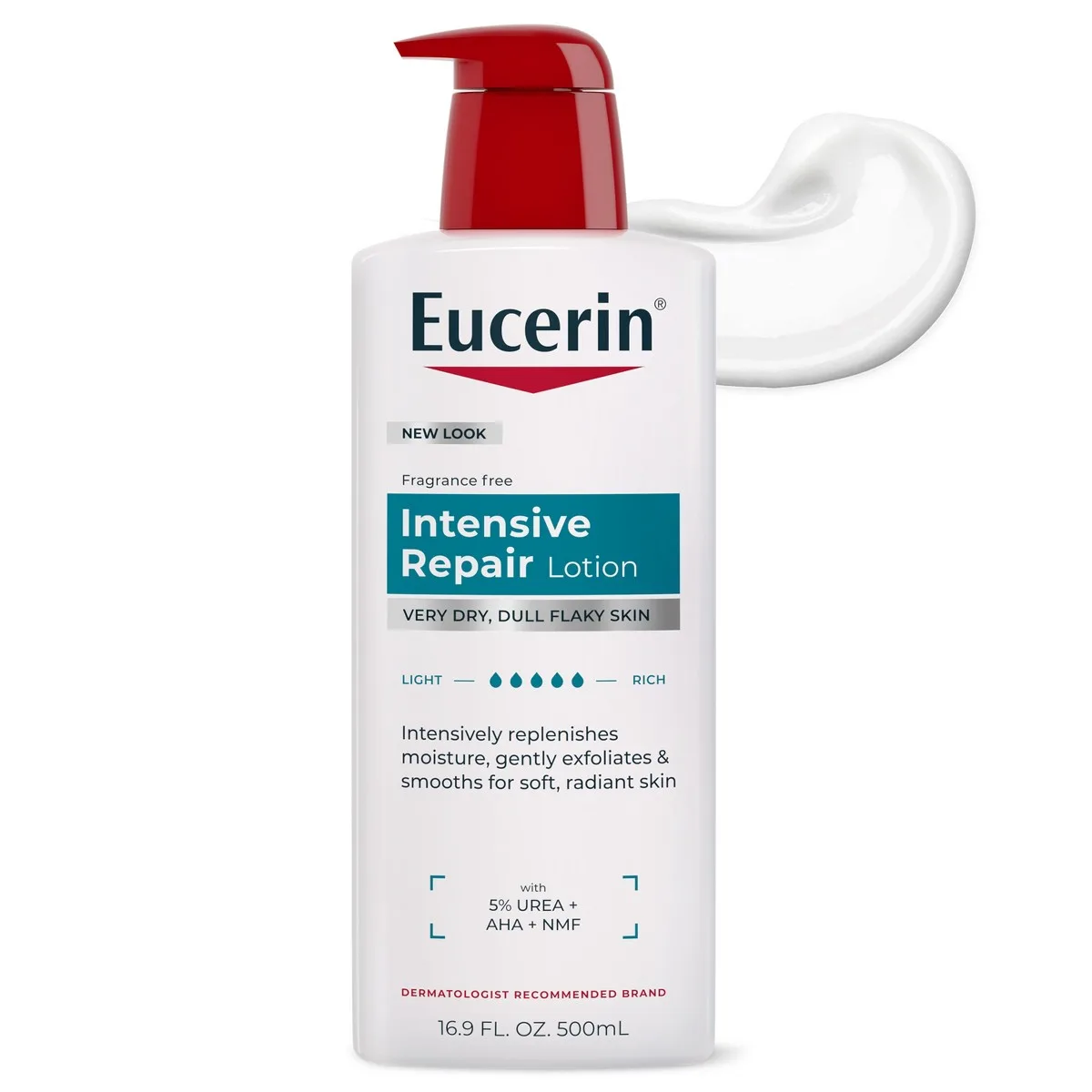
White plastic pump bottle with the signature blue Eucerin label. Functional but utilitarian — designed for a bathroom shelf, not a vanity. Available in 8.4 oz and 16.9 oz sizes.
Expect a mild stinging or warmth on the first few applications, especially on freshly shaved skin or active KP — this is the lactic acid making contact with exposed micro-abrasions and is not a true allergic reaction. The sensation should fade within 5-10 minutes and disappear entirely after the first week as the skin barrier adjusts. Skin will feel softer within the first few days; visible improvement in bump count takes 2-4 weeks.
3-4 months with twice-a-day use to arms and thighs.
All Year
Eucerin's Roughness Relief line emerged from Beiersdorf's clinical research into urea-based dermatology in the late 2000s, addressing a market gap where prescription-strength urea creams were dermatologist-only while drugstore options topped out at glycerin and shea butter. It became one of the first widely-available 5% urea lotions in the US mass market.
Eucerin was founded in 1900 in Germany and has been sold through pharmacies for over a century. Owned by Beiersdorf AG, the brand is developed in collaboration with dermatologists and backed by extensive clinical testing for sensitive and compromised skin conditions.
KP can be cured by exfoliating harder with a scrub.
Physical scrubs typically inflame KP rather than improve it. The lactic-acid-plus-urea chemistry in this lotion targets the cause (keratin plug buildup) rather than scraping at the surface — and it's effective precisely because it doesn't traumatize the follicle.
You can stop using it once your KP clears.
KP has a genetic basis and the formula manages, rather than cures, it. Most users find that bumps return within 2-4 weeks of stopping daily application. The lotion is designed for indefinite long-term use, not a finite treatment course.
Most users feel a smoother texture within 3-5 days as the 5% urea begins softening the keratin plugs. Visible bump reduction typically appears within 2-4 weeks of consistent twice-daily use. Maximum results are usually reached around 6-8 weeks — and lapses of more than a week often see the bumps creep back.
It's formulated and tested as a body lotion, not a facial product. The 5% urea and lactic acid combination is appropriate for the thicker skin on arms, thighs, and elbows, but is likely too intense for daily facial use — especially around the eyes. For facial rough texture, choose a face-formulated AHA or urea product at lower strength.
Yes, expect mild stinging if applied within an hour of shaving — the lactic acid is making contact with disrupted skin. Wait at least an hour after shaving, or apply on your non-shaving days. After the first week or two, your skin barrier typically adapts and the stinging stops.
The active ingredients — urea, lactic acid, and glycerin — are considered safe topically during pregnancy by major dermatology organizations. Lactic acid is one of the AHAs recommended over salicylic acid for pregnant users. As always, confirm with your OB or dermatologist if you have specific concerns.
Eucerin Roughness Relief leads with urea at 5% with a supporting lactic acid component. AmLactin uses 12% ammonium lactate as its primary active and tends to be more aggressive but more drying. CeraVe SA Lotion uses salicylic acid (BHA) and ceramides — gentler on the bumps but slower on KP specifically. Many users alternate between two of these formats.
Yes, but allow the lotion to fully absorb (5-10 minutes) before layering sunscreen. Because lactic acid mildly increases UV sensitivity, daytime sunscreen on exposed areas is recommended — particularly on arms during warmer months.
It's formulated for adult body skin and works at any age on KP, dry rough skin, and the heel/elbow patches that come with adulthood. KP doesn't have an age ceiling — many users start it in their teens or 20s and continue it indefinitely.
Recurring themes our editors read across retailer reviews of this product — summaries in our words, not quotations, and not a substitute for your own patch test.
Visibly reduces KP bumps on arms and thighs within weeks
Smoothing effect lasts longer than petroleum-only body lotions
Fragrance-free formula tolerated by sensitive-skin users
Affordable for the bottle size — lasts months with daily use
Doesn't leave a greasy or sticky residue on clothing
Mild stinging on freshly shaved or broken skin
Texture is thinner than expected for a 'roughness relief' product
Pump bottles sometimes ship without functional pumps
Doesn't fully eliminate KP for everyone — some see only moderate improvement