The One Ingredient That Does the Opposite Job Depending on the Dose
At 5% urea drenches skin in moisture. At 20% it dissolves the dead layer holding your rough patches together. Same molecule, opposite mission — and the percentage is the whole story.
Read the preview
From the DermApproved blog, in Hydration & Barrier: the one ingredient that does the exact opposite job depending on the dose. Meet urea — skincare's chameleon. Turn the dial one way and it drenches your skin in moisture, using machinery your body already owns. Turn it the other way and it starts dissolving the dead, scaly layer on top. Same molecule. Opposite missions. And the only thing that decides which one you get is a single number on the label — a number most people never think to read. That switch is the secret behind why urea quietly rescues the stubborn stuff: the bumpy arms, the cracked heels, the dryness nothing else touches. But there's a catch hiding in urea's helpfulness — a quiet talent that turns dangerous the moment you pair it with the wrong active, and can tip a good routine straight into a wrecked barrier. Where the line sits, and how to use both faces of it without regret — at dermapproved.com/blog.
The molecule that can't decide what it wants to be
Most skincare ingredients have one job. Retinoids remodel, vitamin C brightens, sunscreen filters UV. Urea refuses to pick a lane — and that's not a flaw, it's the entire reason it's quietly indispensable. Depending purely on how much of it is in the jar, urea will either flood your skin with moisture or start dissolving the dead layer sitting on top of it. Same molecule, diametrically opposite outcomes, and the only variable that decides which one you get is the percentage.
This dose-dependence is genuinely unusual in cosmetic chemistry, where most actives simply do more of the same thing as you increase the concentration. Urea does something different at 5% than it does at 20%, and understanding that dial is the difference between using it well and being baffled by it. It's why one urea product is a gentle daily lotion for dry skin and another is a heel balm that visibly sheds calluses — and why the label percentage is the single most important thing to read.
At low doses, it's basically borrowing your own biology
Here's the part that reframes urea from 'chemical exfoliant' to 'native hydrator': urea is a component of your skin's Natural Moisturizing Factor, the built-in blend of water-soluble molecules — alongside glycerol, amino acids, and lactic acid — that keeps your stratum corneum supple. Your skin manufactures and uses urea on purpose, and even has dedicated transporters (including the aquaporin channels that also move glycerol) to shuttle it where it's needed.
So at roughly 2 to 10 percent, urea acts as a classic humectant, a small water-soluble molecule that integrates into the outer skin and holds moisture there — and, notably, it can serve as an endogenous humectant that helps skin retain water even in low-humidity conditions where other humectants struggle. A gentle NMF-style formula like The Ordinary Natural Moisturizing Factors + Inulin Body Lotion uses urea at this low end, pairing it with glycerin and other NMF components so you're essentially topping up the skin's own hydration system rather than introducing anything aggressive. At this dose, urea is soothing, replenishing, and about as far from 'exfoliant' as an ingredient can be.
Cross 10% and it flips into a keratolytic
Now turn the dial up. Above roughly 10%, urea's behavior changes character entirely. Instead of just holding water, it starts breaking the hydrogen bonds that hold keratin — the structural protein of your dead surface cells — together. A 2021 review in Dermatology and Therapy lays out the concentration map clearly: moisturizing effects predominate around 5%, meaningful desquamation appears around 20%, and outright keratolytic action shows up at the highest strengths, with 40% preparations strong enough to soften nail plate. At the 10% inflection point, the emollient ingredient becomes an active one.
What's elegant about urea as a keratolytic is that it exfoliates by loosening and hydrating simultaneously. Unlike a pure acid that can leave skin feeling stripped, urea is softening the thickened tissue while it dismantles it, which is gentler on the surrounding skin. This is why a 10% lotion like Eucerin UreaRepair Plus 10% Urea Lotion sits right at the crossover — hydrating enough for everyday very-dry skin, keratolytic enough to smooth rough, flaky texture over time. The clinical literature backs the practical use: a 2020 paper on medium-concentration urea documents its established role in softening and shedding scale, and a 2025 systematic review found urea formulations produced significant improvement across ichthyosis, atopic dermatitis, psoriasis, and other scaly, dry dermatoses.
Why it's the quiet MVP for KP, heels, and hyperkeratosis
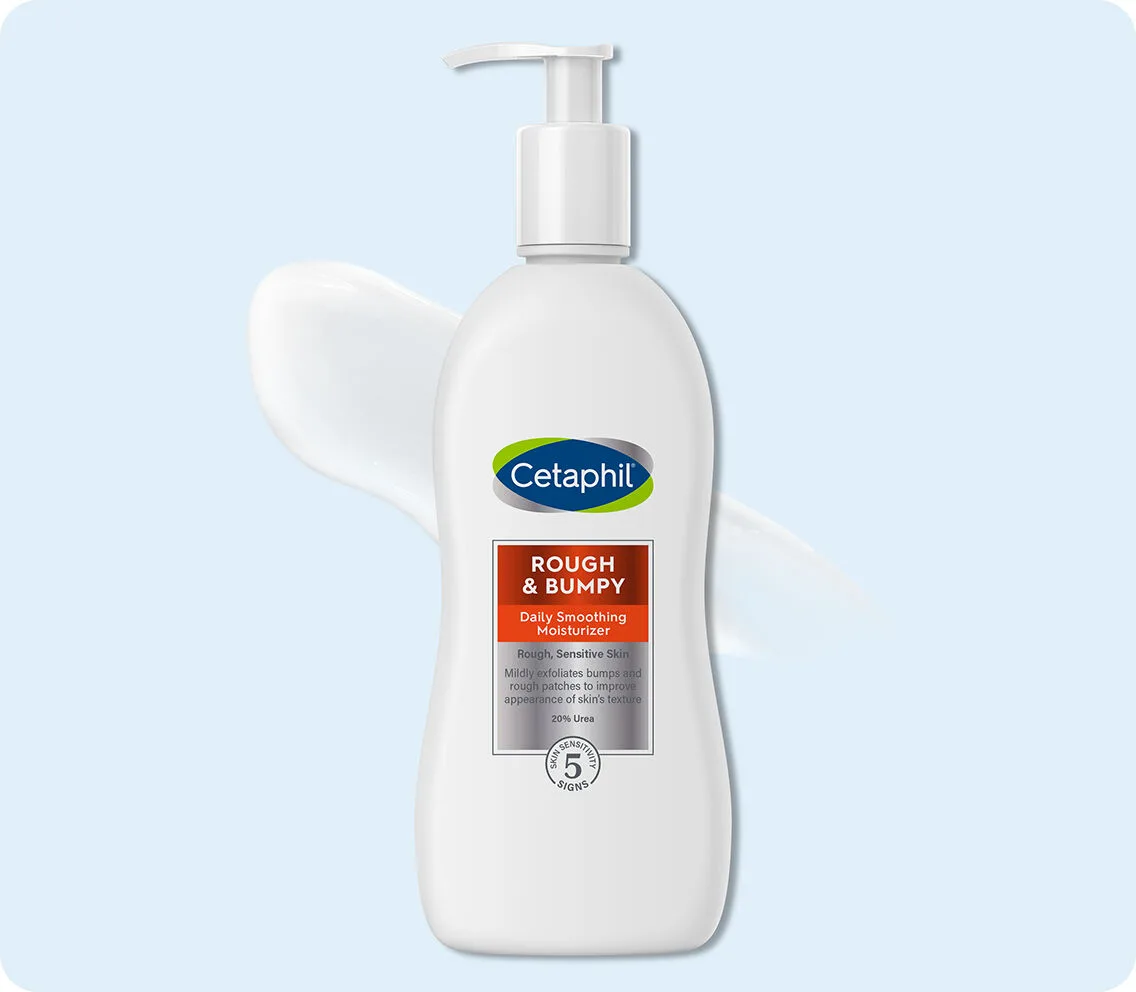
Some skin problems need exactly this combination of hydrate-and-shed, and that's where urea goes from useful to uniquely suited. Keratosis pilaris — those rough little bumps on upper arms and thighs — is a buildup of keratin plugging follicles on skin that's often dry to begin with. A pure exfoliant can smooth the bumps but leave the skin parched; a pure moisturizer soothes the dryness but doesn't clear the plugs. Urea addresses both halves of the problem at once, which is why it's a mainstay in KP formulas, frequently teamed with an alpha hydroxy acid for extra resurfacing. A product like First Aid Beauty KP Smoothing Body Lotion with 10% AHA leans on that urea-plus-acid logic, and a smoothing daily option like Cetaphil Daily Smoothing Moisturizer for Rough & Bumpy Skin takes the gentler-but-consistent route.
Cracked heels and hyperkeratotic patches follow the same logic at higher strengths — thick, hardened skin needs softening and controlled shedding, and urea delivers both without the sting of an aggressive acid peel. There's a bonus mechanism, too: research shows urea does more than move water, actually influencing keratinocyte gene expression to bolster the skin's barrier and its own antimicrobial defenses. It's not just papering over dryness; it's nudging the skin to behave healthier.
The catch: it makes everything else penetrate deeper
Urea's honest downside isn't irritation in the usual sense — it's actually well-tolerated — it's that it's a penetration enhancer. By loosening the stratum corneum and increasing hydration, urea helps whatever you apply near it sink in more readily. That's a feature when you want a companion active to work better, and a liability when the companion active is something harsh. Stack a high-strength urea with a potent acid or a retinoid and you can quietly amplify both, tipping a reasonable routine into an over-exfoliated, compromised-barrier situation.
The fix is sequencing and restraint rather than avoidance. Keep high-percentage urea mostly to the body, where thicker skin tolerates keratolytic strength; on the face, stay at the lower, humectant end and introduce it gradually. If you're already running AHAs, BHAs, or a retinoid, don't casually layer a strong urea on top of all of them the same night — that's precisely the kind of combination our Conflict Checker exists to flag before your barrier does it for you. And when you're comparing two urea products, the percentage and what it's paired with matter far more than the marketing on the front; our Ingredient Decoder is the quick way to see which side of the 10% line a formula actually sits on.
Used with that bit of awareness, urea is one of the most versatile, best-value ingredients in skincare — a single molecule that hydrates the dry and smooths the rough, as long as you respect that the dose is the whole personality.
Products mentioned
Independently reviewed and scored — the real products behind this piece.


References
- Urea in Dermatology: A Review of its Emollient, Moisturizing, Keratolytic, Skin Barrier Enhancing and Antimicrobial Properties — Dermatology and Therapy, 2021
- Effect of topical treatment with urea in ichthyosis, atopic dermatitis, psoriasis, and other skin conditions - a systematic review — Annals of Medicine and Surgery, 2025
- Clinical evidences of urea at medium concentration — International Journal of Clinical Practice, 2020
Every cited link is verified to resolve to the paper named. Where a source could not be independently confirmed, it is listed without a link rather than pointing you somewhere wrong.
Frequently asked
Does urea hydrate or exfoliate skin?
Both — it depends entirely on the concentration. At roughly 10% and below, urea works as a humectant that draws in and holds moisture, part of the skin's own Natural Moisturizing Factor. Above 10%, it becomes keratolytic, breaking down the bonds that hold dead, scaly skin together so it can shed. The percentage on the label tells you which job you're buying.
What percentage of urea is best for keratosis pilaris?
For KP, formulas around 10% hit the useful middle ground — enough to help loosen the keratin plugs while still hydrating the dry skin underneath. Many KP-targeted products pair urea with an alpha hydroxy acid like lactic or glycolic for added resurfacing. Start with consistent daily use rather than reaching for the highest strength immediately, since KP responds better to steady exfoliation than aggressive one-off treatment.
Can I use urea on my face?
Yes, but keep it at the lower, humectant end of the range and introduce it gradually. High-strength keratolytic urea is really designed for thicker body skin like heels and elbows. On the face, a lower percentage delivers the hydrating benefit without over-exfoliating, and you should be cautious layering it with other facial acids or retinoids since urea helps them penetrate more deeply.
Is urea safe to combine with acids or retinol?
It can be, but with care. Urea is a penetration enhancer, so it increases how deeply neighboring actives absorb — helpful for efficacy, risky for irritation. Stacking a strong urea with potent AHAs, BHAs, or a retinoid at once can over-strip the barrier. Introduce one active at a time, keep high-strength urea mostly on the body, and check for conflicts before layering everything together.
Why does urea help cracked heels when regular moisturizer doesn't?
Cracked heels involve thick, hardened, built-up skin that a standard moisturizer can soften but can't shed. Higher-concentration urea does both jobs simultaneously: it hydrates the hardened tissue while breaking the bonds holding the dead layer together, so the callus gradually softens and sheds. That hydrate-and-dissolve combination is exactly what hyperkeratotic skin needs and why urea foot creams outperform plain emollients.