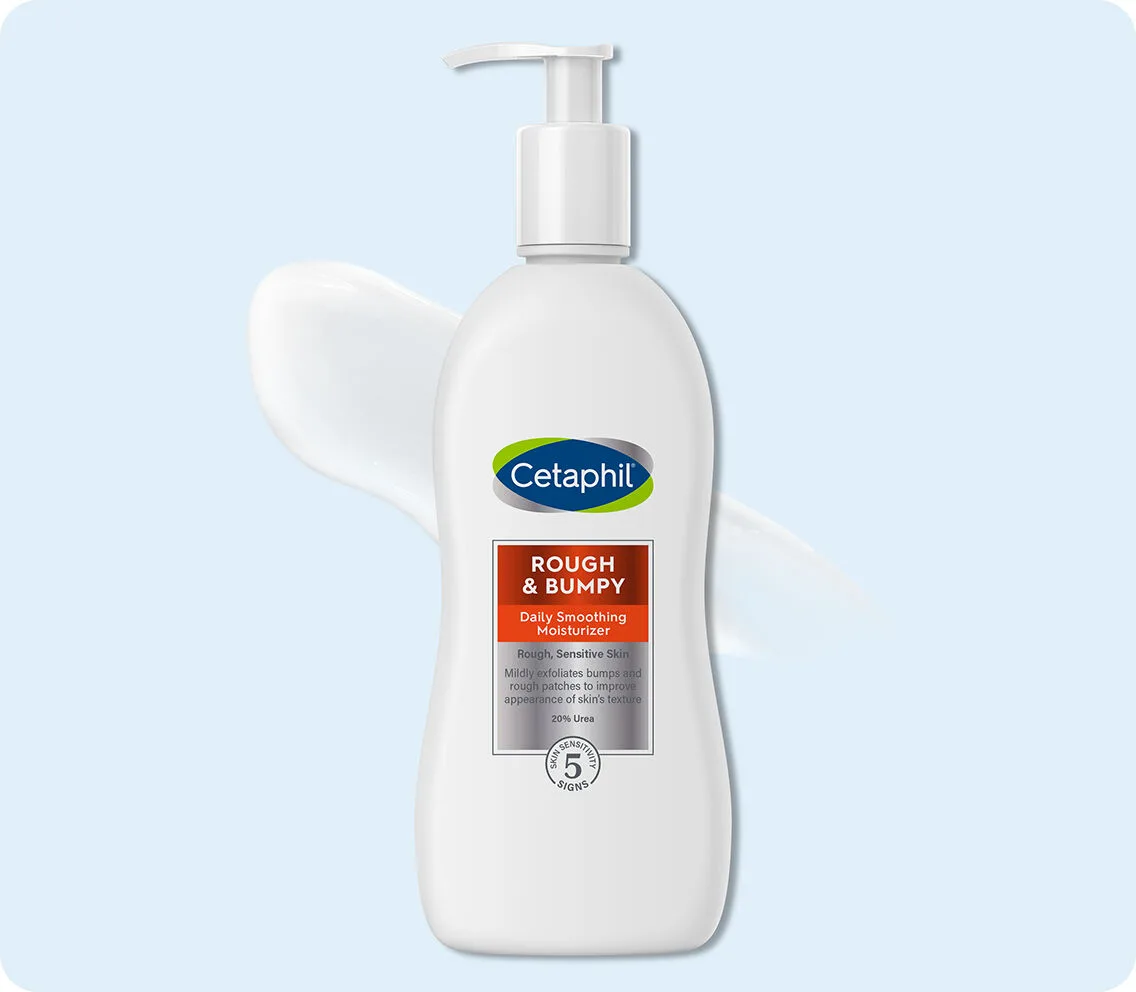
It treats rough, bumpy 'chicken skin' with 20% urea instead of acids. At that concentration urea is both a deep humectant and a keratolytic that dissolves the keratin buildup behind keratosis pilaris — so it smooths effectively but gently, without the stinging acidic exfoliants that make many rough-skin treatments hard to sustain.
Cetaphil Daily Smoothing Moisturizer for Rough & Bumpy Skin Review
Keratosis Pilaris Smoother
body carelotiondermatologist recommendedNot Cruelty Free
A genuinely effective, gentle moisturizer for rough, bumpy 'chicken skin,' built on 20% urea — a dual humectant-and-keratolytic that smooths without stinging acids. Well-priced, broadly tolerable, and easy to use daily, which is exactly what chronic keratosis pilaris demands. The dated formula touches are minor.
Supporting rolefor Keratosis PilarisIn your profileYou chose · Urea has early evidence for keratosis pilaris, and emollient hydration is the recognised companion to treating it — a reasonable supporting choice, short of a recommendation.Limited evidenceGentleNo reviews collected yet
The case for it
Urea has early or mechanistic evidence for this concern, not trial-backed standing.
It is present at an effective concentration, declared or high in the ingredient list.
The formula carries none of the triggers this concern is sensitive to.
What would change this: Trial evidence for the active on this concern would move this from a bet to a recommendation.
Same rule for everyone. “Supporting role” is the verdict on 8,197 of 45,024 concern verdicts across the catalog; rule R8a decided 1,489 of them.
Unchanged since September 5, 2026, engine 5.1.1.
R8a — A plausible-tier active in a category with a supportive job: the sentence names the active instead of saying nothing targets the concern (the AmLactin / CeraVe SA case for keratosis pilaris, where no guideline and single trials leave the keratolytics at early evidence). · the full register
Carrying active
Urea
Standing
plausible — trials support it
Form
adequate (declared 20%) — studied range 10–20%, from the OTC monograph or label; judge it after ~2 weeks
Tolerability
gentle
Row checked
against its sources on July 17, 2026 (evidence table ev-2026.09-r228)
Good choicefor DrynessIn your profileYou chose · Glycerin is a reference standard by mechanism for dryness; this lotion carries it high in the ingredient list.Moderate evidenceGentleNo reviews collected yet
The case for it
Glycerin has trial-supported standing for this concern.
It is present at an effective concentration, declared or high in the ingredient list.
The formula carries none of the triggers this concern is sensitive to.
Same rule for everyone. “Good choice” is the verdict on 9,564 of 45,024 concern verdicts across the catalog; rule R5 decided 9,072 of them.
Unchanged since September 5, 2026, engine 5.1.1.
Good choicefor Rough TextureIn your profileYou chose · Urea is a reference standard by mechanism for rough texture; this lotion carries it at 20%.Moderate evidenceGentleNo reviews collected yet
The case for it
Urea has trial-supported standing for this concern.
It is present at an effective concentration, declared or high in the ingredient list.
The formula carries none of the triggers this concern is sensitive to.
Same rule for everyone. “Good choice” is the verdict on 9,564 of 45,024 concern verdicts across the catalog; rule R5 decided 9,072 of them.
Unchanged since September 5, 2026, engine 5.1.1.
Good choicefor DehydrationIn your profileYou chose · Urea is a reference standard by mechanism for dehydration; this lotion carries it at 20%.Moderate evidenceGentleNo reviews collected yet
The case for it
Urea has trial-supported standing for this concern.
It is present at an effective concentration, declared or high in the ingredient list.
The formula carries none of the triggers this concern is sensitive to.
Same rule for everyone. “Good choice” is the verdict on 9,564 of 45,024 concern verdicts across the catalog; rule R5 decided 9,072 of them.
Unchanged since September 5, 2026, engine 5.1.1.
As a body productNot judged: what a body product is for — real substance, not just slip, realistic to use daily — cannot yet be measured from the ingredient list (only fragrance load can).
A verdict is DermApproved’s assessment of how well a product’s ingredients fit a concern — never a claim about what the product treats. Evidence dots and collected reviews sit beside it and are never blended in.
Rules 0.5.1 · evidence table ev-2026.09-r228 · how we decide
✓ Urea moisturizes and exfoliates at once — no acidic stinging
✓ Gentle and fragrance-free — comfortable for daily, long-term use
✓ Lightweight, non-greasy texture absorbs cleanly
✓ Generous 10oz size at an affordable, accessible price
✓ Works as a general dry-skin body moisturizer too
Cons
✗ Keratosis pilaris returns if daily use stops — it manages, not cures
✗ Contains parabens, which some shoppers prefer to avoid
✗ Stubborn cases may still need a stronger exfoliating treatment
✗ Contains dimethicone and is not fungal-acne safe
✗ Results require consistent, ongoing use to maintain
Review
Full Review
Keratosis pilaris, the small rough bumps that stipple the backs of so many people's upper arms and thighs and sometimes go by chicken skin or strawberry skin, is one of the most common skin conditions there is. It is harmless. It is genetic. And it is, in the most literal sense, incurable: you do not fix keratosis pilaris, you manage it. That single fact is the most important lens for evaluating any product claiming to address it, the Cetaphil Daily Smoothing Moisturizer for Rough & Bumpy Skin included. The question is not just whether it works, but whether you can realistically keep using it for years, because that is what managing a chronic condition demands.
Here is what causes the bumps. In keratosis pilaris, the skin overproduces keratin, the structural protein of the skin's surface, and that keratin builds up and plugs the hair follicles, creating the characteristic rough little raised spots. To smooth the skin, you have to deal with that keratin buildup. The most common approach reaches for exfoliating acids, glycolic, lactic, salicylic, which chemically dissolve the buildup. They work. But they also carry a downside that matters enormously for a chronic condition: at the strengths needed, acids can sting, can dry the skin, and can become genuinely unpleasant to apply day after day, year after year. Many people start an acid treatment for their KP, get good results, then quietly stop because daily stinging is not sustainable. And once you stop, the KP comes back.
This is where Cetaphil's choice of active is genuinely smart. Instead of acids, the moisturizer is built on 20% urea. Urea is one of dermatology's quiet workhorses, and it has a useful dual personality. At low concentrations it behaves as a humectant, drawing water into the skin. But at high concentrations, and 20% is firmly in that range, urea also turns keratolytic: it breaks down and loosens the excess keratin, the very buildup that causes the bumps. So a 20% urea moisturizer smooths the skin toward the same fundamental goal as an acid, dissolving keratin buildup, but by a different mechanism, and crucially without the low pH and the sting. It moisturizes and exfoliates at once. For a condition you have to treat indefinitely, a smoothing ingredient that is genuinely comfortable to apply every single day is no minor advantage. That comfort is the whole game, really.
Around the urea, the formula supports that goal sensibly. Glycerin reinforces the hydration, which matters because well-hydrated skin is softer and the bumps feel less pronounced. Cetyl and myristyl lactate, sitting high on the ingredient list, are lightweight lactate-based emollient esters that lend the lotion a silky slip and a smooth, conditioned finish. Sweet almond oil adds gentle, fatty-acid-rich nourishment. It is a straightforward, focused formula, not exciting, but well aimed at the job, and it is fragrance-free and dermatologist-tested on sensitive skin, which again supports daily, long-term use.
Used daily, it delivers. The texture is a light, silky lotion that absorbs cleanly with no greasy residue and, importantly, no tingling, no sting. Skin feels softer and more hydrated right away. The actual smoothing of the bumpy texture is gradual, building over roughly four weeks of consistent daily use; Cetaphil cites brand testing in which 93% of subjects reported significantly less rough skin after a month. That timeline is honest for a urea product. And the corollary, equally honest, is that the results hold only as long as you keep applying it. Stop, and the keratin builds back up, and the bumps return. That is not a flaw in the product. It is the nature of keratosis pilaris. Anyone expecting a permanent cure from any product will be disappointed.
Where it falls short is minor. The formula is, in a couple of small ways, a little dated: it contains methylparaben and propylparaben. Methylparaben and propylparaben are well-studied, effective preservatives considered safe at cosmetic levels, so this is no safety concern, though some shoppers actively avoid them and should know before buying. It also contains dimethicone and is not fungal-acne safe, worth noting for anyone whose bumps are actually body fungal acne rather than KP. The two are sometimes confused, and if a product like this is not helping, that mix-up is worth considering. And while urea at 20% handles most keratosis pilaris well, genuinely stubborn cases may still need a stronger or additional exfoliating treatment.
Cost-wise, it is a solid pick. Around sixteen dollars for a generous 10-ounce pump bottle is fair, and a bottle lasts roughly two months of daily use on the arms and legs. For a dermatologist-recommended KP moisturizer that genuinely works, it is honestly, accessibly priced, and affordability matters extra for a product you are committing to use indefinitely.
Pull back, and this is a genuinely good, sensible answer to a common and annoying problem. It treats rough, bumpy skin with the right ingredient, urea, at the right concentration, in a gentle, fragrance-free, comfortable formula that you can realistically apply every day for as long as you need to, which, for keratosis pilaris, is forever. It will not cure your chicken skin, because nothing will. But it will reliably, gently, affordably keep it smooth, and for a chronic condition, the treatment you will actually stick with is the best treatment there is.
Formula
Key Ingredients
The hero actives that drive this product's performance.
The hero ingredient, and a clever dual-action one. At low concentrations urea is a humectant; at the high 20% used here it also becomes keratolytic — it breaks down the excess keratin buildup that causes the rough, bumpy texture of conditions like keratosis pilaris. So it smooths and deeply hydrates at once, and it does so without the acidic exfoliants that can sting.
Established mechanismfor Rough Texture · established mechanism
A humectant that works alongside the urea's water-binding action to draw and hold moisture in the skin. Hydration is half the battle with rough, bumpy skin — well-hydrated skin is softer and the bumps feel less pronounced.
Established mechanismfor Dryness · established mechanism
Sitting high on the INCI, these lactate-based esters are lightweight emollients that soften and smooth the skin surface. They give the lotion its silky slip and help the formula leave rough skin feeling immediately conditioned, not greasy.
A gentle, fatty-acid-rich plant oil that nourishes and softens dry, rough skin. It adds an emollient, conditioning layer that complements the urea's exfoliating action, helping the overall result feel smooth rather than stripped.
Not yet assessed
Ingredient standings describe the active at treatment-level doses and
vehicles; this product's own condition grades weigh its actual formula.
Apply generously to rough, bumpy areas — most often the upper arms, thighs, and buttocks — once or twice daily. It works best applied soon after showering, to slightly damp skin, which helps lock in moisture. Consistency is essential: keratosis pilaris is chronic, so the smoothing benefit holds only with ongoing daily use.
Results Timeline
Skin feels softer and more hydrated immediately. Visible smoothing of rough, bumpy texture builds over about four weeks of consistent daily use, with the brand citing 93% of clinical subjects reporting significantly less rough skin in one month.
Pairs Well With
gentle body washesexfoliating body washesricher body creamsbroad-spectrum sunscreen
Cetaphil Daily Smoothing Moisturizer for Rough & Bumpy Skin
Sample PM Routine
Gentle body wash
Cetaphil Daily Smoothing Moisturizer for Rough & Bumpy Skin
Evidence
Science & Expert Perspective
The Science
Urea is a well-established and thoroughly studied dermatological ingredient, and its concentration-dependent dual action is the basis of this product. At lower concentrations, urea functions chiefly as a humectant; it is a component of the skin's own natural moisturizing factor and binds water in the stratum corneum. At higher concentrations, generally around 10% and above, urea additionally becomes keratolytic, disrupting and helping break down excess keratin and the bonds holding corneocytes together. At the 20% used here, both effects are in play, which is why the product can credibly claim to moisturize and smooth at the same time.
This matters specifically for keratosis pilaris, a condition characterized by hyperkeratinization: a buildup of keratin that plugs hair follicles and produces the rough, bumpy texture. Keratolytic ingredients address that buildup, and urea is a long-recognized, well-tolerated option for keratin-thickened skin. Its key practical advantage over acidic exfoliants is that it does not depend on a low pH to work, so it tends to cause less stinging and irritation, which is relevant for a chronic condition requiring sustained daily treatment.
The supporting ingredients are conventional and sound. Glycerin is a well-established humectant, the lactate esters and sweet almond oil are emollients that soften and condition, and dimethicone provides a smooth, protective finish. The formula uses parabens as preservatives; these are among the most studied cosmetic preservatives and are regarded as safe and effective at the concentrations used. Taken together, this is a soundly formulated product whose efficacy rests on a genuinely well-evidenced active at an effective concentration. Its results are real, gradual, and, because keratosis pilaris is a chronic hyperkeratinization disorder, dependent on continued use.
Dermatologist Perspective
Dermatologists frequently recommend urea-based moisturizers for keratosis pilaris and other rough, keratin-thickened skin, valuing urea precisely for its combination of humectant and keratolytic action and its generally good tolerability. Clinical guidance on keratosis pilaris consistently emphasizes two points reflected in how this product should be used: first, that the condition is chronic and genetically influenced, so management is ongoing and a permanent cure should not be expected; and second, that gentle, sustainable routines tend to serve patients better than aggressive ones, since consistency over time is what maintains results. A fragrance-free, non-acidic urea moisturizer suited to daily use aligns well with that approach. Dermatologists also commonly note that bumps on the body are sometimes mistaken between keratosis pilaris and conditions such as fungal folliculitis, and that a product not delivering expected results may warrant a professional look. As a gentle, paraben-preserved moisturizer, it is broadly considered appropriate for sensitive skin and during pregnancy.
Guidance
Usage & Recommendations
How to Use
Massage a generous amount into the rough, bumpy areas, most often the upper arms, thighs, and buttocks, once or twice a day, working it in until it disappears. It performs best on slightly damp skin soon after showering, which helps trap moisture. Consistency is the key variable: because keratosis pilaris is chronic, the smoothing benefit holds only with ongoing daily use. Elsewhere on the body, it doubles as a general dry-skin moisturizer.
Value Assessment
At around $16 for a generous 10oz pump bottle, this moisturizer is fairly priced and represents solid value. A bottle lasts roughly two months of daily application to the arms and legs, keeping the monthly cost low — which genuinely matters here, because keratosis pilaris is a chronic condition and this is a product you commit to using indefinitely. An affordable, effective, dermatologist-recommended treatment that you can sustain long-term is worth more, in practical terms, than a pricier one you might abandon. The formula delivers a well-evidenced active, 20% urea, at an effective concentration without a premium markup. For anyone managing rough, bumpy skin, the value case is strong.
Who Should Buy
Anyone managing keratosis pilaris or rough, bumpy, dry body skin who wants an effective but gentle daily moisturizer they can sustain long-term will find this fits the bill. It suits sensitive skin well, since it smooths without acidic exfoliants, and it is a strong option for anyone who has found acid-based KP treatments too stinging to keep up.
Who Should Skip
Those who specifically avoid parabens should note the preservative system. Genuinely stubborn keratosis pilaris may need a stronger or additional exfoliating treatment alongside it. Anyone whose body bumps may actually be fungal folliculitis rather than keratosis pilaris should get a professional assessment, as this product is not fungal-acne safe and would not address that.
Ready to try Cetaphil Daily Smoothing Moisturizer for Rough & Bumpy Skin?
A lightweight, silky lotion that spreads easily and absorbs into a soft, smooth, non-greasy finish
Scent
Effectively scentless — fragrance-free
Packaging
A 10oz pump bottle in Cetaphil's clean, clinical styling. The pump is hygienic and convenient for daily full-area body use.
Finish
non-greasylightweightvelvety
What to Expect on First Use
Expect a light, silky lotion that absorbs quickly with no scent and no sting — notably, no tingling, since the formula uses urea rather than acids. Skin feels immediately softer and more hydrated. The smoothing of bumpy texture is gradual, building over the following weeks.
How Long It Lasts
About 2 months with daily use on the arms and legs
Keratosis pilaris — the rough, bumpy 'chicken skin' or 'strawberry skin' on the upper arms and thighs — is extremely common, harmless, and persistently frustrating, and most treatments lean on exfoliating acids. Cetaphil's Daily Smoothing Moisturizer takes the urea route instead, a long-trusted dermatological approach to rough, keratin-thickened skin, packaged as a gentle daily body moisturizer.
About Cetaphil Legacy Brand (20+ years)
Cetaphil was founded in 1947 and is one of the most widely dermatologist-recommended skincare brands, with a long track record in gentle, accessibly-priced formulations for sensitive skin. Its claims for this moisturizer are supported by brand-run clinical testing.
Brand founded: 1947
Myth vs. Reality
Common Myths
Myth
Keratosis pilaris can be cured with the right product.
Reality
Keratosis pilaris is a common, harmless, genetically influenced condition, and it cannot be permanently cured. A urea moisturizer like this genuinely manages it — smoothing the bumps and improving texture — but the condition returns if treatment stops. It is managed, not eliminated.
Myth
You need strong exfoliating acids to smooth rough, bumpy skin.
Reality
Acids are one route, but 20% urea is another, and a gentler one. Urea is keratolytic at high concentrations — it breaks down keratin buildup — without the low pH and stinging of acidic exfoliants, which makes it easier to use daily and long-term, which is exactly what chronic keratosis pilaris requires.
FAQ
Frequently Asked Questions
What does the Cetaphil Daily Smoothing Moisturizer do?
It smooths rough, bumpy skin — most often keratosis pilaris on the arms and thighs — and deeply moisturizes. Its 20% urea works two ways: as a humectant that hydrates, and as a keratolytic that breaks down the keratin buildup causing the bumps, without the stinging of acidic exfoliants.
Is this moisturizer good for keratosis pilaris?
Yes — it is specifically designed for it. The 20% urea genuinely smooths the rough, bumpy texture of keratosis pilaris, and brand testing reported 93% of subjects with significantly less rough skin in a month. It manages the condition rather than curing it, so ongoing daily use is needed to maintain results.
Does it sting or irritate like acid exfoliants?
No. The formula deliberately uses urea rather than acidic exfoliants, so it smooths without the low pH and tingling of an acid treatment. It is fragrance-free and dermatologist-tested on sensitive skin, which makes it well suited to daily, long-term use.
Can keratosis pilaris be cured?
No. Keratosis pilaris is a harmless, genetically influenced condition that cannot be permanently cured. This moisturizer manages it effectively — smoothing the bumps and softening the skin — but the texture returns if you stop using it. Think of it as ongoing management, not a one-time fix.
Where should I apply this moisturizer?
Apply it to the rough, bumpy areas — most commonly the upper arms, thighs, and buttocks — once or twice daily. It works best on slightly damp skin soon after showering. It also works well as a general moisturizer for dry skin elsewhere on the body.
Does this product contain parabens?
Yes — the formula contains methylparaben and propylparaben as preservatives. Parabens are well-studied, effective, and considered safe at the levels used in cosmetics, but if you specifically prefer to avoid them, this is worth noting before buying.
Reviews
What Reviewers Tend to Say
Recurring themes our editors read across retailer reviews of this product — summaries in our words, not quotations, and not a substitute for your own patch test.
Common Praise
Visibly smooths rough, bumpy keratosis pilaris over a few weeks
Gentle — no stinging acids, suitable for sensitive skin
Lightweight, non-greasy texture absorbs well
Generous 10oz size at an affordable price
Doubles as a good moisturizer for general dry skin
Common Complaints
Keratosis pilaris returns if use is stopped
Contains parabens, which some prefer to avoid
Stubborn cases may need a stronger exfoliating treatment
At 5% urea drenches skin in moisture. At 20% it dissolves the dead layer holding your rough patches together. Same molecule, opposite mission — and the percentage is the whole story.
The speckling isn't dirt trapped in your pores, which is exactly why scrubbing harder makes it worse — the real fix looks a lot like acne care, moved south.
Every post that dismantles a home remedy owes the reader a replacement. The honest replacement list is embarrassingly cheap, and one item on it is cheaper still — it is a bath.
Products, answers, therapy guides, tools and articles in one search. Brand names,
slang and abbreviations all work — accutane finds isotretinoin, bacne finds truncal acne.