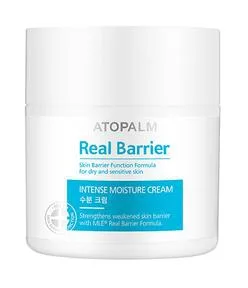
Uses Aestura's patented Ceramide-3 (now Ceramide NP) in an MLE (Multi-Lamellar Emulsion) structure that mimics the lamellar organization of healthy stratum corneum lipids. Unlike many ceramide creams that simply list ceramides on the INCI, this formula pairs them with cholesterol and three free fatty acids in the ratio that actually reassembles barrier lipids.
A Korean pharmacy cream that earns its cult following the hard way — with a lamellar lipid structure that actually rebuilds the barrier, not just coats it. If your skin has been through a rough winter, a retinoid ramp-up, or a bad reaction, this is the jar that quietly puts it back together.
Good choicefor DrynessIn your profileYou chose · Ceramides is a reference standard by mechanism for dryness; this cream carries it.Moderate evidenceGentle1 reviews collected
The case for it
Ceramide NP has trial-supported standing for this concern.
It is plausibly present at a working level, though the concentration is not declared.
The formula carries none of the triggers this concern is sensitive to.
What would change this: A declared concentration would move this to a firmer reading of the dose.
Same rule for everyone. “Good choice” is the verdict on 9,564 of 45,024 concern verdicts across the catalog; rule R5 decided 9,072 of them.
Unchanged since September 5, 2026, engine 5.1.1.
R5 — Trial-supported or guideline-supported active, adequately or plausibly dosed. · the full register
Carrying active
Ceramide NP
Standing
supported — its mechanism is established
Form
plausible
Tolerability
gentle
Row checked
against its sources on July 17, 2026 (evidence table ev-2026.09-r228)
The studies behind the evidence row
Elias PM, Feingold KR (eds), Skin Barrier — stratum corneum ceramides are the principal intercellular lamellar lipid; their depletion is the biochemical signature of dry/xerotic skin — reference work
Good choicefor DehydrationIn your profileYou chose · Panthenol (Vitamin B5) is a reference standard by mechanism for dehydration; this cream carries it.Moderate evidenceGentle1 reviews collected
The case for it
Panthenol has trial-supported standing for this concern.
It is plausibly present at a working level, though the concentration is not declared.
The formula carries none of the triggers this concern is sensitive to.
What would change this: A declared concentration would move this to a firmer reading of the dose.
Same rule for everyone. “Good choice” is the verdict on 9,564 of 45,024 concern verdicts across the catalog; rule R5 decided 9,072 of them.
Unchanged since September 5, 2026, engine 5.1.1.
R5 — Trial-supported or guideline-supported active, adequately or plausibly dosed. · the full register
Carrying active
Panthenol
Standing
supported — its mechanism is established
Form
plausible — studied range 2.5%, from the trials on the row; needs leave-on contact
Tolerability
gentle
Row checked
against its sources on July 17, 2026 (evidence table ev-2026.09-r228)
The studies behind the evidence row
Cosmetic Ingredient Review assessment of panthenol / dexpanthenol — humectant and moisturizer that raises stratum-corneum water content — reference work
Good choicefor Compromised Skin BarrierIn your profileYou chose · Ceramides is a reference standard by mechanism for compromised skin barrier; this cream carries it.Moderate evidenceGentle1 reviews collected
The case for it
Ceramide NP has trial-supported standing for this concern.
It is plausibly present at a working level, though the concentration is not declared.
The formula carries none of the triggers this concern is sensitive to.
What would change this: A declared concentration would move this to a firmer reading of the dose.
Same rule for everyone. “Good choice” is the verdict on 9,564 of 45,024 concern verdicts across the catalog; rule R5 decided 9,072 of them.
Unchanged since September 5, 2026, engine 5.1.1.
R5 — Trial-supported or guideline-supported active, adequately or plausibly dosed. · the full register
Carrying active
Ceramide NP
Standing
supported — its mechanism is established
Form
plausible — studied range 0.5–1%, from the trials on the row; needs leave-on contact; judge it after ~4 weeks
Tolerability
gentle
Row checked
against its sources on July 17, 2026 (evidence table ev-2026.09-r228)
The studies behind the evidence row
Elias PM, Skin Barrier / Coderch et al., ceramides and skin barrier function — ceramides ~50% of SC intercellular lipid mass, essential to the permeability barrier — reference work
Good choicefor SensitivityIn your profileYou chose · No fragrance, drying alcohol, declarable allergens or sensitising preservatives in this cream — the profile sensitive skin looks for.Not yet assessedGentle1 reviews collected
The case for it
Madecassoside has been researched for this concern and the evidence does not support it.
It is plausibly present at a working level, though the concentration is not declared.
The formula carries none of the triggers this concern is sensitive to.
What would change this: A declared concentration would move this to a firmer reading of the dose.
Same rule for everyone. “Good choice” is the verdict on 1,938 of 45,024 concern verdicts across the catalog; rule F2 decided 1,938 of them.
Unchanged since September 5, 2026, engine 5.1.1.
Supporting rolefor EczemaIn your profileYou chose · Panthenol (Vitamin B5) has early evidence for eczema, and emollient therapy is the recognised companion to treating it — a reasonable supporting choice, short of a recommendation.Moderate evidenceGentle1 reviews collected
The case for it
Panthenol has early or mechanistic evidence for this concern, not trial-backed standing.
It is plausibly present at a working level, though the concentration is not declared.
The formula carries none of the triggers this concern is sensitive to.
What would change this: A declared concentration would move this to a firmer reading of the dose.
Same rule for everyone. “Supporting role” is the verdict on 8,197 of 45,024 concern verdicts across the catalog; rule R8a decided 1,489 of them.
Unchanged since September 5, 2026, engine 5.1.1.
R8a — A plausible-tier active in a category with a supportive job: the sentence names the active instead of saying nothing targets the concern (the AmLactin / CeraVe SA case for keratosis pilaris, where no guideline and single trials leave the keratolytics at early evidence). · the full register
Carrying active
Panthenol
Standing
plausible — trials support it
Form
plausible — studied range 5%, from the OTC monograph or label; needs leave-on contact
Tolerability
gentle
Row checked
against its sources on July 17, 2026 (evidence table ev-2026.09-r228)
Supporting rolefor Winter SkinIn your profileYou chose · Nothing here targets winter skin directly; occlusive hydration is the recognised companion to treating it, and this cream does that without known triggers.Not yet assessedGentle1 reviews collected
The case for it
Panthenol has no evidence row yet for this concern — it is in the research queue.
The formula carries none of the triggers this concern is sensitive to.
What would change this: A researched evidence row for the lead active would replace this with a verdict.
Same rule for everyone. “Supporting role” is the verdict on 8,197 of 45,024 concern verdicts across the catalog; rule R8 decided 4,250 of them.
Unchanged since September 5, 2026, engine 5.1.1.
R8 — The category's job (barrier care, humectant hydration, gentle cleansing, photoprotection) is the documented supportive role for this concern. This is the honest verdict for a moisturizer on an acne page. · the full register
Excellent at the jobDoes what a moisturizer is for, on every measure we can take from the label: supplies barrier lipids, draws in water.
A verdict is DermApproved’s assessment of how well a product’s ingredients fit a concern — never a claim about what the product treats. Evidence dots and collected reviews sit beside it and are never blended in.
Rules 0.5.1 · evidence table ev-2026.09-r228 · how we decide
Assessment
Pros & Cons
Pros
✓ MLE structure organizes ceramides, cholesterol and fatty acids into a physiologic barrier
✓ Fragrance-free and gentle enough for eczema flares
✓ Non-greasy finish layers cleanly under sunscreen
✓ Madecassoside and panthenol add meaningful soothing
✓ Rich without feeling suffocating
✓ Backed by two decades of Korean clinical use
✓ Improves tolerance to actives over time
Cons
✗ Jar packaging is less hygienic than a tube
✗ Contains silicones which some users prefer to avoid
✗ Not fungal-acne safe due to free fatty acids
✗ International price is noticeably higher than Korean retail
Review
Full Review
Most ceramide creams treat the word 'ceramide' like a seasoning — a pinch sprinkled onto a boilerplate moisturizer base, enough to make the INCI list look serious. Aestura's Atobarrier 365 Cream treats ceramides like a structural beam. The difference matters, and the easiest way to understand why is to look at where this cream came from.
Aestura started in 2005 as a dermocosmetic project inside Amorepacific's pharmaceutical division, aimed squarely at the patients Korean dermatologists were seeing every week: atopic-prone kids, adults with rosacea and eczema, and the enormous middle category of people whose barriers had been quietly dismantled by over-cleansing and over-exfoliating. The team behind Atobarrier wasn't trying to make a spa cream. They were trying to reassemble skin.
The tool they built the line around is called MLE — Multi-Lamellar Emulsion. In healthy skin, the lipids between your stratum corneum cells are organized in a very specific lamellar pattern: ceramides, cholesterol, and free fatty acids stacked in ordered layers. When that structure falls apart, water leaves and irritants enter. MLE is a formulation technique that pre-arranges those same lipids into the lamellar organization before they ever touch your face. You're not just applying ceramides; you're applying a ready-made piece of barrier architecture.
The claim that ceramides alone fix a barrier is one of the more expensive misconceptions in skincare, and this cream is a standing rebuttal to it. Ceramides delivered without cholesterol and free fatty acids don't slot into the lipid matrix — they sit near it. What the research has repeatedly found is that the three lipid classes have to arrive together, in something close to the right proportions, before transepidermal water loss normalizes at any speed worth measuring. Look at this ingredient list and you'll find Ceramide NP, cholesterol, phytosphingosine, and then stearic, oleic, linoleic, and palmitic acids in sequence. That run of names is the actual product. Everything else is delivery.
The 365 reformulation, released in 2020, kept the lipid complex that made the original Atobarrier a pharmacy staple and upgraded the sensory profile. The cream is rich but whipped — dense enough that you can feel it doing something, but not so heavy that it sits on top of skin. Hydrogenated lecithin helps the lamellar structure hold together; olive-derived emulsifiers and a touch of dimethicone give it the slip. It sinks in within a couple of minutes and leaves behind a satin, non-greasy finish that layers cleanly under sunscreen, which is not a given for creams this substantial. The pH sits at 5.5, matched to skin's own.
Look past the lipids and you find intelligent supporting players. Madecassoside, the purified calming active from Centella asiatica, is dosed alongside whole Centella extract. Panthenol adds humectant support and contributes its own barrier-friendly reputation. Sodium hyaluronate and hydroxyethyl urea pull water into the upper layers so the lipid base has something to seal in. Bisabolol and allantoin round out the soothing picture, and arginine buffers the whole thing. The preservation system is fragrance-free and avoids the usual sensitizers, which is why this is one of the few rich creams you can hand to someone mid-eczema flare without a flinch.
The experience on compromised skin is distinctive. Genuinely raw skin may sting faintly for the first day or two — expected, and it passes. Within the first few days, the tightness that comes with a damaged barrier noticeably lets up. Redness responds within a week or two. By the end of the first month, most users report that their skin is simply less reactive: tolerating actives it used to flinch at, coming back faster from retinoid nights, holding moisture through the afternoon. None of this is dramatic in the TikTok sense. It's the slow, structural kind of improvement that people don't usually film, and the eight and a half thousand reviews behind this cream describe it in almost identical language — calms redness, doesn't pill under sunscreen, doesn't feel greasy.
The drawbacks are worth naming. The base is silicone-light, which is fine for most users but not for the small subset who avoid silicones on principle. It comes in a jar — pretty, and a spatula ships with it in some markets, but less hygienic than a tube or pump. The cholesterol means it isn't vegan. And while the Korean price is reasonable, international markup pushes the cost into territory where it becomes a considered purchase rather than a reflex. A one-liter pump exists for anyone using it on face and body, and the per-gram math there is substantially kinder.
There's also a fungal-acne caveat. The free fatty acid complex is part of what makes this cream structurally useful, but oleic acid in particular is a known trigger for Malassezia-prone skin. If you break out in small uniform bumps after using rich creams, this isn't your cream, and that's not Aestura's fault; it's the chemistry of barrier repair. Everyone else — including children and anyone pregnant — can use it freely, twice a day, on face, neck, or any dry patch that needs it.
For the rest of us, though, this is one of the most quietly competent moisturizers in Korean skincare. It doesn't need to shout. It was built in a hospital supply cabinet and still acts like it.
Formula
Key Ingredients
The hero actives that drive this product's performance.
Anchors the MLE (Multi-Lamellar Emulsion) structure in this cream, slotting into the skin's intercellular lipid matrix to rebuild the barrier alongside the cholesterol and fatty acids also present in this formula.
Established mechanismfor Dryness · established mechanism
Works in a physiologic ratio with the ceramide and fatty acids in this cream to restore the lipid lamellae — the three-lipid combination is critical because ceramides alone don't rebuild the barrier without their partner lipids.
The purified calming active from Centella asiatica, paired here with whole Centella extract to soothe reactive skin while the ceramide complex does its structural repair work.
Apply to slightly damp skin after serums; for very dry skin, press a few drops of facial oil on top in winter.
Results Timeline
Immediate hydration and a softened skin feel on first use. Reduced tightness and flaking within 3-5 days. Visible improvement in barrier function and reduced reactivity within 3-4 weeks of consistent use.
The science behind this cream rests on the physiologic-lipid model of barrier repair, which has been built up across dermatology research since the 1990s. A series of studies led by Peter Elias and colleagues established that ceramides alone do not restore barrier function in damaged skin — they must be combined with cholesterol and free fatty acids in specific ratios, and in some studies the ratio matters more than the absolute amount. When that three-lipid combination is applied to barrier-disrupted skin, transepidermal water loss normalizes faster than with any single lipid class alone. The MLE delivery Aestura uses goes a step further by arranging those lipids into the lamellar pattern of healthy stratum corneum before application, which the brand's own publications and several Korean academic studies suggest accelerates incorporation into the existing lipid matrix. Madecassoside, the purified active from Centella asiatica, has peer-reviewed evidence for reducing inflammatory markers in reactive and wounded skin — a 2008 study in the Journal of Ethnopharmacology documented its ability to modulate TGF-beta and collagen signaling. Panthenol is well-established as both a humectant and a barrier-supporting ingredient, with clinical trials showing improvement in transepidermal water loss and stratum corneum hydration. What makes this specific formula interesting is not any single ingredient but the architecture: a pre-organized lipid complex plus a layered soothing strategy, in a fragrance-free base designed to be used during flares, not between them.
Dermatologist Perspective
Dermatologists routinely recommend ceramide-cholesterol-fatty acid creams for patients dealing with atopic dermatitis, post-procedure skin, and chronic barrier dysfunction, and Aestura's Atobarrier line is frequently cited in Korean clinical practice for exactly this purpose. From a clinical standpoint, the physiologic lipid ratio approach — rather than ceramides in isolation — is what allows a moisturizer to actually restore barrier function rather than simply occlude damaged skin. This cream is commonly suggested as a supportive moisturizer during and after topical steroid tapers, as maintenance therapy between eczema flares, and as a buffer for patients starting retinoids. It is generally considered safe for use on children and during pregnancy, though severe barrier disease should always be managed alongside prescription care.
Guidance
Usage & Recommendations
How to Use
Apply to clean, slightly damp skin after your serums and treatments. Use a pea-to-dime-sized amount for the face and press in with warm palms rather than rubbing. For very dry or compromised skin, layer a hydrating toner or essence underneath and, in winter, press a facial oil on top to lock everything in. Safe for twice-daily use and for application to the neck, chest, and any body areas with dry or eczema-prone skin. On an actively flaring patch, apply a slightly thicker layer as a short-contact 'mask' for 20 minutes before bed.
Value Assessment
At Korean pharmacy pricing (~$25-30), this is an outstanding value — you're paying drugstore money for a cream with hospital-grade formulation heritage and a genuinely structured lipid system. At international retail (~$38-45), the calculation changes. You're still getting real formulation sophistication and two decades of track record, which puts it ahead of most newer K-beauty barrier creams charging similar prices. A larger 1L pump version exists for multi-body use and offers meaningfully better per-gram value if you're using it on face and body.
Who Should Buy
Anyone with dry, sensitive, eczema-prone, or barrier-damaged skin who wants a fragrance-free cream with real formulation sophistication behind it. Also a strong pick for people in the middle of a retinoid ramp-up, recovering from a chemical peel, or dealing with winter skin that tight drugstore creams aren't fixing.
Who Should Skip
Oily, acne-prone users who break out from rich creams, fungal-acne sufferers who react to free fatty acids, and anyone who avoids silicone-based emollients on principle. Combination skin may prefer the Atobarrier 365 Lotion for daytime use and save this for night.
Rich but whipped cream that melts in without feeling heavy
Scent
Unscented
Packaging
White plastic jar with inner lid, spatula included in some markets
Finish
non-greasyvelvetysatin
What to Expect on First Use
On first application, skin feels instantly softer and less tight. Mild stinging may occur on severely compromised skin for the first day or two — this is typical of barrier-repair creams on raw skin and subsides quickly. No purging expected.
How Long It Lasts
3-4 months with twice-a-day use facial application
Aestura grew out of Amorepacific's pharmaceutical division in 2005 to address the needs of atopic-dermatitis patients in Korean hospital settings. The original Atobarrier Cream was one of the first Korean dermocosmetics to use a lamellar-lipid approach. The 365 reformulation in 2020 updated the preservation and sensory profile while keeping the lipid complex that gave the line its clinical reputation.
About Aestura Established Brand (5–20 years)
Aestura is a dermocosmetic brand developed under Amorepacific's pharmaceutical division and has been sold in Korean hospitals and pharmacies since 2005. Its Atobarrier line was developed with Ceramide-3 (now standardized as Ceramide NP) and has been used in clinical settings for managing dry, atopic-prone skin.
Brand founded: 2011 · Product launched: 2020
Myth vs. Reality
Common Myths
Myth
All ceramide creams work the same way.
Reality
Ceramides only rebuild the barrier when combined with cholesterol and free fatty acids in the right ratio. This cream's MLE structure is what distinguishes it from creams that simply spike ceramide onto the INCI list.
FAQ
Frequently Asked Questions
Is Aestura Atobarrier 365 Cream good for eczema?
Yes — the MLE ceramide-cholesterol-fatty acid complex in this cream is specifically designed to rebuild compromised barrier function, and Aestura's Atobarrier line has been used in Korean hospital dermatology for atopic-prone skin since 2005. It's fragrance-free and buffered with madecassoside for additional soothing.
Can I use this under sunscreen?
Yes. The silicone-light base in this cream absorbs without tackiness and layers cleanly under Korean and Western sunscreens. Users report no pilling or flashback issues.
How is this different from CeraVe Moisturizing Cream?
Both rely on ceramides, but Aestura uses a structured MLE (Multi-Lamellar Emulsion) delivery that organizes the lipids into the lamellar pattern found in healthy stratum corneum. It also includes madecassoside and panthenol for soothing, which CeraVe's cream does not.
Can Atobarrier 365 Cream be used by those prone to fungal acne?
Not fully. The formula contains small amounts of oleic and linoleic acids as part of the free fatty acid barrier complex, which can feed Malassezia in fungal-acne-prone users.
Is Atobarrier 365 Cream considered safe for pregnant users?
Yes. The formula contains no retinoids, salicylic acid, or hydroquinone. Ceramides, panthenol, and madecassoside are considered safe during pregnancy and breastfeeding.
Does this replace a prescription eczema cream?
No. It is a supportive barrier-repair moisturizer that can be layered over prescription topicals or used as maintenance between flares. Severe eczema should be managed under a dermatologist's care.
Reviews
What Reviewers Tend to Say
Recurring themes our editors read across retailer reviews of this product — summaries in our words, not quotations, and not a substitute for your own patch test.
Common Praise
Calms redness quickly
Doesn't pill under sunscreen
Non-greasy despite richness
Helps eczema flare-ups
Fragrance-free
Common Complaints
Contains silicones which some users avoid
Jar packaging
Price higher outside Korea
Notable Endorsements
Frequently recommended in Korean dermatology clinicsPopular in Reddit's r/SkincareAddiction barrier-repair discussions
Post-menopausal skin runs on different chemistry — less oil, fewer ceramides, slower repair — and a regimen built to control younger, oilier skin now quietly undermines it. The whole priority list has to flip.
Blistering in the elderly and hives that last for years now answer to the same eczema injection — which says something uncomfortable about how dermatology names things.
After fifty, irritation stops being a free sample of progress and starts being a debt — which is why the right routine is a budget with a small number of well-chosen line items.
Jul 22, 2026· 8 min
Questions people ask about sensitive skin
Verified answers from our questions library — the nuance a product page cannot carry.
Products, answers, therapy guides, tools and articles in one search. Brand names,
slang and abbreviations all work — accutane finds isotretinoin, bacne finds truncal acne.