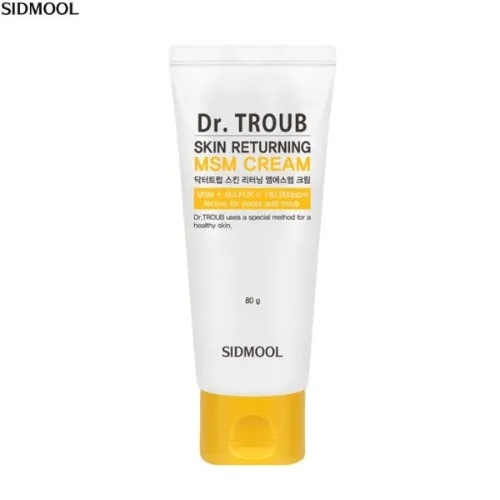
Almost nobody puts methylsulfonylmethane in a face cream at 13 percent, let alone prints the number on the tube beside one percent elemental sulfur, and Sidmool has done both in an eighteen-ingredient gel with no fragrance, oils or silicones. It is a DIY-community formula philosophy made commercial: one bold active, one classic one, and a soothing humectant base that stays out of the way.
A bare, fragrance-free gel built around 13 percent MSM and one percent sulfur, with panthenol, squalane and skullcap to keep it calm. The MSM evidence on skin is thin and the sulfur dose is sub-treatment, so it is a soothing, mildly antimicrobial moisturiser for oily, breakout-prone skin rather than an acne cure, and at this price it is an easy, honest one to try.
This 2025 release is sold outside Korea only through export shops, so there is no Western retailer review pool, and Sidmool's domestic reviews could not be counted at the time of writing. The assessment therefore rests on the declared 13 percent MSM and one percent sulfur, the documented behaviour of the calming base, and the brand's history with its sulfur line, and it flags that topical MSM itself has only thin evidence, so both the score and the practical notes should be read as provisional.
Verdicts
How well it fits each concern
Verdict by concern tap a concern for the case
Good choicefor AcneIn your profileYou chose · Sulfur is an approved or monograph active for acne, but this gel cream carries it at 1% — below the 3–10% the evidence and approvals rest on.Moderate evidenceGentleNo reviews collected yet
The case for it
Sulfur is a first-line active — approved, monograph-listed or named in current guidelines — for this concern.
It is present below the studied range.
The formula carries none of the triggers this concern is sensitive to.
What would change this: A concentration inside the studied range would raise this a step.
Same rule for everyone. “Good choice” is the verdict on 9,564 of 45,024 concern verdicts across the catalog; rule R4 decided 84 of them.
As of September 25, 2026, engine 5.1.1.
R4 — Right molecule, weak dose: still a reasonable choice, not the strong one. · the full register
Carrying active
Sulfur
Standing
first line — a regulator recognises it for this use; trials support it · per § 333.310 Acne active ingredients. (U.S. Food and Drug Administration — 21 CFR Part 333 Subpart D (Topical Acne Drug Products), Code of Federal Regulations via GovInfo), opened July 27, 2026
Form
sub threshold (declared 1%) — studied range 3–10%, from the OTC monograph or label
Tolerability
gentle
Row checked
against its sources on July 27, 2026 (evidence table ev-2026.09-r228)
Good choicefor SensitivityIn your profileYou chose · No fragrance, drying alcohol, declarable allergens or sensitising preservatives in this gel cream — the profile sensitive skin looks for.Not yet assessedGentleNo reviews collected yet
The case for it
Dimethyl Sulfone has no evidence row yet for this concern — it is in the research queue.
The formula carries none of the triggers this concern is sensitive to.
What would change this: A researched evidence row for the lead active would replace this with a verdict.
Same rule for everyone. “Good choice” is the verdict on 1,938 of 45,024 concern verdicts across the catalog; rule F2 decided 1,938 of them.
As of September 25, 2026, engine 5.1.1.
Supporting rolefor Compromised Skin BarrierIn your profileYou chose · Nothing here targets compromised skin barrier directly; barrier lipids and occlusion is the recognised companion to treating it, and this gel cream does that without known triggers.Not yet assessedGentleNo reviews collected yet
The case for it
Dimethyl Sulfone has no evidence row yet for this concern — it is in the research queue.
The formula carries none of the triggers this concern is sensitive to.
What would change this: A researched evidence row for the lead active would replace this with a verdict.
Same rule for everyone. “Supporting role” is the verdict on 8,197 of 45,024 concern verdicts across the catalog; rule R8 decided 4,250 of them.
As of September 25, 2026, engine 5.1.1.
R8 — The category's job (barrier care, humectant hydration, gentle cleansing, photoprotection) is the documented supportive role for this concern. This is the honest verdict for a moisturizer on an acne page. · the full register
Also listed for Excess Oiliness — the actives here (MSM (Methylsulfonylmethane) are in our research queue for that concern; there is no verdict until their evidence rows are written. That is a gap in our table, not a mark against the product.
Falls shortJudged as a moisturizer, it comes up short on: seals moisture in, supplies barrier lipids.
A verdict is DermApproved’s assessment of how well a product’s ingredients fit a concern — never a claim about what the product treats. Evidence dots and collected reviews sit beside it and are never blended in.
Rules 0.5.1 · evidence table ev-2026.09-r228 · how we decide
Assessment
Pros & Cons
Pros
✓ Fragrance-free, oil-free, silicone-free eighteen-ingredient formula with percentages declared
✓ Panthenol, squalane, hyaluronate and allantoin make a genuinely soothing base
✓ One percent sulfur adds mild antibacterial and antifungal activity without peeling
✓ Fungal-acne-safe with nothing that feeds Malassezia
✓ Watery gel that suits oily skin and layers cleanly under sunscreen
✓ Cheap for 80g even after import shipping
Cons
✗ Topical MSM has thin, small-study evidence and no established dose
✗ Sulfur at one percent is below acne-treatment strength
✗ Too light for dry skin without a cream on top
✗ Faint sulfur smell on application
✗ No US retailer, so import shipping and a wait of weeks
✗ No countable review record in any language
Review
Full Review
Long before Sidmool put it in a tube, MSM was a thing Korean acne forums did to their own moisturisers. Methylsulfonylmethane, the organosulfur supplement sold for joints, dissolves easily in water, and a certain kind of DIY skincare enthusiast, the kind Sidmool itself grew out of in the early 2000s, would stir a spoonful into a plain cream on the theory that sulfur calms inflamed skin. Dr. Troub Skin Returning MSM Cream is that idea made properly: 13 percent MSM, declared on the front of the tube, in a gel with one percent elemental sulfur and a short list of soothing ingredients behind it. Eighteen ingredients, no fragrance, no oils beyond a little squalane, no silicones. It is exactly the sort of product this brand has always made, and the interesting question is whether the idea survives contact with the evidence.
The evidence for MSM on skin is thinner than its supplement reputation suggests. Orally it has reasonable trial data for reducing inflammatory markers and some for skin quality, but topical studies are few and small, mostly looking at wrinkles and general condition rather than acne, and none establishes a dose. So 13 percent is a number chosen by the brand rather than by the literature, and the honest reading is that MSM here is a plausible anti-inflammatory whose benefit has not been demonstrated at any concentration in a cream. That does not make it useless. It makes it an experiment, which is what Sidmool's customers have always signed up for.
The sulfur is on firmer ground and at a gentler dose than the name implies. Elemental sulfur is a monograph acne active in the United States at three to ten percent, keratolytic and antibacterial, and Sidmool has built a small cult around it in the Dr. Troub toner and cleanser. At one percent in this gel it is well below treatment strength, which is a deliberate choice: enough for a mild antimicrobial and antifungal note and the faint mineral smell that lasts a few seconds on application, not enough to peel or dry the skin the way a sulfur mask does. The rest of the list is a calming humectant base done well. Glycerin and butylene glycol carry the water, panthenol sits seventh and does its usual barrier work, squalane is the sole emollient, sodium hyaluronate adds surface hydration, and Baikal skullcap and Japanese umbrella pine root extracts bring an anti-redness botanical pair with decent laboratory data. Arginine and allantoin close it out. There is nothing in the formula that feeds Malassezia, nothing that clogs, and nothing that stings intact skin.
In use it behaves like a treatment gel that happens to moisturise. It spreads thin, absorbs in under a minute, and leaves a slightly matte, faintly soft finish that oily and combination skin will find complete on its own and dry skin will find tight within an hour. The people it suits best are the ones the Dr. Troub name has always addressed: oily, congested, prone to red inflamed spots that need calming more than exfoliating. On that skin, a few days of twice-daily use takes the heat out of active breakouts, and over two or three weeks spots tend to flatten faster and look less angry. Whether breakouts become less frequent is a longer, less certain proposition, and the cream does nothing for post-acne marks, texture or blackheads, which want a retinoid or an acid.
What it does not do is compete with benzoyl peroxide or a prescription. Anyone with moderate or severe acne should treat this as a comfortable moisturiser to wear alongside real treatment, not as the treatment, and should avoid layering it directly over benzoyl peroxide or a strong acid, because sulfur plus either adds up to more dryness than the humectant base can cover. Sensitive skin generally tolerates it well thanks to the absence of fragrance and essential oils, though rosacea and eczema should patch test, since sulfur and MSM are mild irritants on a compromised barrier.
The practical caveats are about access rather than formula. Sidmool does not sell through Western retailers, so the cream arrives from Korean export shops at roughly twenty-two to twenty-five dollars for 80g, plus shipping and a wait of a few weeks. There are no English-language reviews to speak of, and the brand's own Korean review pool could not be counted for this assessment, so the score leans on the declared percentages and on a decade of the sulfur line's reputation rather than on crowd data. That is a real limitation for a product whose headline ingredient is itself lightly evidenced.
My verdict, then, is a qualified yes. If you have oily, breakout-prone skin that runs red, you dislike fragrance and heavy creams, and you are the sort of person who enjoys a well-made formulation experiment, this is a cheap, gentle, genuinely calming gel with a bold idea at its centre, and the worst case is a pleasant moisturiser that did not change much. If you have dry skin, moderate acne that needs proven treatment, or no patience for import shipping, the MSM is not a strong enough reason to go to the trouble, and a niacinamide or azelaic acid product with real data will serve you better.
Formula
Key Ingredients
The hero actives that drive this product's performance.
Methylsulfonylmethane at a declared 13 percent, second only to water, is the entire premise of the cream: a small, water-soluble organosulfur compound with anti-inflammatory activity in supplement trials and a thin topical literature, carried here in a bare humectant gel so nothing competes with it for the skin's attention.
Elemental sulfur at one percent, the classic keratolytic and antibacterial acne active that the Dr. Troub line has used across its sulfur toner and cleanser, dosed here far below the three to ten percent of an over-the-counter acne treatment so it reads as a supporting antimicrobial note rather than a drug-strength dose.
Seventh, ahead of the squalane and hyaluronate, panthenol is the barrier-soothing counterweight to the sulfur, converting to pantothenic acid in the skin to support repair on the irritated, post-breakout skin the cream is aimed at.
The only emollient in a formula that otherwise has no oils, esters or silicones; squalane at eighth position gives the watery gel a faint slip and keeps it from drying to a tight film, which is why oily skin can wear it and dry skin will want a cream on top.
Baikal skullcap, with the Japanese umbrella pine root beside it, is the formula's anti-redness botanical pair; baicalin has real anti-inflammatory and antioxidant data in the laboratory, and its placement after the hyaluronate suggests a modest supporting dose.
The last of a calming trio with panthenol and arginine, allantoin sits near the end but does conventional soothing work on skin that sulfur and MSM can leave faintly dry, and the fragrance-free, essential-oil-free formula gives it nothing to fight.
Not yet assessed
Ingredient standings describe the active at treatment-level doses and
vehicles; this product's own condition grades weigh its actual formula.
Use as a light moisturiser after toner and serum on oily or breakout-prone skin, or as a treatment layer under a richer cream on dry or combination skin; it sits well under sunscreen and needs a minute to set. Avoid stacking it with benzoyl peroxide or a strong acid on the same application, since the sulfur adds to their drying effect.
Results Timeline
Redness and post-breakout heat calm within a few days of twice-daily use, and active blemishes tend to look flatter over two to three weeks; any effect on breakout frequency is a gradual four-to-eight-week proposition, and the cream does nothing for texture or pigmentation.
Methylsulfonylmethane is a naturally occurring organosulfur compound, a metabolite of dimethyl sulfoxide, with a substantial oral supplement literature showing reductions in inflammatory cytokines and oxidative stress markers in randomised trials for joint pain and exercise recovery. Its topical literature is sparse. A small number of studies, several industry-supported, have reported improvements in skin firmness, hydration and the appearance of fine lines with topical MSM, and in vitro work shows it dampens inflammatory signalling in keratinocytes; there are no controlled trials of topical MSM for acne or rosacea and no dose-ranging data, so the 13 percent here is a formulator's choice rather than an evidence-based one. What can be said is that MSM is small, water-soluble, well tolerated on skin in the studies that exist, and plausibly contributes an anti-inflammatory effect.
Elemental sulfur has a much older record. It is recognised in the US over-the-counter acne monograph at three to ten percent and in dandruff and seborrhoeic dermatitis products, with keratolytic, antibacterial and antifungal actions attributed to its conversion to pentathionic acid and hydrogen sulfide on the skin surface. At one percent it is below the monograph range, so the cream cannot claim acne treatment on that basis, and the sulfur functions as a mild antimicrobial adjunct with some antifungal relevance to Malassezia-prone skin. Its main tolerability cost is a slight drying effect and a characteristic odour, both minimised at this dose.
The supporting ingredients are conventional and sound. Panthenol converts to pantothenic acid in the skin and has controlled evidence for improving barrier repair and reducing irritation; glycerin, butylene glycol and sodium hyaluronate provide humectancy; squalane is the sole emollient, a non-comedogenic sebum-mimetic lipid. Scutellaria baicalensis root extract supplies baicalin, a flavonoid with well-documented anti-inflammatory and antioxidant activity in cell and animal models and some small human data for reducing redness, and Sciadopitys verticillata root extract is a less-studied Korean botanical used for its anti-inflammatory profile. Allantoin and arginine round out a soothing base. The formula contains no fragrance, essential oils, drying alcohol, fatty acids or esters, which explains its low irritation potential and its suitability for Malassezia-prone skin; the only irritant considerations are sulfur and MSM on a compromised barrier.
Dermatologist Perspective
Clinicians would classify this as a soothing, non-comedogenic moisturiser with a mild antimicrobial note rather than an acne treatment, and the advice follows from that. Sulfur at one percent is below the concentration dermatology uses for comedonal or inflammatory acne, and topical MSM is not part of any treatment guideline, so a patient with more than mild breakouts is generally told to keep the proven actives, a retinoid, benzoyl peroxide or azelaic acid, and to use a cream like this for comfort alongside them if it suits. The formulation itself draws little concern: fragrance-free, oil-free, silicone-free and free of common sensitisers, it is the kind of light gel dermatologists are happy to see on oily, reactive or Malassezia-prone skin, with the usual caution that sulfur can dry a compromised barrier and that rosacea patients should patch test. The main clinical note is about expectations: MSM has interesting anti-inflammatory biology and almost no topical evidence, and a product built around it should be enjoyed as a gentle moisturiser rather than relied on for results.
Guidance
Usage & Recommendations
How to Use
On toned skin, take a small pump of gel, about the size of a chickpea for the whole face, and spread it thinly over the skin, concentrating on areas prone to redness and breakouts. Let it absorb for a minute; it sets to a light, slightly matte finish. In the morning follow with sunscreen. In the evening use it after any serum, and if your skin is dry or the weather is cold, layer a cream over it rather than relying on it alone. Use twice daily on oily skin, or once daily on the T-zone as a targeted layer on combination skin. Keep it on a different application from benzoyl peroxide or strong acids, patch test if you have rosacea or eczema, and expect a faint sulfur note that fades within seconds.
Value Assessment
At around $24.62 for 80g through Korean export retailers, often discounted to about $22, the cream is inexpensive by any measure and lasts three months of twice-daily use, so the per-day cost is trivial even with shipping added. What the money buys is a well-made, fragrance-free calming gel with a generous dose of an ingredient whose topical benefit is unproven, plus a modest sulfur note; what it does not buy is any clinical validation, a Western retailer or a returns policy. Sidmool's two decades of selling sulfur-based Dr. Troub products give the formula a track record its review count cannot, and for oily, breakout-prone skin that wants a light, honest moisturiser the price is fair for an experiment with a soft landing. Compared with a niacinamide or azelaic acid product with real evidence at a similar price, it is a curiosity rather than a bargain.
Who Should Buy
Oily, combination or reactive skin prone to red, inflamed breakouts that wants a fragrance-free, oil-free calming gel to wear alone or under sunscreen, and anyone who enjoys Sidmool's percentage-on-the-label experiments. It suits fungal-acne-prone users and those already on proven acne actives who need a gentle moisturiser alongside them.
Who Should Skip
Anyone with dry skin, since the gel is tight without a cream on top, and anyone with moderate or severe acne expecting a treatment, because one percent sulfur and unproven MSM will not replace a retinoid or benzoyl peroxide. People who want reviews, a US retailer or fast shipping have easier options with better evidence.
Ready to try Sidmool Dr. Troub Skin Returning MSM Cream?
A translucent, watery gel-cream that spreads thin, absorbs in under a minute and leaves a barely-there matte-satin finish with a faint squalane softness.
Scent
Unscented, with a faint mineral-sulfur note on application that disappears as it dries.
Packaging
An 80g white squeeze tube with a yellow flip cap in the Dr. Troub livery, with the MSM-plus-sulfur ppm figure printed on the front; hygienic and travel-friendly.
Finish
mattelightweightfast-absorbing
What to Expect on First Use
The first application is undramatic: a cool, watery gel that sinks in fast, smells faintly of sulfur for a moment and leaves skin calm and slightly matte. Inflamed spots feel less hot by the next morning; dry patches may feel tight until a cream goes on top. There is no purging or sting on intact skin, and any tingle on open blemishes passes quickly.
How Long It Lasts
Around three months used twice daily on the whole face, longer as a targeted layer on the T-zone.
Sidmool grew out of a Korean DIY-skincare community in the early 2000s and its Dr. Troub range has long leaned on sulfur, from the sulfur toner to the sulfur cleanser. The MSM cream, added in 2025, extends that theme with the organosulfur supplement ingredient that Korean acne forums had been mixing into their own creams for years.
About Sidmool Established Brand (5–20 years)
Sidmool is a Daejeon-based Korean indie brand that grew out of a DIY-skincare community around 2000 and is known for short, high-concentration formulas with percentages printed on the label. It publishes no clinical trials; its Dr. Troub line has a long domestic following among acne-prone users, and this MSM cream is a 2025 addition sold abroad only through Korean export retailers.
Brand founded: 2000 · Product launched: 2025
Myth vs. Reality
Common Myths
Myth
MSM at 13 percent works like a high-strength acne drug.
Reality
Methylsulfonylmethane is not a recognised acne active; the topical evidence is a handful of small studies on skin quality and inflammation, and the one percent elemental sulfur here is well below the three to ten percent used in monograph acne treatments. Expect a calming, mildly antimicrobial gel, not a treatment-strength product.
Myth
Sulfur creams will dry out and peel the skin.
Reality
At one percent in a humectant gel with panthenol, squalane and hyaluronate, this sulfur is nowhere near the peeling level of a sulfur mask. The cream is drying only in the sense that it has no oils, which is why dry skin layers a moisturiser over it.
FAQ
Frequently Asked Questions
What does MSM do in the Sidmool Dr. Troub MSM Cream?
Methylsulfonylmethane is an organosulfur compound with anti-inflammatory activity that is well studied as an oral supplement and only lightly studied on skin. At 13 percent it is meant to calm redness and support skin repair; treat it as a soothing ingredient with early evidence rather than a proven acne active.
Does the Dr. Troub MSM Cream smell like sulfur?
Faintly, for a moment on application, from the one percent elemental sulfur and the MSM itself. There is no added fragrance, and the note disappears as the gel dries.
Is the Sidmool MSM Cream moisturising enough on its own?
For oily and combination skin, yes. It is a watery gel with glycerin, hyaluronate and a little squalane but no oils or occlusives, so dry or dehydrated skin will need a cream over it, especially in winter.
Can I use the MSM Cream with benzoyl peroxide or acids?
Better to alternate. The sulfur and MSM are mild, but stacking them with benzoyl peroxide or a strong AHA on the same application adds up to more dryness than most skin wants. Use the cream in the morning and the stronger active at night, or on alternate days.
Is the Dr. Troub MSM Cream safe for fungal acne?
Yes. It contains no fatty acids, esters or polysorbates that feed Malassezia, and the sulfur has mild antifungal activity, which makes it one of the safer moisturisers for fungal-acne-prone skin.
Where can I buy the Sidmool MSM Cream in the US?
It is not stocked by US retailers; Korean export shops such as Beauty Box Korea ship it internationally for roughly 22 to 25 dollars, with shipping and a few weeks' delivery on top.
Reviews
What Reviewers Tend to Say
Recurring themes our editors read across retailer reviews of this product — summaries in our words, not quotations, and not a substitute for your own patch test.
Every cica, calming, and barrier product leans on the same three ingredients, and the real mechanisms are far more specific — and more limited — than 'soothing' lets on.
Picking one skin state and selling through hospital dermatology departments is a genuinely smart strategy. Whether the house botanical earns its billing is a separate question, and the answer is not the one either side wants.
It's in half your products and headlines none of them. Provitamin B5 has the kind of boring, decades-deep barrier and wound-healing evidence that flashier actives can only envy.
Cutting a beard hair takes about a twentieth of a newton. You press with two and stretch your skin by a fifth — which is why almost every shaving problem is a technique problem wearing a hardware costume.
Aug 28, 2026· 10 min
Questions people ask about Acne
Verified answers from our questions library — the nuance a product page cannot carry.
Products, answers, therapy guides, tools and articles in one search. Brand names,
slang and abbreviations all work — accutane finds isotretinoin, bacne finds truncal acne.