A Chinese Brand Built Its Whole Company on Sensitive Skin. The Thesis Is Better Than the Marketing.
Picking one skin state and selling through hospital dermatology departments is a genuinely smart strategy. Whether the house botanical earns its billing is a separate question, and the answer is not the one either side wants.
Read the preview
From the DermApproved blog, in C-Beauty: a company built entirely on sensitive skin. It sells through hospital dermatology departments, which changes who it must convince — a smarter idea than Western beauty retail has managed. But the house botanical carrying the story has a human evidence file that doesn't say what everyone quotes. For the full breakdown, visit dermapproved.com/blog.
The strategy is the interesting part
Most skincare companies grow by addition. Launch a cleanser, add a serum, add a retinol, add a vitamin C, add a sunscreen, and within five years the catalogue covers everything and stands for nothing in particular.
Winona did close to the opposite. It began in 2008 as a side project of Dihon Pharmaceutical, a Chinese pharma firm, with the Winona intellectual property later transferred to Yunnan Botanee Bio-Technology. And rather than becoming a general skincare brand with a soothing range, it became a soothing brand — one skin state, most of the catalogue pointed at it, with the company's public identity built on collaboration with universities, research institutes and hospitals rather than on beauty retail.
The distribution choice is the part worth stealing. Selling through dermatology departments means the person recommending your cream is a clinician who will see the patient again in six weeks. A shopper who reacts to a product bought at a beauty counter mostly stops using it and moves on; a patient who reacts to a product a dermatologist handed them comes back and says so. That is a much shorter and much less forgiving feedback loop, and it changes what a formulation team can get away with.
Whether the formulas earn the positioning is a genuinely separate question from whether the positioning is clever. Both are worth answering, and a single-thesis brand is unusually easy to answer them about — which is itself an argument for the model.
What 'sensitive skin' actually means, and why the category is so slippery
Before assessing anything aimed at sensitive skin, it is worth knowing that the term has a formal definition, arrived at by expert consensus rather than by marketing.
A special interest group of the International Forum for the Study of Itch used a Delphi process to define sensitive skin as a syndrome characterised by unpleasant sensations — stinging, burning, pain, pruritus, tingling — occurring in response to stimuli that normally should not provoke such sensations. Those sensations cannot be explained by lesions attributable to any skin disease. The skin may appear entirely normal, or may show erythema. It can affect any body site, particularly the face.
Read that carefully and three consequences fall out.
First, it is defined by symptoms rather than signs. There is no lesion to photograph, no biomarker to measure, no test that returns positive. A person with sensitive skin and a person without may look identical under a dermatoscope.
Second, it is explicitly a diagnosis of exclusion — the sensations must not be explained by an underlying skin disease. Which means a substantial share of people who describe themselves as having sensitive skin actually have rosacea, atopic dermatitis, seborrhoeic dermatitis or an unrecognised contact allergy, and the correct answer for them is a diagnosis rather than a gentler cream.
Third, because it is subjective and common, it is the most commercially attractive claim in skincare and the least verifiable. No regulator defines 'for sensitive skin', no test is required to print it, and every brand can therefore say it. That is the background against which any sensitive-skin brand, Chinese or otherwise, has to be assessed.
Purslane: a coherent mechanism and a thin human file
Winona's house active is Portulaca oleracea — purslane — a plant with a long history in traditional Chinese medicine for inflammatory conditions. It appears in the brand's core products alongside Prinsepia utilis seed oil and beta-glucan, and it carries the story.
So how good is the evidence? The honest answer has three layers, and the layers are frequently collapsed into one by people quoting them.
The strongest-sounding citation is a randomised, double-blind, placebo-controlled trial in mild-to-moderate chronic hand eczema, conducted in Iran with seventy participants randomised. After four weeks the purslane group showed significantly lower physician-reported fissure scores, and significantly lower participant-reported itching, dryness, and combined symptom scores, against placebo. That is a real trial with a real result.
It is also not a trial of a purslane cream. The intervention was an oral purslane syrup, given alongside topical petrolatum in both arms. It says something about systemic purslane in hand eczema and nothing at all about what a topical extract does on a face. Adverse events were also numerically higher in the purslane arm, though not significantly so. Anyone citing this study to support a moisturiser is citing the wrong route of administration, and it happens constantly.
The second layer is mechanistic and genuinely interesting. A 2025 study prepared an aqueous purslane extract as a carbomer hydrogel and applied it topically in a mouse model of atopic dermatitis. It reduced lesions, symptom scores and epidermal thickness, suppressed proinflammatory signalling, and increased expression of caspase-14 and filaggrin — both genuine barrier proteins. The proposed mechanism was inhibition of JAK1 and downstream STAT signalling, which is a serious pathway to be pointing at, given that JAK inhibition is the mechanism behind a class of prescription eczema drugs. But it is a mouse model plus cultured keratinocytes. It is a reason to run a human trial, not a substitute for one.
The third layer is a small body of work on purslane in cosmetic formats for sensitive and post-procedure skin, which is suggestive and underpowered.
The fair verdict: purslane is not a made-up active, and the JAK1 finding is more mechanistically interesting than most house botanicals can claim. It is also nowhere near the evidence standard of the ingredients sitting next to it in the same jar. Our purslane page carries the grading, and the pattern is the same one that applies to centella — a botanical with a real mechanism, a devoted following, and a human file thinner than the marketing suggests.
Read the formulas and the engine is somewhere else
This is where a single-thesis brand becomes easy to evaluate, because you can look at the actual ingredient lists and ask what is doing the work.
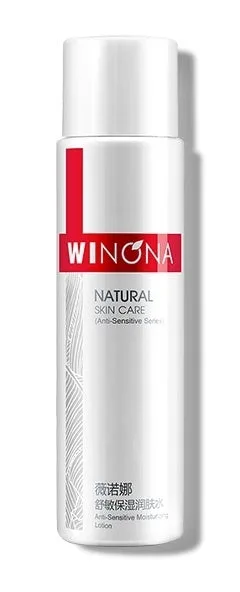
Winona Face Moisturizing Cream pairs the house botanical with ceramide NP, petrolatum, squalane, shea butter, beta-glucan and allantoin. Winona Anti-Sensitive Moist Tolerance-Extreme Face Cream runs purslane with Prinsepia utilis seed oil, beta-glucan, shea butter, dimethicone and sodium hyaluronate. Winona Soothing & Moisturizing Lotion is a lighter humectant-led version of the same idea.
Every one of those formulas is built the way the evidence says a barrier-directed product should be built: a physiological lipid, an occlusive, a humectant, a soothing polysaccharide, and a conservative irritant load. That is the engine. Ceramides have among the best evidence of any moisturiser component, petrolatum is one of the most reliable occlusives in dermatology, and beta-glucan and panthenol-class soothers are standard for a reason.
This is not a criticism disguised as praise. It is how nearly every successful soothing brand works, in every market — the botanical is the narrative and the barrier chemistry is the mechanism. La Roche-Posay Toleriane Ultra Sensitive tells a thermal-spring-water story over a similarly conservative base; Vanicream Daily Facial Moisturizer tells no story at all and arrives at much the same place.
The useful conclusion is that you should buy a Winona cream, if you buy one, for its lipid and occlusive system and its short irritant list — not for the purslane. And that reframing protects you, because it means you can evaluate the next sensitive-skin brand the same way instead of having to adjudicate a new botanical every time. Our sensitive-skin moisturizer ranking and cleanser ranking are built on exactly that logic.
Where a reactive reader should stay sceptical, brand regardless
If your skin stings at things it should not sting at, there are four cautions that survive any brand's positioning, including this one.
The first is the diagnosis-of-exclusion point, and it is the most valuable thing in this article. Because sensitive skin is defined as sensations not explained by an underlying disease, persistent facial burning with visible flushing is more likely to be rosacea than a cosmetic problem, and persistent itching with dryness may be atopic dermatitis. Both have treatments that work considerably better than any moisturiser. If your sensitivity has a pattern — triggered by heat, by alcohol, by a particular season, or accompanied by papules — that pattern belongs in front of a clinician before it belongs in front of a shelf.
The second is that sensitive skin is heterogeneous, so a product that resolves one person's stinging can be useless for another's. No brand, however single-minded, can formulate around a syndrome defined by subjective response. This is the honest limit of the entire category, and it is why per-person testing beats per-brand loyalty.
The third is that 'for sensitive skin' is not a regulated claim anywhere. It requires no test, no threshold and no substantiation. Judge the panel, not the phrase — our ingredient decoder will read one back to you, and the two variables worth checking are fragrance materials and essential oils, which are heavily represented among the allergens patch clinics actually find, whatever the front of the box says about gentleness.
The fourth is temporal. Introduce one product at a time and hold everything else constant for several weeks. Reactive skin generates a lot of noise, and running two changes at once guarantees you learn nothing from either. Recording what you use and when is the unglamorous part that makes the rest work — our sensitive-skin routine sets out a defensible baseline, and the My Skin profile keeps the record so you can see which introduction lines up with which flare.
Winona's thesis, stripped of the botanical story, is that a company should pick a skin state and take it seriously enough to be judged by clinicians. That thesis is correct, and it is a strange indictment of Western beauty retail that so few brands have tried it.
Products mentioned
Independently reviewed and scored — the real products behind this piece.




- Routine Gentle Skincare Routine for Sensitive Skin A defensible baseline to introduce one variable at a time against.
- Ranked list Best Moisturizers for Sensitive Skin Assessed on lipid and occlusive systems rather than on soothing claims.
- Ranked list Best Cleansers for Sensitive Skin The step where irritant load does the most damage in reactive skin.
- Ingredient Purslane Extract (Portulaca Oleracea) The house active, with the evidence graded honestly against its marketing.
- Ingredient Ceramides The component actually carrying these formulas.
- Ingredient Panthenol (Pro-Vitamin B5) The soothing-agent class that sits alongside beta-glucan in this design.
- Ingredient Centella Asiatica (Cica) The same pattern in another market — real mechanism, devoted following, thinner human file than implied.
References
- Definition of Sensitive Skin: An Expert Position Paper from the Special Interest Group on Sensitive Skin of the International Forum for the Study of Itch — Acta Dermato-Venereologica, 2017
- Efficacy and safety of purslane (Portulaca oleracea) for mild to moderate chronic hand eczema; A randomized, double-blind, placebo-controlled clinical trial — Explore, 2024
- Aqueous extracts of Portulaca oleracea L. alleviate atopic dermatitis by restoring skin barrier function — Frontiers in Pharmacology, 2025
- Low-temperature extracted Portulaca oleracea L. as a functional ingredient in facial masks for photorejuvenation of sensitive skin — Cutaneous and Ocular Toxicology, 2025
Every cited link is verified to resolve to the paper named. Where a source could not be independently confirmed, it is listed without a link rather than pointing you somewhere wrong.
Frequently asked
What does 'sensitive skin' actually mean clinically?
An IFSI expert panel defined it by Delphi consensus as a syndrome of unpleasant sensations — stinging, burning, pain, itch, tingling — in response to stimuli that should not normally provoke them, which cannot be explained by lesions attributable to any skin disease. The skin may look entirely normal. It is defined by symptoms rather than signs, with no diagnostic test.
Is there good evidence for purslane on skin?
There is a coherent mechanism and thin human topical data. A mouse model plus keratinocyte study found a topical purslane hydrogel raised filaggrin and caspase-14 and suppressed JAK1/STAT signalling, which is a serious pathway. But the best human trial tested an oral purslane syrup in hand eczema, not a topical cream, so it does not support a moisturiser claim.
Why does a hospital distribution channel matter?
It shortens and hardens the feedback loop. A shopper who reacts to a product bought at a counter usually stops using it silently; a patient who reacts to something a dermatologist recommended returns and reports it. That changes what a formulation team can ship, independently of anything the marketing says.
If the botanical is not the engine, what is?
Barrier chemistry. These formulas pair the house extract with ceramide NP, petrolatum, squalane, shea butter, beta-glucan and allantoin — a physiological lipid, an occlusive, humectants, a soothing polysaccharide and a conservative irritant load. That is what the evidence rewards, and it is how nearly every successful soothing brand in every market is actually built.
I have sensitive skin — is a specialist brand the right answer?
Possibly, but check the diagnosis first. Because sensitive skin is defined as sensations not explained by an underlying disease, persistent facial burning with flushing may be rosacea and persistent itch with dryness may be atopic dermatitis — both treatable considerably better than by any moisturiser. After that, judge the ingredient panel rather than the positioning, since 'for sensitive skin' is unregulated everywhere.