




Rosacea Isn't One Thing — and That's Why Your 'Anti-Redness' Routine Isn't Working
Flushing, bumps, and visible vessels are three different problems hiding under one word, and treating them the same way is how most people make their skin angrier.
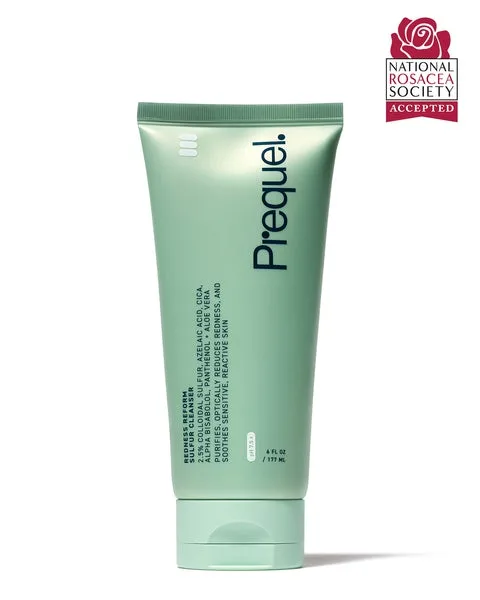
Sulfur is one of skincare's oldest rosacea actives, but its harsh, sulfurous reputation pushed it out of modern formulas. This cleanser revives 2.5% colloidal sulfur, pairs it with azelaic acid, a second evidence-backed rosacea ingredient, and buffers both with a deep soothing stack of cica, bisabolol, panthenol and magnolia bark, earning the National Rosacea Society Seal of Acceptance.
Sulfur is one of skincare's oldest rosacea actives, and Prequel's cleanser rehabilitates it well: 2.5% colloidal sulfur and azelaic acid, two evidence-backed redness ingredients, buffered with a generous soothing stack of cica, bisabolol and panthenol. It is far gentler and less smelly than sulfur's reputation, and it carries the National Rosacea Society seal. Best for oily and combination redness-prone skin; dry skin should use it carefully.
Note: This cleanser is a recent 2025 launch, so independent long-term data is limited. Our scoring relies on ingredient analysis, the well-established evidence for sulfur and azelaic acid in rosacea care, the National Rosacea Society seal, and the brand's dermatologist-led approach. This review will be refreshed as the product's track record lengthens.
The case for it
Cautions: a pH outside the active’s working range.
What would change this: The same active in a leave-on form would be judged on its evidence rather than its contact time.
Same rule for everyone. “Supporting role” is the verdict on 8,197 of 45,024 concern verdicts across the catalog; rule R6 decided 2,017 of them. Unchanged since September 5, 2026, engine 5.1.1.
Brand or formulator? Disclose a concentration or correct a fact →
The studies behind the evidence row
The case for it
Cautions: fungal-acne triggers.
What would change this: A concentration inside the studied range would raise this a step.
Same rule for everyone. “Good choice” is the verdict on 9,564 of 45,024 concern verdicts across the catalog; rule R4 decided 84 of them. Unchanged since September 5, 2026, engine 5.1.1.
Brand or formulator? Disclose a concentration or correct a fact →
The studies behind the evidence row
The case for it
Cautions: fungal-acne triggers.
What would change this: A researched evidence row for the lead active would replace this with a verdict.
Same rule for everyone. “Supporting role” is the verdict on 8,197 of 45,024 concern verdicts across the catalog; rule R8 decided 4,250 of them. Unchanged since September 5, 2026, engine 5.1.1.
Brand or formulator? Disclose a concentration or correct a fact →
The case for it
What would change this: The same active in a leave-on form would be judged on its evidence rather than its contact time.
Same rule for everyone. “Supporting role” is the verdict on 8,197 of 45,024 concern verdicts across the catalog; rule F3 decided 183 of them. Unchanged since September 5, 2026, engine 5.1.1.
Brand or formulator? Disclose a concentration or correct a fact →
The studies behind the evidence row
Falls shortJudged as a cleanser, it comes up short on: pH match to skin.
A verdict is DermApproved’s assessment of how well a product’s ingredients fit a concern — never a claim about what the product treats. Evidence dots and collected reviews sit beside it and are never blended in. Rules 0.5.1 · evidence table ev-2026.09-r228 · how we decide
Sulfur has an image problem. It is one of the oldest active ingredients in all of skincare, used for acne and rosacea for well over a century, and the evidence behind it is genuinely solid. But ask most people what they associate with a sulfur product and you will hear two things: the smell, that faint rotten-egg note, and the feel — chalky, drying, the kind of thing that left skin tight and flaking. As skincare modernized and gentler-feeling actives arrived, sulfur quietly fell out of fashion, not because it stopped working, but because nobody wanted to use it. Prequel's Redness Reform Sulfur Cleanser is, essentially, an attempt to rehabilitate it.
The core of the formula is 2.5% colloidal sulfur. Sulfur is antimicrobial and mildly keratolytic, meaning it helps clear the bumps and congestion that often accompany redness-prone and rosacea-prone skin, and it carries a long clinical history in rosacea care specifically. At 2.5% in a rinse-off cleanser, it is dosed to do useful work without the harshness that drove people away from older, higher-strength sulfur products. Prequel then pairs it with azelaic acid, and that is a smart move: azelaic acid is one of the better-evidenced rosacea ingredients in dermatology — anti-inflammatory and skin-normalizing — and having two redness-focused actives rather than one gives the cleanser a more serious claim to the 'redness reform' name.
What makes this more than a retro novelty is the buffering. A sulfur cleanser lives or dies on whether it is tolerable, and Prequel has stacked this one with soothers: centella asiatica, bisabolol, panthenol, aloe, chamomile flower water, even magnolia-bark compounds and guaiazulene, the blue anti-inflammatory derived from chamomile. The whole supporting cast is built to offset sulfur's drying, harsh tendencies. The result is a cleanser that genuinely does not feel like the sulfur products of memory. It is a soft, creamy wash that lathers lightly and rinses clean without that stripped, squeaky aftermath, and the sulfur smell is reduced to a faint note rather than an assault. That it earned the National Rosacea Society Seal of Acceptance is a meaningful third-party signal that the formula was reviewed and judged appropriate for rosacea-prone skin.
In practice, it does what a clarifying cleanser for redness-prone skin should. Used consistently, it helps calm the bumpy, congested texture that comes with rosacea-adjacent skin, and over several weeks the complexion looks more even and less reactive. It is the kind of product where the payoff is in the routine, not the single wash; the brief contact time of any cleanser limits how much its actives can do, so this works as a steady contributor rather than an overnight fix.
Its limitations start with skin type. Sulfur, even buffered, is better suited to oily and combination skin than to dry skin. If your skin is already dry, this cleanser can tip it further, and you should approach it carefully — once daily in the evening to start, always followed by a moisturizer, building up only if your skin stays comfortable. Genuinely dry or eczema-prone skin may simply find it too much, and that is a fair reason to choose a creamier, non-medicated cleanser instead. The faint sulfur note, while mild, is still present, and a small number of people are sensitive to it. And, importantly, this is not a cure. Sulfur and azelaic acid help manage rosacea-prone skin, but rosacea is a chronic medical condition. The Seal of Acceptance means the formula is appropriate for rosacea-prone skin, not that it treats the disease; persistent or worsening rosacea still belongs in a dermatologist's office, very possibly alongside prescription therapy.
One genuine positive worth flagging: sulfur is antifungal, and the cleanser is a reasonable option for people dealing with fungal acne as well as redness, a combination that is otherwise annoying to shop for. It is also a sensible choice during pregnancy, when both topical sulfur and azelaic acid are generally considered acceptable while many other acne actives are off the table.
On value, this is a strong showing. A generous 6 fl oz of a thoughtfully formulated, dermatologist-developed, rosacea-society-approved cleanser at a modest price is a good deal, and the bottle will last three to four months. As a recent 2025 launch it does not yet have a deep review history, so the confidence here rests on the well-established evidence for its two main actives and on the quality of the formulation rather than years of user reports.
Where that lands: if you have oily or combination, redness-prone or rosacea-prone skin, possibly with a side of fungal acne, this is a genuinely smart, gentle, well-priced cleanser, and a rare modern sulfur product you might actually enjoy using. If your skin is dry, tread carefully or skip it. Prequel set out to make sulfur likable again, and for the right skin, it has largely succeeded.
The hero actives that drive this product's performance.
| Ingredient | Function | Evidence |
|---|---|---|
| Colloidal Sulfur (2.5%) (2.5%) | The cleanser's defining active, sulfur is antimicrobial and gently keratolytic and has a long record in rosacea care; at 2.5% in a rinse-off it works on the bumps, congestion and microbial component of redness-prone skin without the harshness of higher doses. | Regulator-approved for Acne · limited certainty |
| Azelaic Acid | Paired with the sulfur as a second redness-focused active, azelaic acid is anti-inflammatory and helps normalize skin, a well-evidenced rosacea ingredient that reinforces the cleanser's calming, tone-evening intent even given a cleanser's brief contact time. | Regulator-approved for Rosacea · well-established certainty |
| Centella Asiatica Extract | Cica extract is included to offset the drying, sometimes harsh reputation of sulfur, contributing soothing and barrier-supporting activity so the cleanser calms rather than strips redness-prone skin. | Limited for Rosacea |
| Bisabolol | A chamomile-derived anti-irritant that works with the panthenol, aloe and magnolia-bark compounds to build a soothing buffer around the active sulfur and azelaic acid, key to making a sulfur cleanser tolerable for reactive skin. | Not yet assessed |
Ingredient standings describe the active at treatment-level doses and vehicles; this product's own condition grades weigh its actual formula.
Water (Aqua), Glycerin, Sodium Lauroyl Isethionate, Magnesium Aluminum Silicate, Decyl Glucoside, Cocamidopropyl Hydroxysultaine, Sulfur, Sodium Lauroyl Methyl Isethionate, Sodium Lauroamphoacetate, Azelaic Acid, Chamomilla Recutita (Matricaria) Flower Water, Osmanthus Fragrans Flower Extract, Quartz, Panthenol, Bisabolol, Aloe Barbadensis Leaf Juice, Centella Asiatica Extract, Polyglycerin-6, Saccharomyces/Zinc Ferment, Apricot Kernel Oil Polyglyceryl-6 Esters, Guaiazulene, Magnolol, Honokiol, Hydrolyzed Garcinia Mangostana Fruit Extract, Lauric Acid, Coconut Acid, Myristic Acid, Acacia Senegal Gum, Capric Acid, Xanthan Gum, Propanediol, Cocamide MIPA, Hydroxyacetophenone, Octenidine HCl, Potassium Sorbate, Sodium Benzoate, Sodium Chloride, Sodium Polyacryloyldimethyl Taurate, Sodium Isethionate, Polyglyceryl-10 Oleate, Sorbitan Palmitate, Cetyl Phosphate, Potassium Hydroxide, Citric Acid
cleanser
AM & PM
Use as the cleanser step. Massage in and leave on for up to a minute before rinsing to give the sulfur and azelaic acid brief contact time. Always follow with a moisturizer, and with sunscreen in the morning, since active cleansers work best within a gentle, barrier-supportive routine.
Immediate: skin feels clean and clarified after the first wash. Short-term: fewer bumps and a calmer, less congested look within two to three weeks. Full benefit: a more even, less reactive complexion over six to eight weeks of consistent use.
The cleanser rests on two actives with real evidence in rosacea care. Sulfur has a long documented history as a topical agent for acne and rosacea: it is antimicrobial, has activity against the Demodex mites implicated in rosacea, and is mildly keratolytic, helping to clear follicular congestion. It has been used in dermatology for well over a century, and while much of its evidence predates modern trial standards, its role in rosacea-prone skin is well accepted. Azelaic acid is the better-studied of the two: at prescription strength it is an established, FDA-approved rosacea treatment, working through anti-inflammatory action and normalization of keratinization. In an over-the-counter cleanser the azelaic acid concentration is lower and the contact time short, so it functions as a supportive contributor rather than at treatment strength.
That contact-time point is the central scientific caveat for any active cleanser. A cleanser is on the skin briefly before being rinsed away, which inherently limits how much of an active can penetrate and act. This is why the cleanser is best understood as one consistent contributor within a routine, not as a delivery system equivalent to a leave-on treatment.
The soothing stack is the formulation's smartest feature. Sulfur's historical drawback is irritation and dryness, and the formula counters this with centella asiatica, bisabolol, panthenol, aloe, chamomile-derived guaiazulene and magnolia-bark compounds, all recognized anti-inflammatory or barrier-supportive ingredients. The National Rosacea Society Seal of Acceptance indicates the finished product was reviewed for suitability for rosacea-prone skin. The coherent takeaway is that this is a well-constructed cleanser for redness-prone skin, with the standard, honest limitation that a cleanser supports management of rosacea rather than treating the condition itself.
Sulfur and azelaic acid both have recognized places in the dermatological management of rosacea, and clinicians generally regard a gentle, well-formulated sulfur cleanser as a reasonable component of a redness-prone routine. Dermatologists tend to emphasize a few practical points. First, cleansers contribute to rosacea management but do not replace leave-on or prescription treatment, since contact time on the skin is brief. Second, sulfur can be drying, so it is better matched to oily and combination skin, and patients with dry or eczema-prone skin are often advised to use it cautiously or choose a creamier cleanser. Third, gentle, barrier-supportive cleansing and diligent sun protection are foundational for rosacea-prone skin, and an active cleanser should sit within that framework rather than override it. The National Rosacea Society Seal of Acceptance is viewed as a helpful indicator that a product has been assessed as appropriate for rosacea-prone skin. Persistent rosacea still warrants a formal diagnosis and, frequently, prescription therapy.
Wash with it once or twice daily. Massage a small amount over damp skin and, if your skin tolerates it, leave the lather on for up to a minute before rinsing, which gives the sulfur and azelaic acid a little contact time. Rinse with lukewarm water and pat dry. Always follow with a moisturizer, and with sunscreen in the morning. Drier or sulfur-naive skin should begin with once-daily evening use and build up only if skin stays comfortable. Surround it with gentle, non-stripping products for the rest of the routine; an active cleanser works best amid soothing, barrier-supportive steps rather than other harsh ones.
This is a strong value pick. A generous 6 fl oz of a dermatologist-developed cleanser, built on two evidence-backed rosacea actives, buffered with a serious soothing stack, and carrying the National Rosacea Society Seal of Acceptance, comes in at a modest mid-range price, and a tube lasts three to four months at daily use. Medicated and rosacea-targeted cleansers often cost considerably more for less thoughtful formulas, so nothing here reads as a branding premium. The honest qualifier is fit rather than cost: the value only materializes if your skin type suits sulfur, oily and combination skin will get the most from it, while dry skin may not be able to use it comfortably at all. For the right skin, it is one of the better-value options in the redness-prone cleanser category.
Oily or combination skin that is redness-prone or rosacea-prone is the right match here, especially for anyone also dealing with bumps, congestion or fungal acne. It is also a sensible option during pregnancy, when topical sulfur and azelaic acid are generally considered acceptable choices.
Skip it, or use it cautiously, if your skin is dry or eczema-prone, since sulfur can tip already-dry skin into discomfort. Skip it too if you are sensitive to even a faint sulfur scent, or if you are looking for a cure for rosacea rather than a supportive cleanser, which requires dermatologist care.
Ready to try Prequel Redness Reform Sulfur Cleanser?
Buy at Amazon ♥A soft, creamy cleanser that lathers lightly and rinses clean without a stripped, squeaky feel.
Largely neutral, with only a faint sulfur note; no added fragrance.
A 6 fl oz tube, practical and hygienic, with a generous size for a daily cleanser.
From the first wash skin feels clean and clarified rather than tight. Sulfur can feel slightly drying as skin adjusts over the first week; following with a moisturizer is important, and dry skin may prefer once-daily use at first.
About 3-4 months with once- or twice a day.
All Year
The Sulfur Cleanser, a 2025 addition to Prequel's Redness Reform line, was built for redness-prone and rosacea-prone skin. It reflects a small revival of sulfur in dermatologist-led formulating: an old, well-evidenced active rehabilitated with modern soothing ingredients to shed its chalky, smelly image.
Prequel was founded in 2023 by Dr. Sam Ellis, a board-certified medical and cosmetic dermatologist, in partnership with the brand incubator The Center. It focuses on approachable, dermatologist-developed essentials built around proven actives, though as a 2023 brand it still has a relatively short independent track record.
Sulfur cleansers always smell bad and dry out your skin.
That reputation comes from older, higher-strength formulas. This cleanser uses 2.5% colloidal sulfur with a heavy soothing stack of cica, bisabolol, panthenol and aloe, so it has only a faint sulfur note and is far gentler than the sulfur products of the past.
A sulfur cleanser can cure rosacea.
It cannot. Sulfur and azelaic acid are well-evidenced for managing rosacea, and this cleanser can genuinely help, but rosacea is a chronic medical condition. It is best used as part of a routine, often alongside dermatologist-guided treatment.
It is a cleanser for redness-prone and rosacea-prone skin, built on 2.5% colloidal sulfur and azelaic acid, two well-evidenced rosacea actives, plus a soothing stack of cica, bisabolol and panthenol. It targets bumps and congestion while keeping the wash gentle.
Only faintly. Older sulfur cleansers were known for an off-putting smell, but this formula has just a mild sulfur note, kept in check by its modern formulation and soothing ingredients.
Sulfur can be slightly drying, but this formula buffers it heavily with cica, bisabolol, panthenol and aloe, so most redness-prone and sensitive users tolerate it well. Already-dry skin may prefer once-daily use and should always follow with a moisturizer.
It can genuinely help manage redness-prone skin, and it carries the National Rosacea Society Seal of Acceptance, but it is not a cure. Rosacea is a chronic medical condition best managed with a dermatologist, often alongside prescription treatment.
Topical sulfur and azelaic acid are both generally considered acceptable options during pregnancy, which is part of why this cleanser is often suggested for pregnancy-era breakouts. As always, confirm with your own doctor about your full routine.
It can be used once or twice daily. If your skin is on the drier side or new to sulfur, start once daily in the evening, always follow with a moisturizer, and build up as your skin adjusts.
Recurring themes our editors read across retailer reviews of this product — summaries in our words, not quotations, and not a substitute for your own patch test.
Calms bumps and congestion in redness-prone skin
Far gentler than expected for a sulfur cleanser
Minimal sulfur smell
Does not leave skin tight or stripped
Can be drying for already-dry skin
A faint sulfur note still present
Newer product with limited reviews
Best results need consistent use over weeks
Verified answers from our questions library — the nuance a product page cannot carry.