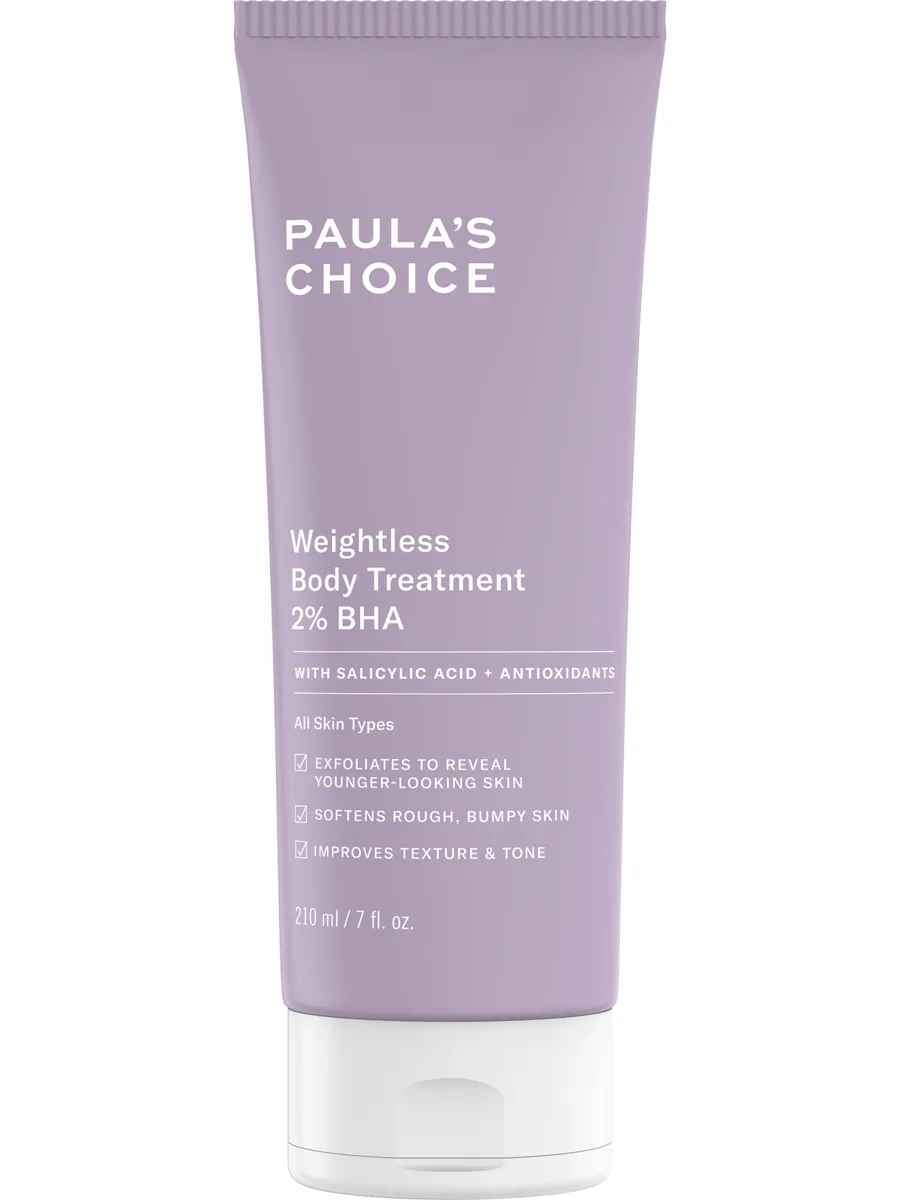
A great many body lotions list salicylic acid; very few state that they are formulated in the acidic pH range where it actually exfoliates, and fewer still keep the texture this light. This one pairs a stated pH of 3.5 to 3.9 with a volatile-silicone base that spreads thin and vanishes, then adds chamomile, bisabolol and allantoin so a daily leave-on acid does not leave arms red — and it has the multi-thousand-review track record to prove the combination works on keratosis pilaris.
Paula's Choice 2% BHA Weightless Body Treatment Review
KP Smoothing Staple
body carelotionclinicalParaben FreeCruelty FreeVegan
The body lotion that made keratosis pilaris a solvable problem for a lot of people: 2% salicylic acid at a stated acidic pH, in a silky silicone-light base with chamomile and bisabolol to keep arms calm. It smooths bumps in two weeks and clears body congestion in a month, costs a fair thirty-five dollars for seven ounces, and asks only that you go slowly and wear sunscreen.
Supporting rolefor Keratosis PilarisIn your profileYou chose · Nothing here targets keratosis pilaris directly; emollient hydration is the recognised companion to treating it, and this lotion does that without known triggers.Moderate evidenceGentleNo reviews collected yet
The case for it
Salicylic Acid has early or mechanistic evidence for this concern, not trial-backed standing.
It is present below the studied range.
The formula carries none of the triggers this concern is sensitive to.
What would change this: A concentration inside the studied range would raise this a step.
Same rule for everyone. “Supporting role” is the verdict on 8,197 of 45,024 concern verdicts across the catalog; rule R8 decided 4,250 of them.
As of September 25, 2026, engine 5.1.1.
R8 — The category's job (barrier care, humectant hydration, gentle cleansing, photoprotection) is the documented supportive role for this concern. This is the honest verdict for a moisturizer on an acne page. · the full register
Carrying active
Salicylic Acid
Standing
plausible — trials support it
Form
sub threshold (declared 2%) — studied range 5%, from the OTC monograph or label; judge it after ~6 weeks
Tolerability
gentle
Row checked
against its sources on July 17, 2026 (evidence table ev-2026.09-r228)
Good choicefor Rough TextureIn your profileYou chose · Salicylic Acid is a reference standard by mechanism for rough texture; this lotion carries it at 2%.Moderate evidenceGentleNo reviews collected yet
The case for it
Salicylic Acid has trial-supported standing for this concern.
It is present at an effective concentration, declared or high in the ingredient list.
The formula carries none of the triggers this concern is sensitive to.
Same rule for everyone. “Good choice” is the verdict on 9,564 of 45,024 concern verdicts across the catalog; rule R5 decided 9,072 of them.
As of September 25, 2026, engine 5.1.1.
Strong choicefor AcneIn your profileYou chose · Salicylic Acid is an approved or monograph active for acne; this lotion carries it at 2%.Moderate evidenceStandard tolerabilityNo reviews collected yet
The case for it
Salicylic Acid is a first-line active — approved, monograph-listed or named in current guidelines — for this concern.
It is present at an effective concentration, declared or high in the ingredient list.
The formula carries no trigger this concern is sensitive to, with the cautions noted.
Cautions: fungal-acne triggers.
Same rule for everyone. “Strong choice” is the verdict on 1,459 of 45,024 concern verdicts across the catalog; rule R2 decided 892 of them.
As of September 25, 2026, engine 5.1.1.
R2 — A regulator- or guideline-recognised first-line active, declared at an effective strength, in a form the claim supports. · the full register
Carrying active
Salicylic Acid
Standing
first line — a regulator recognises it for this use; trials support it · per § 333.310 Acne active ingredients. (U.S. Food and Drug Administration — 21 CFR Part 333 Subpart D (Topical Acne Drug Products), Code of Federal Regulations via GovInfo), opened July 27, 2026
Form
adequate (declared 2%) — studied range 0.5–2%, from the OTC monograph or label; judge it after ~6 weeks
Tolerability
standard — fungal triggers
Row checked
against its sources on July 27, 2026 (evidence table ev-2026.09-r228)
Strong choicefor BlackheadsIn your profileYou chose · Salicylic Acid is an approved or monograph active for blackheads; this lotion carries it at 2%.Moderate evidenceStandard tolerabilityNo reviews collected yet
The case for it
Salicylic Acid is a first-line active — approved, monograph-listed or named in current guidelines — for this concern.
It is present at an effective concentration, declared or high in the ingredient list.
The formula carries no trigger this concern is sensitive to, with the cautions noted.
Cautions: fungal-acne triggers.
Same rule for everyone. “Strong choice” is the verdict on 1,459 of 45,024 concern verdicts across the catalog; rule R2 decided 892 of them.
As of September 25, 2026, engine 5.1.1.
R2 — A regulator- or guideline-recognised first-line active, declared at an effective strength, in a form the claim supports. · the full register
Carrying active
Salicylic Acid
Standing
first line — a regulator recognises it for this use; trials support it · per 21 CFR § 333.350 - Labeling of acne drug products. (US Code of Federal Regulations (Legal Information Institute, Cornell Law School)), opened July 27, 2026
Form
adequate (declared 2%) — studied range 0.5–2%, from the OTC monograph or label; judge it after ~6 weeks
Tolerability
standard — fungal triggers
Row checked
against its sources on July 27, 2026 (evidence table ev-2026.09-r228)
The studies behind the evidence row
OTC monograph, Topical Acne Drug Products — salicylic acid 0.5–2% recognized as an acne treatment active — US Food and Drug Administration
Also listed for Dullness — the actives here (Fatty Alcohols, Salicylic Acid, Dimethicone, Chamomile Extract) are in our research queue for that concern; there is no verdict until their evidence rows are written. That is a gap in our table, not a mark against the product.
As a body productNot judged: what a body product is for — real substance, not just slip, realistic to use daily — cannot yet be measured from the ingredient list (only fragrance load can).
A verdict is DermApproved’s assessment of how well a product’s ingredients fit a concern — never a claim about what the product treats. Evidence dots and collected reviews sit beside it and are never blended in.
Rules 0.5.1 · evidence table ev-2026.09-r228 · how we decide
Assessment
Pros & Cons
Pros
✓ 2% salicylic acid at a stated pH of 3.5 to 3.9 — actually active, not just listed
✓ Smooths keratosis pilaris bumps within two weeks and clears body congestion in a month
✓ Silicone-light lotion spreads thin, absorbs in a minute and leaves no grease
✓ Chamomile, bisabolol and allantoin calm redness and make daily use tolerable
✓ Fragrance-free, oil-free and alcohol-free with a fully disclosed INCI
✓ Helps ingrown hairs surface on legs and the bikini line
✓ One of the largest, most consistent review records in the body-exfoliant category
Cons
✗ Stings on freshly shaved or waxed skin — apply the day after hair removal
✗ Twice-daily use from the start dries some people out; needs a slow ramp
✗ Salicylic acid raises sun sensitivity on exposed arms and shoulders
✗ Thirty-five dollars for 210 mL goes in six to eight weeks on full arms and legs, with no larger size
✗ Silicone finish and chamomile content are not for everyone — compositae allergy is a flag
Review
Full Review
Keratosis pilaris is the most common skin condition nobody talks about. Somewhere around half of adults have the tiny rough bumps on the backs of their upper arms, most of them assume it is dry skin, and the standard response — a loofah, a sugar scrub, a heavier body butter — makes it worse or does nothing. The condition is a keratin plug inside the follicle, not dirt on top of it, and it wants a keratolytic that can get into the pore. Paula's Choice's 2% BHA Weightless Body Treatment has been the answer passed around keratosis pilaris forums for years, and having spent a season with it, the recommendation holds up for the reason such recommendations usually do: the formulation is right.
Right in a specific way. Salicylic acid appears fifth in the list at 2%, the OTC maximum, but the number that matters more is the pH — the brand states 3.5 to 3.9, comfortably in the range where salicylic acid is a working keratolytic rather than an inert additive. That distinction is the whole difference between this and the many body lotions that print '2% salicylic acid' on the front and formulate at a pH where it does nothing. Around the acid sits a lotion built to be forgotten: water, butylene glycol, cetyl alcohol and a dry-feeling emollient, then a silicone system — dimethicone, two volatile cyclosiloxanes, dimethiconol — that spreads it thin and leaves a breathable slip instead of a film. Chamomile, its isolated calming component bisabolol, and allantoin follow to take the sting out; willow herb, green tea and melon extracts add antioxidant support. No fragrance, no oil, no alcohol.
On the skin it earns the word weightless. The lotion is thin and white, sinks in inside a minute, and leaves the faintly silky, dry finish that silicones give — pleasant to most, slightly artificial to the few who dislike that feel. A modest squeeze covers a whole arm. On intact skin there is no sensation at all; on legs shaved that morning there is a short, sharp tingle, which is the one thing the brand's directions underplay and the reason to apply it the day after hair removal rather than straight after. It layers under a moisturiser or clothes without pilling and does not stain.
Results follow the salicylic acid clock. For a few days, nothing. Around week two, the backs of the upper arms stop feeling like fine sandpaper under the palm — the plugs loosening before the bumps visibly go. By week four the bumps themselves are markedly fewer and the skin looks more even; by week eight, on typical KP, the texture is close to smooth, though the pink flush that often accompanies the bumps improves less than the roughness does and rarely disappears. The same schedule applies to congested pores on the back and chest and to ingrown hairs on the legs and bikini line, where loosening the follicle opening lets trapped hairs surface. Stop using it and, over a couple of months, the bumps return; this is control, not cure, and the honest framing is a maintenance product you use a few times a week once the skin is clear.
The cautions are the ones every leave-on acid carries. Twice-daily use from day one over a large area dries some people out; the sensible path is once daily for a week, then twice if the skin allows, then back off at the first flake. Salicylic acid makes skin more sun-sensitive, and upper arms and shoulders in summer need sunscreen over the lotion. Eczema-prone or very sensitive skin should be careful — chamomile is a compositae allergen for some, and a daily acid over a compromised barrier is a poor idea. And there is the pregnancy question, which for a large-area salicylate is genuinely worth a conversation with a provider rather than a shrug.
Price is where the reviews grumble, and the grumble is proportionate. Thirty-five dollars for 210 millilitres is a fair mid-market rate for a correctly formulated leave-on acid — cheaper per ounce than the brand's facial BHA and a little dearer than drugstore KP lotions, most of which are urea or lactic acid rather than a pH-correct BHA. Covering arms and thighs once a day it lasts about two months; arms, legs and back together, closer to six weeks. A larger size would make sense for a product used by the limb, and there is none.
With several thousand ratings holding around 4.4 stars over many years, the consensus is unusually clear for a skincare product: it works on keratosis pilaris and body congestion, it is light and unscented, it can sting on shaved skin, and it costs a bit more than people want to pay for something they use on their legs. That is an accurate review. For anyone with the bumps on their arms who has tried scrubs and moisturisers and been told it is dry skin, this is the product that finally treats the right problem — and the reason the internet keeps recommending it is that it keeps working.
Formula
Key Ingredients
The hero actives that drive this product's performance.
Fifth in the list at 2%, in a lotion the brand states sits at pH 3.5 to 3.9 — the acidic range where salicylic acid is actually active as a keratolytic. It dissolves into the oil in a plugged follicle and loosens the keratin cap, which is why this smooths the sandpaper bumps of keratosis pilaris on arms and thighs where a scrub only reddens them.
Established mechanismfor Rough Texture · established mechanism
The silicone system is what makes a 2% acid lotion 'weightless': volatile cyclosiloxanes carry the formula on and evaporate, and dimethicone and dimethiconol stay behind as a thin, breathable slip that keeps rough skin from feeling tight after the acid does its work. Nothing here is occlusive enough to feel greasy on a summer arm.
The calming trio placed just after the actives: chamomile and its isolated anti-inflammatory component bisabolol, plus allantoin, take the edge off the redness that accompanies keratosis pilaris and the tingle that a leave-on acid can bring on freshly shaved legs. They are why the lotion is tolerable on a daily schedule.
An antioxidant set — epilobium (willow herb) with its documented soothing activity, green tea polyphenols and a melon extract — that the brand includes to protect newly exposed skin; in a leave-on body lotion they contribute a modest supporting benefit rather than a visible one.
The emollient backbone that turns an acid solution into a light cream: cetyl alcohol, a non-drying fatty alcohol, thickens and softens, and PPG-14 butyl ether is a dry-feeling emollient that spreads the lotion thin over a large area — the reason a modest pump covers a whole leg.
Not yet assessed
Ingredient standings describe the active at treatment-level doses and
vehicles; this product's own condition grades weigh its actual formula.
Smooth a thin layer over clean, dry skin on the areas that need it — upper arms, thighs, back, chest — and let it absorb before a moisturiser if the skin is dry; on normal skin it can be the only step. Start with once a day and build to twice. Do not stack it with another exfoliating acid or a retinoid body lotion on the same night, and wear sunscreen on treated skin that sees the sun.
Results Timeline
Immediate: a light, silky finish with no grease and at most a brief tingle on shaved skin. Short-term (1-2 weeks): the sandpaper feel of keratosis pilaris on the upper arms starts to smooth and clogged pores on the back and chest begin to clear. Full benefits (4-8 weeks): visibly fewer bumps, softer texture and brighter skin on arms, legs and trunk, with the redness of KP reduced but rarely eliminated — it is a control, not a cure.
Pairs Well With
gentle body washesceramide body creamsbody sunscreensurea body lotions (alternating)
Keratosis pilaris is a disorder of follicular keratinisation — keratin accumulates at the follicle opening and forms a plug, often with a ring of perifollicular redness — and the logical treatment is a keratolytic that can reach the plug. A 2025 literature review in Cureus assessed the evidence for topical keratolytics in KP and found that alpha-hydroxy acids, beta-hydroxy acids and urea all show benefit as first-line, symptom-directed options; the authors note that salicylic acid is a commonly recommended choice in dermatology texts because of its keratolytic efficacy, follicular penetration and clinician familiarity, while also being candid that the direct high-quality trial evidence for salicylic acid monotherapy in KP is limited and rests mainly on small studies and expert recommendation (Cureus, 2025). That is a fair summary of where this lotion stands scientifically: the mechanism is well established, the specific outcome data are thinner than the size of its user base would suggest.
The mechanism depends on two things the formula gets right. Salicylic acid is lipid-soluble, so it partitions into the sebum-filled follicle rather than staying on the surface — the property that makes a BHA more suitable than a glycolic acid for plugged follicles, and the reason the brand sells a separate AHA lotion for surface flaking. And salicylic acid is only an effective keratolytic in its acidic, un-ionised form; the brand's stated pH of 3.5 to 3.9 keeps most of the 2% dose in that active state, whereas a neutral-pH lotion with the same percentage delivers little exfoliation. The volatile silicone base is not decorative either: cyclopentasiloxane and cyclohexasiloxane spread the lotion thinly across a large surface and then evaporate, leaving the acid, the emollients and a dimethicone film behind — an efficient way to dose a limb with a small amount of product.
The soothing components address the condition's second feature. Chamomile extract and bisabolol, its principal anti-inflammatory sesquiterpene, and allantoin have long records for reducing erythema and irritation; in KP, where perifollicular redness often persists after the plug has cleared, they are relevant rather than cosmetic. Epilobium angustifolium (willow herb) extract has documented anti-inflammatory activity in vitro, and green tea polyphenols contribute antioxidant protection to newly exposed skin. The evidence-based caveats are the standard ones for a leave-on salicylate: increased photosensitivity, cumulative dryness with over-frequent use, and measurable percutaneous absorption of salicylate when applied repeatedly over large areas, which is the basis for caution in pregnancy.
Keratolytics are the standard first-line recommendation for keratosis pilaris, and clinical guidance generally offers salicylic acid, lactic or glycolic acid, and urea as interchangeable options chosen by tolerance and texture preference; a 2% salicylic acid lotion at an acidic pH is a reasonable choice for the follicular plugging of KP and for the comedonal component of truncal acne, and the light vehicle here suits daily use over large areas better than a heavy cream would. Practitioners typically counsel patients that KP is a chronic tendency rather than a curable condition, that improvement takes several weeks, and that maintenance a few times a week is needed to keep bumps from returning. The routine cautions apply: apply sunscreen to treated skin that sees the sun, avoid stacking with other exfoliants or retinoids on the same area, and back off at the first sign of peeling. Salicylate absorption across large areas is the reason pregnant patients are usually advised toward urea or lactic acid instead, and patients with atopic dermatitis or an active flare should avoid any leave-on acid over the affected skin. Persistent inflammatory KP variants or anything resembling folliculitis warrant assessment rather than continued self-treatment.
Guidance
Usage & Recommendations
How to Use
On clean, dry skin — after a shower and towelling off is ideal — squeeze a small amount into the palm and smooth a thin, even layer over the areas that need it: the backs of the upper arms, thighs, buttocks, chest or back. It absorbs within a minute and needs no rinsing. Begin with one application a day; after a week without dryness, move to twice daily if you want faster results, and drop back to once daily or every other day if flaking or stinging appears. Wait a day after shaving or waxing before applying to those areas. Follow with a moisturiser on dry skin, and apply sunscreen over treated skin that will see the sun. Once the bumps have cleared, two or three applications a week keep them away.
Value Assessment
Thirty-five dollars for 210 millilitres is roughly seventeen cents a millilitre — less than the brand's facial 2% BHA per ounce, a little more than drugstore keratosis pilaris lotions, and comparable to prestige body exfoliants that are often formulated at a pH where the acid does little. A travel packette exists but no economy size, which is the clearest weakness for a product applied by the limb: once-daily use on arms and thighs lasts about two months, while arms, legs and back together run through a tube in six weeks. The premium over a drugstore lotion buys a stated working pH, a silicone-light texture that spreads thin, and a calming set that makes daily use tolerable — the differences that decide whether a KP lotion works at all. From a thirty-year-old brand with a consistent formulation record and no hype tax, the price is fair, and the cost per cleared arm is low once maintenance drops to a few times a week.
Who Should Buy
Anyone with keratosis pilaris on the arms or thighs, clogged pores or breakouts on the back and chest, or ingrown hairs on the legs and bikini line, who wants a light, unscented leave-on that actually reaches the follicle. It suits normal, combination, oily and moderately dry skin and people who have been let down by scrubs and body butters.
Who Should Skip
Eczema-prone, very sensitive or barrier-compromised skin should avoid a daily leave-on acid over large areas, and anyone with a compositae or chamomile allergy should note the extract. Pregnant users should talk to a provider before large-area salicylate use, and people who dislike a silicone finish or want a heavily hydrating body cream will prefer a urea or lactic acid lotion instead.
Ready to try Paula's Choice 2% BHA Weightless Body Treatment?
A thin, white, silky lotion — closer to a fluid than a cream — that spreads far, sinks in within a minute and leaves a soft, dry, slightly silicone slip
Scent
None — a faint neutral lotion smell in the hand and nothing once applied
Packaging
A white 210 mL squeeze tube with a flip cap; a smaller travel packette is also sold
Finish
satinnon-greasyfast-absorbing
What to Expect on First Use
The first application is undramatic — a light, quick-absorbing lotion with a mild tingle on freshly shaved legs and none on intact skin. Rough upper arms feel no different for a few days, then noticeably smoother under the fingertips around week two as the keratin plugs loosen. A small purge of clogged pores on the back or chest can appear in the first fortnight; dryness or peeling is the signal to drop to once a day.
How Long It Lasts
About two months at once-daily use on arms and thighs, or five to six weeks covering arms, legs and back
Paula's Choice built its name on the facial 2% BHA Liquid, and this body lotion was the brand's answer to the question customers kept asking — what about the bumps on my arms? It has been in the range for well over a decade under the Resist and then the core line, repackaged in 2020 without a change to the core formula, and has become the default recommendation in online keratosis pilaris communities.
About Paula's Choice Established Brand (5–20 years)
Paula's Choice has formulated fragrance-free, evidence-led skincare since 1995 and built much of its reputation on 2% salicylic acid leave-ons; this body lotion applies that signature active below the neck and states its pH range openly. The brand publishes ingredient rationales and consumer-panel results rather than peer-reviewed trials, and this product carries one of the largest independent review records in the body-exfoliant category.
Brand founded: 1995
Myth vs. Reality
Common Myths
Myth
Scrubbing keratosis pilaris with a rough exfoliating glove or sugar scrub removes the bumps.
Reality
The bumps are keratin plugs inside the follicle, not surface debris, and mechanical scrubbing inflames the surrounding skin without reaching the plug. A leave-on salicylic acid at an acidic pH, like this lotion, dissolves into the follicle and loosens the plug chemically — which is why it works where the glove leaves the arm red.
Myth
Any lotion with salicylic acid on the label will exfoliate the body.
Reality
Salicylic acid needs an acidic formulation to work as a keratolytic; at neutral pH it is largely inert. This product states a pH of 3.5 to 3.9, which is the reason its 2% dose is active — many competing body lotions list the same percentage at a pH that does nothing.
FAQ
Frequently Asked Questions
Does the Paula's Choice 2% BHA Weightless Body Treatment work for keratosis pilaris?
It is one of the most widely recommended leave-on products for it. The 2% salicylic acid, formulated at pH 3.5 to 3.9, dissolves into the follicle and loosens the keratin plugs that cause the bumps; most users feel smoother upper arms within two weeks and see clearly fewer bumps by six to eight. The redness of KP improves less than the texture, and stopping the lotion lets the bumps return.
How often should I apply the 2% BHA Weightless Body Treatment?
Start with once a day on clean, dry skin and move to twice daily only if your skin stays comfortable for a week. If dryness, peeling or stinging appears, drop back to once a day or every other day; the acid keeps working at a lower frequency and the skin adapts.
Can I use the Weightless Body Treatment on my face?
It is formulated for the body, and the brand sells dedicated facial 2% BHA products with lighter textures. The body lotion's silicone base and emollients are heavier than facial skin needs; the active is the same, but the face version is the better fit.
What is the difference between the 2% BHA Weightless Body Treatment and the 10% AHA Skin Revealing Body Lotion?
The BHA lotion uses oil-soluble salicylic acid that travels into the follicle, so it suits keratosis pilaris, clogged pores, body acne and ingrown hairs. The 10% AHA lotion uses water-soluble glycolic acid that works on the surface, so it suits dry, flaky, sun-damaged or dull skin. They can be alternated but should not be layered in one application.
Is the Paula's Choice BHA body lotion safe to use while pregnant?
Two percent salicylic acid on a limited area is generally regarded as low risk, but applying it daily over both arms, legs and back is a large-area use, and salicylates are absorbed through skin. Pregnant users should raise it with their obstetric provider; many choose to limit it to small patches or switch to a urea or lactic acid lotion for the duration.
Does the 2% BHA Weightless Body Treatment help with ingrown hairs after shaving or waxing?
Yes — loosening the keratin at the follicle opening is exactly what lets a trapped hair surface, and it is a common reason people buy the lotion for legs and the bikini line. Apply it the day after hair removal rather than immediately, because it stings on freshly shaved or waxed skin.
Reviews
What Reviewers Tend to Say
Recurring themes our editors read across retailer reviews of this product — summaries in our words, not quotations, and not a substitute for your own patch test.
Common Praise
smooths keratosis pilaris bumps on the arms within a couple of weeks
light, non-greasy lotion that absorbs fast and layers under clothes
clears clogged pores and ingrown hairs on legs and bikini line
fragrance-free and gentle enough for daily use
Common Complaints
thirty-five dollars for seven ounces disappears quickly on full arms and legs
The whole case for salicylic acid rests on one unglamorous fact of chemistry: it dissolves in oil. Understand that, and you know exactly when it beats a glycolic acid — and when it's overkill.
Chamomile's active fraction inhibits the same inflammatory pathways a steroid does, at a fraction of the strength — and the version that works best is grubbed out of Brazilian cerrado, while the synthetic substitute is half inactive by construction.
Adult hormonal acne and teenage acne are different beasts, yet grown women keep drying out deep jawline cysts with teenage products and wondering why it spreads.
May 30, 2026· 5 min
Questions people ask about Acne
Verified answers from our questions library — the nuance a product page cannot carry.
Products, answers, therapy guides, tools and articles in one search. Brand names,
slang and abbreviations all work — accutane finds isotretinoin, bacne finds truncal acne.