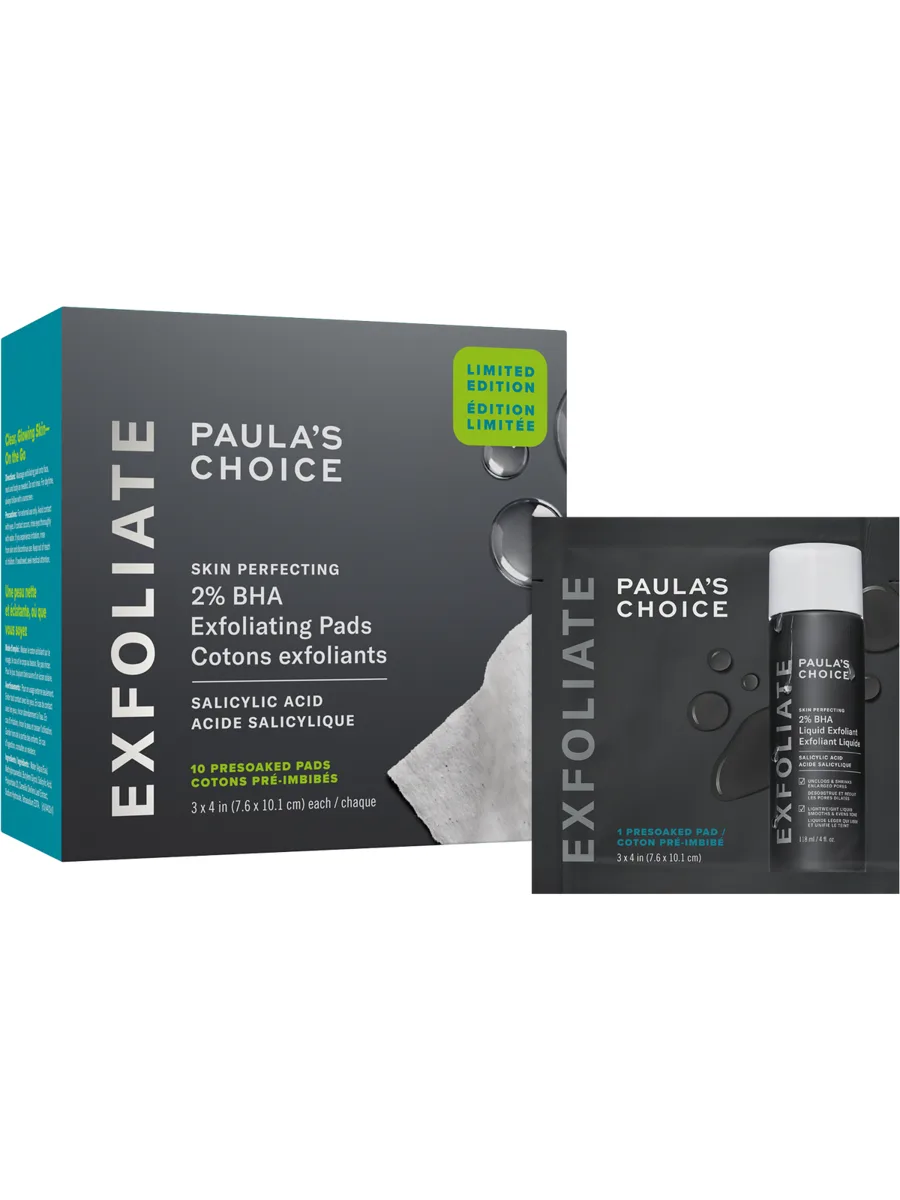
The most recognised leave-on salicylic acid in the category, unchanged, sealed into ten single-use pads — the same eight ingredients and the same pH as the four-ounce bottle, redesigned for the situations the bottle handles badly: travel, the gym, hotel bathrooms and the middle of the back. It is a format decision, not a formula one, and it should be judged that way.
The most famous 2 percent salicylic acid in skincare, unchanged, sealed into ten single-use pads — which makes it an excellent travel companion and a superb way to reach a back full of clogged pores, and an expensive way to do what a bottle does for a fraction of the price. The formula earns every bit of its reputation; the format earns its premium only in the situations the bottle handles badly.
The pads were introduced in 2025 and sit on the same paulaschoice.com listing as the 2% BHA Liquid, sharing its multi-thousand review pool, so the visible ratings describe the formula rather than the pad experience. The formula's record spans two decades and needs no qualification; pad-specific feedback on saturation, dosing and travel durability is a smaller and newer body of reports, and this assessment treats the pads' performance as inherited from the liquid's.
Verdicts
How well it fits each concern
Verdict by concern tap a concern for the case
Strong choicefor BlackheadsIn your profileYou chose · Salicylic Acid is an approved or monograph active for blackheads; this pad carries it at 2%.Moderate evidenceStandard tolerabilityNo reviews collected yet
The case for it
Salicylic Acid 2% is a first-line active — approved, monograph-listed or named in current guidelines — for this concern.
It is present at an effective concentration, declared or high in the ingredient list.
The formula carries no trigger this concern is sensitive to, with the cautions noted.
Cautions: fungal-acne triggers.
Same rule for everyone. “Strong choice” is the verdict on 1,459 of 45,024 concern verdicts across the catalog; rule R2 decided 892 of them.
As of September 25, 2026, engine 5.1.1.
R2 — A regulator- or guideline-recognised first-line active, declared at an effective strength, in a form the claim supports. · the full register
Carrying active
Salicylic Acid 2%
Standing
first line — a regulator recognises it for this use; trials support it · per 21 CFR § 333.350 - Labeling of acne drug products. (US Code of Federal Regulations (Legal Information Institute, Cornell Law School)), opened July 27, 2026
Form
adequate (declared 2%) — studied range 0.5–2%, from the OTC monograph or label; judge it after ~6 weeks
Tolerability
standard — fungal triggers
Row checked
against its sources on July 27, 2026 (evidence table ev-2026.09-r228)
The studies behind the evidence row
OTC monograph, Topical Acne Drug Products — salicylic acid 0.5–2% recognized as an acne treatment active — US Food and Drug Administration
Not for thisfor Large PoresIn your profileYou chose · The actives here have been researched for large pores and the evidence does not support the claim.Not yet assessedStandard tolerabilityNo reviews collected yet
The case for it
Salicylic Acid 2% has been researched for this concern and the evidence does not support it.
It is present at an effective concentration, declared or high in the ingredient list.
The formula carries no trigger this concern is sensitive to, with the cautions noted.
Same rule for everyone. “Not for this” is the verdict on 488 of 45,024 concern verdicts across the catalog; rule R10 decided 488 of them.
As of September 25, 2026, engine 5.1.1.
Good choicefor Rough TextureIn your profileYou chose · Salicylic Acid is a reference standard by mechanism for rough texture; this pad carries it at 2%.Moderate evidenceStandard tolerabilityNo reviews collected yet
The case for it
Salicylic Acid 2% has trial-supported standing for this concern.
It is present at an effective concentration, declared or high in the ingredient list.
The formula carries no trigger this concern is sensitive to, with the cautions noted.
Same rule for everyone. “Good choice” is the verdict on 9,564 of 45,024 concern verdicts across the catalog; rule R5 decided 9,072 of them.
As of September 25, 2026, engine 5.1.1.
Strong choicefor AcneIn your profileYou chose · Salicylic Acid is an approved or monograph active for acne; this pad carries it at 2%.Moderate evidenceStandard tolerabilityNo reviews collected yet
The case for it
Salicylic Acid 2% is a first-line active — approved, monograph-listed or named in current guidelines — for this concern.
It is present at an effective concentration, declared or high in the ingredient list.
The formula carries no trigger this concern is sensitive to, with the cautions noted.
Cautions: fungal-acne triggers.
Same rule for everyone. “Strong choice” is the verdict on 1,459 of 45,024 concern verdicts across the catalog; rule R2 decided 892 of them.
As of September 25, 2026, engine 5.1.1.
R2 — A regulator- or guideline-recognised first-line active, declared at an effective strength, in a form the claim supports. · the full register
Carrying active
Salicylic Acid 2%
Standing
first line — a regulator recognises it for this use; trials support it · per § 333.310 Acne active ingredients. (U.S. Food and Drug Administration — 21 CFR Part 333 Subpart D (Topical Acne Drug Products), Code of Federal Regulations via GovInfo), opened July 27, 2026
Form
adequate (declared 2%) — studied range 0.5–2%, from the OTC monograph or label; judge it after ~6 weeks
Tolerability
standard — fungal triggers
Row checked
against its sources on July 27, 2026 (evidence table ev-2026.09-r228)
A verdict is DermApproved’s assessment of how well a product’s ingredients fit a concern — never a claim about what the product treats. Evidence dots and collected reviews sit beside it and are never blended in.
Rules 0.5.1 · evidence table ev-2026.09-r228 · how we decide
Assessment
Pros & Cons
Pros
✓ Identical eight-ingredient formula to the category's reference 2 percent BHA
✓ One pad covers face, neck and chest, and reaches the back the bottle cannot
✓ Sealed foil sachets are leak-proof and carry-on-friendly
✓ Fragrance-free, alcohol-free, oil-free and buffered to the right pH
✓ No cotton rounds, measuring or spills
✓ Sensible trial format before committing to the four-ounce bottle
✓ Backed by two decades of use of the underlying liquid
Cons
✗ Roughly five times the per-use cost of the same formula in a bottle
✗ Only ten pads per pack — a travel supply, not a routine
✗ Pads feel less saturated than a drenched cotton round
✗ Ten single-use foil sachets per pack is a lot of packaging
✗ Shares its review pool with the liquid, so pad-specific feedback is thin
✗ Same 2 percent strength — no gentler for sensitive skin than the liquid
Review
Full Review
There is exactly one thing to evaluate about Paula's Choice's 2% BHA Exfoliating Toner Pads, and it is not the formula. The ingredient list — water, methylpropanediol, butylene glycol, salicylic acid, polysorbate 20, green tea extract, sodium hydroxide, tetrasodium EDTA — is the 2% BHA Liquid Exfoliant's, in the same order at the same declared 2 percent and the same pH, and that liquid has spent two decades as the reference product of the leave-on salicylic acid category. The pads add nothing to it and take nothing away. What they change is how it gets from the packaging to the skin, and so the honest review is a review of a format: what a sealed, pre-soaked, single-use pad does that a four-ounce bottle and a cotton round do not, and what it costs.
First, briefly, what the formula does, because the pads inherit all of it. Two percent salicylic acid in a water-and-glycol base with no alcohol dissolves into the sebum-filled lining of the pore and loosens the dead-cell plugs that become blackheads, and over the surface it thins the compacted top layer that reads as rough texture. It is buffered to a mildly acidic pH at which the acid is active but not harsh, and the green tea extract is a small antioxidant courtesy that has been there since the beginning. On oily, combination and resilient normal skin it produces smoother texture within days and clearer pores within two to four weeks; on sensitive or rosacea-prone skin it can sting and dry, which is why the brand now sells a 1 percent gel for those faces. It is fragrance-free, oil-free and about as simple as a leave-on acid gets. None of this needed re-proving, and the pads do not attempt to.
Now the format. A pad is a soft, thin fibre soaked in the solution and sealed in a foil sachet, ten to a carton. Tear one open, swipe it over clean, dry skin, and the first thing you notice is how far it goes — face, neck and the whole chest from one pad, with enough left in the fibre for the shoulders. That reach is the format's best argument. Anyone who has tried to apply a liquid to the middle of their back with a cotton round knows it does not work; a pad held in the hand does, and salicylic acid is the standard leave-on for the clogged pores behind back and chest breakouts and for keratosis pilaris on the upper arms. The second argument is travel. The four-ounce bottle is a liquid that spills, exceeds carry-on limits, and needs cotton rounds packed beside it; ten sachets weigh nothing, cannot leak and go through security without a thought. The third is the gym bag, the office drawer and the overnight stay, where a sealed dose is simply easier. In all of those places the pads are a genuinely good product.
The experience on the skin is the liquid's, with one small difference. The pad feels a little less wet than a drenched cotton round, and a few users read that as under-dosing; it is not — the solution is in the fibre and transfers on contact — but it does mean pressing rather than skating the pad across the skin, and it does mean a first-time user should not expect the dripping-wet feel of the bottle. The tingle on the nose and chin, the minute of faint slickness before it sets, the smooth feel by morning: all identical. The cautions are identical too. It is a leave-on acid, so no rinsing, no other exfoliating acid in the routine, a retinoid on alternate nights rather than the same one, and sunscreen every morning as a condition of use rather than a suggestion.
Then the arithmetic, which is where the format asks for a decision. Sixteen dollars for ten pads is roughly a dollar and sixty cents per use. The four-ounce liquid sells for thirty-seven dollars and, at a few drops per application, yields well over a hundred uses, which puts the per-use cost at a few tens of cents. The pads are, per swipe, five or more times the price of the same formula in a bottle. That is not a scandal — single-dose sachets are expensive to fill and seal, and every brand's pads carry the same premium — but it is the whole trade. Nobody should use these as their daily face exfoliant at home; the bottle does that job for a fraction of the cost and with less packaging. The pads are for the situations the bottle handles badly, and a pack of ten is sized as a travel and trial supply rather than a course: three weeks at three uses a week, ten days used daily.
One more thing about the record. On the brand's site the pads share a listing and a review pool with the liquid, so the thousands of reviews visible there describe the formula rather than the format. The formula's record is as deep as any in the category. The pad-specific record — saturation consistency, dose per swipe, whether a sachet dries out in a hot bag — is smaller and newer, dating from the 2025 introduction, and the early complaints are the ones any pad product attracts: less wet than expected, expensive, wasteful. The praise is the reach and the convenience. Both are accurate.
So: buy the bottle for home, and buy these for the plane, the gym and the back. Used that way the pads are one of the more sensible travel skincare purchases available, carrying a formula that needs no defence into places it could not previously go. Used as a replacement for the bottle they are a dollar-sixty swipe of a thirty-seven-dollar formula, and the brand that spent decades teaching people to read value would, one suspects, tell you the same.
Formula
Key Ingredients
The hero actives that drive this product's performance.
Fourth of eight ingredients at a declared 2 percent, the same dose and the same eight-ingredient formula as the brand's flagship liquid, pre-soaked into a pad. It dissolves into the pore lining, loosens the dead-cell plugs behind blackheads and rough texture, and is buffered by sodium hydroxide to the mildly acidic pH at which it works; the pad changes how it is applied, not what it does.
Established mechanismfor Rough Texture · established mechanism
Second in the list — the solvent-humectant that keeps 2 percent salicylic acid dissolved in a water base without alcohol, and the reason the liquid formula has always felt slightly slick rather than astringent. In a pad it also keeps the fibre wet in its sachet and gives the swipe its glide.
The formula's single botanical, sixth of eight, a polyphenol antioxidant with a mild anti-redness role that the brand has carried in this product for two decades. It is a supporting ingredient at a supporting dose, not a reason to buy, and its presence is mostly a sign the formula has not changed.
A mild solubiliser fifth in the list that helps the salicylic acid and green tea stay evenly dispersed in the liquid — and, in a pad, helps the solution wet the fibre uniformly so every swipe delivers the same dose rather than a wet first pad and a dry last one.
Not yet assessed
Ingredient standings describe the active at treatment-level doses and
vehicles; this product's own condition grades weigh its actual formula.
Swipe over clean, dry skin and leave it — no rinsing — then follow with serum and moisturiser once it has set, and sunscreen in the morning. One pad covers the face and neck with enough left for the chest or back, which is where the format shines; it should not share a routine with another leave-on acid, and a retinoid belongs on the nights the pad is not used.
Results Timeline
Skin feels smoother after the first pad and looks it within a few days; blackheads and clogged pores clear over two to four weeks of regular use, the same timeline as the liquid, since the formula is identical. The ten-pad pack is a trial or travel supply rather than a course — at three uses a week it lasts about three weeks, which is long enough to know whether the formula suits.
Pairs Well With
a hydrating serum or moisturiser over the topa retinoid on alternate nightsdaily sunscreen
THIS PRODUCT — swipe face, neck, chest; do not rinse
Moisturiser
Sunscreen
Sample PM Routine
Cleanser
THIS PRODUCT (or retinoid on alternate nights)
Moisturiser
Evidence
Science & Expert Perspective
The Science
The pads carry a formula whose evidence is as settled as any in cosmetic dermatology, so the scientific questions worth asking are about delivery rather than mechanism. Salicylic acid is a lipophilic beta hydroxy acid that partitions into the follicular canal and reduces corneocyte cohesion; leave-on products at 2 percent — the upper limit of the FDA's over-the-counter acne monograph — have controlled evidence for reducing comedones and improving surface texture, and the alcohol-free water-glycol vehicle used here has a long record of tolerability. The sodium hydroxide buffer sets a mildly acidic pH at which a meaningful fraction of the acid is in its active, un-ionised form without the irritation of a lower pH, and the absence of fragrance, alcohol and oil removes the usual confounders.
What a pad changes is dose uniformity and contact. A pre-soaked fibre delivers a fixed volume of solution per sachet, which in principle standardises the dose more than a user-poured cotton round, and polysorbate 20 helps the solution wet the fibre evenly. The transfer of liquid from pad to skin depends on pressure and on how much solution the fibre holds, and it is normal for a pad to deposit a thinner film than a saturated cotton round — the concentration in that film is unchanged, and leave-on salicylic acid's effect over hours depends on concentration and contact time rather than film thickness. The fibre itself is too soft to contribute mechanical exfoliation of any consequence.
Stability is the other format question. Salicylic acid solutions are stable at this pH, and a sealed foil sachet protects the solution from evaporation and light better than an opened bottle does; the practical caveat is that an opened sachet must be used at once, and that heat can dry the fibre if a carton is left in a hot car. No published study compares pad and liquid delivery of this formula, and the pads' performance is inferred from the liquid's.
Dermatologist Perspective
Two percent leave-on salicylic acid is a standard first-line recommendation in dermatology for comedonal acne, blackheads, enlarged pores and keratosis pilaris, and this formula in particular is one clinicians frequently name because it is alcohol-free, fragrance-free and well tolerated on oily and combination skin. The pad format would be regarded as clinically equivalent to the liquid and practically superior for truncal use — patients with back and chest acne are often advised to use pads precisely because application to those areas is otherwise difficult — and for adherence while travelling. The usual cautions carry over unchanged: not for eczematous or barrier-compromised skin, caution in rosacea, no stacking with other leave-on acids, daily photoprotection, and a lower-strength alternative for reactive faces. Dermatologists would also note, plainly, that the per-use cost makes the pads a supplement to the bottle rather than a substitute for most patients.
Guidance
Usage & Recommendations
How to Use
Tear open one sachet and unfold the pad. On clean, dry skin, swipe it over the face and neck, avoiding the eyelids and lash line, then continue over the chest, shoulders or back if wanted — one pad has enough solution for all of it if pressed rather than skated. Do not rinse; allow a minute for the faint slickness to set, then apply serum, moisturiser and, in the morning, a broad-spectrum sunscreen. Use once or twice daily as tolerated, starting at every other day on skin new to leave-on BHA, and keep a retinoid to the nights the pad is not used. Discard each pad after a single use, and store the carton away from heat so the sachets do not dry out.
Value Assessment
Sixteen dollars for ten pads is about a dollar and sixty cents per application, against a few tens of cents per use from the thirty-seven-dollar four-ounce liquid that contains the identical formula — a premium of five-fold or more for convenience, portability and reach. That premium is in line with single-dose pads across the category and is worth paying for travel, gym bags and back-and-shoulder use; it is poor value as a daily at-home face exfoliant, where the bottle is the obvious choice. There is one pack size. Paula's Choice's established reputation is entirely earned by the formula inside, which needs no defence; the pads are a well-executed format that should be bought for the situations that call for it and not as a routine.
Who Should Buy
Existing users of the 2% BHA Liquid who travel, go to the gym or want a leave-on salicylic acid that can reach their back and shoulders, and newcomers who want to trial the category's reference formula before committing to a full bottle. Oily, combination and resilient normal skin with blackheads, enlarged pores or body breakouts will get the most from them.
Who Should Skip
Anyone looking for a daily at-home face exfoliant, for whom the four-ounce liquid is the same formula at a fraction of the per-use cost; people with sensitive, rosacea-prone or barrier-compromised skin, who should look to the brand's 1 percent gel; and anyone who objects to single-use foil packaging. Pregnant users should ask their clinician about leave-on salicylic acid.
Ready to try Paula's Choice 2% BHA Exfoliating Toner Pads?
A soft, thin fibre pad soaked in a clear, slightly slick liquid that glides over the skin and leaves a faint glycol sheen that sets within a minute
Scent
None — fragrance-free, with a faint neutral note of the glycol solution
Packaging
Ten individually sealed foil sachets in a slim white-and-teal carton — hygienic, leak-proof and built for travel and gym bags, at the cost of ten pieces of single-use packaging per pack
Finish
lightweightsatin
What to Expect on First Use
The first pad is familiar to anyone who has used the liquid: a cool glide, a faint tingle on the nose and chin that fades in a minute, no sting on tolerant skin, and a smooth feel by morning. The surprise is how far one pad goes — face, neck and chest from a single sachet — and, for some, that the pad feels a little less wet than a soaked cotton round would.
How Long It Lasts
About three weeks at three uses a week, or ten days of daily use; a travel and trial supply rather than a routine's worth
Paula's Choice's 2% BHA Liquid Exfoliant became a category-defining product over two decades, and its one persistent complaint was logistics — a bottle that spills in luggage, needs a cotton round, and cannot easily reach a back or shoulders. The pads arrived in 2025 as the answer, soaking the unchanged formula into individually wrapped sachets and listing alongside the liquid on the brand's site as a format option rather than a new product.
About Paula's Choice Established Brand (5–20 years)
Paula's Choice, founded in 1995 and owned by Unilever since 2021, built its reputation on fragrance-free, evidence-minded formulas, and its 2% BHA Liquid Exfoliant is the single most recognised leave-on salicylic acid in the category. These pads carry that formula into a single-use format; the credibility is inherited from a product with two decades of use, not earned separately by the pads themselves.
Brand founded: 1995 · Product launched: 2025
Myth vs. Reality
Common Myths
Myth
The pads are a gentler or weaker version of the 2% BHA Liquid.
Reality
The ingredient list is identical, down to the order and the pH. A pad may feel slightly less wet than a drenched cotton round, but the concentration on the skin is the same 2 percent salicylic acid, and the results and the cautions are the liquid's.
Myth
A pad exfoliant scrubs the skin, so it works faster than a liquid.
Reality
The pad's fibre is soft and does no mechanical exfoliation worth the name; it is a delivery vehicle. Leave-on salicylic acid works chemically over hours inside the pore, and swiping harder or longer adds irritation, not speed.
FAQ
Frequently Asked Questions
Are the Paula's Choice 2% BHA Exfoliating Toner Pads the same formula as the 2% BHA Liquid?
Yes — the same eight ingredients in the same order at the same 2 percent salicylic acid and the same pH, soaked into a pad. The brand lists the pads as a format of the liquid on its site, and the results, the tingle and the sunscreen requirement are identical.
How many uses are in a pack of the 2% BHA Toner Pads?
Ten individually sealed pads, one use each. One pad covers the face and neck with enough left for the chest or upper back, which is where the format earns its keep; the pack is a travel or trial supply rather than a month's routine.
Should I rinse after using the 2% BHA Exfoliating Toner Pads?
No. Like the liquid, the pads are a leave-on exfoliant — swipe over clean, dry skin, avoid the eyelids and lash line, let it set and follow with moisturiser. In the morning, sunscreen is essential.
Can the 2% BHA pads be used on body acne?
Yes, and it is one of the best reasons to buy them. A pad reaches the back, shoulders and chest far more easily than a liquid on a cotton round, and salicylic acid is the standard leave-on for the clogged pores behind body breakouts and keratosis pilaris.
Why do the Paula's Choice BHA pads cost more per use than the bottle?
Single-dose sachets are expensive to fill and package, and ten pads for sixteen dollars works out at well over a dollar a use against a few cents per application from the four-ounce liquid. The premium is for convenience and portability, not for a better formula.
Are the 2% BHA Toner Pads suitable for sensitive skin?
Only as much as the liquid is, which is to say cautiously: 2 percent leave-on salicylic acid can sting or dry reactive and rosacea-prone skin, and the brand's own 1 percent gentle gel is the version made for it. The pad format does not make the formula milder.
Reviews
What Reviewers Tend to Say
Recurring themes our editors read across retailer reviews of this product — summaries in our words, not quotations, and not a substitute for your own patch test.
Common Praise
Sealed sachets make it easy to travel with the 2% BHA formula
Reaches the back and shoulders in a way the liquid bottle does not
One pad covers face, neck and chest with product to spare
No spills, no cotton rounds, no measuring
Common Complaints
Far more expensive per use than the bottle
Only ten pads in a pack
Pads can feel less saturated than expected
Single-use sachets generate packaging waste
Notable Endorsements
Same formula as the brand's flagship 2% BHA Liquid Exfoliant, a two-decade category reference
The whole case for salicylic acid rests on one unglamorous fact of chemistry: it dissolves in oil. Understand that, and you know exactly when it beats a glycolic acid — and when it's overkill.
Those tiny dots on your nose are almost certainly not blackheads — they're normal, functional plumbing you will never 'clear,' and the extraction obsession is quietly wrecking the skin around them.
Adult hormonal acne and teenage acne are different beasts, yet grown women keep drying out deep jawline cysts with teenage products and wondering why it spreads.
May 30, 2026· 5 min
Questions people ask about Acne
Verified answers from our questions library — the nuance a product page cannot carry.
Products, answers, therapy guides, tools and articles in one search. Brand names,
slang and abbreviations all work — accutane finds isotretinoin, bacne finds truncal acne.