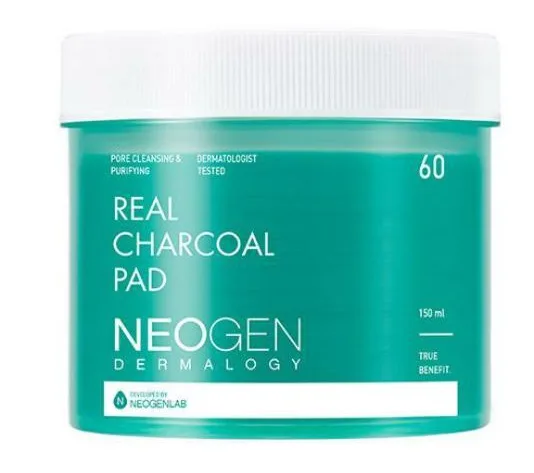
Where most charcoal pads stop at charcoal and alcohol, this one stacks bamboo charcoal with kaolin, calamine, and Canadian glacial and Hungarian moor clays, then adds a slow LHA-PHA exfoliating pair. The adsorbent breadth is genuinely unusual — as is the maximalist essential-oil blend that comes with it.
A thorough charcoal-and-clay deep-cleansing pad with gentle LHA-PHA exfoliation that genuinely mattifies and decongests oily skin. Its weakness is a heavy essential-oil blend that makes it bracing for fans and risky for anyone with reactive or fragrance-sensitive skin.
With the pad on shelves only since around 2019 and carrying several hundred retailer reviews rather than a deep long-term record, this rating leans on the formulation and Neogen's established pad-making history more than on years of accumulated feedback. The unusually long essential-oil list also means individual tolerance diverges widely, so your own patch test is a more reliable guide here than the average score.
Verdicts
How well it fits each concern
Verdict by concern tap a concern for the case
Promisingfor Excess OilinessIn your profileYou chose · Salicylic Acid has trial-level evidence for excess oiliness but no guideline or regulatory standing yet — promising, short of a recommendation; the other actives here are not yet assessed for it.Moderate evidenceStandard tolerabilityNo reviews collected yet
The case for it
Capryloyl Salicylic Acid has trial-level evidence for this concern but no guideline or regulatory standing yet.
It is plausibly present at a working level, though the concentration is not declared.
The formula carries no trigger this concern is sensitive to, with the cautions noted.
What would change this: A declared concentration would move this to a firmer reading of the dose.
Same rule for everyone. “Promising” is the verdict on 7,858 of 45,024 concern verdicts across the catalog; rule R9p decided 7,858 of them.
Unchanged since September 5, 2026, engine 5.1.1.
R9p — 0.5.0: 'Unproven' beside three filled dots read as one question answered twice with opposite words (7,018 rows). The chip measures standing, the dots measure trial volume; where the row carries at least one RCT or a tier-2 source (moderate dots) and the active is present at a working level, the honest word is Promising. Unproven is reserved for plausible-standing rows with limited or weak evidence, or an under-dosed form. Same rank as Unproven — a bet either way; the dots order them. · the full register
Carrying active
Capryloyl Salicylic Acid
Standing
plausible — trials support it
Form
plausible — studied range 30%, from the trials on the row; needs leave-on contact; judge it after ~6 weeks
Tolerability
standard
Row checked
against its sources on July 17, 2026 (evidence table ev-2026.09-r228)
Strong choicefor BlackheadsIn your profileYou chose · Salicylic Acid is an approved or monograph active for blackheads; this pad carries it, though the concentration is not declared.Moderate evidenceStandard tolerabilityNo reviews collected yet
The case for it
Capryloyl Salicylic Acid is a first-line active — approved, monograph-listed or named in current guidelines — for this concern.
It is plausibly present at a working level, though the concentration is not declared.
The formula carries no trigger this concern is sensitive to, with the cautions noted.
What would change this: A declared concentration would move this to a firmer reading of the dose.
Same rule for everyone. “Strong choice” is the verdict on 1,459 of 45,024 concern verdicts across the catalog; rule R3 decided 567 of them.
Unchanged since September 5, 2026, engine 5.1.1.
R3 — Undeclared but plausibly dosed (top-third INCI position, or a potent sub-1% active) — the verdict stands, and the sentence says what disclosure would add. A declared figure below range would have been sub-threshold. · the full register
Carrying active
Capryloyl Salicylic Acid
Standing
first line — a regulator recognises it for this use; trials support it · per 21 CFR § 333.350 - Labeling of acne drug products. (US Code of Federal Regulations (Legal Information Institute, Cornell Law School)), opened July 27, 2026
Form
plausible — studied range 0.5–2%, from the OTC monograph or label; judge it after ~6 weeks
Tolerability
standard
Row checked
against its sources on July 27, 2026 (evidence table ev-2026.09-r228)
The studies behind the evidence row
OTC monograph, Topical Acne Drug Products — salicylic acid 0.5–2% recognized as an acne treatment active — US Food and Drug Administration
Not for thisfor Large PoresIn your profileYou chose · The actives here have been researched for large pores and the evidence does not support the claim.Not yet assessedStandard tolerabilityNo reviews collected yet
The case for it
Capryloyl Salicylic Acid has been researched for this concern and the evidence does not support it.
It is plausibly present at a working level, though the concentration is not declared.
The formula carries no trigger this concern is sensitive to, with the cautions noted.
What would change this: A declared concentration would move this to a firmer reading of the dose.
Same rule for everyone. “Not for this” is the verdict on 488 of 45,024 concern verdicts across the catalog; rule R10 decided 488 of them.
Unchanged since September 5, 2026, engine 5.1.1.
Strong choicefor AcneIn your profileYou chose · Salicylic Acid is an approved or monograph active for acne; this pad carries it, though the concentration is not declared.Moderate evidenceStandard tolerabilityNo reviews collected yet
The case for it
Capryloyl Salicylic Acid is a first-line active — approved, monograph-listed or named in current guidelines — for this concern.
It is plausibly present at a working level, though the concentration is not declared.
The formula carries no trigger this concern is sensitive to, with the cautions noted.
Cautions: fragrance; known irritants.
What would change this: A declared concentration would move this to a firmer reading of the dose.
Same rule for everyone. “Strong choice” is the verdict on 1,459 of 45,024 concern verdicts across the catalog; rule R3 decided 567 of them.
Unchanged since September 5, 2026, engine 5.1.1.
R3 — Undeclared but plausibly dosed (top-third INCI position, or a potent sub-1% active) — the verdict stands, and the sentence says what disclosure would add. A declared figure below range would have been sub-threshold. · the full register
Carrying active
Capryloyl Salicylic Acid
Standing
first line — a regulator recognises it for this use; trials support it · per § 333.310 Acne active ingredients. (U.S. Food and Drug Administration — 21 CFR Part 333 Subpart D (Topical Acne Drug Products), Code of Federal Regulations via GovInfo), opened July 27, 2026
Form
plausible — studied range 0.5–2%, from the OTC monograph or label; judge it after ~6 weeks
Tolerability
standard — fragrance load, irritant load
Row checked
against its sources on July 27, 2026 (evidence table ev-2026.09-r228)
Good choicefor Rough TextureIn your profileYou chose · Salicylic Acid is a reference standard by mechanism for rough texture; this pad carries it.Moderate evidenceStandard tolerabilityNo reviews collected yet
The case for it
Capryloyl Salicylic Acid has trial-supported standing for this concern.
It is plausibly present at a working level, though the concentration is not declared.
The formula carries no trigger this concern is sensitive to, with the cautions noted.
What would change this: A declared concentration would move this to a firmer reading of the dose.
Same rule for everyone. “Good choice” is the verdict on 9,564 of 45,024 concern verdicts across the catalog; rule R5 decided 9,072 of them.
Unchanged since September 5, 2026, engine 5.1.1.
A verdict is DermApproved’s assessment of how well a product’s ingredients fit a concern — never a claim about what the product treats. Evidence dots and collected reviews sit beside it and are never blended in.
Rules 0.5.1 · evidence table ev-2026.09-r228 · how we decide
Assessment
Pros & Cons
Pros
✓ Charcoal, kaolin, and calamine genuinely mattify and decongest oily skin
✓ Gentle LHA-PHA pair exfoliates without high-percentage acids
✓ Visibly loosens blackheads over a few weeks of use
✓ Refreshing herbal scent for those who enjoy essential oils
✓ Convenient pre-soaked pad format with saturation-keeping lid
✓ Effective deep-clean reset for congestion-prone, oily skin
Cons
✗ Heavy essential-oil blend raises irritation risk significantly
✗ Strong herbal scent is polarizing and hard to avoid
✗ Poor fit for dry, sensitive, or reactive skin
✗ Clays leave a slight tightness without a follow-up moisturizer
✗ Smaller 60-pad count runs out fast with daily use
Review
Full Review
There is a particular kind of skincare product that wants to do everything at once, and the Real Charcoal Pad is its patron saint. Open the tub and you are not really buying a charcoal pad so much as a small geology and botany expedition: Canadian glacial clay, Hungarian moor mud, kaolin, calamine, bamboo-derived charcoal, and then a startling parade of essential oils — orange, bergamot, lavender, eucalyptus, peppermint, basil, geranium, litsea. Neogen clearly set out to build the most thorough deep-cleansing pad it could imagine. Whether that maximalism is a feature or a liability depends almost entirely on how much your skin enjoys a bouquet of plant oils, and that tension runs through the whole product.
Mechanically, this is a textured microfiber pad soaked in a dark, slightly gritty essence, sold as 60 pads in a 150ml tub. The exfoliating logic mirrors Neogen's gentler cica pad: rather than reaching for high-percentage glycolic or salicylic acid, it uses capryloyl salicylic acid, the slow lipophilic LHA, alongside gluconolactone, a humectant polyhydroxy acid. That combination resurfaces gradually and keeps water at the surface, which is the right call for a pad meant to be swept across oily, congested skin without leaving it raw. The charcoal and the clays — kaolin, calamine, and the various glacial and moor muds — are there for the physical adsorption story: pulling sebum and grime out of the pore and onto the pad. On oily skin after a long day, that adsorbent action is genuinely satisfying and the pad comes away visibly doing its job.
Around that core sits a busy supporting cast. Glutathione and cyanocobalamin nod toward brightening, caffeine toward a temporary tightening, and a scattering of botanicals — gardenia, evening primrose, kudzu root, ginger, peppermint — fill out the label. Guaiazulene and propolis lend a faint soothing-and-antibacterial angle. It is a long INCI list, and much of it is present at the trailing, fractional end, so the realistic read is that the pad's actual work comes from the charcoal, clays, and the LHA-PHA pair, with the rest contributing scent and marketing copy more than measurable benefit. That is not a knock so much as a reality of how these kitchen-sink formulas are built.
The essential oils, though, are not a trailing footnote — they sit high enough on the list to define the experience. The pad smells herbal and bracing, almost like a spa steam room, and that aroma is the product's most divisive trait. For resilient, oily skin that has never met an essential oil it didn't like, the scent reads as fresh and clarifying and the oils add a mild astringent character. For anyone whose skin is even slightly reactive, this is a formula to approach with real caution: lavender, eucalyptus, peppermint, bergamot, and citrus oils are among the more common botanical sensitizers, and stacking that many in one wipe meaningfully raises the odds of stinging, redness, or a delayed reaction. The high clay-and-charcoal cleansing power and the gentle acids are the good news; the essential-oil load is the asterisk that follows them everywhere.
In daily use on oily and combination skin, the pad performs its core job well. Swept over cleansed skin, it lifts away the day's sebum and leaves the surface matte, smooth, and noticeably less congested, with blackheads loosening over a couple of weeks of regular use. It is best treated as a pre-moisturizer clarifying step rather than a standalone routine, since it does little to hydrate and the clays can leave a faint tightness that a follow-up moisturizer needs to address. Used a few times a week rather than daily, it slots in nicely as a deep-clean reset for skin that runs oily and breaks out around the nose and chin. Pushed to twice-daily on drier or sensitive skin, the combination of adsorbent clays and essential oils is more than most barriers will happily tolerate.
Value is reasonable without being remarkable. At around twenty-two dollars for sixty pads, the per-use cost is fair, though the smaller pad count relative to some of Neogen's other tubs means it runs out faster if you use it daily. You are paying for the breadth of the formula — the clays and charcoal are the real draw — and on that basis it earns its price for the right skin type. What you are not getting is a universally tolerable product; the essential oils take it out of the running for a meaningful slice of potential buyers, and that narrows the value proposition to oily, non-reactive skin specifically.
The honest summary is that this is a capable, enthusiastic deep-cleansing pad with a clear best-case user: someone with oily, resilient, congestion-prone skin who wants a charcoal-and-clay clarifying step with gentle chemical exfoliation built in, and who actively enjoys an herbal-essential-oil scent. For that person it is a genuinely good few-times-a-week treatment. For dry, sensitive, or fragrance-averse skin, the same qualities that make it appealing to oily skin make it a poor fit, and there are calmer charcoal options worth choosing instead. Neogen built something thorough and a little over-eager here, and the trick to liking it is knowing whether your skin shares its enthusiasm.
Formula
Key Ingredients
The hero actives that drive this product's performance.
The adsorbent headliner, working with the kaolin, calamine, and Canadian glacial clay to pull sebum and pore debris onto the pad. On oily skin it is the most visibly effective part of the formula, mattifying the surface in a single sweep.
The lipophilic salicylic derivative that handles slow chemical exfoliation inside the pore, complementing the physical adsorption of the charcoal and clays rather than competing with it. Its gradual action is what lets the pad be used more than once a week.
Established mechanismfor Rough Texture · established mechanism
A humectant polyhydroxy acid that resurfaces gently while drawing water to the surface, partly offsetting the tightness the clays would otherwise leave behind. It is the formula's main concession to keeping the deep-clean from feeling stripping.
The clay backbone that boosts oil absorption and lends a faint soothing, anti-redness quality from the calamine. Together with the charcoal they give the pad its purifying character for congested, oily skin.
Present alongside cyanocobalamin as the formula's brightening nod, though it sits low enough on the list that its role here is supportive rather than a primary reason to choose the pad.
Not yet assessed
Ingredient standings describe the active at treatment-level doses and
vehicles; this product's own condition grades weigh its actual formula.
Use as a clarifying step on cleansed skin before serums and moisturizer, and always follow with a hydrator since the clays leave a slight tightness. Keep it away from the same routine as a strong retinoid or high-percentage acid to avoid over-exfoliating.
Results Timeline
Skin looks matte and feels deep-cleaned right after the first use; blackheads and congestion loosen over two to three weeks of a few uses per week. Oil control reads most consistent by the four-week mark with regular use.
Pairs Well With
lightweight gel moisturizersniacinamide serumsbarrier creams
The deep-cleansing claim rests on adsorption rather than any chemical reaction with the skin: activated charcoal and clays such as kaolin and calamine have large, porous surfaces that bind sebum and surface debris, which is why they leave oily skin looking matte. The evidence for charcoal specifically is modest — it is effective as a physical adsorbent but is not shown to penetrate or clear pores at depth on its own — so the realistic benefit is surface oil control. The chemical exfoliation is the better-supported part. Capryloyl salicylic acid, the LHA, carries a fatty chain that keeps it lipophilic and slow-acting at the pore opening, and gluconolactone, a polyhydroxy acid, resurfaces gently while behaving as a humectant; both are repeatedly described in the dermatology literature as milder, more tolerable alternatives to traditional AHAs and BHA. The complicating factor is the essential-oil content. Oils like lavender, eucalyptus, peppermint, bergamot, and orange contain constituents — linalool, limonene, and related terpenes — that are well-documented contact sensitizers and can oxidize over time into more reactive forms. That is the mechanistic reason this pad's tolerance varies so much: the cleansing actives are sound, but the fragrance load introduces a genuine and individual irritation variable that no amount of charcoal offsets.
Dermatologist Perspective
Clay and charcoal cleansing steps are commonly suggested for oily, acne-prone patients as an occasional way to manage surface sebum, with the understanding that they control oil rather than treat acne at its root. The gentle acids here — a lipophilic salicylic derivative and a polyhydroxy acid — fit the usual guidance to favor milder exfoliants for routine use. Where clinicians tend to raise a flag is the essential-oil content: lavender, citrus, and eucalyptus oils are recognized contact allergens, so standard advice for sensitive, rosacea-prone, or barrier-compromised skin is to choose fragrance-free alternatives. For resilient, oily skin without a history of reactivity, a few-times-a-week deep-cleansing pad like this is generally viewed as a reasonable adjunct, always paired with a moisturizer and sunscreen to offset the clays' drying effect and the acids' sun sensitivity.
Guidance
Usage & Recommendations
How to Use
After cleansing, sweep one pad across the oilier zones of the face — nose, chin, forehead — using the textured side for a slightly deeper clean and avoiding the eye area. Let it absorb briefly, then follow with a hydrating, oil-free moisturizer to counter any tightness from the clays. Begin with two or three uses a week and only increase if your skin stays calm; resilient oily skin can work toward daily, but watch for stinging. Use sunscreen the next morning, since the exfoliating acids leave skin more sun-reactive, and skip pairing it with a retinoid in the same routine.
Value Assessment
At about twenty-two dollars for sixty pads, the value is fair for oily skin that will actually use it as intended. The per-use cost is reasonable, though the smaller pad count means it empties faster than Neogen's larger tubs if you reach for it daily. What you are paying for is the breadth of the adsorbent formula — bamboo charcoal plus kaolin, calamine, and glacial and moor clays — which is genuinely more elaborate than the typical charcoal-and-alcohol pad. The catch is that the same formula rules out a large share of buyers on the essential-oil content alone, so the value only holds up for oily, non-reactive skin. For that user it is a sensibly priced deep-clean; for everyone else, the money is better spent on a calmer option.
Who Should Buy
This is for oily, resilient, congestion-prone skin that wants a charcoal-and-clay deep-cleansing step with built-in gentle exfoliation, and that genuinely enjoys a strong herbal-essential-oil scent. If your skin runs greasy, breaks out around the nose and chin, and has never been bothered by botanical oils, it is a satisfying few-times-a-week clarifying treatment.
Who Should Skip
Skip it if your skin is dry, sensitive, rosacea-prone, or has a compromised barrier, since the clays and the large essential-oil blend are likely to irritate. Anyone who dislikes strongly scented products or reacts to lavender, citrus, or eucalyptus oils should choose a fragrance-free charcoal alternative instead of gambling on this one.
A textured microfiber pad loaded with a dark, faintly gritty essence that wipes on cool and leaves a matte surface.
Scent
Pronounced herbal-spa aroma of eucalyptus, peppermint, lavender, and citrus from the essential-oil blend.
Packaging
A wide tub with a screw lid and inner seal lid to keep the pads saturated; lift from the center with clean fingers or tweezers.
Finish
mattelightweight
What to Expect on First Use
First use feels bracing and clarifying, with a cool tingle from the menthol-adjacent oils and a noticeably matte after-feel. Watch for any lingering sting or redness in the first few days, which is the cue that the essential oils are too much for your skin; if all is calm, build to a few times a week.
How Long It Lasts
Roughly two months at near-daily use, or three to four months if you reserve it as a few-times-a-week deep clean.
The Real Charcoal Pad extends Neogen's signature dual-texture pad format into deep-cleansing territory, leaning on the brand's clay-and-charcoal sourcing story (glacial and moor muds) to differentiate it from the gentler Real Cica and Calming Cica pads in the same line.
About Neogen Established Brand (5–20 years)
Neogen has been a fixture of Korean skincare since 2001, and its Dermalogy pad range — Bio-Peel, Real Cica, Real Charcoal — is one of the most widely exported in the dual-texture pad category. The brand's long experience with the pad format shows in the construction even when the formula itself is ambitious.
Brand founded: 2000 · Product launched: 2019
Myth vs. Reality
Common Myths
Myth
Charcoal pads detoxify the skin by drawing out toxins.
Reality
Charcoal and clays adsorb surface sebum and debris onto the pad, which mattifies and decongests, but they do not remove toxins from the body. The visible benefit here is oil control and pore clearing, not detoxification.
FAQ
Frequently Asked Questions
Is the Neogen Real Charcoal Pad good for oily skin?
Yes — the charcoal, kaolin, and calamine adsorb excess sebum while the LHA and PHA gently exfoliate, which makes it well suited to oily, congestion-prone skin. Drier or sensitive skin is a much weaker match.
Does the Real Charcoal Pad contain fragrance or essential oils?
It has no synthetic fragrance, but it carries a large blend of essential oils including lavender, eucalyptus, peppermint, and citrus. That gives it a strong herbal scent and raises the chance of irritation, so patch testing is important.
How often should I use the Real Charcoal Pad?
A few times a week is the sweet spot for most people, used as a clarifying step. Daily use is possible on resilient oily skin but increases the risk of tightness and irritation from the clays and oils.
Will the Real Charcoal Pad dry out my skin?
The clays can leave a slight tightness, so it is best followed with a hydrating, oil-free moisturizer. It is not designed to hydrate on its own and works best as a deep-clean step rather than a leave-on treatment.
Can I use the Real Charcoal Pad if I have sensitive skin?
It is risky for sensitive or reactive skin because of the essential-oil content. If you want to try it, patch test on the jaw for several days first and stop at any sign of stinging or redness.
Does the charcoal pad help with blackheads?
It helps loosen and reduce the appearance of blackheads over a few weeks of regular use, thanks to the LHA working inside the pore and the clays pulling out surface oil. It manages rather than permanently eliminates them.
Reviews
What Reviewers Tend to Say
Recurring themes our editors read across retailer reviews of this product — summaries in our words, not quotations, and not a substitute for your own patch test.
Common Praise
Visibly deep-cleans and mattifies oily skin
Loosens blackheads with regular use
Refreshing herbal scent for those who like it
Common Complaints
Strong essential-oil scent is polarizing
Can sting or irritate sensitive skin
Slightly drying without a good follow-up moisturizer
The whole case for salicylic acid rests on one unglamorous fact of chemistry: it dissolves in oil. Understand that, and you know exactly when it beats a glycolic acid — and when it's overkill.
Polyhydroxy acids get filed under 'beginner exfoliant,' as if gentle meant weak. The truth is stranger: their bulk is exactly why they work for the skin everything else sets on fire.
Those tiny dots on your nose are almost certainly not blackheads — they're normal, functional plumbing you will never 'clear,' and the extraction obsession is quietly wrecking the skin around them.
Jun 6, 2026· 6 min
Questions people ask about Acne
Verified answers from our questions library — the nuance a product page cannot carry.
Products, answers, therapy guides, tools and articles in one search. Brand names,
slang and abbreviations all work — accutane finds isotretinoin, bacne finds truncal acne.