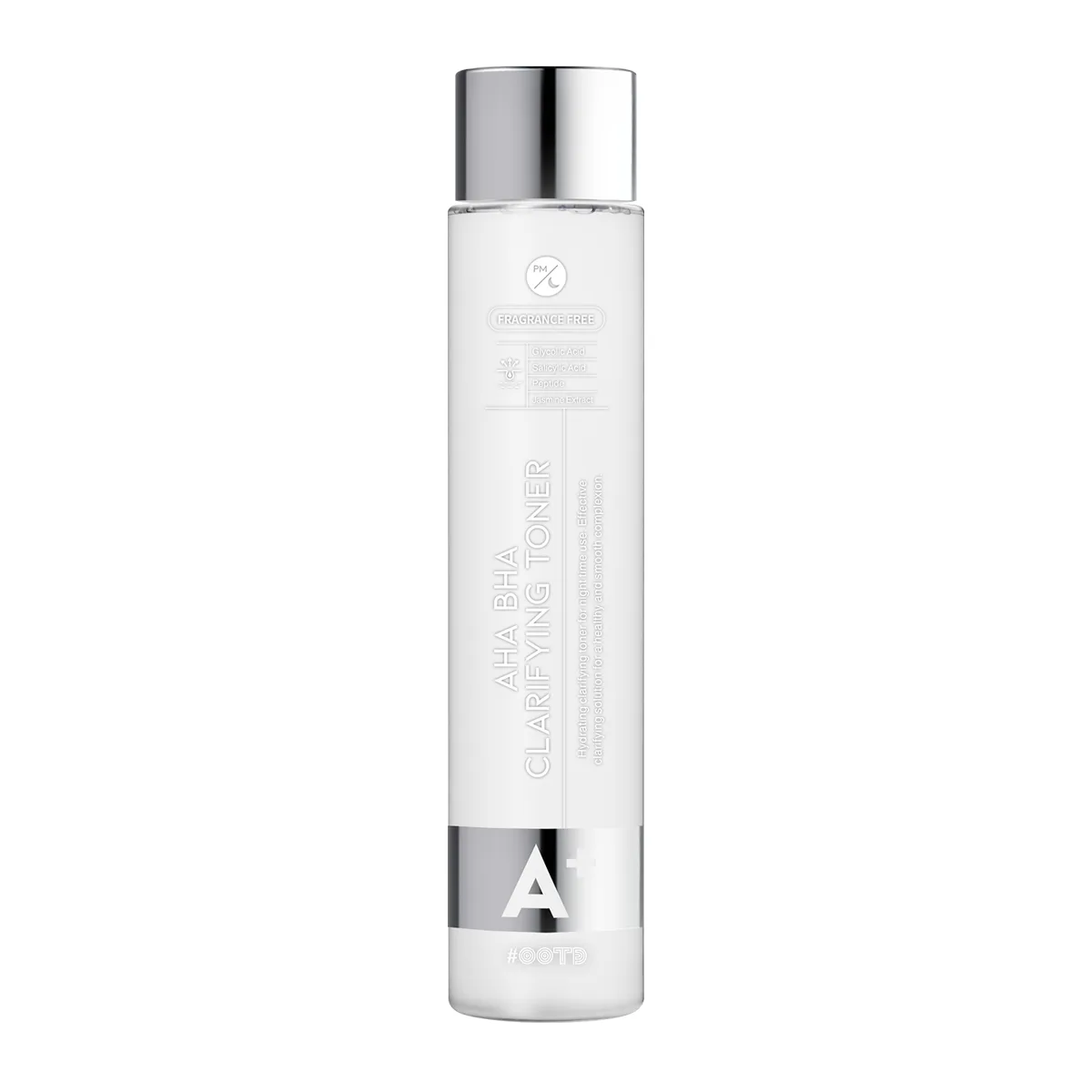
It combines three acid families — salicylic BHA, glycolic AHA, and gluconolactone PHA — then layers in soothing allantoin and a full peptide stack, so it exfoliates and supports recovery in one P.M. step. As the night half of OOTD's day/night system, it's tuned to clarify after the brand's morning plumping toner.
A thoughtfully built night exfoliator that does more than throw acids at your face: it stacks salicylic BHA, glycolic AHA, and gluconolactone PHA, then cushions them with allantoin and a peptide complex so it clarifies without the sting many acid toners deliver. The undisclosed percentages mean it skews gentle, but as a fragrance-free, vegan P.M. step for congestion-prone skin at $19, it's an easy recommendation for people who can't tolerate harsher exfoliants.
Selling since 2023, this toner has a moderate, still-accumulating review base rather than years of consensus, so the rating blends that early feedback with a transparent multi-acid INCI. Because OOTD doesn't publish the salicylic or glycolic percentages or the pH, the exact exfoliating strength is inferred from ingredient order and the buffered base, and the score could shift if formal concentration data emerges.
Verdicts
How well it fits each concern
Verdict by concern tap a concern for the case
Strong choicefor AcneIn your profileYou chose · Salicylic Acid is an approved or monograph active for acne; this liquid carries it, though the concentration is not declared.Moderate evidenceStandard tolerabilityNo reviews collected yet
The case for it
Salicylic Acid is a first-line active — approved, monograph-listed or named in current guidelines — for this concern.
It is plausibly present at a working level, though the concentration is not declared.
The formula carries no trigger this concern is sensitive to, with the cautions noted.
Cautions: fragrance; fungal-acne triggers.
What would change this: A declared concentration would move this to a firmer reading of the dose.
Same rule for everyone. “Strong choice” is the verdict on 1,459 of 45,024 concern verdicts across the catalog; rule R3 decided 567 of them.
Unchanged since September 5, 2026, engine 5.1.1.
R3 — Undeclared but plausibly dosed (top-third INCI position, or a potent sub-1% active) — the verdict stands, and the sentence says what disclosure would add. A declared figure below range would have been sub-threshold. · the full register
Carrying active
Salicylic Acid
Standing
first line — a regulator recognises it for this use; trials support it · per § 333.310 Acne active ingredients. (U.S. Food and Drug Administration — 21 CFR Part 333 Subpart D (Topical Acne Drug Products), Code of Federal Regulations via GovInfo), opened July 27, 2026
Form
plausible — studied range 0.5–2%, from the OTC monograph or label; judge it after ~6 weeks
Tolerability
standard — fragrance load, fungal triggers
Row checked
against its sources on July 27, 2026 (evidence table ev-2026.09-r228)
Strong choicefor BlackheadsIn your profileYou chose · Salicylic Acid is an approved or monograph active for blackheads; this liquid carries it, though the concentration is not declared.Moderate evidenceStandard tolerabilityNo reviews collected yet
The case for it
Salicylic Acid is a first-line active — approved, monograph-listed or named in current guidelines — for this concern.
It is plausibly present at a working level, though the concentration is not declared.
The formula carries no trigger this concern is sensitive to, with the cautions noted.
Cautions: fungal-acne triggers.
What would change this: A declared concentration would move this to a firmer reading of the dose.
Same rule for everyone. “Strong choice” is the verdict on 1,459 of 45,024 concern verdicts across the catalog; rule R3 decided 567 of them.
Unchanged since September 5, 2026, engine 5.1.1.
R3 — Undeclared but plausibly dosed (top-third INCI position, or a potent sub-1% active) — the verdict stands, and the sentence says what disclosure would add. A declared figure below range would have been sub-threshold. · the full register
Carrying active
Salicylic Acid
Standing
first line — a regulator recognises it for this use; trials support it · per 21 CFR § 333.350 - Labeling of acne drug products. (US Code of Federal Regulations (Legal Information Institute, Cornell Law School)), opened July 27, 2026
Form
plausible — studied range 0.5–2%, from the OTC monograph or label; judge it after ~6 weeks
Tolerability
standard — fungal triggers
Row checked
against its sources on July 27, 2026 (evidence table ev-2026.09-r228)
The studies behind the evidence row
OTC monograph, Topical Acne Drug Products — salicylic acid 0.5–2% recognized as an acne treatment active — US Food and Drug Administration
Not for thisfor Large PoresIn your profileYou chose · The actives here have been researched for large pores and the evidence does not support the claim.Not yet assessedStandard tolerabilityNo reviews collected yet
The case for it
Salicylic Acid has been researched for this concern and the evidence does not support it.
It is plausibly present at a working level, though the concentration is not declared.
The formula carries no trigger this concern is sensitive to, with the cautions noted.
What would change this: A declared concentration would move this to a firmer reading of the dose.
Same rule for everyone. “Not for this” is the verdict on 488 of 45,024 concern verdicts across the catalog; rule R10 decided 488 of them.
Unchanged since September 5, 2026, engine 5.1.1.
Good choicefor Rough TextureIn your profileYou chose · Salicylic Acid is a reference standard by mechanism for rough texture; this liquid carries it.Moderate evidenceStandard tolerabilityNo reviews collected yet
The case for it
Salicylic Acid has trial-supported standing for this concern.
It is plausibly present at a working level, though the concentration is not declared.
The formula carries no trigger this concern is sensitive to, with the cautions noted.
What would change this: A declared concentration would move this to a firmer reading of the dose.
Same rule for everyone. “Good choice” is the verdict on 9,564 of 45,024 concern verdicts across the catalog; rule R5 decided 9,072 of them.
Unchanged since September 5, 2026, engine 5.1.1.
Supporting rolefor DullnessIn your profileYou chose · Glycolic Acid is a reference standard by mechanism for dullness, but this liquid carries it below the studied range — a supporting role at best.Moderate evidenceStandard tolerabilityNo reviews collected yet
The case for it
Glycolic Acid has trial-supported standing for this concern.
It is present below the studied range.
The formula carries no trigger this concern is sensitive to, with the cautions noted.
What would change this: A concentration inside the studied range would raise this a step.
Same rule for everyone. “Supporting role” is the verdict on 8,197 of 45,024 concern verdicts across the catalog; rule R7 decided 258 of them.
Unchanged since September 5, 2026, engine 5.1.1.
R7 — A supported active under-dosed cannot be recommended for the concern; if the category has a supportive job it may still help alongside treatment. · the full register
Carrying active
Glycolic Acid
Standing
supported — its mechanism is established
Form
sub threshold — studied range 4–10%, from the trials on the row; needs leave-on contact; judge it after ~8 weeks
Tolerability
standard
Row checked
against its sources on July 17, 2026 (evidence table ev-2026.09-r228)
The studies behind the evidence row
Harry's Cosmeticology / Baran & Maibach Textbook of Cosmetic Dermatology — humectant, emollient and occlusive classification — standard reference text
Promisingfor Excess OilinessIn your profileYou chose · Salicylic Acid has trial-level evidence for excess oiliness but no guideline or regulatory standing yet — promising, short of a recommendation; the other actives here are not yet assessed for it.Moderate evidenceStandard tolerabilityNo reviews collected yet
The case for it
Salicylic Acid has trial-level evidence for this concern but no guideline or regulatory standing yet.
It is plausibly present at a working level, though the concentration is not declared.
The formula carries no trigger this concern is sensitive to, with the cautions noted.
Cautions: fungal-acne triggers.
What would change this: A declared concentration would move this to a firmer reading of the dose.
Same rule for everyone. “Promising” is the verdict on 7,858 of 45,024 concern verdicts across the catalog; rule R9p decided 7,858 of them.
Unchanged since September 5, 2026, engine 5.1.1.
R9p — 0.5.0: 'Unproven' beside three filled dots read as one question answered twice with opposite words (7,018 rows). The chip measures standing, the dots measure trial volume; where the row carries at least one RCT or a tier-2 source (moderate dots) and the active is present at a working level, the honest word is Promising. Unproven is reserved for plausible-standing rows with limited or weak evidence, or an under-dosed form. Same rank as Unproven — a bet either way; the dots order them. · the full register
Carrying active
Salicylic Acid
Standing
plausible — trials support it
Form
plausible — studied range 30%, from the trials on the row; needs leave-on contact; judge it after ~6 weeks
Tolerability
standard — fungal triggers
Row checked
against its sources on July 17, 2026 (evidence table ev-2026.09-r228)
A verdict is DermApproved’s assessment of how well a product’s ingredients fit a concern — never a claim about what the product treats. Evidence dots and collected reviews sit beside it and are never blended in.
Rules 0.5.1 · evidence table ev-2026.09-r228 · how we decide
Assessment
Pros & Cons
Pros
✓ Three-acid blend (BHA, AHA, PHA) clarifies on multiple levels
✓ Salicylic acid leads for pore congestion and blackheads
✗ Skews gentle — too mild for experienced exfoliant users
✗ Can be drying if used too frequently
✗ Not fungal-acne safe due to polyglyceryl laurate
✗ Open-mouth bottle isn't ideal for acid stability
Review
Full Review
There's a quiet philosophical shift happening in K-beauty exfoliants, and this OOTD toner is a tidy example of it. The old playbook was to chase potency: higher acid percentages, lower pH, a sting that doubled as proof of work. The newer approach is to spread the exfoliating load across several gentler acid families and then deliberately soften the blow with soothing and recovery ingredients. OOTD's P.M. clarifying toner is built squarely on that second idea, and whether it's right for you comes down to whether you want a clarifier that decongests quietly or one that announces itself.
The acid lineup is genuinely three-tiered. Salicylic acid leads — and its position ahead of the glycolic is telling, because it shifts the toner's emphasis toward getting into pores rather than just polishing the surface. As an oil-soluble BHA, salicylic acid is the right tool for blackheads, congestion, and the dull, bumpy texture that comes from clogged pores, and it has a calming effect on the look of redness as a bonus. Glycolic acid, the smallest and most studied AHA, handles the surface: it loosens the bonds between dead cells so they shed more evenly, leaving skin smoother and brighter by morning. Then gluconolactone, a polyhydroxy acid, rounds things out with mild exfoliation plus a humectant, water-binding quality that's the secret to why this doesn't bite. PHAs are large molecules that work slowly and gently, and including one alongside the AHA and BHA is what lets the formula clarify on multiple levels without stacking up to harshness.
What genuinely sets this apart from a basic acid toner is everything wrapped around the acids. Allantoin sits high in the list as a soothing buffer, jasmine flower extract adds a balancing, conditioning quality (without crossing into fragrance — the formula is scent-free), and then there's the peptide stack: copper tripeptide-1, acetyl hexapeptide-8, and two oligopeptides, carried over from OOTD's other formulas. Putting repair-oriented peptides into an exfoliating toner is an unusual move. Exfoliation is, by nature, a small controlled insult to the skin, so pairing it with ingredients that support recovery and resilience is a logical, if ambitious, idea. The realistic caveat is the same as with the brand's other peptide products: at toner-level concentrations and lower in the list, the peptides are a gentle supportive bonus, not the headline.
The honest limitation is transparency. OOTD doesn't publish the percentages of the salicylic or glycolic acids or the formula's pH, and for an exfoliant those numbers matter — they're the difference between a meaningful resurfacing treatment and a mild refresher. Based on ingredient order and the heavily buffered, sensitive-skin-minded base, this reads as a gentle-to-moderate exfoliant rather than a powerhouse. That's a feature if your skin can't handle strong acids and a frustration if you're a seasoned exfoliant user chasing visible resurfacing. Several reviewers land exactly there, praising how it smooths without stinging while others wish it hit harder. Both are right; it just depends on what your skin needs.
In use, it behaves like the gentle clarifier it is. It's a clear, lightweight liquid you sweep on with a cotton pad or press in with your hands, and it absorbs fast with no residue. The first couple of weeks can bring some mild flaking or a bit of purging in congested areas as the exfoliation gets going, but the sensation is more 'fresh and tingly clean' than 'on fire.' The usual acid rules still apply: this is a nighttime-only step, you shouldn't layer it with retinoids or other acids on the same evening, and daytime sun protection becomes non-negotiable because exfoliated skin is more vulnerable to UV.
The value is the easy part. At $19 for 250ml direct from the brand, you're getting a large bottle of a fragrance-free, vegan, multi-acid toner that also happens to carry soothing and peptide extras — that's a lot of formula for the money, and used a few nights a week it lasts months. OOTD is still an emerging brand without a long clinical pedigree, so you're betting on the formula rather than decades of validation, but the actives here are all well-characterized and don't lean on the brand's reputation to work. As the night half of a routine — clarify and resurface in the evening, hydrate and protect by day with the A.M. toner and sunscreen — it slots in neatly. Buy it if you want gentle, buffered, multi-level exfoliation that won't wreck a reactive barrier; look elsewhere if you need a high-percentage acid treatment with the numbers printed on the box.
A final word on expectations and rhythm: the way you use a buffered acid toner matters as much as the formula itself. Because this one is gentle, the temptation is to reach for it nightly to speed things along, but that's exactly how people tip from healthy exfoliation into a damaged barrier. The smarter approach is to treat it as a two-or-three-nights-a-week habit, alternating with pure hydration and barrier repair on the off nights, and to watch how your skin responds over a month rather than a week. Used with that patience, the multi-acid blend keeps congestion and dullness in check without the rebound irritation that aggressive exfoliants cause — which, for the oily-but-sensitive crowd this is aimed at, is the whole point.
Formula
Key Ingredients
The hero actives that drive this product's performance.
The lead exfoliant here, placed ahead of the glycolic acid — an oil-soluble BHA that gets into pores to clear congestion and calm the look of redness, making this toner's clarifying angle more about decongesting than surface polishing.
Established mechanismfor Rough Texture · established mechanism
The AHA partner that works on the skin's surface to loosen dull, dead cells for a smoother, brighter morning-after finish; paired with the deeper-reaching salicylic acid it gives the toner a two-level exfoliating action.
Established mechanismfor Rough Texture · established mechanism
A gentle PHA that adds mild exfoliation and humectant cushioning, softening the overall acid load so the toner is less likely to sting than a straight AHA/BHA blend on this brand's sensitive-skin-minded base.
Leads a peptide stack carried over from OOTD's other formulas, included to support repair and resilience in skin that's just been exfoliated — an unusual pairing of actives-plus-recovery in a single P.M. toner.
A balancing botanical that helps keep skin comfortable and conditioned around the acids, contributing a subtle softening quality without any added fragrance in this scent-free formula.
Use at night after cleansing as your exfoliating step, before serums and moisturizer. Don't layer it with other strong acids or retinoids on the same night, and always follow with sunscreen the next morning.
Results Timeline
Smoother, fresher-feeling skin within a few uses; clearer pores and more even texture over 4-6 weeks of using it a few nights a week. Start slow to let skin adjust to the combined acids.
The toner's exfoliating logic rests on three acid classes with distinct, well-documented mechanisms. Salicylic acid, an oil-soluble beta-hydroxy acid, penetrates sebum-filled pores and has strong evidence for reducing comedones and inflammatory acne lesions, which is why its lead position here matters for congestion-prone skin. Glycolic acid, the lowest-molecular-weight alpha-hydroxy acid, is among the best-studied AHAs for loosening corneocyte adhesion and improving surface texture and radiance, with efficacy that rises with concentration and falls with higher pH. Gluconolactone, a polyhydroxy acid, exfoliates more gently than AHAs because its larger molecule penetrates slowly, and it carries humectant and mild antioxidant properties — research positions PHAs as a tolerable option for sensitive skin that still want chemical exfoliation. The critical missing variable is dosage: the efficacy of all three acids is concentration- and pH-dependent, and OOTD discloses neither, so the realistic read from ingredient order and the buffered base is a gentle-to-moderate exfoliant. The peptide complex (copper tripeptide-1 and others) has promising data for repair signaling but, at toner concentrations within a rinse-off-adjacent format, functions as supportive rather than corrective. The honest synthesis is a credibly formulated multi-acid clarifier whose true strength can't be pinned down without published percentages.
References
Salicylic acid as a peeling agent: a comprehensive review — Clinical, Cosmetic and Investigational Dermatology (2015)
Glycolic acid peel therapy - a current review — Clinical, Cosmetic and Investigational Dermatology (2013)
Dermatologist Perspective
Multi-acid toners like this are commonly suggested in clinical settings for oily and congestion-prone skin, where a salicylic-led blend addresses blackheads and comedonal acne while gentler AHAs and PHAs improve texture. The buffered, fragrance-free formulation aligns with standard guidance to introduce chemical exfoliants slowly and pair them with diligent daytime sun protection, since exfoliated skin is more photosensitive. Clinicians typically caution that stacking acids with retinoids or using them too frequently is a leading cause of barrier disruption, so a few nights a week is the usual starting recommendation. Because the acid percentages aren't published, this is generally viewed as a maintenance-strength clarifier rather than a substitute for in-office peels or prescription treatments for more stubborn acne.
Guidance
Usage & Recommendations
How to Use
Use it at night after cleansing, two to three evenings a week to start, increasing only as your skin adjusts. Apply with a saturated cotton pad swept over the face, or press a few drops in with your palms, avoiding the eye area. Follow with a hydrating serum and moisturizer; don't combine it with retinoids or other acids on the same night. Crucially, wear a broad-spectrum sunscreen every morning while using it, since exfoliated skin burns more easily. If you notice tightness, flaking, or stinging, scale back the frequency.
Value Assessment
At $19 for 250ml from the brand, this is excellent value for a fragrance-free, vegan multi-acid toner that also folds in soothing agents and peptides — comparable single-acid toners often cost as much with less in them. Reseller and import listings run higher, so buying from the brand or an authorized retailer is the way to capture that price. Only one size is offered, but at a few nights a week the bottle stretches across several months, keeping the per-use cost very low. The trade-off is that you're paying an emerging brand for a formula rather than a long track record, and the lack of published percentages means you can't be sure exactly how much exfoliating power you're getting — but for gentle, everyday clarifying, the price makes it a low-risk buy.
Who Should Buy
Reach for this if you have oily or combination, congestion-prone skin and want a gentle, buffered way to tackle blackheads and rough texture at night. It's especially good for people who find traditional acid toners too stingy or fragranced, and for anyone building an affordable vegan P.M. routine around OOTD's day/night system.
Who Should Skip
Skip it if you're a seasoned exfoliant user who wants high, clearly-labeled acid percentages and visible resurfacing — this skews mild. Very dry, sensitive, rosacea-prone, or barrier-compromised skin should approach cautiously or avoid daily use, and anyone strictly avoiding malassezia triggers should note the polyglyceryl laurate.
A clear, lightweight liquid with a faint slip from the humectants, soaking into skin quickly with no oily residue.
Scent
Scentless — no added fragrance, with only the barest natural note from the jasmine extract.
Packaging
A 250ml bottle for decanting onto a cotton pad or palms; functional but not airless, so the acids and peptides are best used within the period-after-opening window.
Finish
lightweightfast-absorbingnon-greasy
What to Expect on First Use
The first few nights bring a mild fresh, tingly clean feeling rather than a harsh sting, thanks to the PHA and soothing buffers. Some surface flaking or purging of congested areas can show up in the first couple of weeks as exfoliation gets going.
How Long It Lasts
Around 4-5 months when used a few nights a week, less if applied nightly.
OOTD pairs daytime plumping with nighttime clarifying in its routine system, and this toner is the P.M. counterpart to its glow toners. The multi-acid-plus-peptide build reflects a current K-beauty trend of softening exfoliant intensity with recovery actives instead of just dialing up the acids.
About OOTD Emerging Brand (2–5 years)
OOTD (styled #OOTD, 'oxygen of the day') is a certified-vegan Korean brand built around a fragrance-free A.M./P.M. routine system. It markets ingredient-transparent, science-led formulas, though as a brand founded in the early 2020s it still has limited independent clinical validation.
Brand founded: 2021 · Product launched: 2023
Myth vs. Reality
Common Myths
Myth
A clarifying acid toner should sting to prove it's working.
Reality
This toner uses gluconolactone and allantoin to buffer the AHA and BHA, so it clarifies with minimal sting — discomfort is a sign of over-exfoliation, not efficacy.
Myth
You can use an exfoliating toner morning and night for faster results.
Reality
Stacking acids daily on this formula risks barrier damage; a few nights a week is enough, and daytime calls for the gentler A.M. toner plus sunscreen instead.
FAQ
Frequently Asked Questions
How often should I use the OOTD AHA BHA Clarifying Toner P.M?
Start with two to three nights a week and build up as your skin tolerates it. Because it combines salicylic, glycolic, and gluconolactone, daily use can be too much for many people — let your skin set the pace and always wear sunscreen the next day.
Is the OOTD clarifying toner good for acne and blackheads?
Yes — salicylic acid is oil-soluble and gets into pores to clear congestion and blackheads, while glycolic acid smooths the surface. The fragrance-free, allantoin-buffered base makes it a gentler option for acne-prone skin than many acid toners.
Can I use this OOTD toner with retinol or vitamin C?
Avoid layering it with retinoids or other strong acids on the same night to prevent irritation. Keep vitamin C to your morning routine and use this toner at night, separated from your other actives.
Is the OOTD AHA BHA toner fragrance-free and vegan?
Yes — it's formulated without added fragrance or essential oils and is certified vegan. The only botanical aromatic is jasmine flower extract, present at a low, non-perfuming level.
What makes this different from the OOTD A.M toner?
The P.M toner is an exfoliating, clarifying treatment built on AHA/BHA/PHA acids for nighttime, while the A.M toner is a gentle hydrating-and-plumping step for daytime. They're designed to be used as a morning-and-night pair.
Reviews
What Reviewers Tend to Say
Recurring themes our editors read across retailer reviews of this product — summaries in our words, not quotations, and not a substitute for your own patch test.
The whole case for salicylic acid rests on one unglamorous fact of chemistry: it dissolves in oil. Understand that, and you know exactly when it beats a glycolic acid — and when it's overkill.
The smallest AHA gets deepest and shows results soonest — which is precisely why routines built around it overshoot, and why the people who do best with it use it least.
A generation started using acids daily because the bottle said 'daily,' then wondered why their skin turned raw, shiny, and spotty. The right cadence is almost always lower than the label suggests.
May 28, 2026· 6 min
Questions people ask about Acne
Verified answers from our questions library — the nuance a product page cannot carry.
Products, answers, therapy guides, tools and articles in one search. Brand names,
slang and abbreviations all work — accutane finds isotretinoin, bacne finds truncal acne.