



The Truth About Pore Strips, Pore Vacuums, and 'Shrinking' Your Pores
You cannot shrink a pore. But you can change how visible it is — and almost everything sold to 'minimize' pores is pulling the wrong lever.
Solution is one of the few consumer-grade exfoliants that combines all three hydroxy acid families — AHA (glycolic + lactic), BHA (salicylic), and PHA (gluconolactone) — in a single leave-on formula. The graduated molecular size approach means each acid type works at a different depth of the skin, providing comprehensive exfoliation from the pore level to the surface. The PHA inclusion makes the blend more tolerable than a straight glycolic-salicylic combination would be.
Solution is Glossier's sharpest skincare product — a 10% triple-acid exfoliant that delivers real, visible results for texture, pore congestion, and dullness. The AHA/BHA/PHA combination is intelligently formulated, and the niacinamide inclusion shows genuine formulation sophistication. But this is not a product for everyone — sensitive and dry skin types should look elsewhere.
The case for it
Cautions: fungal-acne triggers.
Same rule for everyone. “Strong choice” is the verdict on 1,459 of 45,024 concern verdicts across the catalog; rule R2 decided 892 of them. Unchanged since September 5, 2026, engine 5.1.1.
Brand or formulator? Disclose a concentration or correct a fact →
The studies behind the evidence row
The case for it
Same rule for everyone. “Good choice” is the verdict on 9,564 of 45,024 concern verdicts across the catalog; rule R5 decided 9,072 of them. Unchanged since September 5, 2026, engine 5.1.1.
Brand or formulator? Disclose a concentration or correct a fact →
The studies behind the evidence row
The case for it
Same rule for everyone. “Good choice” is the verdict on 9,564 of 45,024 concern verdicts across the catalog; rule R5 decided 9,072 of them. Unchanged since September 5, 2026, engine 5.1.1.
Brand or formulator? Disclose a concentration or correct a fact →
The studies behind the evidence row
The case for it
What would change this: A declared concentration would move this to a firmer reading of the dose.
Same rule for everyone. “Promising” is the verdict on 7,858 of 45,024 concern verdicts across the catalog; rule R9p decided 7,858 of them. Unchanged since September 5, 2026, engine 5.1.1.
Brand or formulator? Disclose a concentration or correct a fact →
The studies behind the evidence row
The case for it
Cautions: fungal-acne triggers.
Same rule for everyone. “Strong choice” is the verdict on 1,459 of 45,024 concern verdicts across the catalog; rule R2 decided 892 of them. Unchanged since September 5, 2026, engine 5.1.1.
Brand or formulator? Disclose a concentration or correct a fact →
The studies behind the evidence row
The case for it
Cautions: a photosensitising active — use sun protection.
What would change this: A declared concentration would move this to a firmer reading of the dose.
Same rule for everyone. “Unproven” is the verdict on 1,111 of 45,024 concern verdicts across the catalog; rule R9 decided 1,111 of them. Unchanged since September 5, 2026, engine 5.1.1.
Brand or formulator? Disclose a concentration or correct a fact →
The studies behind the evidence row
The case for it
Cautions: fungal-acne triggers.
What would change this: A declared concentration would move this to a firmer reading of the dose.
Same rule for everyone. “Promising” is the verdict on 7,858 of 45,024 concern verdicts across the catalog; rule R9p decided 7,858 of them. Unchanged since September 5, 2026, engine 5.1.1.
Brand or formulator? Disclose a concentration or correct a fact →
The studies behind the evidence row
A verdict is DermApproved’s assessment of how well a product’s ingredients fit a concern — never a claim about what the product treats. Evidence dots and collected reviews sit beside it and are never blended in. Rules 0.5.1 · evidence table ev-2026.09-r228 · how we decide
For three years, Glossier had a very clear identity: gentle products for people who wanted their skin to look effortlessly good without the intimidation of clinical skincare. Then, in January 2018, the brand released a product with a 10% acid concentration and the word "exfoliating" in the name, and the entire Glossier community had to recalibrate its assumptions. Solution was a declaration that the brand could operate in treatment territory without abandoning its approachable aesthetic, and years later it has proven that thesis more convincingly than anyone — Glossier included — probably expected.
The formulation is the most interesting thing here, and it rewards a close look. Rather than leaning on a single acid at high concentration, the formula distributes its 10% total across three distinct hydroxy acid families, and the logic is molecular size. Glycolic acid, the smallest AHA at 76 daltons, penetrates deepest into the stratum corneum and disrupts dead-cell adhesion at a level no larger molecule can reach. Lactic acid, at 90 daltons, works the middle layers while pulling double duty as a humectant — an unusually thoughtful inclusion that keeps the whole thing from being purely dehydrating. And gluconolactone, the PHA at 178 daltons, handles the outermost surface, big enough to stay shallow and gentle enough to be tolerated by skin the glycolic alone might overwhelm.
The salicylic acid at 0.5% is doing something categorically different. It's the only oil-soluble acid in the mix, which means it can dissolve into sebum and reach the lining of a pore — a compartment no AHA or PHA can access, because water and oil do not mix and pores are full of oil. At half a percent it works quietly, dismantling the plug of dead cells and sebum that becomes a blackhead. Low enough to avoid the theatrical peeling that stronger BHAs cause; high enough to make pore congestion visibly better across four to six weeks.
Niacinamide is the detail that separates this from a generic acid toner, and it's genuinely well-reasoned. It inhibits melanosome transfer, which means it helps prevent the post-inflammatory hyperpigmentation that can paradoxically follow acid-accelerated turnover — a real risk in melanin-rich skin, where aggressive exfoliation sometimes leaves you darker than you started. It also supports ceramide synthesis, helping the barrier rebuild itself while the acids are deliberately disrupting the surface. That's not an afterthought; it's what makes the formula sustainable to use for years rather than weeks. Aloe and glycerin sit behind it doing the comfort work, and phytic acid quietly chelates.
In practice it's simple and rewards you quickly. Dispense onto a cotton pad, sweep across dry skin, wait. The tingle arrives within seconds — fizzy, prickly, unmistakable. First-time users find it alarming; it subsides in two or three minutes and diminishes substantially as skin acclimates. By the next morning the texture is smoother and there's a subtle brightness. Two to three weeks of every-other-night use produces genuinely impressive cumulative clarity: more even, more refined, visibly less congested.
One belief worth killing here, because it drives real harm: the tingle is not a performance indicator. It tells you acid is contacting skin, and nothing more. As tolerance builds, the sensation fades while the benefit continues — a fading tingle means your skin adapted, not that the product stopped working. Persistent burning is a different signal entirely, and that one you stop for.
The caveats matter. Ten percent of acid, with glycolic in the mix, is not for everyone. Dry skin gets drier. Sensitive skin reacts with redness and stinging that goes well past ordinary tingling. A compromised barrier will get worse, not better. Acne-prone skin may purge in the first fortnight before it improves. And the temptation to use it nightly should be resisted — every-other-day, or three to four times weekly, delivers better long-term results than daily use, which reliably wrecks the barrier and produces worse texture than you started with. More is not faster here; more is just more.
Sunscreen is not a suggestion. Glycolic acid substantially increases UV sensitivity, and using an AHA without daily SPF is a way of trading texture for pigmentation. The fall-winter start recommendation exists for exactly this reason. Nor should it share an evening with a retinoid, another acid, benzoyl peroxide, or vitamin C — each of those is a fine partner on a different night and a poor one on the same night.
The cotton pad method, intuitive as it is, wastes a non-trivial amount of liquid to absorption — the most common practical gripe, and a fair one.
At twenty-four dollars for 4.4 ounces, lasting three to four months at every-other-day use, the per-use cost lands well under a dollar and comfortably below the clinical acid toners with comparable active profiles. The current reformulation also dropped the fragrance the original carried, which makes it genuinely fragrance-free in a category where gratuitous scent is the norm.
Solution says something interesting about its maker. It proved that a brand known for no-makeup makeup and gentle serums could build a serious treatment product, and that an audience intimidated by acids from clinical brands could be brought into that world through packaging, tone, and trust. The formula itself holds up on its own merits: multi-acid is smarter than a single-acid blast, the niacinamide is doing real work, and the results are visible. For oily to combination skin dealing with texture, congestion and dullness, it remains one of the most accessible entry points into chemical exfoliation that's actually worth taking seriously.
The hero actives that drive this product's performance.
| Ingredient | Function | Evidence |
|---|---|---|
| Glycolic Acid | The smallest-molecule AHA in this triple-acid blend, glycolic acid penetrates deepest into the stratum corneum to dissolve the bonds between dead cells. As part of a 10% total acid concentration alongside lactic acid and gluconolactone, it provides the most aggressive layer of exfoliation in this formula — targeting texture, dullness, and fine lines at a level the larger-molecule acids cannot reach. | Established mechanism for Rough Texture · established mechanism |
| Lactic Acid | A larger-molecule AHA that exfoliates more gently than glycolic acid while providing humectant properties — lactic acid draws moisture to the skin surface even as it dissolves dead cells. In this multi-acid formula, it bridges the gap between the deep penetration of glycolic and the surface-level gentleness of gluconolactone. | Established mechanism for Rough Texture · established mechanism |
| Gluconolactone | The PHA (polyhydroxy acid) in this blend, gluconolactone is the gentlest of the three acid types. Its large molecular structure limits penetration to the outermost skin layers, providing surface exfoliation with minimal irritation. It also functions as a humectant and antioxidant, making the overall acid blend more tolerable than a glycolic-only formula would be. | Not yet assessed |
| Salicylic Acid (0.5%) | The lone BHA in this formula at 0.5% — oil-soluble, meaning it can penetrate into pores to dissolve the sebum and dead cell buildup that causes blackheads and congestion. While the AHAs work the surface, salicylic acid works inside the pore, making this a comprehensive exfoliant that addresses both surface texture and subsurface congestion. | Established mechanism for Rough Texture · established mechanism |
| Niacinamide | Provides brightening, pore-refining, and anti-inflammatory benefits that complement the exfoliating acids. Niacinamide helps reduce the post-inflammatory hyperpigmentation that acid exfoliation reveals and supports barrier recovery, partially counterbalancing the potential irritation from the 10% acid blend. | Limited for Acne |
| Aloe Vera | Provides soothing and hydrating support in a formula that could otherwise be drying and irritating. The aloe juice helps calm the skin's response to the acid blend, reducing the likelihood of redness and discomfort during the adjustment period. | Not yet assessed |
Ingredient standings describe the active at treatment-level doses and vehicles; this product's own condition grades weigh its actual formula.
Water/Aqua/Eau, Sodium Hydroxide, Lactic Acid, Glycolic Acid, Gluconolactone, Propanediol, Pentylene Glycol, Magnesium Chloride, Glycerin, Salicylic Acid, Niacinamide, Aloe Barbadensis Leaf Juice, Ethylhexylglycerin, Citric Acid, Phytic Acid, Polysorbate 20, Amylopectin, Polydextrose, Dextrin, Caprylyl Glycol
treatment
PM
Apply after cleansing on dry skin using a cotton pad. Wait 1-2 minutes for the acids to work before applying subsequent products. Do not layer with other exfoliating acids, retinoids, or vitamin C on the same evening. Always use sunscreen the following morning — AHAs increase photosensitivity.
Skin feels smoother and cleaner within 24 hours of first use. After 1 week, skin appears brighter and smoother. After 2 weeks, pores look more refined. Full texture and clarity improvement typically visible at 4-6 weeks of consistent use. Some initial purging may occur in the first 1-2 weeks for acne-prone skin.
Solution's exfoliating strategy leverages the well-documented differences in hydroxy acid molecular size and solubility. Glycolic acid (76 Da) has the smallest molecular weight of all AHAs, allowing it to penetrate most deeply into the stratum corneum. A landmark 1996 study by Van Scott and Yu in the Journal of the American Academy of Dermatology established the concentration-dependent and pH-dependent efficacy of glycolic acid, demonstrating measurable increases in epidermal thickness and collagen deposition at regular-use concentrations.
Lactic acid (90 Da) provides a complementary mechanism — while its larger molecular size limits penetration depth compared to glycolic, it possesses inherent humectant properties that glycolic lacks. A 2024 review in the Indian Journal of Dermatology confirmed that lactic acid peels demonstrate significantly lower irritation potential than glycolic acid at equivalent concentrations, making it an ideal partner in a multi-acid formula.
Gluconolactone, the PHA component, represents the gentlest end of the exfoliation spectrum. A study by Edison et al. published in the Journal of Cosmetic Dermatology found that PHAs provided comparable exfoliation benefits to AHAs with significantly reduced stinging and irritation, attributed to their larger molecular size (178 Da for gluconolactone) and additional humectant and antioxidant chelating properties.
The 0.5% salicylic acid adds a fundamentally different exfoliation pathway. As a lipophilic BHA, it dissolves in sebum and penetrates the lipid-rich environment of the pore lining — a space that water-soluble AHAs cannot effectively reach. This makes it specifically effective against comedonal acne, where sebum-dead cell plugs form the primary lesion.
Niacinamide's presence is strategically important. A 2005 study by Hakozaki et al. in the British Journal of Dermatology demonstrated that 5% niacinamide significantly reduced hyperpigmentation after 8 weeks of use by inhibiting melanosome transfer from melanocytes to keratinocytes. In the context of an acid exfoliant that accelerates cell turnover, niacinamide helps prevent the darkening that can paradoxically accompany exfoliation in melanin-rich skin types.
Dermatologists recognize the AHA/BHA/PHA approach as a sophisticated exfoliation strategy that provides broader coverage than any single acid can achieve alone. Dermatology professionals frequently recommend graduated introductions for multi-acid products — starting at 2-3 times per week and building tolerance over 4-6 weeks. Clinicians note that the 0.5% salicylic acid, while at a conservative concentration, is sufficient for maintenance of pore clarity and mild comedonal acne management. The niacinamide inclusion is viewed favorably as it supports barrier recovery during active exfoliation. Dermatologists consistently emphasize that daily broad-spectrum sunscreen SPF 30+ is non-negotiable when using AHA-containing leave-on products, as glycolic acid in particular significantly increases UV sensitivity.
Dispense a small amount onto a cotton pad and sweep across clean, dry skin in the evening. Avoid the eye area, lips, and any broken skin. Wait 1-2 minutes before applying subsequent products (serum, moisturizer). Start with 2-3 times per week and gradually increase frequency as tolerated. Never use in the morning without applying broad-spectrum SPF 30+ afterward. Do not combine with retinoids, other acid exfoliants, or vitamin C serums on the same evening. If persistent redness, burning, or dryness occurs, reduce frequency or discontinue.
At twenty-four dollars for 4.4 fl oz, Solution offers solid value for a multi-acid leave-on exfoliant. The generous bottle size and the fact that it lasts three to four months with every-other-day use bring the per-use cost well below a dollar. Compared to clinical acid toners from dermatologist-developed brands, it is notably less expensive per ounce while delivering a comparable active acid profile. The cotton pad application method does waste some product, but even accounting for that, the overall cost-effectiveness is reasonable. As an established product with eight years of market history and Leaping Bunny certification, the pricing reflects fair value rather than brand premium.
Oily to combination skin types dealing with texture, enlarged pores, blackheads, post-acne dark marks, or general dullness. Ideal for people who want a single-step exfoliant that addresses both surface texture and pore-level congestion. Best suited for those with some experience using active skincare ingredients, or beginners willing to introduce slowly.
Anyone with sensitive, dry, or eczema-prone skin. Those with a compromised skin barrier or active rosacea. Pregnant or nursing individuals (contains salicylic acid). People who are already using prescription retinoids or strong leave-on AHAs and do not want to alternate. Anyone unwilling to commit to daily sunscreen use.
Ready to try Glossier Solution Exfoliating Skin Perfector?
Buy at Amazon ♥Thin, watery liquid with no viscosity — feels like water when applied via cotton pad. Absorbs almost instantly with no residue. Slight tingling sensation on application that subsides within minutes.
Unscented in the current reformulation. No added fragrance.
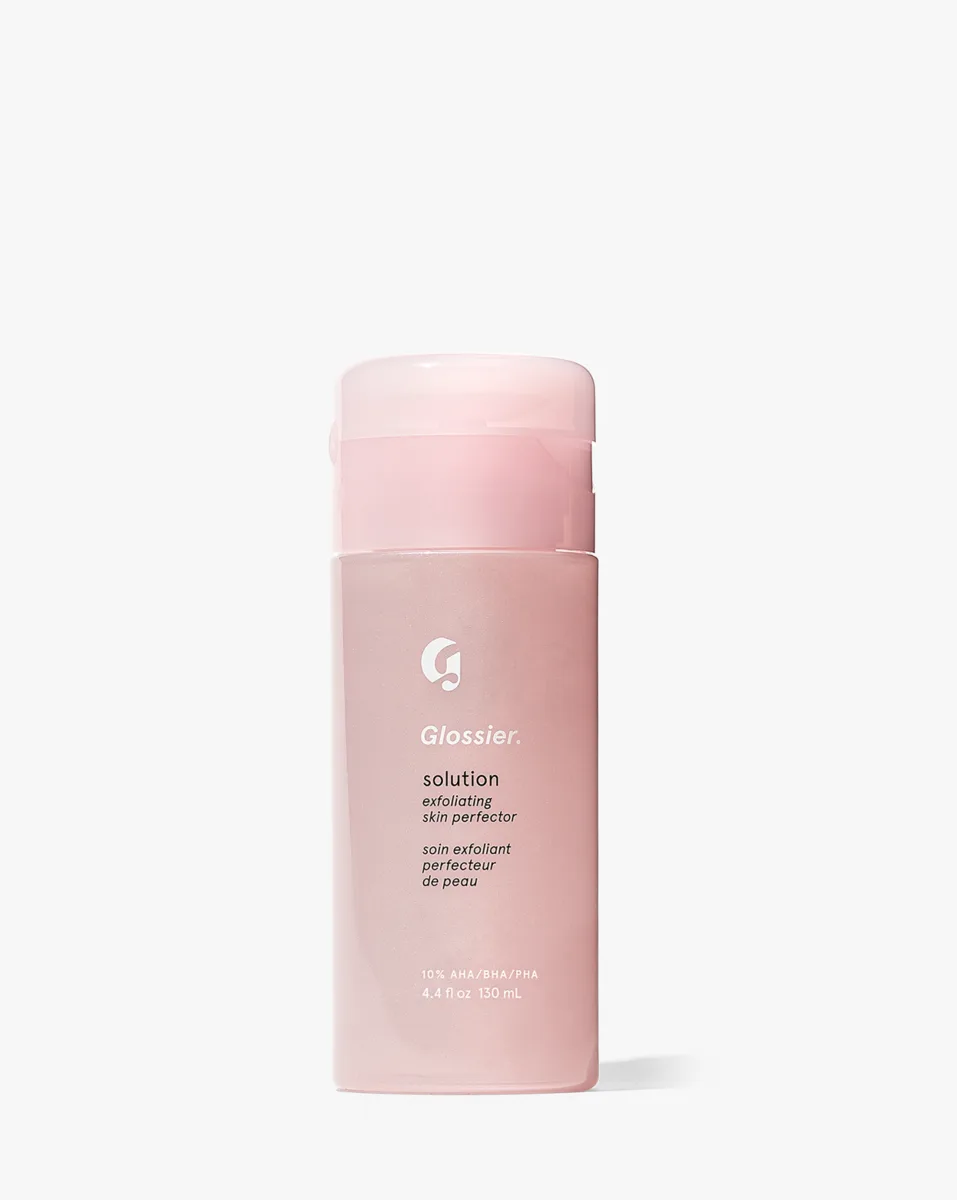
Glass bottle with a dispensing cap. The current version features Glossier's signature pink tones. Dispense onto a cotton pad for application.
Expect a noticeable tingling or slight stinging sensation on first use — this is normal for a 10% acid blend. The sensation typically lasts 1-3 minutes and diminishes with regular use as skin acclimates. Some users experience mild redness immediately after application. Skin feels smoother the morning after the first use. Purging (temporary increase in breakouts) may occur in the first 1-2 weeks for acne-prone skin.
3-4 months with every-other-day evening use
fall winter
Launched in January 2018, Solution was Glossier's boldest skincare move — a 10% acid exfoliant from a brand known for gentle, low-intervention products. The product reflected a strategic expansion beyond the 'your skin but better' philosophy into genuine treatment territory. Its AHA/BHA/PHA blend was inspired by dermatological approaches to chemical peels, scaled down to daily-use concentrations.
Glossier was founded in 2014 by Emily Weiss, growing out of the influential beauty blog Into The Gloss. The brand is Leaping Bunny certified cruelty-free and has built a devoted following through direct-to-consumer sales and community-driven product development, though it does not have clinical or dermatologist-developed origins.
The tingling means the product is working — no tingle means it's not effective.
Tingling indicates acid activity on the skin, but the degree of sensation does not correlate with efficacy. As skin acclimates to regular acid use, tingling diminishes while exfoliating benefits continue. Persistent burning or pain — as opposed to mild tingling — indicates the formula is too strong for your skin and should be discontinued.
You should use chemical exfoliants every day for best results.
A 10% acid blend like Solution works best with every-other-day or 3-4 times per week application, particularly at the start. Daily use of strong acids can compromise the skin barrier, leading to increased sensitivity, dehydration, and paradoxically worse texture. Less frequent, consistent use delivers better long-term results.
Start with every other evening and gradually increase to nightly use if your skin tolerates it well. Most dermatological guidance recommends introducing acid exfoliants slowly — begin with 2-3 times per week for the first two weeks. Never use Solution in the morning without applying SPF 30+ afterward, as AHAs significantly increase UV sensitivity.
Not on the same evening. Both products exfoliate and can compromise the skin barrier when combined. Alternate them — Solution on Monday, Wednesday, Friday evenings and retinol on Tuesday, Thursday evenings, for example. If you experience any irritation, reduce the frequency of both.
Purging is possible, particularly if you are acne-prone or have subsurface congestion. The BHA (salicylic acid) component pushes existing clogs to the surface faster, which can look like a breakout in the first 1-2 weeks. If new breakouts continue beyond 4-6 weeks, the product may be causing irritation rather than purging, and you should discontinue use.
For most sensitive skin types, yes. The 10% total acid concentration includes glycolic acid — the smallest, most penetrating AHA — which can cause significant irritation on reactive skin. If you have sensitive skin but want chemical exfoliation, look for PHA-only products or low-concentration lactic acid formulas, which are gentler starting points.
It can help with post-inflammatory hyperpigmentation (the dark marks left after acne heals) through its AHA exfoliation and niacinamide content. However, it will not improve atrophic (pitted) acne scars, which require professional treatments like microneedling, laser resurfacing, or dermal fillers. For dark marks specifically, consistent use over 8-12 weeks typically shows measurable improvement.
No. The formula contains salicylic acid, which is a BHA related to aspirin. While the 0.5% topical concentration is considered low-risk by many dermatologists, most obstetric guidelines recommend avoiding salicylic acid products during pregnancy as a precaution. Consult your OB-GYN before using any acid exfoliant while pregnant or nursing.
Recurring themes our editors read across retailer reviews of this product — summaries in our words, not quotations, and not a substitute for your own patch test.
Visible brightening and texture improvement within the first week
Effectively addresses blackheads and pore congestion
Lightweight liquid format is easy to apply
Fragrance-free in current reformulation
Stings or burns on application, especially initially
Too strong for sensitive or dry skin types
Adjustment period with potential purging
Cotton pad application wastes product
Verified answers from our questions library — the nuance a product page cannot carry.