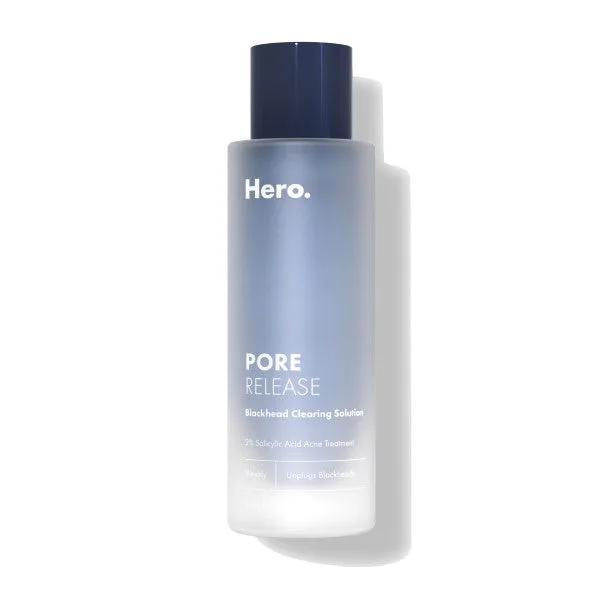
Rather than relying on a single acid, it combines a pore-penetrating BHA, a resurfacing AHA, and a gentle PHA, then cushions the trio with aloe and lotus root water so it tackles blackheads at multiple levels while staying more tolerable than a single high-strength acid. It brings the brand's blackhead focus into a leave-on exfoliant.
A well-balanced triple-acid toner that brings Hero's blackhead obsession into a leave-on exfoliant. Salicylic, glycolic, and gluconolactone tackle congestion at the pore and surface, cushioned by aloe and lotus so it stays tolerable. It genuinely smooths texture and clears blackheads with consistent use, but it is aimed at oily skin and easy to overdo, so restraint and sunscreen are non-negotiable.
Strong choicefor BlackheadsIn your profileYou chose · Salicylic Acid is an approved or monograph active for blackheads; this liquid carries it, though the concentration is not declared.Moderate evidenceGentleNo reviews collected yet
The case for it
Salicylic Acid is a first-line active — approved, monograph-listed or named in current guidelines — for this concern.
It is plausibly present at a working level, though the concentration is not declared.
The formula carries none of the triggers this concern is sensitive to.
What would change this: A declared concentration would move this to a firmer reading of the dose.
Same rule for everyone. “Strong choice” is the verdict on 1,459 of 45,024 concern verdicts across the catalog; rule R3 decided 567 of them.
Unchanged since September 5, 2026, engine 5.1.1.
R3 — Undeclared but plausibly dosed (top-third INCI position, or a potent sub-1% active) — the verdict stands, and the sentence says what disclosure would add. A declared figure below range would have been sub-threshold. · the full register
Carrying active
Salicylic Acid
Standing
first line — a regulator recognises it for this use; trials support it · per 21 CFR § 333.350 - Labeling of acne drug products. (US Code of Federal Regulations (Legal Information Institute, Cornell Law School)), opened July 27, 2026
Form
plausible — studied range 0.5–2%, from the OTC monograph or label; judge it after ~6 weeks
Tolerability
gentle
Row checked
against its sources on July 27, 2026 (evidence table ev-2026.09-r228)
The studies behind the evidence row
OTC monograph, Topical Acne Drug Products — salicylic acid 0.5–2% recognized as an acne treatment active — US Food and Drug Administration
Not for thisfor Large PoresIn your profileYou chose · The actives here have been researched for large pores and the evidence does not support the claim.Not yet assessedGentleNo reviews collected yet
The case for it
Salicylic Acid has been researched for this concern and the evidence does not support it.
It is plausibly present at a working level, though the concentration is not declared.
The formula carries none of the triggers this concern is sensitive to.
What would change this: A declared concentration would move this to a firmer reading of the dose.
Same rule for everyone. “Not for this” is the verdict on 488 of 45,024 concern verdicts across the catalog; rule R10 decided 488 of them.
Unchanged since September 5, 2026, engine 5.1.1.
Promisingfor Excess OilinessIn your profileYou chose · Salicylic Acid has trial-level evidence for excess oiliness but no guideline or regulatory standing yet — promising, short of a recommendation; the other actives here are not yet assessed for it.Moderate evidenceGentleNo reviews collected yet
The case for it
Salicylic Acid has trial-level evidence for this concern but no guideline or regulatory standing yet.
It is plausibly present at a working level, though the concentration is not declared.
The formula carries none of the triggers this concern is sensitive to.
What would change this: A declared concentration would move this to a firmer reading of the dose.
Same rule for everyone. “Promising” is the verdict on 7,858 of 45,024 concern verdicts across the catalog; rule R9p decided 7,858 of them.
Unchanged since September 5, 2026, engine 5.1.1.
R9p — 0.5.0: 'Unproven' beside three filled dots read as one question answered twice with opposite words (7,018 rows). The chip measures standing, the dots measure trial volume; where the row carries at least one RCT or a tier-2 source (moderate dots) and the active is present at a working level, the honest word is Promising. Unproven is reserved for plausible-standing rows with limited or weak evidence, or an under-dosed form. Same rank as Unproven — a bet either way; the dots order them. · the full register
Carrying active
Salicylic Acid
Standing
plausible — trials support it
Form
plausible — studied range 30%, from the trials on the row; needs leave-on contact; judge it after ~6 weeks
Tolerability
gentle
Row checked
against its sources on July 17, 2026 (evidence table ev-2026.09-r228)
Good choicefor Rough TextureIn your profileYou chose · Salicylic Acid is a reference standard by mechanism for rough texture; this liquid carries it high in the ingredient list.Moderate evidenceGentleNo reviews collected yet
The case for it
Salicylic Acid has trial-supported standing for this concern.
It is present at an effective concentration, declared or high in the ingredient list.
The formula carries none of the triggers this concern is sensitive to.
Same rule for everyone. “Good choice” is the verdict on 9,564 of 45,024 concern verdicts across the catalog; rule R5 decided 9,072 of them.
Unchanged since September 5, 2026, engine 5.1.1.
Strong choicefor AcneIn your profileYou chose · Salicylic Acid is an approved or monograph active for acne; this liquid carries it, though the concentration is not declared.Moderate evidenceGentleNo reviews collected yet
The case for it
Salicylic Acid is a first-line active — approved, monograph-listed or named in current guidelines — for this concern.
It is plausibly present at a working level, though the concentration is not declared.
The formula carries none of the triggers this concern is sensitive to.
What would change this: A declared concentration would move this to a firmer reading of the dose.
Same rule for everyone. “Strong choice” is the verdict on 1,459 of 45,024 concern verdicts across the catalog; rule R3 decided 567 of them.
Unchanged since September 5, 2026, engine 5.1.1.
R3 — Undeclared but plausibly dosed (top-third INCI position, or a potent sub-1% active) — the verdict stands, and the sentence says what disclosure would add. A declared figure below range would have been sub-threshold. · the full register
Carrying active
Salicylic Acid
Standing
first line — a regulator recognises it for this use; trials support it · per § 333.310 Acne active ingredients. (U.S. Food and Drug Administration — 21 CFR Part 333 Subpart D (Topical Acne Drug Products), Code of Federal Regulations via GovInfo), opened July 27, 2026
Form
plausible — studied range 0.5–2%, from the OTC monograph or label; judge it after ~6 weeks
Tolerability
gentle
Row checked
against its sources on July 27, 2026 (evidence table ev-2026.09-r228)
A verdict is DermApproved’s assessment of how well a product’s ingredients fit a concern — never a claim about what the product treats. Evidence dots and collected reviews sit beside it and are never blended in.
Rules 0.5.1 · evidence table ev-2026.09-r228 · how we decide
Assessment
Pros & Cons
Pros
✓ Triple-acid blend tackles blackheads at pore and surface
✓ Oil-soluble salicylic acid targets blackheads where they live
✓ Aloe and lotus root water buffer the exfoliation nicely
✓ Visibly smoother texture and clearer pores with use
✗ Too strong for dry or sensitive skin if overused
✗ Easy to over-exfoliate and damage the barrier
✗ Not recommended during pregnancy due to salicylic acid
✗ Results require ongoing, disciplined use to maintain
Review
Full Review
Hero Cosmetics built its entire reputation on a satisfying premise: a blemish comes to a head, you slap a patch on it, the patch sucks out the gunk, and you win. But there is a whole category of congestion that premise cannot touch, the blackhead, the stubborn clog that sits in the pore and never surfaces, never comes to a head, never gives a patch anything to absorb. Pore Release is Hero's answer to that gap, and it is a meaningful pivot: from the instant gratification of clearing surfaced spots to the slower, more disciplined work of keeping pores clear over time with a leave-on chemical exfoliant. It is a different kind of product requiring a different kind of patience, and on its own terms it is a solid one. The strategy here is layering acids rather than betting on a single one, which is a sensible way to address congestion at more than one depth. Salicylic acid, the BHA, is the headliner and the right choice for blackheads specifically: it is oil-soluble, so it penetrates into the sebum-filled pore lining and dissolves the debris from within, exactly where blackheads live. Glycolic acid, the smallest and most potent AHA, works on the surface, sloughing away the dead-cell buildup that clogs pores and dulls texture. And gluconolactone, a gentle polyhydroxy acid sitting high in the list, adds a slower, more superficial, hydrating exfoliation that also helps soften the overall harshness of the blend. The thinking is that the three together clear congestion above and inside the pore more completely than any one acid alone, while the PHA keeps the experience from being as aggressive as a high-strength single acid. Crucially, Hero did not just stack acids and call it a day. The formula is cushioned with aloe barbadensis leaf juice and nelumbo nucifera, lotus, root water, both sitting prominently in the list, providing a soothing, hydrating counterweight to the exfoliation. That buffering is what keeps Pore Release from being a barrier-stripping experience, and it is the difference between a thoughtfully built acid toner and a harsh one. In use, it is a thin, watery liquid you swipe on with a cotton round or pat in with your hands after cleansing. The texture is pleasant and essence-like, absorbing fast with no residue. The first few uses may bring a mild, brief tingle, which is normal; what you want to watch for is sharp stinging or lingering burning, which is your skin asking you to slow down. Used correctly, up to three times a week, most people find their skin looks smoother and feels less congested within the first week or two, with blackheads appearing fewer and pores looking cleaner and tighter over a month or so of consistent use. The brand cites a 14-day study with self-assessed reduction in blackhead and clogged-pore appearance within seven days, and while self-assessed brand studies deserve a grain of salt, the result is plausible given the actives. Here is the honest part, and it is the same caution that applies to any effective acid toner: this is easy to overdo, and overdoing it backfires. The triple-acid load means more exfoliating power, which is great in moderation and damaging in excess. People who reach for it daily, or who layer it with retinoids, vitamin C, or other acids on the same night, risk a compromised barrier, which paradoxically can make oily skin produce more oil and congestion, the opposite of the goal. The discipline of three times a week maximum, with a hydrating moisturizer afterward and absolutely non-negotiable daily sunscreen, since acids increase sun sensitivity, is not optional fine print; it is the difference between this working and this hurting. Restraint is the entire skill of using it well. On suitability, this is firmly a product for oily and combination, blackhead-prone, congestion-prone skin, the people whose pores actually need this kind of clearing. Dry and sensitive skin should approach with real caution or skip it; the multi-acid formula, soothing additions notwithstanding, is more than delicate or reactive skin generally wants, and rosacea-prone skin should be especially careful. One firm flag: salicylic acid in a leave-on exfoliant means this is not recommended during pregnancy, so it is a clear skip for expectant users in favor of gentler options. On the positive side, the formula is fragrance-free, vegan, cruelty-free, and oil-free, and the ingredient list is fully and transparently disclosed, which is exactly what you want to see on an acid product. As a brand venture, this is Hero stepping outside its patch comfort zone into leave-on treatment territory, and while its exfoliant track record is shorter than its long patch legacy, the formula itself is built on thoroughly studied acids and sensible buffering, not gimmicks. Backed by Church & Dwight, the quality and consistency are dependable, and at around twenty dollars for a 100ml bottle that lasts three to four months at the recommended frequency, the value is fair. The verdict is that Pore Release is a genuinely good blackhead and texture toner for the right person: oily or combination skin that is congestion-prone and willing to use it with discipline. It smooths, it clears, and it refines pore appearance through a well-considered acid blend that stays more tolerable than its strength suggests. Use it three times a week, never the same night as other strong actives, always with sunscreen, and it earns its place. Overuse it, or use it on skin that is too dry or sensitive for it, and it will turn on you, which is true of every acid worth using.
Formula
Key Ingredients
The hero actives that drive this product's performance.
The oil-soluble BHA in this toner penetrates into the pore lining to dissolve the sebum and debris behind blackheads; it is the lead actor in the blackhead claim, working from inside the follicle while the glycolic acid resurfaces the skin above it.
Established mechanismfor Rough Texture · established mechanism
The smallest alpha hydroxy acid, glycolic acid exfoliates the skin surface to clear pore-clogging buildup and smooth texture, complementing the deeper-acting salicylic acid in this formula for a surface-plus-pore exfoliation rather than one alone.
Established mechanismfor Rough Texture · established mechanism
A gentle polyhydroxy acid placed high in the list, gluconolactone exfoliates and hydrates with a larger molecule that works more slowly and superficially, softening the overall acid load here so the toner refines pores with less harshness than the stronger acids alone would bring.
Sitting prominently in the formula alongside lotus root water, aloe adds a soothing, hydrating counterweight to the three exfoliating acids, helping buffer the irritation that a multi-acid toner can otherwise cause.
Not yet assessed
Ingredient standings describe the active at treatment-level doses and
vehicles; this product's own condition grades weigh its actual formula.
Use after cleansing on dry skin, before serums and moisturizer, up to three times a week; do not pair it the same night with retinoids, vitamin C, or other exfoliating acids, and always follow with sunscreen the next morning since acids increase sun sensitivity.
Results Timeline
The brand cites a self-assessed reduction in blackheads and clogged-pore appearance within 7 days in a 14-day study. Realistically, smoother texture and less oiliness show within 1-2 weeks, with clearer-looking pores building over 4-6 weeks of consistent, moderated use.
Pairs Well With
A gentle non-stripping cleanserA hydrating barrier moisturizerDaily sunscreen
Pore Release is built on three of the best-evidenced exfoliating acids, used in a combination that makes mechanistic sense for blackheads. Salicylic acid is a lipophilic beta hydroxy acid with extensive research support for penetrating sebum-filled follicles, exfoliating within the pore, and reducing comedonal acne, which is precisely why it is the appropriate lead active against blackheads, which are oxidized sebum-and-keratin plugs inside the follicle. Glycolic acid is the most studied alpha hydroxy acid, a small molecule that loosens the bonds between surface corneocytes to exfoliate the skin and improve texture and the appearance of clogged pores, complementing the BHA's deeper action with surface resurfacing. Gluconolactone, a polyhydroxy acid, has a growing evidence base as a gentler exfoliant: its larger molecular size means slower, more superficial penetration and better tolerance, plus humectant and mild antioxidant properties, which is why its prominent placement helps temper the overall acid load. The soothing additions are reasonable rather than heroic: aloe vera and lotus root water provide hydration and mild calming that help offset acid-related irritation, supported by glycerin and arginine. The grounded conclusion is that this is a legitimately effective exfoliating toner for congestion and texture in tolerant skin, with the key scientific caveat being dose and frequency: chemical exfoliants improve skin within a use ceiling, beyond which they compromise the barrier, and acids meaningfully increase photosensitivity, making diligent daily sunscreen a non-negotiable part of the regimen.
Dermatologist Perspective
Chemical exfoliant toners combining salicylic and glycolic acids are a recognized approach in clinical practice for blackheads, oiliness, and rough texture, since the oil-soluble BHA addresses the follicular plug while the AHA resurfaces the skin. The general guidance emphasizes restraint: exfoliating acids deliver their benefit at modest frequency, and over-application is a common cause of barrier damage that worsens the very oiliness and congestion patients are trying to treat. The inclusion of a gentle PHA and soothing botanicals is viewed as a sensible way to improve tolerability. Standard clinical advice with any leave-on acid is to avoid layering multiple strong actives, to maintain a supportive moisturizer, and to use daily broad-spectrum sunscreen because of increased photosensitivity. Salicylic acid in a leave-on product is also a reason this type of toner is typically advised against during pregnancy.
Guidance
Usage & Recommendations
How to Use
After cleansing, apply to dry skin using a cotton round, a soft cloth, or clean hands, either all over the face or focused on congested areas like the T-zone. Start with two to three times a week at most, and if your skin tolerates it well, hold steady rather than increasing frequency. Follow with a hydrating serum and moisturizer to support the barrier. Do not use it the same night as retinoids, vitamin C, or other exfoliating acids. Because acids increase sun sensitivity, apply a broad-spectrum sunscreen every morning without fail while using this toner.
Value Assessment
At around twenty dollars for a 100ml bottle, Pore Release is reasonable value for a transparent, well-formulated triple-acid toner. Used at the recommended frequency of up to three times a week, a bottle lasts roughly three to four months, which works out to a sensible per-use cost for an effective leave-on exfoliant. The formula's quality, three studied acids cushioned by aloe and lotus, justifies the price over a bare-bones single-acid liquid. The value holds only if you use it as directed, since over-application both wastes product and risks irritation. Backed by Church & Dwight, it is a dependable, fairly priced option for congestion-prone skin, neither a bargain nor overpriced.
Who Should Buy
This is for oily and combination skin that is genuinely blackhead-prone or congestion-prone and wants a leave-on exfoliant to smooth texture and clear pores over time. It suits people comfortable with chemical exfoliation who will use it with discipline, follow with sunscreen, and want a transparent, fragrance-free triple-acid formula at a fair price.
Who Should Skip
Dry, sensitive, or rosacea-prone skin should generally skip it or approach with great caution, as the triple-acid load can overwhelm a delicate barrier despite the soothing additions. Anyone pregnant should avoid it because of the leave-on salicylic acid, and those unwilling to use daily sunscreen or prone to over-exfoliating are better off leaving it alone.
A thin, watery liquid that spreads easily and absorbs quickly with no tackiness, much like a lightweight essence-toner.
Scent
Fragrance-free, with only a faint plant-derived note from the aloe and lotus water.
Packaging
Frosted bottle with a flip cap, dispensed onto a cotton round or hands.
Finish
non-greasylightweight
What to Expect on First Use
On the first few uses you may feel a mild, brief tingle from the acids, which is normal and should settle quickly; if it stings sharply or lingers, your skin is telling you to use it less often. Texture often feels smoother within the first week, though pushing frequency too fast invites irritation.
How Long It Lasts
A 100ml bottle used up to three times weekly lasts roughly three to four months for most people.
Hero built its name clearing surfaced spots with patches, but blackheads, the clogs that never come to a head, needed a different approach. Pore Release was developed as the brand's leave-on answer to congestion, using a layered AHA, BHA, and PHA system with botanical soothers to address blackheads and pore appearance over time rather than spot by spot.
About Hero Cosmetics Established Brand (5–20 years)
Hero Cosmetics, founded in 2017 and acquired by Church & Dwight in 2022, moved beyond its patch heritage into leave-on treatments like this exfoliating toner. The brand pairs an acne-focused reputation with a straightforward, well-disclosed triple-acid formula, though its experience in chemical exfoliants is shorter than its long track record with patches.
Brand founded: 2017 · Product launched: 2022
Myth vs. Reality
Common Myths
Myth
Using an acid toner more often clears blackheads faster.
Reality
Over-exfoliating with a triple-acid formula damages the barrier and can worsen oiliness and irritation, not speed results. Three times a week at most, with consistent moderate use, is what delivers smoother pores; more is counterproductive.
Myth
This will permanently shrink your pores.
Reality
No topical truly shrinks pore size, which is largely genetic. By clearing the sebum and debris that stretch and darken pores, this toner makes them look smaller and cleaner, but the effect is maintained through ongoing use, not permanent.
FAQ
Frequently Asked Questions
What does Hero Cosmetics Pore Release do?
It is a leave-on exfoliating toner that combines salicylic acid, glycolic acid, and gluconolactone to clear blackheads, smooth texture, and minimize the appearance of clogged pores. Aloe and lotus root water are added to soothe and buffer the three acids.
How often should I use Pore Release?
Up to three times a week at most. Because it contains three exfoliating acids, using it more often risks over-exfoliating and damaging your barrier, which can worsen oiliness and congestion rather than improving them.
Is Pore Release good for sensitive or dry skin?
Not especially. It is formulated for oily and combination, blackhead-prone skin, and the triple-acid load can be too much for dry or sensitive types despite the soothing aloe and lotus. Sensitive skin should patch test and use it sparingly, if at all.
Can I use Pore Release while pregnant?
No. It contains leave-on salicylic acid, which is generally advised against during pregnancy, so it is best to skip it and choose a gentler, pregnancy-safe exfoliating option instead.
Can I use Pore Release with retinol or vitamin C?
Not on the same night. Layering Pore Release with retinoids, vitamin C, or other acids significantly raises the risk of irritation and barrier damage. Alternate them on different nights and keep your routine simple while using this toner.
Does Pore Release actually shrink pores?
It makes pores look smaller and cleaner by clearing the sebum and debris that stretch and darken them, but it cannot permanently shrink pore size, which is largely genetic. The refined appearance is maintained through ongoing use.
Reviews
What Reviewers Tend to Say
Recurring themes our editors read across retailer reviews of this product — summaries in our words, not quotations, and not a substitute for your own patch test.
Common Praise
Visibly smoother skin and fewer blackheads
Three acids with soothing aloe is well balanced
Not overly stripping for an exfoliating toner
Good size for the price
Common Complaints
Too strong for sensitive skin if overused
Triple-acid load can sting on compromised skin
Results need consistent use to maintain
Easy to overdo and irritate
Notable Endorsements
Backed by a brand 14-day consumer study on blackhead appearancePopular among oily and blackhead-prone users
The whole case for salicylic acid rests on one unglamorous fact of chemistry: it dissolves in oil. Understand that, and you know exactly when it beats a glycolic acid — and when it's overkill.
Polyhydroxy acids get filed under 'beginner exfoliant,' as if gentle meant weak. The truth is stranger: their bulk is exactly why they work for the skin everything else sets on fire.
They all get sold as 'exfoliation,' but molecule size and oil-solubility make them genuinely different tools — and picking the wrong one is why so many people wreck their barrier.
Jun 9, 2026· 5 min
Questions people ask about Acne
Verified answers from our questions library — the nuance a product page cannot carry.
Products, answers, therapy guides, tools and articles in one search. Brand names,
slang and abbreviations all work — accutane finds isotretinoin, bacne finds truncal acne.