It is the century-old calamine-and-alcohol drying lotion with a Korean formulation team's fingerprints on it: a five-part centella complex placed high on the list to buffer the drying, guaiazulene for extra redness relief, and a trace of salicylic acid for the label. The format, the two-layer bottle and the cotton-swab ritual are borrowed wholesale from the American original that every K-beauty fan recognises.
A Korean take on the century-old pink drying lotion: alcohol and calamine flatten a surface whitehead overnight, a high-placed centella complex and azulene keep the aftermath calmer than the American originals, and a trace of salicylic acid decorates the label. It does the one thing drying lotions do and nothing else, stings, can mark deeper skin, and comes with brand copy that misidentifies its own key ingredient.
Sold since 2019, this drying lotion has several hundred retailer reviews, but Neogen has published no study of it and its own marketing misdescribes its main ingredient, so the assessment rests on the disclosed formula and the long clinical history of calamine, alcohol and tea tree in spot care. The salicylic acid concentration is undisclosed and, by list position, low.
Verdicts
How well it fits each concern
Verdict by concern tap a concern for the case
Strong choicefor AcneIn your profileYou chose · Salicylic Acid is an approved or monograph active for acne; this suspension carries it, though the concentration is not declared.Moderate evidenceStandard tolerabilityNo reviews collected yet
The case for it
Salicylic Acid is a first-line active — approved, monograph-listed or named in current guidelines — for this concern.
It is plausibly present at a working level, though the concentration is not declared.
The formula carries no trigger this concern is sensitive to, with the cautions noted.
Cautions: fragrance.
What would change this: A declared concentration would move this to a firmer reading of the dose.
Same rule for everyone. “Strong choice” is the verdict on 1,459 of 45,024 concern verdicts across the catalog; rule R3 decided 567 of them.
As of September 25, 2026, engine 5.1.1.
R3 — Undeclared but plausibly dosed (top-third INCI position, or a potent sub-1% active) — the verdict stands, and the sentence says what disclosure would add. A declared figure below range would have been sub-threshold. · the full register
Carrying active
Salicylic Acid
Standing
first line — a regulator recognises it for this use; trials support it · per § 333.310 Acne active ingredients. (U.S. Food and Drug Administration — 21 CFR Part 333 Subpart D (Topical Acne Drug Products), Code of Federal Regulations via GovInfo), opened July 27, 2026
Form
plausible — studied range 0.5–2%, from the OTC monograph or label; judge it after ~6 weeks
Tolerability
standard — fragrance load
Row checked
against its sources on July 27, 2026 (evidence table ev-2026.09-r228)
A verdict is DermApproved’s assessment of how well a product’s ingredients fit a concern — never a claim about what the product treats. Evidence dots and collected reviews sit beside it and are never blended in.
Rules 0.5.1 · evidence table ev-2026.09-r228 · how we decide
Assessment
Pros & Cons
Pros
✓ Calamine and alcohol visibly flatten surface whiteheads overnight
✓ Five-part centella complex placed high keeps the post-spot mark calmer
✓ Tea tree oil at fifth adds a plausible antimicrobial nudge
✓ Guaiazulene, panthenol and licorice soften the drying
✓ Fragrance-free apart from the tea tree and citrus extracts
✓ A 15 mL bottle lasts six months or more of spot use
✓ Cheaper than the imported drying lotions it copies
Cons
✗ Denatured alcohol second on the list stings and flakes the surrounding skin
✗ Can leave post-inflammatory marks on medium and deeper skin tones
✗ Salicylic acid is a trace at twenty-eighth, not a treatment dose
✗ Does nothing for cystic or deep breakouts, or for prevention
✗ Brand copy wrongly describes calamine as derived from sulfur
✗ Fiddly two-layer bottle and cotton-swab ritual
Review
Full Review
Neogen describes the pink powder at the bottom of this bottle as a natural pink calamine ingredient from sulfur. It is worth stopping on that sentence, because it is not a stretch or a simplification; it is wrong. Calamine is zinc oxide with a pinch of ferric oxide for colour, and has been since the pharmacopoeias standardised it. Sulfur is a different element entirely and, as it happens, a different acne active that this product does not contain. The confusion is easy to trace: the pink drying lotions this bottle is modelled on, the ones American brands have sold since the 1960s and Korean shoppers imported by the case, often pair calamine with sulfur, and somewhere between the mood board and the copy deck the two fused. It is a small error, but it means the brand's description of what the product does cannot be taken on trust, and the list has to speak for itself.
The list, read plainly, describes a drying lotion. Water, then denatured alcohol, then calamine, then glycerin: the clear top layer of the bottle is alcohol and water, the pink sediment is calamine, and the swab-through-the-layers ritual is the same one drugstore drying lotions have used for decades. Dab the pink paste on a whitehead at night and the alcohol flashes off while the calamine sits as a crust, absorbing oil and fluid from the spot; by morning it is flatter, less red and often gone within a couple of nights. That is a genuine effect, one of the oldest in acne care, and it works here exactly as it works in the originals.
What Neogen has added is more interesting than the copy suggests. Tea tree oil is fifth, high enough to be a real dose on a spot, and tea tree has some trial evidence against mild acne, though it also stings and sensitises, especially with alcohol beside it. Then, from sixth to twelfth, comes the brand's Cica5 complex, whole centella extract plus its four triterpenes, placed far higher than any drying lotion has ever bothered to put a soothing agent. Guaiazulene, the chamomile-derived anti-inflammatory that gives the sediment a rosy cast, sits further down with panthenol and licorice. The practical result is that the mark left after the spot resolves tends to look calmer and fade a little faster than the crust of a plain calamine lotion leaves, which is the one thing here that improves on the format.
The salicylic acid is a different story. It sits twenty-eighth, behind the papaya, blackberry and lemongrass extracts and just ahead of the emulsifiers, which in an over-the-counter acne product would be well under the half-percent floor and here, on a Korean cosmetic label with no drug panel, is simply a trace. It exists so the box can say BHA and gentle peeling. It is not why the product works, and anyone buying this as a salicylic acid treatment is buying the wrong thing.
The limitations are the limitations of every drying lotion, and they deserve plain statement. It flattens surface pimples that have come to a head, and it is useless on cysts and nodules, which have nothing on the surface to dry; dabbing alcohol on a deep bump only irritates the skin above it. It does nothing about the next breakout, because it contains no active at a level that prevents anything. And the alcohol and calamine dry the skin around the spot as well as the spot, which on dry or reactive faces means flaking and on medium to deep skin tones means a real risk of a post-inflammatory mark where the crust sat, a complaint that recurs in the reviews. The smallest possible dot, never rubbed, never on skin that is already peeling, is the only safe way to use it.
The ritual deserves a word too, because it is where most people go wrong. The bottle must not be shaken, or the calamine disperses into the alcohol and you get a thin pink wash that does nothing; the swab has to go straight down through the clear layer and come back up with paste. Most first-time users dip too shallow, get mostly alcohol, and conclude the product is weak, when the paste at the bottom is the product. The second mistake is generosity: a blob the size of the spot itself, not a smear across the cheek, is the dose, and anything beyond it is alcohol on skin that did not need drying.
As a physical product it is what it needs to be: a fifteen-millilitre glass bottle, used a drop at a time, that lasts most people six months or longer. At around thirteen dollars it is cheaper than the imported originals that inspired it, which was presumably the point, and it comes with a better soothing story and a worse ingredient explanation.
So take the sulfur claim as the warning it is and read the bottle instead. This is calamine and alcohol with a thoughtful centella buffer, a dose of tea tree, and a decorative salicylic acid, and on an oily, resilient face with an occasional whitehead it does its overnight job well. On dry, sensitive or darker skin, or on anything deeper than a whitehead, a hydrocolloid patch will do more with less risk, and no drying lotion of any brand will keep the next spot from arriving.
Formula
Key Ingredients
The hero actives that drive this product's performance.
The pink sediment at the bottom of the bottle, third on the list: zinc oxide tinted with a little iron oxide, the same mineral that has been dabbed on rashes and pimples for a century. It dries and shrinks a surface spot overnight by absorbing oil and fluid, and it is the ingredient doing the actual work here. Neogen's copy calls it a form of sulfur, which is simply wrong.
Second on the list, the clear top layer of the bottle and the fastest-acting part of the formula: it flashes off and dries the spot quickly, which is why the morning result is so visible and why the surrounding skin can end up flaky or, on darker tones, marked. It is the reason this works and the reason it can be overused.
Fifth on the list, high enough to be a genuine dose in a spot product. Tea tree oil has trial evidence against mild acne at five percent, and in a targeted dab it may contribute an antimicrobial nudge; it is also a sensitiser, especially with alcohol beside it, and the likely source of the stinging some users report.
Neogen's five-part centella package placed unusually high, sixth to twelfth, to counter the drying of the alcohol and calamine with the triterpenes centella is known for. It is a smarter buffer than most drying lotions carry and part of why the post-spot mark tends to look calmer.
The chamomile-derived blue-violet anti-inflammatory that gives the sediment its rosy tint alongside the calamine and adds a little redness relief. It sits at twenty-fourth, a supporting role, and the reduction in redness users notice is mostly the calamine and the shrinking of the spot itself.
Twenty-eighth on the list, behind the botanicals and just ahead of the emulsifiers, which places it well below the 0.5 to 2 percent an over-the-counter acne treatment carries. It gives the label a BHA line and may loosen a little surface debris on the spot; it is not the reason the product works and the product is not a salicylic acid treatment.
Regulator-approvedfor Acne · emerging certainty
Ingredient standings describe the active at treatment-level doses and
vehicles; this product's own condition grades weigh its actual formula.
Dab the pink sediment onto individual surface spots as the last step at night, on top of moisturizer, and leave it to dry; do not spread it, do not use it on cystic bumps that have no head, and skip it on any night the surrounding skin is already dry or peeling from a retinoid or acid.
Results Timeline
A whitehead or small surface pimple is visibly flatter and less red by the next morning, and usually gone in two or three nights. It does nothing for cysts or deep nodules, and it has no effect on preventing new breakouts; results are spot by spot.
Pairs Well With
A hydrocolloid patch on alternate nightsA fragrance-free moisturizer underneathNeogen A-Clear Soothing Toner
Neogen A-Clear Aid Soothing Pink Eraser dabbed on spots
Evidence
Science & Expert Perspective
The Science
The mechanism of a drying lotion is physical and has changed little in a century. Calamine, a pharmacopoeial mixture of zinc oxide with about half a percent of ferric oxide, is a mild astringent and absorbent that draws fluid and sebum from a superficial lesion and forms a protective crust, and zinc oxide has additional weak anti-inflammatory and antibacterial activity; suspended in an alcohol-water vehicle, it is deposited as a paste when the alcohol evaporates, and the evaporation itself dries and contracts the lesion. That is effective for a pustule or whitehead with a superficial component and irrelevant to a nodule or cyst, whose inflammation sits in the dermis. The cost of the mechanism is the vehicle: denatured alcohol at the second position disrupts the stratum corneum of the skin it touches, and repeated application to the same site produces the desquamation and, in skin phototypes IV to VI, the post-inflammatory hyperpigmentation that users report. Tea tree oil at the fifth position is the formula's only ingredient with acne trial data; a 5 percent tea tree gel reduced lesion counts comparably to 5 percent benzoyl peroxide with slower onset in the classic 1990 comparison, and later small trials support a modest effect, but tea tree is also a recognised sensitiser, more so when oxidised, and its combination with alcohol increases irritant potential. The Cica5 complex supplies centella's triterpenes, asiaticoside, madecassoside, asiatic acid and madecassic acid, with documented anti-inflammatory and wound-healing activity in leave-on use, which is a rational counter to the vehicle's irritancy and likely explains the calmer resolution some users describe. Guaiazulene is a chamomile-derived azulene with modest anti-inflammatory data. Salicylic acid at the twenty-eighth position, behind numerous botanical extracts, is well below the 0.5 to 2 percent range recognised for acne treatment; the 2024 American Academy of Dermatology acne guidelines list salicylic acid as a conditionally recommended topical with low-certainty evidence even at those concentrations (https://pubmed.ncbi.nlm.nih.gov/38300170/), and at a trace level here it has no expected effect. The product contains no sulfur, contrary to the brand's description; sulfur is a separate monograph acne active. Limonene and citrus extracts add minor fragrance-allergen exposure.
Drying lotions occupy a small, well-understood niche in clinical thinking: they are a reasonable overnight measure for the occasional superficial pustule in oily, resilient skin, and a poor idea for everything else. Practitioners would note that the calamine-and-alcohol mechanism cannot reach nodular or cystic lesions, that it does nothing to prevent new lesions, and that its irritant vehicle carries a meaningful risk of post-inflammatory hyperpigmentation in darker skin types and of flaking and barrier disruption in dry or sensitive skin, for whom a hydrocolloid patch is usually the safer overnight option. The centella and azulene additions would be regarded as a sensible mitigation rather than a treatment, tea tree oil as a plausible but sensitising adjunct, and the salicylic acid as present at a level without therapeutic meaning. The brand's description of calamine as a sulfur derivative would be corrected; the product contains no sulfur. For persistent or moderate acne the standing advice remains a daily leave-on with evidence, benzoyl peroxide, a topical retinoid or, where appropriate, prescription therapy, with a spot product like this used only occasionally alongside.
Guidance
Usage & Recommendations
How to Use
At night, after cleansing and applying moisturizer, and without shaking the bottle, push a clean cotton swab down through the clear liquid until it reaches the pink sediment at the bottom. Lift out a small amount of the pink paste and dot it directly onto individual whiteheads or surface pimples, covering only the spot, and let it dry to a crust for a minute before lying down. Leave it on overnight and rinse it off in the morning, then apply sunscreen. Use a fresh swab each time to keep the bottle clean, do not apply it to cystic bumps, rub it in, or use it on skin that is already dry or peeling from a retinoid or acid, and stop if the surrounding skin flakes or darkens. Keep the cap tight so the alcohol layer does not evaporate.
Value Assessment
Around thirteen dollars for 15 millilitres sounds expensive by volume, but a drying lotion is used a swab-tip at a time and the bottle lasts most people six months or more, so the cost per spot is trivial and the price undercuts the imported American originals by a few dollars. What the money buys is the classic calamine-and-alcohol effect plus a better soothing package than those originals carry; what it does not buy is any active that prevents breakouts, a meaningful salicylic acid dose or a formula safe for dry, reactive or darker skin. Against hydrocolloid patches, which cost a similar amount per month and carry no irritation or pigmentation risk, the value is fair only for people whose skin tolerates alcohol well and who prefer a lotion to a patch.
Who Should Buy
People with oily or combination, resilient skin who get the occasional surface whitehead and want an overnight drying dab that leaves a calmer mark than the classic pink lotions, and who like the ritual of the two-layer bottle. It suits fans of Neogen's A-Clear line and anyone who found the imported originals too expensive.
Who Should Skip
Anyone with dry, sensitive, rosacea-prone or eczema-prone skin should avoid the alcohol and tea tree, and people with medium to deep skin tones or a history of dark marks after spots should prefer a hydrocolloid patch. It is useless on cystic or deep breakouts, does nothing for prevention, and is not a salicylic acid treatment despite the label.
Ready to try Neogen A-Clear Aid Soothing Pink Eraser?
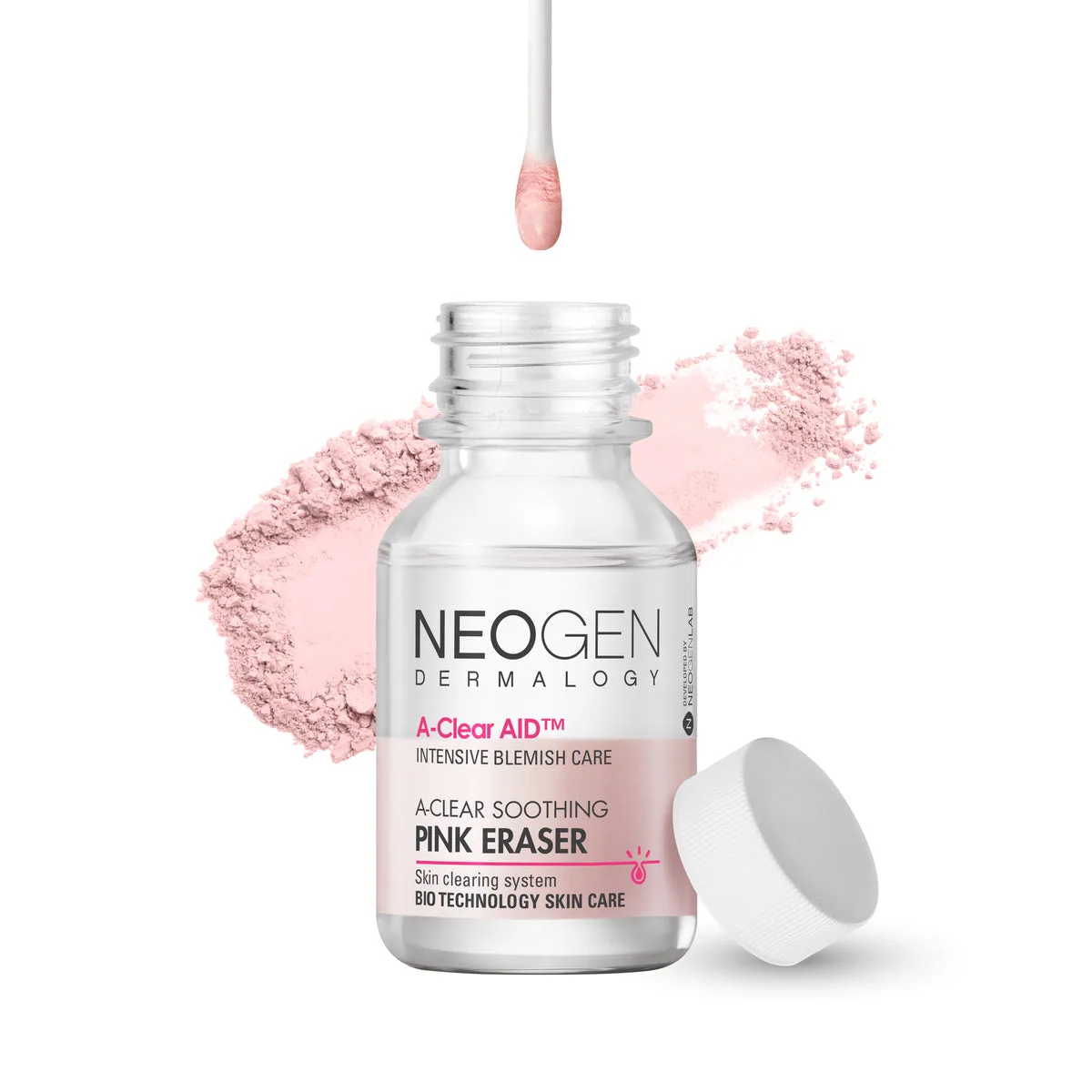
A two-layer bottle: a clear alcohol-based liquid on top and a dense pink calamine sediment below, applied as a chalky, quick-drying paste that sets to a pink crust on the spot.
Scent
Fragrance-free but not scentless; a sharp alcohol note with a whiff of tea tree on application, gone within a minute.
Packaging
A 15 mL clear glass bottle with a screw cap showing the two layers, boxed in the A-Clear line's pink and white; a cotton swab is the applicator and the bottle must not be shaken.
Finish
matte
What to Expect on First Use
The first use is a small ritual, dipping a swab through the clear layer to the pink sediment and dotting it on a spot, then a sharp alcohol sting for a few seconds and a pink crust that dries in a minute. By morning a whitehead is usually flatter and less angry. Dry or reactive skin will notice flaking around the spot within a night or two, and darker skin should watch for a mark where the crust sat.
How Long It Lasts
Six months or more of occasional spot use; the 15 mL bottle is used a drop at a time.
Neogen built its A-Clear line in 2019 for the Korean acne market, and the Pink Eraser was its answer to the pink drying lotions that American brands had sold since the 1960s and that Korean shoppers were importing at a premium. Neogen kept the format and added the centella and azulene soothing story its range is known for, marketing it, somewhat confusingly, as a calamine from sulfur.
About Neogen Legacy Brand (20+ years)
Neogen Dermalogy, the consumer brand of Korean biotech Neogen Corporation, launched its A-Clear acne range in 2019 with this two-layer drying lotion as the spot treatment, following a format American drugstores have sold for decades. The product has no published study, and its own marketing describes calamine as derived from sulfur, which it is not, so the brand's copy is not a reliable guide to the chemistry.
Brand founded: 2000 · Product launched: 2019
Myth vs. Reality
Common Myths
Myth
Calamine is a form of sulfur.
Reality
Neogen's own copy says so, and it is incorrect. Calamine is zinc oxide with a small amount of ferric oxide for the pink colour; sulfur is a different element and a different acne active. This product contains no sulfur. The confusion probably comes from the pink drying lotions it resembles, some of which do contain sulfur alongside calamine.
Myth
A drying lotion treats acne.
Reality
It treats a pimple. Calamine and alcohol dry and flatten a surface whitehead overnight, and that is a genuine, useful, cosmetic effect on one spot; it does nothing to the clogged pores, bacteria and inflammation that produce the next one, and the salicylic acid here is far too low to help with that. Prevention needs a daily leave-on.
FAQ
Frequently Asked Questions
How do you use the Neogen A-Clear Soothing Pink Eraser?
Do not shake the bottle. After cleansing and moisturizing at night, push a clean cotton swab down through the clear layer into the pink sediment, then dot only the pink paste onto individual spots and let it dry to a crust. Leave it overnight and rinse in the morning. Use it on surface whiteheads, not on deep or cystic bumps.
Does the Neogen Pink Eraser contain salicylic acid?
Yes, but at a low, undisclosed level: it sits twenty-eighth on the list, behind the botanical extracts, well under the 0.5 to 2 percent an over-the-counter acne treatment uses. The product works through calamine and alcohol drying the spot, not through the salicylic acid.
Is the Neogen Pink Eraser the same as the classic pink drying lotion?
It is the same idea and format, a two-layer bottle of alcohol-based liquid over pink calamine sediment applied with a swab, but the formula differs: Neogen adds a five-part centella complex, azulene, tea tree oil and a trace of salicylic acid, and contains no sulfur. Its own copy describing calamine as coming from sulfur is a mistake.
Can the Neogen Pink Eraser cause dark marks?
It can on medium and deeper skin tones, or on anyone prone to post-inflammatory marks, because the alcohol and calamine dry and irritate the skin around the spot as well as the spot itself. Use the smallest possible dot, never rub, skip it if the surrounding skin is already flaky, and wear sunscreen by day.
Is the Neogen Pink Eraser safe for sensitive skin?
Not really. Denatured alcohol is the second ingredient and tea tree oil the fifth, with citrus extracts and declared limonene further down, and stinging is the most common complaint. The centella complex softens it, but rosacea-prone, eczema-prone or reactive skin is better served by a hydrocolloid patch.
Does the Neogen Pink Eraser work on cystic acne?
No. Calamine and alcohol dry out surface pimples that have come to a head; a cyst or nodule sits deep under the skin with nothing on the surface to dry, and dabbing a drying lotion on it only irritates the skin above. Deep breakouts need a leave-on treatment or prescription care.
Reviews
What Reviewers Tend to Say
Recurring themes our editors read across retailer reviews of this product — summaries in our words, not quotations, and not a substitute for your own patch test.
The supplier specification for standard witch hazel water caps the tannin content — the fraction all the research is about — at a level indistinguishable from none. The tightness you feel is the solvent.
Adult hormonal acne and teenage acne are different beasts, yet grown women keep drying out deep jawline cysts with teenage products and wondering why it spreads.
The K-beauty buzzword slaps a green leaf on half the shelf — but centella is one of the rare botanicals with genuine wound-healing data. The trick is knowing which molecule is doing the job.
Feb 27, 2026· 6 min
Questions people ask about Acne
Verified answers from our questions library — the nuance a product page cannot carry.
Products, answers, therapy guides, tools and articles in one search. Brand names,
slang and abbreviations all work — accutane finds isotretinoin, bacne finds truncal acne.