Guaiazulene — the chamomile-derived compound responsible for the distinctive blue color — is the defining ingredient that sets this cream apart from the hundreds of generic centella soothing creams on the K-beauty market. While most calming creams rely on centella alone, this formula layers guaiazulene's anti-inflammatory pathway on top of centella's triterpene action, plus ceramide NP for barrier repair and a full peptide complex for skin regeneration. The Allure Best of Beauty recognition and 2+ million units sold confirm it's more than just a pretty color.
The calming cream that earned its cult status through performance rather than marketing. Two million bottles sold and an Allure Best of Beauty award later, the Midnight Blue Calming Cream remains one of K-beauty's most trusted products for angry, inflamed, or post-treatment skin. The guaiazulene-centella combination genuinely works — and the iconic blue color is just a bonus.
Good choicefor SensitivityIn your profileYou chose · No fragrance, drying alcohol, declarable allergens or sensitising preservatives in this cream — the profile sensitive skin looks for.Not yet assessedGentleNo reviews collected yet
The case for it
Centella Asiatica Extract has been researched for this concern and the evidence does not support it.
It is plausibly present at a working level, though the concentration is not declared.
The formula carries none of the triggers this concern is sensitive to.
What would change this: A declared concentration would move this to a firmer reading of the dose.
Same rule for everyone. “Good choice” is the verdict on 1,938 of 45,024 concern verdicts across the catalog; rule F2 decided 1,938 of them.
Unchanged since September 5, 2026, engine 5.1.1.
Supporting rolefor RosaceaIn your profileYou chose · Centella Asiatica has early evidence for rosacea, and barrier repair and gentle hydration is the recognised companion to treating it — a reasonable supporting choice, short of a recommendation.Moderate evidenceGentleNo reviews collected yet
The case for it
Centella Asiatica Extract has early or mechanistic evidence for this concern, not trial-backed standing.
It is plausibly present at a working level, though the concentration is not declared.
The formula carries none of the triggers this concern is sensitive to.
What would change this: A declared concentration would move this to a firmer reading of the dose.
Same rule for everyone. “Supporting role” is the verdict on 8,197 of 45,024 concern verdicts across the catalog; rule R8a decided 1,489 of them.
Unchanged since September 5, 2026, engine 5.1.1.
R8a — A plausible-tier active in a category with a supportive job: the sentence names the active instead of saying nothing targets the concern (the AmLactin / CeraVe SA case for keratosis pilaris, where no guideline and single trials leave the keratolytics at early evidence). · the full register
Carrying active
Centella Asiatica Extract
Standing
plausible — trials support it
Form
plausible
Tolerability
gentle
Row checked
against its sources on July 17, 2026 (evidence table ev-2026.09-r228)
Supporting rolefor AcneIn your profileYou chose · Nothing here targets acne directly; barrier care alongside acne treatment is the recognised companion to treating it, and this cream does that without known triggers.Not yet assessedStandard tolerabilityNo reviews collected yet
The case for it
Centella Asiatica Extract has no evidence row yet for this concern — it is in the research queue.
The formula carries no trigger this concern is sensitive to, with the cautions noted.
Cautions: fungal-acne triggers.
What would change this: A researched evidence row for the lead active would replace this with a verdict.
Same rule for everyone. “Supporting role” is the verdict on 8,197 of 45,024 concern verdicts across the catalog; rule R8 decided 4,250 of them.
Unchanged since September 5, 2026, engine 5.1.1.
R8 — The category's job (barrier care, humectant hydration, gentle cleansing, photoprotection) is the documented supportive role for this concern. This is the honest verdict for a moisturizer on an acne page. · the full register
Good choicefor Compromised Skin BarrierIn your profileYou chose · Ceramides is a reference standard by mechanism for compromised skin barrier; this cream carries it.Moderate evidenceGentleNo reviews collected yet
The case for it
Ceramide NP has trial-supported standing for this concern.
It is plausibly present at a working level, though the concentration is not declared.
The formula carries none of the triggers this concern is sensitive to.
What would change this: A declared concentration would move this to a firmer reading of the dose.
Same rule for everyone. “Good choice” is the verdict on 9,564 of 45,024 concern verdicts across the catalog; rule R5 decided 9,072 of them.
Unchanged since September 5, 2026, engine 5.1.1.
R5 — Trial-supported or guideline-supported active, adequately or plausibly dosed. · the full register
Carrying active
Ceramide NP
Standing
supported — its mechanism is established
Form
plausible — studied range 0.5–1%, from the trials on the row; needs leave-on contact; judge it after ~4 weeks
Tolerability
gentle
Row checked
against its sources on July 17, 2026 (evidence table ev-2026.09-r228)
The studies behind the evidence row
Elias PM, Skin Barrier / Coderch et al., ceramides and skin barrier function — ceramides ~50% of SC intercellular lipid mass, essential to the permeability barrier — reference work
Supporting rolefor Post-ProcedureIn your profileYou chose · Centella Asiatica has early evidence for post procedure, and barrier support is the recognised companion to treating it — a reasonable supporting choice, short of a recommendation.Moderate evidenceGentleNo reviews collected yet
The case for it
Centella Asiatica Extract has early or mechanistic evidence for this concern, not trial-backed standing.
It is plausibly present at a working level, though the concentration is not declared.
The formula carries none of the triggers this concern is sensitive to.
What would change this: A declared concentration would move this to a firmer reading of the dose.
Same rule for everyone. “Supporting role” is the verdict on 8,197 of 45,024 concern verdicts across the catalog; rule R8a decided 1,489 of them.
Unchanged since September 5, 2026, engine 5.1.1.
R8a — A plausible-tier active in a category with a supportive job: the sentence names the active instead of saying nothing targets the concern (the AmLactin / CeraVe SA case for keratosis pilaris, where no guideline and single trials leave the keratolytics at early evidence). · the full register
Carrying active
Centella Asiatica Extract
Standing
plausible — trials support it
Form
plausible — studied range 0.05%, from the OTC monograph or label; needs leave-on contact
Tolerability
gentle
Row checked
against its sources on July 17, 2026 (evidence table ev-2026.09-r228)
Does the jobDoes what a moisturizer is for: draws in water, softens and smooths.
A verdict is DermApproved’s assessment of how well a product’s ingredients fit a concern — never a claim about what the product treats. Evidence dots and collected reviews sit beside it and are never blended in.
Rules 0.5.1 · evidence table ev-2026.09-r228 · how we decide
Assessment
Pros & Cons
Pros
✓ Guaiazulene provides genuine, rapid anti-inflammatory action visible within minutes
✓ Dual calming system with centella asiatica for multi-pathway soothing
✓ Ceramide NP and rich emollient blend support barrier repair alongside calming
✓ Completely fragrance-free and silicone-free — suitable for highly reactive skin
✓ Award-winning (Allure Best of Beauty, Reviewty No.1 Cream) with 2 million+ units sold
✓ Available in both tube and jar formats for preference flexibility
Cons
✗ May not provide sufficient moisture for very dry skin without additional products
✗ Blue tint can transfer to white pillowcases if over-applied at night
✗ Peptide concentrations appear modest based on INCI positioning
✗ Price is slightly high per milliliter compared to drugstore calming alternatives
Review
Full Review
Some products become cult favorites because they look good on Instagram. Others earn the devotion by being the thing you reach for at your skin's worst moments — the night after an overzealous chemical peel, the morning your rosacea decides to remind you it exists, the week your skin barrier surrenders to winter. Klairs' Midnight Blue Calming Cream is the second kind. Its two million sales weren't built on aesthetic — though the vivid blue is undeniably gorgeous — but on the quiet reputation that spreads through online forums and group chats: 'this is the one that actually works.'
The formula's defining ingredient is guaiazulene, a sesquiterpene compound derived from chamomile oil that gives the cream its striking midnight blue color. This isn't a cosmetic dye or a marketing gimmick — guaiazulene is a genuine anti-inflammatory agent that inhibits lipid peroxidation and reduces the production of inflammatory mediators. It's the same compound that makes chamomile essential oil blue, isolated and concentrated for topical anti-inflammatory application.
Centella asiatica extract provides the second calming pillar. The combination is strategically sound: guaiazulene works primarily through antioxidant and anti-inflammatory pathways (lipid peroxidation inhibition, pro-inflammatory mediator suppression), while centella's triterpenes operate through NF-kB modulation and TGF-beta-driven collagen repair. Two different mechanisms targeting the same outcome — calmed, repaired skin — with better combined efficacy than either could achieve alone.
The emollient matrix is deliberately rich. Shea butter, argan oil, and jojoba oil deliver fatty acids and phytosterols that nourish compromised skin barriers. Beeswax provides a mild occlusive seal that keeps the active ingredients working on the skin rather than evaporating. Ceramide NP integrates into the formula with lecithin support, adding lipid barrier repair at the structural level. This is a cream that understands that calming inflammation is only half the job — the other half is rebuilding the barrier that let the irritation happen in the first place.
The peptide complex mirrors what Klairs includes in their Fundamental Eye Butter and Vitamin C Drop: Acetyl Hexapeptide-8, SH-Oligopeptide-1 and -2, SH-Polypeptide-1, -9, and -11, plus a Bacillus/soybean ferment extract. These are supplementary rather than starring — positioned late in the INCI — but they add a skin-repair dimension that generic calming creams lack. The growth-factor-like peptides support cellular renewal in skin that's been damaged by inflammation, UV, or procedures.
On the skin, the blue cream is immediately soothing. The color blends away within seconds of application, disappearing into a colorless layer that feels neither heavy nor insubstantial. It hits a textural sweet spot — rich enough that irritated skin feels protected and cocooned, lightweight enough that combination skin can wear it during the day. The satin-smooth finish sits well under makeup and doesn't interfere with sunscreen application.
The calming effect is the product's strongest suit and its primary reason for existing. Redness from over-exfoliation, post-procedure inflammation, environmental sensitivity, and stress-related flare-ups all respond visibly within minutes of application. This isn't placebo — the guaiazulene's anti-inflammatory mechanism has documented onset within topical application timescales, and the centella extract provides immediate soothing that users can feel as the cream absorbs.
The beeswax inclusion is worth addressing for the ingredient-conscious consumer. Klairs has been publicly transitioning toward fully vegan formulations, and many of their newer products carry vegan certification. The Midnight Blue Calming Cream, developed in 2016, predates this shift and still contains beeswax. It functions well in the formula as a mild occlusive, but its presence means this product isn't suitable for strict vegans. Whether Klairs will eventually reformulate to remove it remains to be seen.
For very dry skin, this cream may not provide sufficient standalone moisture in harsh conditions. The emollient blend is respectable — shea butter and argan oil are serious moisturizing ingredients — but the formula prioritizes calming over deep hydration. Layering a hyaluronic acid serum underneath and a heavier occlusive on top (on particularly dry nights) extends its effectiveness for drier skin types.
At around twenty-seven dollars for sixty milliliters, the pricing is fair for an award-winning soothing cream with ceramide, peptide, and guaiazulene technology. Klairs' fifteen-year track record, cruelty-free certification, and the product's own accumulated accolades provide the kind of third-party validation that justifies confidence in the purchase. You're not betting on an unknown — you're buying into a product that earned Allure's respect and two million customers' loyalty through consistent, genuine performance.
The Midnight Blue Calming Cream occupies a specific and valuable niche: it's the emergency room in your skincare cabinet. Not the daily driver (though it works fine as one), but the product you trust when your skin needs intervention. It's the cream that turns a three-day redness episode into an overnight recovery. And that kind of reliability — the knowledge that you have something in the drawer that actually, genuinely calms your skin down — is worth more than any luxury ingredient list.
Formula
Key Ingredients
The hero actives that drive this product's performance.
The signature ingredient that gives this cream its distinctive blue color. Derived from chamomile, guaiazulene provides potent anti-inflammatory and antioxidant effects that form the calming core of this formula. It works alongside centella asiatica to create a dual-pathway approach to soothing inflamed, irritated, or sensitized skin.
Listed high in the formula as a primary soothing and skin-repair ingredient. Provides triterpene-mediated anti-inflammatory action that complements the guaiazulene's chamomile-derived calming, creating a multi-pathway soothing strategy for reactive and damaged skin.
Reinforces the skin's lipid barrier, which is often compromised in the irritated and sensitive skin conditions this cream targets. Works within the rich emollient matrix of shea butter, argan oil, and beeswax to deliver ceramides in a format that integrates into the existing barrier architecture.
Established mechanismfor Compromised Skin Barrier · established mechanism
Provides rich emollient and occlusive properties that create a protective layer over irritated skin. In this formula, shea butter works alongside argan and jojoba oils to deliver fatty acids and phytosterols that support barrier repair while the guaiazulene and centella calm the underlying inflammation.
Adds anti-aging peptide functionality to what is primarily a calming cream, targeting expression lines while the soothing actives address inflammation. Part of a broader peptide complex that includes growth-factor-like SH-polypeptides for skin repair support.
Not yet assessed
Ingredient standings describe the active at treatment-level doses and
vehicles; this product's own condition grades weigh its actual formula.
Apply as the closing step of your routine before sunscreen in the morning, or as the last step at night. Can be used as a spot treatment on particularly irritated areas. A thin layer is sufficient — the rich texture means a little goes a long way.
Results Timeline
Immediate calming and redness reduction visible within minutes of application. Skin barrier improvement and sustained irritation reduction become apparent after 1-2 weeks of consistent use. Long-term skin resilience and reduced reactivity develop over 4-8 weeks.
Pairs Well With
Centella-based toners for layered calmingHydrating serums with hyaluronic acidGentle chemical exfoliants (on alternate nights)
Guaiazulene, the signature active in this formula, is a sesquiterpene hydrocarbon derived from chamazulene, which is formed during steam distillation of chamomile essential oil. Its anti-inflammatory mechanism operates through multiple pathways: inhibition of lipid peroxidation, suppression of 5-lipoxygenase activity (reducing leukotriene production), and scavenging of reactive oxygen species. Published research in the European Journal of Pharmacology has demonstrated guaiazulene's ability to reduce UV-induced inflammation and oxidative stress markers in skin tissue.
Centella asiatica extract provides complementary anti-inflammatory action through its triterpene compounds — asiaticoside, madecassoside, asiatic acid, and madecassic acid. These compounds modulate the NF-kB pathway, a master regulator of inflammatory gene expression, while simultaneously stimulating TGF-beta-mediated collagen synthesis. The dual anti-inflammatory and pro-regenerative action is particularly valuable in the context of compromised skin barriers, where inflammation and structural damage co-occur.
The combination of guaiazulene (operating through lipid peroxidation inhibition and leukotriene suppression) with centella (operating through NF-kB modulation and TGF-beta stimulation) creates an anti-inflammatory strategy that addresses multiple points in the inflammatory cascade. This multi-target approach is a well-established principle in pharmacology — attacking a biological pathway at multiple nodes typically produces greater effect than maximizing intervention at a single point.
Ceramide NP reinforces the structural dimension of skin repair. One trial published in the Journal of Clinical Investigation has shown that ceramide depletion is both a cause and consequence of barrier disruption and inflammation, creating a self-perpetuating cycle. Topical ceramide replacement — particularly when delivered with lecithin to form lamellar structures — helps break this cycle by restoring the lipid architecture that prevents future inflammation.
Dermatologist Perspective
Dermatologists frequently recommend guaiazulene-containing products for patients with rosacea-type redness and post-procedure inflammation. Working dermatologists consistently stress that the Klairs Midnight Blue Calming Cream's combination of guaiazulene, centella, and ceramide NP addresses both the inflammatory event and the barrier dysfunction that often triggers it — a more complete approach than single-ingredient calming products. The fragrance-free, silicone-free formulation makes it suitable for patients with contact dermatitis or multiple chemical sensitivities. Dermatologists often suggest this cream as a recovery product following chemical peels, microneedling, or laser treatments, though they emphasize following specific post-procedure protocols over general product recommendations.
Guidance
Usage & Recommendations
How to Use
Apply a thin layer of the cream as the last step of your skincare routine (before sunscreen in the morning). For targeted use, apply directly to areas of redness or irritation as a spot treatment. For full-face use, a pea-sized amount is sufficient. Allow 1-2 minutes for absorption. Can also be used as an overnight recovery mask — apply a slightly thicker layer before bed on nights when skin is particularly irritated.
Value Assessment
At approximately $27 for 60ml, this cream sits in a reasonable range for its quality and track record. The guaiazulene ingredient is relatively uncommon in skincare and typically commands a premium. Factor in the ceramide NP, peptide complex, and quality emollients (shea butter, argan oil, jojoba oil), and the cost-per-active-ingredient is competitive. The 2020 Allure Best of Beauty recognition and over 2 million global sales provide third-party validation that reinforces the value proposition. A 30ml option is available for those who want to try before committing to the full size.
Who Should Buy
Anyone with sensitive, easily irritated, or rosacea-prone skin who needs a reliable calming cream for daily use or emergency recovery. Post-procedure patients looking for a gentle, fragrance-free product to support skin healing. Combination skin types who over-exfoliate and need a soothing reset product in their routine.
Who Should Skip
Strict vegans — this product contains beeswax. Those with very dry skin who need a deeply emollient night cream — this prioritizes calming over heavy moisture. Anyone looking for a lightweight gel-cream may find the shea butter and oil content too rich for very oily skin in humid conditions.
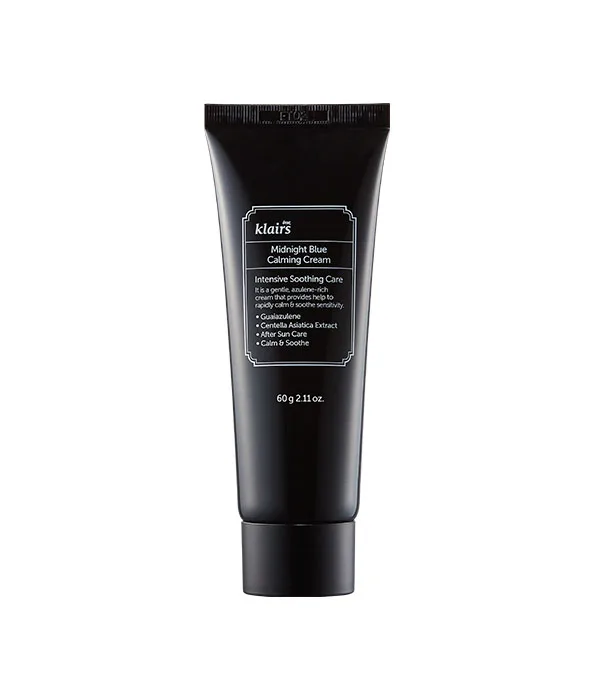
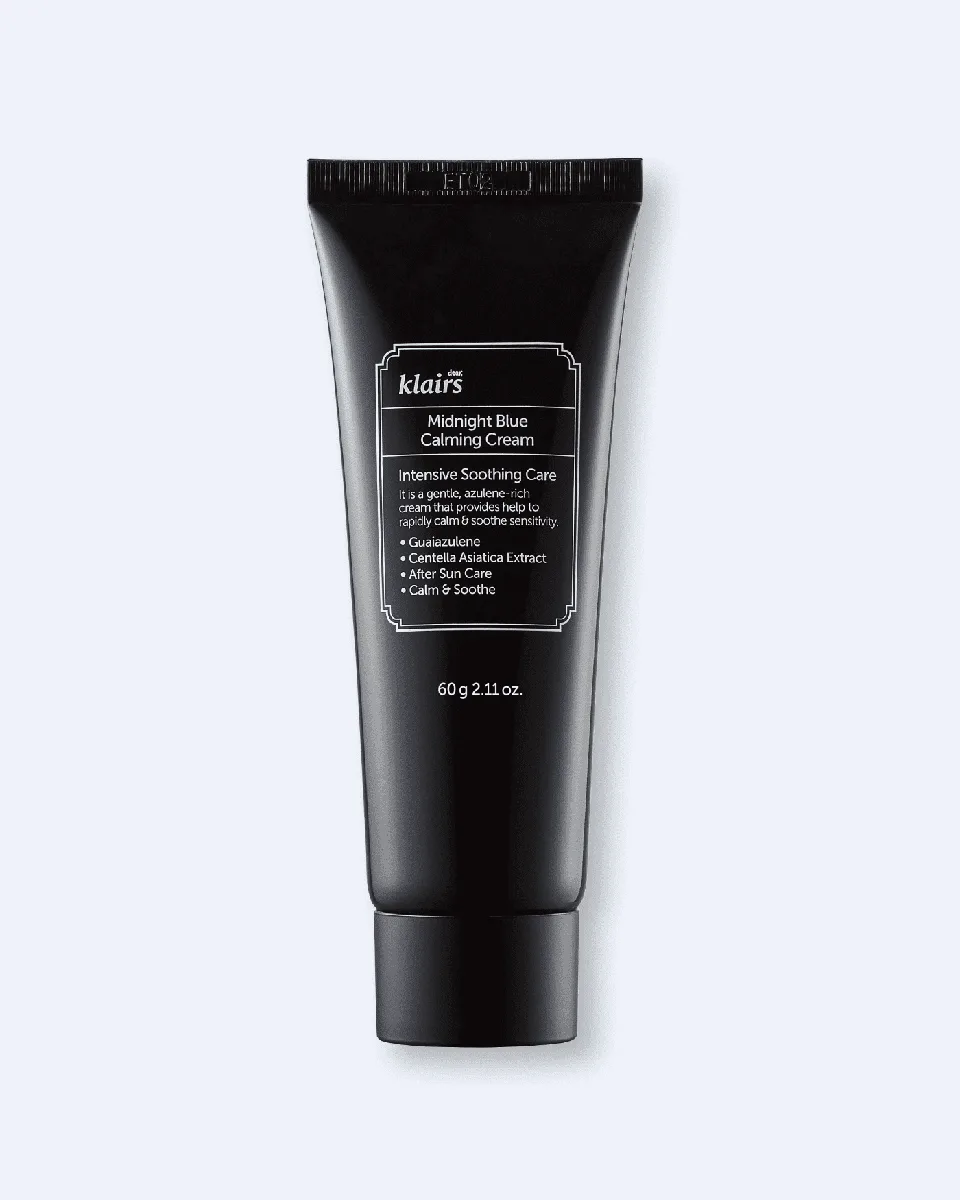
Rich blue cream with a smooth, almost gel-cream consistency. Despite its vivid color, it blends completely clear on the skin. Absorbs well without leaving a greasy or heavy residue.
Scent
Completely unscented — no fragrance, essential oils, or detectable aroma.
Packaging
Available in both a 60ml tube and a 30ml jar. The tube is more hygienic and travel-friendly. Clean, minimal design with deep blue accents reflecting the product's guaiazulene-derived color.
Finish
satinnon-greasylightweight
What to Expect on First Use
The vivid blue cream is immediately striking — it looks like concentrated calm in a tube. On application, the color disappears as it's blended into the skin. The calming effect is nearly instant: redness visibly diminishes within minutes. No tingling, stinging, or adjustment period.
How Long It Lasts
2-3 months applied morning and evening face application (60ml tube)
The Midnight Blue Calming Cream was the product that established Klairs' reputation beyond South Korea. Its distinctive blue color — natural, from guaiazulene rather than dye — made it instantly recognizable on social media, and its genuine calming performance turned viral attention into lasting loyalty. It became the cream that sensitive-skin sufferers recommended to each other in online forums, the one product that 'actually worked' after years of trying and failing with gentler-seeming products.
About Klairs Established Brand (5–20 years)
Dear, Klairs was founded in 2010 in South Korea with a sensitive-skin-first philosophy. The Midnight Blue Calming Cream has sold over 2 million units globally, won the 2023 Reviewty Award for No.1 Cream, and received the 2020 Allure Best of Beauty award. The brand holds KARA cruelty-free certification.
Brand founded: 2010 · Product launched: 2016
Myth vs. Reality
Common Myths
Myth
The blue color means it contains artificial dyes that could irritate sensitive skin.
Reality
The blue comes entirely from guaiazulene, a naturally derived anti-inflammatory compound from chamomile. It's not a dye — it's an active ingredient with documented soothing properties. The color blends away completely on application.
Myth
Calming creams are only needed when skin is visibly irritated.
Reality
This cream's ceramide NP, peptide complex, and barrier-supporting oils provide daily skin resilience benefits even when skin isn't actively inflamed. Using it consistently helps prevent irritation episodes rather than just treating them reactively.
FAQ
Frequently Asked Questions
Is Klairs Midnight Blue Calming Cream good for rosacea?
Many users with rosacea report positive results — the guaiazulene and centella asiatica combination provides dual anti-inflammatory pathways that can help reduce the redness and sensitivity associated with rosacea. The fragrance-free, silicone-free formula minimizes irritation triggers. However, as with any product for rosacea-prone skin, patch testing is recommended.
Why is Klairs Midnight Blue Calming Cream blue?
The blue color comes from guaiazulene, a naturally occurring compound derived from chamomile. It's not an artificial dye — it's an active anti-inflammatory ingredient. The blue color disappears when blended into the skin, leaving no visible tint.
Can I use Klairs Midnight Blue Calming Cream after chemical peels or laser treatments?
Yes — this cream's soothing ingredients (guaiazulene, centella, ceramide NP) make it well-suited for post-procedure recovery. Apply a thin layer to calm inflammation and support barrier repair. Many users specifically keep this cream for post-treatment use. Always follow your dermatologist's specific post-procedure instructions.
Is Klairs Midnight Blue Calming Cream vegan?
No — this product contains beeswax, making it not vegan. This is notable because Klairs has been transitioning toward fully vegan formulations. If vegan certification is important to you, check other products in the Klairs lineup that have received vegan certification.
Will the blue cream stain my skin or pillowcase?
The blue color blends completely clear when applied to skin — it won't stain your face. However, if you apply a thick layer at night, some blue tint can transfer to white pillowcases. Using a thin, well-absorbed layer and allowing a few minutes before lying down prevents this.
Is this cream moisturizing enough for dry skin?
For mild dryness, the shea butter, argan oil, and beeswax provide adequate moisture. For significantly dry skin, it may work best as a soothing treatment layer under a richer night cream. Its primary strength is calming rather than deep moisturization.
Reviews
What Reviewers Tend to Say
Recurring themes our editors read across retailer reviews of this product — summaries in our words, not quotations, and not a substitute for your own patch test.
Common Praise
Immediately calms redness and irritation on application
Beautiful blue color that blends clear on skin
Fragrance-free and silicone-free — very gentle
Rich enough to soothe without feeling heavy or greasy
Excellent post-procedure or post-exfoliation recovery cream
Common Complaints
May not be moisturizing enough for very dry skin as a standalone
Contains beeswax — not vegan despite brand's vegan direction
Price feels slightly high for the amount of product
Blue tint can transfer to pillowcases if over-applied at night
Some find it too rich for very oily skin in summer
Notable Endorsements
2020 Allure Best of Beauty2023 Reviewty Awards No.1 CreamOver 2 million units sold globally
Serums, masks, and peptide 'treatments' replaced the waxy balm this year. Some of it is real barrier science; some is a controlled irritant that stings your lips into looking fuller for an hour.
Topically, the molecule the argument tells you to avoid is one the stratum corneum is structurally built from — and in acne-prone skin the documented finding is a shortage of it.
Western sensitive skincare works by subtraction — remove the fragrance, remove the alcohol, shorten the list. Japan's answer adds a designed molecule back in, and one of the two bets has a trial literature.
A wrecked barrier is the most common self-inflicted skin condition and the one with the clearest fix — the difficulty is that the routine which caused it feels productive and the one that repairs it feels like giving up.
Aug 5, 2026· 8 min
Questions people ask about sensitive skin
Verified answers from our questions library — the nuance a product page cannot carry.
Products, answers, therapy guides, tools and articles in one search. Brand names,
slang and abbreviations all work — accutane finds isotretinoin, bacne finds truncal acne.