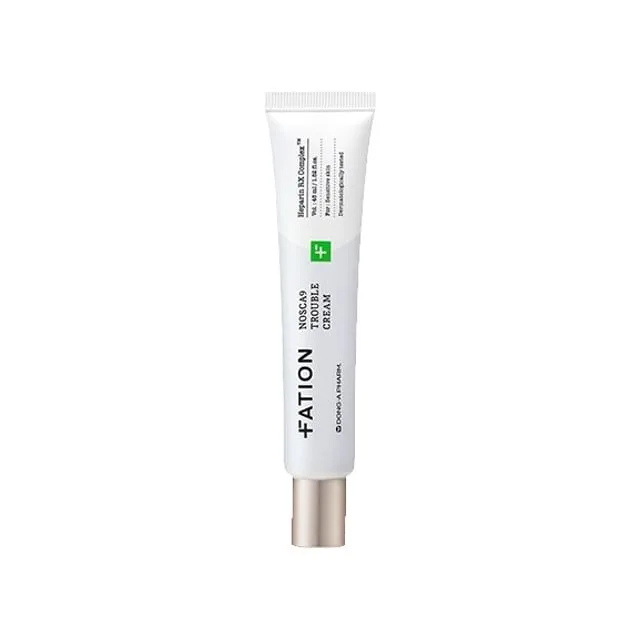
It pairs a complete physiologic ceramide-cholesterol-phytosphingosine barrier complex with centella, beta-glucan and the unusual sodium heparin (Heparin RX) anti-inflammatory, in a fully fragrance-free base — a genuinely clinical-minded, anti-redness barrier cream for troubled skin at a budget price.
A genuinely derm-grade barrier-repair cream for troubled skin: a complete physiologic ceramide-cholesterol-phytosphingosine complex, centella, beta-glucan and the unusual sodium heparin, all fragrance-free. It calms redness and rebuilds the barrier impressively well for the price, making it an excellent moisturizer for acne-prone, irritated, or barrier-compromised skin — with the one real caveat that it isn't fungal-acne safe.
Fation's Nosca9 line is widely sold with a solid base of retailer reviews and a dermatological positioning, so the medium-confidence rating blends that feedback with a transparent, fragrance-free ingredient list whose barrier-repair sophistication is clear. The ceramide complex and soothing actives are well-evidenced; the sodium heparin is brand-distinctive but less documented in cosmetic use, so its specific contribution is the main open question.
Verdicts
How well it fits each concern
Verdict by concern tap a concern for the case
Supporting rolefor AcneIn your profileYou chose · Nothing here targets acne directly; barrier care alongside acne treatment is the recognised companion to treating it, and this cream does that without known triggers.Not yet assessedStandard tolerabilityNo reviews collected yet
The case for it
Sodium Heparin has no evidence row yet for this concern — it is in the research queue.
The formula carries no trigger this concern is sensitive to, with the cautions noted.
Cautions: fungal-acne triggers.
What would change this: A researched evidence row for the lead active would replace this with a verdict.
Same rule for everyone. “Supporting role” is the verdict on 8,197 of 45,024 concern verdicts across the catalog; rule R8 decided 4,250 of them.
Unchanged since September 5, 2026, engine 5.1.1.
R8 — The category's job (barrier care, humectant hydration, gentle cleansing, photoprotection) is the documented supportive role for this concern. This is the honest verdict for a moisturizer on an acne page. · the full register
Good choicefor SensitivityIn your profileYou chose · No fragrance, drying alcohol, declarable allergens or sensitising preservatives in this cream — the profile sensitive skin looks for.Not yet assessedGentleNo reviews collected yet
The case for it
Centella, Artemisia & Beta-Glucan has been researched for this concern and the evidence does not support it.
It is plausibly present at a working level, though the concentration is not declared.
The formula carries none of the triggers this concern is sensitive to.
What would change this: A declared concentration would move this to a firmer reading of the dose.
Same rule for everyone. “Good choice” is the verdict on 1,938 of 45,024 concern verdicts across the catalog; rule F2 decided 1,938 of them.
Unchanged since September 5, 2026, engine 5.1.1.
Good choicefor Compromised Skin BarrierIn your profileYou chose · Ceramides is a reference standard by mechanism for compromised skin barrier; this cream carries it.Moderate evidenceGentleNo reviews collected yet
The case for it
Five-Ceramide Complex, Cholesterol & Phytosphingosine has trial-supported standing for this concern.
It is plausibly present at a working level, though the concentration is not declared.
The formula carries none of the triggers this concern is sensitive to.
What would change this: A declared concentration would move this to a firmer reading of the dose.
Same rule for everyone. “Good choice” is the verdict on 9,564 of 45,024 concern verdicts across the catalog; rule R5 decided 9,072 of them.
Unchanged since September 5, 2026, engine 5.1.1.
plausible — studied range 0.5–1%, from the trials on the row; needs leave-on contact; judge it after ~4 weeks
Tolerability
gentle
Row checked
against its sources on July 17, 2026 (evidence table ev-2026.09-r228)
The studies behind the evidence row
Elias PM, Skin Barrier / Coderch et al., ceramides and skin barrier function — ceramides ~50% of SC intercellular lipid mass, essential to the permeability barrier — reference work
Supporting rolefor RosaceaIn your profileYou chose · Centella Asiatica has early evidence for rosacea, and barrier repair and gentle hydration is the recognised companion to treating it — a reasonable supporting choice, short of a recommendation.Moderate evidenceGentleNo reviews collected yet
The case for it
Centella, Artemisia & Beta-Glucan has early or mechanistic evidence for this concern, not trial-backed standing.
It is plausibly present at a working level, though the concentration is not declared.
The formula carries none of the triggers this concern is sensitive to.
What would change this: A declared concentration would move this to a firmer reading of the dose.
Same rule for everyone. “Supporting role” is the verdict on 8,197 of 45,024 concern verdicts across the catalog; rule R8a decided 1,489 of them.
Unchanged since September 5, 2026, engine 5.1.1.
R8a — A plausible-tier active in a category with a supportive job: the sentence names the active instead of saying nothing targets the concern (the AmLactin / CeraVe SA case for keratosis pilaris, where no guideline and single trials leave the keratolytics at early evidence). · the full register
Carrying active
Centella, Artemisia & Beta-Glucan
Standing
plausible — trials support it
Form
plausible
Tolerability
gentle
Row checked
against its sources on July 17, 2026 (evidence table ev-2026.09-r228)
Good choicefor DrynessIn your profileYou chose · Ceramides is a reference standard by mechanism for dryness; this cream carries it.Moderate evidenceGentleNo reviews collected yet
The case for it
Five-Ceramide Complex, Cholesterol & Phytosphingosine has trial-supported standing for this concern.
It is plausibly present at a working level, though the concentration is not declared.
The formula carries none of the triggers this concern is sensitive to.
What would change this: A declared concentration would move this to a firmer reading of the dose.
Same rule for everyone. “Good choice” is the verdict on 9,564 of 45,024 concern verdicts across the catalog; rule R5 decided 9,072 of them.
Unchanged since September 5, 2026, engine 5.1.1.
against its sources on July 17, 2026 (evidence table ev-2026.09-r228)
The studies behind the evidence row
Elias PM, Feingold KR (eds), Skin Barrier — stratum corneum ceramides are the principal intercellular lamellar lipid; their depletion is the biochemical signature of dry/xerotic skin — reference work
Supporting rolefor Post-ProcedureIn your profileYou chose · Panthenol (Vitamin B5) has early evidence for post procedure, and barrier support is the recognised companion to treating it — a reasonable supporting choice, short of a recommendation.Moderate evidenceGentleNo reviews collected yet
The case for it
Panthenol & Allantoin has early or mechanistic evidence for this concern, not trial-backed standing.
It is plausibly present at a working level, though the concentration is not declared.
The formula carries none of the triggers this concern is sensitive to.
What would change this: A declared concentration would move this to a firmer reading of the dose.
Same rule for everyone. “Supporting role” is the verdict on 8,197 of 45,024 concern verdicts across the catalog; rule R8a decided 1,489 of them.
Unchanged since September 5, 2026, engine 5.1.1.
R8a — A plausible-tier active in a category with a supportive job: the sentence names the active instead of saying nothing targets the concern (the AmLactin / CeraVe SA case for keratosis pilaris, where no guideline and single trials leave the keratolytics at early evidence). · the full register
Carrying active
Panthenol & Allantoin
Standing
plausible — trials support it
Form
plausible — studied range 0.5–2%, from the OTC monograph or label; needs leave-on contact
Tolerability
gentle
Row checked
against its sources on July 17, 2026 (evidence table ev-2026.09-r228)
Excellent at the jobDoes what a moisturizer is for, on every measure we can take from the label: supplies barrier lipids, draws in water.
A verdict is DermApproved’s assessment of how well a product’s ingredients fit a concern — never a claim about what the product treats. Evidence dots and collected reviews sit beside it and are never blended in.
Rules 0.5.1 · evidence table ev-2026.09-r228 · how we decide
Assessment
Pros & Cons
Pros
✓ Complete physiologic ceramide, cholesterol and phytosphingosine barrier complex
✓ Deep soothing roster: centella, artemisia, beta-glucan, panthenol, allantoin
✓ Unusual sodium heparin (Heparin RX) anti-inflammatory active
✗ Not fungal-acne safe despite the troubled-skin focus
✗ Ceramide-rich base may feel rich for very oily skin
✗ Sodium heparin's cosmetic evidence base is limited
✗ Rich, lipid-heavy texture suits dry skin more than very oily
✗ Sodium heparin's cosmetic benefit is hard to quantify
Review
Full Review
Most 'trouble' or acne creams take the same approach: strip, dry, and attack. They pile in actives to fight breakouts and treat the resulting tightness and irritation as an acceptable cost. Fation's Nosca9 Trouble Cream comes at the problem from the opposite, smarter direction — it's an acne-line product built almost entirely around calming and rebuilding the skin barrier, on the well-founded logic that troubled skin is usually irritated, compromised skin. Read the ingredient list and it's clear this is a more clinically-minded formula than its budget price suggests.
The heart of it is a complete barrier-repair system, and 'complete' is the right word. There's a full five-ceramide complex — NP, NS, AP, AS and EOP — paired with cholesterol and phytosphingosine. These are the exact physiologic lipids the skin barrier is built from, in roughly the proportions that matter, and a blend this thorough is the gold standard for barrier repair. For skin that's broken out, over-treated, and reactive, replenishing these lipids is genuinely the most effective thing a moisturizer can do, and most budget creams don't bother with more than a token ceramide. This one is serious about it.
Then there's the brand's signature flourish: sodium heparin, the 'Heparin RX' Fation builds the Nosca9 line around. Heparin is rarely seen in cosmetics — it's better known as a pharmaceutical anticoagulant — but it has anti-inflammatory and soothing properties, and here it works alongside a strong roster of evidence-backed calmers: centella asiatica, mugwort (artemisia) leaf extract, beta-glucan, panthenol and allantoin. That's an unusually deep soothing line-up, all aimed at quieting the redness and inflammation that ride along with breakouts. Lightweight, low-comedogenic meadowfoam and rice bran oils plus squalane condition without heaviness, and chlorella and a glucose-ferment element round things out.
Crucially, the whole thing is fragrance-free and essential-oil-free. After several products in this category that undercut their 'calming' claims with essential oils, it's a genuine relief to find an acne-and-sensitivity cream that simply leaves fragrance out — exactly as a product for reactive, broken-out skin should. That single choice makes it appropriate for the sensitive, rosacea-prone, and barrier-compromised skin that so often overlaps with acne. The texture matches the intent: a medium-weight cream that spreads softly and absorbs to a cushioned, comfortable, non-greasy finish, soothing on contact with no sting.
Where this cream really earns its keep is as a buffer in an active routine. Anyone using retinoids, benzoyl peroxide, or exfoliating acids for acne knows the irritation tax — dryness, flaking, redness, the temptation to quit. A fragrance-free ceramide-and-cholesterol cream layered into that routine offsets exactly those problems, supporting the consistency that actually clears skin. Used that way, it's not competing with your acne treatment; it's making your acne treatment sustainable.
The trade-offs are few but worth stating. The biggest is that it isn't fungal-acne safe: it contains caprylic/capric triglyceride, plant oils, and polyglyceryl esters that can feed Malassezia, so if your 'acne' is actually fungal (malassezia folliculitis), this is the wrong cream despite the troubled-skin branding. It's also not vegan — sodium heparin is animal-derived — and the brand's cruelty-free status isn't clearly established. The rich, ceramide-heavy base, while a strength for most, may feel like more than very oily skin wants. None of these undercut the core quality; they just define the edges.
Value is strong. At around eighteen dollars for 45ml, a fragrance-free cream with a complete physiologic ceramide complex, cholesterol, phytosphingosine, a deep soothing roster, and the unusual heparin is a genuinely good deal — the kind of barrier-repair sophistication that often costs significantly more from Western derm-cosmetic brands. It comes from a brand with real dermatological positioning and a solid review base, so it's a credible, well-reviewed choice rather than a leap of faith.
It's worth highlighting how unusual it is to find this caliber of barrier formulation at a budget price, because the ceramide-cholesterol-phytosphingosine combination isn't just marketing box-ticking — the ratio and completeness of physiologic lipids genuinely influence how well a cream repairs the barrier, and getting all the pieces in one affordable tube is rare. Many pricier 'barrier' creams skimp with a single ceramide and call it a day. Fation's pharmaceutical roots show here, in a formula that reads like it was designed by people who understand what a compromised barrier actually needs rather than what photographs well.
The bottom line: this is the standout of Fation's range and one of the better budget barrier creams for troubled skin, full stop. If your skin is acne-prone, irritated, reactive, or barrier-compromised — and especially if you're using acne actives that leave it raw — this fragrance-free, ceramide-rich, heparin-and-centella cream is an easy, affordable recommendation that calms and rebuilds rather than strips. The only people who should look elsewhere are the fungal-acne-prone and those wanting a vegan formula. For everyone else with troubled skin, it's a quietly excellent, clinically-minded cream that punches well above its price.
Formula
Key Ingredients
The hero actives that drive this product's performance.
A genuinely complete barrier-repair system — ceramides NP, NS, AP, AS and EOP with cholesterol and phytosphingosine, the exact physiologic lipids the skin barrier is built from; this is the heart of why the cream calms and rebuilds compromised, blemish-stressed skin rather than just sitting on it.
Established mechanismfor Compromised Skin Barrier · established mechanism
Sodium Heparin (Heparin RX)
The brand's signature, rarely-seen-in-cosmetics active — a compound with anti-inflammatory and soothing properties that Fation builds its troubled-skin line around, working with the centella and panthenol to quiet the redness and irritation that accompany breakouts.
A trio of well-evidenced soothing actives — centella, mugwort (artemisia) leaf extract and beta-glucan — that calm inflammation and support recovery, reinforcing the cream's anti-redness, sensitive-skin-friendly character.
Lightweight, low-comedogenic meadowfoam and rice bran oils plus skin-mimicking squalane condition and soften without heaviness, giving the cream a comfortable feel suited to blemish-prone skin that still needs moisture.
A reliable soothing-and-conditioning pair that rounds out the calming roster, helping reactive, broken-out skin feel comfortable and supported as the barrier lipids do their slower repair work.
Limitedfor Post-Procedure
Ingredient standings describe the active at treatment-level doses and
vehicles; this product's own condition grades weigh its actual formula.
Apply over treatment serums as the moisturizer step; its fragrance-free, ceramide-rich formula makes it an ideal barrier-repair layer to buffer acne actives like retinoids or BHAs that leave skin dry and irritated.
Results Timeline
Immediate comfort and reduced tightness; visibly calmer redness over one to two weeks; steadier barrier resilience and fewer irritation-driven flare-ups over 4-6 weeks of consistent use.
The cream's strongest science is its barrier-repair complex. It contains a full physiologic lipid blend — ceramides NP, NS, AP, AS and EOP with cholesterol and phytosphingosine — and decades of research support that ceramide-dominant, cholesterol-containing lipid mixtures restore barrier function and reduce transepidermal water loss more effectively than incomplete blends; this is precisely the kind of replenishment compromised, acne-treated skin needs. The soothing actives are well-evidenced too: centella asiatica's triterpenes have strong anti-inflammatory and barrier-supportive data, beta-glucan has evidence for soothing and supporting healing, and panthenol and allantoin are well-documented conditioners. Artemisia (mugwort) leaf extract has soothing antioxidant associations. The signature sodium heparin is the most novel inclusion: heparin has recognized anti-inflammatory activity and is used medically (e.g., in scar and bruise gels), but robust published evidence for topical cosmetic anti-acne or anti-redness benefit is limited, so it is best regarded as a plausible, brand-distinctive soother rather than a proven hero. The formula's fragrance-free, essential-oil-free construction meaningfully lowers irritation risk. The one formulation limitation is fungal-acne compatibility: caprylic/capric triglyceride, plant oils and polyglyceryl esters can feed Malassezia. The evidence-aligned conclusion: a genuinely well-built, barrier-first cream for troubled and sensitive skin, strongest on its ceramide complex and soothing roster.
Dermatologist Perspective
Barrier-repair moisturizers built on complete physiologic lipid blends — ceramides with cholesterol and phytosphingosine — are exactly what clinical guidance recommends for acne-prone skin undergoing active treatment, where retinoids, benzoyl peroxide and acids commonly compromise the barrier and drive irritation that derails adherence. This cream's lipid complex and deep soothing roster (centella, beta-glucan, panthenol, allantoin) align closely with that approach, and the fragrance-free formulation is precisely what is advised for reactive, rosacea-prone, or sensitized skin. Sodium heparin is an unusual but plausible anti-inflammatory inclusion, used medically though with limited cosmetic-specific evidence. The key clinical caveat is fungal-acne (malassezia folliculitis): the oils and esters here can aggravate it, so accurate diagnosis matters. For barrier-compromised, irritated, acne-prone or sensitive skin, this is the kind of supportive, non-stripping moisturizer clinicians tend to favor.
Guidance
Usage & Recommendations
How to Use
Use it as the moisturizer step, morning and night, smoothing a small amount over the face after toner and any treatment serums. It's an ideal buffer in an acne routine: layer it after a retinoid, benzoyl peroxide, or BHA to offset the dryness and irritation those actives cause. In the morning, follow with sunscreen. The fragrance-free, ceramide-rich formula suits twice-daily use even on reactive skin; very oily skin can use a thinner layer. If your breakouts are fungal-acne, choose a different moisturizer.
Value Assessment
At roughly $18.00 for 45ml, this is excellent value for what it delivers: a complete physiologic ceramide-cholesterol-phytosphingosine complex with a deep soothing roster and the distinctive sodium heparin, fragrance-free, is barrier-repair sophistication that often costs $30-50 from Western derm-cosmetic labels. The tube lasts a couple of months, and its role as both a daily moisturizer and an actives buffer adds practical value for anyone managing acne. The main caveats narrowing its value are fungal-acne incompatibility and the non-vegan heparin; for the broad troubled-and-sensitive-skin audience it targets, though, it's one of the stronger value picks in the category.
Who Should Buy
Buy it if your skin is acne-prone, irritated, reactive, rosacea-prone, or barrier-compromised — especially if you use acne actives that leave it dry and raw. The fragrance-free, ceramide-and-heparin formula calms and rebuilds, making it an excellent supportive moisturizer for troubled and sensitive skin alike.
Who Should Skip
Skip it if your breakouts are specifically fungal acne (malassezia folliculitis), since it isn't fungal-acne safe, or if you want a vegan formula — sodium heparin is animal-derived. Very oily skin that finds ceramide-rich creams too rich may also prefer a lighter option.
A medium-weight cream that spreads with a soft slip and absorbs into a smooth, cushioned, non-greasy finish.
Scent
No added fragrance; clean and essentially neutral.
Packaging
A 45ml tube; practical and hygienic for daily use.
Finish
velvetynon-greasysatin
What to Expect on First Use
Goes on soft and absorbs to a comfortable, calmed finish with no sting on irritated skin and no scent. Reactive, broken-out skin tends to feel immediately soothed, and the barrier benefits build quietly over the following weeks.
How Long It Lasts
Around 2-3 months of daily use from the 45ml tube.
Fation is a Korean dermatological brand, and its Nosca9 (Noska Nine) line is built for blemish-prone, irritated skin around the signature Heparin RX complex; this cream is the line's barrier-repair moisturizer, leaning on lipids and soothers rather than harsh acne actives.
About Fation Established Brand (5–20 years)
Fation is a Korean dermatological-skincare brand whose Nosca9 (Noska Nine) line is widely sold for troubled, acne-prone skin and built around its signature Heparin RX (sodium heparin) complex. Its formulas are more clinically-minded than typical budget K-beauty, though independent published research on the specific products is limited.
Brand founded: 2018
Myth vs. Reality
Common Myths
Myth
Acne-prone skin should avoid rich, ceramide creams and stick to oil-free gels.
Reality
Breakout-prone skin is often dry, irritated and barrier-compromised — especially when using acne actives. A fragrance-free ceramide-and-cholesterol cream like this calms and rebuilds the barrier, which can actually reduce irritation-driven flare-ups; the main caveat is that it isn't fungal-acne safe.
FAQ
Frequently Asked Questions
Is this cream good for acne-prone skin?
Yes, as a barrier-repair moisturizer for troubled skin. It calms redness and rebuilds the barrier with a full ceramide-cholesterol-phytosphingosine complex, centella and sodium heparin, which is especially helpful when acne actives leave skin dry and irritated. Note it isn't fungal-acne safe.
What is the Heparin RX / sodium heparin in this cream?
Sodium heparin is Fation's signature active, rarely used in cosmetics, included for its anti-inflammatory and soothing properties. It works alongside centella and panthenol to quiet the redness and irritation that come with breakouts.
Is the Nosca9 Trouble Cream fragrance-free?
Yes — it's both fragrance-free and essential-oil-free, which, combined with its ceramide-rich, soothing formula, makes it well-suited to sensitive, reactive, and barrier-compromised skin.
Can I use this to buffer retinoids or acne treatments?
It's an excellent buffer. Layered over or after a retinoid or BHA, its ceramide-and-cholesterol barrier complex and soothers help offset the dryness and irritation those actives cause, supporting consistency in an acne routine.
Is it fungal-acne safe?
No. It contains caprylic/capric triglyceride, plant oils and polyglyceryl esters that can feed Malassezia, so those with fungal acne specifically should choose a different moisturizer despite its troubled-skin focus.
Reviews
What Reviewers Tend to Say
Recurring themes our editors read across retailer reviews of this product — summaries in our words, not quotations, and not a substitute for your own patch test.
Every cica, calming, and barrier product leans on the same three ingredients, and the real mechanisms are far more specific — and more limited — than 'soothing' lets on.
Topically, the molecule the argument tells you to avoid is one the stratum corneum is structurally built from — and in acne-prone skin the documented finding is a shortage of it.
Every word on a plant oil label describes what was left in — including the proteins that sensitise and the compounds that go rancid — and the variable that decided the one head-to-head trial isn't printed anywhere.
Western sensitive skincare works by subtraction — remove the fragrance, remove the alcohol, shorten the list. Japan's answer adds a designed molecule back in, and one of the two bets has a trial literature.
Aug 28, 2026· 9 min
Questions people ask about Acne
Verified answers from our questions library — the nuance a product page cannot carry.
Products, answers, therapy guides, tools and articles in one search. Brand names,
slang and abbreviations all work — accutane finds isotretinoin, bacne finds truncal acne.