Unrefined Sounds Better and Is Sometimes Worse. Here's the Actual Trade.
Every word on a plant oil label describes what was left in — including the proteins that sensitise and the compounds that go rancid — and the variable that decided the one head-to-head trial isn't printed anywhere.
Read the preview
From the DermApproved blog, in Natural and Botanical: cold-pressed, unrefined, virgin. Every one of those words means the same thing — we did less to it. Less processing keeps the antioxidants. It also keeps the allergens and the compounds that go rancid. In the trial that compared two plant oils directly, the label wasn't what decided it. For the full breakdown, visit dermapproved.com/blog.
Four words, one meaning, almost no regulation
Walk the oil aisle and you will meet cold-pressed, expeller-pressed, virgin, extra-virgin, first-press, raw and unrefined. They are not a ladder of quality. They are variations on a single statement: fewer things were done to this.
Cold-pressed means mechanical extraction with the temperature held below a stated threshold and no solvent. Expeller-pressed means mechanical extraction where friction heat is not controlled, so it may reach temperatures that cold-pressing would disqualify. Virgin and extra-virgin are precisely defined for olive oil and largely borrowed marketing everywhere else — there is no international standard making 'extra-virgin argan' mean anything specific. Unrefined means the oil skipped the RBD sequence: refining, bleaching and deodorising.
The axis nobody advertises is extraction method. A great deal of commodity oil is solvent-extracted with hexane, which pulls far more oil out of the same seed and is the reason cheap oil is cheap. That step, not the pressing temperature, is the biggest single processing difference between a supermarket bottle and a boutique one — and it appears on no label because there is no requirement to disclose it.
The useful reframe is this: none of these words tells you what is in the oil. They tell you what was not removed. What was there to begin with is decided by the seed, and that is the variable that ends up mattering.
What refining actually strips, broken down by step
The caricature is that refining destroys everything and unrefined keeps everything. The measured picture is more selective, and the selectivity is what makes the decision tractable.
A study tracking rapeseed oil through each stage of industrial refining quantified the losses separately, and the pattern is striking. Neutralisation — the alkali wash that removes free fatty acids — was the most destructive single step for the polyphenol fraction, removing 47.9–61.2% of total phenolics and 46.9–52.9% of measured antioxidant capacity. Bleaching, which is adsorptive clay filtration rather than chemical whitening, took a further 21.2–27.4% of tocopherols. Deodorisation, a high-temperature steam strip, was the biggest tocopherol loss at 32.8–42.2%. Degumming, the first step, barely touched anything.
Phytosterols came through comparatively intact: single-digit percentage losses at each stage, the largest being under 10% at neutralisation and deodorisation.
Read that as a hierarchy of fragility. Polyphenols are the first casualty and mostly do not survive refining at all. Tocopherols — vitamin E, the oil's own built-in antioxidant — take a heavy but partial hit. Sterols, which are a meaningful part of why plant oils have any barrier-relevant activity, largely persist.
So the honest version of 'refining strips the good stuff' is: it strips the polyphenols almost entirely, roughly halves the vitamin E, and leaves the sterols. Whether that matters depends entirely on which of those three you were buying the oil for, and for most facial oils the answer is that nobody has ever established a topical dose-response for the polyphenol fraction at all.
The allergen case, which is the strongest argument for refined
Here is the part that gets left out of every 'choose unrefined' recommendation, and it is not a small point.
Plant oils carry trace residual protein from the seed. Refining removes it. That is not a theoretical claim — it was tested directly. A double-blind, crossover challenge study published in the BMJ fed 60 subjects with confirmed peanut allergy both crude and refined peanut oil. None of the 60 reacted to the refined oil. Six of them, 10%, reacted to the crude. The authors' conclusion was that crude peanut oil should continue to be avoided and that refined oil did not pose a risk to any subject tested.
Subsequent work followed the same logic through other oils and other routes. A study in the Journal of Allergy and Clinical Immunology traced which specific refining steps remove trace allergenic protein from sunflower oil, and a separate investigation examined a refined peanut oil-containing topical dermatologic agent in peanut-sensitive people.
Why this matters more for skincare than for cooking: the skin you are most likely to apply an oil to is the skin that most needs it, which is to say dry, cracked, eczematous or otherwise disrupted. That is exactly the condition in which residual protein has the best access. If there is a nut or seed allergy anywhere in the household, or you are applying an oil to a child, or you are treating a broken barrier, refined is the safer default and 'more natural' is an argument against your own interests.
Our ingredient decoder will show you what an INCI list actually contains — a formulation naming Helianthus annuus seed oil does not tell you which grade, but the presence of tocopherol as an added ingredient is often a tell that the base was refined and the antioxidant put back.
Rancidity is a fatty acid problem, not a processing problem
The second common assumption is that unrefined oils last longer because they retain their natural antioxidants. Sometimes they do. Often they do not, and the reason is that oxidative stability is dominated by a different variable entirely.
What governs it is the fatty acid profile. Polyunsaturates — linoleic and particularly alpha-linolenic acid — have multiple double bonds and oxidise readily. Monounsaturates like oleic acid are considerably more stable. Saturated fats are more stable still. So sunflower, safflower, rosehip and flaxseed sit at the unstable end no matter how carefully they were pressed, while high-oleic variants of the same crops last far longer.
Unrefined oils do retain their tocopherols, which slows oxidation. They also retain trace metals, chlorophyll and residual moisture, all of which accelerate it — chlorophyll in particular makes an oil photosensitive to oxidation in a clear bottle. Net, an unrefined oil is not reliably more stable, and it frequently has a shorter commercial shelf life.
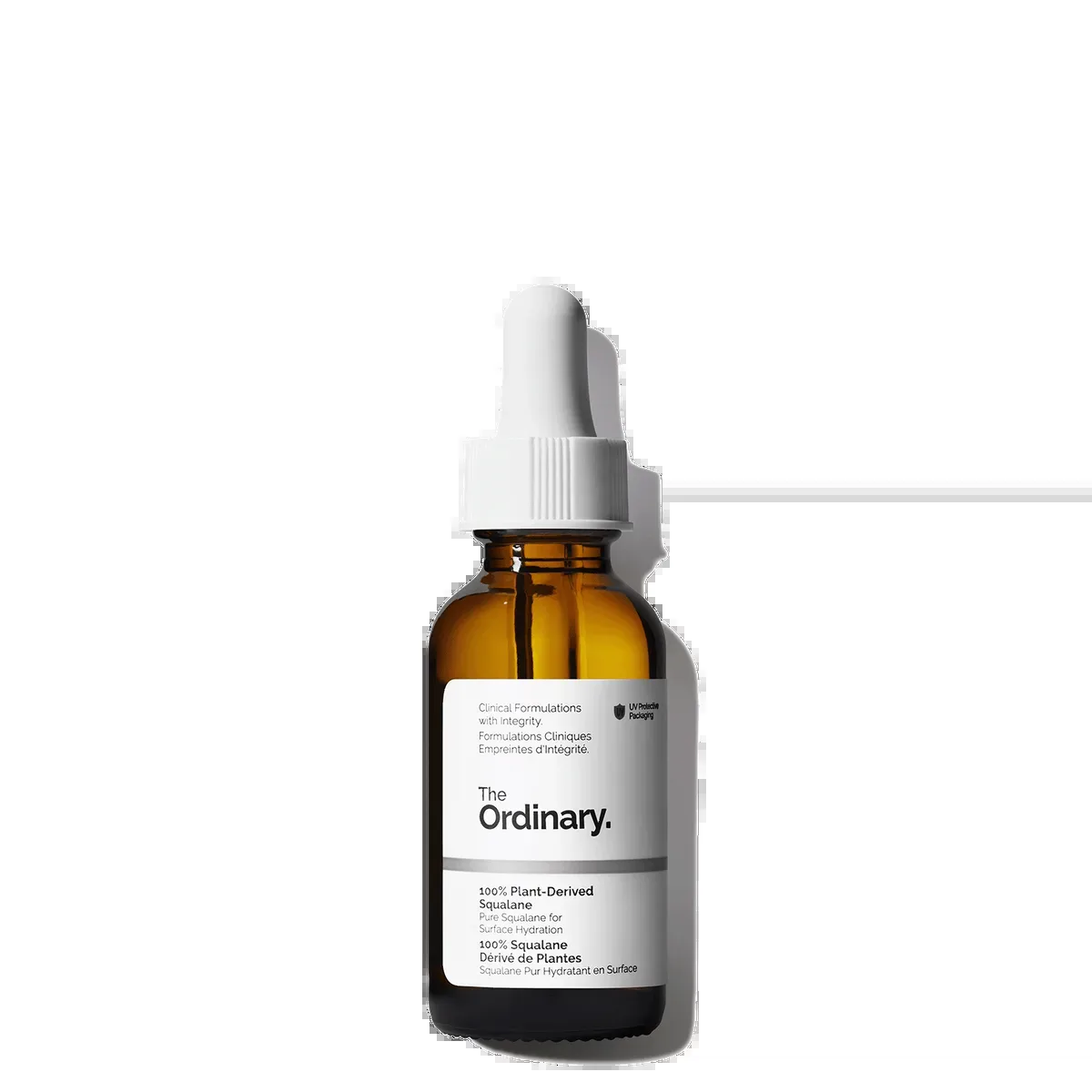
Two ingredients dodge the problem entirely by not being triglycerides. Jojoba is a liquid wax ester, structurally different from a fat, and is famously stable. Squalane is a fully saturated hydrocarbon — the hydrogenated form of squalene — with no double bonds left to oxidise. The Ordinary 100% Plant-Derived Squalane is the extreme end of the processing spectrum, and its virtues are precisely the ones processing creates: no residual protein, no polyphenols to lose, essentially no oxidation, no scent.
Learn the smell, because it is the only home test that works. Fresh oils smell nutty, green or faintly grassy. Turned oils smell like crayons, putty, old paint or fish. That shift is aldehyde formation, and those aldehydes are irritants — a rancid oil is not merely a less effective oil, it is an actively worse one on inflamed skin. Our shelf life tool will give you a realistic disposal date for a given oil rather than the optimistic one on the box.
The trial that reframes the whole label question
If you read only one piece of research on plant oils and skin, make it this one, because it demonstrates that the argument people are having is about the wrong variable.
Nineteen adult volunteers, with and without a history of atopic dermatitis, took part in randomised forearm-controlled studies. In one cohort, six drops of olive oil went on one forearm and six drops of sunflower seed oil on the other, twice daily for four weeks. Same person, same environment, same frequency — the only difference was which oil.
Topical olive oil significantly damaged the skin barrier. Sunflower seed oil did not.
Both are plant oils. Both are available cold-pressed, virgin and unrefined. Both are recommended constantly for dry skin and, in much of the world, for newborn skin care. The label vocabulary that this article has spent four sections on would rate them identically.
The explanation is composition. Olive oil is dominated by oleic acid, which is a known penetration enhancer and disrupts the ordered lamellar arrangement of stratum corneum lipids — useful if you want to drive something through skin, damaging if the skin's job is to keep water in. Sunflower seed oil is linoleic-rich, and linoleic acid feeds directly into the skin's own ceramide synthesis rather than disordering it.
That is the sentence worth carrying away: the variable that decided a controlled trial between two plant oils was fatty acid profile, and fatty acid profile is not printed anywhere on the front of a bottle. Meanwhile the variables that are printed — cold-pressed, virgin, organic — did not enter into it. Our olive oil page covers this result in more detail, because it is the single most counterintuitive finding in the botanical oil literature and it contradicts a great deal of confident advice.
So which do you buy unrefined, and which refined
The decision comes down to three questions, in this order.
Is the skin intact? If you are applying oil to eczematous, cracked, broken or infant skin, buy refined. The protein-removal evidence is direct and the downside of the polyphenol loss is speculative. This also applies if anyone in the household has a relevant seed or nut allergy. The eczema pathway covers what belongs on a compromised barrier more generally, and reading labels when your skin is reactive is the practical version of this section.
Are the minor components the actual reason you are buying it? Sometimes they genuinely are, and then unrefined earns its premium. Unrefined shea butter retains the unsaponifiable fraction — the sterol and triterpene content that distinguishes it from a generic fat — and refined shea is a bland moisturiser by comparison. Cold-pressed argan is bought for its tocopherol content, which is exactly what deodorisation removes; The Ordinary 100% Organic Cold-Pressed Moroccan Argan Oil and Krave Beauty 100% Cold-Pressed Tamanu Oil are both sold on that logic and both are legitimate versions of it. Rosehip is bought for its carotenoid and retinoid-adjacent content, which is why The Ordinary Rosehip Seed Oil is sold cold-pressed — and also why it is the fastest-turning oil in most people's bathrooms and should be bought small, kept dark and refrigerated.
Or do you just want the barrier benefit without the complications? Then skip the argument. Squalane and jojoba give you occlusion and slip with no protein, no polyphenols to degrade and no meaningful oxidation. A formulated blend such as Byoma Recovery Oil takes the same approach at a system level — stable base lipids with the interesting fractions added deliberately and in known amounts, rather than left in and hoped for. Drunk Elephant Virgin Marula Luxury Facial Oil sits at the other end, a high-oleic virgin oil, and is a reasonable choice for someone whose skin tolerates oleic acid well — a genuinely individual variable.
What none of this supports is the default assumption that less processing is automatically better. Processing is a set of operations, each of which removes something specific. Whether that is a loss or a gain depends on what you were trying to do. Our plant oils overview carries the full composition tables if you want to reason from the fatty acid profile rather than the front of the label — which, on the evidence, is the variable that decides the outcome.
Products mentioned
Independently reviewed and scored — the real products behind this piece.


- Therapy guide Eczema What belongs on a compromised barrier, where the refined default matters most
- Ingredient Plant & Seed Oils Full composition tables for reasoning from fatty acid profile rather than the label
- Ingredient Olive Oil The oleic-acid barrier result in detail — the most counterintuitive finding here
- Ingredient Sunflower Oil (Helianthus Annuus Seed Oil) The linoleic-rich comparator that came through the trial intact
- Ingredient Safflower Oil Same polyunsaturate-heavy profile and the same stability problem
- Ingredient Jojoba Oil A wax ester rather than a triglyceride, which is why it does not turn
- Ingredient Squalane Fully saturated, no double bonds left to oxidise
- Ingredient Shea Butter The clearest case where unrefined genuinely buys the unsaponifiable fraction
- Question What should I look for on a psoriasis product label? The practical label-reading version for reactive skin
References
- The effect of refining process on the physicochemical properties and micronutrients of rapeseed oils — PLOS ONE, 2019
- Randomised, double blind, crossover challenge study of allergenicity of peanut oils in subjects allergic to peanuts — BMJ, 1997
- Influence of refining steps on trace allergenic protein content in sunflower oil — Journal of Allergy and Clinical Immunology, 2000
- Investigation of the allergenicity of a refined peanut oil-containing topical dermatologic agent in persons who are sensitive to peanuts — Cutis, 2001
- Effect of olive and sunflower seed oil on the adult skin barrier: implications for neonatal skin care — Pediatric Dermatology, 2013
Every cited link is verified to resolve to the paper named. Where a source could not be independently confirmed, it is listed without a link rather than pointing you somewhere wrong.
Frequently asked
Is cold-pressed oil better for my skin than refined?
Not automatically. Cold-pressing preserves polyphenols and tocopherols, and it also preserves the residual seed proteins that carry allergen risk and the trace metals and chlorophyll that speed oxidation. On intact skin where the minor fraction is the reason you bought the oil, unrefined is worth it. On broken or eczematous skin, refined is the safer default.
Why would I ever want a refined oil in skincare?
Because refining removes residual protein, and that is the fraction with allergen risk. A double-blind crossover challenge found none of 60 peanut-allergic subjects reacted to refined peanut oil while 10% reacted to crude. Refined oils are also more stable, more consistent batch to batch, and scent-free, which matters if you are reactive to fragrance.
Which plant oils go rancid fastest?
The polyunsaturate-heavy ones — rosehip, flaxseed, standard sunflower and safflower — because multiple double bonds oxidise readily. Processing barely changes this; fatty acid profile dominates. Jojoba is a wax ester and squalane is fully saturated, which is why both are effectively immune to the problem.
How do I tell if my facial oil has turned?
By smell. Fresh plant oils read as nutty, green or grassy; oxidised ones smell like crayons, putty, old paint or fish. That change is aldehyde formation, and those aldehydes are irritants — so a turned oil is not just weaker, it is worse on inflamed skin than nothing at all.
Is olive oil good for dry skin?
The controlled evidence says be careful. In a forearm-controlled study applying olive oil to one arm and sunflower seed oil to the other twice daily for four weeks, olive oil significantly damaged the skin barrier while sunflower did not. Oleic acid disrupts the ordered lipid lamellae; linoleic acid feeds ceramide synthesis. It is a composition difference, not a quality one.