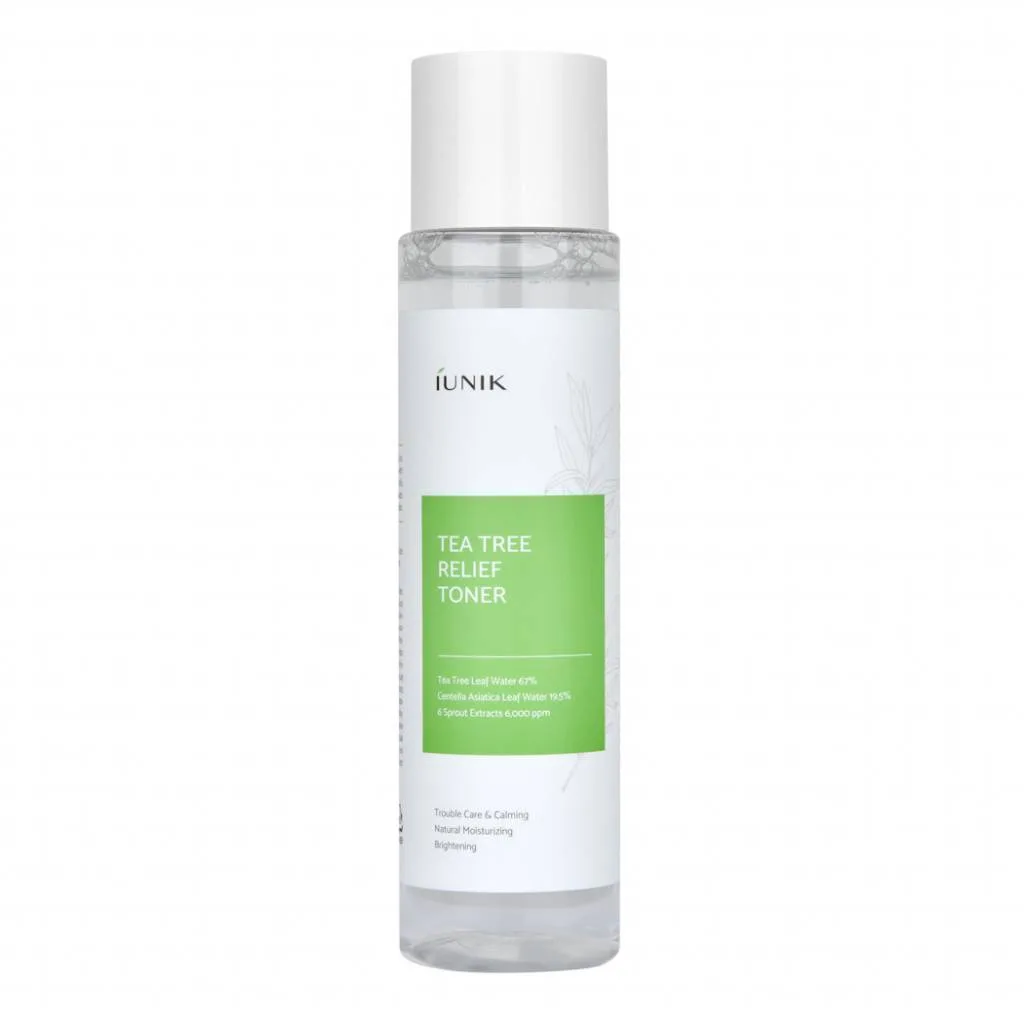
IUNIK uses 67% tea tree leaf water — exceptional concentration well above typical K-beauty tea tree toner inclusions. Combined with 20% centella leaf water and niacinamide for multi-mechanism acne-and-soothing chemistry. Distinguishes from generic toners through the high-concentration botanical platform.
IUNIK's Tea Tree Relief Toner combines 67% tea tree leaf water (exceptional concentration) with 20% centella leaf water and niacinamide in an acne-targeted K-beauty toner format. At $18.50 for 200ml the value is strong. The fragrance addition limits sensitive-skin suitability; otherwise an excellent acne-prone toner with documented anti-bacterial and anti-inflammatory chemistry.
Promisingfor AcneIn your profileYou chose · Niacinamide has trial-level evidence for acne but no guideline or regulatory standing yet — promising, short of a recommendation; the other actives here are not yet assessed for it.Moderate evidenceStandard tolerability16 reviews collected
The case for it
Niacinamide has trial-level evidence for this concern but no guideline or regulatory standing yet.
It is plausibly present at a working level, though the concentration is not declared.
The formula carries no trigger this concern is sensitive to, with the cautions noted.
Cautions: fragrance.
What would change this: A declared concentration would move this to a firmer reading of the dose.
Same rule for everyone. “Promising” is the verdict on 7,858 of 45,024 concern verdicts across the catalog; rule R9p decided 7,858 of them.
Unchanged since September 5, 2026, engine 5.1.1.
R9p — 0.5.0: 'Unproven' beside three filled dots read as one question answered twice with opposite words (7,018 rows). The chip measures standing, the dots measure trial volume; where the row carries at least one RCT or a tier-2 source (moderate dots) and the active is present at a working level, the honest word is Promising. Unproven is reserved for plausible-standing rows with limited or weak evidence, or an under-dosed form. Same rank as Unproven — a bet either way; the dots order them. · the full register
Carrying active
Niacinamide
Standing
plausible — trials support it
Form
plausible — studied range 4–5%, from the OTC monograph or label; needs leave-on contact; judge it after ~8 weeks
Tolerability
standard — fragrance load
Row checked
against its sources on July 17, 2026 (evidence table ev-2026.09-r228)
Promisingfor Excess OilinessIn your profileYou chose · Niacinamide has trial-level evidence for excess oiliness but no guideline or regulatory standing yet — promising, short of a recommendation; the other actives here are not yet assessed for it.Moderate evidenceStandard tolerability16 reviews collected
The case for it
Niacinamide has trial-level evidence for this concern but no guideline or regulatory standing yet.
It is plausibly present at a working level, though the concentration is not declared.
The formula carries no trigger this concern is sensitive to, with the cautions noted.
What would change this: A declared concentration would move this to a firmer reading of the dose.
Same rule for everyone. “Promising” is the verdict on 7,858 of 45,024 concern verdicts across the catalog; rule R9p decided 7,858 of them.
Unchanged since September 5, 2026, engine 5.1.1.
R9p — 0.5.0: 'Unproven' beside three filled dots read as one question answered twice with opposite words (7,018 rows). The chip measures standing, the dots measure trial volume; where the row carries at least one RCT or a tier-2 source (moderate dots) and the active is present at a working level, the honest word is Promising. Unproven is reserved for plausible-standing rows with limited or weak evidence, or an under-dosed form. Same rank as Unproven — a bet either way; the dots order them. · the full register
Carrying active
Niacinamide
Standing
plausible — trials support it
Form
plausible — studied range 2%, from the trials on the row; needs leave-on contact; judge it after ~8 weeks
Tolerability
standard
Row checked
against its sources on July 17, 2026 (evidence table ev-2026.09-r228)
Avoidfor SensitivityIn your profileYou chose · This formula carries fragrance — the kind of thing reactive skin flags first.Not yet assessedCarries a trigger16 reviews collected
The case for it
Centella Asiatica Leaf Water has been researched for this concern and the evidence does not support it.
It is present at an effective concentration, declared or high in the ingredient list.
The formula carries a known trigger for this concern, which decides the verdict before any efficacy question.
What would change this: Removing the trigger named above would let the actives be judged on their own.
Same rule for everyone. “Avoid” is the verdict on 1,909 of 45,024 concern verdicts across the catalog; rule F1 decided 605 of them.
Unchanged since September 5, 2026, engine 5.1.1.
Avoidfor RosaceaIn your profileYou chose · This formula carries fragrance — a known trigger for rosacea — so it is not a fit however good its actives are.Moderate evidenceCarries a trigger16 reviews collected
The case for it
Centella Asiatica Leaf Water has early or mechanistic evidence for this concern, not trial-backed standing.
It is present at an effective concentration, declared or high in the ingredient list.
The formula carries a known trigger for this concern, which decides the verdict before any efficacy question.
What would change this: Removing the trigger named above would let the actives be judged on their own.
Same rule for everyone. “Avoid” is the verdict on 1,909 of 45,024 concern verdicts across the catalog; rule R1 decided 1,304 of them.
Unchanged since September 5, 2026, engine 5.1.1.
R1 — Safety outranks praise (MASTER-PLAN §1.7). A condition-weighted trigger (multiplier ≥ 2 in condition-fit-matrix) decides the verdict before any efficacy question. · the full register
Carrying active
Centella Asiatica Leaf Water
Standing
plausible — trials support it
Form
adequate (declared 20%)
Tolerability
harsh — fragrance load
Row checked
against its sources on July 17, 2026 (evidence table ev-2026.09-r228)
Also listed for Blackheads and Fungal Acne — the actives here (Centella Asiatica, Niacinamide, Allantoin, Purslane Extract) are in our research queue for those concerns; there is no verdict until their evidence rows are written. That is a gap in our table, not a mark against the product.
Does the jobDoes what a toner is for: not alcohol-driven, adds something real. Not measured from the label: restores skin pH, plays well with what follows.
A verdict is DermApproved’s assessment of how well a product’s ingredients fit a concern — never a claim about what the product treats. Evidence dots and collected reviews sit beside it and are never blended in.
Rules 0.5.1 · evidence table ev-2026.09-r228 · how we decide
Assessment
Pros & Cons
Pros
✓ 67% tea tree leaf water is exceptional concentration — significantly above typical K-beauty tea tree inclusions
✓ 20% centella leaf water adds documented anti-inflammatory support
✓ Niacinamide at meaningful 2-3% concentration for barrier and brightening support
✗ Strong herbal tea tree scent is divisive — not for users who dislike herbal aromatherapy
✗ Less effective for very dry skin types where richer hydration is needed
✗ Tea tree allergen consideration for users with documented Melaleuca sensitivity
Review
Full Review
Tea tree occupies an awkward middle ground as an acne ingredient. The essential oil has solid published evidence for calming inflammation and knocking back acne-causing bacteria, with some studies putting it in the same conversation as benzoyl peroxide for tolerability, yet at concentrations high enough to matter it's frequently too irritating for daily use. The clever workaround is tea tree leaf water, the hydrosol left after distillation, which captures the water-soluble compounds and most of the terpinen-4-ol while leaving the harsh, neat essential oil behind. IUNIK built its Tea Tree Relief Toner on exactly that gentler chemistry, and then did something genuinely unusual: it dialed the leaf water up to 67% and made it the literal first ingredient.
That concentration is the headline, and it's well above what most K-beauty tea tree toners bother with. The formula leads with tea tree leaf water at 67%, immediately followed by centella asiatica leaf water at 20%, and that dual leaf-water base is what sets it apart structurally. Most toners use plain water as the chassis and treat botanicals as secondary garnish; here, two active botanical waters are the chassis, which means the soothing and antibacterial chemistry is woven through the whole product rather than sprinkled on top. Butylene glycol, water, 1,2-hexanediol, and niacinamide follow in the next positions, with the niacinamide landing in roughly the sixth slot, a placement that suggests a meaningful 2-3% level, enough to support the barrier, help regulate sebum, and add a little brightening that complements the tea tree's antibacterial action.
What keeps this from drying skin out the way many acne toners do is the genuinely generous soothing and humectant layer. Glycerin, betaine, pentylene glycol, and sodium hyaluronate handle hydration, while allantoin and dipotassium glycyrrhizate, a licorice-root derivative with anti-inflammatory credentials, buffer the actives. On top of that sits a comprehensive botanical cast, aloe, purslane, perilla leaf, rooibos, myrrh resin, and licorice root, each contributing antioxidant and calming chemistry. This is K-beauty layering at full tilt rather than minimalist Western formulation, and the result is a toner that clarifies without leaving skin feeling stripped or tight. The marketed sprout extract blend, the rapeseed-broccoli-wheat-alfalfa-radish-cabbage complex at a claimed 6,000ppm, is referenced in promotion but not fully visible in the published INCI, so it's fair to treat it as a nice-if-present bonus rather than a load-bearing active.
In use, the texture is watery and absorbs instantly with no tackiness, and skin feels clean and fresh afterward, not squeaky or parched. The freshness is immediate; the actual acne and blackhead improvement is cumulative, typically building over two to four weeks of consistent application. A pleasant practical detail is that the formula is oil-free and falls into the fungal-acne-safe camp, and tea tree's documented antifungal activity means it may help with Malassezia folliculitis, the fungal acne that masquerades as ordinary breakouts, which makes this one of the more useful K-beauty picks for mixed or fungal-prone skin specifically.
The formula's main limitation is its fragrance. Between the strong, genuinely herbal tea tree aroma and an added fragrance on top, the sensory profile is polarizing, the kind of thing some users find bracing and refreshing and others find overwhelming, and it nudges the toner away from being ideal for fragrance-sensitive or reactive skin. A patch test is the sensible move for anyone with documented fragrance sensitivity, and the rare user with an actual Melaleuca allergy should steer clear entirely. It's also not the right call for very dry skin, where the clarifying, oil-free character leaves you wanting the richer hydration a different product would provide. These are real caveats, but they're narrow ones, and they don't undercut the core competence of the formula.
It's worth lingering on what the high tea tree concentration actually buys you, because the number alone could read as a marketing flex rather than a functional choice. The published research on Melaleuca alternifolia is genuinely substantial: terpinen-4-ol, its key active, has documented antibacterial, anti-inflammatory, and antifungal activity, and topical tea tree has held its own against benzoyl peroxide in acne studies while tending to be better tolerated. The catch has always been that the essential oil's irritation potential caps how much you can comfortably use. By delivering the chemistry through leaf water instead, IUNIK gets to push the concentration far higher than usual while keeping the formula gentle, and the 20% centella leaf water sitting right behind it layers in well-evidenced wound-healing and soothing support from asiaticoside and madecassoside. That combination, antibacterial clarifying on one side, calming barrier support on the other, is what lets the toner work on active breakouts without the rebound dryness that drives so many people off acne toners entirely. With a 2019 launch and a substantial review history, this is a settled, well-understood product rather than a hopeful newcomer, which is why the confidence in it runs high.
Value is where it pulls comfortably ahead. At $18.50 for a full 200ml, you're paying a low per-ounce price for a high-concentration tea tree platform with real centella and niacinamide alongside it, which is strong within the K-beauty acne-toner category, and the high data confidence here is earned by a launch that goes back to 2019 and a substantial review history since. Established and well-distributed internationally, this isn't a hype product still proving itself; it's a known quantity with a track record. The right buyer is anyone with acne-prone, oily, combination, or fungal-acne-prone skin who wants effective tea tree chemistry at a fair price and doesn't mind, or actively enjoys, a herbal scent. The wrong buyer is fragrance-sensitive skin, anyone with a tea tree allergy, very dry skin needing deep hydration, or someone specifically after exfoliating-acid chemistry, which this deliberately isn't. On its own terms, it's an excellent, sensibly priced acne toner that does precisely what it sets out to do.
Formula
Key Ingredients
The hero actives that drive this product's performance.
First INCI position at exceptional 67% concentration — tea tree leaf water provides anti-bacterial and anti-inflammatory effects through terpinen-4-ol content. The leaf water format is significantly gentler than tea tree essential oil while retaining the active chemistry.
Second INCI position at 20% concentration — centella adds documented anti-inflammatory and wound-healing support that complements the tea tree antibacterial chemistry for comprehensive acne-and-soothing positioning.
Marketing references 6,000ppm sprout extracts from rapeseed, broccoli, wheat, alfalfa, radish, and cabbage — though not all visible in published INCI extract. Provides anti-aging botanical claim.
Allantoin provides skin-conditioning effects; dipotassium glycyrrhizate (licorice root derivative) adds anti-inflammatory support that buffers the active chemistry.
Apply to cotton pad or palms after cleansing, sweep across face. Use as the toner step in AM and PM. The high tea tree concentration suits acne-prone skin specifically; pair with the brand's Centella Calming AC Spot Cream for targeted treatment.
Results Timeline
Immediate freshness and skin clarity; cumulative acne improvement builds over 2-4 weeks of consistent use.
Tea tree (Melaleuca alternifolia) has extensive published research documenting antibacterial, anti-inflammatory, and antifungal effects through its terpinen-4-ol content. Topical tea tree has clinical evidence for acne treatment with comparable efficacy to benzoyl peroxide in some studies but with better tolerability. Tea tree leaf water (hydrosol) provides significantly gentler chemistry than tea tree essential oil while retaining water-soluble active compounds. The 67% leaf water concentration provides meaningful tea tree chemistry without the irritation risk of essential oil application. Centella asiatica has well-documented anti-inflammatory and wound-healing effects through asiaticoside, madecassoside, and asiatic acid content. Niacinamide at 2-5% concentrations has well-documented barrier, sebum-regulating, and brightening effects. The multi-source humectant stack provides established hydration support. Allantoin has documented skin-conditioning effects. Dipotassium glycyrrhizate (licorice root derivative) has documented anti-inflammatory effects. The combined formulation represents a comprehensive K-beauty acne toner with strong individual ingredient evidence; the 67% tea tree leaf water concentration is the formulation's most distinctive scientific feature.
Tea tree-based acne toners are commonly recommended in dermatology as alternatives to or complements to prescription topical treatments for mild-to-moderate acne. The IUNIK Tea Tree Relief Toner's chemistry — concentrated tea tree leaf water plus centella, niacinamide, and supporting botanicals — is consistent with mainstream clinical recommendations for daily acne maintenance. Clinicians treating patients with significant acne typically combine cosmetic toners with prescription treatments (topical adapalene, tretinoin, benzoyl peroxide) for measurable clinical effect. For mild acne, sensitive acne, or maintenance between flares, this product is a credible choice. The fragrance consideration is a routine caution for atopic patients.
Guidance
Usage & Recommendations
How to Use
Apply to cotton pad or palms after cleansing, sweep gently across face including problem areas. Use as the toner step in both AM and PM routines. Pairs well as part of an acne-targeted routine combining with the brand's complementary Centella Calming AC Spot Cream for targeted treatment of blemishes. Follow with serum and moisturizer. Always use SPF in the day.
Value Assessment
At $18.50 for 200ml ($2.75 per ounce), the toner offers strong value within the K-beauty acne toner category. The Ordinary Glycolic Acid 7% Toning Solution ($1.11/oz) is the budget benchmark but uses different chemistry. COSRX AHA/BHA Clarifying Treatment Toner ($5/oz) is the K-beauty mainstream comparison. Paula's Choice 2% BHA Liquid ($8.75/oz) is the prestige BHA alternative. IUNIK Tea Tree Relief Toner is competitively priced for its specific tea tree positioning and high active concentration.
Who Should Buy
Acne-prone, oily, combination, or fungal-acne-prone skin users seeking tea tree chemistry at strong K-beauty value. IUNIK platform builders. Users who tolerate fragrance and herbal scents. Buyers seeking effective acne toner without aggressive AHA/BHA chemistry.
Who Should Skip
Fragrance-sensitive users — choose fragrance-free alternatives like Klairs Supple Preparation Facial Toner. Documented tea tree (Melaleuca) allergic individuals. Very dry skin needing richer humectant chemistry. Users seeking primary chemical exfoliation through AHA or BHA toners.
Watery toner that absorbs instantly. Distinct herbal tea tree scent is unmistakable on application. Skin feels clean and fresh — not stripped or tight. Cumulative acne and clarity improvement builds over 2-4 weeks of consistent use.
How Long It Lasts
Approximately 3-4 months applied morning and evening
Launched in 2019 as part of IUNIK's tea tree platform aimed at acne-prone and oily skin types. Has built strong international distribution and reputation as a K-beauty acne treatment toner since release.
About IUNIK Established Brand (5–20 years)
IUNIK's Tea Tree Relief Toner anchors the brand's tea tree platform with exceptional 67% tea tree leaf water concentration. Long-established K-beauty toner with substantial international distribution and review history since 2019 launch.
Brand founded: 2017 · Product launched: 2019
Myth vs. Reality
Common Myths
Myth
Tea tree water is just dilute essential oil.
Reality
Tea tree leaf water is produced through distillation of tea tree leaves, capturing the water-soluble compounds while leaving most of the essential oil behind. The result is significantly gentler than tea tree essential oil while retaining the documented terpinen-4-ol content that drives antibacterial effects. The 67% leaf water concentration in this toner provides meaningful tea tree chemistry without the irritation risk of pure essential oil application.
FAQ
Frequently Asked Questions
Is 67% tea tree water too strong for daily use?
No — tea tree leaf water is significantly gentler than tea tree essential oil. The 67% concentration of leaf water (not essential oil) is appropriate for daily use even on sensitive acne-prone skin. The brand's broad fragrance addition is the more meaningful sensitivity consideration than the tea tree itself.
Is this fragrance-free?
No — the formulation includes fragrance/parfum. Users sensitive to added fragrance should consider a fragrance-free alternative like Klairs Supple Preparation Facial Toner or COSRX Centella Toner.
How does this compare to Paula's Choice 2% BHA?
Different chemistry. Paula's Choice 2% BHA uses salicylic acid for chemical exfoliation. IUNIK Tea Tree uses concentrated tea tree leaf water and centella for antibacterial and anti-inflammatory effects. Both target acne but through different mechanisms. Many users find layering them (BHA AM, tea tree PM, or alternate days) provides complementary acne management.
Can I use the Tea Tree Relief Toner while pregnant or breastfeeding?
Yes — no retinoids, salicylic acid, or other pregnancy-contraindicated actives. Tea tree leaf water at this concentration is considered safe during pregnancy.
Will the 200ml bottle last?
Approximately 3-4 months at twice-daily use.
Is this suitable for fungal acne?
Yes — the formulation is oil-free and uses ingredients generally considered fungal-acne safe. Tea tree specifically has documented antifungal properties that may help with fungal acne (Malassezia folliculitis).
Reviews
What Reviewers Tend to Say
Recurring themes our editors read across retailer reviews of this product — summaries in our words, not quotations, and not a substitute for your own patch test.
Common Praise
67% tea tree leaf water is exceptional concentration
Visible acne and blackhead improvement over weeks
Lightweight non-tacky texture
Great value at $18.50 for 200ml
Effective for fungal acne
Common Complaints
Fragrance addition limits sensitive use
Tea tree scent is divisive — strong herbal character
Less effective for very dry skin
Notable Endorsements
IUNIK signature tea tree platform anchorK-beauty acne toner category leader
The strongest counterexample to blanket botanical scepticism is also one of the more common contact allergens — and holding both facts at once is the only honest way to read it.
Five brands that own the feed, judged on their ingredient lists rather than their view counts — including the one active all five suddenly added at once, and what that tells you.
Essential oils are declared by botanical name rather than as fragrance, which is why the most heavily perfumed products in the natural aisle can carry the reassuring word — and why the bottle gets more sensitising the longer you own it.
Cutting a beard hair takes about a twentieth of a newton. You press with two and stretch your skin by a fifth — which is why almost every shaving problem is a technique problem wearing a hardware costume.
Aug 28, 2026· 10 min
Questions people ask about Acne
Verified answers from our questions library — the nuance a product page cannot carry.
Products, answers, therapy guides, tools and articles in one search. Brand names,
slang and abbreviations all work — accutane finds isotretinoin, bacne finds truncal acne.