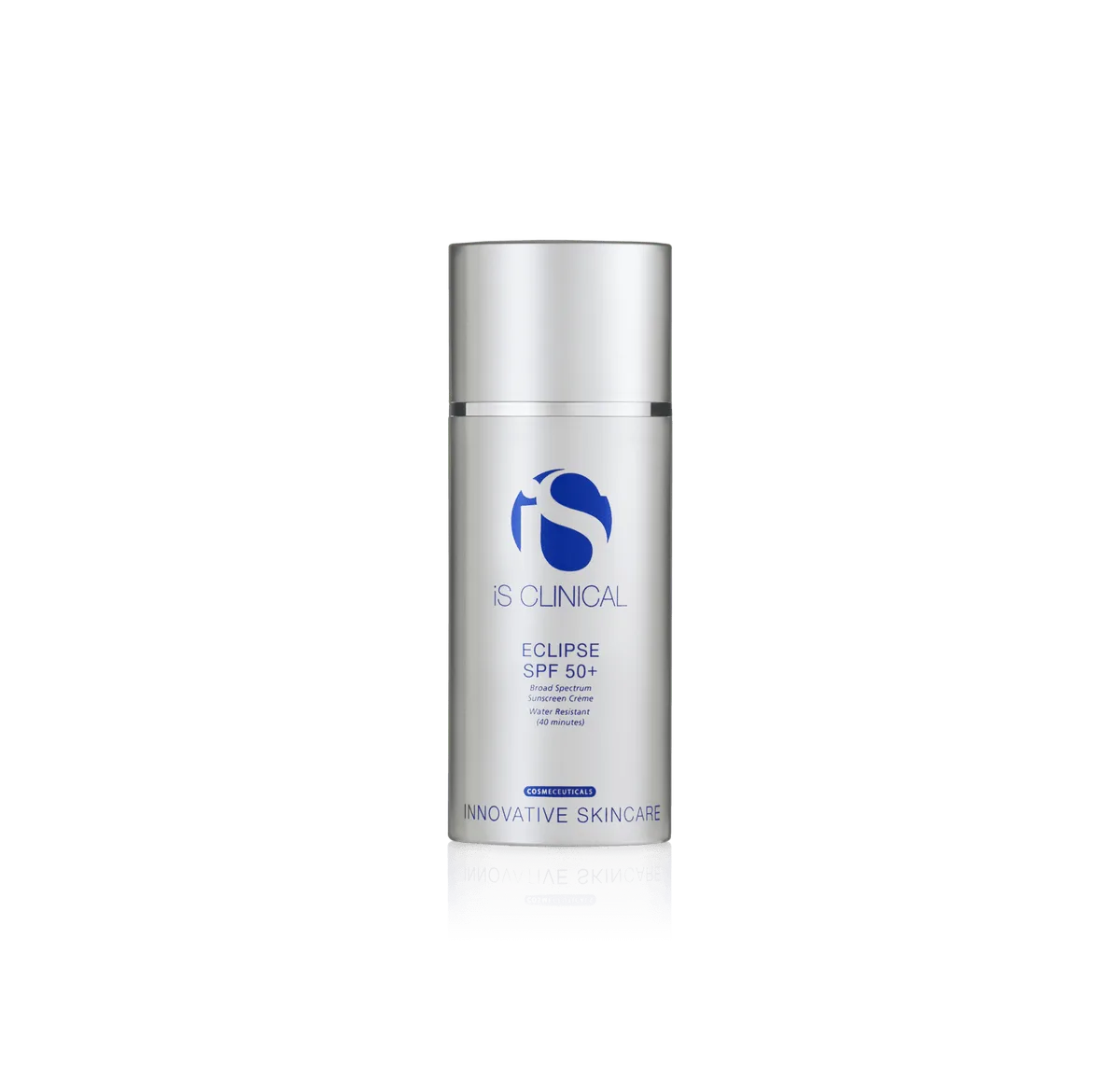
Most mineral sunscreens either feel heavy and leave white cast or sacrifice UV protection for cosmetic elegance. Eclipse uses sophisticated dispersion chemistry (polyhydroxystearic acid, alumina, methicone particle coatings) that allows the mineral filters to spread evenly with minimal cast. The PerfecTint versions add iron oxide tinting for visible-light protection — critical for melasma. The clinical-grade formulation backed by dermatology distribution channels.
A genuinely well-engineered mineral sunscreen that solves the two problems mineral filters usually pose: white cast and clunky texture. Titanium dioxide and zinc oxide deliver reliable broad-spectrum protection, and the PerfecTint iron oxide versions add visible-light defense that matters for melasma. The clinical-tier price is the main friction point, but the formulation chemistry is the real deal. A standout for sensitive and post-procedure skin.
Full protectionfor Sun DamageIn your profileYou chose · Broad-spectrum SPF 50 with titanium dioxide, zinc oxide: the protection sun damage calls for.Moderate evidenceGentleNo reviews collected yet
The case for it
Titanium Dioxide is a first-line active — approved, monograph-listed or named in current guidelines — for this concern.
It is present at an effective concentration, declared or high in the ingredient list.
The formula carries none of the triggers this concern is sensitive to.
Same rule for everyone. “Full protection” is the verdict on 2,288 of 45,024 concern verdicts across the catalog; rule P1 decided 2,232 of them.
Unchanged since September 5, 2026, engine 5.1.1.
P1 — Photoprotection standing is regulatory (M020 / Annex VI filters; 21 CFR 201.327 attaches the early-skin-aging claim to tested broad-spectrum SPF 15+). SPF 30 is the AAD daily-use bar. · the full register
Carrying active
Titanium Dioxide
Standing
first line — a regulator recognises it for this use; trials support it · per § 352.10 Sunscreen active ingredients. (U.S. Food and Drug Administration — 21 CFR Part 352 (Sunscreen Drug Products for Over-the-Counter Human Use), Code of Federal Regulations via GovInfo), opened July 27, 2026
Form
adequate (declared 5.2%) — studied range up to 25%, from the OTC monograph or label; needs leave-on contact
Tolerability
gentle
Row checked
against its sources on July 27, 2026 (evidence table ev-2026.09-r228)
21 CFR 352.10 — Sunscreen active ingredients — US Food and Drug Administration / Electronic Code of Federal Regulations (retrieved 2026-07-16; note stayed effective date), opened July 16, 2026
Full protectionfor HyperpigmentationIn your profileYou chose · Broad-spectrum SPF 50 with titanium dioxide, zinc oxide: the protection hyperpigmentation calls for.Not yet assessedGentleNo reviews collected yet
The case for it
Titanium Dioxide has no evidence row yet for this concern — it is in the research queue.
The formula carries none of the triggers this concern is sensitive to.
What would change this: A researched evidence row for the lead active would replace this with a verdict.
Same rule for everyone. “Full protection” is the verdict on 2,288 of 45,024 concern verdicts across the catalog; rule P1 decided 2,232 of them.
Unchanged since September 5, 2026, engine 5.1.1.
P1 — Photoprotection standing is regulatory (M020 / Annex VI filters; 21 CFR 201.327 attaches the early-skin-aging claim to tested broad-spectrum SPF 15+). SPF 30 is the AAD daily-use bar. · the full register
Full protectionfor MelasmaIn your profileYou chose · Broad-spectrum SPF 50 with iron oxides for visible light — what melasma needs from a sunscreen.Not yet assessedGentleNo reviews collected yet
The case for it
Titanium Dioxide has no evidence row yet for this concern — it is in the research queue.
The formula carries none of the triggers this concern is sensitive to.
What would change this: A researched evidence row for the lead active would replace this with a verdict.
Same rule for everyone. “Full protection” is the verdict on 2,288 of 45,024 concern verdicts across the catalog; rule P2 decided 56 of them.
Unchanged since September 5, 2026, engine 5.1.1.
Supporting rolefor RosaceaIn your profileYou chose · Nothing here targets rosacea directly; photoprotection against a known trigger is the recognised companion to treating it, and this cream does that without known triggers.Not yet assessedGentleNo reviews collected yet
The case for it
Titanium Dioxide has no evidence row yet for this concern — it is in the research queue.
The formula carries none of the triggers this concern is sensitive to.
What would change this: A researched evidence row for the lead active would replace this with a verdict.
Same rule for everyone. “Supporting role” is the verdict on 8,197 of 45,024 concern verdicts across the catalog; rule R8 decided 4,250 of them.
Unchanged since September 5, 2026, engine 5.1.1.
R8 — The category's job (barrier care, humectant hydration, gentle cleansing, photoprotection) is the documented supportive role for this concern. This is the honest verdict for a moisturizer on an acne page. · the full register
Good choicefor SensitivityIn your profileYou chose · No fragrance, drying alcohol, declarable allergens or sensitising preservatives in this cream — the profile sensitive skin looks for.Not yet assessedGentleNo reviews collected yet
The case for it
Titanium Dioxide has no evidence row yet for this concern — it is in the research queue.
The formula carries none of the triggers this concern is sensitive to.
What would change this: A researched evidence row for the lead active would replace this with a verdict.
Same rule for everyone. “Good choice” is the verdict on 1,938 of 45,024 concern verdicts across the catalog; rule F2 decided 1,938 of them.
Unchanged since September 5, 2026, engine 5.1.1.
Does the jobDoes what a sunscreen is for: UVA coverage, kind to the skin wearing it. Not measured from the label: pleasant enough to actually use.
A verdict is DermApproved’s assessment of how well a product’s ingredients fit a concern — never a claim about what the product treats. Evidence dots and collected reviews sit beside it and are never blended in.
Rules 0.5.1 · evidence table ev-2026.09-r228 · how we decide
✓ Particle-coating chemistry minimizes white cast and pilling
✓ Iron oxide PerfecTint versions add genuine visible-light protection
✓ Exceptionally well-tolerated on sensitive and post-procedure skin
✓ Fragrance-free with no tingling or sting on application
✓ Non-greasy matte finish wears comfortably under makeup
✓ Vitamin E adds antioxidant defense against UV free radicals
Cons
✗ $65 for 3.5 oz is steep versus drugstore mineral sunscreens
✗ Tinted shade range is limited for deeper skin tones
✗ Sold mainly through professional channels, limiting easy access
✗ Texture can feel slightly heavy for very oily skin
✗ Counterfeit risk on unauthorized third-party marketplaces
Review
Full Review
The reason most people give up on mineral sunscreen is not the protection. It is the experience: the ghostly white cast, the draggy texture that pills under makeup, the sense that you have spackled rather than moisturized. iS Clinical Eclipse SPF 50+ is interesting precisely because the most important ingredients in it are not the UV filters at all. They are the dispersion agents, polyhydroxystearic acid, alumina, and methicone, that coat the titanium dioxide and zinc oxide particles and let them spread evenly instead of clumping into visible residue. That particle chemistry is the quiet engineering that makes a mineral-only formula behave like a cosmetically elegant one.
iS Clinical is worth a word of context. The brand was founded in 2005 by Bryan Johns and Charlene Valledor as a clinical skincare line built specifically for professional dermatology and aesthetic medical practice, distributed largely through licensed skincare professionals rather than open retail shelves. Eclipse, launched in 2014, has become one of its most-recognized products, and it slots neatly into that professional positioning: a sunscreen designed to be the one a dermatologist hands a patient after a laser session or a peel.
The active system is mineral-only: 5.20% titanium dioxide and 1.10% zinc oxide. Titanium dioxide carries the bulk of the UV protection and is highly photostable, meaning it does not degrade under sun exposure the way some chemical filters can. Zinc oxide, while present at a lower percentage, extends coverage into the longer-wave UVA range where titanium dioxide is comparatively weaker, so the pairing rounds out the broad-spectrum profile. This combination is also one of the best-tolerated UV filter systems available, which is why it is the default recommendation for sensitive skin, pediatric use, and skin recovering from procedures.
The most clinically meaningful addition is the iron oxides in the PerfecTint versions. Beyond providing the color match, iron oxides absorb and scatter visible light, including the high-energy visible (HEVIS, or blue) light that contributes to melasma and post-inflammatory hyperpigmentation. It's not a marketing flourish. Randomized controlled research has shown that iron oxide-containing SPF 50 sunscreens produce significantly greater improvement in melasma than equivalent untinted sunscreens, and tinted formulations can attenuate visible light by well over 90%. For anyone managing pigmentation, an iron oxide-tinted mineral sunscreen is the photoprotection standard, and Eclipse delivers it in a clinical-grade base. Vitamin E, present in both free tocopherol and the stable acetate form, adds antioxidant defense against UV-generated free radicals, a thoughtful secondary layer.
In use, Eclipse spreads as a medium-weight cream with the slight cushion typical of mineral formulas, then sets into a non-greasy matte finish over three to five minutes. The Translucent version keeps white cast minimal for a mineral sunscreen at this filter load, and the PerfecTint shades blur into the skin with subtle color. It is comfortable under makeup, fragrance-free, and notably free of tingling or sting, which is exactly what you want on post-laser or post-peel skin. The myth that mineral sunscreens must leave a cast is one this formula partially retires, though honesty requires noting that cast is always more pronounced on deeper skin tones, and the tinted shade range is genuinely limited at the deeper end. That is a real gap for a brand at this price.
Another point worth dwelling on is the difference between SPF number and real-world protection. SPF 30 blocks about 97% of UVB, SPF 50 about 98%, and the gap narrows further beyond that. The headline number on this product, 50+, is reassuring, but the protection you actually get depends almost entirely on how much you apply and how often you reapply. Most people use far less sunscreen than the testing standard assumes, which means they receive a fraction of the labeled SPF. Eclipse's real advantage is not its peak number but its broad-spectrum reliability: the photostable titanium-zinc pairing plus iron oxide visible-light coverage means that what it does protect against, it protects against consistently.
The brand context also matters for how you should think about Eclipse. iS Clinical has positioned itself, since its founding in 2005, as a brand that lives inside dermatology and aesthetic practices rather than on open retail shelves. That is not pure marketing: professional distribution means the product is formulated and tested with post-procedure use in mind, and the people most likely to recommend it, dermatologists and aesthetic clinicians, are also the ones whose patients most need a reliable mineral sunscreen. Eclipse is, in a real sense, designed to be the sunscreen handed across a treatment room.
The other honest limitations are about cost and access. At $65 for 3.5 oz, Eclipse is expensive next to drugstore mineral sunscreens that, on pure UV-filter terms, are functionally similar. The premium buys the dispersion chemistry, the iron oxide visible-light coverage, the vitamin E, and the clinical distribution and quality assurance, but a budget-conscious shopper who does not need the tinted visible-light protection can get adequate mineral UV defense for far less. Distribution itself is a friction point: Eclipse is sold mainly through dermatology offices, medspas, and authorized online retailers, and counterfeit risk is real with prestige clinical brands on unauthorized marketplaces. Very oily skin may also find the texture slightly heavier than ideal.
Where Eclipse earns its keep is the intersection of sensitive skin, post-procedure skin, and pigmentation management. If you have rosacea, react to chemical filters, are healing from an in-office treatment, or are actively managing melasma, this is one of the most reliable formulas you can reach for, and the cosmetic elegance means you will actually wear it daily, which is the whole point of sunscreen. For everyone else, it is an excellent product whose value depends entirely on whether you need what the premium pays for. The formulation deserves its reputation; just go in clear-eyed about the price.
Formula
Key Ingredients
The hero actives that drive this product's performance.
The primary mineral UV filter in this formula, providing broad-spectrum UVA/UVB protection through physical scattering and absorption. Titanium dioxide is highly photostable and doesn't degrade under UV exposure — making it a reliable filter for sustained protection. At 5.20%, it provides the bulk of the formula's UV protection capacity.
Regulator-approvedfor Sun Damage · limited certainty
Provides additional broad-spectrum UV protection complementing the titanium dioxide. The combination of titanium dioxide plus zinc oxide is one of the most-tolerated UV filter systems available — appropriate for sensitive skin, post-procedure skin, and pediatric use. At 1.10%, zinc oxide adds spectral coverage in the long-wave UVA range that titanium dioxide alone is weaker at.
Regulator-approvedfor Sun Damage · limited certainty
Tinting pigments providing the PerfecTint version's color match. Critically, iron oxides also extend the formula's protection into the visible light spectrum — including HEVIS blue light, which contributes to melasma and post-inflammatory hyperpigmentation. For users with pigmentation concerns, iron oxide-tinted mineral sunscreens are the photoprotection gold standard.
Dual-form vitamin E inclusion (free tocopherol plus the stable acetate form) provides antioxidant defense against UV-generated free radicals. The combination supplements the mineral UV filtration with secondary chemical antioxidant action — a thoughtful pairing in a professional-tier sunscreen.
A combination of dispersion agents and coatings that allow the mineral UV filters to spread evenly without producing the chunky white cast typical of older mineral sunscreens. The Polyhydroxystearic Acid and Methicone coat the titanium and zinc particles, while Alumina provides surface treatment for improved cosmetic finish. This is the formulation chemistry that makes Eclipse cosmetically elegant despite being mineral-based.
Not yet assessed
Ingredient standings describe the active at treatment-level doses and
vehicles; this product's own condition grades weigh its actual formula.
Use as the last step of morning skincare, 15 minutes before sun exposure. For full SPF 50+ protection, apply at least 1/4 teaspoon to the face alone. The PerfecTint versions provide additional visible-light protection for melasma management. Available in Translucent (untinted), PerfecTint Beige, and other shade options.
Results Timeline
Immediate UV protection on application. Long-term photoprotection benefits accumulate over months of consistent daily use. For melasma patients, the iron oxide-tinted versions provide superior protection vs non-tinted alternatives.
Pairs Well With
iS Clinical antioxidant serums underneathNiacinamide serums for layered protectionLight hydrating serums under for dry skin
Eclipse's formulation logic separates cleanly into UV protection and visible-light protection, and both halves are well-supported. The UV side uses 5.20% titanium dioxide and 1.10% zinc oxide. Titanium dioxide is highly photostable and provides the bulk of broad-spectrum coverage, while zinc oxide contributes coverage in the longer-wave UVA range where titanium dioxide is comparatively weaker, making the combination genuinely broad-spectrum rather than UVB-skewed. This mineral pairing is also among the best-tolerated filter systems, which is why it is standard guidance for sensitive and post-procedure skin. The more distinctive science is the iron oxide story in the PerfecTint versions. Visible light, particularly the high-energy blue (HEVIS) portion, has been shown to induce pigmentation, and conventional UV filters do not block it. Iron oxides absorb and scatter visible light, and the research base here is solid: randomized controlled studies, including work published in the Journal of Drugs in Dermatology and summarized in recent reviews in Photodermatology, Photoimmunology and Photomedicine, have demonstrated that iron oxide-containing SPF 50 sunscreens produce significantly greater improvement in melasma than equivalent untinted sunscreens, with tinted formulations attenuating visible light transmittance by upward of 90%. The supporting dispersion chemistry, polyhydroxystearic acid, alumina, and methicone coating the mineral particles, is the formulation engineering that allows even spreading and minimizes white cast, translating the filter load into a cosmetically usable product. Free and esterified vitamin E rounds out the formula with antioxidant defense against UV-generated reactive oxygen species. Taken together, this is a coherent photoprotection design where the mineral filters, iron oxides, and antioxidant work address distinct, complementary parts of the light-damage spectrum.
Dermatologists frequently recommend mineral-only sunscreens for patients with sensitive skin, rosacea, or skin recovering from procedures, because titanium dioxide and zinc oxide are among the best-tolerated UV filters and carry minimal sensitization risk. iS Clinical Eclipse is commonly distributed through dermatology and aesthetic medical practices, and it is often handed to patients after lasers, peels, and microneedling for exactly that reason. Clinicians also increasingly emphasize tinted, iron oxide-containing sunscreens for patients managing melasma and post-inflammatory hyperpigmentation, since visible light contributes to these conditions and standard UV filters do not block it. Clinicians consistently stress that the SPF number matters less than consistent, adequate application and reapplication, and that even an excellent sunscreen underperforms when used in too small a quantity. For freshly treated skin, dermatologists typically advise confirming with the treating provider before resuming sunscreen, and they regard persistent or patterned pigmentation such as melasma as warranting in-person evaluation rather than reliance on photoprotection alone.
Guidance
Usage & Recommendations
How to Use
Apply Eclipse as the final step of your morning skincare routine, about 15 minutes before sun exposure. Use at least a quarter teaspoon for the face alone, which is the established quantity for achieving the labeled SPF; most people apply far too little and get only a fraction of the protection. Smooth it evenly and allow three to five minutes for it to set into its matte finish before applying makeup. Reapply every two hours during prolonged sun exposure, and after swimming or heavy sweating. Choose the Translucent version for untinted protection or a PerfecTint shade if you want color match plus visible-light protection, which is the better option for melasma. For freshly procedured skin, confirm with your provider that you are cleared for sunscreen.
Value Assessment
At $65 for 3.5 oz, Eclipse sits firmly in clinical-tier pricing, and the value depends on what you need. On pure UV-filter terms, drugstore mineral sunscreens cost a fraction and protect adequately. What the premium buys is the dispersion chemistry that delivers cosmetic elegance, the iron oxide visible-light protection in the PerfecTint versions, vitamin E antioxidant support, and the quality assurance of professional distribution from a brand established in 2005. The product comes only in this 3.5 oz size, so there is no larger format to improve per-unit cost, though the tube lasts roughly eight to ten weeks at proper application. For sensitive, post-procedure, or melasma-affected skin, the formulation justifies the spend. For a straightforward UV-protection need without pigmentation concerns, the premium is harder to defend.
Who Should Buy
This is an excellent pick for sensitive, rosacea-prone, or reactive skin that does not tolerate chemical filters, and for anyone recovering from in-office procedures. The PerfecTint versions are particularly worthwhile for people managing melasma or post-inflammatory hyperpigmentation who need visible-light protection alongside UV defense.
Who Should Skip
Budget-focused shoppers who simply need solid UV protection without tinted visible-light coverage can find functionally similar mineral sunscreens for far less. Those with very oily skin may prefer a lighter texture, and people with deeper skin tones should be aware that the tinted shade range is limited at the deeper end.
Ready to try iS Clinical Eclipse SPF 50+ Sunscreen?
Medium-weight cream that spreads evenly with the slight cushion typical of mineral sunscreens. Absorbs into a non-greasy matte finish over 3-5 minutes. The PerfecTint versions provide subtle color match; Translucent version has minimal white cast for a mineral sunscreen.
Scent
Fragrance-free with no significant base scent.
Packaging
Professional-tier packaging — white plastic tube with the iS Clinical clinical-medical branding. Standard 3.5 oz size for face sunscreen use.
Finish
mattenon-greasy
What to Expect on First Use
Cream spreads with a slight cushion as the mineral filters disperse evenly. Sets into a matte finish over 3-5 minutes with minimal white cast for a mineral sunscreen at this filter concentration. Comfortable under makeup. No tingling or irritation — exceptionally well-tolerated even on sensitive or post-procedure skin.
How Long It Lasts
8-10 weeks with daily face application at proper sunscreen quantity.
iS Clinical launched Eclipse in 2014 specifically to address the gap between cosmetically-elegant chemical sunscreens and well-tolerated but visually-compromised mineral alternatives. The PerfecTint technology was developed alongside iron oxide research demonstrating visible-light protection importance for melasma. The product has become one of the most-recommended professional-tier sunscreens in dermatology and aesthetic medical practices.
About iS Clinical Established Brand (5–20 years)
iS Clinical was founded in 2005 by Bryan Johns and Charlene Valledor as a clinical skincare brand specifically focused on professional dermatology and aesthetic medical practice. The brand operates with dermatology partnerships and is distributed primarily through licensed skincare professionals. Eclipse SPF 50+ has been one of the brand's most-recognized professional-tier sunscreens.
Brand founded: 2002 · Product launched: 2014
Myth vs. Reality
Common Myths
Myth
Mineral sunscreens always leave a white cast.
Reality
Modern mineral sunscreens like Eclipse use particle coating and dispersion chemistry that significantly reduces white cast. The polyhydroxystearic acid, alumina, and methicone coatings on the titanium dioxide and zinc oxide particles allow even spreading and minimal visible residue. White cast is more pronounced on deeper skin tones, but Eclipse's translucent version is one of the better-performing mineral sunscreens for cosmetic finish.
Myth
Higher SPF numbers mean dramatically better protection.
Reality
SPF 30 blocks 97% of UVB; SPF 50 blocks 98%; SPF 100 blocks 99%. The percentage difference is small once you exceed SPF 30. What matters more than peak SPF is consistent reapplication (every 2 hours during sun exposure) and broad-spectrum UVA protection — areas where this Eclipse SPF 50+ formula performs strongly with its titanium-zinc combination plus iron oxide visible-light coverage.
FAQ
Frequently Asked Questions
What's the difference between Translucent and PerfecTint versions?
Translucent provides UV protection without tint — slightly more visible mineral cast. PerfecTint versions add iron oxide pigments for skin-matching color plus critical visible-light protection (HEVIS/blue light), particularly important for melasma patients. For pigmentation management, choose PerfecTint; for unbiased UV protection without color, choose Translucent.
Which retailers carry Eclipse SPF 50+ Sunscreen?
iS Clinical is distributed primarily through licensed skincare professionals — dermatology offices, aesthetic medical practices, medspas, and licensed estheticians. Some authorized online retailers (Dermstore, SkinStore, Bluemercury, Skincare Essentials) also carry the brand. Avoid unauthorized third-party sellers on Amazon or unfamiliar marketplaces — counterfeit risk is real with prestige clinical brands.
Is it safe after laser or microneedling?
Yes — iS Clinical Eclipse is one of the most-recommended sunscreens for post-procedure skin. The mineral-only UV filtration is gentle, the formula is fragrance-free, and the brand's clinical positioning means it's specifically tested for post-procedure use. For freshly-procedured skin (within 24-48 hours), confirm with your provider that you're cleared for sunscreen application.
How does it compare to EltaMD UV Clear?
EltaMD UV Clear is a chemical-mineral hybrid (zinc oxide plus octinoxate) with niacinamide and lactic acid at $39 for 1.7 oz. Eclipse is mineral-only (titanium dioxide + zinc oxide) without chemical filters at $65 for 3.5 oz. EltaMD is appropriate for users wanting hybrid filtration and acne-supporting niacinamide; Eclipse is appropriate for users requiring pure mineral filtration (sensitive skin, post-procedure, melasma).
Can Eclipse SPF 50+ Sunscreen be used while pregnant or breastfeeding?
Yes — titanium dioxide and zinc oxide mineral filters are considered safer during pregnancy than chemical alternatives. Iron oxide tinting is also pregnancy-compatible. The vitamin E content is safe. Eclipse is frequently recommended by dermatologists for pregnant patients managing pregnancy-induced melasma.
Will it work under makeup?
Yes — Eclipse layers well under foundation or tinted moisturizer once fully absorbed (3-5 minutes). The matte finish provides a slightly grippy base for makeup application. The Translucent version is more versatile under makeup; the PerfecTint versions can serve as a tinted moisturizer alternative for users who prefer minimal additional coverage.
How much should I use?
For full SPF 50+ protection, apply at least 1/4 teaspoon to the face alone — this is the established dermatology guidance for proper sunscreen application. Underapplication significantly reduces actual SPF achieved on skin. Most users underapply sunscreen by 50-75%, getting much less protection than the label SPF indicates. The 3.5 oz tube lasts approximately 8-10 weeks at proper application.
Reviews
What Reviewers Tend to Say
Recurring themes our editors read across retailer reviews of this product — summaries in our words, not quotations, and not a substitute for your own patch test.
Iron oxide tinting provides critical visible-light protection for melasma
Excellent tolerability across sensitive skin types
Appropriate for post-procedure skin (post-laser, post-peel, post-microneedling)
Strong dermatology-tier brand credibility
Common Complaints
$65 for 3.5 oz is high vs functionally similar drugstore mineral sunscreens
Available only through professional/licensed distribution channels
Texture can feel slightly heavy for very oily skin
Tinted versions have limited shade range for deeper skin tones
Not cruelty-free certified
Notable Endorsements
Frequently recommended by dermatologists and aesthetic medical practicesProfessional sunscreen distribution through licensed skincare professionalsFeatured in dermatology editorial coverage for melasma and post-procedure photoprotection
Every pigment-fading active runs against a re-pigmenting stimulus, and for melasma part of that stimulus is visible light — which broad-spectrum sunscreen does essentially nothing about unless you can see it on your face.
IPL is a filtered flashlamp, a true vascular laser is one wavelength aimed at haemoglobin, and the choice between them turns on a distinction almost no consult makes: whether your redness is vessels or a state.
Sep 2, 2026· 9 min
Questions people ask about Hyperpigmentation
Verified answers from our questions library — the nuance a product page cannot carry.
Products, answers, therapy guides, tools and articles in one search. Brand names,
slang and abbreviations all work — accutane finds isotretinoin, bacne finds truncal acne.