



Four Kitchen Masks, Graded: One Is a Drug, One Stains, Two Are Just Nice
The blanket dismissal of DIY masks is lazy, because these four grade completely differently once you look at what is actually in them and at what dose.
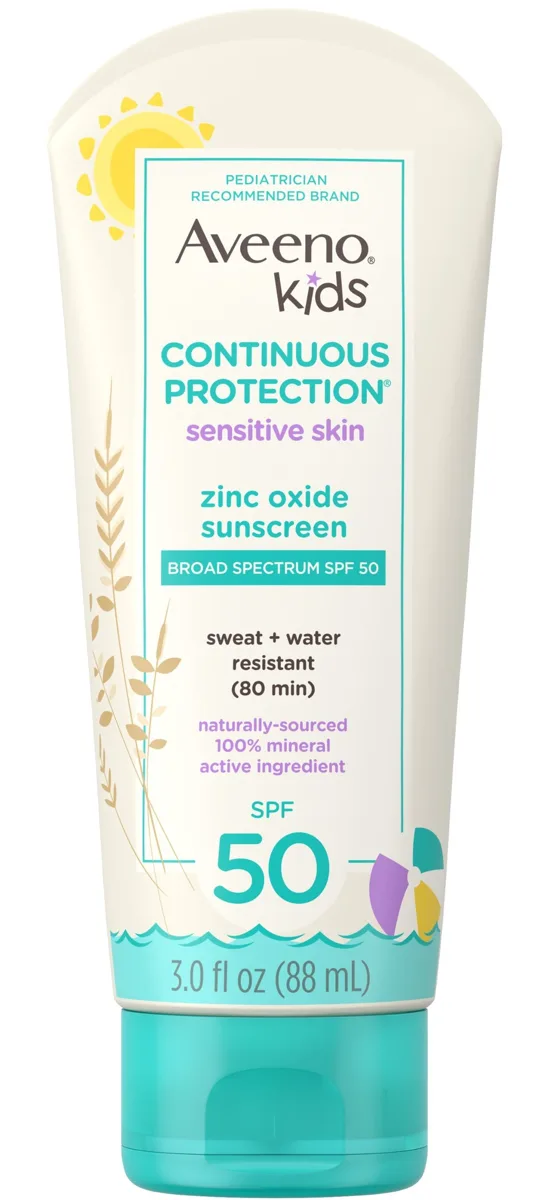
It scales Aveeno's sensitive-skin baby formula up for older, more active kids: the same 21.6% zinc oxide and oat-feverfew soothing system, tuned to hold its sweat- and water-resistant film through a full day of running around. The complete absence of chemical filters is the deliberate selling point for parents who want oxybenzone nowhere near their child.
Essentially the sensitive-skin baby formula sized up for active kids: 21.6% zinc oxide for legitimate SPF 50, tear-free, and softened with oat and feverfew. It holds up to sweat and pool water, but the thick white application and small bottle are the trade-offs you accept for a chemical-filter-free option.
The case for it
Same rule for everyone. “Full protection” is the verdict on 2,288 of 45,024 concern verdicts across the catalog; rule P1 decided 2,232 of them. Unchanged since September 5, 2026, engine 5.1.1.
Brand or formulator? Disclose a concentration or correct a fact →
The studies behind the evidence row
The case for it
What would change this: A researched evidence row for the lead active would replace this with a verdict.
Same rule for everyone. “Good choice” is the verdict on 1,938 of 45,024 concern verdicts across the catalog; rule F2 decided 1,938 of them. Unchanged since September 5, 2026, engine 5.1.1.
Brand or formulator? Disclose a concentration or correct a fact →
The case for it
What would change this: A declared concentration would move this to a firmer reading of the dose.
Same rule for everyone. “Strong choice” is the verdict on 1,459 of 45,024 concern verdicts across the catalog; rule R3 decided 567 of them. Unchanged since September 5, 2026, engine 5.1.1.
Brand or formulator? Disclose a concentration or correct a fact →
The studies behind the evidence row
Does the jobDoes what a sunscreen is for: UVA coverage, kind to the skin wearing it. Not measured from the label: pleasant enough to actually use.
A verdict is DermApproved’s assessment of how well a product’s ingredients fit a concern — never a claim about what the product treats. Evidence dots and collected reviews sit beside it and are never blended in. Rules 0.5.1 · evidence table ev-2026.09-r228 · how we decide
Take Aveeno's most cautious baby sunscreen, keep the formula almost entirely intact, and put it in a bottle aimed at older kids. That is the honest story of this product, and rather than being a knock, it is actually the most reassuring thing about it. The ingredient lists for the baby and kids versions are functionally identical, right down to the 21.6% zinc oxide active and the oat-and-feverfew soothing duo. The brand's bet is simple: a formula gentle enough for an infant's reactive skin is a formula you can trust on a seven-year-old without thinking twice. Start with the active, because it is the whole point. This is a 100% mineral sunscreen, all of its SPF 50 protection riding on a single high load of zinc oxide. There is no oxybenzone, no octinoxate, no chemical filters of any kind, which is precisely the headline for the parent who has read enough about filter absorption to want none of that conversation near their kid. Zinc oxide is a genuine broad-spectrum filter, reflecting and absorbing both UVA and UVB, and at this concentration it has the muscle to back the SPF 50 claim as long as you apply enough. That last clause matters more than anything else in this review, so keep it in mind. The supporting cast is built for two jobs. The first is durability. A backbone of dimethicones, phenyl trimethicone, C12-15 alkyl benzoate, and polyhydroxystearic acid disperses the zinc evenly and locks it into a film that resists sweat and water for the labeled 80 minutes. For a kid who treats a sprinkler like a personal challenge, that water resistance is not a luxury, it is the difference between protection and a false sense of it. The second job is comfort, handled by the oat kernel flour and feverfew sitting low in the formula. Thick mineral films can feel heavy and occasionally itchy on reactive skin, and the oat in particular has a real, well-documented soothing effect that takes the edge off. On a child who already gets flushed and irritated easily, that calming layer is a thoughtful addition rather than a marketing flourish. Now the trade-offs, because this is a mineral sunscreen and mineral sunscreens are honest about their limitations whether you want them to be or not. It goes on thick and white. There is a stretch of rubbing required before the cast sheers down, and on a wiggling kid who would rather be anywhere else, that application can feel like a wrestling match. On deeper skin tones the white residue is more stubborn and can read grey, which is a real and frequently voiced frustration. There is a brief tacky phase before the film sets, and in serious heat it can feel a little heavy until it dries down. None of this is a formulation flaw so much as the physics of a high-zinc product, but it is the daily reality of using it. The tear-free behavior earns its place in the product name. Kids rub their eyes, sweat drips, and a sunscreen that stings on contact gets abandoned by the second use. This one genuinely does not burn, and that single quality-of-life win is a big part of why it survives in family rotations. It is the kind of detail that does not show up in an ingredient analysis but absolutely shows up in whether the bottle gets used or quietly migrates to the back of a drawer. Where it stumbles is the same place the baby version does: the bottle is small and the per-ounce cost is not trivial. Three fluid ounces disappears quickly when you are covering a whole child and reapplying every couple of hours, and a full summer of regular use makes the math start to sting. The good news is the kids size tends to be priced a touch more competitively than its baby sibling, and larger formats exist that bring the cost down meaningfully if you buy ahead of the season. As a single bottle for occasional outings it is fine; as your entire summer supply for an active kid, plan to restock and budget accordingly. The bigger picture is that this is a genuinely good mineral sunscreen wearing a kids label, and the things people dislike about it are the things that make it effective. The white cast is your proof of coverage. The thickness is the film doing its job. The single zinc active is the entire reason a cautious parent picked it up. If you have decided that mineral-only is the right call for your child and you are willing to do the rubbing-in and the restocking, this is one of the more trustworthy options on a drugstore shelf, built on a formula that was originally designed for skin even more delicate than your kid's. It is also worth situating this within how kids actually behave outdoors, because that is where a sunscreen succeeds or fails in practice. The best formula in the world is useless if a child squirms away mid-application or rubs it straight into their eyes and refuses the next coat. This tube clears both hurdles: the tear-free behavior removes the eye-sting meltdown, and the water-resistant film means one good application early in the day is not instantly undone by the first run through a sprinkler. Pair it with a rash guard and a wide hat and you are not asking the sunscreen to cover every inch on its own, which is the realistic way to keep an active kid protected. The white cast, annoying as it is, even doubles as a coverage map for a distracted parent, showing at a glance which spots got missed. Taken together, these are the unglamorous, real-world reasons a mineral formula like this earns a permanent spot in the family bag.
The hero actives that drive this product's performance.
| Ingredient | Function | Evidence |
|---|---|---|
| Zinc Oxide 21.6% (21.6%) | Carries the entire SPF 50 claim on its own at 21.6%, with no chemical filters in support. The high load is dispersed through the dimethicone-and-ester base so it bonds into a sweat-resistant film that survives a full afternoon of playground activity. | Regulator-approved for Sun Damage · limited certainty |
| Oat Kernel Flour (Avena Sativa) | Sits near the end of the list as the brand's calming signature, included to keep the thick mineral film from feeling harsh on the kind of itchy, easily-flushed skin many kids have rather than to add UV protection. | Regulator-approved for Eczema · limited certainty |
| Feverfew Extract (Chrysanthemum Parthenium) | A trace botanical anti-irritant paired with the oat, intended to take some redness out of the equation on reactive children's skin; its position in the list means it supports comfort, not the SPF figure. | Not yet assessed |
| Glycerin | The single humectant in a heavily occlusive formula, drawing a small amount of water into the skin so the dense zinc layer reads as protective rather than drying on kids who already run dry. | Clinically supported for Eczema · well-established certainty |
Ingredient standings describe the active at treatment-level doses and vehicles; this product's own condition grades weigh its actual formula.
Active Ingredient: Zinc Oxide 21.6%. Inactive Ingredients: Water, C12-15 Alkyl Benzoate, Styrene/Acrylates Copolymer, Octyldodecyl Citrate Crosspolymer, Phenyl Trimethicone, Cetyl PEG/PPG-10/1 Dimethicone, Dimethicone, Polyhydroxystearic Acid, Glycerin, Ethyl Methicone, Silica, Cetyl Dimethicone, Triethoxycaprylylsilane, Phenoxyethanol, Glyceryl Behenate, Sodium Chloride, Acrylates/Dimethicone Copolymer, Chlorphenesin, Phenethyl Alcohol, Avena Sativa (Oat) Kernel Flour, Caprylyl Glycol, Cetyl Dimethicone/Bis-Vinyldimethicone Crosspolymer, Chrysanthemum Parthenium (Feverfew) Flower/Leaf/Stem Juice
sunscreen
AM
Use it as the final daytime step over any moisturizer, applied 15 minutes before heading outdoors. Because kids rub their eyes, the tear-free formula tolerates a bit of sweat-driven migration without stinging.
Protection kicks in as soon as the film sets, roughly 15 minutes after application. There is no skincare payoff to track over weeks; it is a single-purpose photoprotection product judged entirely on coverage and reapplication.
The evidence here mirrors the formula's two priorities: photoprotection and tolerability. Zinc oxide is a broad-spectrum inorganic filter active across the UVA and UVB range, and at 21.6% it provides ample capacity for the labeled SPF 50 when applied at the standard testing density. The recurring real-world gap between labeled and achieved SPF is overwhelmingly an application-volume problem; photoprotection literature shows protection drops sharply when users apply less than roughly 2 mg per square centimeter, and mineral products are especially prone to under-application as people try to minimize the white cast. That makes generous application the single most important behavior with a product like this. On the tolerability side, oat and colloidal oatmeal components are recognized skin protectants with documented anti-inflammatory activity attributed to avenanthramides, which is why Aveeno anchors its sensitive-skin positioning on them and why the National Eczema Association seal applies. Feverfew contributes additional antioxidant and anti-irritant potential, though its trace concentration and thinner evidence base mean it plays a minor supporting role. The formulation intelligence is in the base: the silicone-and-ester system is what turns a high, otherwise draggy zinc load into a water-resistant film that stays put through sweat and swimming, which is exactly the demand a kids' sunscreen has to meet. In short, the science supporting this product is less about a novel active and more about reliable delivery of a proven one.
Mineral sunscreens such as this one are commonly the go-to clinical suggestion for children, especially those prone to eczema or sensitivity, because zinc oxide has a long safety record and minimal absorption. In practice, dermatologists tend to steer parents toward fragrance-free, single-active formulas precisely like this when a child's skin reacts to chemical filters or scented products, and the eczema seal supports that use. The most frequent practical counsel is about quantity and timing: enough product to leave a faint visible layer, applied 15 minutes before sun exposure and reapplied every two hours and after swimming. Sun-protective clothing, hats, and shade are typically framed as the first line of defense for children, with sunscreen covering the skin that cannot be shielded by fabric.
Apply a thick, even coat to all exposed skin roughly 15 minutes before going outdoors, and do not forget ears, the nape of the neck, the part in the hair, and the tops of the feet. Rub it in until the white film sets rather than leaving streaks. Reapply at minimum every two hours, and right after swimming, heavy sweating, or toweling off. For all-day outdoor play, pair it with a hat and a rash guard so you are not relying on sunscreen alone to cover every inch.
The kids size lands in a friendlier price range than you might fear, often a few dollars below the comparable baby tube, which nudges its value up slightly. Still, three fluid ounces is a small amount to cover an active child with the generous, frequently reapplied layers a mineral SPF demands, so the per-ounce cost climbs once you account for real usage. The formula justifies a modest premium over no-name mineral sunscreens because the zinc load is honest and the soothing additions are real. For heavy summer use, the larger or multi-pack formats are the smarter buy and bring the cost per ounce down considerably. As an occasional bottle it is reasonably priced; as a season-long supply it adds up.
Parents who want a fully mineral, oxybenzone-free sunscreen for a school-age child, particularly one with sensitive or eczema-prone skin, and who value the tear-free formula enough to deal with a white cast. Adults with reactive skin who like a gentle zinc lotion can use it just as easily.
Families who need an invisible finish, or whose children have deeper skin where the residue turns ashy, will be happier with a tinted or sheerer mineral option. Anyone covering a very active kid all summer should weigh whether the small bottle is economical, and texture-averse users will find the thick application tedious.
Ready to try Aveeno Kids Continuous Protection Zinc Oxide Sunscreen SPF 50?
Buy at Amazon ♥Dense, opaque white lotion with a brief tacky phase; dries down to a sweat-resistant matte film once fully worked into the skin.
Free of added fragrance, leaving only a light, neutral base smell with a hint of oat.
Travel-size 3 fl oz squeeze bottle sized to live in a backpack or beach bag.
First use means a chalky white layer and a short sticky window before the formula sets into its water-resistant film. It will not sting eyes during the inevitable rub, which is the practical reason it survives use on restless kids.
A 3 fl oz bottle lasts roughly a week to ten days of daily full-coverage use on a child, or a couple of full beach days with proper reapplication.
summer
Aveeno extended its colloidal-oatmeal Continuous Protection line from babies to kids as parents kept asking for a single-active mineral option for school-age children. The formula deliberately mirrors the baby version, betting that what works for the most reactive skin will reassure parents of older kids too.
A 1945 brand rooted in oatmeal-based dermatology, Aveeno holds the National Eczema Association seal across much of its range and is a staple recommendation from pediatric and general dermatologists for delicate, easily-irritated skin.
Kids' sunscreen is just adult sunscreen in a brighter bottle.
This formula is genuinely tuned for tolerability: a single zinc active, no fragrance, and added oat and feverfew to calm reactive skin. The differences are in what is left out and what is added to reduce irritation, not just the label art.
If it does not feel like anything, it is working.
Mineral sunscreens leave a perceptible film, and that slight heaviness and white tint are signs an adequate protective layer is present. A completely weightless feel on a mineral product usually means too little was applied.
The ingredient lists are functionally identical, including the 21.6% zinc oxide active and the soothing oat and feverfew. The kids version is essentially the same sensitive-skin formula in a bottle marketed for older children.
No. It is a 100% mineral sunscreen relying solely on zinc oxide, with no oxybenzone, octinoxate, or other chemical UV filters, which is its main appeal for cautious parents.
Yes. The high zinc oxide content reflects UV and is inherently white. The cast can be worked into the skin but not fully eliminated, and it is more noticeable on deeper skin tones.
It is water and sweat resistant for up to 80 minutes. After swimming, heavy sweating, or towel-drying you should reapply, even within that window, to maintain protection.
It is formulated for sensitive skin and carries the National Eczema Association seal, using a single zinc active plus calming oat and feverfew with no added fragrance, which suits many eczema-prone kids.
Use enough to leave a faint visible layer on all exposed skin. Under-applying to avoid the white cast lowers the real SPF you get, so a generous, even coat is essential to actually reach SPF 50 protection.
Recurring themes our editors read across retailer reviews of this product — summaries in our words, not quotations, and not a substitute for your own patch test.
Doesn't sting active kids' eyes
Holds up to pool and sweat
Gentle on sensitive skin
Reassuring single-active formula
Goes on thick and white
Takes work to rub in on kids
Small bottle empties fast
White residue on darker skin
Verified answers from our questions library — the nuance a product page cannot carry.