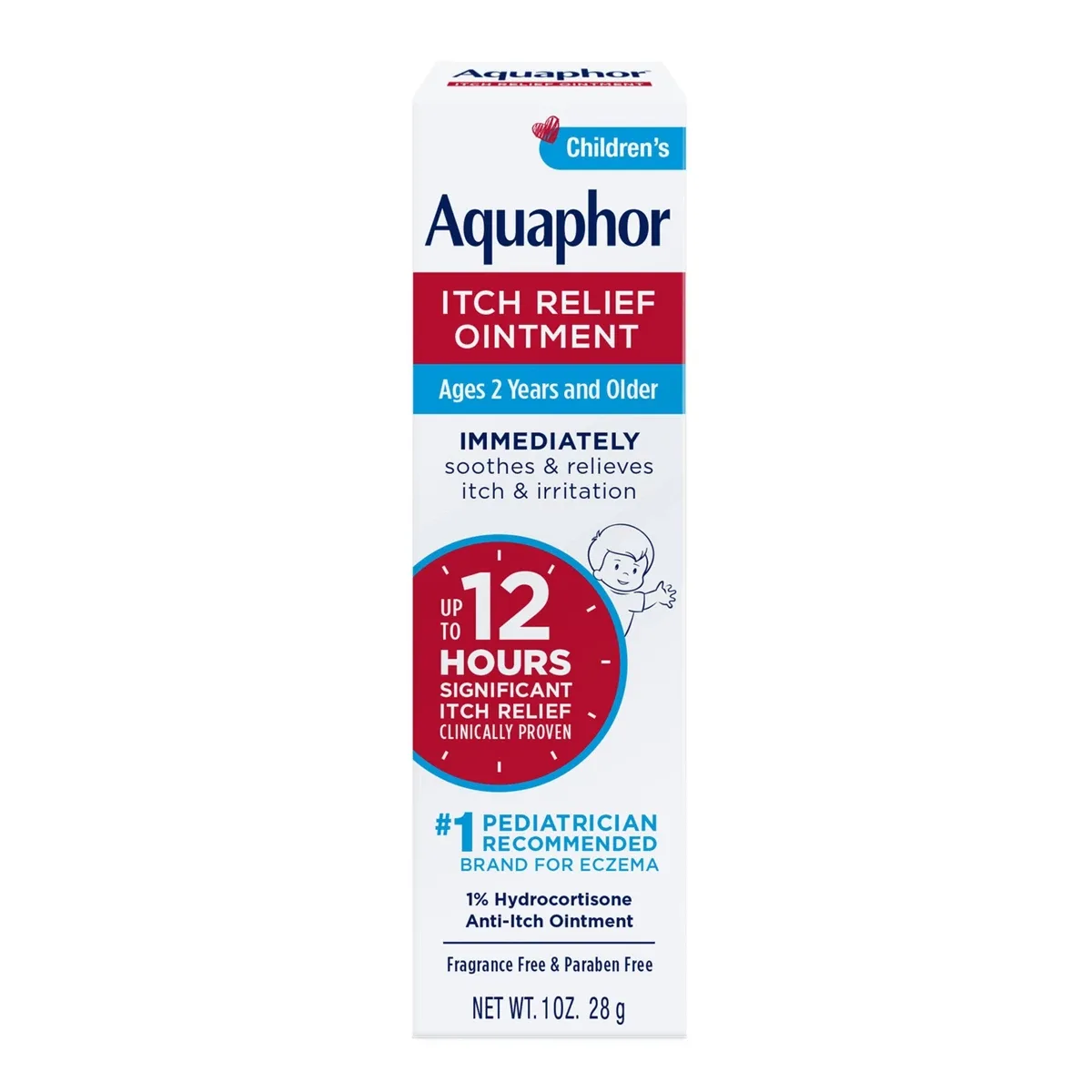
Rather than the watery or alcohol-based anti-itch creams common in the category, this delivers maximum-strength OTC hydrocortisone inside Aquaphor's signature petrolatum-and-panthenol ointment base. That occlusive vehicle keeps the steroid in prolonged contact with scratched skin while protecting the barrier, and the children's framing means it skips fragrance and adds bisabolol for extra soothing.
A small tube that does one job well: it puts maximum-strength OTC hydrocortisone inside Aquaphor's soothing petrolatum base to quiet itchy bites, rashes, and eczema flares. Fragrance-free and gentle enough for kids, it is a smart medicine-cabinet staple rather than an everyday skincare product, and the lanolin is its one real caveat.
Strong choicefor EczemaIn your profileYou chose · Petrolatum is an approved or monograph active for eczema; this ointment carries it high in the ingredient list.Moderate evidenceGentleNo reviews collected yet
The case for it
Petrolatum is a first-line active — approved, monograph-listed or named in current guidelines — for this concern.
It is present at an effective concentration, declared or high in the ingredient list.
The formula carries none of the triggers this concern is sensitive to.
Same rule for everyone. “Strong choice” is the verdict on 1,459 of 45,024 concern verdicts across the catalog; rule R2 decided 892 of them.
Unchanged since September 5, 2026, engine 5.1.1.
R2 — A regulator- or guideline-recognised first-line active, declared at an effective strength, in a form the claim supports. · the full register
Carrying active
Petrolatum
Standing
first line — a regulator recognises it for this use; its mechanism is established; trials support it · per 21 CFR § 347.50 - Labeling of skin protectant drug products. (US Code of Federal Regulations (Legal Information Institute, Cornell Law School)), opened July 27, 2026
Form
adequate — studied range up to 100%, from the OTC monograph or label; needs leave-on contact; judge it after ~1 weeks
Tolerability
gentle
Row checked
against its sources on July 27, 2026 (evidence table ev-2026.09-r228)
Good choicefor SensitivityIn your profileYou chose · No fragrance, drying alcohol, declarable allergens or sensitising preservatives in this ointment — the profile sensitive skin looks for.Not yet assessedGentleNo reviews collected yet
The case for it
Hydrocortisone 1% has no evidence row yet for this concern — it is in the research queue.
The formula carries none of the triggers this concern is sensitive to.
What would change this: A researched evidence row for the lead active would replace this with a verdict.
Same rule for everyone. “Good choice” is the verdict on 1,938 of 45,024 concern verdicts across the catalog; rule F2 decided 1,938 of them.
Unchanged since September 5, 2026, engine 5.1.1.
Good choicefor Compromised Skin BarrierIn your profileYou chose · Petrolatum is a reference standard by mechanism for compromised skin barrier; this ointment carries it high in the ingredient list.Moderate evidenceGentleNo reviews collected yet
The case for it
Petrolatum has trial-supported standing for this concern.
It is present at an effective concentration, declared or high in the ingredient list.
The formula carries none of the triggers this concern is sensitive to.
Same rule for everyone. “Good choice” is the verdict on 9,564 of 45,024 concern verdicts across the catalog; rule R5 decided 9,072 of them.
Unchanged since September 5, 2026, engine 5.1.1.
A verdict is DermApproved’s assessment of how well a product’s ingredients fit a concern — never a claim about what the product treats. Evidence dots and collected reviews sit beside it and are never blended in.
Rules 0.5.1 · evidence table ev-2026.09-r228 · how we decide
Assessment
Pros & Cons
Pros
✓ Maximum-strength 1% OTC hydrocortisone calms itch fast
✓ Soothing petrolatum base protects scratched, broken skin
✓ Fragrance-free and paraben-free for reactive skin
✓ Panthenol and bisabolol add gentle barrier support
✓ Faint cooling sensation without harsh menthol sting
✓ Compact tube is easy to keep in a bag or kit
✓ Relief reportedly lasts up to twelve hours per use
Cons
✗ Thick ointment leaves a greasy, glossy film
✗ Contains lanolin alcohol, a common contact allergen
✗ Small 1 oz tube depletes quickly with frequent use
✗ Limited to short-term, small-area use per label
✗ Not suitable for everyday or whole-face application
Review
Full Review
Aquaphor spent the better part of a century being known for exactly one thing: a tub or tube of petrolatum-based ointment that people reach for when skin is chapped, raw, freshly tattooed, or recovering from a derm appointment. So there is something quietly interesting about taking that famously inert, do-everything base and dropping a genuine medicated active into it. That is precisely what the Children's Itch Relief Ointment is, and it is worth understanding what that combination actually buys you. The active here is hydrocortisone at one percent, the maximum strength available over the counter. Hydrocortisone is a mild topical corticosteroid, and its entire job is to dial down the local inflammatory cascade that produces itch, redness, and swelling. On a mosquito bite, a contact rash, or a small eczema flare, that translates to relief that tends to start within minutes and, by the brand's claim, lasts up to twelve hours. None of this is novel chemistry; 1% hydrocortisone has been a drugstore staple for decades and is one of the most thoroughly characterized topicals you can buy. What makes this version distinct is not the steroid but the vehicle it rides in. Most anti-itch products in the category are thin creams, lotions, or alcohol-forward gels that flash-cool and then evaporate. This one is an ointment in the truest Aquaphor sense, built on petrolatum and mineral oil with ceresin wax and lanolin alcohol giving it body. That matters more than it sounds. An occlusive base keeps the hydrocortisone in prolonged contact with the skin instead of letting it wick away, and it simultaneously seals scratched, broken skin against moisture loss and outside irritants while the rash settles. For a child who is going to keep touching and scratching a bite, that protective film is doing real work beyond the medication itself. The formula then layers in supporting players that fit the soothing theme. Panthenol, the provitamin B5 that shows up across so many barrier-repair products, supports skin recovery under that occlusive seal. Glycerin pulls in a bit of water. Bisabolol, derived from chamomile, adds a gentle anti-irritant note that suits the children's positioning, and a menthol derivative called menthoxypropanediol supplies a faint cooling sensation without the sharp sting of straight menthol. Crucially, the whole thing is fragrance-free and paraben-free, which is exactly what you want on reactive, already-irritated skin. Texturally, you should know what you are signing up for. This is a thick, glossy ointment that stays put and leaves a visible sheen on whatever you apply it to. That is a feature for a scratched bite on a forearm and a drawback if you were hoping for something that vanishes into the skin. It is greasy in the way every petrolatum ointment is greasy, and the most common complaint in user reviews is exactly that feel, along with the small one-ounce tube running out faster than people expect if they use it generously. The honest limitation worth flagging is lanolin alcohol. Lanolin is a known contact allergen for a meaningful slice of the population, and its presence here is a little ironic in a product aimed at sensitive, reactive skin. If a child has a known lanolin or wool allergy, this is not the tube for them, and a patch test on a small area is sensible for anyone with a history of contact dermatitis. There is also a usage ceiling that is easy to miss: like all OTC hydrocortisone, this is meant for short-term, localized use. The label directs against using it on large areas, on broken or oozing skin, or for more than seven days without medical guidance, and that is not fine print to ignore, especially on a child. Within those boundaries, though, it does its job cleanly. It is also worth understanding why the children's framing is more than a marketing label. Kids tend to scratch with abandon, which both worsens a rash and breaks the skin, and they are more bothered by stinging, alcohol-forward anti-itch products. By building this around a thick, soothing ointment instead of a thin medicated lotion, the formula gives the skin a protective film that resists scratching while the hydrocortisone calms the underlying inflammation, and the bisabolol and faint cooling note add comfort without the harsh bite of menthol or camphor. That combination, gentle base plus mild active plus no fragrance, is exactly what makes it sensible to keep on hand for a child, even if the same logic applies just as well to an adult with a stubborn bite. As skincare-adjacent products go, this is less a routine item and more a targeted tool. You are not reaching for it every morning; you are reaching for it when a bug bite, a brush with poison ivy, or a flare-up has a kid clawing at their skin. Judged on that basis, it is a thoughtful little formula: a proven active in a protective base that happens to be the thing the brand does better than almost anyone. At around eight dollars for the tube it is reasonably priced for an occasional-use medicated ointment, even if the per-ounce math looks steep next to a giant jar of plain Aquaphor. The value is in having the right tool when itch strikes, not in stretching it across daily use. If you keep a small kit for scrapes and bites, this earns its spot, with the lanolin caveat noted and the seven-day rule respected. It is not the product you build a routine around; it is the one you are quietly grateful to find in the cabinet at the moment an itch turns a calm evening into a scratching contest.
Formula
Key Ingredients
The hero actives that drive this product's performance.
Ingredient
Function
Evidence
Hydrocortisone 1% (1%)
The active anti-itch agent here, a mild topical corticosteroid that calms the inflammatory signaling behind itch from bites, rashes, and eczema flares. Pairing it with the petrolatum-and-lanolin ointment base means the steroid stays in contact with the skin under an occlusive seal rather than evaporating off.
Forms the occlusive backbone of the ointment, sealing the hydrocortisone and humectants against itchy, broken skin and blocking transepidermal water loss while a rash heals. It is also what gives this product its slick, protective film over scratched areas.
Established mechanismfor Compromised Skin Barrier · established mechanism
Converts to pantothenic acid in skin and supports the barrier repair this formula is built around, complementing the steroid's anti-inflammatory action by helping irritated, scratched skin recover faster under the occlusive layer.
A chamomile-derived soothing agent included to add a gentle anti-irritant layer alongside the hydrocortisone, aimed at the sensitive, reactive skin this children's formula targets.
Not yet assessed
Ingredient standings describe the active at treatment-level doses and
vehicles; this product's own condition grades weigh its actual formula.
Spot-apply directly to the itchy, irritated area rather than across the whole face. Because it is an occlusive ointment, let it sit on its own rather than layering serums on top of treated spots.
Results Timeline
Itch relief often begins within minutes to a couple of hours of the first application, with the brand citing up to 12 hours of relief per use. Visible calming of a rash typically follows over one to three days; the package directs discontinuing after seven days unless a clinician advises otherwise.
Pairs Well With
Fragrance-free moisturizer on surrounding skinGentle non-soap cleanser
Aquaphor Children's Itch Relief Ointment (on affected spots)
Fragrance-free moisturizer (surrounding skin)
Sample PM Routine
Gentle cleanser
Aquaphor Children's Itch Relief Ointment (on affected spots)
Evidence
Science & Expert Perspective
The Science
The case for this product rests on two well-supported pillars working together: a low-potency corticosteroid and an occlusive vehicle. Hydrocortisone at 1% is the maximum over-the-counter strength of topical corticosteroid, classified as low-potency, and decades of dermatologic practice support its use for short-term relief of itch and inflammation from insect bites, contact dermatitis, and mild eczema. Its mechanism is to suppress local inflammatory mediators, which is why the relief feels relatively quick. The more formulation-specific point is the vehicle. The base here is petrolatum and mineral oil, and petrolatum is among the most effective occlusive agents studied, capable of reducing transepidermal water loss substantially when applied to skin. By delivering hydrocortisone in this kind of ointment rather than a fast-evaporating cream or gel, the formula keeps the active in sustained contact with the skin and simultaneously protects a scratched or compromised barrier. The supporting ingredients are also evidence-aligned: panthenol (provitamin B5) has data supporting its role in skin barrier function and wound healing, and bisabolol, a chamomile-derived compound, has anti-inflammatory and skin-soothing properties reported in the literature. Menthoxypropanediol is a menthol derivative used for a mild cooling sensation with less irritation potential than free menthol. The combination is logical: a proven active in a protective, barrier-supporting base, with mild anti-irritants suited to children's skin. The main formulation trade-off, lanolin alcohol, is included for its emollient and occlusive contribution but is a recognized contact sensitizer, which is the relevant cautionary note in the evidence base.
Dermatologist Perspective
Low-potency topical corticosteroids such as 1% hydrocortisone are a standard first-line option in clinical guidance for short-term relief of itch and localized inflammation from insect bites, mild contact dermatitis, and eczema flares. In practice, the emphasis is on brief, targeted use: applying a thin layer to the affected area, avoiding broken or weeping skin and large surface areas, and limiting duration to about a week unless a clinician advises otherwise. Delivering the steroid in an occlusive ointment base is generally viewed favorably for protecting scratched skin, though the same occlusivity can increase steroid absorption, reinforcing the case for restraint. For a child with persistent, spreading, or recurrent rashes, evaluation by a clinician is typically recommended rather than ongoing self-treatment, and known lanolin sensitivity is treated as a reason to choose a different product.
Guidance
Usage & Recommendations
How to Use
Clean and gently dry the affected area first. Apply a thin layer of the ointment directly to the itchy spot up to three to four times a day, or as directed on the label, rubbing in lightly. Use it only on small, localized areas such as bites, rashes, or flare patches, and avoid broken, oozing, or large areas of skin. Keep it away from the eyes and do not use it inside the nose or mouth. Because it is occlusive, let the treated spot sit rather than layering other actives on top. Discontinue after seven days unless a healthcare professional advises continued use, and seek medical advice if the condition worsens or spreads.
Value Assessment
At roughly eight dollars for a single one-ounce tube, this sits at the higher end per ounce for OTC hydrocortisone, and the price clearly reflects the Aquaphor base and children's positioning rather than the active alone, which is inexpensive in generic form. That said, it is an occasional-use medicated ointment, not a daily moisturizer, so the per-ounce figure matters less than whether you have the right tool when itch strikes. For a household that wants a fragrance-free, barrier-protecting anti-itch option in a compact tube, the cost is reasonable and the formulation justifies a modest premium. Shoppers comfortable with a plainer generic hydrocortisone cream can get the same active for less, minus the soothing occlusive vehicle.
Who Should Buy
Parents and households wanting a fragrance-free, gentle anti-itch option for occasional bites, rashes, and mild eczema flares will find this a sensible medicine-cabinet staple. It suits sensitive skin that reacts to fragranced or alcohol-based anti-itch products, and the protective ointment base is a plus for skin that is being scratched.
Who Should Skip
Anyone with a known lanolin or wool-alcohol allergy should avoid it, as should those who dislike a greasy, occlusive feel. It is also the wrong choice for large rashes, broken or weeping skin, fungal infections, or chronic conditions needing ongoing treatment, where a clinician's guidance and a different product are more appropriate.
Ready to try Aquaphor Children's Itch Relief Ointment?
A thick, semi-translucent ointment that stays put on the skin and leaves a glossy protective film over the treated spot.
Scent
Fragrance-free, with only the faint waxy note of the petrolatum-lanolin base and a whisper of cooling from the menthol derivative.
Packaging
Small 1 oz squeeze tube with a flip or screw cap, sized for a medicine cabinet or bag.
Finish
non-greasy
What to Expect on First Use
On first use it goes on slick and stays glossy, with a faint cooling sensation from the menthoxypropanediol; the itch usually starts easing within minutes. There is no purging or adjustment period, but the ointment feel is noticeably heavier than a lotion.
How Long It Lasts
A 1 oz tube lasts a long time for occasional bite, rash, and flare spot-treatment, but only a few weeks if used daily over larger eczema patches.
Aquaphor built its reputation on a single petrolatum-based healing ointment used for everything from chapped lips to post-procedure skin. This children's itch-relief version extends that occlusive base into the medicated OTC space, adding 1% hydrocortisone to address the specific problem of kids scratching at bites, rashes, and eczema flares.
About Aquaphor Legacy Brand (20+ years)
Aquaphor is a Beiersdorf brand with roots dating to 1925, long established as a dermatologist-recommended healing ointment. Its petrolatum-based occlusive formulas are routinely used in clinical and post-procedure settings, and the brand carries extensive real-world track record.
Brand founded: 1925
Myth vs. Reality
Common Myths
Myth
Hydrocortisone ointment will thin a child's skin if used for an itch.
Reality
Skin thinning is a concern with strong steroids used long-term, not with short courses of 1% hydrocortisone. This product is meant for brief, spot use, and the label specifically directs stopping after seven days unless a clinician says otherwise.
Myth
An ointment this greasy must clog pores and cause breakouts.
Reality
It is designed for itchy bites and rashes on body skin, not for all-over facial use. While the petrolatum, mineral oil, and lanolin make it occlusive, spot-applying it to a bug bite is very different from slathering it across acne-prone facial skin.
FAQ
Frequently Asked Questions
What is the active ingredient in Aquaphor Children's Itch Relief Ointment?
The active ingredient is 1% hydrocortisone, the maximum strength available over the counter. It is delivered in Aquaphor's petrolatum-based ointment with panthenol, glycerin, and bisabolol for added soothing.
How quickly does this Aquaphor itch ointment work?
Relief from itching often begins within minutes to a couple of hours, and the brand cites up to 12 hours of relief per application. The occlusive ointment base helps keep the hydrocortisone in contact with the skin for sustained effect.
Can this be used on a child's face?
It is intended for small, localized itchy spots like bites and rashes, not for whole-face use, and should be kept away from the eyes. For facial use on a child, especially around delicate areas, it is best to check with a pediatrician or dermatologist first.
How long can you use Aquaphor Children's Itch Relief Ointment?
Like all OTC hydrocortisone, it is meant for short-term use. The label directs applying it to affected areas for up to seven days, and stopping unless a healthcare professional advises continued use.
Does it contain any common allergens?
Yes. It contains lanolin alcohol, which is a recognized contact allergen for some people. Anyone with a known lanolin or wool allergy should choose a different anti-itch product, and a patch test is wise for sensitive skin.
Is this different from regular Aquaphor Healing Ointment?
Yes. Regular Aquaphor Healing Ointment has no medicated active, while this version adds 1% hydrocortisone to actively relieve itch, plus bisabolol and a cooling menthol derivative aimed at children's sensitive skin.
Reviews
What Reviewers Tend to Say
Recurring themes our editors read across retailer reviews of this product — summaries in our words, not quotations, and not a substitute for your own patch test.
Common Praise
Stops itch quickly
Gentle enough for kids' sensitive skin
Soothing ointment base
Handy small tube for bites and rashes
Common Complaints
Greasy ointment feel
Small 1 oz size runs out fast
Lanolin can bother allergy-prone skin
Not for use on large areas or broken skin
Notable Endorsements
Maximum-strength 1% hydrocortisone (OTC)Hypoallergenic and fragrance-free positioning
Occupational hand dermatitis is one of the most common work-related diseases on earth, it follows a script, and the cheapest fix works only if you start it before the skin splits.
Every post that dismantles a home remedy owes the reader a replacement. The honest replacement list is embarrassingly cheap, and one item on it is cheaper still — it is a bath.
Chamomile's active fraction inhibits the same inflammatory pathways a steroid does, at a fraction of the strength — and the version that works best is grubbed out of Brazilian cerrado, while the synthetic substitute is half inactive by construction.
It's in half your products and headlines none of them. Provitamin B5 has the kind of boring, decades-deep barrier and wound-healing evidence that flashier actives can only envy.
Sep 23, 2025· 5 min
Questions people ask about Eczema
Verified answers from our questions library — the nuance a product page cannot carry.
Products, answers, therapy guides, tools and articles in one search. Brand names,
slang and abbreviations all work — accutane finds isotretinoin, bacne finds truncal acne.