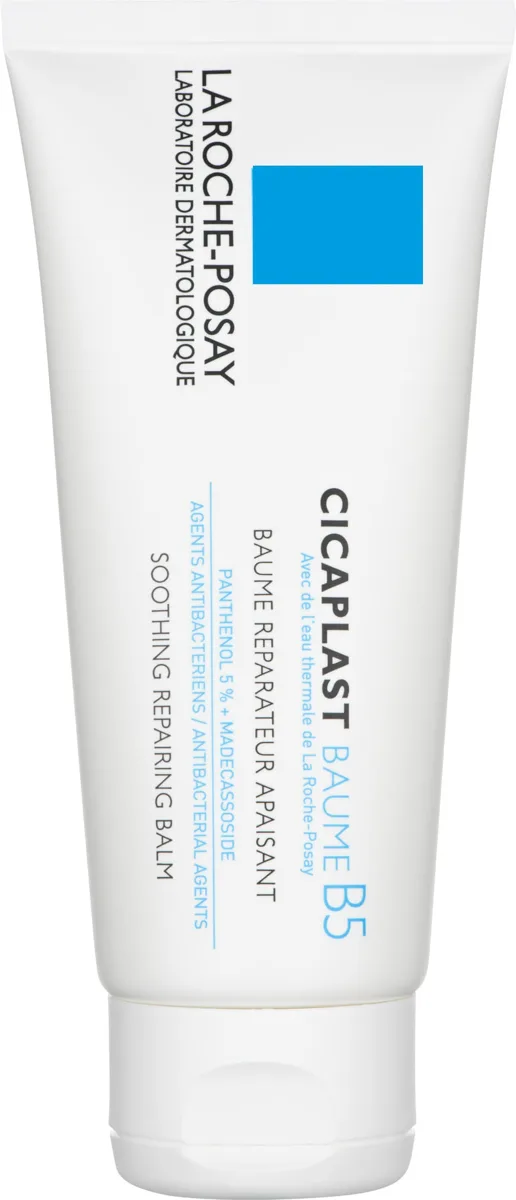
Most barrier-repair balms either over-emphasize occlusion (petrolatum) or under-deliver on active content. Cicaplast Baume B5+ combines 5% panthenol with isolated madecassoside, a trace mineral complex, and a sophisticated balm vehicle that's substantial but not greasy.
The blue tube that lives in dermatology offices, tattoo studios, and a lot of well-stocked bathroom cabinets for good reason. Cicaplast Baume B5+ pairs a meaningful 5 percent panthenol with madecassoside and a trace mineral complex in a rich but non-greasy balm, and it genuinely calms compromised, chapped, post-procedure skin within a day or two. At under 20 dollars, it is one of the best value-to-performance picks in skincare.
Promisingfor Post-ProcedureIn your profileYou chose · Panthenol (Vitamin B5) has trial-level evidence for post procedure but no guideline or regulatory standing yet — promising, short of a recommendation; the other actives here are not yet assessed for it.Moderate evidenceGentleNo reviews collected yet
The case for it
Panthenol has trial-level evidence for this concern but no guideline or regulatory standing yet.
It is present at an effective concentration, declared or high in the ingredient list.
The formula carries none of the triggers this concern is sensitive to.
What would change this: Guideline or regulatory standing for the active on this concern would move this from a promising bet to a recommendation.
Same rule for everyone. “Promising” is the verdict on 7,858 of 45,024 concern verdicts across the catalog; rule R9p decided 7,858 of them.
Unchanged since September 5, 2026, engine 5.1.1.
R9p — 0.5.0: 'Unproven' beside three filled dots read as one question answered twice with opposite words (7,018 rows). The chip measures standing, the dots measure trial volume; where the row carries at least one RCT or a tier-2 source (moderate dots) and the active is present at a working level, the honest word is Promising. Unproven is reserved for plausible-standing rows with limited or weak evidence, or an under-dosed form. Same rank as Unproven — a bet either way; the dots order them. · the full register
Carrying active
Panthenol
Standing
plausible — trials support it
Form
adequate (declared 5%) — studied range 0.5–2%, from the OTC monograph or label; needs leave-on contact
Tolerability
gentle
Row checked
against its sources on July 17, 2026 (evidence table ev-2026.09-r228)
Good choicefor DrynessIn your profileYou chose · Shea Butter is a reference standard by mechanism for dryness; this balm carries it.Moderate evidenceGentleNo reviews collected yet
The case for it
Shea Butter + Glycerin has trial-supported standing for this concern.
It is plausibly present at a working level, though the concentration is not declared.
The formula carries none of the triggers this concern is sensitive to.
What would change this: A declared concentration would move this to a firmer reading of the dose.
Same rule for everyone. “Good choice” is the verdict on 9,564 of 45,024 concern verdicts across the catalog; rule R5 decided 9,072 of them.
Unchanged since September 5, 2026, engine 5.1.1.
Promisingfor EczemaIn your profileYou chose · Panthenol (Vitamin B5) has trial-level evidence for eczema but no guideline or regulatory standing yet — promising, short of a recommendation; the other actives here are not yet assessed for it.Moderate evidenceGentleNo reviews collected yet
The case for it
Panthenol has trial-level evidence for this concern but no guideline or regulatory standing yet.
It is present at an effective concentration, declared or high in the ingredient list.
The formula carries none of the triggers this concern is sensitive to.
What would change this: Guideline or regulatory standing for the active on this concern would move this from a promising bet to a recommendation.
Same rule for everyone. “Promising” is the verdict on 7,858 of 45,024 concern verdicts across the catalog; rule R9p decided 7,858 of them.
Unchanged since September 5, 2026, engine 5.1.1.
R9p — 0.5.0: 'Unproven' beside three filled dots read as one question answered twice with opposite words (7,018 rows). The chip measures standing, the dots measure trial volume; where the row carries at least one RCT or a tier-2 source (moderate dots) and the active is present at a working level, the honest word is Promising. Unproven is reserved for plausible-standing rows with limited or weak evidence, or an under-dosed form. Same rank as Unproven — a bet either way; the dots order them. · the full register
Carrying active
Panthenol
Standing
plausible — trials support it
Form
adequate (declared 5%) — studied range 5%, from the OTC monograph or label; needs leave-on contact
Tolerability
gentle
Row checked
against its sources on July 17, 2026 (evidence table ev-2026.09-r228)
Good choicefor SensitivityIn your profileYou chose · No fragrance, drying alcohol, declarable allergens or sensitising preservatives in this balm — the profile sensitive skin looks for.Not yet assessedGentleNo reviews collected yet
The case for it
Madecassoside has been researched for this concern and the evidence does not support it.
It is plausibly present at a working level, though the concentration is not declared.
The formula carries none of the triggers this concern is sensitive to.
What would change this: A declared concentration would move this to a firmer reading of the dose.
Same rule for everyone. “Good choice” is the verdict on 1,938 of 45,024 concern verdicts across the catalog; rule F2 decided 1,938 of them.
Unchanged since September 5, 2026, engine 5.1.1.
Unprovenfor Acne ScarringIn your profileYou chose · Centella Asiatica has early or mechanistic evidence for acne scarring — a reasonable bet, not a recommendation; the other actives here are not yet assessed for it.Limited evidenceGentleNo reviews collected yet
The case for it
Madecassoside has early or mechanistic evidence for this concern, not trial-backed standing.
It is plausibly present at a working level, though the concentration is not declared.
The formula carries none of the triggers this concern is sensitive to.
What would change this: A declared concentration would move this to a firmer reading of the dose.
Same rule for everyone. “Unproven” is the verdict on 1,111 of 45,024 concern verdicts across the catalog; rule R9 decided 1,111 of them.
Unchanged since September 5, 2026, engine 5.1.1.
R9 — Plausible-tier actives alone do not earn a recommendation, and 'not for this' would overstate the case against them. 'Unproven' with the evidence dots lets the reader judge the bet (added 0.2.0 after the first shadow run put a 10% niacinamide serum at 'not for this' for hyperpigmentation). 0.5.0: the closing clause reads the other heroes — "nothing else here addresses it" only when every other active has a researched 'none' row; "not yet assessed" when that is the truth. Rows whose dots read moderate or better now reach R9p first. · the full register
Carrying active
Madecassoside
Standing
plausible — trials support it
Form
plausible
Tolerability
gentle
Row checked
against its sources on July 17, 2026 (evidence table ev-2026.09-r228)
Also listed for Compromised Skin Barrier and Winter Skin — the actives here (Panthenol (Vitamin B5) are in our research queue for those concerns; there is no verdict until their evidence rows are written. That is a gap in our table, not a mark against the product.
A verdict is DermApproved’s assessment of how well a product’s ingredients fit a concern — never a claim about what the product treats. Evidence dots and collected reviews sit beside it and are never blended in.
Rules 0.5.1 · evidence table ev-2026.09-r228 · how we decide
Assessment
Pros & Cons
Pros
✓ Meaningful 5 percent panthenol concentration for real barrier repair
✓ Visibly calms irritated, compromised skin within about 24 hours
✓ Madecassoside adds wound-healing and anti-inflammatory support
✓ Genuinely multipurpose for face, body, lips, and hands
✓ Fragrance-free, paraben-free, and pregnancy-safe
✓ Rich but non-greasy texture, not just heavy occlusion
✓ Exceptional value for a dermatology-tier formulation
Cons
✗ Shea butter content makes it unsuitable for fungal-acne avoidance
✗ Rich texture can feel heavy for oily skin in summer
✗ Tube packaging exposes the formula to air over time
✗ Multipurpose positioning can confuse first-time buyers
✗ Slightly waxy finish takes a moment to fully absorb
Review
Full Review
There are a handful of products that show up everywhere once you start paying attention, and Cicaplast Baume B5+ is one of them. It is in dermatology offices for post-laser and post-peel recovery. It is recommended by tattoo artists for fresh ink. It is the thing parents reach for when a child has wind-chapped cheeks, and the thing skincare enthusiasts keep around for the inevitable retinoid-overdid-it weekend. That breadth of use is the most interesting thing about it, and it is not an accident. La Roche-Posay launched the Cicaplast line as its flagship barrier-repair and post-procedure franchise, and the Baume B5+ became the most recognized product in it precisely because the formula does something genuinely useful rather than just occlusive.
That distinction matters. Plenty of barrier balms are essentially petrolatum: they seal the skin and slow water loss, which helps, but they bring no active healing support. Cicaplast Baume B5+ is built differently. Its anchor is 5 percent panthenol, the pro-vitamin B5 the product is named for, and 5 percent is a meaningful, clinically relevant concentration rather than a token splash. Panthenol converts in the skin to pantothenic acid and feeds into the synthesis of the fatty acids and lipids that make up the stratum corneum, which is why it has decades of evidence behind it for accelerating barrier repair and calming inflammation. Layered on top of that is madecassoside, an isolated active from Centella asiatica with documented anti-inflammatory and wound-healing effects, including stimulation of collagen synthesis. The combination is the formula's signature: panthenol rebuilds the barrier while madecassoside tackles the inflammation. A trace mineral complex of zinc, copper, and manganese gluconates rounds it out, with the zinc in particular providing a measure of antimicrobial support that is sensible for broken or post-procedure skin where infection prevention matters. A shea butter and glycerin base gives the formula its substance: shea provides emollient triglycerides and natural vitamin E, glycerin pulls in water.
In use, this is a rich, opaque white balm that absorbs into a slightly waxy satin finish. It feels substantial and protective without being a greasy mess, and the calming effect on irritated skin is quick. Most users notice visibly less redness and discomfort within about 24 hours, and for chronic dryness or post-procedure recovery the benefit compounds over the following weeks. It is essentially scentless with a faint fatty character, fragrance-free, and paraben-free. Versatility is its hallmark: face, body, lips, hands, cracked cuticles, wind-burned cheeks, tattoo aftercare, and barrier emergencies all fall within its range. It is pregnancy-safe, since none of its ingredients are contraindicated.
The limitations are real but minor. The shea butter content means it is not fungal-acne safe, so anyone managing Malassezia-driven breakouts should be cautious about facial use, and the brand makes a gel version for exactly that reason. The texture is rich enough that normal or oily skin may find it heavy for everyday full-face use in summer, though as a targeted treatment it is fine for any skin type. The tube packaging, while practical, exposes the formula to air each time you open it, which is a minor stability consideration over a long product life. And the very versatility that makes it great can confuse first-time buyers who are not sure exactly when to use it; the simplest framing is to treat it as a targeted repair balm for whatever part of your skin is currently struggling.
Value is where this product is genuinely outstanding. At roughly 20 dollars for 40 ml, with larger sizes available, you are getting a dermatology-tier barrier-repair formula at drugstore pricing. The larger tube improves the per-ml value further. La Roche-Posay, founded in 1975, is a legacy pharmacy brand with deep clinical research backing and a long history of dermatologist recommendation, so this is not a case of paying for a name; the price genuinely undersells the formulation. With 14-plus years on the market, tens of thousands of reviews, and a 4.7 average rating, the real-world track record is about as solid as it gets. One small piece of advice on using it well: this is a targeted repair product, not necessarily a default everyday all-over moisturizer for every skin type. The most common mistake first-time buyers make is treating it as either too narrow, reserving it only for emergencies, or too broad, slathering it over oily skin in summer. The sweet spot is to reach for it whenever a specific area of your skin is struggling: the patch that flaked after retinol, the corner of the mouth that always cracks in winter, the cheeks after a windy run, the spot of eczema on the hand. Used that way, a single tube quietly handles a long list of minor skin crises.
For anyone who deals with a compromised barrier, eczema flares, post-procedure recovery, or just seasonal chapping, this earns its cult status. It is one of the easiest recommendations in skincare.
Formula
Key Ingredients
The hero actives that drive this product's performance.
Sits at meaningful concentration as the formula's primary barrier-restoring active. Pro-vitamin B5 has decades of clinical evidence for accelerating barrier repair, calming inflammation, and supporting wound healing. The 'B5' in the product name references this anchor ingredient.
Isolated active from centella asiatica with documented anti-inflammatory and wound-healing effects through type I collagen synthesis stimulation. The combination with panthenol creates the formula's signature dual barrier-and-inflammation approach.
Three trace mineral gluconates provide antimicrobial backup (particularly the zinc) alongside cofactor support for skin repair enzymes. The combination is appropriate for post-procedure and compromised-barrier applications where infection prevention matters alongside barrier restoration.
Apply as a targeted treatment to compromised skin areas (post-laser, post-peel, eczema flares, wind-burned cheeks, chapped lips). Can be used as a face mask layered thick at night for very dry skin, or as a daily moisturizer for chronic xerosis cases. Compatible with all subsequent products.
Results Timeline
Immediate: skin feels protected and soothed within minutes. 1-2 weeks: visible improvement in barrier function for compromised areas. 4-8 weeks: cumulative healing of chronic xerosis or post-procedure recovery.
The formula's effectiveness comes from a deliberate two-active pairing rather than simple occlusion. Panthenol is the anchor, and it has a substantial evidence base. A randomized controlled study in which skin was deliberately irritated with sodium lauryl sulfate found that a dexpanthenol cream accelerated barrier repair, increased hydration, and significantly reduced erythema compared with vehicle. More recent work in the Journal of Cosmetic Dermatology (Gao et al., 2025) found that a panthenol-enriched product improved skin barrier recovery after laser treatment, with measured increases in stratum corneum moisture and reductions in transepidermal water loss and redness. Mechanistically, panthenol is converted to pantothenic acid and ultimately coenzyme A, feeding the synthesis of the fatty acids and sphingolipids that build the stratum corneum lipid matrix, which is why a 5 percent dose acts on barrier structure rather than just surface hydration. The second active, madecassoside, was shown in Planta Medica (Liu et al., 2008) to facilitate burn wound healing in mice, reducing inflammatory cell infiltration and enhancing epithelialization and collagen synthesis. Pairing the two is the point: panthenol rebuilds the lipid barrier while madecassoside addresses the inflammatory and reparative side, and the zinc-copper-manganese gluconate complex adds antimicrobial and enzyme-cofactor support appropriate for broken skin. The shea butter and glycerin base then provides the occlusive and humectant vehicle that keeps the actives in contact with the skin.
This is one of the products dermatologists most frequently hand patients after in-office procedures such as lasers, chemical peels, and microneedling, because it supports barrier recovery while soothing the inflammation those treatments produce. Clinical dermatologists also commonly recommend it for eczema-prone skin during and between flares, for compromised barriers from over-exfoliation, and for everyday chapping and irritation. Dermatologists generally note that panthenol and madecassoside are well-tolerated, evidence-supported ingredients suitable for sensitive skin and safe in pregnancy. They typically clarify, however, that while this balm supports and accelerates healing, it does not treat the underlying cause of conditions like atopic dermatitis, and for active moderate-to-severe eczema flares it is usually used alongside prescription anti-inflammatory therapy rather than in place of it.
Guidance
Usage & Recommendations
How to Use
Apply to clean skin as a targeted treatment on whatever area is compromised: post-procedure skin, eczema patches, wind-burned cheeks, chapped lips, cracked hands, or fresh tattoos following your artist's aftercare guidance. A thin layer is enough for most uses; for very dry skin or overnight repair, it can be applied more thickly, even as a leave-on mask. It works AM or PM and is compatible with all other products, so layer it after serums and under or in place of moisturizer as needed. For chronic dryness it can be used daily; for most people, targeted use on problem areas is the typical approach.
Value Assessment
At around 20 dollars for the 40 ml tube, with larger sizes available, this is one of the strongest value propositions in skincare. The formulation quality is dermatology-tier, with a clinically meaningful 5 percent panthenol concentration and an isolated Centella active, yet the price sits firmly in drugstore territory. Opting for a larger size improves the per-milliliter cost further, which is worthwhile given how broadly the product can be used. Because La Roche-Posay is a legacy pharmacy brand with decades of clinical research behind it, this is not a premium charged for a name; if anything, the price understates the formulation. For most users, it is an easy, low-risk purchase.
Who Should Buy
Anyone who deals with a compromised skin barrier, eczema flares, post-procedure recovery, seasonal chapping, or over-exfoliation should keep this on hand. It is especially good for dry and sensitive skin, and it is a smart, affordable multitasker for the whole household given its safety in pregnancy and broad range of uses.
Who Should Skip
Those managing fungal acne should skip facial use because of the shea butter content, and opt for the gel version instead. Oily-skinned users looking for a lightweight everyday full-face moisturizer may find the rich balm texture heavier than they want, though it still works fine as a spot treatment.
Rich opaque white balm that absorbs into a slightly waxy satin finish
Scent
Essentially scentless with mild fatty character
Packaging
Plastic tube with screw cap
Finish
satinocclusive
What to Expect on First Use
First applications feel substantial and protective. Skin feels immediately calmed. Visible improvement of irritation typically registers within 24 hours.
La Roche-Posay launched the Cicaplast line as the brand's flagship post-procedure and barrier-repair franchise. Cicaplast Baume B5+ became one of the brand's most recognized products globally and is one of the most-recommended products in US dermatology offices.
About La Roche-Posay Legacy Brand (20+ years)
La Roche-Posay was founded in 1975 in the French town of La Roche-Posay, known for its thermal spring water. The brand is part of L'Oreal's Active Cosmetics Division and is one of the most extensively studied and dermatologist-recommended pharmacy brands in the world. Distributed through US drugstores, Sephora, Ulta, and dermatology offices with strong clinical research backing.
Brand founded: 1975 · Product launched: 2010
Myth vs. Reality
Common Myths
Myth
All barrier-repair balms are essentially Vaseline.
Reality
Petrolatum (Vaseline) provides occlusive barrier but no active healing support. Cicaplast Baume B5+ adds 5% panthenol for barrier signaling, madecassoside for wound healing, and a mineral complex for antimicrobial support — meaningfully different from pure petrolatum.
Myth
You shouldn't use Cicaplast on your face long-term.
Reality
The formula is appropriate for face use including chronic application — fragrance-free, non-comedogenic on the brand's testing, and dermatologist-tested. The 'temporary' positioning some users assume isn't reflected in the brand's labeling.
FAQ
Frequently Asked Questions
What's the difference between Cicaplast Baume B5 and B5+?
B5+ is the reformulated newer version with slightly enhanced active concentration and updated supporting cast. Functionally similar to the original, with the + indicating the updated formula. Most current products on shelves are B5+.
Can I use it on my face daily?
Yes — fragrance-free, dermatologist-tested formula is appropriate for daily face use, particularly for users dealing with chronic barrier issues, eczema, or post-procedure recovery. For most users, targeted application to specific problem areas is more typical than full-face daily use.
Can Cicaplast Baume B5+ be used while pregnant?
Yes — panthenol, madecassoside, shea butter, glycerin, and the supporting ingredients are all considered safe for pregnancy and breastfeeding.
Will it heal my eczema?
It can support eczema management and accelerate barrier recovery during flare-ups, but it's not a treatment for the underlying eczema condition. For active eczema flares, dermatologists typically pair Cicaplast Baume with prescription topical (steroid, calcineurin inhibitor) or use it as the maintenance moisturizer between flares.
Can I use it as a tattoo aftercare?
Yes — Cicaplast Baume is widely recommended by tattoo artists for tattoo aftercare, providing barrier protection and supporting healing without disrupting the tattoo pigment. The fragrance-free formula is appropriate for the broken-skin healing context.
How does it compare to Aquaphor?
Aquaphor is essentially petrolatum + lanolin + bisabolol — pure occlusive with minimal active content. Cicaplast Baume adds panthenol, madecassoside, and the mineral complex for active barrier support beyond pure occlusion. Both are useful; Cicaplast is more sophisticated for cosmetic application, Aquaphor is more occlusive for very-broken skin.
Reviews
What Reviewers Tend to Say
Recurring themes our editors read across retailer reviews of this product — summaries in our words, not quotations, and not a substitute for your own patch test.
Common Praise
Genuinely repairs compromised skin barrier within days
Excellent value for the dermatology-tier formulation
Multipurpose for face, body, lips, hands, and post-procedure
Fragrance-free, paraben-free formulation
5% panthenol concentration is meaningful
Common Complaints
Tube packaging exposes formula to air over time
Slightly heavy texture for normal/oily users in summer
Shea butter limits strict fungal-acne avoidance
Multipurpose positioning can confuse first-time buyers about specific use cases
Notable Endorsements
Widely recommended by US dermatologists for post-procedure recoveryNational Eczema Association credibility
Every cica, calming, and barrier product leans on the same three ingredients, and the real mechanisms are far more specific — and more limited — than 'soothing' lets on.
It's in half your products and headlines none of them. Provitamin B5 has the kind of boring, decades-deep barrier and wound-healing evidence that flashier actives can only envy.
Irritant and allergic contact dermatitis can look identical on the arm and take opposite instructions — and the single most common mistake in skincare is applying the tolerance-building logic of one to the immune memory of the other.
The splash made sense when the blade had been on someone else's face that morning. Applied to a barrier you stripped forty seconds ago, the sting is not the product working — it is skin reporting a breach.
Aug 28, 2026· 10 min
Questions people ask about Eczema
Verified answers from our questions library — the nuance a product page cannot carry.
Products, answers, therapy guides, tools and articles in one search. Brand names,
slang and abbreviations all work — accutane finds isotretinoin, bacne finds truncal acne.