Hands Fail in Four Stages, and Almost Everyone Intervenes at Stage Three
Occupational hand dermatitis is one of the most common work-related diseases on earth, it follows a script, and the cheapest fix works only if you start it before the skin splits.
Read the preview
From the DermApproved blog, in Men's Grooming: working hands fail in four stages, and stage four doesn't reverse. The cruel part — the fix becomes unbearable exactly when it becomes urgent. Cream stings a split, so people quit when it matters most. Which is why men with intact hands at sixty did something cheap, much earlier. For the full breakdown, visit dermapproved.com/blog.
The script your hands are following
There is a sequence, and once you have seen it named you cannot unsee it on other people's hands.
Stage one is tightness after washing that resolves within an hour. Nobody treats this, and it is the only stage where treatment is trivially easy. Stage two is visible dryness and fine scaling across the knuckles and the backs of the fingers, with the skin looking slightly matte and feeling rough against fabric. Stage three is fissuring: short, deep splits at the finger creases, at the fingertip pads, and around the nail folds, which bleed, catch on things, and hurt disproportionately to their size. Stage four is chronic hand dermatitis — the point at which the skin no longer recovers over a weekend, redness and thickening become the baseline rather than the flare, and the condition persists after the exposure stops.
The transition that matters is between two and three, and almost nobody notices it happening because stage two is not painful. Pain arrives with the fissure, which is also the point at which a moisturiser stings enough that people stop applying it. This is the central perversity of the whole subject: the intervention becomes intolerable at exactly the moment it becomes urgent.
The scale of this is genuinely large and almost invisible in consumer skincare coverage. Hand eczema has a one-year prevalence of up to around 10% in the general population and a lifetime prevalence approaching 15%. In occupations involving water, detergents or metalworking fluids, prevalence runs to roughly 30%. A meta-analysis of incidence by occupation put hairdressers at 21.4 new cases per 100 person-years, nurses at 16.9 and metal workers at 12.4 — figures that would be treated as a public health emergency if the affected organ were anything other than skin. And the dominant mechanism is not exotic: irritant contact dermatitis from wet work is the most common cause of occupational hand disease, ahead of allergy.
The dose-response is worth memorising because it reframes what to change. Having wet hands for between a quarter and a half of the working day more than doubles the odds of hand eczema. Not harsh chemicals — wet. The number of times skin is wetted and dried is a bigger lever than the gentleness of the soap you wet it with, which is why switching to a nicer hand wash while washing forty times a shift changes almost nothing. Our answer on hands cracking and bleeding at work covers what to do once you are already at stage three.
Four exposures that look the same and are not
Grouping every rough-hands problem under "my job is hard on my skin" hides four mechanisms with four different answers.
Wet work and repeated washing act by lipid extraction. Surfactants solubilise the intercellular lipids that hold the stratum corneum together, and water itself causes swell-and-shrink cycles that mechanically stress the corneocyte layer. The answer is frequency reduction where possible, an alcohol-based sanitiser instead of a wash where the hands are not visibly soiled — which reads as counterintuitive and is well supported, because sanitiser does not strip lipids the way a detergent does — and replacement of the lipid after every wetting.
Gym chalk is a drying agent by design. Magnesium carbonate is alkaline and hygroscopic, so it pulls moisture out of the stratum corneum, which is precisely what a lifter wants for grip and precisely what skin does not want, and the friction of a knurled bar then abrades the dehydrated layer. Liquid chalk compounds it by adding alcohol to the same job. The fix is not abstinence but housekeeping: wash the chalk off rather than letting it sit, and file the calluses down before they tear rather than after.
Cement is the most aggressive exposure in the trades and works two ways at once. Wet cement is strongly alkaline and produces irritant injury that ranges from dermatitis to genuine chemical burns on prolonged contact. Separately, cement historically contained water-soluble hexavalent chromium, one of the most significant occupational allergens ever documented, and chromate allergy was a career-ending diagnosis for bricklayers for decades.
That story has an ending worth telling properly, because it is a case of regulation succeeding where no product could. Denmark began adding ferrous sulfate to cement in 1981, reducing soluble chromate below 2 ppm. The EU followed with Directive 2003/53/EC, prohibiting the supply of cement above that threshold from 2005. Researchers then went looking for the effect, and found it: UK incidence of chromate-attributed allergic contact dermatitis declined, with a greater fall among workers with potential cement exposure, and sensitisation among bricklayers and tile setters has continued to decrease since. No hand cream in history has produced an effect that size. The people who argued for the restriction were right, and the industry resisting it was wrong, and it is worth saying so plainly rather than filing it under "regulations."
Solvents and metalworking fluids are the fourth. Degreasers do to skin lipids what they are designed to do to engine parts. Cutting fluids are irritant and allergenic simultaneously, because the biocides and corrosion inhibitors added to keep them from spoiling are themselves sensitisers. Here, unlike the others, allergy is common enough that persistent dermatitis in a machinist warrants patch testing rather than another cream.
The glove is not the answer. The glove is an exposure.
The reflex advice is to wear gloves, and it is half-right in a way that causes real harm.
Occlusive gloves genuinely block external contact. They also create their own microclimate, and the measurements are not ambiguous: wearing occlusive gloves produces short-term impairment of barrier function with increased transepidermal water loss, alongside temporary over-hydration of the stratum corneum. Skin that is macerated is skin that lets irritants in more easily. And the fluid inside the glove is not water — it is sweat, which is more irritating than water, and heat plus occlusion is itself a recognised trigger for irritant contact dermatitis. A man wearing nitrile for an eight-hour shift is protecting his hands from one exposure by subjecting them to another.
The practical protocol that resolves this is unfashionable and effective. Wear the glove only for the task that requires it rather than continuously. Use a textile liner whenever occlusive gloves will be on for more than about ten minutes — the recommendation exists precisely because liners absorb the moisture that would otherwise sit against skin — and change the liner when it is saturated, because a wet cotton liner has become the problem it was meant to solve. Never put a glove on damp hands.
Then the allergy layer, which catches people who have done everything else right. The main sensitisers in rubber gloves are not the rubber but the accelerators used to cure it, chiefly the thiuram and carbamate groups. Accelerator-free nitrile gloves exist and are the correct substitution for anyone who reacts. A detail worth knowing before you get tested: roughly a fifth of thiuram sensitisations are missed when only the standard thiuram mix is tested rather than the individual substances, so a negative screen is not the end of the inquiry if the clinical picture fits. Our patch test tool covers how testing works and what it can and cannot establish, and the question of whether your own products are contributing is worth ruling out before blaming the workplace.
The pre-work barrier cream is oversold. Say it plainly.
An entire category of industrial "barrier creams" and "invisible gloves" is sold on the promise of a protective film applied before the shift. The evidence does not carry the marketing.
The Cochrane review of interventions for preventing occupational irritant hand dermatitis pooled nine randomised trials covering 2,888 workers without hand dermatitis at baseline — metalworkers, slaughterhouse and factory staff, cleaners and kitchen workers, hospital employees, hairdressing apprentices. Across barrier creams, moisturisers, and both combined, fewer participants developed dermatitis than in control groups, but none of the differences reached statistical significance, and the review concluded there was insufficient evidence to support the workplace interventions studied for primary prevention. The confidence intervals were wide and the trials were probably underpowered, so this is "not demonstrated" rather than "shown useless" — a distinction that matters and that both the sellers and the cynics tend to collapse.
Our reading, stated as an opinion rather than a finding: the pre-work barrier product is the weakest link in the chain and the one most heavily marketed, while the after-work emollient has the better mechanistic case and costs less. A film applied at seven in the morning has been washed off by nine. Lipid replaced at the end of a shift has all night to work on skin that is not being re-insulted. If your employer supplies both, use both — it is free and the trend was in the right direction. If you are buying, buy the ointment. Our answer on whether pre-work barrier creams protect hands goes through what they can plausibly do.
The intervention with the strongest support is the one nobody sells, because it is not a product: reduce the number of wet-dry cycles, substitute the sensitiser, fix the glove protocol. Skincare is the mitigation layer, not the control.
Why the greasy one wins at night
Hand products are chosen on feel, and feel is inversely correlated with efficacy here. The pleasant lotion that vanishes is mostly water, delivered from an emulsion that evaporates and leaves a thin film of emollient. On a face that is adequate. On a fissured palm exposed to detergent every hour, it is not.
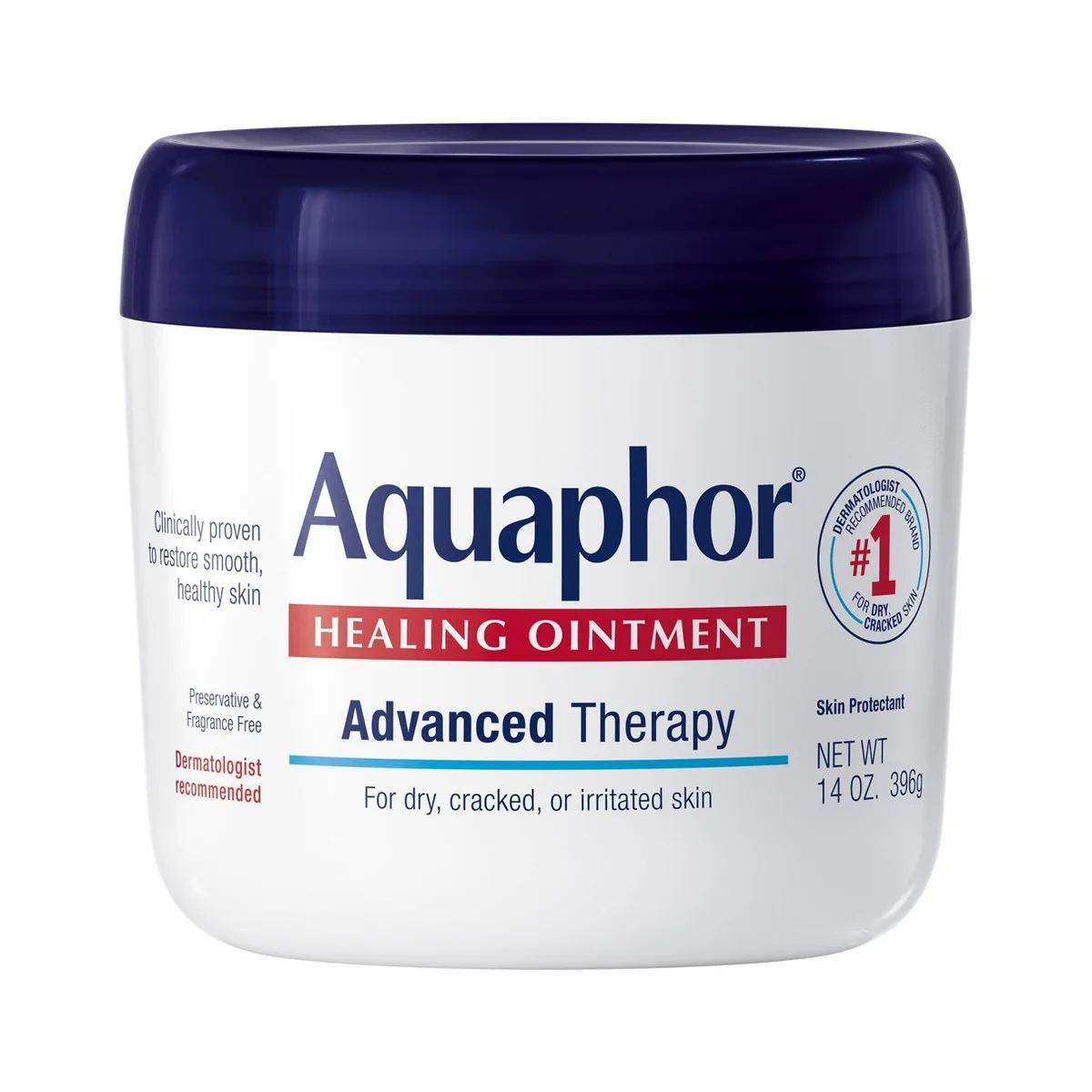
The physical argument for ointments is straightforward: an occlusive layer with very low water content dramatically reduces transepidermal water loss, and a stratum corneum held at higher water content repairs faster and splits less. Petrolatum is the reference standard here and remains, unglamorously, among the most effective single ingredients in dermatology. A plain jar such as Vaseline Original Healing Jelly does the core job, and a formulated version like CeraVe Healing Ointment or Aquaphor Healing Ointment adds humectants and ceramides to a similar base. Our petrolatum page and the answer on whether petrolatum is best for cracked hands handle the comedogenicity and "it just sits on top" objections, both of which are more misunderstanding than critique.
The protocol that transforms results is not a product at all. Apply a thick layer of ointment last thing at night and sleep in cotton gloves. Occlusion overnight turns a marginal application into a genuinely therapeutic one, it costs almost nothing, and the greasiness that stops people using ointment in daylight is irrelevant at midnight. Two weeks of this on stage-two hands routinely does what two months of daytime lotion does not.
For daytime, the target changes: you need something that survives washing without making tools slippery. Barrier-repair creams with a lipid profile — CeraVe Therapeutic Hand Cream, SkinFix Eczema+ Hand Repair Cream, or the water-resistant occlusive base in Curel Extreme Dry Hand Relief — are built for reapplication rather than for a single overnight sitting. Our ceramides page covers what that lipid replacement actually does and does not achieve.
Two honest cautions on actives. Urea is excellent on thickened, rough, callused skin, where it both hydrates and softens keratin — Eucerin Advanced Repair Hand Cream pairs it with ceramides for exactly that presentation. On an open fissure it stings badly, and the sting is what makes people abandon the routine, so heal the split with a bland ointment first and bring urea in afterward; the urea page explains how the behaviour changes with concentration. And the perennial trades favourite O'Keeffe's Working Hands earns its reputation on very dry, cracked hands, but a fragranced, botanically active option such as Jack Black Industrial Strength Hand Healer contains eucalyptus oil, and on skin already sensitised by work exposure the fragrance component is a real risk rather than a theoretical one. When in doubt, Neutrogena Norwegian Formula Fragrance-Free is the plainest high-glycerin option on the shelf.
If you are also using a prescription topical steroid on hand eczema, our fingertip unit calculator translates the vague instruction to "apply thinly" into an actual quantity for the hands — undertreating a flare with a correctly prescribed steroid is one of the more common reasons the flare persists.
When it is the job, and why writing it down matters
At some point the question stops being which cream and becomes whether this is an occupational disease, and that shift has practical consequences most workers never learn about.
Two signals point that way. The first is the weekend test: skin that improves noticeably over days away from work and deteriorates within a shift or two of returning is describing its own cause. The second is failure to improve despite a genuinely good routine — correct emollient, overnight occlusion, glove protocol fixed — which suggests either an allergen still in play or an exposure too intense for mitigation.
Patch testing is what separates irritant from allergic disease, and the distinction changes the plan entirely. Irritant dermatitis is a dose problem and responds to reducing exposure. Allergic contact dermatitis is an immune response that does not care about dose past the threshold, so it requires identifying and removing the specific substance — the glove accelerator, the epoxy hardener, the biocide in the cutting fluid, the chromate in older cement. Testing is also where the surprises live: a machinist convinced his problem is oil sometimes turns out to be reacting to the gloves he wears to avoid the oil. Our answer on documenting work-caused hand dermatitis covers what to record and when, and the contact dermatitis pathway maps the escalation from emollient to prescription topical to specialist referral. If the picture is more chronic and atopic than exposure-driven, the eczema pathway is the more relevant route, and the answer on eczema at work with gloves deals with the overlap.
Document early, because the record is what enables everything downstream: a glove substitution request, a role adjustment, an occupational health referral, a claim if it comes to that. Photographs with dates, a note of what you handle, and the fact that you raised it are worth more than a remembered account two years later.
The opinion this piece has been building to is deflating and, we think, correct. This is not a skincare problem that skincare solves. It is an exposure problem with a skincare mitigation layer, and the mitigation works well but only at the stage where nothing hurts yet. The men who keep their hands intact across thirty years in the trades are not the ones with the best cream. They are the ones who started applying an ordinary ointment every night back when their hands were merely dry, and who treated a fissure as a warning rather than a normal feature of the job. It is not a normal feature of the job. It is stage three.
Products mentioned
Independently reviewed and scored — the real products behind this piece.




- Therapy guide Contact dermatitis Escalation from emollient to prescription topical to specialist referral, and where patch testing fits.
- Therapy guide Eczema The route when the picture is atopic rather than purely exposure-driven.
- Ingredient Petrolatum (Petroleum Jelly) The reference occlusive, and the objections to it.
- Ingredient Urea (Carbamide) Why its behaviour changes with concentration, and why it stings on fissures.
- Ingredient Ceramides What lipid replacement does and does not achieve on a damaged barrier.
- Question My hands are cracking and bleeding at work — is that urgent? What to do once fissuring has already started.
- Question Do barrier creams applied before work protect my hands? What a pre-shift barrier product can plausibly achieve.
- Question What do I do if my job is causing my hand dermatitis? What to record, and when, if this turns out to be occupational.
- Question Is plain petrolatum really the best thing for cracked hands? Handles the 'it just sits on top' objection to ointments.
- Question Did my skincare routine cause this? Worth ruling out your own products before blaming the workplace.
- Question What helps hand eczema at work? The overlap between atopic hand eczema and glove occlusion.
References
- Occupational Hand Dermatitis — Current Allergy and Asthma Reports, 2023
- Incidence Rate of Hand Eczema in Different Occupations: A Systematic Review and Meta-analysis — Acta Dermato-Venereologica, 2022
- Interventions for preventing occupational irritant hand dermatitis — Cochrane Database of Systematic Reviews, 2018
- The effects of protective occlusive gloves on stratum corneum barrier properties — Contact Dermatitis, 1995
- Allergic contact dermatitis to rubber accelerators in protective gloves: Problems, challenges, and solutions for occupational skin protection — Allergologie Select, 2021
- Has European Union legislation to reduce exposure to chromate in cement been effective in reducing the incidence of allergic contact dermatitis attributed to chromate in the UK? — Occupational and Environmental Medicine, 2012
- Occupational contact allergy in bricklayers, tile setters etc. - Current spectrum of sensitization and recent time trends — Allergologie Select, 2017
Every cited link is verified to resolve to the paper named. Where a source could not be independently confirmed, it is listed without a link rather than pointing you somewhere wrong.
Frequently asked
Why do my hands split at the finger creases specifically?
Those sites bend constantly, so the stratum corneum there is under repeated tensile stress, and skin that has lost water content and lipid cohesion fails along the line of greatest strain. Fissuring at the creases and fingertip pads is the third stage of a predictable progression, not a random event.
Is hand sanitiser worse for my skin than washing?
Generally the opposite, where hands are not visibly soiled. Detergents extract intercellular lipids and the wet-dry cycle itself stresses the corneocyte layer, whereas alcohol gel does not strip lipids the same way. Wet hands for a quarter to a half of the day more than doubles hand eczema odds — reducing washings is the bigger lever.
Do barrier creams actually stop work-related hand dermatitis?
Not demonstrably. The Cochrane review of nine trials in 2,888 workers found the trend favoured barrier creams and moisturizers, but no result reached statistical significance and the review called the evidence insufficient for primary prevention. Use them if provided, but spend your own money on an overnight ointment.
Are gloves making my hands worse?
They can. Occlusive gloves raise transepidermal water loss and over-hydrate the stratum corneum, and the sweat trapped inside is more irritating than plain water. Use a textile liner beyond about ten minutes of wear, replace it once saturated, and never glove damp hands.
What is the single most effective thing I can do for cracked working hands?
Thick ointment at night under cotton gloves. Overnight occlusion converts an ordinary application into a genuinely therapeutic one, the greasiness is irrelevant while you sleep, and two weeks of it typically outperforms months of daytime lotion. Start before the skin splits, not after.
When should I ask for patch testing?
When your hands clearly improve away from work and relapse on return, or when a correct routine fails to help. Patch testing separates irritant dermatitis, which is a dose problem, from allergic contact dermatitis, which requires identifying and removing the specific substance — often a glove accelerator or a fluid additive rather than the obvious culprit.