Seven ingredients. That's it. In a market drowning in fifty-ingredient moisturizers, Aquaphor's radical simplicity is its differentiator. The formula pairs petrolatum's unmatched occlusive power with panthenol's wound-healing properties, glycerin's humectant capacity, and bisabolol's anti-inflammatory action — each ingredient serving a specific, evidence-based purpose with no filler.
A century-old formula that remains the gold standard for barrier protection because nobody has found a way to improve on the fundamentals. Seven ingredients, zero filler, and the kind of dermatological credibility that takes a hundred years to earn. Greasy? Absolutely. Effective? Unimpeachably.
Strong choicefor DrynessIn your profileYou chose · Petrolatum is an approved or monograph active for dryness; this ointment carries it at 41%.Moderate evidenceGentleNo reviews collected yet
The case for it
Petrolatum 41% is a first-line active — approved, monograph-listed or named in current guidelines — for this concern.
It is present at an effective concentration, declared or high in the ingredient list.
The formula carries none of the triggers this concern is sensitive to.
Same rule for everyone. “Strong choice” is the verdict on 1,459 of 45,024 concern verdicts across the catalog; rule R2 decided 892 of them.
Unchanged since September 5, 2026, engine 5.1.1.
Strong choicefor EczemaIn your profileYou chose · Petrolatum is an approved or monograph active for eczema; this ointment carries it at 41%.Moderate evidenceGentleNo reviews collected yet
The case for it
Petrolatum 41% is a first-line active — approved, monograph-listed or named in current guidelines — for this concern.
It is present at an effective concentration, declared or high in the ingredient list.
The formula carries none of the triggers this concern is sensitive to.
Same rule for everyone. “Strong choice” is the verdict on 1,459 of 45,024 concern verdicts across the catalog; rule R2 decided 892 of them.
Unchanged since September 5, 2026, engine 5.1.1.
R2 — A regulator- or guideline-recognised first-line active, declared at an effective strength, in a form the claim supports. · the full register
Carrying active
Petrolatum 41%
Standing
first line — a regulator recognises it for this use; its mechanism is established; trials support it · per 21 CFR § 347.50 - Labeling of skin protectant drug products. (US Code of Federal Regulations (Legal Information Institute, Cornell Law School)), opened July 27, 2026
Form
adequate (declared 41%) — studied range up to 100%, from the OTC monograph or label; needs leave-on contact; judge it after ~1 weeks
Tolerability
gentle
Row checked
against its sources on July 27, 2026 (evidence table ev-2026.09-r228)
Good choicefor Compromised Skin BarrierIn your profileYou chose · Petrolatum is a reference standard by mechanism for compromised skin barrier; this ointment carries it at 41%.Moderate evidenceGentleNo reviews collected yet
The case for it
Petrolatum 41% has trial-supported standing for this concern.
It is present at an effective concentration, declared or high in the ingredient list.
The formula carries none of the triggers this concern is sensitive to.
Same rule for everyone. “Good choice” is the verdict on 9,564 of 45,024 concern verdicts across the catalog; rule R5 decided 9,072 of them.
Unchanged since September 5, 2026, engine 5.1.1.
Supporting rolefor Winter SkinIn your profileYou chose · Nothing here targets winter skin directly; occlusive hydration is the recognised companion to treating it, and this ointment does that without known triggers.Not yet assessedGentleNo reviews collected yet
The case for it
Petrolatum 41% has no evidence row yet for this concern — it is in the research queue.
The formula carries none of the triggers this concern is sensitive to.
What would change this: A researched evidence row for the lead active would replace this with a verdict.
Same rule for everyone. “Supporting role” is the verdict on 8,197 of 45,024 concern verdicts across the catalog; rule R8 decided 4,250 of them.
Unchanged since September 5, 2026, engine 5.1.1.
R8 — The category's job (barrier care, humectant hydration, gentle cleansing, photoprotection) is the documented supportive role for this concern. This is the honest verdict for a moisturizer on an acne page. · the full register
Good choicefor SensitivityIn your profileYou chose · No fragrance, drying alcohol, declarable allergens or sensitising preservatives in this ointment — the profile sensitive skin looks for.Not yet assessedGentleNo reviews collected yet
The case for it
Petrolatum 41% has no evidence row yet for this concern — it is in the research queue.
The formula carries none of the triggers this concern is sensitive to.
What would change this: A researched evidence row for the lead active would replace this with a verdict.
Same rule for everyone. “Good choice” is the verdict on 1,938 of 45,024 concern verdicts across the catalog; rule F2 decided 1,938 of them.
Unchanged since September 5, 2026, engine 5.1.1.
Good choicefor Post-ProcedureIn your profileYou chose · Petrolatum is a reference standard by mechanism for post procedure; this ointment carries it at 41%.Moderate evidenceGentleNo reviews collected yet
The case for it
Petrolatum 41% has trial-supported standing for this concern.
It is present at an effective concentration, declared or high in the ingredient list.
The formula carries none of the triggers this concern is sensitive to.
Same rule for everyone. “Good choice” is the verdict on 9,564 of 45,024 concern verdicts across the catalog; rule R5 decided 9,072 of them.
Unchanged since September 5, 2026, engine 5.1.1.
Does the jobDoes what a moisturizer is for: seals moisture in, draws in water.
A verdict is DermApproved’s assessment of how well a product’s ingredients fit a concern — never a claim about what the product treats. Evidence dots and collected reviews sit beside it and are never blended in.
Rules 0.5.1 · evidence table ev-2026.09-r228 · how we decide
Assessment
Pros & Cons
Pros
✓ Seven-ingredient formula where every component serves a specific dermatological purpose
✓ Petrolatum reduces transepidermal water loss more effectively than any other topical ingredient
✓ Panthenol and glycerin add genuine hydration and healing that pure petroleum jelly lacks
✓ National Eczema Association Seal, Good Housekeeping Seal, and FDA OTC drug registration
✓ Extraordinary value — a fourteen-ounce jar under twenty dollars lasts months of daily use
✓ A century of dermatological trust and over 55,000 consumer reviews averaging 4.8 stars
Cons
✗ Greasy, heavy texture does not absorb — impractical for daytime facial use
✗ Contains lanolin alcohol, a known allergen for approximately 1-2% of the population
✗ Can stain pillowcases, fabrics, and clothing when used on the face at night
✗ Too occlusive for oily skin — may trap sebum and worsen congestion in some users
Review
Full Review
There are products in skincare that require explanation. You need to understand the peptide technology, the vitamin C derivative, the encapsulation system. And then there's Aquaphor, which requires exactly one sentence: it puts a seal on your skin so moisture stays in and everything else stays out.
That simplicity is not a limitation. It's the entire point. Aquaphor Healing Ointment contains seven ingredients. Seven. In a jar. No fragrance, no preservatives, no dyes, no silicones, no trendy botanicals. Just petrolatum, mineral oil, ceresin wax, lanolin alcohol, panthenol, glycerin, and bisabolol. It reads less like an ingredient list and more like a dermatology textbook's definition of what a healing ointment should contain.
The history matters for context. Aquaphor was developed in 1925 by Beiersdorf's U.S. laboratories — the same company behind Eucerin and NIVEA. For its first fifty-seven years, it was sold exclusively to medical professionals. Doctors, hospitals, and pharmacies. The first five-pound containers went to burn units and dermatology offices, not Sephora shelves. Consumer availability didn't happen until 1982, and the current Advanced Therapy formulation — the one you can buy at Target today — was introduced in 1991. This product has been earning the trust of dermatologists longer than most skincare brands have existed.
The active ingredient is petrolatum at 41%. This is an FDA-registered OTC skin protectant, not a cosmetic claim. Petrolatum is the most effective occlusive ingredient ever studied — research demonstrates that it reduces transepidermal water loss by up to 99%, outperforming every cream, lotion, and gel moisturizer on the market. At 41%, Aquaphor delivers serious occlusive power while leaving room for functional inactive ingredients that petroleum jelly alone cannot provide.
This is the critical distinction between Aquaphor and Vaseline that the internet endlessly debates. Vaseline is 100% petrolatum — a pure seal with no additional activity. Aquaphor adds panthenol (provitamin B5), which is a humectant that pulls moisture into the stratum corneum and actively supports cellular repair. It adds glycerin, the most studied humectant in dermatology. And it adds bisabolol, a chamomile-derived anti-inflammatory that calms irritated, compromised skin. These four ingredients — petrolatum sealing, panthenol healing, glycerin hydrating, bisabolol soothing — create a system that's greater than the sum of its parts.
The texture is exactly what you'd expect from an ointment and nothing like what you'd want from a daytime moisturizer. Thick, translucent, waxy, and unapologetically greasy. It melts on contact with warm skin and spreads more easily than you'd think, but it does not absorb. It sits there, forming a visible glossy barrier, which is precisely its job. If you're using this on your face, it's a nighttime-only proposition. Accept the greasy pillowcase. Your skin will thank you by morning.
The "slugging" trend brought Aquaphor back into mainstream skincare conversation, but dermatologists have been recommending it for decades. Apply a thin layer as the final step in your nighttime routine — over hyaluronic acid, over ceramide cream, over whatever your skin needs — and the petrolatum seal locks everything in. The result is skin that wakes up softer, plumper, and more hydrated than any overnight mask has managed. It's not glamorous. It works.
Beyond facial slugging, Aquaphor's versatility is legendary. Cracked heels, chapped lips, dry cuticles, minor cuts, diaper rash, tattoo aftercare, post-procedure healing, eczema flares, winter-cracked hands. The National Eczema Association gave it their Seal of Acceptance. Good Housekeeping has maintained its seal since 2013. It's HSA/FSA eligible. A fourteen-ounce jar costs under twenty dollars and lasts months. The value proposition is almost embarrassingly good.
The lanolin alcohol question deserves a direct answer. Lanolin is derived from sheep's wool and is one of the more common contact allergens — it appears on standard dermatology patch test trays. For the roughly 1-2% of people with lanolin sensitivity, Aquaphor is not an option. For everyone else, a clinical study of 499 subjects showed zero allergic contact dermatitis reactions with Aquaphor's purified lanolin alcohol. The risk is real but small, and it means the product is neither vegan nor suitable for those with wool allergies.
The cruelty-free status is similarly straightforward: Beiersdorf, the parent company, allows animal testing where required by law for market access. Aquaphor is not Leaping Bunny or PETA certified. For consumers who prioritize cruelty-free certification, this is a dealbreaker, and alternatives exist.
What Aquaphor represents, fundamentally, is the argument that skincare doesn't need to be complicated to be effective. A hundred years of dermatological evidence supports petrolatum-based barrier protection. The additions of panthenol, glycerin, and bisabolol are thoughtful and purposeful, not decorative. Every ingredient in this formula has a clear job, and no ingredient is included for marketing reasons.
In a market where moisturizers routinely contain fifty ingredients, twelve peptides, and a story about a remote mountain spring, Aquaphor sits quietly in its blue-and-white jar, doing exactly what it's always done. Sealing skin. Supporting healing. Seven ingredients. A century of proof.
Formula
Key Ingredients
The hero actives that drive this product's performance.
The FDA-registered active ingredient and cornerstone of this formula. Petrolatum creates a semi-occlusive barrier that reduces transepidermal water loss by up to 99% — more effectively than any other single topical ingredient. At 41%, it provides the protective seal while the remaining 59% of the formula delivers emollients and humectants, making this more functional than pure petroleum jelly.
Regulator-approvedfor Dryness · established mechanism
Functions as both a humectant and a wound-healing accelerant in this ointment. Panthenol penetrates the stratum corneum and converts to pantothenic acid (vitamin B5), which is essential for lipid synthesis and cellular repair. It adds a hydrating component that pure petrolatum formulations lack, pulling moisture into the skin while the petrolatum seal prevents its escape.
The primary humectant working beneath the petrolatum barrier. Glycerin draws water from the dermis and environment into the stratum corneum, providing the active hydration that the occlusive petrolatum layer then locks in. This humectant-occlusive partnership is what makes Aquaphor more hydrating than petroleum jelly alone.
Established mechanismfor Dryness · established mechanism
A chamomile-derived anti-inflammatory that provides soothing and skin-calming properties. In this ointment designed for compromised, cracked, and irritated skin, bisabolol reduces the inflammatory response that accompanies barrier damage, complementing the physical protection of the petrolatum seal with active anti-inflammatory support.
Not yet assessed
Ingredient standings describe the active at treatment-level doses and
vehicles; this product's own condition grades weigh its actual formula.
Full INCI List
Active Ingredient: Petrolatum 41% (Skin Protectant). Inactive Ingredients: Mineral Oil, Ceresin, Lanolin Alcohol, Panthenol, Glycerin, Bisabolol
Apply as the absolute final step in your nighttime routine. A thin layer is sufficient — the goal is a protective seal, not a thick mask. For 'slugging,' apply over a hydrating serum and moisturizer on damp skin. Can be used on targeted dry patches during the day (lips, hands, cuticles, elbows). Avoid applying over active treatments like retinol unless directed by a dermatologist, as the occlusive seal can intensify irritation.
Results Timeline
Immediate relief from dryness and tightness on first application. Cracked, chapped skin shows noticeable improvement within 24-48 hours. Compromised skin barrier recovery with consistent use over 1-2 weeks. Long-term use maintains barrier integrity and prevents recurrence of dryness.
Petrolatum remains the most extensively validated occlusive agent in dermatological research. A foundational study by Ghadially et al. in the Journal of Clinical Investigation (1992) demonstrated that petrolatum-based formulations accelerate barrier recovery after experimentally induced damage by providing an external lipid source that allows the stratum corneum to repair without losing moisture. Unlike purely inert occlusives, petrolatum has been shown to permeate into the intercellular lipid domains of the stratum corneum, actively participating in barrier restoration rather than simply sitting on the surface.
Panthenol (provitamin B5) converts to pantothenic acid in the skin, where it serves as a precursor to coenzyme A — essential for fatty acid synthesis and cellular energy metabolism. A comprehensive review by Proksch et al. in the Journal of Dermatological Treatment (2017) confirmed that topical panthenol improves stratum corneum hydration, reduces transepidermal water loss, and accelerates epidermal wound healing. In this formula, panthenol provides active healing support that pure petrolatum cannot.
Bisabolol (alpha-bisabolol), derived from chamomile, has demonstrated anti-inflammatory effects through inhibition of cyclooxygenase and 5-lipoxygenase pathways. Its inclusion in Aquaphor is particularly relevant for compromised or eczematous skin where inflammation accompanies barrier damage.
The lanolin alcohol concern has been addressed by a clinical study published in the Journal of Drugs in Dermatology, which found zero cases of allergic contact dermatitis in 499 subjects using this specific Aquaphor formulation. The study attributed this to the high purity of the lanolin alcohol used, suggesting that allergenicity is linked to impurities in lower-grade lanolin rather than the lanolin alcohol molecule itself.
Aquaphor occupies a unique position in dermatology: it is simultaneously the simplest and most universally recommended product in many dermatologists' arsenals. Practicing dermatologists routinely recommend Aquaphor for post-procedural care (after laser treatments, chemical peels, and microneedling), for eczema management as part of soak-and-seal therapy, and as the occlusive step in barrier-repair regimens. Dermatologists note that the addition of panthenol and glycerin to the petrolatum base makes Aquaphor meaningfully more effective than petroleum jelly for healing applications. The one consistent caveat dermatologists raise is lanolin sensitivity — they recommend patch testing for patients with known contact dermatitis histories before widespread use.
Guidance
Usage & Recommendations
How to Use
For facial slugging: After your complete nighttime routine (cleanser, serums, moisturizer), apply a thin, even layer of Aquaphor as the final step. A pea-sized amount covers the full face. For targeted use: Apply directly to dry patches, cracked lips, cuticles, or rough skin as needed throughout the day. For post-procedure care: Apply a thin layer to treated areas as directed by your dermatologist. For eczema: Apply generously over affected areas after bathing while skin is still slightly damp to seal in moisture.
Value Assessment
At $18.39 for a 14-ounce jar ($1.31 per ounce), Aquaphor offers extraordinary value by any measure. The product lasts 4-6 months with nightly facial use and significantly longer when used only on targeted areas. Smaller tube formats (1.75 oz at $6.29) provide portability at a slightly higher per-ounce cost. The HSA/FSA eligibility further reduces the effective price. As a legacy pharmacy brand backed by Beiersdorf's century of dermatological research, the price reflects genuine value — not brand positioning. There is arguably no better value proposition in all of skincare.
Who Should Buy
Anyone with dry, compromised, or irritated skin who needs the most effective occlusive barrier available at any price. Essential for eczema sufferers, post-procedure patients, retinol users experiencing dryness, winter skin warriors, and anyone who wants to try slugging with the product dermatologists actually recommend for it.
Who Should Skip
Those with lanolin allergy or wool sensitivity should avoid this product entirely. Consumers who prioritize vegan and cruelty-free certification need to look elsewhere. Very oily or acne-prone skin types may find the occlusive texture too heavy for full-face use, though targeted application on dry patches is still an option.
Thick, semi-solid, translucent ointment with a waxy consistency that melts on contact with warm skin. Heavier than a cream but lighter and more spreadable than pure petroleum jelly. Does not absorb — forms a visible protective film.
Scent
Unscented. Very faint inherent petrolatum base scent that most users do not notice. No added fragrance of any kind.
Packaging
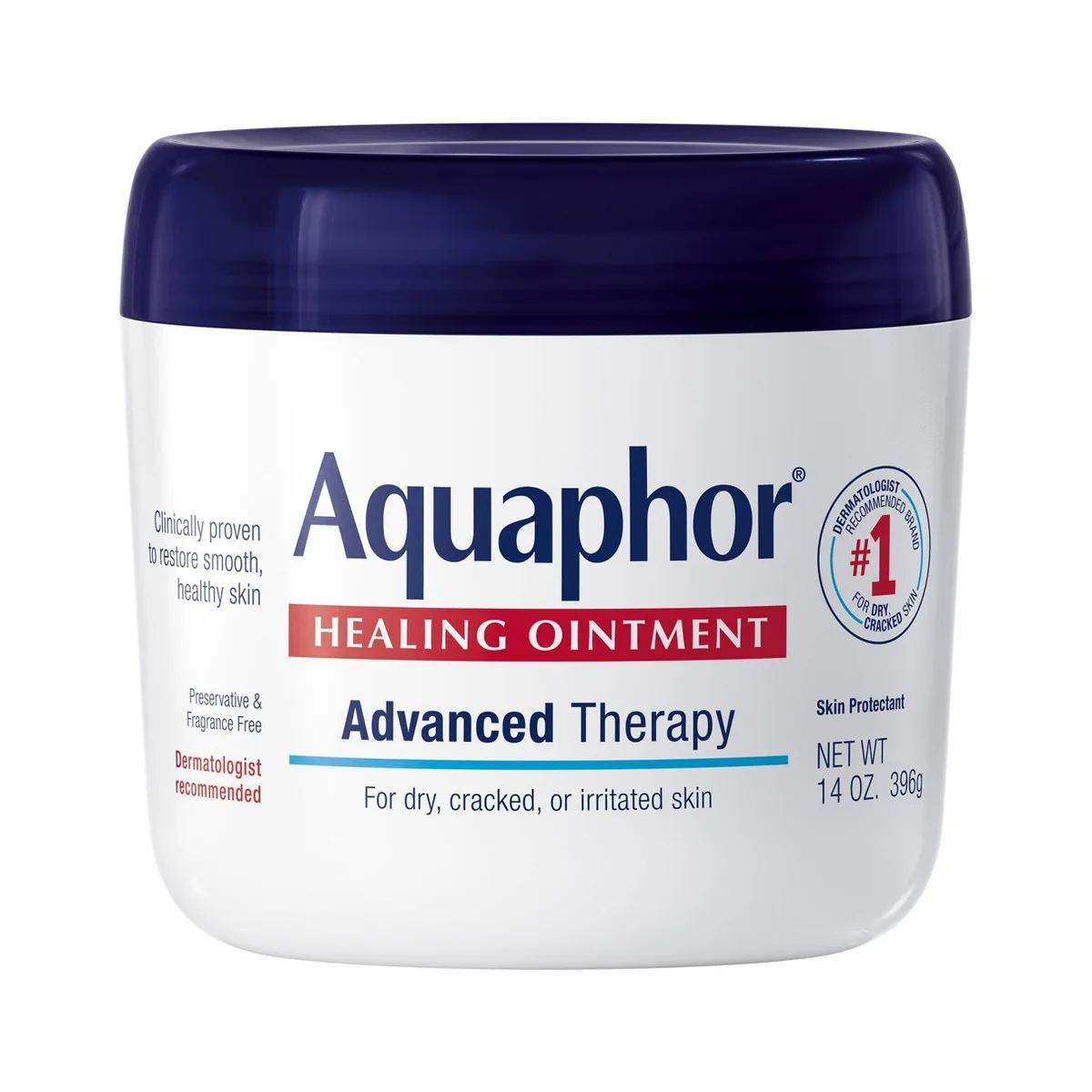
The 14 oz size comes in a wide-mouth screw-top plastic jar with Aquaphor's blue and white branding. Also available in squeeze tubes (1.75 oz, 3.5 oz, 7 oz) with flip-top caps, and travel-size tubes (0.35 oz, 2-pack). The jar features the Good Housekeeping Seal and NEA Seal of Acceptance.
Finish
dewyglowy
What to Expect on First Use
On first application, the ointment feels thick and greasy — this is by design. It forms an immediate occlusive seal over the skin that you can feel and see. Dry, tight skin feels relieved within minutes. The texture takes getting used to; this is not a disappearing moisturizer. For nighttime slugging, apply a thin layer and accept that your face will look glossy. By morning, the skin underneath feels dramatically softer and more hydrated.
How Long It Lasts
4-6 months with nightly facial use (14 oz jar); significantly longer if used only on targeted areas
National Eczema Association Seal of AcceptanceGood Housekeeping SealFDA OTC Skin ProtectantHSA/FSA EligibleClinically Proven Non-Comedogenic
Background
The Story Behind This Product
Aquaphor was born in 1925 in the U.S. laboratories of Beiersdorf, originally sold in five-pound containers to doctors and pharmacists. For its first fifty-seven years, it was a professional-only product — the ointment dermatologists kept in their offices and hospitals stocked in their burn units. Consumer availability didn't begin until 1982, and the current Advanced Therapy formulation launched in 1991. A century later, it remains essentially the same concept: petrolatum made smarter with a handful of functional additions.
About Aquaphor Legacy Brand (20+ years)
Aquaphor was developed in 1925 in the U.S. laboratories of Beiersdorf Inc. (parent company of Eucerin and NIVEA, headquartered in Hamburg, Germany). The current Advanced Therapy formulation was introduced in 1991. Aquaphor holds the National Eczema Association Seal of Acceptance, the Good Housekeeping Seal, and is the number-one dermatologist-recommended brand for dry, cracked skin. Its petrolatum-based formulations are referenced in dermatological literature spanning a century.
Brand founded: 1925 · Product launched: 1925
Myth vs. Reality
Common Myths
Myth
Petroleum jelly and Aquaphor are the same thing.
Reality
Pure petroleum jelly (Vaseline) is 100% petrolatum. Aquaphor is 41% petrolatum blended with panthenol, glycerin, bisabolol, and other ingredients that add humectant, healing, and anti-inflammatory properties. Aquaphor hydrates; pure petroleum jelly only seals.
Myth
Petrolatum-based products clog pores and cause acne.
Reality
Cosmetic-grade petrolatum is clinically non-comedogenic. Aquaphor has been dermatologically tested and confirmed non-comedogenic. While the heavy texture may trap sebum in already-oily skin, the ingredient itself does not block pores. Dermatologists routinely recommend it for compromised skin, including acne patients on drying medications.
Myth
Aquaphor is too heavy to use on the face.
Reality
Dermatologists frequently recommend Aquaphor for facial use — as a lip treatment, a post-procedure protectant, and as the final step in 'slugging' routines. The key is using a thin layer rather than a thick coat, and reserving facial use primarily for nighttime.
FAQ
Frequently Asked Questions
What is the difference between Aquaphor and Vaseline?
Vaseline is 100% petrolatum — a pure occlusive with no additional active ingredients. Aquaphor contains 41% petrolatum plus panthenol (vitamin B5), glycerin, and bisabolol, which add humectant hydration, wound-healing support, and anti-inflammatory properties. Aquaphor actively hydrates and soothes; Vaseline only seals.
Can I use Aquaphor on my face for slugging?
Yes. Aquaphor is one of the most dermatologist-recommended products for facial slugging — applying a thin occlusive layer as the final step in your nighttime routine. Apply over a hydrating serum and moisturizer on damp skin. Use a thin layer and reserve for nighttime use, as the glossy finish is impractical during the day.
Is Aquaphor safe for eczema?
Yes. Aquaphor holds the National Eczema Association Seal of Acceptance and is widely recommended by dermatologists for eczema management. Its occlusive barrier reduces transepidermal water loss and protects compromised skin, while panthenol and bisabolol support healing and reduce inflammation.
Does Aquaphor clog pores?
Aquaphor is clinically tested and confirmed non-comedogenic. Cosmetic-grade petrolatum does not inherently clog pores. However, those with very oily skin may find that the heavy occlusive layer traps existing sebum, so use on targeted dry areas rather than full-face application if you're acne-prone.
Can I use Aquaphor over retinol?
Use caution. Applying an occlusive like Aquaphor over retinol can trap the active ingredient against the skin, intensifying both its effects and its irritation. Dermatologists sometimes recommend applying Aquaphor around the eyes, nose, and mouth before retinol to protect sensitive areas, but layering it over retinol-treated skin can cause increased peeling and redness.
Is Aquaphor safe during pregnancy?
Yes. The seven-ingredient formula contains no retinoids, salicylic acid, or other ingredients flagged during pregnancy. Aquaphor is widely used during pregnancy for dry skin, cracked nipples during breastfeeding, and general skin protection.
Is Aquaphor vegan and cruelty-free?
No on both counts. Aquaphor contains lanolin alcohol (derived from sheep's wool), which makes it non-vegan. The parent company Beiersdorf allows animal testing where required by law for market access, meaning the brand is not cruelty-free certified.
Reviews
What Reviewers Tend to Say
Recurring themes our editors read across retailer reviews of this product — summaries in our words, not quotations, and not a substitute for your own patch test.
Common Praise
Heals cracked, dry, chapped skin within 24-48 hours of first application
A little goes a very long way, making even the large jar extremely economical
Fragrance-free and gentle enough for sensitive skin, babies, and post-procedure care
The gold standard occlusive for nighttime 'slugging' in skincare routines
Common Complaints
Greasy, heavy texture that sits on skin rather than absorbing
Too shiny and occlusive for daytime facial use in most situations
Contains lanolin alcohol, which can cause reactions in lanolin-sensitive individuals
Not vegan-friendly due to the lanolin-derived ingredient
Can stain pillowcases, fabrics, and clothing if not fully absorbed
Notable Endorsements
Number-one dermatologist-recommended brand for dry, cracked skinNational Eczema Association Seal of AcceptanceGood Housekeeping Seal (since 2013)FDA-registered OTC skin protectant
Occupational hand dermatitis is one of the most common work-related diseases on earth, it follows a script, and the cheapest fix works only if you start it before the skin splits.
Every post that dismantles a home remedy owes the reader a replacement. The honest replacement list is embarrassingly cheap, and one item on it is cheaper still — it is a bath.
Yuka's published rule is that the single worst ingredient sets the score. Not how much of it there is, not what it does in that base — its presence. Here is why that is a defensible design choice and a bad safety verdict.
Aug 28, 2026· 10 min
Questions people ask about Eczema
Verified answers from our questions library — the nuance a product page cannot carry.
Products, answers, therapy guides, tools and articles in one search. Brand names,
slang and abbreviations all work — accutane finds isotretinoin, bacne finds truncal acne.