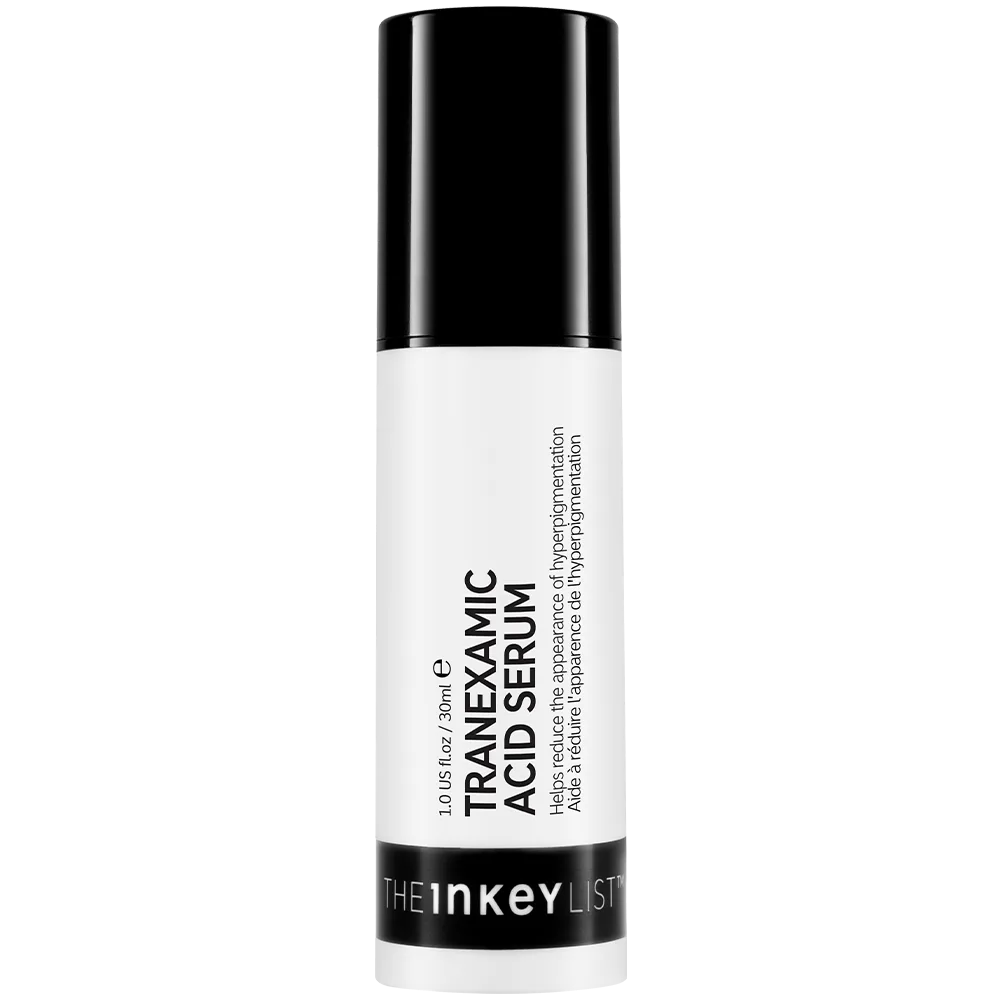
One of the few affordable tranexamic acid treatments that discloses its exact 2% concentration and pairs it with ascorbyl glucoside and acai extract for a triple-action brightening approach. Most tranexamic acid products at this price point either hide their concentrations or use tranexamic acid as a supporting player rather than the hero.
The INKEY List Tranexamic Acid Night Treatment Review
Budget Brightening Workhorse
serumgelindieParaben FreeCruelty FreeVegan
A smartly formulated, no-nonsense brightening treatment that punches above its $18 price tag. The disclosed 2% tranexamic acid and vitamin C derivative work through complementary pathways to fade dark spots without irritation — the kind of quiet, effective treatment that earns a permanent spot in your routine rather than demanding attention.
Promisingfor HyperpigmentationIn your profileYou chose · Tranexamic Acid has trial-level evidence for hyperpigmentation but no guideline or regulatory standing yet — promising, short of a recommendation; the other actives here are not yet assessed for it.Moderate evidenceGentleNo reviews collected yet
The case for it
Tranexamic Acid has trial-level evidence for this concern but no guideline or regulatory standing yet.
It is present at an effective concentration, declared or high in the ingredient list.
The formula carries none of the triggers this concern is sensitive to.
What would change this: Guideline or regulatory standing for the active on this concern would move this from a promising bet to a recommendation.
Same rule for everyone. “Promising” is the verdict on 7,858 of 45,024 concern verdicts across the catalog; rule R9p decided 7,858 of them.
Unchanged since September 5, 2026, engine 5.1.1.
R9p — 0.5.0: 'Unproven' beside three filled dots read as one question answered twice with opposite words (7,018 rows). The chip measures standing, the dots measure trial volume; where the row carries at least one RCT or a tier-2 source (moderate dots) and the active is present at a working level, the honest word is Promising. Unproven is reserved for plausible-standing rows with limited or weak evidence, or an under-dosed form. Same rank as Unproven — a bet either way; the dots order them. · the full register
Carrying active
Tranexamic Acid
Standing
plausible — trials support it
Form
adequate (declared 2%) — studied range 2–5%, from the OTC monograph or label; needs leave-on contact; judge it after ~12 weeks
Tolerability
gentle
Row checked
against its sources on July 17, 2026 (evidence table ev-2026.09-r228)
Promisingfor Dark SpotsIn your profileYou chose · Vitamin C has trial-level evidence for dark spots but no guideline or regulatory standing yet — promising, short of a recommendation; the other actives here are not yet assessed for it.Moderate evidenceGentleNo reviews collected yet
The case for it
Ascorbyl Glucoside has trial-level evidence for this concern but no guideline or regulatory standing yet.
It is present at an effective concentration, declared or high in the ingredient list.
The formula carries none of the triggers this concern is sensitive to.
What would change this: Guideline or regulatory standing for the active on this concern would move this from a promising bet to a recommendation.
Same rule for everyone. “Promising” is the verdict on 7,858 of 45,024 concern verdicts across the catalog; rule R9p decided 7,858 of them.
Unchanged since September 5, 2026, engine 5.1.1.
R9p — 0.5.0: 'Unproven' beside three filled dots read as one question answered twice with opposite words (7,018 rows). The chip measures standing, the dots measure trial volume; where the row carries at least one RCT or a tier-2 source (moderate dots) and the active is present at a working level, the honest word is Promising. Unproven is reserved for plausible-standing rows with limited or weak evidence, or an under-dosed form. Same rank as Unproven — a bet either way; the dots order them. · the full register
Carrying active
Ascorbyl Glucoside
Standing
plausible — trials support it
Form
adequate (declared 2%) — studied range 1–28%, from the trials on the row; needs leave-on contact; judge it after ~12 weeks
Tolerability
gentle
Row checked
against its sources on July 17, 2026 (evidence table ev-2026.09-r228)
Promisingfor Sun DamageIn your profileYou chose · Vitamin C has trial-level evidence for sun damage but no guideline or regulatory standing yet — promising, short of a recommendation; the other actives here are not yet assessed for it.Moderate evidenceGentleNo reviews collected yet
The case for it
Ascorbyl Glucoside has trial-level evidence for this concern but no guideline or regulatory standing yet.
It is present at an effective concentration, declared or high in the ingredient list.
The formula carries none of the triggers this concern is sensitive to.
What would change this: Guideline or regulatory standing for the active on this concern would move this from a promising bet to a recommendation.
Same rule for everyone. “Promising” is the verdict on 7,858 of 45,024 concern verdicts across the catalog; rule R9p decided 7,858 of them.
Unchanged since September 5, 2026, engine 5.1.1.
R9p — 0.5.0: 'Unproven' beside three filled dots read as one question answered twice with opposite words (7,018 rows). The chip measures standing, the dots measure trial volume; where the row carries at least one RCT or a tier-2 source (moderate dots) and the active is present at a working level, the honest word is Promising. Unproven is reserved for plausible-standing rows with limited or weak evidence, or an under-dosed form. Same rank as Unproven — a bet either way; the dots order them. · the full register
Carrying active
Ascorbyl Glucoside
Standing
plausible — trials support it
Form
adequate (declared 2%)
Tolerability
gentle
Row checked
against its sources on July 17, 2026 (evidence table ev-2026.09-r228)
The studies behind the evidence row
Use of topical ascorbic acid and its effects on photodamaged skin topography — Archives of Otolaryngology–Head & Neck Surgery — PubMed type includes 'Randomized Controlled Trial'; n=19 evaluable; active AND vehicle supplied by Cellex-C International; private facial plastic surgery practice (1999), opened July 16, 2026
Unprovenfor Acne ScarringIn your profileYou chose · Vitamin C has early or mechanistic evidence for acne scarring — a reasonable bet, not a recommendation; the other actives here are not yet assessed for it.Limited evidenceGentleNo reviews collected yet
The case for it
Ascorbyl Glucoside has early or mechanistic evidence for this concern, not trial-backed standing.
It is present at an effective concentration, declared or high in the ingredient list.
The formula carries none of the triggers this concern is sensitive to.
What would change this: Trial evidence for the active on this concern would move this from a bet to a recommendation.
Same rule for everyone. “Unproven” is the verdict on 1,111 of 45,024 concern verdicts across the catalog; rule R9 decided 1,111 of them.
Unchanged since September 5, 2026, engine 5.1.1.
R9 — Plausible-tier actives alone do not earn a recommendation, and 'not for this' would overstate the case against them. 'Unproven' with the evidence dots lets the reader judge the bet (added 0.2.0 after the first shadow run put a 10% niacinamide serum at 'not for this' for hyperpigmentation). 0.5.0: the closing clause reads the other heroes — "nothing else here addresses it" only when every other active has a researched 'none' row; "not yet assessed" when that is the truth. Rows whose dots read moderate or better now reach R9p first. · the full register
Carrying active
Ascorbyl Glucoside
Standing
plausible — trials support it
Form
adequate (declared 2%)
Tolerability
gentle
Row checked
against its sources on July 17, 2026 (evidence table ev-2026.09-r228)
Also listed for Dullness and Acne — the actives here (Vitamin C, Tranexamic Acid, Botanical Extracts, Squalane) are in our research queue for those concerns; there is no verdict until their evidence rows are written. That is a gap in our table, not a mark against the product.
Where our review and the verdict differ. The review below was written on the formulation and the published trials; the verdicts above apply the stricter standing test in our methodology — an active earns a recommendation only with guideline or regulatory standing for the concern. Where the two disagree, the verdict is DermApproved’s position.
A verdict is DermApproved’s assessment of how well a product’s ingredients fit a concern — never a claim about what the product treats. Evidence dots and collected reviews sit beside it and are never blended in.
Rules 0.5.1 · evidence table ev-2026.09-r228 · how we decide
Assessment
Pros & Cons
Pros
✓ Disclosed 2% tranexamic acid concentration matching clinical study levels
✓ Dual-pathway brightening with vitamin C derivative for complementary action
✓ Genuinely affordable at $18 for a treatment with proven actives
✓ Fragrance-free and largely gentle formula suitable for sensitive-leaning skin
✓ Photostable formula works effectively for both AM and PM application
✓ Lightweight gel texture layers well under most moisturizers and sunscreens
✓ Leaping Bunny and Vegan Society certified for ethically minded consumers
✓ Airless pump packaging preserves active ingredient stability
Cons
✗ Tacky finish can cause pilling under makeup or heavier products
✗ Results require 8-12 weeks of patience with no immediate visible payoff
✗ 30 mL bottle feels small — frequent repurchasing needed with twice-daily use
✗ Contains 1-methylhydantoin-2-imide, a formaldehyde-releasing preservative
✗ Faint chemical scent may bother those with fragrance sensitivity
Review
Full Review
Before tranexamic acid became a skincare buzzword, it was quietly doing the unglamorous work of stopping bleeding in operating rooms and managing heavy menstrual flow. The discovery that it could also interrupt the melanin production cascade was one of those delightful accidents of dermatological research — doctors noticed patients taking oral tranexamic acid for other conditions were developing more even-toned skin. The INKEY List, a brand built on the principle that clinical actives shouldn't require a clinical budget, saw the opportunity in 2020 and released one of the first affordable topical formulations at a disclosed 2% concentration.
The formula itself is deceptively simple. Tranexamic acid at 2% sits at the concentration range used in published clinical studies, where it works by blocking plasminogen activation in keratinocytes — essentially intercepting the distress signal that UV exposure sends to melanocytes telling them to ramp up melanin production. It's an upstream approach, targeting the messenger rather than the factory, which is why it tends to be gentler than ingredients like hydroquinone that directly suppress melanin synthesis. That upstream mechanism also answers the common assumption that tranexamic acid only helps melasma: because plasminogen activation is a pathway shared across UV-triggered pigmentation, published research at 2-3% shows it works on post-inflammatory marks from acne and on sun spots too, not just melasma.
Pairing it with 2% ascorbyl glucoside was a smart formulation choice. This stable vitamin C derivative attacks hyperpigmentation from a different angle — tyrosinase inhibition — meaning you get two distinct mechanisms of action in a single product. The ascorbyl glucoside also brings antioxidant protection, which matters because UV-generated free radicals are one of the triggers that start the whole pigmentation cascade in the first place. Its glucose-bonded structure keeps it stable in this water-based gel, and — crucially — photostable, which is the answer to the second myth this product carries: that the vitamin C derivative confines it to nighttime. It doesn't. The inclusion of acai fruit extract at 2% rounds out the antioxidant profile, while squalane adds lightweight barrier support and a lactobacillus ferment lends a little microbiome support without overcomplicating the formula.
Texturally, this is a lightweight gel with a barely-there yellow tint. It applies smoothly with a thin consistency that sits somewhere between water and a traditional serum. Absorption takes about sixty seconds, and here is where the product shows its one consistent weakness: it can leave a slightly tacky film. For PM use, this is barely noticeable under a moisturizer. For AM use under makeup, you'll want to give it a full minute to set and apply your next steps with pressing motions rather than rubbing to avoid pilling.
The fragrance-free formula is genuinely minimal on the irritation front, though it's worth noting the inclusion of 1-methylhydantoin-2-imide, a preservative in the formaldehyde-releaser family. At the concentration present here, it's well within safety guidelines, but consumers who specifically avoid this preservative category should be aware. Benzyl alcohol also appears as a preservative, which is an EU-listed allergen — again, at low concentrations, but transparency matters. The olive-derived emulsifiers mean it isn't strictly fungal-acne-safe, and as with any tranexamic acid product, pregnancy use is a question best raised with a provider.
Performance-wise, this is a marathon runner, not a sprinter. The most consistent feedback across nearly two thousand reviews is that results are real but require patience. The first two to four weeks may bring subtle brightening — a slight evening of overall tone that's hard to pinpoint. The real payoff arrives around the eight to twelve week mark, when post-inflammatory hyperpigmentation from acne and sun spots begin visibly fading. This timeline aligns perfectly with what clinical studies on topical tranexamic acid demonstrate, so temper your expectations accordingly.
The product was originally named the Tranexamic Acid Night Treatment, suggesting PM-only use. In 2022, The INKEY List renamed it to simply Tranexamic Acid Serum — a change driven by the reality that both tranexamic acid and ascorbyl glucoside are photostable and work during the day. Using it AM and PM with consistent sunscreen application is the approach most likely to deliver visible results.
At $18 for 30 mL, the per-milliliter cost is reasonable for a treatment serum with disclosed active concentrations. The airless pump packaging protects the formula and dispenses cleanly, though the bottle is admittedly compact — expect to replace it every two to three months with twice-daily use. For a brand that has only been around since 2018, The INKEY List doesn't have the decades of clinical heritage that backs legacy brands, but its commitment to ingredient transparency and realistic concentrations lends genuine credibility, and its review base — near two thousand entries averaging around four stars — reflects exactly the product's character: patient users see real fading, while the recurring complaints are the tacky finish and the slow timeline.
This is the kind of treatment that doesn't wow you on day one. There's no tingle, no visible glow, no immediate gratification. What it offers instead is a quietly effective, evidence-based approach to fading dark spots that respects your skin's tolerance threshold. For anyone dealing with post-acne marks, sun spots, or early melasma who wants to start treatment without risking irritation, this is one of the smartest $18 you can spend in skincare.
Formula
Key Ingredients
The hero actives that drive this product's performance.
A lysine analog that disrupts the keratinocyte-melanocyte signaling pathway by inhibiting plasminogen activation, reducing melanin overproduction at its source. In this formula, it works alongside ascorbyl glucoside for a dual-pathway approach to fading dark spots without the irritation of hydroquinone.
A stable vitamin C derivative that inhibits tyrosinase activity through a different mechanism than the tranexamic acid, creating a complementary brightening effect. Its glucose-bonded structure keeps it stable in this water-based gel format, releasing active vitamin C gradually on the skin.
Rich in anthocyanins and polyphenols, provides antioxidant defense against the UV-driven free radical damage that triggers melanin overproduction. Supports the brightening actives by addressing oxidative stress that can worsen existing hyperpigmentation.
A skin-identical lipid that provides lightweight barrier support without greasiness, helping maintain hydration while the brightening actives work. Its non-comedogenic profile keeps this treatment suitable for oily and acne-prone skin types that often struggle with post-inflammatory hyperpigmentation.
A postbiotic lysate that supports the skin's microbiome diversity and may help strengthen barrier resilience during the brightening treatment process. Complements the formula's gentle approach by promoting a healthy skin environment for recovery.
Not yet assessed
Ingredient standings describe the active at treatment-level doses and
vehicles; this product's own condition grades weigh its actual formula.
Apply after cleansing and water-based toners. In AM, always follow with SPF — essential when using brightening actives. At PM, can be layered under retinoids for enhanced dark spot correction. Allow 30-60 seconds to absorb before the next step to minimize pilling.
Results Timeline
Subtle brightening and more even tone within 2-4 weeks. Noticeable fading of dark spots and post-inflammatory marks at 8-12 weeks with consistent use. Full results typically visible after 3 months of daily application.
Topical tranexamic acid has built a compelling evidence base over the past decade, particularly for melasma and post-inflammatory hyperpigmentation. A 2014 study published in the Journal of Research in Medical Sciences found that 3% topical tranexamic acid applied twice daily for 12 weeks was comparable to a combination of 3% hydroquinone and 0.01% dexamethasone in reducing melasma severity scores (MASI), with significantly fewer side effects. This is notable because hydroquinone has long been the gold standard for hyperpigmentation but carries risks of irritation and ochronosis with prolonged use.
The mechanism is well-characterized: tranexamic acid is a synthetic lysine analog that blocks the conversion of plasminogen to plasmin in keratinocytes. UV exposure normally triggers this conversion, which then activates prostaglandin and arachidonic acid pathways that signal melanocytes to increase melanin production. By interrupting this cascade at the plasminogen level, tranexamic acid addresses pigmentation at its trigger point rather than at the melanin synthesis stage.
A 2022 systematic review in Clinical, Cosmetic and Investigational Dermatology (Alsharif et al.) analyzed nine studies covering 196 participants and found topical tranexamic acid at 2-3% concentrations effective for post-inflammatory hyperpigmentation with minimal transient side effects. The review noted that while intradermal delivery showed the strongest results, topical application remained effective and significantly more practical for daily use.
The combination with ascorbyl glucoside in this formula adds a second evidence-backed pathway. A 2014 study in Skin Research and Technology (Lee et al.) demonstrated that a combination of 2% niacinamide plus 2% tranexamic acid significantly reduced facial pigmentation after 8 weeks compared to vehicle control. While this product pairs tranexamic acid with a vitamin C derivative rather than niacinamide, the principle of multi-pathway targeting — blocking melanocyte activation while simultaneously inhibiting tyrosinase — is consistent with the combinatorial approach that research supports.
The 2% concentration used here falls within the effective range documented in clinical literature, lending credibility to the formulation's potential efficacy when used consistently with sun protection.
Dermatologists have increasingly embraced topical tranexamic acid as a versatile brightening agent, particularly for patients who cannot tolerate hydroquinone or need a long-term maintenance option. Clinicians consistently acknowledge that tranexamic acid's distinct mechanism of action — targeting plasminogen-mediated melanocyte signaling rather than direct melanin inhibition — makes it suitable for combination protocols with retinoids, vitamin C, or azelaic acid. This product's 2% concentration and gentle formulation are commonly cited as an accessible entry point for patients beginning hyperpigmentation treatment. Dermatologists emphasize that consistent sunscreen use is non-negotiable when using any brightening active, as UV exposure directly triggers the pigmentation pathway that tranexamic acid works to interrupt.
Guidance
Usage & Recommendations
How to Use
Dispense one to two pumps onto clean, dry skin after cleansing and any water-based toners. Gently press into areas of concern — dark spots, acne marks, or areas of uneven tone — and allow 30-60 seconds to absorb before applying the next step. Use AM and PM for best results. In the morning, always follow with a broad-spectrum SPF 30 or higher. At night, this can be layered under a retinoid. Avoid applying immediately after strong AHA or BHA exfoliants in the same routine.
Value Assessment
At $18 for 30 mL, this treatment falls in a sweet spot for active-driven skincare — significantly cheaper than prescription options and most prestige brightening serums, while offering disclosed concentrations that match clinical research. The cost per month works out to roughly $6-9 depending on usage frequency, which is remarkably affordable for a treatment serum. The INKEY List is still a relatively young brand without the decades of clinical validation behind legacy names, but the formulation itself stands on well-studied ingredients at documented concentrations. The only value concern is the compact bottle size — heavy users may find the repurchase frequency adds up.
Who Should Buy
Anyone dealing with post-acne marks, sun spots, or early melasma who wants an affordable, gentle brightening treatment with clinically backed actives. Especially well-suited for oily and combination skin types who need a lightweight formula that won't add grease or congestion.
Who Should Skip
Those who avoid formaldehyde-releasing preservatives should note the inclusion of 1-methylhydantoin-2-imide. If you need rapid brightening results for an event or timeline, this product's 8-12 week payoff period may be frustrating. Very dry skin types may find it insufficient without significant moisturizing layers on top.
Ready to try The INKEY List Tranexamic Acid Night Treatment?
Translucent gel with a slight yellow tint, thicker than a water serum but lighter than a cream. Smooth application with moderate slip.
Scent
Fragrance-free with a faint chemical note that dissipates quickly after application.
Packaging
30 mL opaque white airless pump bottle with black cap. Minimalist design consistent with The INKEY List's no-frills branding. The airless pump preserves ingredient stability and provides hygienic dispensing.
Finish
lightweightnon-greasy
What to Expect on First Use
The gel applies smoothly and absorbs within a minute, though it can leave a slightly tacky film. No tingling or stinging for most users. Brightening effects are gradual — expect no dramatic changes in the first two weeks. This is a slow-burn treatment that builds results over multiple skin cycles.
How Long It Lasts
6-8 weeks applied morning and night, 2-3 months with once-daily application
The INKEY List launched this treatment in 2020 as part of their mission to make clinical-grade actives accessible at drugstore prices. Originally called the 'Night Treatment,' it was renamed to 'Tranexamic Acid Serum' in 2022 to reflect that dermatologists and users found it equally effective for AM use — a move that highlights how consumer feedback shaped the product's positioning.
About The INKEY List Established Brand (5–20 years)
The INKEY List launched in 2018, founded by Colette Laxton and Mark Curry with a mission to make effective skincare affordable and transparent. The brand is Leaping Bunny certified and Vegan Society certified, and has built credibility through ingredient transparency, though independent clinical validation of its specific formulations remains limited.
Brand founded: 2018 · Product launched: 2020
Myth vs. Reality
Common Myths
Myth
Tranexamic acid is only effective for melasma and won't help with acne scars or sun spots.
Reality
Published research shows topical tranexamic acid at 2-3% concentrations is effective for multiple forms of hyperpigmentation including post-inflammatory hyperpigmentation from acne, sun damage, and melasma. It works by inhibiting plasminogen activation in keratinocytes, a pathway common to all UV-triggered pigmentation.
Myth
This product can only be used at night because of the vitamin C derivative.
Reality
Ascorbyl glucoside is a stable vitamin C form that doesn't degrade in sunlight. The brand renamed this product from 'Night Treatment' to 'Serum' specifically because it's safe and effective for daytime use when paired with sunscreen.
FAQ
Frequently Asked Questions
Can I use The INKEY List Tranexamic Acid Night Treatment in the morning?
Yes — despite the original 'Night Treatment' name, this formula is stable for AM use. The ascorbyl glucoside is a photostable vitamin C derivative, and tranexamic acid actually helps counteract UV-triggered melanin production. The brand renamed it to 'Serum' in 2022 for this reason. Always follow with SPF 30+ when using it during the day.
How long does it take to see results from tranexamic acid?
Most users report subtle brightening within 2-4 weeks, with meaningful dark spot fading at 8-12 weeks of consistent use. This product's 2% concentration aligns with concentrations used in clinical studies, but skin cell turnover takes time. Pairing it with daily sunscreen significantly improves results.
Can I use this with retinol or vitamin C serums?
Yes to both. Tranexamic acid pairs well with retinoids — use this serum first, then apply your retinoid. It already contains ascorbyl glucoside (a vitamin C derivative), so layering an additional vitamin C serum isn't necessary but won't cause issues. Avoid combining with strong AHA/BHA exfoliants in the same routine to prevent irritation.
Is The INKEY List Tranexamic Acid safe during pregnancy?
Topical tranexamic acid has minimal systemic absorption, and some dermatologists consider it a safer alternative to hydroquinone during pregnancy. However, there isn't enough clinical data specific to topical use in pregnancy for a definitive recommendation. Consult your OB-GYN or dermatologist before use.
What's the difference between tranexamic acid and hydroquinone for dark spots?
Both target hyperpigmentation but through different mechanisms. Hydroquinone directly inhibits melanin production and works faster but has usage limits and potential side effects. This product's tranexamic acid works by blocking the UV-triggered signaling that tells melanocytes to overproduce melanin — a gentler, upstream approach that's safe for long-term use without cycling off.
Reviews
What Reviewers Tend to Say
Recurring themes our editors read across retailer reviews of this product — summaries in our words, not quotations, and not a substitute for your own patch test.
Common Praise
Affordable entry into tranexamic acid at $18
Visible fading of post-acne marks with consistent use
Lightweight gel texture absorbs well
Fragrance-free and generally gentle
Layers nicely under other products
Transparent ingredient concentrations
Common Complaints
Tacky finish that can cause pilling under makeup
Results require patience — 8-12 weeks minimum
Small 30 mL bottle at $18 feels pricey per mL
Faint chemical scent despite being fragrance-free
Some users report no visible improvement
Notable Endorsements
NBC Select Best Tranexamic Acid Serums listMultiple dermatologist recommendations as an affordable hyperpigmentation treatment
It was invented to stop bleeding during surgery. In 2026 it's in dozens of brightening serums — and the evidence is better than most trend ingredients can claim.
'Dark spots' bundles at least five distinct processes that sit at different depths, respond to different things, and have wildly different prognoses — one clears on its own, one relapses forever, and one will not move for any serum ever made.
In the largest maintenance trial of its kind, 78.8% of patients cleared in eight weeks and only 53% were still clear six months later — and the thing that predicted relapse was not how well they cleared.
Products, answers, therapy guides, tools and articles in one search. Brand names,
slang and abbreviations all work — accutane finds isotretinoin, bacne finds truncal acne.