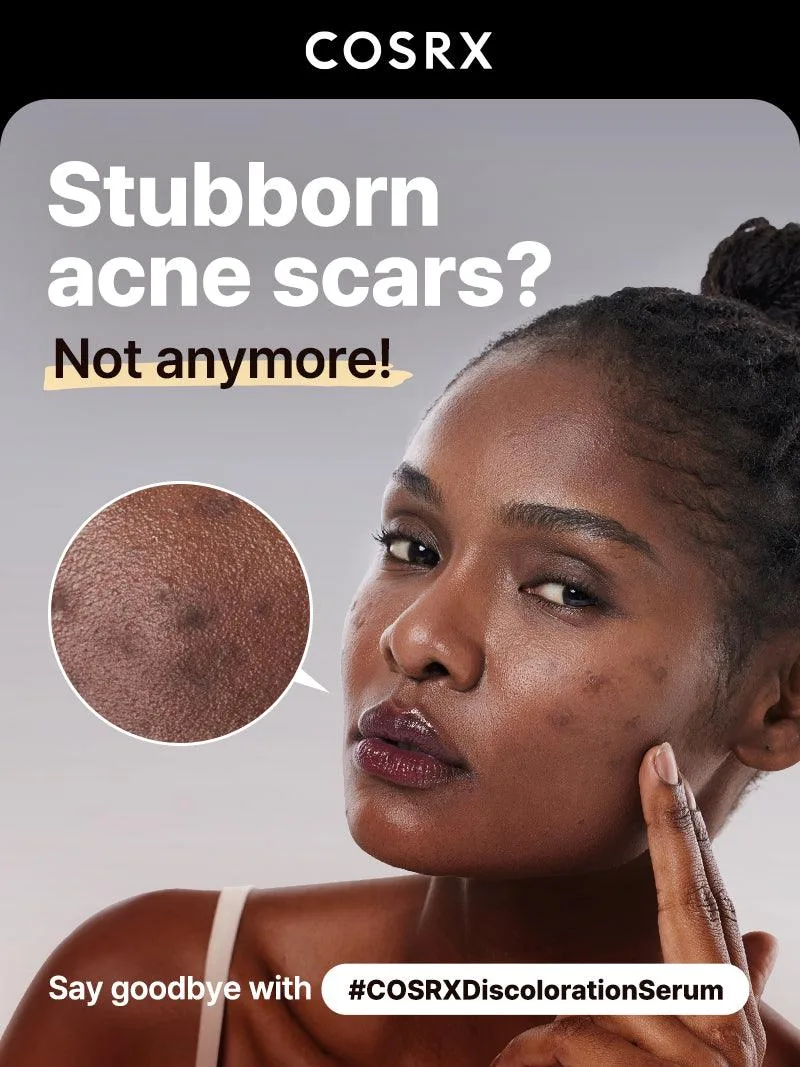
Most brightening serums rely on one or two active ingredients. This serum stacks six distinct anti-pigmentation actives — alpha-arbutin, niacinamide, tranexamic acid, acetyl glucosamine, glutathione, and ferulic acid — each targeting a different stage of the melanin production and transfer cycle. The multi-pathway approach means discoloration is addressed from synthesis to transfer to surface removal simultaneously, while four forms of hyaluronic acid and madecassoside ensure the treatment remains hydrating and soothing rather than aggressive.
COSRX The Alpha-Arbutin 2 Discoloration Care Serum Review
Multi-Pathway Brightening Powerhouse
serumserumk beautyParaben FreeNot Cruelty Free
COSRX's most ambitious formulation to date — six brightening actives targeting every stage of the melanin pathway in a single serum, backed by clinical testing showing visible dark spot reduction in four weeks. The multi-pathway approach is genuinely sophisticated, though the alcohol content and active-heavy formula make this a better fit for resilient skin than reactive skin.
Note: This serum was released in October 2024 and our assessment is based on limited long-term data. The score here leans on ingredient analysis, COSRX's clinical testing data, and early user feedback from approximately 1,800 reviews. Longer-term data may revise this scoring upward or downward.
Verdicts
How well it fits each concern
Verdict by concern tap a concern for the case
Good choicefor HyperpigmentationIn your profileYou chose · Niacinamide is a trial-supported active for hyperpigmentation; this serum carries it at 5%.Moderate evidenceGentleNo reviews collected yet
The case for it
Niacinamide has trial-supported standing for this concern.
It is present at an effective concentration, declared or high in the ingredient list.
The formula carries none of the triggers this concern is sensitive to.
Same rule for everyone. “Good choice” is the verdict on 9,564 of 45,024 concern verdicts across the catalog; rule R5 decided 9,072 of them.
Unchanged since September 5, 2026, engine 5.1.1.
Promisingfor Dark SpotsIn your profileYou chose · Niacinamide has trial-level evidence for dark spots but no guideline or regulatory standing yet — promising, short of a recommendation; the other actives here are not yet assessed for it.Moderate evidenceGentleNo reviews collected yet
The case for it
Niacinamide has trial-level evidence for this concern but no guideline or regulatory standing yet.
It is present at an effective concentration, declared or high in the ingredient list.
The formula carries none of the triggers this concern is sensitive to.
What would change this: Guideline or regulatory standing for the active on this concern would move this from a promising bet to a recommendation.
Same rule for everyone. “Promising” is the verdict on 7,858 of 45,024 concern verdicts across the catalog; rule R9p decided 7,858 of them.
Unchanged since September 5, 2026, engine 5.1.1.
R9p — 0.5.0: 'Unproven' beside three filled dots read as one question answered twice with opposite words (7,018 rows). The chip measures standing, the dots measure trial volume; where the row carries at least one RCT or a tier-2 source (moderate dots) and the active is present at a working level, the honest word is Promising. Unproven is reserved for plausible-standing rows with limited or weak evidence, or an under-dosed form. Same rank as Unproven — a bet either way; the dots order them. · the full register
Carrying active
Niacinamide
Standing
plausible — trials support it
Form
adequate (declared 5%)
Tolerability
gentle
Row checked
against its sources on July 17, 2026 (evidence table ev-2026.09-r228)
Good choicefor MelasmaIn your profileYou chose · Tranexamic Acid is a trial-supported active for melasma; this serum carries it at 3%.Strong evidenceGentleNo reviews collected yet
The case for it
Tranexamic Acid has trial-supported standing for this concern.
It is present at an effective concentration, declared or high in the ingredient list.
The formula carries none of the triggers this concern is sensitive to.
Same rule for everyone. “Good choice” is the verdict on 9,564 of 45,024 concern verdicts across the catalog; rule R5 decided 9,072 of them.
Unchanged since September 5, 2026, engine 5.1.1.
Promisingfor DullnessIn your profileYou chose · Hyaluronic Acid has trial-level evidence for dullness but no guideline or regulatory standing yet — promising, short of a recommendation; the other actives here are not yet assessed for it.Moderate evidenceGentleNo reviews collected yet
The case for it
Multi-Molecular Hyaluronic Acid Complex has trial-level evidence for this concern but no guideline or regulatory standing yet.
It is plausibly present at a working level, though the concentration is not declared.
The formula carries none of the triggers this concern is sensitive to.
What would change this: A declared concentration would move this to a firmer reading of the dose.
Same rule for everyone. “Promising” is the verdict on 7,858 of 45,024 concern verdicts across the catalog; rule R9p decided 7,858 of them.
Unchanged since September 5, 2026, engine 5.1.1.
R9p — 0.5.0: 'Unproven' beside three filled dots read as one question answered twice with opposite words (7,018 rows). The chip measures standing, the dots measure trial volume; where the row carries at least one RCT or a tier-2 source (moderate dots) and the active is present at a working level, the honest word is Promising. Unproven is reserved for plausible-standing rows with limited or weak evidence, or an under-dosed form. Same rank as Unproven — a bet either way; the dots order them. · the full register
Carrying active
Multi-Molecular Hyaluronic Acid Complex
Standing
plausible — trials support it
Form
plausible
Tolerability
gentle
Row checked
against its sources on July 17, 2026 (evidence table ev-2026.09-r228)
Promisingfor Sun DamageIn your profileYou chose · Niacinamide has trial-level evidence for sun damage but no guideline or regulatory standing yet — promising, short of a recommendation; the other actives here are not yet assessed for it.Moderate evidenceGentleNo reviews collected yet
The case for it
Niacinamide has trial-level evidence for this concern but no guideline or regulatory standing yet.
It is present at an effective concentration, declared or high in the ingredient list.
The formula carries none of the triggers this concern is sensitive to.
What would change this: Guideline or regulatory standing for the active on this concern would move this from a promising bet to a recommendation.
Same rule for everyone. “Promising” is the verdict on 7,858 of 45,024 concern verdicts across the catalog; rule R9p decided 7,858 of them.
Unchanged since September 5, 2026, engine 5.1.1.
R9p — 0.5.0: 'Unproven' beside three filled dots read as one question answered twice with opposite words (7,018 rows). The chip measures standing, the dots measure trial volume; where the row carries at least one RCT or a tier-2 source (moderate dots) and the active is present at a working level, the honest word is Promising. Unproven is reserved for plausible-standing rows with limited or weak evidence, or an under-dosed form. Same rank as Unproven — a bet either way; the dots order them. · the full register
Carrying active
Niacinamide
Standing
plausible — trials support it
Form
adequate (declared 5%) — studied range 5–10%, from the OTC monograph or label; needs leave-on contact; judge it after ~8 weeks
Tolerability
gentle
Row checked
against its sources on July 17, 2026 (evidence table ev-2026.09-r228)
Not for thisfor Acne ScarringIn your profileYou chose · The actives here have been researched for acne scarring and the evidence does not support the claim.Not yet assessedGentleNo reviews collected yet
The case for it
Niacinamide has been researched for this concern and the evidence does not support it.
It is present at an effective concentration, declared or high in the ingredient list.
The formula carries none of the triggers this concern is sensitive to.
Same rule for everyone. “Not for this” is the verdict on 488 of 45,024 concern verdicts across the catalog; rule R10 decided 488 of them.
Unchanged since September 5, 2026, engine 5.1.1.
Promisingfor AcneIn your profileYou chose · Niacinamide has trial-level evidence for acne but no guideline or regulatory standing yet — promising, short of a recommendation; the other actives here are not yet assessed for it.Moderate evidenceGentleNo reviews collected yet
The case for it
Niacinamide has trial-level evidence for this concern but no guideline or regulatory standing yet.
It is present at an effective concentration, declared or high in the ingredient list.
The formula carries none of the triggers this concern is sensitive to.
What would change this: Guideline or regulatory standing for the active on this concern would move this from a promising bet to a recommendation.
Same rule for everyone. “Promising” is the verdict on 7,858 of 45,024 concern verdicts across the catalog; rule R9p decided 7,858 of them.
Unchanged since September 5, 2026, engine 5.1.1.
R9p — 0.5.0: 'Unproven' beside three filled dots read as one question answered twice with opposite words (7,018 rows). The chip measures standing, the dots measure trial volume; where the row carries at least one RCT or a tier-2 source (moderate dots) and the active is present at a working level, the honest word is Promising. Unproven is reserved for plausible-standing rows with limited or weak evidence, or an under-dosed form. Same rank as Unproven — a bet either way; the dots order them. · the full register
Carrying active
Niacinamide
Standing
plausible — trials support it
Form
adequate (declared 5%) — studied range 4–5%, from the OTC monograph or label; needs leave-on contact; judge it after ~8 weeks
Tolerability
gentle
Row checked
against its sources on July 17, 2026 (evidence table ev-2026.09-r228)
Also listed for Rough Texture — the actives here (Niacinamide, Tranexamic Acid, Acetyl Glucosamine, Alpha Arbutin) are in our research queue for that concern; there is no verdict until their evidence rows are written. That is a gap in our table, not a mark against the product.
Where our review and the verdict differ. The review below was written on the formulation and the published trials; the verdicts above apply the stricter standing test in our methodology — an active earns a recommendation only with guideline or regulatory standing for the concern. Where the two disagree, the verdict is DermApproved’s position.
A verdict is DermApproved’s assessment of how well a product’s ingredients fit a concern — never a claim about what the product treats. Evidence dots and collected reviews sit beside it and are never blended in.
Rules 0.5.1 · evidence table ev-2026.09-r228 · how we decide
Assessment
Pros & Cons
Pros
✓ Six distinct brightening actives targeting every stage of the melanin production cascade
✓ Clinical testing shows 22.31% dark spot reduction in just four weeks
✓ Four forms of hyaluronic acid provide hydration alongside treatment for comfortable daily wear
✓ Madecassoside and panthenol add soothing support to balance the active load
✓ Excellent value at $25 for 50ml — comparable multi-active serums cost $40-80
✓ Fragrance-free formula with no essential oils
✓ Lightweight texture layers well under moisturizer and sunscreen
Cons
✗ Contains denatured alcohol — a debatable inclusion in a brightening treatment serum
✗ Multiple potent actives may overwhelm sensitive, rosacea-prone, or barrier-compromised skin
✗ Slight tackiness during absorption requires a moment before layering next step
✗ Frosted glass bottle makes it impossible to see how much product remains
✗ Limited long-term data — product launched October 2024
Review
Full Review
Hyperpigmentation is stubborn because melanin production is not a single event — it is a cascade. An enzyme activates. Melanin is synthesized. It is packaged into melanosomes. Those melanosomes are transferred to keratinocytes. The pigmented cells migrate to the skin surface. Most brightening products interrupt one or two steps in this chain and call it a day. The COSRX Alpha-Arbutin 2 Discoloration Care Serum attempts something more ambitious: it stations an active at virtually every stage of the cascade and asks them to work simultaneously.
Alpha-arbutin at 2% handles the opening move — it inhibits tyrosinase, the enzyme that catalyzes the first step of melanin synthesis. Tranexamic acid at an estimated 3% suppresses melanin production through the plasmin pathway, a mechanism entirely distinct from tyrosinase inhibition and particularly relevant for melasma, where plasmin-mediated signaling plays a documented role. Niacinamide at approximately 5% blocks the transfer of melanosomes from melanocytes to keratinocytes — it does not stop melanin from being made but prevents it from reaching the visible skin surface. Acetyl glucosamine promotes exfoliation of already-pigmented cells, accelerating their removal from the surface. Glutathione provides antioxidant tyrosinase inhibition through yet another mechanism. And ferulic acid contributes antioxidant support that protects against the UV-induced free radicals that trigger melanogenesis in the first place.
On paper, this is one of the most comprehensive anti-pigmentation formulas available at any price point, let alone $25. The question is whether stacking this many actives in a single product creates synergy or chaos.
The early evidence suggests synergy. COSRX's clinical testing reported a 20.47% melanin reduction and 22.31% dark spot reduction after just four weeks — results that are clinically meaningful, though it is worth noting these are the brand's own tests, not independent peer-reviewed studies. User reviews broadly corroborate the timeline: visible fading of post-inflammatory hyperpigmentation and dark spots in the one-to-two-month range, with continued improvement through three months of consistent use. The one thing nobody should expect is speed — brightening runs on the skin's own turnover clock, and the first fortnight buys you a general luminosity rather than a spot that has actually gone.
The texture is a pleasant lightweight serum with a slight beige-yellow tint that absorbs without greasiness. There is a brief window of tackiness during absorption — likely attributable to the niacinamide and hyaluronic acid concentrations — that resolves within a minute. The formula includes four forms of hyaluronic acid and madecassoside, which serve dual purposes: they provide the hydration and soothing support that a treatment serum needs to remain comfortable with daily use, and they create an optimal environment for the brightening actives to work. Dehydrated, inflamed skin is less responsive to brightening treatments, so addressing hydration and calm alongside pigmentation is a smart formulation strategy.
The honest complications center on the formula's intensity. This is a serum with six distinct actives at meaningful concentrations, plus alcohol (denatured) appearing at position 14 in the INCI list. For resilient, non-reactive skin, this combination is tolerable and effective. For sensitive skin, rosacea-prone skin, or compromised barriers, the cumulative load of alpha-arbutin, niacinamide, tranexamic acid, acetyl glucosamine, citric acid, and alcohol may be too much. Some users report flushing — likely from the niacinamide — and a minority report breakouts that suggest the multi-active approach overwhelmed their skin's tolerance threshold.
The inclusion of alcohol is the formula's most debatable choice. At its INCI position, the concentration is likely low — perhaps 1-3% — and its role is probably as a penetration enhancer for the actives or a texture modifier. Two solvents sitting nearby, dimethyl isosorbide and diethoxyethyl succinate, point the same direction: this is a formula working hard to keep six water-shy actives dissolved and moving into skin. Sodium metabisulfite further down is doing protective duty, keeping glutathione and arbutin from oxidizing in the bottle. Reasonable formulation choices, all of them — but in a product aimed at users who may already have sensitized skin from sun damage, melasma, or post-inflammatory marks, any amount of drying alcohol remains a fair point of contention.
The supporting cast deserves recognition. Licorice root extract adds yet another brightening pathway. Panthenol provides barrier support. Allantoin calms. Madecassoside — the most anti-inflammatory of the centella triterpenoids — contributes soothing that helps the skin tolerate the active load. Tocopherol provides antioxidant protection. These are not afterthoughts but integral to the formula's strategy of pushing active concentration while maintaining tolerability. The lecithin and silicones do mean this is not a fit for a Malassezia-avoidant routine.
Two persistent myths are worth dispatching here, because they shape how people use a serum like this. The first is that alpha-arbutin is a watered-down hydroquinone; it isn't. It competes with tyrosinase reversibly rather than poisoning the enzyme outright, which is why it carries none of hydroquinone's ochronosis or rebound baggage. The second is that niacinamide cannot be combined with other brightening actives — an idea that has somehow survived a decade of evidence to the contrary. Niacinamide is among the most cooperative molecules in skincare, and here it is doing a job none of the others can do.
What does require caution is the total active load across your whole routine, not within this bottle. Stacking this on top of a strong AHA or a high-dose vitamin C in the same sitting is how tolerable becomes intolerable. Start once a day in the evening for a week or two, then build. And wear sunscreen — every one of these six actives is working against a process that UV restarts each morning, and skipping SPF turns the whole exercise into a treadmill.
At $25 for 50ml, the value proposition is strong. Comparable multi-active brightening serums from premium brands typically run $40-80 for similar volumes, and a bottle here lasts two to three months at twice-daily use. COSRX's accessible pricing means the multi-pathway approach is available to consumers who might otherwise be limited to single-active budget options. The frosted glass bottle is the one design own-goal: elegant, and completely opaque to how much serum you have left. Reviews are numerous but young — the serum only launched in late 2024 — so the enthusiasm should be read as a strong early signal rather than a settled verdict.
This serum represents COSRX at its most sophisticated — a formula that reflects genuine understanding of melanin biology rather than trend-chasing. It is not a product for everyone, and it should not be the first step for someone new to brightening actives. But for anyone with resilient skin dealing with stubborn discoloration who has tried single-active approaches without adequate results, the multi-pathway philosophy offers a compelling escalation strategy at a price that makes experimentation low-risk.
Formula
Key Ingredients
The hero actives that drive this product's performance.
A tyrosinase inhibitor that blocks the enzyme responsible for melanin production at its source, working at the earliest stage of the pigmentation cascade while the niacinamide and tranexamic acid in this formula target downstream steps for comprehensive multi-stage discoloration control.
Inhibits the transfer of melanosomes from melanocytes to keratinocytes — a different stage of pigmentation than the alpha-arbutin targets — meaning existing melanin is prevented from reaching the visible skin surface even as new melanin production is simultaneously suppressed.
Suppresses melanin synthesis via the plasmin pathway — a mechanism distinct from both alpha-arbutin's tyrosinase inhibition and niacinamide's transfer blocking — adding a third anti-pigmentation pathway particularly effective for melasma and stubborn post-inflammatory hyperpigmentation.
Promotes exfoliation of pigmented cells from the skin surface while enhancing hyaluronic acid synthesis in the dermis, addressing discoloration through accelerated cell turnover rather than melanin suppression — the fourth distinct brightening pathway in this formula.
A tripeptide antioxidant that inhibits tyrosinase through a different mechanism than alpha-arbutin, while also scavenging free radicals that trigger melanogenesis — providing both preventive and corrective antioxidant support to the formula's multi-pathway brightening system.
Four forms of hyaluronic acid at different molecular weights ensure the brightening actives are delivered in a hydrated environment, preventing the dryness and irritation that concentrated treatment serums often cause while maintaining plumpness alongside pigmentation correction.
Plausible mechanismfor Dullness
Ingredient standings describe the active at treatment-level doses and
vehicles; this product's own condition grades weigh its actual formula.
Apply 2-3 drops after cleansing and toning, before moisturizer. Lightweight enough to layer under heavier creams. Sunscreen SPF 30+ is essential in the morning as brightening actives increase photosensitivity. Allow a minute to absorb before applying next step to minimize tackiness.
Results Timeline
Subtle improvement in skin brightness within 1-2 weeks. Visible fading of dark spots and post-inflammatory hyperpigmentation at the 4-week mark. Significant improvement in overall tone evenness, melasma appearance, and discoloration at 8-12 weeks of consistent twice-daily use.
COSRX The Alpha-Arbutin 2 Discoloration Care Serum
Moisturizer
Sunscreen SPF 30+
Sample PM Routine
Oil cleanser
Water-based cleanser
Hydrating toner
COSRX The Alpha-Arbutin 2 Discoloration Care Serum
Moisturizer
Evidence
Science & Expert Perspective
The Science
The multi-pathway approach in this serum reflects current dermatological understanding that effective hyperpigmentation treatment requires targeting multiple stages of melanogenesis. Alpha-arbutin's mechanism was elucidated in a study published in the Journal of Biological Chemistry (1995), which demonstrated that alpha-arbutin is a competitive and reversible inhibitor of tyrosinase — it occupies the enzyme's active site without permanently inactivating it, providing melanin suppression without the cytotoxic risks of irreversible inhibitors like hydroquinone.
Tranexamic acid's role in pigmentation was established through its use in treating melasma. A randomized controlled trial published in the Journal of the American Academy of Dermatology (2020) found that topical tranexamic acid at 3% significantly reduced melasma severity over 12 weeks compared to placebo. The mechanism involves inhibition of the plasminogen/plasmin pathway, which reduces the UV-induced production of arachidonic acid and prostaglandins that stimulate melanocyte activity — a pathway distinct from tyrosinase inhibition.
Niacinamide's melanosome transfer inhibition was demonstrated in the landmark study by Hakozaki et al. published in the British Journal of Dermatology (2002), which showed that 5% niacinamide reduced hyperpigmented spots by 35-68% over 8 weeks by preventing melanosomes from reaching keratinocytes. Combined with the tyrosinase inhibition from alpha-arbutin and the plasmin pathway suppression from tranexamic acid, the formula creates three independent anti-pigmentation mechanisms operating simultaneously.
Acetyl glucosamine (N-acetyl glucosamine) was studied in combination with niacinamide in research published in Experimental Dermatology (2007), which found that the combination produced greater reduction in facial hyperpigmentation than either ingredient alone — suggesting a synergistic interaction between melanin transfer inhibition and accelerated desquamation of pigmented cells.
The four forms of hyaluronic acid serve a functional role beyond hydration: adequately hydrated skin demonstrates improved barrier function and enhanced penetration of topical actives. Research in Skin Research and Technology (2004) showed that pre-hydration of the stratum corneum significantly increased the percutaneous absorption of water-soluble compounds, suggesting the HA complex may enhance delivery of the brightening actives in this formula.
Niacinamide and N-acetyl glucosamine combination for treatment of hyperpigmentation — Experimental Dermatology (2007)
Dermatologist Perspective
Dermatologists increasingly favor multi-pathway approaches to hyperpigmentation, recognizing that single-agent strategies often produce incomplete or temporary results. Dermatology practitioners would view this serum's combination of tyrosinase inhibition (alpha-arbutin, glutathione), plasmin pathway suppression (tranexamic acid), melanosome transfer blocking (niacinamide), and accelerated desquamation (acetyl glucosamine) as a well-reasoned strategy that mirrors the combination therapy approach used in clinical dermatology for melasma management. The concentrations appear clinically relevant — 2% alpha-arbutin and estimated 3% tranexamic acid fall within the ranges studied in clinical trials. Dermatologists would, however, flag the alcohol content as unnecessary and recommend that patients with sensitive skin or active rosacea start with once-daily application to assess tolerance before escalating.
Guidance
Usage & Recommendations
How to Use
After cleansing and toning, dispense 2-3 drops onto fingertips or directly onto the face. Pat gently into the skin, focusing on areas of discoloration, dark spots, or uneven tone. Allow 30-60 seconds to absorb before applying moisturizer. Use both morning and evening for best results. Sunscreen SPF 30 or higher is essential in the morning, as brightening actives increase photosensitivity. For sensitive skin, start with once-daily evening application for the first 1-2 weeks before increasing to twice daily.
Value Assessment
At $25 for 50ml, this serum significantly undercuts comparable multi-active brightening serums from premium and clinical brands, which typically price similar formulations at $40-80. The 50ml volume lasting 2-3 months brings the daily cost to roughly 25-40 cents — exceptional value for a serum stacking six brightening actives with four forms of hyaluronic acid. For COSRX, this pricing is consistent with their mission of making effective skincare accessible, and the ingredient quality at this price point is genuinely difficult to match in the current market.
Who Should Buy
Anyone with normal-to-resilient skin dealing with stubborn hyperpigmentation, dark spots, post-inflammatory marks from acne, melasma, or general dullness who has found single-active brightening products insufficient. This is a strong choice for those ready to escalate their brightening approach without escalating to prescription treatments.
Who Should Skip
Sensitive, rosacea-prone, or barrier-compromised skin types should approach with caution — the multiple potent actives and alcohol content may cause irritation or flushing. Those already using strong exfoliants or high-concentration vitamin C should be mindful of their total active load when adding this serum.
Ready to try COSRX The Alpha-Arbutin 2 Discoloration Care Serum?
A lightweight serum with a slightly viscous consistency and a delicate beige-yellow tint. Not oily. Takes a moment to fully absorb with slight initial tackiness that dries down to a comfortable finish.
Scent
Unscented — no noticeable fragrance or herbal scent.
Packaging
Frosted glass dropper bottle with glass pipette dispenser. Minimalist COSRX clinical design. The frosted glass looks elegant but makes it impossible to see remaining product level.
Finish
satinnon-greasyfast-absorbing
What to Expect on First Use
Expect a lightweight serum that absorbs with slight tackiness for the first 30-60 seconds before drying down. No immediate visible change — brightening actives work over weeks, not minutes. Some users with sensitive skin may experience mild flushing from the niacinamide, which typically subsides with continued use. Start with once-daily application (PM) for the first week before moving to twice-daily.
How Long It Lasts
2-3 months applied morning and evening of 2-3 drops
Launched in October 2024 as a US exclusive at Ulta Beauty, this serum filled a gap in COSRX's lineup — the brand had hydration (Snail Mucin) and exfoliation (AHA/BHA line) covered, but lacked a dedicated hyperpigmentation treatment. COSRX developed the formula around the concept of targeting all stages of discoloration simultaneously rather than relying on a single mechanism. Clinical testing showed a 20.47% melanin reduction and 22.31% dark spot reduction after 4 weeks, positioning it as an evidence-backed entry into the competitive brightening serum market.
About COSRX Established Brand (5–20 years)
COSRX launched in 2013 and quickly became one of K-beauty's most recognized skincare brands globally. Known for minimal-ingredient, functional formulations, COSRX has built a strong following through transparent labeling and effective products, though independent clinical studies on its specific formulations remain limited.
Brand founded: 2013 · Product launched: 2024
Myth vs. Reality
Common Myths
Myth
Alpha-arbutin is just a weaker version of hydroquinone.
Reality
Alpha-arbutin inhibits tyrosinase through a different mechanism than hydroquinone — it competes with the enzyme's substrate rather than permanently inactivating it. This means alpha-arbutin provides effective melanin suppression without the ochronosis risk, rebound hyperpigmentation, or cytotoxicity concerns associated with long-term hydroquinone use.
Myth
You cannot combine niacinamide with other brightening actives.
Reality
Niacinamide is one of the most compatible skincare actives and works synergistically with alpha-arbutin and tranexamic acid. Each targets a different stage of pigmentation — niacinamide blocks melanin transfer while the others suppress production — creating complementary effects rather than interference.
FAQ
Frequently Asked Questions
How does the COSRX Alpha-Arbutin serum work on dark spots?
This serum targets dark spots through six distinct pathways simultaneously: alpha-arbutin and glutathione inhibit tyrosinase (the enzyme that produces melanin), tranexamic acid suppresses melanin synthesis via the plasmin pathway, niacinamide blocks melanin transfer to the skin surface, acetyl glucosamine accelerates exfoliation of pigmented cells, and ferulic acid provides antioxidant support. This multi-pathway approach addresses discoloration at every stage from production to visible expression.
How long does it take to see results from the COSRX Alpha-Arbutin serum?
Clinical testing showed a 20.47% melanin reduction and 22.31% dark spot reduction after 4 weeks of use. Most users report noticeable fading of dark spots and post-inflammatory hyperpigmentation at the 4-week mark, with continued improvement through 8-12 weeks of consistent twice-daily application.
Can you use the COSRX Alpha-Arbutin serum with vitamin C?
Yes, but for sensitive skin it is best to use them at different times of day — vitamin C in the morning and the alpha-arbutin serum in the evening — to avoid potential irritation from layering multiple brightening actives. The serum already contains ferulic acid, which provides antioxidant synergy with the brightening actives.
Is the COSRX Alpha-Arbutin serum safe during pregnancy?
Pregnancy safety data for topical alpha-arbutin and tranexamic acid is limited. Niacinamide is generally considered safe during pregnancy. Consult your healthcare provider before using this serum if you are pregnant or breastfeeding.
Does the COSRX Alpha-Arbutin serum contain alcohol?
Yes — the formula contains alcohol (denatured) at a low concentration based on its position in the INCI list. While the amount is likely insufficient to cause significant drying for most skin types, those with very sensitive or dry skin should be aware of its presence.
Can sensitive skin use the COSRX Alpha-Arbutin serum?
The formula contains multiple potent actives (alpha-arbutin, niacinamide at ~5%, tranexamic acid, acetyl glucosamine) plus a small amount of alcohol, which may overwhelm very sensitive or reactive skin. Start with once-daily application in the evening for the first 1-2 weeks and monitor for flushing or irritation before increasing to twice-daily use.
Reviews
What Reviewers Tend to Say
Recurring themes our editors read across retailer reviews of this product — summaries in our words, not quotations, and not a substitute for your own patch test.
Common Praise
Visible fading of dark spots and PIH within 4 weeks
Lightweight non-greasy texture layers well under moisturizer
Affordable for the concentration and variety of brightening actives
Fragrance-free with no noticeable scent
Soothing despite being a treatment serum thanks to madecassoside and panthenol
Common Complaints
Can feel slightly tacky before fully absorbing
Some users report breakouts from multiple actives overwhelming skin
Not very hydrating on its own — requires moisturizer on top
Frosted glass bottle makes it hard to see remaining product level
Some sensitive skin users report flushing or irritation from the niacinamide concentration
Notable Endorsements
Earned Amazon's Choice designation by early 2025Launched as a US exclusive at Ulta BeautyFeatured in multiple K-beauty publications
It was invented to stop bleeding during surgery. In 2026 it's in dozens of brightening serums — and the evidence is better than most trend ingredients can claim.
The evidence runs backwards. Topical and oral glutathione have small randomised trials behind them; the intravenous version — the most expensive, most heavily promoted route — has none at all.
Every brown mark gets lumped together as a 'dark spot,' but the four common types have different causes and answer to different treatments. Misidentifying yours is the most likely reason your serum 'isn't working.'
Pigment lasers shatter melanin with light. Point one at a solar lentigo and it's a small miracle; point it at melasma and it can rebound darker. The target, not the technology, decides.
Feb 20, 2026· 5 min
Questions people ask about Hyperpigmentation
Verified answers from our questions library — the nuance a product page cannot carry.
Products, answers, therapy guides, tools and articles in one search. Brand names,
slang and abbreviations all work — accutane finds isotretinoin, bacne finds truncal acne.