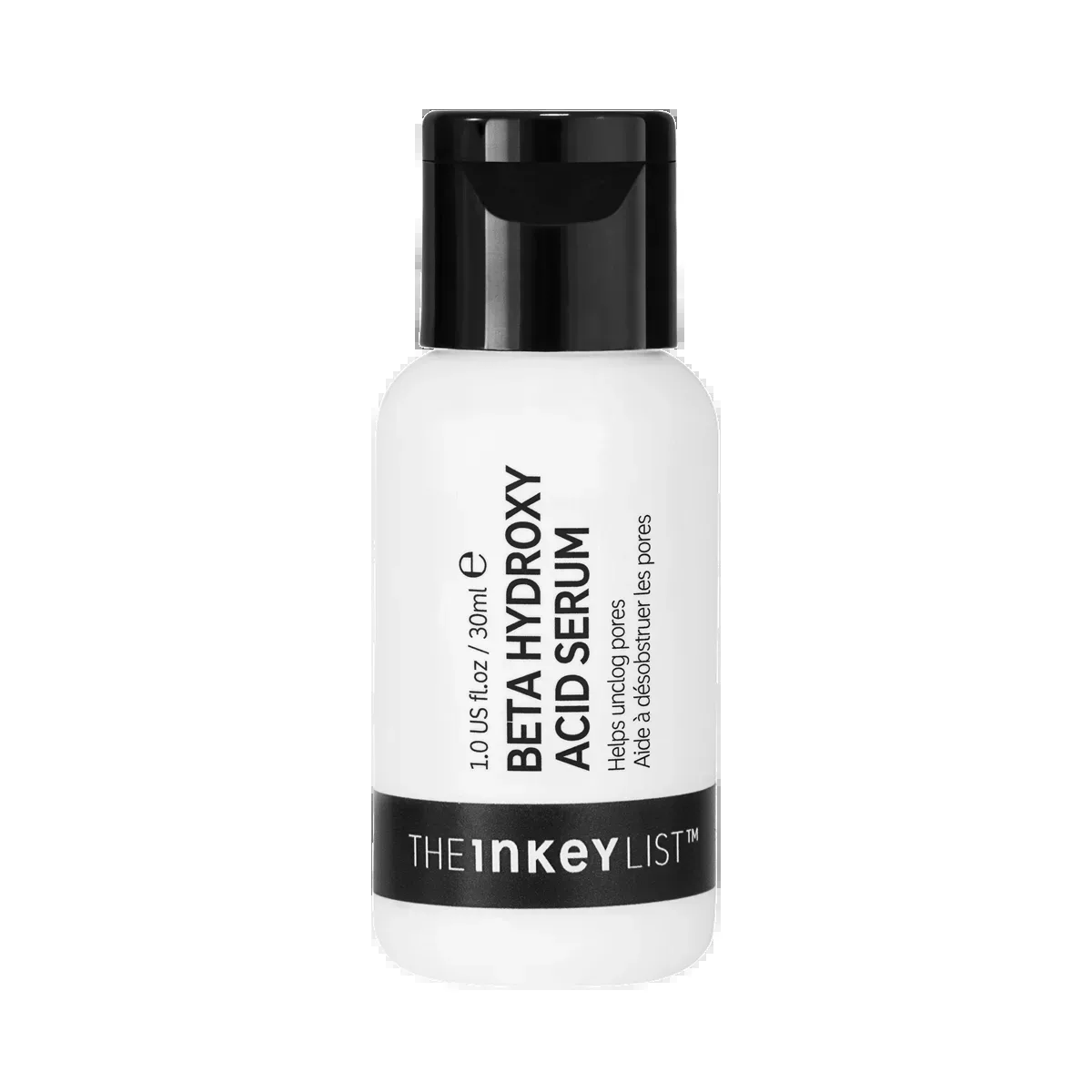
With only 13 ingredients, this is one of the most stripped-back BHA serums available — no fragrance, no alcohol, no silicones, no unnecessary actives competing for attention. The formula focuses entirely on its three-part strategy: 2% salicylic acid to clear pores, zinc PCA to control oil, and 1% hyaluronic acid to maintain hydration. That functional minimalism at $11 is genuinely hard to beat.
Thirteen ingredients, $11, and one of the cleanest BHA formulations on the market. The INKEY List strips away everything unnecessary and delivers exactly what acne-prone and oily skin needs — no more, no less.
Strong choicefor AcneIn your profileYou chose · Salicylic Acid is an approved or monograph active for acne; this serum carries it at 2%.Moderate evidenceGentleNo reviews collected yet
The case for it
Salicylic Acid is a first-line active — approved, monograph-listed or named in current guidelines — for this concern.
It is present at an effective concentration, declared or high in the ingredient list.
The formula carries none of the triggers this concern is sensitive to.
Same rule for everyone. “Strong choice” is the verdict on 1,459 of 45,024 concern verdicts across the catalog; rule R2 decided 892 of them.
Unchanged since September 5, 2026, engine 5.1.1.
R2 — A regulator- or guideline-recognised first-line active, declared at an effective strength, in a form the claim supports. · the full register
Carrying active
Salicylic Acid
Standing
first line — a regulator recognises it for this use; trials support it · per § 333.310 Acne active ingredients. (U.S. Food and Drug Administration — 21 CFR Part 333 Subpart D (Topical Acne Drug Products), Code of Federal Regulations via GovInfo), opened July 27, 2026
Form
adequate (declared 2%) — studied range 0.5–2%, from the OTC monograph or label; judge it after ~6 weeks
Tolerability
gentle
Row checked
against its sources on July 27, 2026 (evidence table ev-2026.09-r228)
Strong choicefor BlackheadsIn your profileYou chose · Salicylic Acid is an approved or monograph active for blackheads; this serum carries it at 2%.Moderate evidenceGentleNo reviews collected yet
The case for it
Salicylic Acid is a first-line active — approved, monograph-listed or named in current guidelines — for this concern.
It is present at an effective concentration, declared or high in the ingredient list.
The formula carries none of the triggers this concern is sensitive to.
Same rule for everyone. “Strong choice” is the verdict on 1,459 of 45,024 concern verdicts across the catalog; rule R2 decided 892 of them.
Unchanged since September 5, 2026, engine 5.1.1.
R2 — A regulator- or guideline-recognised first-line active, declared at an effective strength, in a form the claim supports. · the full register
Carrying active
Salicylic Acid
Standing
first line — a regulator recognises it for this use; trials support it · per 21 CFR § 333.350 - Labeling of acne drug products. (US Code of Federal Regulations (Legal Information Institute, Cornell Law School)), opened July 27, 2026
Form
adequate (declared 2%) — studied range 0.5–2%, from the OTC monograph or label; judge it after ~6 weeks
Tolerability
gentle
Row checked
against its sources on July 27, 2026 (evidence table ev-2026.09-r228)
The studies behind the evidence row
OTC monograph, Topical Acne Drug Products — salicylic acid 0.5–2% recognized as an acne treatment active — US Food and Drug Administration
Not for thisfor Large PoresIn your profileYou chose · The actives here have been researched for large pores and the evidence does not support the claim.Not yet assessedGentleNo reviews collected yet
The case for it
Salicylic Acid has been researched for this concern and the evidence does not support it.
It is present at an effective concentration, declared or high in the ingredient list.
The formula carries none of the triggers this concern is sensitive to.
Same rule for everyone. “Not for this” is the verdict on 488 of 45,024 concern verdicts across the catalog; rule R10 decided 488 of them.
Unchanged since September 5, 2026, engine 5.1.1.
Promisingfor Excess OilinessIn your profileYou chose · Zinc has trial-level evidence for excess oiliness but no guideline or regulatory standing yet — promising, short of a recommendation; the other actives here are not yet assessed for it.Moderate evidenceGentleNo reviews collected yet
The case for it
Zinc PCA has trial-level evidence for this concern but no guideline or regulatory standing yet.
It is plausibly present at a working level, though the concentration is not declared.
The formula carries none of the triggers this concern is sensitive to.
What would change this: A declared concentration would move this to a firmer reading of the dose.
Same rule for everyone. “Promising” is the verdict on 7,858 of 45,024 concern verdicts across the catalog; rule R9p decided 7,858 of them.
Unchanged since September 5, 2026, engine 5.1.1.
R9p — 0.5.0: 'Unproven' beside three filled dots read as one question answered twice with opposite words (7,018 rows). The chip measures standing, the dots measure trial volume; where the row carries at least one RCT or a tier-2 source (moderate dots) and the active is present at a working level, the honest word is Promising. Unproven is reserved for plausible-standing rows with limited or weak evidence, or an under-dosed form. Same rank as Unproven — a bet either way; the dots order them. · the full register
Carrying active
Zinc PCA
Standing
plausible — trials support it
Form
plausible — studied range 1%, from the OTC monograph or label; needs leave-on contact
Tolerability
gentle
Row checked
against its sources on July 17, 2026 (evidence table ev-2026.09-r228)
Good choicefor Rough TextureIn your profileYou chose · Salicylic Acid is a reference standard by mechanism for rough texture; this serum carries it at 2%.Moderate evidenceGentleNo reviews collected yet
The case for it
Salicylic Acid has trial-supported standing for this concern.
It is present at an effective concentration, declared or high in the ingredient list.
The formula carries none of the triggers this concern is sensitive to.
Same rule for everyone. “Good choice” is the verdict on 9,564 of 45,024 concern verdicts across the catalog; rule R5 decided 9,072 of them.
Unchanged since September 5, 2026, engine 5.1.1.
A verdict is DermApproved’s assessment of how well a product’s ingredients fit a concern — never a claim about what the product treats. Evidence dots and collected reviews sit beside it and are never blended in.
Rules 0.5.1 · evidence table ev-2026.09-r228 · how we decide
Assessment
Pros & Cons
Pros
✓ 2% salicylic acid at optimal BHA concentration for pore clearing and breakout prevention
✓ Just 13 ingredients — one of the cleanest BHA formulas available
✓ Zinc PCA adds oil regulation that complements the BHA's pore-clearing action
✓ 1% hyaluronic acid prevents the dryness typical of BHA-only products
✓ Exceptional value at $11 for a well-formulated treatment serum
✗ Can cause dryness and peeling if overused or used on already-dry skin
✗ Not effective for severe or cystic acne — designed for mild to moderate concerns
✗ Squeeze tube packaging can dispense inconsistent amounts
✗ Initial purging period may last 1-2 weeks before improvement
✗ Not pregnancy-safe due to salicylic acid content
Review
Full Review
Open the ingredient list of most acne serums and you'll find 30-40 ingredients, half of them there for texture, preservation, or marketing appeal. Open The INKEY List's Beta Hydroxy Acid Serum and you'll count thirteen. Thirteen ingredients to do exactly one thing: unclog pores and keep them that way. It's the skincare equivalent of a direct flight — no layovers, no frills, just efficient arrival at the destination.
The active ingredient is 2% salicylic acid, the maximum concentration allowed in over-the-counter products and the gold standard for treating blackheads, breakouts, and pore congestion. Salicylic acid is oil-soluble, which is the specific reason it outperforms AHAs for acne: while glycolic and lactic acid exfoliate the skin's surface, salicylic acid actually penetrates into the pore lining, dissolving the sebum-and-dead-cell mixture that forms blackheads and inflamed breakouts from the inside out.
What elevates this serum beyond "basic BHA" is the supporting ingredient selection. Zinc PCA provides sebum regulation — it doesn't just clear existing oil, it helps reduce future overproduction. This dual action means you're addressing both the symptom (clogged pores) and a root cause (excess sebum) simultaneously. Sodium hyaluronate at 1% ensures the exfoliation doesn't leave skin feeling stripped or dry, a common complaint with BHA products that forget skin still needs moisture even when it's oily. Betaine adds an osmolyte's cushioning humectancy, and Biosaccharide Gum-1 and maltodextrin bring a prebiotic, moisture-binding component that helps maintain the skin's microbiome while the salicylic acid does its work.
The texture is practically invisible — a thin, watery serum that absorbs in seconds and leaves no residue, film, or tackiness. There's zero scent. No tingling, no burning, no dramatic sensations. This lack of theater actually surprises some users, who expect to feel something happening. But that expectation is a myth worth retiring: salicylic acid's mechanism is slow and methodical, working over hours and days inside pores rather than in dramatic seconds on the surface, so the absence of a sting is a sign of a gentle, well-built vehicle, not weak actives.
Results follow a predictable pattern for most users. The first week or two may bring mild purging — small breakouts surfacing as the salicylic acid brings existing comedones to the surface faster than they would have emerged on their own. This is a normal and well-documented response to BHA use that resolves on its own. By weeks three to four, blackheads start to visibly diminish. Pores appear smaller because they're no longer stretched by impacted sebum. Oil production may feel more balanced. By six to eight weeks, the frequency and severity of new breakouts typically decrease as the ongoing exfoliation prevents new congestion from building up. The roughly 2,500 reviewers, averaging 4.3 stars, largely report exactly this arc — clearer skin and fewer blackheads within weeks — with the main complaints being dryness from overuse and the imprecise squeeze tube.
The limitations are mostly inherent to salicylic acid rather than this specific formula. BHA is drying — even with the sodium hyaluronate buffer, oily skin types will handle this better than dry skin types. Sensitive, eczema-prone, or rosacea-affected skin should avoid this entirely. The 2% concentration, while standard, is still a chemical exfoliant that requires sunscreen use and careful integration with other actives. This serum should not be used simultaneously with retinol, other BHAs or AHAs, or high-concentration vitamin C — alternate nights with these products instead. And because of the salicylic acid, it's not a pregnancy-safe pick. Notably, it is fungal-acne safe, which sets it apart from many acne products.
At $11 for 30ml, the value proposition borders on absurd — and it directly refutes the assumption that cheap skincare can't match expensive skincare. The 2% salicylic acid here is chemically identical to the salicylic acid in serums costing five to ten times more; the supporting ingredients — zinc PCA, hyaluronic acid, biosaccharide gum — are not cheap fillers. The INKEY List achieves this pricing through brutally efficient packaging (a plain white tube), minimal marketing spend, and the deliberate choice to keep the formula short and focused, not by compromising the active. A tube lasts two to three months of nightly full-face use.
The packaging is functional and unpretentious. The squeeze tube dispenses product easily, though a controlled pump would be preferable for consistency. The minimalist design is on-brand for The INKEY List, which has made plainness a virtue in a market obsessed with aesthetics.
For what it sets out to do — deliver salicylic acid effectively, affordably, and without unnecessary complications — this serum is nearly flawless. It won't solve severe cystic acne, it won't replace a dermatologist's treatment plan for persistent breakouts, and it won't hydrate dry skin. But for the millions of people dealing with blackheads, occasional breakouts, and oily-skin texture issues, this $11 tube is a remarkably smart formulation that respects both your skin and your budget. In a category where the loudest marketing usually attaches to the emptiest formulas, there is something quietly radical about a serum that refuses to oversell itself — no glow claims, no exotic botanicals, no price tag pretending the salicylic acid inside is somehow rarer than it is. It does one job, does it well, and trusts you to notice. For a first BHA, or a permanent one, that is exactly the right kind of boring.
Formula
Key Ingredients
The hero actives that drive this product's performance.
At the FDA-maximum over-the-counter concentration of 2%, salicylic acid is oil-soluble, allowing it to penetrate into pores and dissolve the sebum and dead cell buildup that causes blackheads and breakouts. In this minimal formula, it works without competing actives — supported only by hydration and oil-control ingredients that complement rather than complicate its job.
Established mechanismfor Rough Texture · established mechanism
At 1%, this low-molecular-weight hyaluronic acid derivative offsets the drying effects that salicylic acid can cause, maintaining skin hydration and comfort while the BHA exfoliates. This pairing is what makes this serum more tolerable for daily use than many BHA treatments.
A sebum-regulating form of zinc that works synergistically with the salicylic acid — while the BHA clears existing pore congestion, zinc PCA helps control the excess oil production that leads to future breakouts.
Limitedfor Acne
Ingredient standings describe the active at treatment-level doses and
vehicles; this product's own condition grades weigh its actual formula.
Apply a thin layer to clean, dry skin. Can be used morning or evening, but PM is preferred for beginners. Follow with a lightweight moisturizer. Introduce gradually — start with every other day and build to daily use as tolerated.
Results Timeline
Reduced oiliness and smoother texture within 1-2 weeks. Visible reduction in blackheads and pore congestion by 3-4 weeks. Continued improvement in breakout frequency over 6-8 weeks of consistent use.
Salicylic acid (2-hydroxybenzoic acid) is one of the most extensively studied topical acne treatments. Its lipophilic nature allows it to penetrate the pilosebaceous unit — the pore and its associated oil gland — where it dissolves the intracellular lipid cement binding corneocytes together. A systematic review published in Clinical, Cosmetic and Investigational Dermatology confirmed that 2% salicylic acid significantly reduces both non-inflammatory (blackheads, whiteheads) and inflammatory acne lesions, with efficacy comparable to benzoyl peroxide for mild to moderate acne but with a more favorable tolerability profile (Arif, 2015).
The addition of Zinc PCA is evidence-informed. Zinc has well-documented sebostatic (oil-reducing) and anti-inflammatory properties. A paper published in Dermatologic Therapy demonstrated that topical zinc compounds reduced sebum production and inflammatory lesion count in acne patients (Gupta et al., Dermatologic Therapy, 2014). The PCA (pyrrolidone carboxylic acid) form enhances zinc's delivery into the skin while also functioning as a natural moisturizing factor component.
Sodium hyaluronate at 1% addresses the key tolerability challenge of BHA products. By maintaining stratum corneum hydration during chemical exfoliation, hyaluronic acid prevents the compensatory sebum overproduction that can occur when the skin barrier is stripped by exfoliants — a cycle that paradoxically worsens oiliness. The combination of BHA for exfoliation plus HA for hydration is an increasingly validated approach in modern acne management.
Dermatologists widely recommend 2% salicylic acid as a first-line over-the-counter treatment for mild to moderate acne, blackheads, and pore congestion. Working dermatologists would view this formula favorably for its clean ingredient list, appropriate BHA concentration, and the intelligent inclusion of zinc PCA for oil regulation. The absence of fragrance and alcohol aligns with dermatological recommendations for acne-prone skin, which is often simultaneously sensitive. Dermatologists would note that while this serum is effective for comedonal acne and oily skin maintenance, patients with moderate to severe inflammatory acne would benefit from prescription-strength treatments alongside or instead of this product.
Guidance
Usage & Recommendations
How to Use
Apply a thin layer to clean, dry skin in the evening. Dispense a pea-sized amount and spread evenly across the face, avoiding the eye area. Allow 1-2 minutes to absorb before applying moisturizer. Start with every other evening for the first two weeks, then increase to nightly as tolerated. Always use SPF 30+ the following morning. Can be used in the morning as well for oilier skin types, but start with PM only.
Value Assessment
At $11 for 30ml, this is one of the best value BHA serums on the market. The 2% salicylic acid concentration is identical to what you'd find in products costing three to five times more, and the supporting ingredients — zinc PCA, 1% sodium hyaluronate, biosaccharide gum — add genuine functional value rather than filler. The only cost-saving measure visible in the product is the packaging, which is plain but perfectly functional. For anyone building an affordable acne-management routine, this serum should be one of the first purchases.
Who Should Buy
Oily and combination skin types dealing with blackheads, enlarged pores, mild to moderate breakouts, or general skin congestion. Budget-conscious consumers who want clinical-grade BHA performance without luxury pricing. Anyone building a simple, effective acne-management routine.
Who Should Skip
Dry skin types, those with eczema, rosacea, or severely compromised barriers. Pregnant or nursing individuals should avoid salicylic acid in leave-on products. Those with severe cystic acne need prescription treatments rather than OTC BHA alone.
Ready to try The INKEY List Beta Hydroxy Acid Serum?
Lightweight, watery serum with a barely-there viscosity — thin enough to spread easily but not so runny that it drips
Scent
None — completely unscented, no detectable fragrance or ingredient smell
Packaging
Simple white squeeze tube with minimal branding, consistent with The INKEY List's no-frills aesthetic
Finish
lightweightfast-absorbingmatte
What to Expect on First Use
First application feels like water — no tingling, burning, or immediate sensation for most users. Those new to BHA may experience mild purging (small breakouts surfacing) in the first 1-2 weeks as the salicylic acid brings existing congestion to the surface. This is temporary and resolves with continued use.
The INKEY List built its brand on the premise that effective skincare shouldn't require a luxury budget or a chemistry degree. The BHA Serum embodies this philosophy — it takes one of dermatology's most proven acne-fighting ingredients, puts it at the optimal concentration, adds smart supporting ingredients, and prices it at a point where replacing it is a non-decision.
About The INKEY List Established Brand (5–20 years)
The INKEY List launched in 2018 with a mission to make effective skincare accessible through transparent ingredient lists and budget-friendly pricing. The brand has rapidly gained credibility at Sephora and among ingredient-focused consumers, though its track record is still relatively short compared to established clinical brands.
Brand founded: 2018 · Product launched: 2020
Myth vs. Reality
Common Myths
Myth
You need to feel tingling for a BHA to be working
Reality
Salicylic acid works by dissolving sebum and dead cells inside pores — a process that happens below the skin's surface and doesn't require a burning sensation. The absence of tingling in this formula is a feature of the gentle vehicle, not a sign of inefficacy.
Myth
Cheap skincare products can't be as effective as expensive ones
Reality
The 2% salicylic acid in this $11 serum is chemically identical to the salicylic acid in serums costing five to ten times more. The INKEY List achieves its pricing through minimal packaging and marketing spend, not by compromising the active ingredient.
FAQ
Frequently Asked Questions
How often should I use The INKEY List BHA Serum?
Start with every other evening, applying to clean dry skin before moisturizer. After two weeks, if your skin tolerates it well without excessive dryness, you can increase to nightly use. Some people also use it in the morning, but always follow with SPF as BHA increases sun sensitivity.
Can The INKEY List BHA Serum cause purging?
Yes — in the first 1-2 weeks, salicylic acid can bring existing pore congestion to the surface, causing small breakouts that may look worse before they look better. This is a normal purging response, not an allergic reaction. If irritation persists beyond 4 weeks or includes redness and swelling, discontinue use.
Is The INKEY List BHA Serum good for blackheads?
This is one of its primary strengths. Salicylic acid is oil-soluble, meaning it can penetrate into pores to dissolve the sebum plugs that form blackheads. At 2%, this serum delivers the optimal concentration for dissolving pore congestion without excessive irritation. Most users see noticeable blackhead reduction within 3-4 weeks.
Can I use The INKEY List BHA with niacinamide?
Yes — niacinamide and salicylic acid complement each other well. Apply the BHA serum first on clean skin, wait a minute for absorption, then layer a niacinamide serum on top. Niacinamide helps regulate oil production and calm inflammation, supporting the BHA's pore-clearing work.
Is The INKEY List BHA safe during pregnancy?
Salicylic acid (a beta hydroxy acid) is generally advised against during pregnancy, particularly in leave-on products at 2% concentration. Consult your healthcare provider before using this serum if you are pregnant or nursing.
Can I use The INKEY List BHA with retinol?
It's best to alternate evenings rather than using both in the same routine. Both salicylic acid and retinol can cause dryness and irritation, and layering them increases the risk of over-exfoliation. Use the BHA on some nights and retinol on others, with moisturizer after each.
Reviews
What Reviewers Tend to Say
Recurring themes our editors read across retailer reviews of this product — summaries in our words, not quotations, and not a substitute for your own patch test.
Common Praise
Excellent value for a well-formulated BHA serum
Noticeably clearer skin and fewer blackheads within weeks
Lightweight texture absorbs quickly without residue
Clean formula with no unnecessary fillers
Common Complaints
Can cause dryness or peeling if overused
May not be strong enough for severe cystic acne
No pump dispenser — squeeze tube can dispense too much
The whole case for salicylic acid rests on one unglamorous fact of chemistry: it dissolves in oil. Understand that, and you know exactly when it beats a glycolic acid — and when it's overkill.
The internet's favorite hydrator has a counterintuitive dark side — in dry air, a humectant with nothing to seal it can pull water out of your skin instead of into it.
Those tiny dots on your nose are almost certainly not blackheads — they're normal, functional plumbing you will never 'clear,' and the extraction obsession is quietly wrecking the skin around them.
Jun 6, 2026· 6 min
Questions people ask about Acne
Verified answers from our questions library — the nuance a product page cannot carry.
Products, answers, therapy guides, tools and articles in one search. Brand names,
slang and abbreviations all work — accutane finds isotretinoin, bacne finds truncal acne.