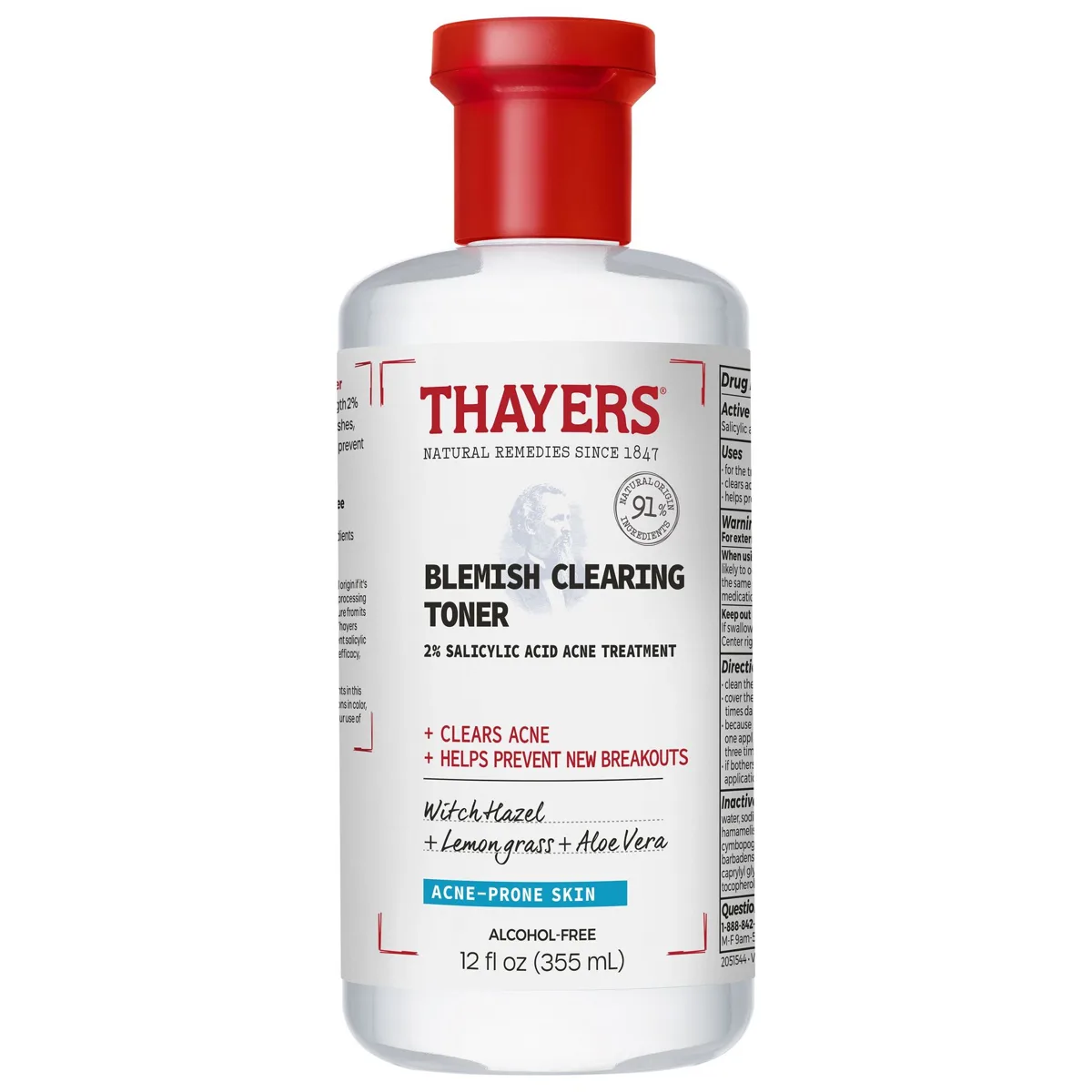
Most two percent salicylic acid toners buy their efficacy with alcohol and pay for it in dryness. This one is alcohol-free and puts sodium hyaluronate, glycerin and aloe near the top of the list, so a full-strength OTC acne active arrives in a toner that leaves skin comfortable, at a price and in a bottle size no mid-range BHA matches. The lemongrass oil is the one choice a formulator focused purely on acne-prone skin would not have made.
A real acne treatment in a Thayers bottle: two percent salicylic acid, the OTC maximum, delivered alcohol-free with hyaluronate, glycerin and aloe so it clears pores without stripping, for fifteen dollars and twelve ounces. Oily, congested skin gets one of the best-value BHA toners on any shelf. The lemongrass oil, with four declared allergens behind a 'fragrance-free' label, is the flaw, and reactive acne-prone skin should weigh it.
Strong choicefor AcneIn your profileYou chose · Salicylic Acid is an approved or monograph active for acne; this liquid carries it at 2%.Moderate evidenceStandard tolerabilityNo reviews collected yet
The case for it
Salicylic Acid 2% is a first-line active — approved, monograph-listed or named in current guidelines — for this concern.
It is present at an effective concentration, declared or high in the ingredient list.
The formula carries no trigger this concern is sensitive to, with the cautions noted.
Cautions: fragrance; known irritants.
Same rule for everyone. “Strong choice” is the verdict on 1,459 of 45,024 concern verdicts across the catalog; rule R2 decided 892 of them.
As of September 25, 2026, engine 5.1.1.
R2 — A regulator- or guideline-recognised first-line active, declared at an effective strength, in a form the claim supports. · the full register
Carrying active
Salicylic Acid 2%
Standing
first line — a regulator recognises it for this use; trials support it · per § 333.310 Acne active ingredients. (U.S. Food and Drug Administration — 21 CFR Part 333 Subpart D (Topical Acne Drug Products), Code of Federal Regulations via GovInfo), opened July 27, 2026
Form
adequate (declared 2%) — studied range 0.5–2%, from the OTC monograph or label; judge it after ~6 weeks
Tolerability
standard — fragrance load, irritant load
Row checked
against its sources on July 27, 2026 (evidence table ev-2026.09-r228)
Strong choicefor BlackheadsIn your profileYou chose · Salicylic Acid is an approved or monograph active for blackheads; this liquid carries it at 2%.Moderate evidenceStandard tolerabilityNo reviews collected yet
The case for it
Salicylic Acid 2% is a first-line active — approved, monograph-listed or named in current guidelines — for this concern.
It is present at an effective concentration, declared or high in the ingredient list.
The formula carries no trigger this concern is sensitive to, with the cautions noted.
Same rule for everyone. “Strong choice” is the verdict on 1,459 of 45,024 concern verdicts across the catalog; rule R2 decided 892 of them.
As of September 25, 2026, engine 5.1.1.
R2 — A regulator- or guideline-recognised first-line active, declared at an effective strength, in a form the claim supports. · the full register
Carrying active
Salicylic Acid 2%
Standing
first line — a regulator recognises it for this use; trials support it · per 21 CFR § 333.350 - Labeling of acne drug products. (US Code of Federal Regulations (Legal Information Institute, Cornell Law School)), opened July 27, 2026
Form
adequate (declared 2%) — studied range 0.5–2%, from the OTC monograph or label; judge it after ~6 weeks
Tolerability
standard
Row checked
against its sources on July 27, 2026 (evidence table ev-2026.09-r228)
The studies behind the evidence row
OTC monograph, Topical Acne Drug Products — salicylic acid 0.5–2% recognized as an acne treatment active — US Food and Drug Administration
Unprovenfor Excess OilinessIn your profileYou chose · Salicylic Acid has early or mechanistic evidence for excess oiliness — a reasonable bet, not a recommendation; the other actives here are not yet assessed for it.Moderate evidenceStandard tolerabilityNo reviews collected yet
The case for it
Salicylic Acid 2% has early or mechanistic evidence for this concern, not trial-backed standing.
It is present below the studied range.
The formula carries no trigger this concern is sensitive to, with the cautions noted.
What would change this: A concentration inside the studied range would raise this a step.
Same rule for everyone. “Unproven” is the verdict on 1,111 of 45,024 concern verdicts across the catalog; rule R9 decided 1,111 of them.
As of September 25, 2026, engine 5.1.1.
R9 — Plausible-tier actives alone do not earn a recommendation, and 'not for this' would overstate the case against them. 'Unproven' with the evidence dots lets the reader judge the bet (added 0.2.0 after the first shadow run put a 10% niacinamide serum at 'not for this' for hyperpigmentation). 0.5.0: the closing clause reads the other heroes — "nothing else here addresses it" only when every other active has a researched 'none' row; "not yet assessed" when that is the truth. Rows whose dots read moderate or better now reach R9p first. · the full register
Carrying active
Salicylic Acid 2%
Standing
plausible — trials support it
Form
sub threshold (declared 2%) — studied range 30%, from the trials on the row; needs leave-on contact; judge it after ~6 weeks
Tolerability
standard
Row checked
against its sources on July 17, 2026 (evidence table ev-2026.09-r228)
Not for thisfor Large PoresIn your profileYou chose · The actives here have been researched for large pores and the evidence does not support the claim.Not yet assessedStandard tolerabilityNo reviews collected yet
The case for it
Salicylic Acid 2% has been researched for this concern and the evidence does not support it.
It is present at an effective concentration, declared or high in the ingredient list.
The formula carries no trigger this concern is sensitive to, with the cautions noted.
Same rule for everyone. “Not for this” is the verdict on 488 of 45,024 concern verdicts across the catalog; rule R10 decided 488 of them.
As of September 25, 2026, engine 5.1.1.
A verdict is DermApproved’s assessment of how well a product’s ingredients fit a concern — never a claim about what the product treats. Evidence dots and collected reviews sit beside it and are never blended in.
Rules 0.5.1 · evidence table ev-2026.09-r228 · how we decide
Assessment
Pros & Cons
Pros
✓ Two percent salicylic acid, the OTC maximum, as a registered acne active
✓ Alcohol-free, so it treats without the tightness of typical BHA toners
✓ Sodium hyaluronate, glycerin and aloe placed high keep skin comfortable
✓ Clears blackheads and small breakouts within one to two weeks in practice
✓ Twelve ounces for fifteen dollars, lasting about four months
✓ Six years on shelves and around four thousand ratings behind it
✓ Matching pad format for travel
Cons
✗ Lemongrass oil with four declared allergens undercuts the fragrance-free label
✗ Stings on open blemishes and can redden reactive skin
✗ Cannot treat deep or cystic acne, like any BHA toner
✗ Single 12 oz size with a free-pouring spout
✗ Reformulation from tea tree means older reviews describe a different bottle
✗ Requires daily sunscreen and careful pairing with retinoids
Review
Full Review
Turn the bottle around and there is something none of the other Thayers toners carry: a Drug Facts panel. Active ingredient, salicylic acid, two percent. Everything else the brand sells is a cosmetic, a botanical water that tightens or hydrates or smells nice and makes no claim it could be held to. This one is registered as an over-the-counter acne drug, at the maximum strength the FDA monograph allows, and that single line changes what a review has to ask. Not whether it is pleasant, though it mostly is, but whether it works, and for whom, and what it costs the skin to use it.
The answer to the first question is straightforward, because two percent salicylic acid is one of the best-documented acne actives available without a prescription. It is oil-soluble, so it travels down into the pore lining where water-based exfoliants can't, and it loosens the plugs of sebum and dead cells that become blackheads and whiteheads. Used consistently, it clears existing congestion over one to two weeks and reduces new blemishes over a month, which is exactly what Thayers' one-week and four-week panels claim and what the roughly four thousand ratings across Amazon and Ulta, at 4.5 to 4.6, describe. It does not reach deep, cystic acne, and no BHA toner does; that is a different class of problem.
The answer to the second question is where the formula earns its reputation. Most two percent salicylic toners get their acid into solution with alcohol and pay for it in tightness and flaking, which is why so many acne-prone people abandon them. Thayers goes the other way. There is no alcohol at all, and sodium hyaluronate, glycerin and aloe juice sit in the top ten, higher than in most acne products, holding water on the surface while the acid works underneath. The brand's non-distilled witch hazel is here too, adding its mild tannin astringency. The upshot is a treatment-strength BHA that feels like a toner: a brief tingle, a clean surface, no drum-tight cheeks an hour later. That comfort is why people stay on it, and staying on it is what makes salicylic acid work.
Then the third question, and the flaw. The label says fragrance-free, and in the narrow regulatory sense it is true: there is no added parfum. But the ninth ingredient is lemongrass essential oil, and beneath it the list declares citral, farnesol, limonene and geraniol, four of the fragrance allergens EU rules require by name. The toner smells sharply and pleasantly of lemongrass, and many reviewers like that; it also stings on open blemishes and, for a meaningful minority of reactive faces, brings the redness that a fragranced product would. Thayers pitches the oil as botanical antibacterial support, and lemongrass does have activity against acne bacteria in the laboratory, but there is no leave-on clinical evidence for it, and on a product aimed at acne-prone skin, which is disproportionately reactive skin, it is an unforced error. The earlier version of this toner used tea tree oil instead, which had the same problem in a different scent, so the reformulation improved the humectants without fixing the essential-oil habit.
In use, the routine is the OTC label's. Once daily to start, in the evening, swept over cleansed skin on a cotton pad and followed by moisturizer; twice daily only if the skin stays comfortable, which in practice means very oily skin only. It should alternate nights with a retinoid rather than share them, stay off nights with the brand's AHA toner, and sit under a sunscreen every morning. Skin new to salicylic acid often pushes a crop of small breakouts to the surface in the first fortnight as congestion clears; that settles. A sting that outlasts the first minute, or redness that builds over days, is the lemongrass, and it means this is the wrong BHA for that face. Dry, sensitive, rosacea-prone and eczema-prone skin should not start.
The twelve-ounce bottle, the only size, lasts about four months of nightly full-face use and far longer as a T-zone treatment, and at fifteen dollars it makes the mid-range BHA toners it competes with look expensive. A 60-pad version of the same formula costs more per use but travels better. Thayers' 178-year history is decorative here; what matters is the OTC registration, the six years this product has been on shelves, and the review record, all of which are solid.
So: for oily and combination skin with blackheads and small breakouts, that has found other salicylic toners too drying, this is one of the best-value acne treatments in a drugstore, and its comfort is the reason it works in the long run. For reactive acne-prone skin, the lemongrass oil is a genuine risk that the 'fragrance-free' claim disguises, and an unscented two percent BHA is the safer buy. And for anyone with deep or cystic acne, a toner of any kind is the wrong shelf; benzoyl peroxide, a retinoid or a dermatologist is the next step.
Formula
Key Ingredients
The hero actives that drive this product's performance.
The monograph-maximum acne dose, declared as the drug active, in a water-based toner rather than a pad or gel; it is oil-soluble enough to work down into the pore lining and loosen the plugs that become blackheads and whiteheads, and at two percent it is a genuine treatment strength, which is what separates this bottle from every other Thayers toner.
The brand's tannin-rich maceration, placed after the lemongrass oil and doing what it does across the line: a mild astringent tightening and a little anti-inflammatory support that suits the oily, congested skin the salicylic acid is treating.
The 'non-stripping' half of the promise: a humectant trio placed unusually high for an acne toner, holding water on the surface so that a daily two percent BHA leaves skin clearer rather than tight and flaky, which is the reason people stick with this one when they abandon harsher acne toners.
The scent and the brand's 'botanical antibacterial' claim, an essential oil with in-vitro activity against acne bacteria but no leave-on clinical data, and the source of the citral, geraniol, farnesol and limonene declared beneath it; it is the formula's main irritation risk on a product the label calls fragrance-free.
Not yet assessed
Ingredient standings describe the active at treatment-level doses and
vehicles; this product's own condition grades weigh its actual formula.
One cotton-pad pass over cleansed skin per day to start, in the evening, then moisturize; build to twice daily only if the skin stays comfortable. Alternate nights with a retinoid rather than stacking, keep it off nights with an AHA, and wear sunscreen every morning.
Results Timeline
Surface oil and the feel of congestion ease within days. Existing blackheads and small whiteheads start to clear over one to two weeks, which is the point of the brand's one-week claim, and fewer new blemishes appear by four weeks with consistent use; deeper cystic acne is beyond what a two percent BHA toner can do.
Salicylic acid at two percent is the FDA acne monograph's upper limit for over-the-counter products and has a substantial evidence base: as a lipophilic beta hydroxy acid it penetrates the sebum-filled follicle, where it loosens corneocyte cohesion in the follicular lining and reduces the microcomedones that precede visible acne, with controlled studies showing reductions in non-inflammatory and mild inflammatory lesions over four to twelve weeks of twice-daily use. It also has mild anti-inflammatory activity through the same pathway as aspirin, its chemical relative. Efficacy is pH-dependent; the formula is buffered with citric acid and sodium hydroxide and the pH is undisclosed. The brand's one-week clarity and four-week blemish panels are manufacturer-run but consistent with the published timeline for two percent salicylic acid.
The tolerability design is the more distinctive part. Conventional salicylic toners rely on alcohol as a solvent, which adds barrier disruption; this formula uses a mild surfactant pair, decyl glucoside and cocamidopropyl betaine, to keep the acid in solution without ethanol, and places sodium hyaluronate, glycerin and aloe juice high enough to offset the drying effect of daily keratolysis, all three being well documented humectants. Non-distilled witch hazel contributes tannins with modest anti-inflammatory and astringent evidence.
Lemongrass oil (Cymbopogon flexuosus) has in-vitro activity against Cutibacterium acnes, largely attributable to citral, but no clinical evidence for acne in leave-on use at cosmetic concentrations. Its listed components, citral, geraniol, farnesol and limonene, are all declared fragrance allergens under EU cosmetic regulation, with limonene forming sensitising hydroperoxides on oxidation; the combination represents a meaningful sensitisation risk for a product marketed to acne-prone skin, which is more often barrier-compromised. Salicylic acid raises photosensitivity modestly and is a drug active; topical two percent use in pregnancy is generally regarded as low risk but is a matter for individual medical advice. The formula is oil-free and contains no fatty esters, making it compatible with Malassezia-prone skin apart from the essential oil.
Dermatologist Perspective
Two percent salicylic acid is a standard first-line over-the-counter recommendation for comedonal and mild inflammatory acne, and dermatologists generally regard an alcohol-free, humectant-buffered vehicle as an advantage because irritation is the main reason patients abandon BHA products before they have had time to work. On those criteria this toner is a sensible choice, and its price and size make adherence easier. The reservation clinicians would raise is the lemongrass oil and its declared allergen components, which are inconsistent with the 'fragrance-free' framing and would be flagged for patients with sensitive or eczema-prone skin; an unscented two percent salicylic product would be the usual alternative for that group. Standard counselling applies: start once daily, add sunscreen, alternate with rather than stack on a retinoid, and expect two to four weeks for visible change. Patients with nodular or cystic acne, or acne that does not improve within eight weeks, would be advised that a salicylic toner is not the right treatment and to escalate to benzoyl peroxide, a retinoid or prescription care.
Guidance
Usage & Recommendations
How to Use
Cleanse in the evening, then wet a cotton pad and sweep a thin layer over the affected areas or the whole face, avoiding the eyes, lips and any broken skin. Let it dry for a minute and follow with a moisturizer. Start with one application a day, as the OTC label directs, and move to twice daily only if the skin stays comfortable after two weeks; very oily skin may manage that, most will not need it. Use it on alternate nights from a retinoid, never on the same night as an AHA, and wear a broad-spectrum sunscreen every morning. Expect a brief tingle; stop if burning or redness persists beyond the first minute or builds over days. Cap the bottle tightly and pour carefully, since the spout runs freely.
Value Assessment
Fifteen dollars for 12 fl oz of a full-strength, alcohol-free two percent BHA toner is cheap by any measure, and at nightly full-face use on a cotton pad the bottle lasts around four months, far longer as a targeted treatment. There's only one size, plus a 60-pad version that costs more per application for the convenience. What the money buys is an OTC-registered acne active in a vehicle comfortable enough to use daily, backed by a long review record and the brand's panels; what it doesn't buy is a fragrance-free formula in the sense reactive skin needs, or any answer to cystic acne. For oily, congested skin that tolerates the lemongrass, it is among the best-value salicylic acid products sold, and the price leaves room to buy a good moisturizer and sunscreen alongside it.
Who Should Buy
Oily and combination skin with blackheads, clogged pores and small breakouts that wants a genuine two percent salicylic acid treatment without the dryness of alcohol-based toners, at a price that makes daily use easy. It suits people who tolerate lemongrass scent and essential oils and who will pair it with moisturizer and sunscreen.
Who Should Skip
The reactive end of acne-prone skin, sensitive, rosacea-prone, eczema-prone or fragrance-allergic, for whom the lemongrass oil and its four declared allergens are a real risk despite the fragrance-free label; an unscented BHA is safer. Anyone with cystic or nodular acne, which needs stronger treatment, and anyone pregnant who hasn't checked salicylic acid with their doctor.
Ready to try Thayers Blemish Clearing 2% BHA Toner?
A clear, water-thin liquid with a faint slip from the glycerin and hyaluronate; it soaks a cotton pad instantly and dries within a minute to a clean, slightly tacky-then-smooth surface.
Scent
A sharp, fresh lemongrass with a lemon-drop edge from the citral; not an added perfume, but unmistakably a scent, and one that lingers a minute or two after application.
Packaging
The standard 12 oz clear Thayers bottle with a red flip-top cap and a small pour opening, single size; a matching 60-count pad format is sold separately. The bottle pours generously, so tip carefully over a cotton pad.
Finish
naturalnon-greasy
What to Expect on First Use
A mild tingle on the first sweep and a faint lemongrass sting on any open blemish, then a clean, un-tight feel. Skin new to salicylic acid may push a crop of small breakouts to the surface in the first two weeks as congestion clears; persistent redness or burning that outlasts the tingle is the lemongrass oil objecting, not the acid working.
How Long It Lasts
About four months at nightly full-face use on a cotton pad, longer as a T-zone or every-other-night treatment.
Thayers launched the Blemish Clearing toner in 2019, the year before L'Oréal bought the company, as its first registered OTC drug product and its first real departure from scented witch hazel waters. The original formula paired the two percent salicylic acid with tea tree oil; the post-acquisition reformulation swapped in lemongrass oil and hyaluronate, added the clinical panel claims and the 'BHA' branding, and a 60-pad version followed for the same audience.
About Thayers Legacy Brand (20+ years)
Thayers has made witch hazel toners in Connecticut since 1847 and is the top-selling US toner brand; its acne toner is an FDA OTC monograph drug carrying a declared two percent salicylic acid, and since L'Oréal's 2020 acquisition the brand backs it with its own one-week and four-week clinical panels. The company's heritage is botanical rather than research-led, and the panels are unpublished.
Brand founded: 1847 · Product launched: 2019
Myth vs. Reality
Common Myths
Myth
It says fragrance-free on the bottle, so there's nothing in it that smells or sensitises.
Reality
There's no added parfum, which is what the claim technically means, but lemongrass essential oil is on the list along with its components citral, geraniol, farnesol and limonene, all declared fragrance allergens. It smells strongly of lemongrass and can irritate reactive skin exactly as a fragrance would.
Myth
A stronger salicylic toner would clear acne faster.
Reality
Two percent is the maximum the FDA acne monograph allows for over-the-counter salicylic acid, so there is no stronger legal OTC toner. Persistent or cystic acne needs a different class of treatment, benzoyl peroxide, a retinoid or a prescription, not more BHA.
FAQ
Frequently Asked Questions
Is the Thayers Blemish Clearing 2% BHA Toner an actual acne treatment?
Yes. It is registered as an over-the-counter acne drug with salicylic acid at two percent, the maximum strength the FDA monograph permits, so it does what a salicylic acid treatment does: clears pore plugs and helps prevent new blackheads and whiteheads. It won't reach deep cystic acne, which needs a different kind of treatment.
Why does the Thayers BHA toner smell of lemongrass if it's fragrance-free?
Because it contains lemongrass essential oil rather than an added perfume, which is how the brand can make the claim. The oil brings citral, geraniol, farnesol and limonene, all of which are declared fragrance allergens, so for practical purposes it behaves like a scented product and reactive skin should treat it as one.
How often should I use the Thayers Blemish Clearing toner?
Thayers suggests starting once daily and increasing to twice if the skin adjusts, which follows the OTC salicylic acid labelling. Most skin does best with once nightly on a cotton pad, followed by moisturizer; twice daily suits very oily skin only, and dryness or flaking means backing off.
Can I use the Thayers BHA toner with retinol or the Thayers AHA toner?
Alternate rather than stack. Salicylic acid and a retinoid on the same night invite irritation, and two exfoliating acids together are unnecessary; use the BHA toner some evenings and the retinoid or AHA on others, and always wear sunscreen in the morning.
Did Thayers change the Blemish Clearing toner formula?
Yes. The original 2019 version used tea tree oil; the current 2% BHA formula uses lemongrass oil instead and adds sodium hyaluronate, along with new clinical claims and the BHA name. Older reviews and some retailer listings still describe the tea tree version.
Is the Thayers BHA toner safe during pregnancy?
Topical salicylic acid at two percent in a rinse-free toner is generally considered low risk by dermatologists, but it is a drug active and opinions differ, so anyone pregnant should check with their own doctor before adding it. The lemongrass oil is the other consideration for sensitised pregnancy skin.
Reviews
What Reviewers Tend to Say
Recurring themes our editors read across retailer reviews of this product — summaries in our words, not quotations, and not a substitute for your own patch test.
Common Praise
Clears blackheads and small breakouts within a couple of weeks
Doesn't dry or tighten like other salicylic toners
Huge bottle for the price
Fresh lemongrass scent
Common Complaints
Lemongrass oil stings and can cause redness
Not strong enough for cystic acne
Reformulation from tea tree changed the smell and feel
'Fragrance-free' claim is misleading given the essential oil
Notable Endorsements
FDA OTC monograph acne drug (salicylic acid 2%)Brand clinical panels at one and four weeks
The fourth most frequent positive patch test in North America is an oxidation product of a molecule that occurs naturally in lavender. Nobody synthesised it into your face cream.
Essential oils are declared by botanical name rather than as fragrance, which is why the most heavily perfumed products in the natural aisle can carry the reassuring word — and why the bottle gets more sensitising the longer you own it.
The whole case for salicylic acid rests on one unglamorous fact of chemistry: it dissolves in oil. Understand that, and you know exactly when it beats a glycolic acid — and when it's overkill.
The supplier specification for standard witch hazel water caps the tannin content — the fraction all the research is about — at a level indistinguishable from none. The tightness you feel is the solvent.
Aug 28, 2026· 9 min
Questions people ask about Acne
Verified answers from our questions library — the nuance a product page cannot carry.
Products, answers, therapy guides, tools and articles in one search. Brand names,
slang and abbreviations all work — accutane finds isotretinoin, bacne finds truncal acne.