The core innovation is the syndet surfactant system — sodium cocoyl isethionate paired with sodium lauroamphoacetate — which removes excess oil with clinical effectiveness while causing minimal barrier disruption. The addition of sunflower seed oil, counterintuitive in an oil-reducing product, reflects the evidence-based understanding that linoleic acid application helps normalize rather than simply strip oily skin.
A quietly excellent cleanser that does exactly what oily and combination skin needs — removes excess sebum thoroughly without triggering the stripped-then-oily cycle that aggressive cleansers perpetuate. It's not exciting, but it's correct, and the generous size makes it one of the best-value daily cleansers in the Paula's Choice lineup.
Supporting rolefor Excess OilinessIn your profileYou chose · Nothing here targets excess oiliness directly; sebum removal without stripping is the recognised companion to treating it, and this cream does that without known triggers.Not yet assessedStandard tolerabilityNo reviews collected yet
The case for it
Sodium Cocoyl Isethionate has no evidence row yet for this concern — it is in the research queue.
The formula carries no trigger this concern is sensitive to, with the cautions noted.
Cautions: fungal-acne triggers.
What would change this: A researched evidence row for the lead active would replace this with a verdict.
Same rule for everyone. “Supporting role” is the verdict on 8,197 of 45,024 concern verdicts across the catalog; rule R8 decided 4,250 of them.
Unchanged since September 5, 2026, engine 5.1.1.
R8 — The category's job (barrier care, humectant hydration, gentle cleansing, photoprotection) is the documented supportive role for this concern. This is the honest verdict for a moisturizer on an acne page. · the full register
Supporting rolefor AcneIn your profileYou chose · Nothing here targets acne directly; gentle cleansing that does not strip is the recognised companion to treating it, and this cream does that without known triggers.Not yet assessedStandard tolerabilityNo reviews collected yet
The case for it
Sodium Cocoyl Isethionate has no evidence row yet for this concern — it is in the research queue.
The formula carries no trigger this concern is sensitive to, with the cautions noted.
Cautions: fungal-acne triggers.
What would change this: A researched evidence row for the lead active would replace this with a verdict.
Same rule for everyone. “Supporting role” is the verdict on 8,197 of 45,024 concern verdicts across the catalog; rule R8 decided 4,250 of them.
Unchanged since September 5, 2026, engine 5.1.1.
R8 — The category's job (barrier care, humectant hydration, gentle cleansing, photoprotection) is the documented supportive role for this concern. This is the honest verdict for a moisturizer on an acne page. · the full register
Also listed for Large Pores — the actives here (Sodium Cocoyl Isethionate (SCI) are in our research queue for that concern; there is no verdict until their evidence rows are written. That is a gap in our table, not a mark against the product.
Does the jobDoes what a cleanser is for: puts something back, surfactant mildness. Not measured from the label: pH match to skin.
A verdict is DermApproved’s assessment of how well a product’s ingredients fit a concern — never a claim about what the product treats. Evidence dots and collected reviews sit beside it and are never blended in.
Rules 0.5.1 · evidence table ev-2026.09-r228 · how we decide
Assessment
Pros & Cons
Pros
✓ Syndet surfactant system removes excess oil without barrier-stripping or rebound oiliness
✓ Cream-to-foam texture provides satisfying lather without the harshness of sulfate foam
✓ Completely fragrance-free with no essential oils or botanical fragrances
✓ Generous 8 oz size with 16 oz economy option makes it one of the best-value PC products
✓ Sulfate-free and silicone-free with Leaping Bunny certification
Cons
✗ Can feel slightly drying on the drier patches of combination skin
✗ No active treatment ingredients — purely a cleansing product with no acne-fighting or anti-aging extras
✗ Light foam may feel insufficient for those accustomed to rich sulfate lathers
✗ May not fully remove heavy waterproof makeup or mineral sunscreen in a single wash
✗ Simple formula feels unremarkable compared to more ingredient-dense PC products
Review
Full Review
The oily skin cleanser market is dominated by products that attack the symptom with the enthusiasm of someone trying to put out a fire with a flamethrower. They foam aggressively, they strip enthusiastically, and they leave your face feeling like a freshly squeegeed window — temporarily matte, deeply dehydrated, and primed to produce even more oil by lunchtime. The Paula's Choice Skin Balancing Oil-Reducing Cleanser opts for diplomacy over warfare, an approach that traces directly to founder Paula Begoun's evidence-first philosophy.
The surfactant architecture tells the whole story. Sodium cocoyl isethionate — a coconut-derived syndet surfactant — leads the cleansing system. In dermatological research, SCI consistently demonstrates lower irritation potential, lower protein denaturation, and lower transepidermal water loss compared to sulfate-based surfactants. Sodium lauroamphoacetate provides secondary cleansing support as an amphoteric surfactant, further reducing the overall irritation profile. Together, they deliver a cleansing experience that removes excess oil and debris with quiet efficiency rather than dramatic force. This is the practical rebuttal to the belief that oily skin needs an aggressive, deeply-foaming wash: harsh surfactants trigger compensatory sebum production, so stripping the skin twice a day tends to make it oilier, not less.
The cream-to-foam transformation is one of the product's small pleasures. A pea-sized amount of the dense, whipped-cream-like base generates a surprisingly generous fine-bubbled lather when mixed with water. It's not the voluminous, fluffy foam of a sulfate cleanser — the bubbles are smaller, denser, and more refined. The foam does enough to satisfy the psychological need for lather without the aggressive degreasing that heavy foam indicates.
The inclusion of sunflower seed oil raises eyebrows in an oil-reducing product until you understand the fatty acid logic, and it debunks a second myth — that any oil in the ingredients will make oily skin worse. Research has established that sebum from oily and acne-prone skin contains disproportionately less linoleic acid and more oleic acid compared to normal skin. Sunflower seed oil is one of the richest plant sources of linoleic acid, and even brief topical exposure during cleansing can begin to shift the sebum composition toward a healthier ratio. It's the oleic-dominant oils that exacerbate oiliness; this is the opposite kind, and it's a subtle, evidence-based choice that distinguishes this formula from the oil-fearing approach of most competitors.
Glycerin and aloe vera round out the functional ingredients, providing humectant hydration and soothing respectively. These aren't glamorous additions, but they're essential for the formula's core promise: cleaning without punishing. Glycerin keeps the skin's water content intact as the surfactants remove excess lipids, and aloe vera calms any transient irritation from the cleansing process.
The post-wash sensation is the litmus test, and this cleanser passes it cleanly. Skin feels matte and genuinely clean — the excess oil is gone, the surface is smooth, and there's a quiet freshness that doesn't tip into tightness. For comparison, a sulfate cleanser typically produces a squeaky-clean sensation followed by tightness within five minutes; this cleanser produces a clean sensation followed by comfortable neutrality. The distinction is subtle but meaningful, especially for oily skin types who've internalized 'tight' as 'clean.'
Results over time are more about what doesn't happen than what does. You won't see a dramatic reduction in oil production — no topical cleanser can reprogram sebaceous glands. What you may notice over two to four weeks is that the oil production becomes slightly less frantic. When you're not stripping the barrier twice a day, the skin's compensatory mechanisms don't need to work as hard, and the midday shine arrives a bit later or feels a bit less aggressive. That said, it isn't fungal-acne-safe, the stearic acid and cetearyl alcohol give it a mild comedogenic footnote, and combination skin may find drier patches feel a touch tight — this is an oily-and-combination cleanser, not a dry-skin one.
The formula is deliberately simple — seventeen ingredients, no actives, no exfoliants, no treatment agents. This is a cleanser that knows its lane. It cleans. It doesn't try to treat acne, reduce pores, or deliver anti-aging benefits; for that, you'll need the leave-on products in your routine, and it won't reliably lift heavy waterproof makeup or mineral sunscreen without a first oil cleanse. Some users will find this simplicity refreshing; others will feel they're not getting enough for their money.
On that topic: at twenty-four dollars for eight ounces (with a sixteen-ounce size available), this is one of the most economical products in the Paula's Choice lineup. The concentrated formula stretches further than the bottle size suggests — most users need only a pea-sized amount per wash — and with twice-daily use the standard bottle lasts three to four months. For a sulfate-free, fragrance-free, vegan, cruelty-free, pregnancy-safe cleanser from a brand with three decades of credibility, the value is genuinely good, and its roughly 500 reviewers, averaging 4.3 stars, include many who cite years of continuous loyal use. This is a product for people who have finally realized that the most effective thing their cleanser can do for oily skin is stop making things worse. It's the skincare equivalent of a ceasefire — stop the aggression, let the skin recalibrate, and save the actual treatment for products designed to stay on your face.
Formula
Key Ingredients
The hero actives that drive this product's performance.
A coconut-derived surfactant that anchors this formula's cleansing approach — classified as a 'syndet' (synthetic detergent), it removes excess oil and debris while causing significantly less lipid barrier disruption than sulfate surfactants. This is what allows the cleanser to be effective on oily skin without triggering the rebound oil production that harsh cleansing causes.
A skin-identical humectant that replenishes moisture during cleansing, ensuring the surfactants remove excess sebum without dehydrating the skin. In an oil-reducing cleanser, glycerin is the key to the balancing act — clean skin that still retains adequate hydration.
A linoleic acid-rich emollient that may seem counterintuitive in an oil-reducing cleanser but serves a specific purpose: linoleic acid is the fatty acid most deficient in oily, acne-prone skin, and its topical application — even briefly during cleansing — helps normalize sebum composition rather than just stripping it away.
Provides anti-inflammatory and soothing benefits during the cleansing step, helping to calm the irritation that oily and combination skin types often experience from their cleansing products. The aloe also contributes hydration that counterbalances the surfactants' oil-removing action.
Not yet assessed
Ingredient standings describe the active at treatment-level doses and
vehicles; this product's own condition grades weigh its actual formula.
Use as a standalone cleanser for morning routine or as the second step in a double-cleansing routine at night. The cream-to-foam texture provides enough cleansing power for most sunscreens and light makeup without needing a separate oil cleanser first.
Results Timeline
Immediate sensation of clean, mattified skin after first use. Reduced midday oiliness noticeable within the first week of consistent use. Over 2-4 weeks, some users report a more balanced baseline oil production as the skin adjusts to gentler cleansing.
Pairs Well With
BHA liquid exfoliantNiacinamide serumLightweight gel moisturizerOil-free sunscreen
The surfactant selection in this cleanser is grounded in dermatological research on cleansing-induced barrier disruption. Sodium cocoyl isethionate (SCI), the primary surfactant, has been extensively studied as a mild alternative to traditional anionic surfactants. Ananthapadmanabhan et al. (2004) in the Journal of the American Academy of Dermatology demonstrated that SCI-based cleansers produced significantly less transepidermal water loss, less protein extraction from the stratum corneum, and better maintenance of skin hydration compared to sodium lauryl sulfate-based formulations.
The inclusion of sunflower seed oil reflects evidence on the linoleic acid deficiency in acne-prone skin. Letawe et al. (1998) in Clinical and Experimental Dermatology found that sebum from acne patients contained significantly lower linoleic acid concentrations compared to controls, and that topical linoleic acid application reduced microcomedone size by approximately 25% over one month. While the contact time in a rinse-off cleanser is brief, the principle of supplementing the deficient fatty acid rather than simply stripping all lipids represents an evidence-informed approach to oily skin cleansing.
The overall formulation approach aligns with current dermatological consensus that gentle cleansing preserves skin barrier integrity and allows better outcomes from subsequent treatment products. The American Academy of Dermatology's clinical guidelines for acne management specifically recommend mild, non-irritating cleansers as the foundation of any treatment regimen.
Dermatologist Perspective
Skin-care clinicians consistently recommend gentle, sulfate-free cleansers for oily and acne-prone skin, countering the common patient belief that oily skin requires aggressive cleansing. Dermatologists note that SCI-based cleansers like this one maintain the acid mantle more effectively than sulfate alternatives, which is critical for oily skin where barrier disruption triggers compensatory sebum overproduction. Dermatologists frequently advise patients to pair a gentle cleanser with leave-on treatments — BHA exfoliants, retinoids, or benzoyl peroxide — for effective acne management, rather than relying on the cleanser itself for treatment.
Guidance
Usage & Recommendations
How to Use
Wet face with lukewarm water. Take a pea-sized amount (the concentrated formula goes further than you expect) and work into a lather between wet hands. Massage gently over the face for 30-60 seconds, focusing on the T-zone and any areas of excess oiliness. Rinse thoroughly and pat dry. Use twice daily, morning and evening. For heavy makeup days, consider a double cleanse with an oil-based cleanser first.
Value Assessment
At $24 for 8 oz, with a 16 oz size available for even better per-ounce value, this is one of the most economical products in the Paula's Choice lineup. The concentrated formula requires only a pea-sized amount per use, stretching the 8 oz bottle to 3-4 months of twice-daily use — approximately $0.20-$0.27 per day. For a sulfate-free, fragrance-free cleanser from a brand with 30 years of credibility, the value proposition is excellent. The 16 oz refill option further improves economics for committed users.
Who Should Buy
Oily and combination skin types who want thorough but gentle daily cleansing without the barrier-stripping effects of sulfate cleansers. Especially suited for those who've noticed that aggressive cleansers make their oiliness worse, and for anyone using leave-on treatments like retinoids or BHA exfoliants who need a gentle cleansing foundation.
Who Should Skip
Dry skin types who need a hydrating or cream cleanser that leaves behind moisture, and anyone who wants a cleanser with active treatment ingredients like salicylic acid or benzoyl peroxide built in.
Ready to try Paula's Choice Skin Balancing Oil-Reducing Cleanser?
Concentrated cream that transforms into a gentle, fine-bubbled foam when mixed with water. The initial texture is dense and whipped — a small amount creates substantial lather. Rinses cleanly without residue.
Scent
Completely fragrance-free with no discernible scent. Neutral.
Packaging
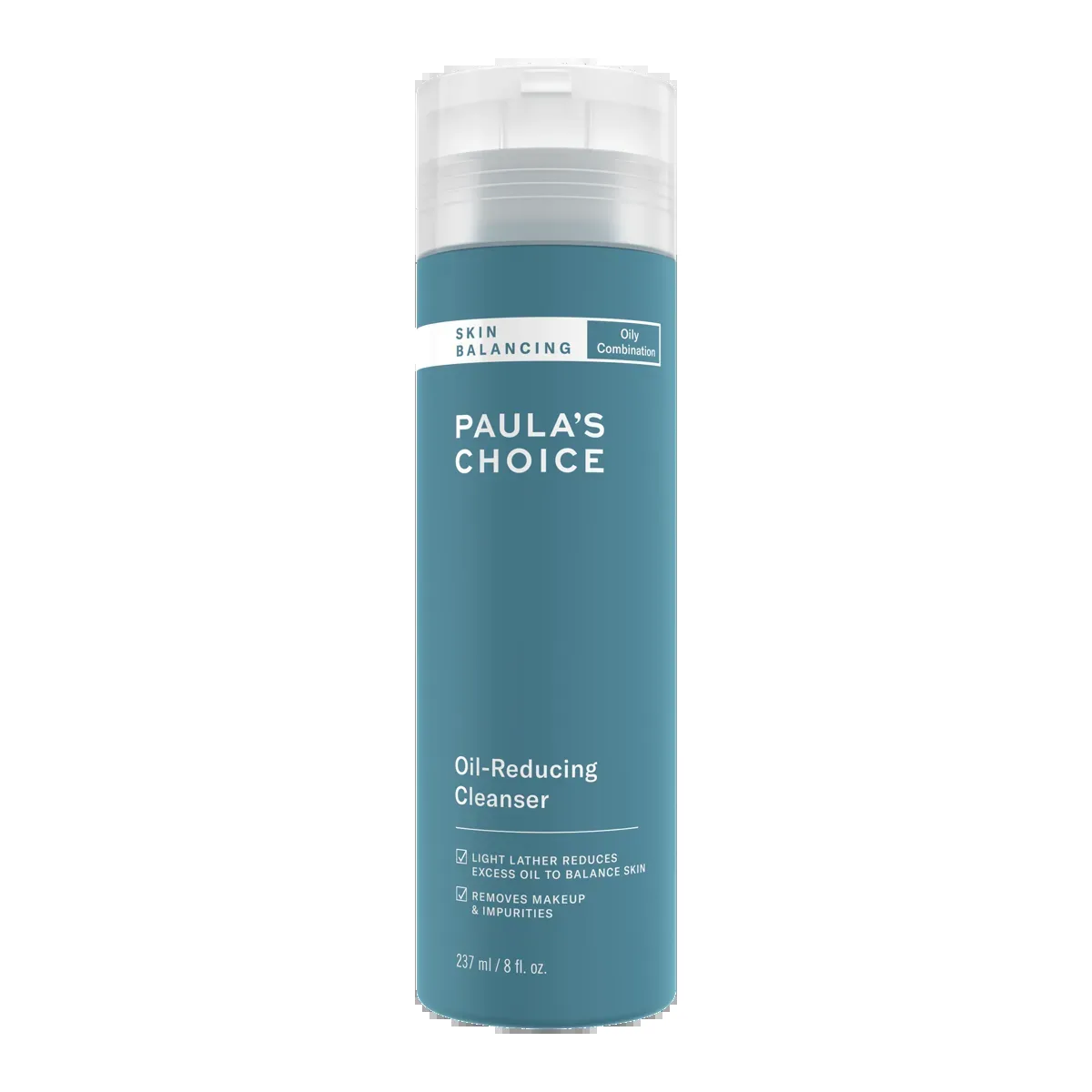
White plastic squeeze bottle in the Skin Balancing line's clean branding. Available in 8 oz standard bottle and a larger 16 oz economy size. Practical, no-frills design consistent with Paula's Choice packaging.
Finish
non-greasymatte
What to Expect on First Use
The cream-to-foam transformation is satisfying — a pea-sized amount generates more lather than expected. Skin feels immediately clean and mattified after rinsing, without the tight, stripped sensation that sulfate cleansers produce. The absence of fragrance and the neutral sensory experience may feel underwhelming to users transitioning from more performative cleansers.
How Long It Lasts
3-4 months applied morning and night for the 8 oz size; 6-8 months for the 16 oz
The Skin Balancing line was designed around the observation that most oily skin cleansers overcorrect the problem — they strip so aggressively that the skin rebounds with even more oil production. Paula Begoun's approach was to cleanse thoroughly but gently, using syndet surfactants that target sebum without dismantling the underlying lipid barrier.
About Paula's Choice Established Brand (5–20 years)
Paula's Choice was founded in 1995 by consumer advocate Paula Begoun, known as the 'Cosmetics Cop,' and has built its reputation on evidence-based, fragrance-free formulations. The brand is Leaping Bunny certified and widely recommended by dermatologists for its transparent, research-driven approach.
Harsh surfactants trigger compensatory sebum production, worsening oiliness over time. This cleanser's mild syndet system removes excess oil without disrupting the lipid barrier, allowing the skin to gradually produce less compensatory sebum.
Myth
A cleanser with oil in the ingredients will make oily skin worse.
Reality
The sunflower seed oil in this formula is rich in linoleic acid — the fatty acid that oily, acne-prone skin is actually deficient in. Brief exposure during cleansing helps normalize sebum composition. It's the oleic acid-dominant oils that exacerbate oiliness.
FAQ
Frequently Asked Questions
Will this cleanser help reduce my oil production over time?
It won't directly regulate sebum glands, but by cleansing without stripping the lipid barrier, it avoids the rebound oil production that harsh cleansers trigger. Many users report that after switching from sulfate cleansers, their skin gradually becomes less oily as the compensatory sebum production cycle breaks.
Can this remove sunscreen and makeup effectively?
Yes — it handles most sunscreens and light-to-moderate makeup in a single wash. For heavy waterproof formulas or mineral sunscreens, consider a double cleanse with an oil-based first cleanser followed by this as the second step.
Why does an oil-reducing cleanser contain sunflower oil?
Sunflower seed oil is rich in linoleic acid, a fatty acid that research has shown is deficient in acne-prone and oily skin. Brief exposure during cleansing helps normalize sebum composition at the fatty acid level, which is fundamentally different from just stripping oil off the surface.
Is the 16 oz size the same formula?
Yes — the 16 oz bottle contains the identical formula as the 8 oz. It offers better per-ounce value for committed daily users and generates less packaging waste.
Is this cleanser suitable for acne-prone skin?
Yes — the sulfate-free, fragrance-free formula is well-suited for acne-prone skin that needs gentle but thorough cleansing. However, it contains no active acne-fighting ingredients like salicylic acid or benzoyl peroxide. Pair it with a leave-on BHA exfoliant or acne treatment for active breakout management.
Reviews
What Reviewers Tend to Say
Recurring themes our editors read across retailer reviews of this product — summaries in our words, not quotations, and not a substitute for your own patch test.
Common Praise
Removes makeup and sunscreen thoroughly without stripping skin
Leaves skin feeling clean and soft rather than tight and dry
A small amount goes a long way — very economical to use
Gentle enough for daily twice-daily use on oily and combination skin
Many users report years of continuous loyal use
Fragrance-free and non-irritating formula
Common Complaints
Can leave combination skin feeling slightly tight in drier patches
Doesn't lather as richly as some users expect from a foam cleanser
May not fully remove heavy waterproof makeup or mineral sunscreen alone
Formula is simple and unremarkable — no standout treatment benefits
Not ideal for very dry skin types despite the balanced approach
The burn trials are real and the skeptics who dismiss aloe as folklore are wrong — but the same substance has delayed healing in other wounds, and none of it says anything about what a soothing gel does to intact skin.
Occupational hand dermatitis is one of the most common work-related diseases on earth, it follows a script, and the cheapest fix works only if you start it before the skin splits.
Every post that dismantles a home remedy owes the reader a replacement. The honest replacement list is embarrassingly cheap, and one item on it is cheaper still — it is a bath.
Aug 28, 2026· 9 min
Questions people ask about Acne
Verified answers from our questions library — the nuance a product page cannot carry.
Products, answers, therapy guides, tools and articles in one search. Brand names,
slang and abbreviations all work — accutane finds isotretinoin, bacne finds truncal acne.