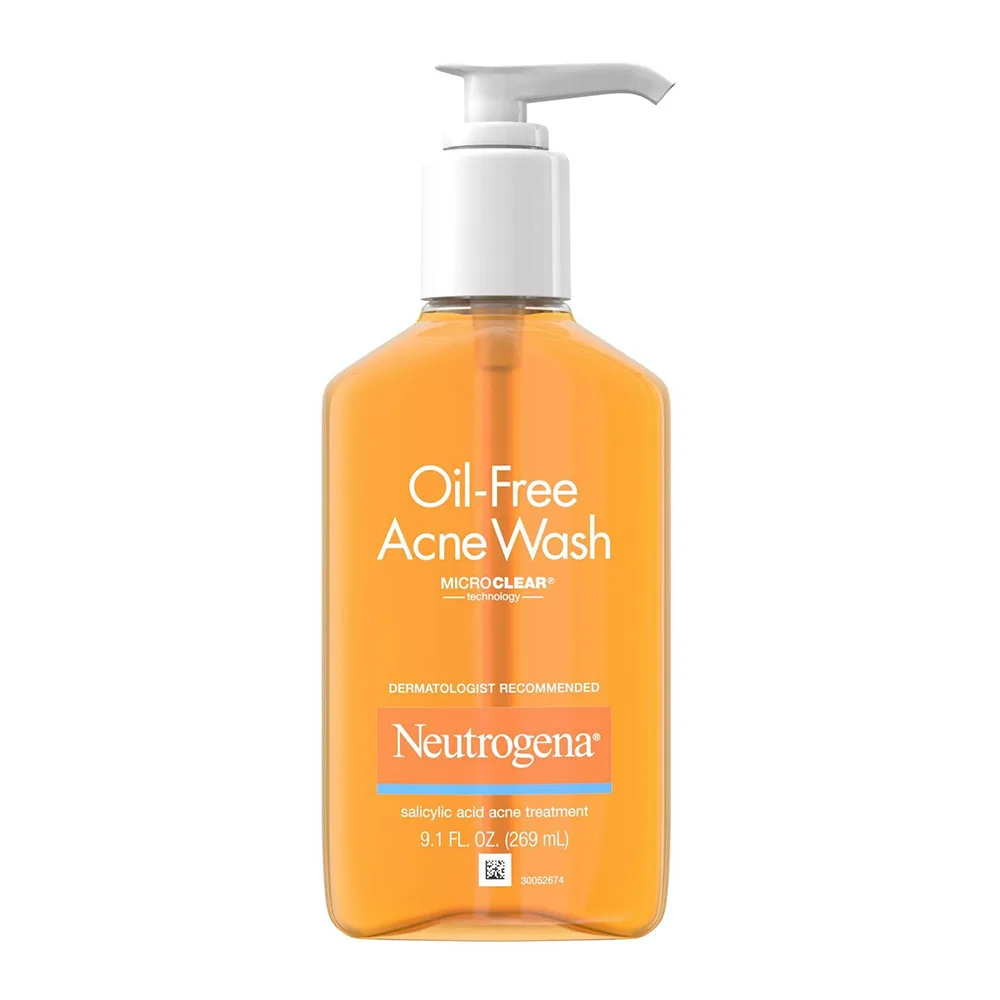
Neutrogena's MicroClear technology claims to enhance salicylic acid delivery deeper into pores compared to generic SA cleansers, and the formula is optimized at pH 4.2 — close to the acid's active range. With nearly three decades on market and tens of thousands of reviews, it has more real-world validation than virtually any competing acne cleanser.
A no-nonsense salicylic acid cleanser that's been doing exactly what it promises for nearly thirty years — controlling oil, clearing blackheads, and keeping mild-to-moderate acne in check at a price that makes daily use painless. It's not gentle and it's not glamorous, but it works, and three decades of dermatologist recommendation and user validation say more than any marketing campaign.
Good choicefor AcneIn your profileYou chose · Salicylic Acid is an approved or monograph active for acne; this rinse-off gel carries it at 2% — short contact still counts for this active, but a leave-on does more.Moderate evidenceStandard tolerabilityNo reviews collected yet
The case for it
Salicylic Acid is a first-line active — approved, monograph-listed or named in current guidelines — for this concern.
It is present at an effective concentration, declared or high in the ingredient list.
The formula carries no trigger this concern is sensitive to, with the cautions noted.
Cautions: fragrance.
Same rule for everyone. “Good choice” is the verdict on 9,564 of 45,024 concern verdicts across the catalog; rule R2r decided 408 of them.
Unchanged since September 5, 2026, engine 5.1.1.
R2r — Rinse-off exceptions (BPO wash, salicylic acid cleanser) deliver a real but smaller effect than the leave-on form; they cap at 'good choice'. Medicated shampoos for scalp concerns are exempt — the shampoo is the treatment form. Editorial decision 2 Sep 2026, pending advisory review. · the full register
Carrying active
Salicylic Acid
Standing
first line — a regulator recognises it for this use; trials support it · per § 333.310 Acne active ingredients. (U.S. Food and Drug Administration — 21 CFR Part 333 Subpart D (Topical Acne Drug Products), Code of Federal Regulations via GovInfo), opened July 27, 2026
Form
adequate (declared 2%) — studied range 0.5–2%, from the OTC monograph or label; judge it after ~6 weeks
Tolerability
standard — fragrance load
Row checked
against its sources on July 27, 2026 (evidence table ev-2026.09-r228)
Good choicefor BlackheadsIn your profileYou chose · Salicylic Acid is an approved or monograph active for blackheads; this rinse-off gel carries it at 2% — short contact still counts for this active, but a leave-on does more.Moderate evidenceGentleNo reviews collected yet
The case for it
Salicylic Acid is a first-line active — approved, monograph-listed or named in current guidelines — for this concern.
It is present at an effective concentration, declared or high in the ingredient list.
The formula carries none of the triggers this concern is sensitive to.
Same rule for everyone. “Good choice” is the verdict on 9,564 of 45,024 concern verdicts across the catalog; rule R2r decided 408 of them.
Unchanged since September 5, 2026, engine 5.1.1.
R2r — Rinse-off exceptions (BPO wash, salicylic acid cleanser) deliver a real but smaller effect than the leave-on form; they cap at 'good choice'. Medicated shampoos for scalp concerns are exempt — the shampoo is the treatment form. Editorial decision 2 Sep 2026, pending advisory review. · the full register
Carrying active
Salicylic Acid
Standing
first line — a regulator recognises it for this use; trials support it · per 21 CFR § 333.350 - Labeling of acne drug products. (US Code of Federal Regulations (Legal Information Institute, Cornell Law School)), opened July 27, 2026
Form
adequate (declared 2%) — studied range 0.5–2%, from the OTC monograph or label; judge it after ~6 weeks
Tolerability
gentle
Row checked
against its sources on July 27, 2026 (evidence table ev-2026.09-r228)
The studies behind the evidence row
OTC monograph, Topical Acne Drug Products — salicylic acid 0.5–2% recognized as an acne treatment active — US Food and Drug Administration
Supporting rolefor Excess OilinessIn your profileYou chose · Rinse-off gel: Salicylic Acid gets seconds of contact, so this supports a routine for excess oiliness rather than treating it.Moderate evidenceGentleNo reviews collected yet
The case for it
Salicylic Acid has early or mechanistic evidence for this concern, not trial-backed standing.
It is in a rinse-off product, so it gets seconds of contact rather than the leave-on exposure the evidence assumes.
The formula carries none of the triggers this concern is sensitive to.
What would change this: The same active in a leave-on form would be judged on its evidence rather than its contact time.
Same rule for everyone. “Supporting role” is the verdict on 8,197 of 45,024 concern verdicts across the catalog; rule R6 decided 2,017 of them.
Unchanged since September 5, 2026, engine 5.1.1.
R6 — Contact time cannot deliver a leave-on claim; the product is judged on its job (cleansing without aggravating). Explicit exceptions (BPO wash, SA cleanser, medicated shampoos) never reach this rule because their rows set rinse_off_ok. · the full register
Carrying active
Salicylic Acid
Standing
plausible — trials support it
Form
contact limited — studied range 30%, from the trials on the row; needs leave-on contact; judge it after ~6 weeks
Tolerability
gentle
Row checked
against its sources on July 17, 2026 (evidence table ev-2026.09-r228)
Supporting rolefor Large PoresIn your profileYou chose · Rinse-off gel: Salicylic Acid gets seconds of contact, so this supports a routine for large pores rather than treating it.Not yet assessedGentleNo reviews collected yet
The case for it
Salicylic Acid has been researched for this concern and the evidence does not support it.
It is in a rinse-off product, so it gets seconds of contact rather than the leave-on exposure the evidence assumes.
The formula carries none of the triggers this concern is sensitive to.
What would change this: The same active in a leave-on form would be judged on its evidence rather than its contact time.
Same rule for everyone. “Supporting role” is the verdict on 8,197 of 45,024 concern verdicts across the catalog; rule R6 decided 2,017 of them.
Unchanged since September 5, 2026, engine 5.1.1.
R6 — Contact time cannot deliver a leave-on claim; the product is judged on its job (cleansing without aggravating). Explicit exceptions (BPO wash, SA cleanser, medicated shampoos) never reach this rule because their rows set rinse_off_ok. · the full register
Carrying active
Salicylic Acid
Standing
none
Form
contact limited — studied range 0.5–2%, from the OTC monograph or label; needs leave-on contact; judge it after ~6 weeks
Supporting rolefor Rough TextureIn your profileYou chose · Rinse-off gel: Salicylic Acid gets seconds of contact, so this supports a routine for rough texture rather than treating it.Moderate evidenceGentleNo reviews collected yet
The case for it
Salicylic Acid has trial-supported standing for this concern.
It is in a rinse-off product, so it gets seconds of contact rather than the leave-on exposure the evidence assumes.
The formula carries none of the triggers this concern is sensitive to.
What would change this: The same active in a leave-on form would be judged on its evidence rather than its contact time.
Same rule for everyone. “Supporting role” is the verdict on 8,197 of 45,024 concern verdicts across the catalog; rule R6 decided 2,017 of them.
Unchanged since September 5, 2026, engine 5.1.1.
R6 — Contact time cannot deliver a leave-on claim; the product is judged on its job (cleansing without aggravating). Explicit exceptions (BPO wash, SA cleanser, medicated shampoos) never reach this rule because their rows set rinse_off_ok. · the full register
Carrying active
Salicylic Acid
Standing
supported — its mechanism is established
Form
contact limited — studied range 0.5–2%, from the trials on the row; needs leave-on contact; judge it after ~6 weeks
Tolerability
gentle
Row checked
against its sources on July 17, 2026 (evidence table ev-2026.09-r228)
The studies behind the evidence row
International Cosmetic Ingredient Dictionary and Handbook — declared function — Personal Care Products Council
United States Pharmacopeia / National Formulary — excipient monograph — USP-NF
Does the jobDoes what a cleanser is for: puts something back, surfactant mildness.
A verdict is DermApproved’s assessment of how well a product’s ingredients fit a concern — never a claim about what the product treats. Evidence dots and collected reviews sit beside it and are never blended in.
Rules 0.5.1 · evidence table ev-2026.09-r228 · how we decide
Assessment
Pros & Cons
Pros
✓ Thirty years of real-world validation and over 30,000 user reviews backing its efficacy
✓ 2% salicylic acid at pH 4.2 is optimized for BHA activity during the cleansing window
✓ Rinses completely clean with zero residue — critical for acne-prone skin
✓ Under $10 for a 9.1 oz pump bottle lasting 3-4 months of twice-daily use
✓ HSA/FSA eligible as an FDA-classified OTC acne treatment
✓ Pump bottle dispenser is hygienic and controls product amount effectively
✓ MicroClear technology enhances salicylic acid delivery into pore lining
Cons
✗ Can be overly drying for combination and dry skin types — moisturizer is mandatory
✗ Contains fragrance and artificial dyes with no functional purpose in an acne treatment
✗ Not effective as a standalone treatment for cystic or severe nodular acne
✗ Benzalkonium chloride is a potential sensitizer for some reactive skin types
✗ The six-ounce tube format is messier and harder to control than the pump bottle
Review
Full Review
There's something to be said for a product that's been quietly doing its job since the mid-1990s while everything around it has been disrupted, reinvented, and disrupted again. The Neutrogena Oil-Free Acne Wash doesn't have a TikTok aesthetic. It doesn't come in minimalist packaging designed for your shelfie. It comes in an orange pump bottle with straightforward labeling, and it has been one of the bestselling acne cleansers in the United States for longer than some of its competitors' founders have been alive.
The formula is disarmingly simple. Salicylic acid at 2% — the FDA maximum for OTC acne treatment — serves as the sole active ingredient in a gel base that lathers, cleanses, and rinses clean. That's it. No ten-ingredient active complex, no proprietary blend with a name that sounds like a luxury hotel. Just a beta-hydroxy acid in a well-engineered vehicle designed to get it where it needs to go.
What Neutrogena does claim as a differentiator is MicroClear technology — a delivery system designed to dissolve oil and boost salicylic acid penetration into pores. Whether this technology meaningfully outperforms standard SA delivery is debatable, but the formula is optimized at a pH of 4.2, which matters more than most consumers realize. Salicylic acid has a pKa of 2.97, meaning it needs an acidic environment to remain in its active, un-ionized form. At pH 4.2, a meaningful portion of the acid is in the right state to penetrate oily pore linings and do its work — even during the relatively brief contact time of a cleanser.
The cleansing experience itself is satisfying in a straightforward way. The amber gel produces a rich lather that spreads easily and feels like it's actually cleaning — not in a harsh, squeaky way, but in a thorough, oil-is-being-addressed way. Rinse, and it's gone. No residue, no film, no lingering slippery feeling that makes you wonder if you've actually rinsed properly. The skin feels clean and oil-free, which is exactly what someone with acne-prone skin wants from their cleanser.
The supporting ingredients are functional rather than exciting. Cocamidopropyl betaine provides secondary cleansing with lower irritation potential than the primary surfactant. Aloe and chamomile extracts offer mild anti-inflammatory support to buffer the acid's drying tendency. Glycerin provides a touch of hydration. C12-15 alkyl lactate prevents the formula from being completely stripping. It's a competent formulation team backing up a proven active ingredient.
Now, the honest part. This cleanser can be drying. Not 'slightly tight if you forget moisturizer' drying — genuinely, noticeably drying, especially if you have combination skin that leans toward dry in certain areas. The salicylic acid is doing its job of dissolving oil, and the surfactant system is thorough about removing it. For solidly oily skin, this feels like relief. For anything less than thoroughly oily, it can feel like too much. The answer isn't to avoid the product but to moisturize immediately after every use and consider scaling to once daily if twice is too aggressive for your skin.
The fragrance is the other issue worth addressing directly. It's there, it's noticeable during use, and it has no functional purpose in an acne treatment. Fragrance is a known sensitizer, and in a product designed for skin that's already inflamed and reactive, it's a puzzling inclusion that Neutrogena has never removed in three decades of reformulations. The artificial dyes (Yellow 5 and Red 40) fall in the same category — they make the gel look orange, which is nice for branding but does nothing for your skin.
For what this cleanser does well — and it does it very well — the results speak through volume. Over thirty thousand user reviews across major retailers, with an average rating around 4.3 stars, tell a consistent story: it controls oil, it reduces blackheads, and it helps keep mild-to-moderate acne manageable when used consistently. The keywords in user reviews cluster around 'clean,' 'effective,' 'reliable,' and 'affordable.' These aren't exciting adjectives, but they're the ones that matter for a product you'll use twice a day for months.
The value proposition is almost unreasonably good. Under ten dollars for a 9.1-ounce pump bottle that lasts three to four months of twice-daily use. The per-use cost is measured in pennies. HSA and FSA eligibility means you may not even be paying out of pocket. For a product with OTC drug classification, clinical validation, and decades of dermatologist recommendation, this pricing essentially removes cost as a barrier to acne treatment.
What this cleanser is not: a miracle worker for severe acne. Cystic acne, nodular acne, and hormonal breakouts that originate deep beneath the skin surface are beyond what any salicylic acid cleanser can address on its own. This is a surface-level treatment that excels at keeping pores clear, managing oil, and preventing the kind of comedonal and mild inflammatory acne that most people deal with. For anything more severe, see a dermatologist — this cleanser can be part of that treatment plan, but it won't be the whole plan.
Neutrogena's position as the number-one dermatologist-recommended skincare brand in America isn't based on hype or influencer partnerships. It's based on decades of making products that dermatologists can confidently recommend to patients who need reliable, accessible, evidence-based skincare at prices that don't require a discussion about budget. The Oil-Free Acne Wash is perhaps the purest expression of that philosophy — a proven active ingredient, a functional delivery system, an accessible price, and thirty years of validation from both clinicians and consumers.
It won't win a beauty award. It won't go viral. It will, however, keep your pores clear and your oil in check for about three cents a wash, which is the kind of quiet competence that deserves recognition even if it isn't particularly photogenic.
Formula
Key Ingredients
The hero actives that drive this product's performance.
Oil-soluble beta-hydroxy acid that penetrates into pores to dissolve sebum plugs and dead skin cells, delivered via Neutrogena's MicroClear technology which claims to boost the acid's penetration to the source of breakouts within the pore lining.
Established mechanismfor Rough Texture · established mechanism
Soothing botanical included to offset the potential drying and irritating effects of the salicylic acid and surfactant system, providing mild anti-inflammatory support during cleansing.
Chamomile extract with anti-inflammatory and skin-calming properties that works alongside the aloe to buffer irritation from the active acid, helping the cleanser remain tolerable for daily use on acne-prone skin.
Not yet assessed
Ingredient standings describe the active at treatment-level doses and
vehicles; this product's own condition grades weigh its actual formula.
Use as your primary cleanser morning and evening. Wet face, apply a small amount, massage for 30-60 seconds focusing on oily and breakout-prone areas, and rinse thoroughly. Follow immediately with a hydrating toner or moisturizer to counteract any drying effect.
Results Timeline
Oil control is noticeable from first use. Reduction in blackheads and surface texture typically visible within 1-2 weeks. Improvement in acne breakout frequency takes 4-8 weeks of consistent daily use. Maximum benefit reached around 8-12 weeks.
Salicylic acid is one of the best-studied topical acne treatments, with a mechanism of action that's distinct from other common actives. As a beta-hydroxy acid, it's oil-soluble — unlike glycolic acid and other alpha-hydroxy acids — allowing it to penetrate into the lipid-rich environment of sebaceous follicles. Once inside the pore, it dissolves the intercellular cement holding dead keratinocytes together, promoting desquamation and preventing the formation of comedones (clogged pores) that are the precursor to inflammatory acne.
A double-blind, placebo-controlled study published in the Journal of the American Academy of Dermatology (2012) demonstrated that 2% salicylic acid cleansing formulations produce statistically significant reductions in both inflammatory and non-inflammatory acne lesions compared to vehicle-only cleansers. The study confirmed efficacy even with the brief contact times inherent to rinse-off products.
More recently, a 2025 study published in the Journal of Drugs in Dermatology examined 2% salicylic acid cleansers with advanced delivery technology and found that they effectively treat acne without compromising skin barrier integrity — addressing one of the primary concerns about daily acid cleanser use.
The pH of 4.2 is a critical formulation decision. Salicylic acid's pKa is 2.97, meaning at pH 4.2, approximately 6% of the acid is in its un-ionized (active) form. While this sounds low, it represents the functional fraction that can penetrate the lipid-rich pore environment. Higher pH would reduce this further; lower pH would increase efficacy but also dramatically increase irritation. The 4.2 pH strikes the balance between activity and tolerability that has made this formula sustainable for daily use over decades.
The surfactant system uses sodium C14-16 olefin sulfonate as the primary cleanser — a sulfonate (not sulfate) that provides effective oil removal with somewhat lower irritation potential than sodium lauryl sulfate. Cocamidopropyl betaine as the co-surfactant further moderates the cleansing intensity, though the overall system is still on the thorough end of the cleansing spectrum.
References
Efficacy of a 2% salicylic acid cleansing formulation in acne vulgaris — Journal of the American Academy of Dermatology (2012)
Dermatologists frequently recommend this cleanser as a first-line OTC treatment for patients with mild to moderate comedonal and inflammatory acne. Practicing dermatologists often observe that the 2% salicylic acid concentration is the gold standard for OTC acne cleansers, and the rinse-off format allows daily use with less irritation risk than leave-on acid treatments. Dermatologists commonly pair this with benzoyl peroxide spot treatments, prescribing the salicylic acid cleanser for daily pore maintenance and benzoyl peroxide for targeted inflammatory lesions. For patients on prescription retinoids, dermatologists may recommend reducing use to once daily or switching to a gentler cleanser if combined drying becomes excessive.
Guidance
Usage & Recommendations
How to Use
Wet face with lukewarm water. Dispense a small amount (about a pump) into hands. Massage gently over face for 30-60 seconds, focusing on oily and breakout-prone areas like the T-zone, chin, and jawline. Avoid the eye area. Rinse thoroughly with lukewarm water and pat dry. Follow immediately with a moisturizer — this step is non-negotiable, as the cleanser removes oil effectively and skin needs hydration replenished. Use once or twice daily depending on tolerance. If dryness occurs, reduce to evening use only.
Value Assessment
At approximately $10 for 9.1 fl oz, this is one of the most cost-effective medicated acne cleansers available. The pump bottle lasts 3-4 months with twice-daily facial use, putting the per-wash cost around three cents. A smaller 6 fl oz tube is available at $8-9 for those who want to test the product before committing to the larger size. HSA/FSA eligibility further reduces the effective cost for many consumers. For an FDA-regulated OTC acne drug with clinical validation and three decades of dermatologist recommendation, this pricing is exceptionally accessible.
Who Should Buy
If you have oily or combination skin dealing with blackheads, whiteheads, or mild-to-moderate breakouts, this is one of the most proven and affordable places to start. It's particularly well-suited for teens and young adults beginning an acne treatment routine, and for anyone who wants a no-frills medicated cleanser that works.
Who Should Skip
Look elsewhere if you have dry or sensitive skin that can't tolerate daily acid exposure, or if you're bothered by fragrance and artificial dyes in your skincare. Also not appropriate as a standalone treatment for severe cystic acne — you'll need prescription intervention for that.
Medium-thick translucent amber gel that produces a satisfying lather when worked into wet skin. Rinses clean without residue.
Scent
Fresh, clean fragrance that's noticeable during use but doesn't linger on skin after rinsing.
Packaging
The 9.1 fl oz size comes in a transparent orange pump bottle, allowing you to see the product level. The 6 fl oz size is a squeeze tube with flip-top cap. Orange and white branding with clear salicylic acid percentage labeling.
Finish
matte
What to Expect on First Use
On first use, the gel lathers easily and leaves skin feeling clean — noticeably oil-free, sometimes borderline tight depending on your skin type. The salicylic acid is not noticeably tingly at this pH and in a rinse-off format. Oil control is apparent from the first wash, though acne-clearing benefits take weeks to fully manifest.
How Long It Lasts
3-4 months with twice-a-day use facial use for the 9.1 fl oz pump bottle
Launched in the mid-1990s as Neutrogena expanded its acne portfolio beyond the original transparent soap bar, the Oil-Free Acne Wash became one of the first widely available salicylic acid cleansers at the drugstore level. It filled a gap between harsh benzoyl peroxide washes and gentle-but-ineffective cosmetic cleansers, offering medicated acne treatment in an accessible daily-use format. Three decades later, it remains one of the bestselling acne cleansers in the United States.
About Neutrogena Legacy Brand (20+ years)
Neutrogena was founded in 1930 and is the #1 dermatologist-recommended skincare brand in the United States. The Oil-Free Acne Wash has been a flagship OTC acne treatment for approximately three decades, with clinical validation of its 2% salicylic acid delivery system and tens of thousands of user reviews.
Brand founded: 1930 · Product launched: 1995
Myth vs. Reality
Common Myths
Myth
Salicylic acid cleansers don't work because the acid rinses off too quickly.
Reality
While contact time is shorter than a leave-on treatment, the pH 4.2 formula and MicroClear delivery system are designed to maximize efficacy during the cleansing window. Clinical studies have shown that 2% salicylic acid cleansers produce statistically significant reductions in acne lesions compared to placebo cleansers, even with typical rinse-off contact times.
Myth
Acne washes should make your skin feel tight and squeaky-clean to work.
Reality
That tight, stripped feeling indicates over-drying, which can actually trigger increased oil production and worsen acne over time. This cleanser removes excess oil effectively, but if you consistently feel tight afterward, it may be too aggressive for your skin — scale back to once daily and ensure you're moisturizing immediately after.
FAQ
Frequently Asked Questions
How often should I use Neutrogena Oil-Free Acne Wash?
For most oily and acne-prone skin types, twice daily (morning and evening) is effective. If you experience dryness or tightness, scale back to once daily — typically in the evening — and use a gentler cleanser in the morning. Always follow with a moisturizer to prevent the cleanser from disrupting your skin barrier.
Can I use this acne wash with benzoyl peroxide?
Yes, but stagger them. Using a salicylic acid cleanser and a benzoyl peroxide spot treatment together is a common dermatologist-recommended approach. Use this cleanser to wash your face, then apply benzoyl peroxide as a targeted spot treatment afterward. Avoid using a benzoyl peroxide wash and this salicylic acid wash in the same routine — choose one cleanser per session.
Does Neutrogena Oil-Free Acne Wash work for cystic acne?
This cleanser is most effective for mild to moderate acne — surface breakouts, blackheads, whiteheads, and excess oil. Cystic and nodular acne originates deep beneath the skin surface and typically requires prescription-strength treatments like retinoids, antibiotics, or isotretinoin. This wash can be part of a cystic acne routine, but it won't be sufficient as a standalone treatment.
Is the salicylic acid in this cleanser effective if I only leave it on for 30 seconds?
Yes — the formula is optimized at pH 4.2, close to salicylic acid's active range, and Neutrogena's MicroClear technology enhances delivery during the brief contact time. Clinical studies on 2% salicylic acid cleansers show significant acne reduction even with standard rinse-off use. For maximum benefit, massage for 30-60 seconds before rinsing.
Can I use this with retinol or retinoids?
Yes, but be strategic. This cleanser provides chemical exfoliation via salicylic acid, and retinoids provide cell turnover — combining both can be effective but also drying. Start by using the acne wash in the morning and your retinoid at night, with moisturizer after each. If irritation occurs, reduce the acne wash to once daily or every other day.
Why does this acne wash make my skin feel tight?
The combination of surfactants and 2% salicylic acid at pH 4.2 effectively removes oil, which can leave skin feeling stripped. This is a sign to ensure you're moisturizing immediately after cleansing. If persistent tightness occurs, reduce to once-daily use or switch to every other day. Some users find using this only in the evening and a gentler cleanser in the morning strikes the right balance.
Reviews
What Reviewers Tend to Say
Recurring themes our editors read across retailer reviews of this product — summaries in our words, not quotations, and not a substitute for your own patch test.
Common Praise
Effectively controls oil and reduces breakouts with consistent use
Great lather that leaves skin feeling thoroughly clean
Rinses completely with no residue or film
Excellent value — affordable and a little goes a long way
Noticeable reduction in blackheads within weeks
Pump bottle is convenient and hygienic for daily use
Common Complaints
Can be overly drying, especially for those with combination or dry skin
Contains fragrance and artificial dyes that may irritate sensitive skin
Not effective for cystic or severe nodular acne
Some users see no significant improvement in breakout frequency
The 6 oz tube format is harder to control than the pump bottle
Notable Endorsements
#1 dermatologist-recommended skincare brand in the U.S.Consistently featured in dermatologist-curated best acne wash lists
The whole case for salicylic acid rests on one unglamorous fact of chemistry: it dissolves in oil. Understand that, and you know exactly when it beats a glycolic acid — and when it's overkill.
Chamomile's active fraction inhibits the same inflammatory pathways a steroid does, at a fraction of the strength — and the version that works best is grubbed out of Brazilian cerrado, while the synthetic substitute is half inactive by construction.
Those tiny dots on your nose are almost certainly not blackheads — they're normal, functional plumbing you will never 'clear,' and the extraction obsession is quietly wrecking the skin around them.
Jun 6, 2026· 6 min
Questions people ask about Acne
Verified answers from our questions library — the nuance a product page cannot carry.
Products, answers, therapy guides, tools and articles in one search. Brand names,
slang and abbreviations all work — accutane finds isotretinoin, bacne finds truncal acne.