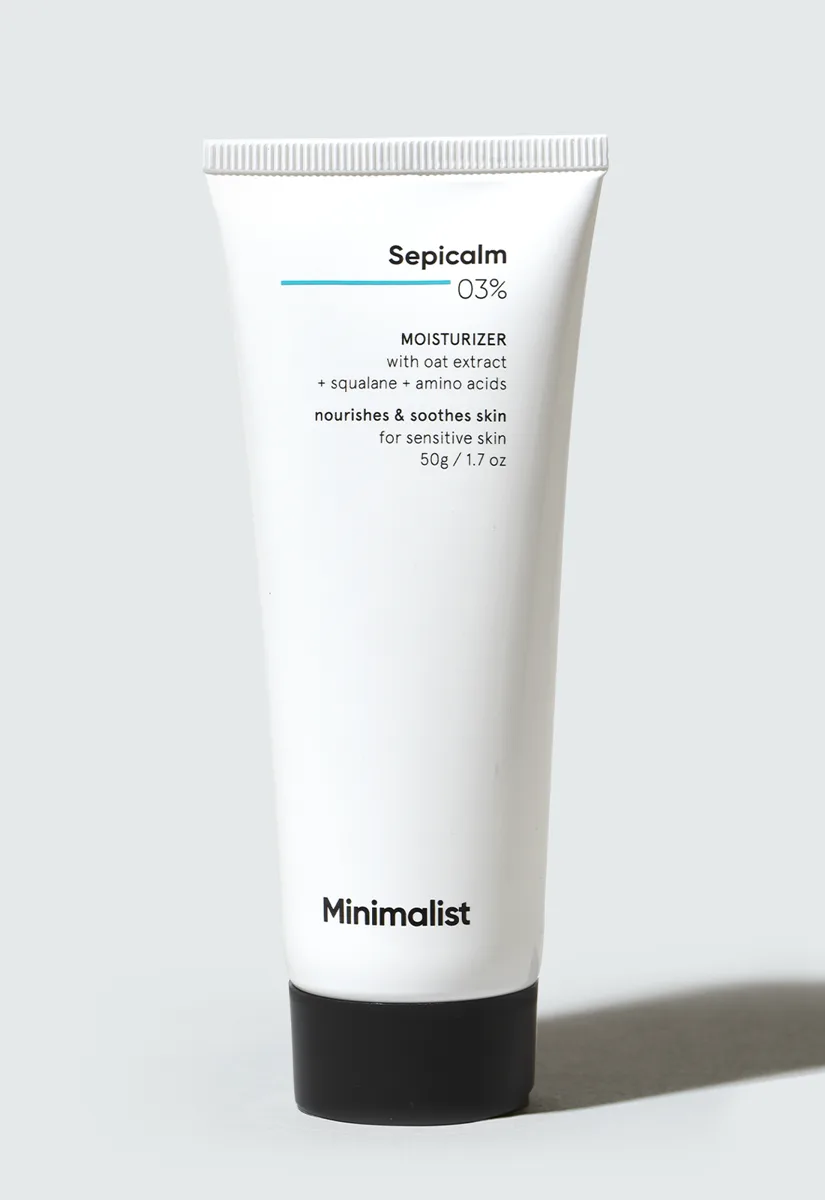
Most sub-$12 soothing moisturizers either skip the marquee active entirely or dose it homeopathically. Minimalist prints the 3% Sepicalm concentration on the front of the box and actually hits the manufacturer's recommended use level — that kind of transparency at this price point is still unusual.
A genuinely honest soothing moisturizer that does the unusual thing of printing its active concentration on the front of the box and actually delivering on it. At under $12 for a Sepicalm-at-efficacy-level formula stacked with oat, bisabolol and panthenol, it's one of the better sensitive-skin buys coming out of the indie Indian skincare scene.
Note: While Minimalist has been selling this moisturizer since 2021, most of the available reviews are concentrated in South Asian retail channels. Our scoring weights ingredient analysis alongside regional user feedback. Anticipate a revised score once the data set fills out properly.
Verdicts
How well it fits each concern
Verdict by concern tap a concern for the case
Good choicefor SensitivityIn your profileYou chose · No fragrance, drying alcohol, declarable allergens or sensitising preservatives in this cream — the profile sensitive skin looks for.Not yet assessedGentleNo reviews collected yet
The case for it
Glycerin has no evidence row yet for this concern — it is in the research queue.
The formula carries none of the triggers this concern is sensitive to.
What would change this: A researched evidence row for the lead active would replace this with a verdict.
Same rule for everyone. “Good choice” is the verdict on 1,938 of 45,024 concern verdicts across the catalog; rule F2 decided 1,938 of them.
Unchanged since September 5, 2026, engine 5.1.1.
Supporting rolefor Compromised Skin BarrierIn your profileYou chose · Nothing here targets compromised skin barrier directly; barrier lipids and occlusion is the recognised companion to treating it, and this cream does that without known triggers.Not yet assessedGentleNo reviews collected yet
The case for it
Glycerin has no evidence row yet for this concern — it is in the research queue.
The formula carries none of the triggers this concern is sensitive to.
What would change this: A researched evidence row for the lead active would replace this with a verdict.
Same rule for everyone. “Supporting role” is the verdict on 8,197 of 45,024 concern verdicts across the catalog; rule R8 decided 4,250 of them.
Unchanged since September 5, 2026, engine 5.1.1.
R8 — The category's job (barrier care, humectant hydration, gentle cleansing, photoprotection) is the documented supportive role for this concern. This is the honest verdict for a moisturizer on an acne page. · the full register
Supporting rolefor RosaceaIn your profileYou chose · Nothing here targets rosacea directly; barrier repair and gentle hydration is the recognised companion to treating it, and this cream does that without known triggers.Not yet assessedGentleNo reviews collected yet
The case for it
Panthenol has been researched for this concern and the evidence does not support it.
It is plausibly present at a working level, though the concentration is not declared.
The formula carries none of the triggers this concern is sensitive to.
What would change this: A declared concentration would move this to a firmer reading of the dose.
Same rule for everyone. “Supporting role” is the verdict on 8,197 of 45,024 concern verdicts across the catalog; rule R8 decided 4,250 of them.
Unchanged since September 5, 2026, engine 5.1.1.
R8 — The category's job (barrier care, humectant hydration, gentle cleansing, photoprotection) is the documented supportive role for this concern. This is the honest verdict for a moisturizer on an acne page. · the full register
Carrying active
Panthenol
Standing
none
Form
plausible — studied range 1–5%, from the OTC monograph or label; needs leave-on contact
Good choicefor DrynessIn your profileYou chose · Glycerin is a reference standard by mechanism for dryness; this cream carries it high in the ingredient list.Moderate evidenceGentleNo reviews collected yet
The case for it
Glycerin has trial-supported standing for this concern.
It is present at an effective concentration, declared or high in the ingredient list.
The formula carries none of the triggers this concern is sensitive to.
Same rule for everyone. “Good choice” is the verdict on 9,564 of 45,024 concern verdicts across the catalog; rule R5 decided 9,072 of them.
Unchanged since September 5, 2026, engine 5.1.1.
Supporting rolefor Post-ProcedureIn your profileYou chose · Panthenol (Vitamin B5) has early evidence for post procedure, and barrier support is the recognised companion to treating it — a reasonable supporting choice, short of a recommendation.Moderate evidenceGentleNo reviews collected yet
The case for it
Panthenol has early or mechanistic evidence for this concern, not trial-backed standing.
It is plausibly present at a working level, though the concentration is not declared.
The formula carries none of the triggers this concern is sensitive to.
What would change this: A declared concentration would move this to a firmer reading of the dose.
Same rule for everyone. “Supporting role” is the verdict on 8,197 of 45,024 concern verdicts across the catalog; rule R8a decided 1,489 of them.
Unchanged since September 5, 2026, engine 5.1.1.
R8a — A plausible-tier active in a category with a supportive job: the sentence names the active instead of saying nothing targets the concern (the AmLactin / CeraVe SA case for keratosis pilaris, where no guideline and single trials leave the keratolytics at early evidence). · the full register
Carrying active
Panthenol
Standing
plausible — trials support it
Form
plausible — studied range 0.5–2%, from the OTC monograph or label; needs leave-on contact
Tolerability
gentle
Row checked
against its sources on July 17, 2026 (evidence table ev-2026.09-r228)
Does the jobDoes what a moisturizer is for: draws in water, softens and smooths.
A verdict is DermApproved’s assessment of how well a product’s ingredients fit a concern — never a claim about what the product treats. Evidence dots and collected reviews sit beside it and are never blended in.
Rules 0.5.1 · evidence table ev-2026.09-r228 · how we decide
Assessment
Pros & Cons
Pros
✓ Sepicalm dosed at the manufacturer's full 3% efficacy level
✓ Active concentration printed transparently on the front of the box
✓ Genuinely fragrance-free — no masking scent or essential oils
✓ Stacks oat, bisabolol and panthenol for layered soothing
✓ Under $12 price undercuts most international sensitive-skin creams
✓ Works well as a buffer layer under retinoids or azelaic acid
✓ Plays well under sunscreen with no pilling
Cons
✗ 50g tub runs out in six to eight weeks with twice-daily use
✗ Jar-and-spatula packaging feels cheaper than a pump would
✗ Not fungal acne safe due to fatty alcohols and PEG-100 stearate
✗ Availability outside India is inconsistent and adds shipping cost
✗ Not rich enough for the driest winter skin as a standalone night cream
Review
Full Review
Minimalist built its whole brand identity around a single piece of packaging design: putting active concentrations in bold type on the front of every box. In a market where hero-ingredient marketing has historically done a lot of heavy lifting — sometimes for formulas containing whisper-dose amounts of their flagship active — that kind of transparency was genuinely new when founder Mohit Yadav launched the brand out of Jaipur in 2020. This moisturizer is one of the clearest examples of why that choice mattered. The box says 3% Sepicalm, and the formula actually uses 3% Sepicalm. That is, stubbornly, still worth pointing out.
Sepicalm S is a branded soothing active from the French ingredient supplier Seppic, built around sodium palmitoyl proline combined with Nymphaea alba (water lily) flower extract. Its proposed mechanism is osmolyte-assisted, helping skin cells maintain water balance under stress, which in practice translates to reduced visible redness and faster recovery from irritation. The supplier's own in-use recommendation tops out around 3 percent, which is exactly where Minimalist has landed. Stacked behind it you get oat kernel extract (the avenanthramides do the same calming work through a slightly different inflammatory pathway), panthenol, bisabolol from chamomile, and a sensible emollient backbone of squalane, caprylic/capric triglyceride and dimethicone. Glycerin sits third on the INCI list, which is where you want it in a daily moisturizer rather than whispered in near the preservative. Allantoin adds one more anti-irritant to the pile, and the whole thing is balanced to pH 5.5 — matching the skin's own acid mantle, which is precisely the detail a barrier-repair product should sweat.
The texture is medium-weight — not the whipped, airy feel of a gel-cream, not the thick occlusive cushion of a classic dry-skin moisturizer. It sinks in with a few seconds of work, leaves behind a soft natural finish, and gets along fine with mineral and chemical sunscreens layered on top. There's no scent. Not a masking fragrance, not essential oils playing the unscented card — genuinely nothing. If you've been using fragranced moisturizers and your skin is acting up, the first few minutes with this cream tend to be quietly revelatory. The correct first impression, in fact, is no impression: no tingle, no heat, no sting — and if your skin has been feeling raw from over-enthusiastic actives, the existing sting tends to stop within seconds of application. It's also PETA-certified cruelty-free, vegan, and safe through pregnancy, which makes it one of the few products in a reactive-skin routine that never needs to be benched.
Where it earns its keep is in the stacking. A single soothing active in an otherwise unremarkable base can do real work, but formulators who care about reactive skin tend to build redundancy — different mechanisms calming inflammation from different angles, so that if one user doesn't respond well to Sepicalm, the oat and the bisabolol are still pulling their weight. This formula does that. It's also a sensible buffer product: applied before a low-dose retinoid (the sandwich method) or layered after azelaic acid, the cream takes the edge off without blunting the actives entirely.
The limits are worth being honest about. The 50g jar disappears quickly if you're using this twice daily on face and neck — figure six to eight weeks of runway. The jar-and-spatula packaging is hygienic enough but feels cheaper than it needs to, and there's no travel-friendly pump option. Availability outside India has improved but is still inconsistent through secondary marketplaces, which means shipping costs can close the gap between this and the international sensitive-skin brands it's meant to undercut. And it's not fungal acne safe — the cetearyl alcohol and PEG-100 stearate rule it out for a specific minority of Malassezia-reactive users.
The other thing worth noting is that Minimalist was acquired by Hindustan Unilever in 2024. For some buyers that raises the usual questions about whether indie quality survives a multinational roll-up; so far the formulations haven't visibly changed, but it's something to watch over the next year or two. The 3,500 reviews averaging 4.2 stars give a fair pre-acquisition baseline: the redness relief, the lightweight-but-not-drying balance, and the honest pricing dominate the praise, while the complaints center on the small tub vanishing quickly, patchy international availability, and occasional reports of separation in older batches — a quality-control wrinkle worth knowing about, and one the new corporate owner has every resource to iron out.
What this product gives you, for the money, is a soothing moisturizer that gets the active concentration right, pairs it with several real supporting ingredients, and doesn't make you pay for luxury packaging or a brand heritage surcharge. If your skin is reactive, if you're rebuilding your barrier after going too hard on actives, if you've been priced out of the $30-and-up sensitive-skin aisle — this is a specifically good answer. It's not the richest moisturizer for deep winter, it's not the most elegant format on the market, and it won't replace prescription-strength interventions for severe rosacea. But at under $12 with a transparent label and a formula that actually backs up what the box claims, it's doing something increasingly rare in skincare: telling you the truth and charging you a fair price for it.
Formula
Key Ingredients
The hero actives that drive this product's performance.
The soothing active the whole formula is built around — at 3% it sits at the manufacturer's recommended efficacy ceiling and works to quiet visible redness while supporting the skin's own osmolyte response. Paired here with oat extract and bisabolol, it's doing the heavy lifting for reactive, post-actives skin.
Adds a second soothing mechanism on top of Sepicalm — avenanthramides in oat calm itch and irritation, which is exactly what you want stacked behind a reactivity-focused moisturizer like this one.
Sits third on the INCI, which is where it needs to be in a daily moisturizer — pulls water into the upper layers so the squalane and dimethicone above it have something to seal in.
Established mechanismfor Dryness · established mechanism
A skin-identical emollient that mimics the lipids your own skin makes — it gives this otherwise lightweight cream its slight cushion without pushing it into heavy, occlusive territory.
Established mechanismfor Dryness · established mechanism
Converts to pantothenic acid in skin and supports barrier repair — a sensible addition in a formula specifically marketed to people whose barrier is already complaining.
Derived from chamomile, it layers a third anti-inflammatory mechanism on top of Sepicalm and oat — the kind of redundancy that actually matters when the target user is reactive.
Not yet assessed
Ingredient standings describe the active at treatment-level doses and
vehicles; this product's own condition grades weigh its actual formula.
Apply after water-based serums and before sunscreen in the AM, or as the final step at night. Works well as a buffer layer under retinoids for sensitive users.
Results Timeline
Immediate comfort and reduced stinging on application. Visible redness reduction in 1-2 weeks with consistent twice-daily use. Full barrier benefits around 4-6 weeks.
The active story here is almost entirely about Sepicalm S, oat, and the established soothing auxiliaries layered behind them. Sepicalm S is a branded ingredient complex marketed by Seppic combining sodium palmitoyl proline with Nymphaea alba extract; its proposed mechanism involves supporting the skin's osmolyte response to environmental stress, which in manufacturer in-use testing at the 2-3% range has shown reductions in visible erythema. Independent peer-reviewed studies on the specific Sepicalm complex are limited, so the strongest evidence here is for the individual components and the category. Oat extract's role in skin soothing is much better established — avenanthramides, the signature polyphenolic compounds in Avena sativa, have been shown in multiple in vitro studies to inhibit NF-κB activation and reduce pro-inflammatory cytokine release in human keratinocytes, which is part of the rationale behind the FDA's recognition of colloidal oatmeal as a skin protectant. Panthenol (pro-vitamin B5) has decades of data supporting its role in stratum corneum hydration and in accelerating barrier repair after surfactant or tape-stripping injury. Bisabolol, the main active in chamomile, has demonstrated anti-inflammatory effects through inhibition of prostaglandin synthesis in multiple in vitro models. What makes this formula worth discussing as a combination rather than as a checklist is the redundancy: you're not betting your calm-down response on a single mechanism, which matters because not every reactive user responds to every soothing pathway. Stacking Sepicalm (osmolyte support), oat (NF-κB modulation), and bisabolol (prostaglandin inhibition) inside a fragrance-free, squalane-cushioned base is the kind of layered approach that characterizes the best soothing moisturizers on the market, and it's unusual to see it done at this price point.
Dermatologist Perspective
Dermatologists frequently recommend simple, fragrance-free moisturizers with well-studied soothing ingredients for patients with rosacea, sensitive skin, and barrier compromise — and this formula checks most of the boxes that come up in those conversations. Dermatology professionals typically look for glycerin high on the INCI, an absence of fragrance and essential oils, at least one evidence-backed soothing active, and a supportive lipid component; this product provides all four. For post-procedure patients (after chemical peels, microneedling, or laser), products combining panthenol with oat or chamomile-derived soothers are commonly used as part of recovery protocols. The main caveat a dermatologist would flag is the presence of cetearyl alcohol and PEG-100 stearate, which make it unsuitable for Malassezia-driven folliculitis. For the typical sensitive or reactive patient who isn't dealing with that specific condition, this is the kind of unassuming daily moisturizer many clinicians would consider a reasonable budget option.
Guidance
Usage & Recommendations
How to Use
Apply a pea-to-almond-sized amount to clean, slightly damp skin after any water-based serums. In the morning, layer it before sunscreen — wait 30 to 60 seconds for it to absorb to avoid pilling under mineral SPFs. At night, use it as the final step on its own, or as a buffer layer before a low-dose retinoid (the sandwich method: moisturizer, retinoid, moisturizer again) if your skin is still adjusting. For active flare-ups or post-procedure skin, apply more generously and consider reapplying during the day. Use the included spatula to keep the jar hygienic, and keep the tub out of direct sunlight.
Value Assessment
At roughly $10 for 50g, this moisturizer is one of the clearer value propositions in the sensitive-skin aisle. The 3% Sepicalm dose is at the supplier's recommended efficacy ceiling — not a marketing sprinkle — and the supporting cast of oat, panthenol, bisabolol, and squalane would comfortably fit into formulas priced two to three times higher. The honest limit on the value story is sizing: the 50g tub is the only option, so users who need this across face and neck will burn through it relatively quickly. There's no larger-size upgrade path. Even accounting for that, the per-use cost stays well under what the international sensitive-skin brands charge for comparable formulas, and the front-of-box transparency means you're paying for what's actually inside.
Who Should Buy
Buy this if you have reactive, sensitive, or easily-irritated skin and you want an honestly-dosed soothing moisturizer without paying the premium sensitive-skin tax. It's especially good for people rebuilding their barrier after overdoing actives, for rosacea-prone skin looking for a daily calm-down layer, and for anyone using retinoids or azelaic acid who wants a buffer.
Who Should Skip
Pass on this if you have confirmed fungal acne — the cetearyl alcohol and PEG-100 stearate may aggravate Malassezia-driven folliculitis. This one is also wrong for you if you need a truly rich, occlusive overnight cream for very dry winter skin, or if you're unwilling to deal with the jar-and-spatula format over a pump.
Ready to try Minimalist Sepicalm 3% + Oat Face Moisturizer?
Medium-weight white cream that rubs in without any tackiness or white cast.
Scent
None — genuinely fragrance-free, no masking scent.
Packaging
50g screw-top plastic jar with a plastic spatula included — hygienic enough but a pump would travel better.
Finish
non-greasylightweightnatural
What to Expect on First Use
The first application should feel unremarkable in the best way — no tingle, no sting, no heat. If you've been layering actives and your skin feels raw, you'll likely notice the sting stop within seconds of applying. No purge, no adjustment period; this isn't that kind of product.
How Long It Lasts
About 6-8 weeks applied morning and night full-face application.
Minimalist launched in 2020 specifically to push back against the Indian skincare market's tradition of hiding actives behind hero-ingredient marketing. This moisturizer was one of the brand's early sensitive-skin picks, built around Seppic's Sepicalm S — a branded osmolyte-soothing active — paired with oat extract for everyday use on reactive skin. Hindustan Unilever acquired the brand in 2024.
About Minimalist Emerging Brand (2–5 years)
Minimalist (legally Be Minimalist, acquired by Hindustan Unilever in 2024) launched in 2020 out of Jaipur with a transparency-first approach that prints active concentrations on the front of every box. The brand has built credibility in South Asia through cosmetic-chemist-led formulations, though independent long-term clinical validation of specific SKUs is still limited.
Brand founded: 2020 · Product launched: 2021
Myth vs. Reality
Common Myths
Myth
If a moisturizer is gentle enough for sensitive skin, it must be too weak to do anything.
Reality
This formula is 'gentle' because it omits fragrance, essential oils, and denatured alcohol — not because it lacks actives. Sepicalm at 3% is an active ingredient doing measurable work.
FAQ
Frequently Asked Questions
What is Sepicalm and why is it in this moisturizer?
Sepicalm S is a branded soothing active from French supplier Seppic, built around sodium palmitoyl proline and water lily extract. In this Minimalist formula it's dosed at 3% — the manufacturer's recommended upper efficacy level — to calm visible redness and support the skin's natural osmolyte response on reactive skin.
Can I use this moisturizer with retinol or azelaic acid?
Yes — the fragrance-free, bisabolol-and-oat-buffered base actually makes it one of the better pairings for retinoids and azelaic acid. Many users apply this cream before a low-dose retinoid as a sandwich-method buffer or layer it after azelaic acid to calm the initial tingle.
Is this moisturizer fungal acne safe?
Not strictly. It contains cetearyl alcohol and PEG-100 stearate, which some Malassezia-sensitive users react to. If you have confirmed fungal acne, this isn't the best choice — look for a simpler glycerin-and-squalane-only formula instead.
Is Minimalist Sepicalm moisturizer fragrance-free?
Yes, genuinely. There's no added fragrance, no essential oils, and no masking scent. Out of the jar it smells faintly like the emulsifier base and nothing else.
How does this compare to more expensive sensitive-skin moisturizers?
The formulation hits the key soothing checkpoints — a branded calming active at efficacy level, oat extract, panthenol, bisabolol, squalane — at a price that undercuts most international sensitive-skin creams. What you give up is premium packaging, richer occlusivity, and the long track record of legacy derm brands.
Can Sepicalm 3% + Oat Face Moisturizer be used while pregnant or breastfeeding?
There are no ingredients in the formula that are typically flagged as pregnancy concerns — no retinoids, no salicylic acid, no high-risk essential oils. As always, run any skincare past your OB if you're uncertain.
Reviews
What Reviewers Tend to Say
Recurring themes our editors read across retailer reviews of this product — summaries in our words, not quotations, and not a substitute for your own patch test.
Chamomile's active fraction inhibits the same inflammatory pathways a steroid does, at a fraction of the strength — and the version that works best is grubbed out of Brazilian cerrado, while the synthetic substitute is half inactive by construction.
It's in half your products and headlines none of them. Provitamin B5 has the kind of boring, decades-deep barrier and wound-healing evidence that flashier actives can only envy.
Flushing, bumps, and visible vessels are three different problems hiding under one word, and treating them the same way is how most people make their skin angrier.
May 29, 2026· 5 min
Questions people ask about sensitive skin
Verified answers from our questions library — the nuance a product page cannot carry.
Products, answers, therapy guides, tools and articles in one search. Brand names,
slang and abbreviations all work — accutane finds isotretinoin, bacne finds truncal acne.