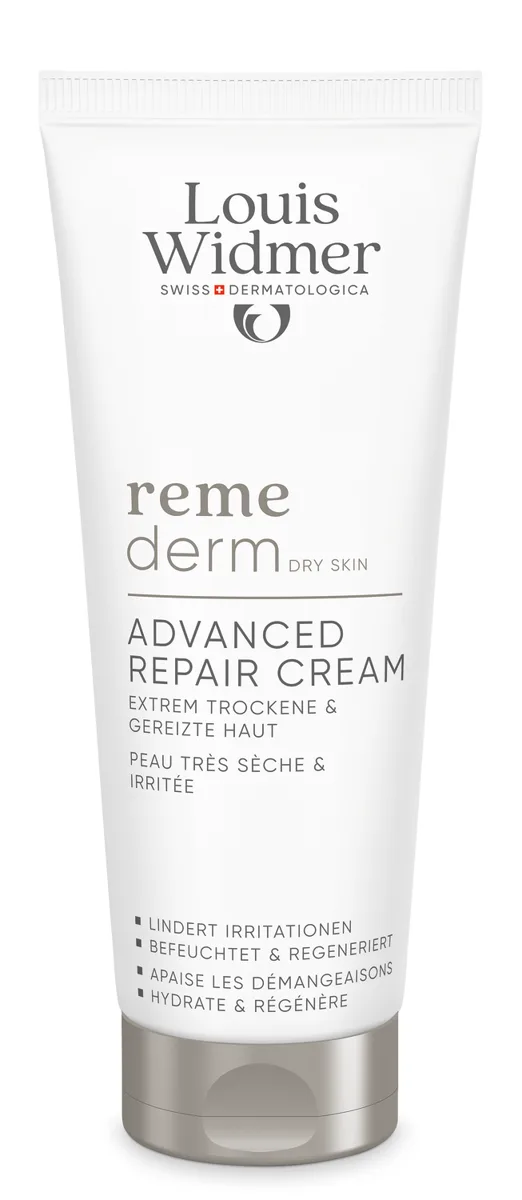
It is a true medical-grade repair cream from a Swiss pharmacy brand, combining a barrier-friendly 3% urea and 2% panthenol with antimicrobial microsilver, borage oil and vitamins for compromised, eczema-prone skin — and, crucially, offered in a fragrance-free version. That allergen-conscious option, plus the clinical dosing, sets it apart from cosmetic moisturizers.
A genuine medical-grade repair cream from a legacy Swiss pharmacy brand: clinically-dosed 3% urea and 2% panthenol with antimicrobial microsilver, borage oil and vitamins, built to rescue very dry, eczema-prone and compromised skin. It calms tightness and roughness fast, is well-tolerated, and — crucially — comes in a fragrance-free version. The main limits are the scented default and a richness oily skin won't want.
Good choicefor DrynessIn your profileYou chose · Jojoba Oil is a reference standard by mechanism for dryness; this cream carries it.Moderate evidenceGentleNo reviews collected yet
The case for it
Borage Oil + Jojoba + Vitamins A & E has trial-supported standing for this concern.
It is plausibly present at a working level, though the concentration is not declared.
The formula carries none of the triggers this concern is sensitive to.
What would change this: A declared concentration would move this to a firmer reading of the dose.
Same rule for everyone. “Good choice” is the verdict on 9,564 of 45,024 concern verdicts across the catalog; rule R5 decided 9,072 of them.
Unchanged since September 5, 2026, engine 5.1.1.
Supporting rolefor Compromised Skin BarrierIn your profileYou chose · Nothing here targets compromised skin barrier directly; barrier lipids and occlusion is the recognised companion to treating it, and this cream does that without known triggers.Not yet assessedGentleNo reviews collected yet
The case for it
Urea has no evidence row yet for this concern — it is in the research queue.
The formula carries none of the triggers this concern is sensitive to.
What would change this: A researched evidence row for the lead active would replace this with a verdict.
Same rule for everyone. “Supporting role” is the verdict on 8,197 of 45,024 concern verdicts across the catalog; rule R8 decided 4,250 of them.
Unchanged since September 5, 2026, engine 5.1.1.
R8 — The category's job (barrier care, humectant hydration, gentle cleansing, photoprotection) is the documented supportive role for this concern. This is the honest verdict for a moisturizer on an acne page. · the full register
Supporting rolefor EczemaIn your profileYou chose · Nothing here targets eczema directly; emollient therapy is the recognised companion to treating it, and this cream does that without known triggers.Moderate evidenceGentleNo reviews collected yet
The case for it
Urea has early or mechanistic evidence for this concern, not trial-backed standing.
It is present below the studied range.
The formula carries none of the triggers this concern is sensitive to.
What would change this: A concentration inside the studied range would raise this a step.
Same rule for everyone. “Supporting role” is the verdict on 8,197 of 45,024 concern verdicts across the catalog; rule R8 decided 4,250 of them.
Unchanged since September 5, 2026, engine 5.1.1.
R8 — The category's job (barrier care, humectant hydration, gentle cleansing, photoprotection) is the documented supportive role for this concern. This is the honest verdict for a moisturizer on an acne page. · the full register
Carrying active
Urea
Standing
plausible — trials support it
Form
sub threshold (declared 3%) — studied range 5–10%, from the OTC monograph or label; needs leave-on contact; judge it after ~2 weeks
Tolerability
gentle
Row checked
against its sources on July 17, 2026 (evidence table ev-2026.09-r228)
Good choicefor SensitivityIn your profileYou chose · No fragrance, drying alcohol, declarable allergens or sensitising preservatives in this cream — the profile sensitive skin looks for.Not yet assessedGentleNo reviews collected yet
The case for it
Urea has no evidence row yet for this concern — it is in the research queue.
The formula carries none of the triggers this concern is sensitive to.
What would change this: A researched evidence row for the lead active would replace this with a verdict.
Same rule for everyone. “Good choice” is the verdict on 1,938 of 45,024 concern verdicts across the catalog; rule F2 decided 1,938 of them.
Unchanged since September 5, 2026, engine 5.1.1.
Supporting rolefor PsoriasisIn your profileYou chose · Nothing here targets psoriasis directly; emollient therapy is the recognised companion to treating it, and this cream does that without known triggers.Moderate evidenceGentleNo reviews collected yet
The case for it
Urea has early or mechanistic evidence for this concern, not trial-backed standing.
It is present below the studied range.
The formula carries none of the triggers this concern is sensitive to.
What would change this: A concentration inside the studied range would raise this a step.
Same rule for everyone. “Supporting role” is the verdict on 8,197 of 45,024 concern verdicts across the catalog; rule R8 decided 4,250 of them.
Unchanged since September 5, 2026, engine 5.1.1.
R8 — The category's job (barrier care, humectant hydration, gentle cleansing, photoprotection) is the documented supportive role for this concern. This is the honest verdict for a moisturizer on an acne page. · the full register
Carrying active
Urea
Standing
plausible — trials support it
Form
sub threshold (declared 3%) — studied range 5–10%, from the OTC monograph or label; needs leave-on contact; judge it after ~2 weeks
Tolerability
gentle
Row checked
against its sources on July 17, 2026 (evidence table ev-2026.09-r228)
Falls shortJudged as a moisturizer, it comes up short on: seals moisture in, supplies barrier lipids.
A verdict is DermApproved’s assessment of how well a product’s ingredients fit a concern — never a claim about what the product treats. Evidence dots and collected reviews sit beside it and are never blended in.
Rules 0.5.1 · evidence table ev-2026.09-r228 · how we decide
Assessment
Pros & Cons
Pros
✓ Clinically-dosed 3% urea and 2% panthenol for real repair
✓ Borage oil and vitamins rebuild a damaged barrier
✓ Available in a genuinely fragrance-free version
✓ Calms very dry, eczema-prone skin quickly
✓ Rich yet non-greasy, well-tolerated finish
✓ Reasonably priced for a medical-grade cream
Cons
✗ Scented default not for the fragrance-sensitive
✗ Rich texture too heavy for oily skin
✗ Fungal-acne-prone users should approach with caution
✗ Limited availability outside Europe
Review
Full Review
There is a category of skincare that never trends. It does not come in beautiful jars, it is not founded by a celebrity, and it rarely appears in a viral video. It lives behind the counter of European pharmacies, formulated by people whose first instinct is to ask what the skin actually needs, and it just quietly works. Louis Widmer, a Swiss brand founded by a pharmacist in 1959, is a paragon of this unshowy tradition, and the Remederm Advanced Repair Cream is exactly the kind of competent, clinically-minded product that explains why pharmacists keep recommending it.
The formula reads like it was designed by someone solving a problem rather than chasing a trend. The hydration comes from urea at 3% — and that percentage is deliberate. Urea is concentration-dependent: at high strengths it is a powerful keratolytic that can sting cracked skin, but at 3% it behaves mainly as a gentle, water-binding humectant that hydrates deep into the skin and lightly smooths roughness without the burn. It's worth pausing on that, because urea's stinging reputation — earned by the 10%-and-up foot creams — scares off exactly the sensitive-skinned people who'd benefit from the low-dose version. Paired with it is panthenol at a solid 2%, one of the best-evidenced ingredients for accelerating barrier recovery and calming irritation. Together, urea and panthenol are a genuinely effective, well-tolerated repair duo for the very dry, eczema-prone, winter-cracked skin this cream targets.
Around that core, the cream adds the kind of thoughtful extras that distinguish medical-grade from cosmetic. There is microsilver at 0.1%, elemental silver included for its antimicrobial action — a real, functional choice for the cracked, fissured, scratch-prone skin of conditions like eczema, where tiny breaks can become irritated and infected. Borage oil, rich in gamma-linolenic acid, supplies the lipids a damaged barrier needs to rebuild, jojoba conditions, vitamins A and E add antioxidant and turnover support, and bisabolol and an amino-acid complex round out the soothing and barrier-restoring profile — that last one reinforcing the same natural moisturizing factor family the urea belongs to. Nothing here is decorative; every active has a job.
What truly sets Louis Widmer apart, though, is a brand-wide philosophy that matters enormously for this exact use case: they offer nearly every product, including this one, in both scented and fragrance-free versions. For a repair cream meant for compromised, reactive, eczema-prone skin — the skin most likely to react to fragrance — having a genuinely fragrance-free option is not a nicety, it is the responsible default, and it is the version anyone with actively irritated skin should choose. That allergen-conscious flexibility is a level of clinical thoughtfulness most cosmetic brands never bother with.
In use, it does what a good repair cream should. It is a rich, cushioned cream that immediately eases the tight, rough, uncomfortable feeling of very dry skin, then rubs down to a protective, non-tacky layer rather than a greasy slick. Over a week or two of twice-daily use, irritated skin reads visibly calmer, smoother and more resilient. It is the kind of cream you reach for on the worst winter days, on flaking shins, on eczema patches, on a face that has been over-treated and needs to recover. That whole-body versatility is part of the design: it works as the final sealing step over any treatment, takes midday reapplication on chapped hands and elbows without complaint, and is gentle enough — no problematic actives anywhere in the deck — to use through pregnancy. Its natural season is deep fall and winter, when the tightness sets in, though chronically dry skin will keep it in rotation year-round.
The pharmacy-channel review base — several hundred ratings holding in the high fours — reads the way you'd expect for a product like this: fast relief for very dry and eczema-prone skin, gratitude for the fragrance-free option, and a rich texture that surprises people by not staying greasy. The complaints are logistical more than cosmetic: the scented default catching out reactive buyers, the heaviness on oily skin, and the sourcing hassle outside Europe.
The limitations are modest and honest. The scented version, while pleasant, is not for the fragrance-sensitive — so choose the fragrance-free one if that is you. The rich texture is built for dry and compromised skin, so oily skin will find it more than it needs, and it is not fungal-acne safe. And like much of the European pharmacy world, availability outside Europe can be patchy. None of these are knocks on how well it works.
Value is genuinely good for a medical-grade product. It is reasonably priced, the actives are properly dosed rather than token, and a 75ml tube lasts a couple of months of facial use — with larger body-sized formats improving the per-milliliter math for anyone treating more than a face. You are paying for clinical formulation and decades of pharmacy trust, not packaging.
Taken together, this is an excellent, unglamorous, properly-formulated barrier repair cream for very dry, sensitive, eczema-prone and compromised skin, the kind of quietly competent product that earns loyalty by simply working. Choose the fragrance-free version if your skin is reactive, skip it if you are oily, and otherwise it is one of the easier recommendations for anyone whose skin needs genuine repair rather than a cosmetic glow.
Formula
Key Ingredients
The hero actives that drive this product's performance.
A natural-moisturizing-factor humectant at a barrier-friendly 3% — it binds water deep into the stratum corneum and gently smooths roughened, scaly skin without the stinging higher urea concentrations can cause on cracked skin, the hydrating core of this repair cream.
Provitamin B5 at a solid 2%, well-evidenced for accelerating barrier recovery and calming irritation — paired with the urea, it drives the cream's repair action on very dry, eczema-prone and compromised skin.
Limitedfor Eczema
Microsilver (0.1%) (0.1%)
Elemental silver included for its antimicrobial action on cracked, fissured skin where breaks invite irritation — a deliberate medical-grade addition that helps keep stressed, scratch-prone skin (such as in eczema) from secondary microbial aggravation.
Gamma-linolenic-acid-rich borage oil with jojoba and vitamins A and E supplies the lipids and antioxidants a damaged barrier needs to rebuild, reducing the irritation and roughness of very dry skin alongside the humectants.
Established mechanismfor Dryness · established mechanism
Ingredient standings describe the active at treatment-level doses and
vehicles; this product's own condition grades weigh its actual formula.
Apply to clean skin morning and night, focusing on very dry, rough or compromised areas. For severely damaged skin, choose the fragrance-free version. It seals well as the final moisturizing step over any treatments.
Results Timeline
Immediate relief of tightness and roughness; visibly calmer, smoother and more resilient skin over one to two weeks of consistent use.
This is a well-constructed barrier-repair formula with appropriately-dosed, evidence-backed actives. Urea at 3% functions primarily as a humectant and natural-moisturizing-factor component, binding water in the stratum corneum and providing mild smoothing; its keratolytic, potentially stinging effect emerges only at higher concentrations (typically 10% and above), so 3% is well-suited to sensitive, compromised skin. Panthenol at 2% has robust evidence for accelerating epidermal barrier recovery, improving hydration, and reducing inflammation, making it a cornerstone repair active. Microsilver (elemental silver at 0.1%) has documented broad-spectrum antimicrobial activity and is used in barrier-damaged and eczema-prone skin contexts to limit microbial colonization of fissured skin, though large cosmetic trial data is limited. Borage oil is a rich source of gamma-linolenic acid, an omega-6 fatty acid relevant to barrier lipid synthesis with supportive evidence for atopic, dry skin; jojoba provides sebum-mimicking emollience, and tocopheryl acetate and retinyl palmitate add antioxidant and turnover support. Bisabolol and an amino-acid complex contribute soothing and NMF support. The formulation is allergen-conscious, and the availability of a fragrance-free version is clinically significant for the reactive, compromised skin it targets, since fragrance is a leading sensitizer. There are no notable formulation weaknesses for the intended use. Evidence is at the ingredient level rather than from trials on the finished cream.
Dermatologist Perspective
This cream aligns closely with dermatological management of very dry, atopic and compromised skin: a humectant (urea) plus barrier-repairing panthenol and lipids is the standard, evidence-based approach, and the modest 3% urea is appropriately gentle for sensitive, fissured skin rather than the higher keratolytic strengths reserved for thickened or scaly conditions. Clinicians value the inclusion of a fragrance-free version, since fragrance is a frequent trigger of contact and atopic dermatitis, and would direct patients with active eczema or reactive skin to that option. Microsilver is a reasonable adjunct for scratch-prone, fissured skin at risk of secondary colonization, and borage-derived gamma-linolenic acid has support in atopic skin. Overall, dermatologists would regard this as a sound, well-dosed medical-grade emollient suitable for daily use on dry and barrier-compromised skin, with the rich texture best reserved for dry rather than oily or acne-prone skin.
Guidance
Usage & Recommendations
How to Use
Apply to clean skin morning and night, concentrating on the driest, roughest or most irritated areas — face, hands, shins, elbows or eczema-prone patches. Use it as the final moisturizing step, sealing in any treatments applied beforehand. For actively irritated, eczema-prone or sensitive skin, choose the fragrance-free version. Reapply through the day on very dry or chapped areas as needed. Because it is rich, oily or acne-prone skin should use it sparingly or only on dry zones. There are no special photosensitivity concerns, but daily sunscreen remains good general practice.
Value Assessment
For a medical-grade repair cream, the value is strong. It is reasonably priced, and unlike many cosmetic moisturizers that float token actives, the urea, panthenol and supporting ingredients here are properly dosed to do real work, so you are paying for genuine efficacy and decades of Swiss pharmacy credibility rather than packaging. A 75ml tube lasts a couple of months of twice-daily facial use, and larger and body formats improve the per-milliliter math for whole-body dryness. The fragrance-free option adds value for the reactive skin that needs it most. The main caveats to value are availability outside Europe and the fact that very basic dry-skin creams cost less — but few match this clinical dosing and the fragrance-free flexibility, making it a well-justified buy for skin that needs real repair.
Who Should Buy
Buy this if you have very dry, sensitive, eczema-prone or compromised skin and want a properly-dosed, medical-grade repair cream that calms and rebuilds the barrier. The fragrance-free version is ideal for reactive or atopic skin, and the rich texture suits anyone battling winter dryness, chapping or over-treated skin.
Who Should Skip
Skip it if you have oily or acne-prone skin, since the rich formula is heavier than you need and it is not fungal-acne safe. The fragrance-sensitive should avoid the scented version (choose the fragrance-free one instead), and those outside Europe may find it hard to source consistently.
Ready to try Louis Widmer Remederm Advanced Repair Cream?
Rich, cushioned cream that rubs down to a protective, non-tacky finish
Scent
Light cosmetic scent in the scented version; the fragrance-free version is essentially scentless
Packaging
Tube, offered in scented and fragrance-free versions and multiple sizes
Finish
non-greasyprotectivevelvety
What to Expect on First Use
Spreads as a dense, cushioned cream that immediately eases the tight, rough feel of very dry skin, settling to a protective non-tacky layer; the fragrance-free version is the right choice for actively irritated skin.
How Long It Lasts
Around 2-3 months of twice a day use facial use from the 75ml tube
Louis Widmer built its reputation in Swiss pharmacies on dermatologically-considered, allergen-conscious skincare, pioneering the practice of offering nearly every product in both scented and fragrance-free forms. The Remederm range extends that ethos to medical-grade barrier repair for the driest, most compromised skin.
About Louis Widmer Legacy Brand (20+ years)
Louis Widmer is a Swiss dermo-cosmetic brand founded in 1959 by pharmacist Louis Widmer, sold primarily through pharmacies and known for clinically-minded, allergen-conscious formulas — famously offering most products in both scented and fragrance-free versions. Its Remederm line is a long-trusted medical-grade range for very dry, compromised skin.
Brand founded: 1959
Myth vs. Reality
Common Myths
Myth
Urea creams always sting and are too harsh for sensitive, cracked skin.
Reality
Urea's effect is concentration-dependent. At high percentages it is strongly keratolytic and can sting broken skin, but at the 3% used here it acts mainly as a gentle humectant that hydrates and lightly smooths — well-tolerated even on sensitive, eczema-prone skin, which is exactly the audience this cream targets.
FAQ
Frequently Asked Questions
What makes the Remederm Advanced Repair Cream 'medical-grade'?
It uses clinically-dosed actives — 3% urea, 2% panthenol, antimicrobial microsilver, borage oil and vitamins A and E — formulated by a Swiss pharmacy brand specifically for very dry, eczema-prone and compromised skin, rather than the lower-active cosmetic approach of typical moisturizers.
Is there a fragrance-free version?
Yes — Louis Widmer famously offers most products, including this cream, in both scented and fragrance-free versions. For actively irritated, eczema-prone or sensitive skin, the fragrance-free version is the recommended choice.
Will the urea sting my cracked skin?
Unlikely at this strength. The 3% urea here acts mainly as a gentle hydrating humectant rather than a strong keratolytic, so it is generally well-tolerated even on sensitive, eczema-prone skin, unlike high-percentage urea creams that can sting broken skin.
Why does it contain silver?
The microsilver (0.1%) is an antimicrobial included to protect cracked, fissured skin from secondary microbial aggravation — useful for scratch-prone conditions like eczema, where small breaks can become irritated. It is functional, not cosmetic.
Can I use it on my body as well as my face?
Yes — it is suited to very dry, compromised skin anywhere, and the Remederm line includes body formats too. Focus it on the driest, roughest or most irritated areas, morning and night.
Reviews
What Reviewers Tend to Say
Recurring themes our editors read across retailer reviews of this product — summaries in our words, not quotations, and not a substitute for your own patch test.
Common Praise
Calms very dry, irritated skin fast
Available fragrance-free
Rich without feeling greasy after rub-in
Trusted medical-grade formula
Common Complaints
Scented version not for the fragrance-sensitive
Rich texture for oily skin
Limited availability outside Europe
Higher per-ml than basic creams
Notable Endorsements
Swiss dermo-cosmetic repair linePharmacy-grade for compromised skin
Every post that dismantles a home remedy owes the reader a replacement. The honest replacement list is embarrassingly cheap, and one item on it is cheaper still — it is a bath.
It's in half your products and headlines none of them. Provitamin B5 has the kind of boring, decades-deep barrier and wound-healing evidence that flashier actives can only envy.
Occupational hand dermatitis is one of the most common work-related diseases on earth, it follows a script, and the cheapest fix works only if you start it before the skin splits.
Products, answers, therapy guides, tools and articles in one search. Brand names,
slang and abbreviations all work — accutane finds isotretinoin, bacne finds truncal acne.