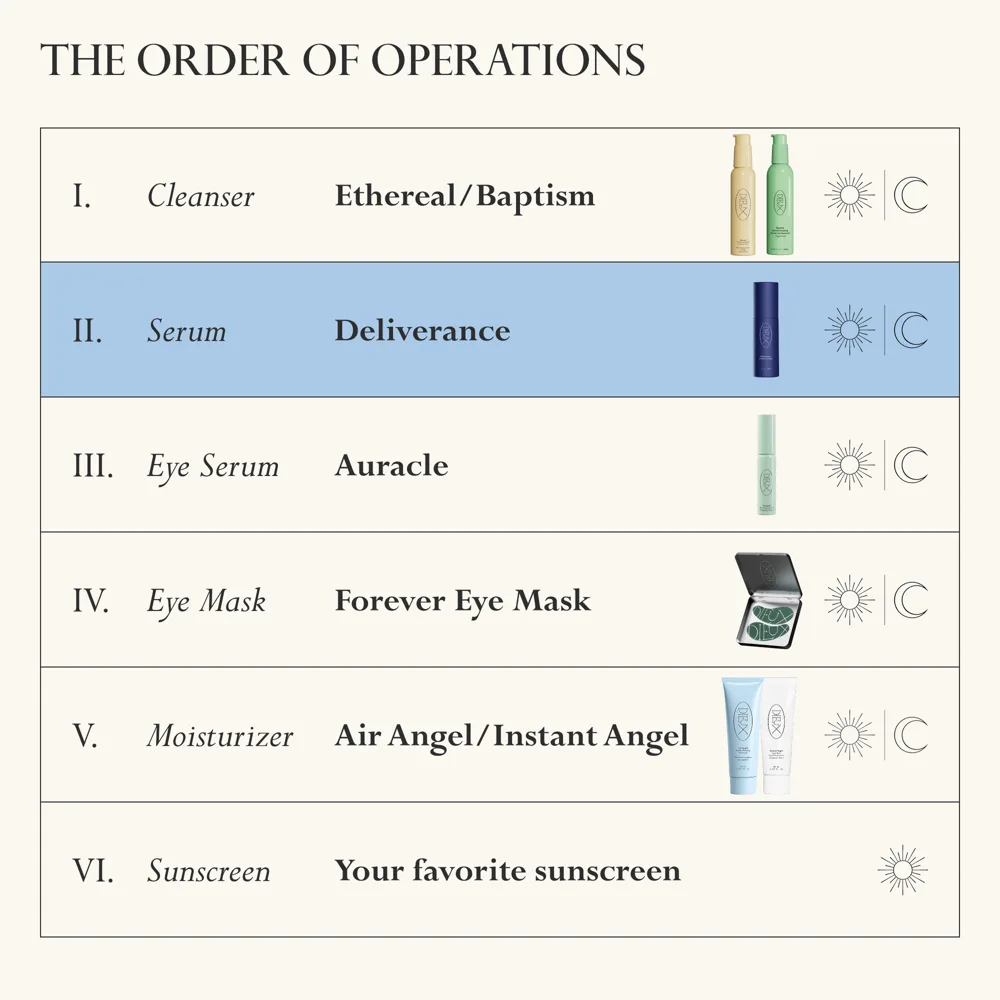
Unlike most soothing serums that rely on a single calming ingredient, this reformulated Deliverance stacks niacinamide, centella, ectoin, bisabolol, ceramides, and phytosphingosine in one bottle. The removal of hemp seed oil from the original made it fungal-acne safe, which opened the serum up to an entirely new group of users who couldn't use the original.
The reformulated non-cannabinoid version of Dieux's flagship calming serum, and for most readers it's the better buy. A multi-ingredient barrier-and-soothing stack that calms reactive skin through several mechanisms at once, now fungal-acne safe and easier to recommend. The premium price remains the only real sticking point.
Good choicefor SensitivityIn your profileYou chose · No fragrance, drying alcohol, declarable allergens or sensitising preservatives in this serum — the profile sensitive skin looks for.Not yet assessedGentle100% report improvement · n = 40
The case for it
Centella Asiatica Extract has been researched for this concern and the evidence does not support it.
It is plausibly present at a working level, though the concentration is not declared.
The formula carries none of the triggers this concern is sensitive to.
What would change this: A declared concentration would move this to a firmer reading of the dose.
Same rule for everyone. “Good choice” is the verdict on 1,938 of 45,024 concern verdicts across the catalog; rule F2 decided 1,938 of them.
Unchanged since September 5, 2026, engine 5.1.1.
Unprovenfor RosaceaIn your profileYou chose · Niacinamide has early or mechanistic evidence for rosacea — a reasonable bet, not a recommendation; the other actives here are not yet assessed for it.Limited evidenceGentle250 reviews collected
The case for it
Niacinamide has early or mechanistic evidence for this concern, not trial-backed standing.
It is plausibly present at a working level, though the concentration is not declared.
The formula carries none of the triggers this concern is sensitive to.
What would change this: A declared concentration would move this to a firmer reading of the dose.
Same rule for everyone. “Unproven” is the verdict on 1,111 of 45,024 concern verdicts across the catalog; rule R9 decided 1,111 of them.
Unchanged since September 5, 2026, engine 5.1.1.
R9 — Plausible-tier actives alone do not earn a recommendation, and 'not for this' would overstate the case against them. 'Unproven' with the evidence dots lets the reader judge the bet (added 0.2.0 after the first shadow run put a 10% niacinamide serum at 'not for this' for hyperpigmentation). 0.5.0: the closing clause reads the other heroes — "nothing else here addresses it" only when every other active has a researched 'none' row; "not yet assessed" when that is the truth. Rows whose dots read moderate or better now reach R9p first. · the full register
Carrying active
Niacinamide
Standing
plausible — trials support it
Form
plausible — studied range 2%, from the OTC monograph or label; needs leave-on contact; judge it after ~8 weeks
Tolerability
gentle
Row checked
against its sources on July 17, 2026 (evidence table ev-2026.09-r228)
Promisingfor Post-ProcedureIn your profileYou chose · Centella Asiatica has trial-level evidence for post procedure but no guideline or regulatory standing yet — promising, short of a recommendation; the other actives here are not yet assessed for it.Moderate evidenceGentle250 reviews collected
The case for it
Centella Asiatica Extract has trial-level evidence for this concern but no guideline or regulatory standing yet.
It is plausibly present at a working level, though the concentration is not declared.
The formula carries none of the triggers this concern is sensitive to.
What would change this: A declared concentration would move this to a firmer reading of the dose.
Same rule for everyone. “Promising” is the verdict on 7,858 of 45,024 concern verdicts across the catalog; rule R9p decided 7,858 of them.
Unchanged since September 5, 2026, engine 5.1.1.
R9p — 0.5.0: 'Unproven' beside three filled dots read as one question answered twice with opposite words (7,018 rows). The chip measures standing, the dots measure trial volume; where the row carries at least one RCT or a tier-2 source (moderate dots) and the active is present at a working level, the honest word is Promising. Unproven is reserved for plausible-standing rows with limited or weak evidence, or an under-dosed form. Same rank as Unproven — a bet either way; the dots order them. · the full register
Carrying active
Centella Asiatica Extract
Standing
plausible — trials support it
Form
plausible — studied range 0.05%, from the OTC monograph or label; needs leave-on contact
Tolerability
gentle
Row checked
against its sources on July 17, 2026 (evidence table ev-2026.09-r228)
Good choicefor Compromised Skin BarrierIn your profileYou chose · Niacinamide is a reference standard by mechanism for compromised skin barrier; this serum carries it high in the ingredient list.Moderate evidenceGentle250 reviews collected
The case for it
Niacinamide has trial-supported standing for this concern.
It is present at an effective concentration, declared or high in the ingredient list.
The formula carries none of the triggers this concern is sensitive to.
Same rule for everyone. “Good choice” is the verdict on 9,564 of 45,024 concern verdicts across the catalog; rule R5 decided 9,072 of them.
Unchanged since September 5, 2026, engine 5.1.1.
Good choicefor DrynessIn your profileYou chose · Ceramides is a reference standard by mechanism for dryness; this serum carries it.Moderate evidenceGentle250 reviews collected
The case for it
Ceramide NP has trial-supported standing for this concern.
It is plausibly present at a working level, though the concentration is not declared.
The formula carries none of the triggers this concern is sensitive to.
What would change this: A declared concentration would move this to a firmer reading of the dose.
Same rule for everyone. “Good choice” is the verdict on 9,564 of 45,024 concern verdicts across the catalog; rule R5 decided 9,072 of them.
Unchanged since September 5, 2026, engine 5.1.1.
R5 — Trial-supported or guideline-supported active, adequately or plausibly dosed. · the full register
Carrying active
Ceramide NP
Standing
supported — its mechanism is established
Form
plausible
Tolerability
gentle
Row checked
against its sources on July 17, 2026 (evidence table ev-2026.09-r228)
The studies behind the evidence row
Elias PM, Feingold KR (eds), Skin Barrier — stratum corneum ceramides are the principal intercellular lamellar lipid; their depletion is the biochemical signature of dry/xerotic skin — reference work
Where our review and the verdict differ. The review below was written on the formulation and the published trials; the verdicts above apply the stricter standing test in our methodology — an active earns a recommendation only with guideline or regulatory standing for the concern. Where the two disagree, the verdict is DermApproved’s position.
A verdict is DermApproved’s assessment of how well a product’s ingredients fit a concern — never a claim about what the product treats. Evidence dots and collected reviews sit beside it and are never blended in.
Rules 0.5.1 · evidence table ev-2026.09-r228 · how we decide
Assessment
Pros & Cons
Pros
✓ Multi-ingredient soothing stack addresses inflammation from several pathways simultaneously
✓ Niacinamide, centella, ectoin, and ceramides all supported by real research
✓ Fungal-acne safe unlike the original cannabinoid formulation
✓ Excellent buffer for retinoid irritation and other reactive routines
✓ Thin, watery texture layers invisibly under anything
✓ Fragrance-free, alcohol-free, and pregnancy-safe
✓ Refill program reduces plastic waste and slightly lowers repurchase cost
Cons
✗ Expensive at $85 for 30ml relative to comparable calming serums
✗ Minimal emollient content — dry skin needs a richer cream on top
✗ Glass pipette dropper can be fussy for daily use
✗ Only one size available, no travel or value option
✗ Some longtime Dieux fans prefer the discontinued cannabinoid version
Review
Full Review
When an indie brand reformulates one of its founding products, it usually happens quietly. Ingredients get swapped, labels get updated, and customers either notice or don't. Dieux did the opposite with Deliverance. The brand publicly announced on social media that they were removing the CBD from their cannabinoid serum and replacing it with a more rigorously-supported calming stack, and co-founder Charlotte Palermino walked through the reasoning with the kind of detail that most brands reserve for investor decks. The explanation came down to two things. First, the scientific evidence for topical CBD, while emerging, was never as robust as the evidence for ingredients like niacinamide, centella, and ectoin — and Dieux wanted the product to lead with its strongest cards. Second, the regulatory environment around CBD in cosmetics had become a real operational burden that was limiting where and how the brand could sell. Rather than hide the change, Dieux turned it into a public argument about what they wanted their products to stand for, and that's the right place to start when reviewing this specific version.
What you actually get in the reformulated bottle is a thin, watery serum that absorbs on contact with no tack, no grease, and no residue. The texture is closer to a toner-essence than a traditional serum — you can layer anything over it within thirty seconds without any pilling, which matters more than it sounds if you're trying to build a multi-step routine on reactive skin. Dispense two or three drops onto a clean fingertip, pat it across your face, and within minutes you'll feel the cooling, slightly cushioned finish that tells you the soothing actives are doing their job.
The formulation reads like a tour of every well-studied calming ingredient in modern skincare. Niacinamide sits near the top of the list, reducing transepidermal water loss, strengthening the stratum corneum, and calming visible redness. Centella asiatica extract delivers asiaticoside and madecassoside, two traditional wound-healing compounds with a growing evidence base for reactive skin. Ectoin, the less famous standout, is an amino-acid derivative that stabilizes cellular membranes against osmotic and oxidative stress — it's the reason this serum still handles reactive skin well without its original cannabinoid. Bisabolol contributes fast anti-inflammatory action, panthenol and allantoin add classic comfort, and ceramide NP alongside phytosphingosine and squalane rebuilds the actual lipid barrier that lets sensitivity develop in the first place. The layered, multi-mechanism approach is the whole point. Most soothing serums pick one calming ingredient and build around it. Dieux stacks six or seven, and the result is a serum that addresses inflammation, barrier loss, oxidative stress, and cellular stability all in the same bottle.
On reactive skin, the results build in predictable ways. Within the first few uses you'll notice an immediate cooling sensation and a softer look after application. Over one to two weeks of twice-daily use, baseline redness tends to recede and triggers like weather changes, stress, or active ingredients produce less dramatic reactions. Over four to eight weeks, the barrier story takes over — your skin becomes genuinely more tolerant, and the serum stops being something you reach for to calm a flare-up and starts being a maintenance layer that prevents flare-ups from happening in the first place. That's the real value of a well-built soothing serum, and this one delivers on it as reliably as anything we've reviewed in the category.
The reformulation also fixed the one meaningful practical problem with the original Deliverance. The old version contained hemp seed oil, which made it unsuitable for anyone with fungal acne or Malassezia-driven conditions. The new version swaps that out for squalane, which is a saturated hydrocarbon that doesn't feed yeast, and this means an entire group of readers who couldn't use the original can now use the reformulation without issue. That's not a minor change — fungal acne is a relatively common issue that many 'soothing' serums ironically make worse. Dieux fixed it quietly in the reformulation, and the product is stronger for it.
The flaws are few and mostly predictable. The price remains high for the category at $85 for 30ml, and it's fair to point out that comparable niacinamide-and-centella serums from other brands are available for less. The glass pipette can be fussy for daily dispensing, though this is a common complaint across the Dieux line and part of the trade-off for refillable glass packaging. And the formula is intentionally minimal on richer emollient ingredients — if you have very dry or mature skin, you'll want to layer a heavier moisturizer on top, because this is a serum that calms and rebuilds but does not provide substantial occlusive comfort on its own.
The value conversation is where honesty matters most. This is a genuinely well-built product and it's probably the best-formulated entry in Dieux's lineup after Forever Eye Mask. The $85 price tag is defensible if you care about the refill program, the brand's transparency ethos, and the specific multi-ingredient stacking approach. It's harder to defend on pure ingredient-to-dollar math, because you can get niacinamide, centella, and ceramides in a single serum from several established brands at $30-$50. What you can't get elsewhere is this specific combination of ingredients, this level of formulation care, and this particular brand's public commitment to evolving its products transparently over time. Whether that package is worth the premium is a personal call, but for readers who value it, this serum earns its place in a routine. For readers who don't, there are good alternatives, and you shouldn't feel bad about picking one.
Formula
Key Ingredients
The hero actives that drive this product's performance.
The lead active in this reformulated barrier serum, working at a well-tolerated concentration to reduce transepidermal water loss and soothe visible redness. In this formula it anchors a multi-soother stack — centella handles inflammation, ceramides rebuild barrier lipids, and niacinamide integrates both effects at the cellular level.
Established mechanismfor Compromised Skin Barrier · established mechanism
A traditional calming extract rich in asiaticoside and madecassoside. Works in this serum to reduce visible redness and support wound healing, filling the soothing role that CBD occupied in the original Deliverance formulation.
An amino acid derivative that stabilizes cellular membranes against environmental and oxidative stress. In this reformulation it's a meaningful reason the serum still calms reactive skin without its original cannabinoid active — ectoin addresses the osmotic stress angle of sensitivity.
Provides structural barrier lipid replenishment, working alongside phytosphingosine and squalane to rebuild the skin barrier that allows sensitivity to develop in the first place. Small but functional concentration paired with niacinamide for synergistic barrier effects.
Established mechanismfor Compromised Skin Barrier · established mechanism
A chamomile-derived anti-inflammatory that complements the centella by addressing acute redness and irritation. In this formula it's the fast-acting soother that provides the immediate calming sensation within minutes of application.
Not yet assessed
Ingredient standings describe the active at treatment-level doses and
vehicles; this product's own condition grades weigh its actual formula.
Apply to clean skin before heavier moisturizers. Pat gently — the thin texture absorbs within seconds. Can layer before or after retinoids to buffer irritation.
Results Timeline
Immediate cooling and soothing within minutes. Short-term (1-2 weeks): reduced reactivity and baseline redness. Full benefits (4-8 weeks): measurable improvement in barrier function and tolerance of other actives.
This reformulated serum is anchored by some of the best-studied calming actives in modern skincare. Niacinamide has extensive peer-reviewed support for reducing transepidermal water loss, improving barrier function, and reducing visible redness — a body of evidence going back decades that makes it one of the most reliable ingredients in the category. Centella asiatica extract contributes asiaticoside, madecassoside, and asiatic acid, triterpenoid compounds with published research on wound healing and anti-inflammatory effects. A commonly cited review in the Journal of Ethnopharmacology documented centella's role in modulating inflammatory cytokine expression and supporting collagen synthesis, which aligns with the reputation centella has earned in Korean skincare as a go-to for compromised skin. Ectoin, though less famous, has emerging research supporting its role as a cellular membrane stabilizer under osmotic and oxidative stress, particularly in the context of environmental aggressors and sensitive skin. Bisabolol, a sesquiterpene derived from chamomile, has well-documented anti-inflammatory effects and has been used in dermatology for decades for its ability to reduce acute erythema. The barrier-repair story is completed by ceramide NP, phytosphingosine, and squalane, which collectively rebuild the lipid matrix of the stratum corneum. What makes this specific formulation interesting is the stacking strategy. Rather than relying on any single soothing ingredient, Dieux layers six or seven complementary mechanisms — barrier reinforcement, anti-inflammatory action, cellular stress protection, and wound-healing support — so that the final performance on reactive skin is less dependent on the variability of any one ingredient. This is sophisticated, evidence-literate formulation.
Dermatologist Perspective
Dermatologists typically welcome well-formulated soothing serums with niacinamide, centella, and ceramides as appropriate choices for patients with rosacea, eczema, post-procedure skin, and general sensitivity. Working dermatologists often point out that multi-ingredient soothing stacks have a real advantage over single-active formulations because reactive skin is rarely a single-pathway problem — barrier dysfunction, inflammation, and oxidative stress all contribute, and a formulation that addresses multiple pathways simultaneously tends to perform more consistently in clinical practice. Deliverance is generally considered a safe layer to recommend alongside prescription treatments for rosacea and eczema, and is often used as a buffer for patients starting tretinoin or other retinoid therapies. The main caveat from dermatologists is that this serum will not replace prescription treatments for moderate-to-severe inflammatory conditions.
Guidance
Usage & Recommendations
How to Use
Apply twice daily, morning and evening, after cleansing and any water-based toner. Dispense two or three drops onto a clean fingertip or directly onto damp skin, and pat gently across the face and neck, focusing on areas of visible redness or reactivity. Allow 30 seconds for absorption before layering moisturizer, sunscreen, or treatment products. Can be applied before a retinoid as a buffer layer, or after a retinoid on particularly reactive nights. Works well as a daily maintenance layer in routines with strong actives. Store upright at room temperature and close the pipette firmly after each use.
Value Assessment
At $85 for 30ml, Deliverance remains expensive relative to the competition. The formulation is genuinely high-quality and reflects careful indie-brand construction, but comparable soothing serums built around niacinamide and centella are widely available at $30-$50 from more established brands. The premium here reflects Dieux's small-batch economics, refillable glass packaging, and the brand's unusually high investment in transparent communication. The refill program does reduce the per-use cost on repurchase by a few dollars, and readers who value the brand's ethos will find the price reasonable. Readers optimizing for pure ingredient value should know that equivalent stacks exist elsewhere for less.
Who Should Buy
Readers with sensitive, reactive, or rosacea-prone skin who want a sophisticated multi-ingredient calming serum. Anyone building or maintaining a retinoid routine and looking for a reliable buffer layer. Fungal-acne-prone readers who wanted to try the original Deliverance but couldn't. Dieux loyalists and readers who value the brand's transparency and refill program.
Who Should Skip
Budget-conscious shoppers who can get comparable niacinamide-and-centella stacks for half the price. Very dry or mature skin that needs a richer, more emollient serum rather than a water-weight calming layer. Readers who specifically wanted the original cannabinoid version — the reformulated one is different by design.
A thin, watery serum with a faint gel feel that absorbs on contact without any tackiness.
Scent
Completely fragrance-free with a faint, neutral ingredient scent.
Packaging
Opaque glass bottle with a glass pipette dropper, compatible with Dieux's refill pouch program.
Finish
lightweightfast-absorbingsatin
What to Expect on First Use
On first application, the serum feels cool and calming within seconds. Users with reactive skin typically notice reduced redness within the first few uses. Absorbs within 30 seconds leaving no residue — you can layer anything on top without pilling or interference.
How Long It Lasts
About 2-3 months per unit with twice-a-day use to the face
This version of Deliverance launched in 2023 as a reformulation of Dieux's original 2021 cannabinoid-containing serum. Dieux publicly announced the reformulation on social media and explained that the CBD was being removed in favor of a stack of more rigorously-supported calming ingredients, while preserving the core barrier-repair ethos. The reformulation was controversial with longtime fans of the original but has been well-received on its own merits.
About Dieux Emerging Brand (2–5 years)
Dieux Skin was co-founded in 2020 by Charlotte Palermino, Joyce de Lemos, and Marta Cros. The brand has built credibility through transparent formulation communication and a commitment to refillable packaging. This reformulated version of Deliverance replaced the brand's original CBD-containing serum.
Brand founded: 2020 · Product launched: 2023
Myth vs. Reality
Common Myths
Myth
The reformulated Deliverance is weaker than the original because CBD was removed.
Reality
CBD was only one ingredient in the original soothing stack. The reformulated version actually strengthens the core barrier-repair story by adding phytosphingosine and increasing emphasis on well-studied soothers like ectoin and centella. On most measures, this version performs equally or better on reactive skin.
FAQ
Frequently Asked Questions
How does this compare to the original CBD Deliverance?
The reformulated version removes the CBD and hemp seed oil but preserves the niacinamide, centella, ectoin, and ceramide backbone. It adds phytosphingosine for additional barrier support and is now fungal-acne safe. Performance on general sensitivity and redness is comparable to the original.
Is this worth $85 for 30ml?
The formulation is well-built and genuinely effective for reactive skin, but the price premium reflects Dieux's indie economics and refill program. Comparable niacinamide-and-centella serums are available at lower price points. If you value the brand's transparency ethos and refillable packaging, the price is defensible; if you're optimizing purely for ingredients per dollar, you'll find better value elsewhere.
Can I layer this with retinol or tretinoin?
Absolutely. This serum is specifically designed to buffer retinoid irritation. Apply it before your retinoid to pre-soothe the skin, or immediately after on particularly reactive nights. The niacinamide, centella, ectoin, and ceramides collectively mitigate retinoid-related redness and peeling.
Is Deliverance Serum considered safe for pregnant users?
Yes — the reformulated version contains no retinoids, salicylic acid, or cannabinoids, and all ingredients are generally considered safe during pregnancy. However, if you have specific concerns or a high-risk pregnancy, consult your OB before adding any new product to your routine.
Will this clear my redness from rosacea?
It will visibly reduce redness and reactivity for many rosacea-prone users over several weeks, but it is a cosmetic soothing serum and not a prescription treatment. Persistent or moderate-to-severe rosacea still requires dermatologist-prescribed therapies like topical ivermectin, metronidazole, or azelaic acid — use this serum alongside those treatments, not as a replacement.
Is Deliverance Serum safe for fungal-acne-prone skin?
Yes — unlike the original Deliverance, which contained hemp seed oil, this reformulated version is fungal-acne safe. The squalane is an unsaturated hydrocarbon that does not feed Malassezia, and the rest of the formula uses non-triggering humectants and peptide-derived soothers.
Reviews
What Reviewers Tend to Say
Recurring themes our editors read across retailer reviews of this product — summaries in our words, not quotations, and not a substitute for your own patch test.
Chamomile's active fraction inhibits the same inflammatory pathways a steroid does, at a fraction of the strength — and the version that works best is grubbed out of Brazilian cerrado, while the synthetic substitute is half inactive by construction.
Ectoin protects microbes in some of Earth's harshest habitats by rearranging water itself. In 2026 it's the barrier ingredient with unusually real science — and one honest limit the marketing skips.
Western sensitive skincare works by subtraction — remove the fragrance, remove the alcohol, shorten the list. Japan's answer adds a designed molecule back in, and one of the two bets has a trial literature.
A wrecked barrier is the most common self-inflicted skin condition and the one with the clearest fix — the difficulty is that the routine which caused it feels productive and the one that repairs it feels like giving up.
Aug 5, 2026· 8 min
Questions people ask about sensitive skin
Verified answers from our questions library — the nuance a product page cannot carry.
Products, answers, therapy guides, tools and articles in one search. Brand names,
slang and abbreviations all work — accutane finds isotretinoin, bacne finds truncal acne.