What separates the #3 from the #2 is salicylic acid — a beta hydroxy acid that penetrates into pores due to its oil-solubility, dissolving the sebum plugs that cause blackheads and congestion from the inside. This makes it a genuine BHA treatment toner rather than just a surface exfoliant. The #3 has been the go-to version for oily and acne-prone skin within the Three-Step System for decades.
The salicylic acid earns its place here — genuine BHA pore-clearing in a toner format that oily skin types have relied on for decades. But the alcohol delivery system is a relic of sixties formulation, and modern BHA toners do the same job without punishing your barrier in the process.
Promisingfor Excess OilinessIn your profileYou chose · Salicylic Acid has trial-level evidence for excess oiliness but no guideline or regulatory standing yet — promising, short of a recommendation; the other actives here are not yet assessed for it.Moderate evidenceGentleNo reviews collected yet
The case for it
Salicylic Acid has trial-level evidence for this concern but no guideline or regulatory standing yet.
It is plausibly present at a working level, though the concentration is not declared.
The formula carries none of the triggers this concern is sensitive to.
What would change this: A declared concentration would move this to a firmer reading of the dose.
Same rule for everyone. “Promising” is the verdict on 7,858 of 45,024 concern verdicts across the catalog; rule R9p decided 7,858 of them.
Unchanged since September 5, 2026, engine 5.1.1.
R9p — 0.5.0: 'Unproven' beside three filled dots read as one question answered twice with opposite words (7,018 rows). The chip measures standing, the dots measure trial volume; where the row carries at least one RCT or a tier-2 source (moderate dots) and the active is present at a working level, the honest word is Promising. Unproven is reserved for plausible-standing rows with limited or weak evidence, or an under-dosed form. Same rank as Unproven — a bet either way; the dots order them. · the full register
Carrying active
Salicylic Acid
Standing
plausible — trials support it
Form
plausible — studied range 30%, from the trials on the row; needs leave-on contact; judge it after ~6 weeks
Tolerability
gentle
Row checked
against its sources on July 17, 2026 (evidence table ev-2026.09-r228)
Not for thisfor Large PoresIn your profileYou chose · The actives here have been researched for large pores and the evidence does not support the claim.Not yet assessedGentleNo reviews collected yet
The case for it
Salicylic Acid has been researched for this concern and the evidence does not support it.
It is plausibly present at a working level, though the concentration is not declared.
The formula carries none of the triggers this concern is sensitive to.
What would change this: A declared concentration would move this to a firmer reading of the dose.
Same rule for everyone. “Not for this” is the verdict on 488 of 45,024 concern verdicts across the catalog; rule R10 decided 488 of them.
Unchanged since September 5, 2026, engine 5.1.1.
Strong choicefor AcneIn your profileYou chose · Salicylic Acid is an approved or monograph active for acne; this liquid carries it, though the concentration is not declared.Moderate evidenceStandard tolerabilityNo reviews collected yet
The case for it
Salicylic Acid is a first-line active — approved, monograph-listed or named in current guidelines — for this concern.
It is plausibly present at a working level, though the concentration is not declared.
The formula carries no trigger this concern is sensitive to, with the cautions noted.
Cautions: known irritants.
What would change this: A declared concentration would move this to a firmer reading of the dose.
Same rule for everyone. “Strong choice” is the verdict on 1,459 of 45,024 concern verdicts across the catalog; rule R3 decided 567 of them.
Unchanged since September 5, 2026, engine 5.1.1.
R3 — Undeclared but plausibly dosed (top-third INCI position, or a potent sub-1% active) — the verdict stands, and the sentence says what disclosure would add. A declared figure below range would have been sub-threshold. · the full register
Carrying active
Salicylic Acid
Standing
first line — a regulator recognises it for this use; trials support it · per § 333.310 Acne active ingredients. (U.S. Food and Drug Administration — 21 CFR Part 333 Subpart D (Topical Acne Drug Products), Code of Federal Regulations via GovInfo), opened July 27, 2026
Form
plausible — studied range 0.5–2%, from the OTC monograph or label; judge it after ~6 weeks
Tolerability
standard — irritant load
Row checked
against its sources on July 27, 2026 (evidence table ev-2026.09-r228)
Strong choicefor BlackheadsIn your profileYou chose · Salicylic Acid is an approved or monograph active for blackheads; this liquid carries it, though the concentration is not declared.Moderate evidenceGentleNo reviews collected yet
The case for it
Salicylic Acid is a first-line active — approved, monograph-listed or named in current guidelines — for this concern.
It is plausibly present at a working level, though the concentration is not declared.
The formula carries none of the triggers this concern is sensitive to.
What would change this: A declared concentration would move this to a firmer reading of the dose.
Same rule for everyone. “Strong choice” is the verdict on 1,459 of 45,024 concern verdicts across the catalog; rule R3 decided 567 of them.
Unchanged since September 5, 2026, engine 5.1.1.
R3 — Undeclared but plausibly dosed (top-third INCI position, or a potent sub-1% active) — the verdict stands, and the sentence says what disclosure would add. A declared figure below range would have been sub-threshold. · the full register
Carrying active
Salicylic Acid
Standing
first line — a regulator recognises it for this use; trials support it · per 21 CFR § 333.350 - Labeling of acne drug products. (US Code of Federal Regulations (Legal Information Institute, Cornell Law School)), opened July 27, 2026
Form
plausible — studied range 0.5–2%, from the OTC monograph or label; judge it after ~6 weeks
Tolerability
gentle
Row checked
against its sources on July 27, 2026 (evidence table ev-2026.09-r228)
The studies behind the evidence row
OTC monograph, Topical Acne Drug Products — salicylic acid 0.5–2% recognized as an acne treatment active — US Food and Drug Administration
Good choicefor Rough TextureIn your profileYou chose · Salicylic Acid is a reference standard by mechanism for rough texture; this liquid carries it high in the ingredient list.Moderate evidenceGentleNo reviews collected yet
The case for it
Salicylic Acid has trial-supported standing for this concern.
It is present at an effective concentration, declared or high in the ingredient list.
The formula carries none of the triggers this concern is sensitive to.
Same rule for everyone. “Good choice” is the verdict on 9,564 of 45,024 concern verdicts across the catalog; rule R5 decided 9,072 of them.
Unchanged since September 5, 2026, engine 5.1.1.
Promisingfor DullnessIn your profileYou chose · Hyaluronic Acid has trial-level evidence for dullness but no guideline or regulatory standing yet — promising, short of a recommendation; the other actives here are not yet assessed for it.Moderate evidenceGentleNo reviews collected yet
The case for it
Sodium Hyaluronate has trial-level evidence for this concern but no guideline or regulatory standing yet.
It is plausibly present at a working level, though the concentration is not declared.
The formula carries none of the triggers this concern is sensitive to.
What would change this: A declared concentration would move this to a firmer reading of the dose.
Same rule for everyone. “Promising” is the verdict on 7,858 of 45,024 concern verdicts across the catalog; rule R9p decided 7,858 of them.
Unchanged since September 5, 2026, engine 5.1.1.
R9p — 0.5.0: 'Unproven' beside three filled dots read as one question answered twice with opposite words (7,018 rows). The chip measures standing, the dots measure trial volume; where the row carries at least one RCT or a tier-2 source (moderate dots) and the active is present at a working level, the honest word is Promising. Unproven is reserved for plausible-standing rows with limited or weak evidence, or an under-dosed form. Same rank as Unproven — a bet either way; the dots order them. · the full register
Carrying active
Sodium Hyaluronate
Standing
plausible — trials support it
Form
plausible
Tolerability
gentle
Row checked
against its sources on July 17, 2026 (evidence table ev-2026.09-r228)
Does the jobDoes what a toner is for: not alcohol-driven, adds something real. Not measured from the label: restores skin pH, plays well with what follows.
A verdict is DermApproved’s assessment of how well a product’s ingredients fit a concern — never a claim about what the product treats. Evidence dots and collected reviews sit beside it and are never blended in.
Rules 0.5.1 · evidence table ev-2026.09-r228 · how we decide
Assessment
Pros & Cons
Pros
✓ Salicylic acid provides genuine BHA pore-clearing that surface-only exfoliants cannot match
✓ Nearly sixty years of market validation with thousands of satisfied repeat purchasers
✓ Reformulated with hyaluronic acid glycerin and trehalose to buffer drying effects
✓ Multiple size options including value jumbo sizes for committed Three-Step users
✓ Fragrance-free and paraben-free despite the legacy formula
Cons
✗ Alcohol denat. as second ingredient creates significant barrier disruption potential
✗ Salicylic acid concentration is undisclosed making potency assessment difficult
✗ Modern BHA toners achieve similar results without alcohol-induced irritation
✗ Can cause flaking and over-drying if not followed with adequate moisturizer
✗ Stings noticeably on application which some users find unpleasant
Review
Full Review
If the Clarifying Lotion 2 invented daily exfoliation, the Clarifying Lotion 3 invented daily pore clearing. The addition of salicylic acid — a beta hydroxy acid that's oil-soluble and can therefore penetrate into the sebum-filled pore lining — transformed the Step 2 experience from surface smoothing into genuine congestion treatment. For combination-oily skin types, this distinction matters enormously. Dead cells on the surface create dullness. Dead cells trapped inside pores create blackheads. You need different tools for each problem.
Salicylic acid is that different tool. Unlike the glycolic and lactic acids that dominate many modern exfoliating toners, BHA doesn't just work on the surface — it dissolves the intercellular glue within the pore itself, loosening the compacted mixture of sebum, dead keratinocytes, and debris that forms a blackhead. The concentration in this formula likely sits around 0.5%, enough for maintenance-level pore clearing without the intensity of a 2% treatment product. It's designed for daily use within a routine, not as a standalone acne treatment. Clinique doesn't disclose the number, which is its own small frustration in an era when most brands do.
The witch hazel provides complementary surface-level astringent activity. Its tannins temporarily tighten pore openings, creating an immediate refinement effect that's visible within minutes of application. The combination of internal BHA action and external astringent tightening is what makes the Three-Step faithful describe their pores as looking 'cleaner' than they do with any other toner.
The cotton pad ritual is part of the product's enduring appeal. Sweeping a soaked pad across the face produces visible residue — dead cells, sebum, and traces of remaining cleanser — that provides tangible, satisfying proof the product is doing something. This sensory feedback loop is psychologically powerful and is one reason the Three-Step System generates such strong loyalty. You can see the exfoliation happening, which almost no other step in skincare offers.
But we need to talk about the alcohol again. It's the second ingredient, same as in the #2, and it's doing the same thing: serving as a fast-evaporating vehicle that delivers the actives and then disappears, leaving that instant matte-tight sensation oily skin users interpret as clean. In 1968, this was standard formulation, and Norman Orentreich was working with the tools of his decade. Today we know that chronic alcohol exposure dissolves the intercellular lipids of the stratum corneum, raises transepidermal water loss, and can actually worsen oil production by provoking compensatory sebum secretion. The reformulation added sodium hyaluronate, glycerin, and trehalose as hydration buffers — the same strategy as the #2 — but these additions are mitigation, not elimination. The trehalose in particular does real work stabilizing membranes under dehydration stress. It is a life raft, not a hull.
That compensatory-oil mechanism is worth dwelling on, because it drives the single most common mistake people make with this product. Oily skin sees a matte face after toning and concludes that moisturizer would undo the good work. The opposite happens. Skin stripped of its lipids signals for more, and by three o'clock the T-zone has answered emphatically. Follow this toner with an oil-free moisturizer every single time, or the shine you're fighting will be partly of your own manufacture.
The honest reality is that modern BHA toners deliver equivalent or superior salicylic acid exfoliation in alcohol-free, pH-optimized vehicles that don't require a hydration safety net. They work without stinging, without stripping, and without the barrier risk daily alcohol exposure creates. The science of exfoliation has advanced considerably since the original formulation, and this bottle has not moved with it.
That said, the Clarifying Lotion 3 works. Thousands of reviews and decades of consistent repurchase confirm that for oily and combination skin types who tolerate alcohol, it delivers visible pore refinement, blackhead reduction, and improved skin clarity over weeks of daily use. The formula's longevity on the market is itself a form of evidence — products that don't deliver results don't survive sixty years of competition. Introduce it once daily and build to twice over a fortnight; a little flaking in week one is the BHA finding its footing.
At twenty-three dollars for 6.7 ounces — two to three months of twice-daily use — the pricing is fair for prestige, and the jumbo sizes offer excellent per-ounce value for committed users. The pregnancy caution around salicylic acid is worth noting: while the concentration is likely low, many clinicians advise switching to BHA-free alternatives during pregnancy, which makes the #2 the safer Three-Step option for expecting users. Dry, sensitive, rosacea-prone or eczematous skin should not be anywhere near this bottle.
There's also a fairness point owed to the salicylic acid itself, which takes blame it hasn't earned. At the concentration used here — well under the two percent ceiling of an over-the-counter acne treatment — daily BHA is comfortably tolerable for the oily and combination skin this bottle was designed around. What stings on application, what tightens, what flakes in the second week, is overwhelmingly the alcohol. Remove it and you'd have a mild, sensible exfoliating toner nobody would think twice about.
This is a legacy product in the truest sense. It works, it's been validated by time, and for the right skin type, it delivers real results. It's also a product that formulation science has clearly surpassed. The question isn't whether it's effective — it is. The question is whether effectiveness with unnecessary irritation is still the best option when gentler alternatives exist.
Formula
Key Ingredients
The hero actives that drive this product's performance.
The defining upgrade from Clarifying Lotion 2 — a beta hydroxy acid that penetrates into pores due to its oil-solubility, dissolving the sebum and dead cell buildup that causes blackheads and congestion. In this alcohol-based vehicle, the salicylic acid is delivered in a quick-penetrating format that doesn't linger on the surface.
Established mechanismfor Rough Texture · established mechanism
Works alongside the salicylic acid as a secondary astringent, providing tannin-based pore-tightening action on the surface while the BHA works within the pores. The combination addresses congestion from two directions — surface refinement and internal decongestion.
The hydration counterbalance in a formula dominated by alcohol and BHA. Draws moisture into the newly exfoliated stratum corneum, preventing the excessive dryness and flaking that untreated BHA application can cause on combination-oily skin.
Protects skin cells from dehydration stress caused by the alcohol vehicle, stabilizing cell membranes and preventing the protein denaturation that repeated alcohol exposure can trigger over time.
Not yet assessed
Ingredient standings describe the active at treatment-level doses and
vehicles; this product's own condition grades weigh its actual formula.
Sweep across face with a cotton pad after cleansing, concentrating on the T-zone and areas prone to congestion. Follow immediately with moisturizer. The #3 formula is designed for combination-oily skin — if you're on the drier side of combination, try #2 instead.
Results Timeline
Immediate clean matte feeling. Pores appear refined within 1-2 weeks. Blackheads and congestion noticeably reduced at 4-6 weeks. Oil control improves progressively with consistent use.
Pairs Well With
Clinique Dramatically Different Moisturizing Geloil-free moisturizersniacinamide serums
Salicylic acid's pore-clearing mechanism is well-established in dermatological literature. As a beta hydroxy acid with oil-solubility (log P of 2.26), it penetrates into the lipid-rich environment within pores, where it disrupts the desmosomal connections between corneocytes and dissolves the sebaceous plugs that form comedones. This oil-soluble penetration is what distinguishes BHA from water-soluble AHAs like glycolic acid, which primarily work on the skin surface.
At the likely concentration of 0.5% or below in this formula, salicylic acid provides maintenance-level exfoliation rather than therapeutic acne treatment. Research reported in the Journal of the American Academy of Dermatology has established that even low-concentration salicylic acid improves skin texture, reduces comedone counts, and enhances overall skin clarity when used consistently over four to eight weeks.
The alcohol vehicle, while cosmetically elegant as a fast-evaporating delivery system, has well-documented effects on the skin barrier. Ethanol and its denatured forms dissolve intercellular lipids in the stratum corneum, increasing transepidermal water loss and reducing the barrier's defensive capacity. The trehalose in this formula provides some protection — this disaccharide has been shown to stabilize phospholipid membranes during dehydration stress — but the protection is partial rather than complete against chronic daily alcohol exposure.
Dermatologist Perspective
Dermatologists recognize the Clarifying Lotion 3 as a historically significant product that introduced millions of consumers to BHA exfoliation. Dermatologists in everyday practice consistently observe that the salicylic acid provides genuine pore-clearing benefit for oily and combination skin types. However, most dermatologists today would recommend alcohol-free BHA formulations as first-line toners, reserving the Clinique system for patients who have used it successfully for years and prefer not to change. Dermatologists also advise that the salicylic acid content, while likely low, warrants discussion with pregnant or breastfeeding patients.
Guidance
Usage & Recommendations
How to Use
After cleansing, saturate a cotton pad and sweep across the entire face and neck, concentrating on the T-zone and areas prone to congestion and blackheads. Avoid the eye area. Use twice daily as Step 2 in the Three-Step System. Always follow immediately with moisturizer — skipping this step can worsen oil production. If new to BHA, start with once daily and increase to twice daily over two weeks.
Value Assessment
At twenty-three dollars for 6.7 ounces, the Clarifying Lotion 3 offers decent value for a prestige BHA toner — two to three months of twice-daily use at the standard size. The jumbo sizes (13.5 oz and 16.5 oz) bring the per-ounce cost down significantly for committed users. Compared to modern prestige BHA toners that range from twenty to forty dollars for similar volumes, the pricing is competitive. However, effective drugstore BHA toners now exist at half the price without the alcohol content.
Who Should Buy
Combination-oily skin types with visible blackheads, pore congestion, and excess shine who want a daily BHA toner within the trusted Clinique Three-Step framework. Ideal for longtime users who know the formula works for their skin and value the consistency of a decades-old routine.
Who Should Skip
Dry, sensitive, or rosacea-prone skin. Anyone with a compromised skin barrier or active eczema. Those who cannot tolerate alcohol in skincare products. Pregnant or breastfeeding individuals should consult their healthcare provider due to the salicylic acid content.
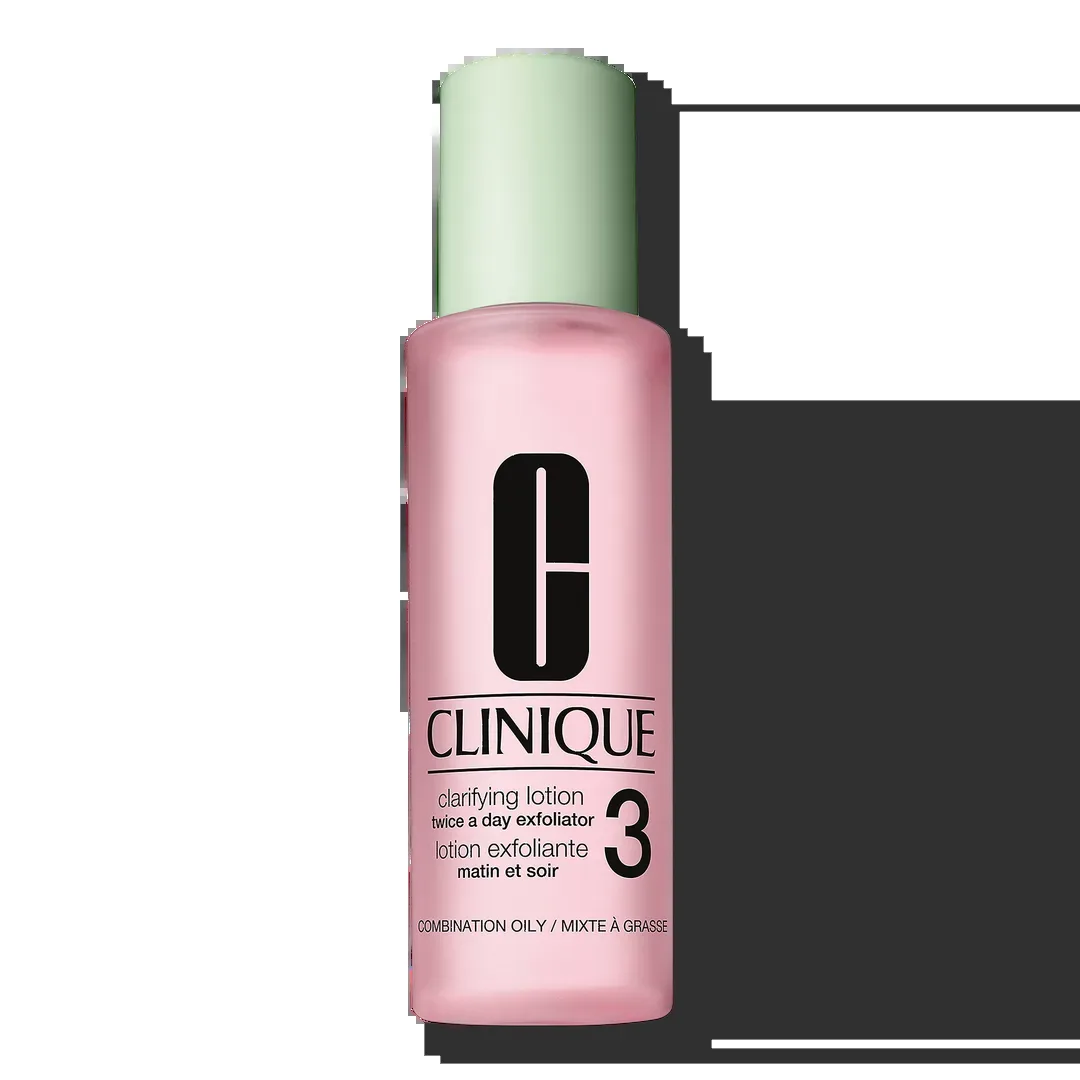
Thin, watery liquid with a subtle purple-orange tint. Applied with a cotton pad. Non-viscous and quick-drying.
Scent
Fragrance-free but the alcohol scent is pronounced — more noticeable than the #2 version. Dissipates within seconds.
Packaging
Iconic Clinique clear bottle with green cap. Available in 2.0 oz, 6.7 oz, 13.5 oz, and 16.5 oz sizes.
Finish
matteclean
What to Expect on First Use
A definite sting on application — sharper than the #2 due to the salicylic acid. The combination of alcohol and BHA creates an intense clean sensation that oily skin users often describe as satisfying. Cotton pad shows visible residue. Skin feels matte and tight within seconds. Some mild dryness or flaking may occur in the first week as skin adjusts to the BHA.
Clarifying Lotion 3 has been the workhorse of the Three-Step System for combination-oily skin since 1968. While the #2 caters to drier skin with gentler exfoliation, the #3 adds salicylic acid for the pore-clogging, blackhead-prone, oily T-zone that defined the skin type Clinique originally called 'Skin Type III.' It's the formula that taught a generation of oily-skinned teenagers and young adults that their skin needed exfoliation, not punishment.
About Clinique Legacy Brand (20+ years)
Clinique was founded in 1968 as the first prestige cosmetics brand to be allergy-tested and fragrance-free, developed in partnership with dermatologist Norman Orentreich. A subsidiary of Estée Lauder Companies, Clinique pioneered dermatologist-guided skincare and remains one of the most recognized prestige skincare brands worldwide.
Brand founded: 1968
Myth vs. Reality
Common Myths
Myth
Salicylic acid in toner is too harsh for daily use
Reality
The concentration in this formula is likely 0.5% or lower — well below the 2% maximum in OTC acne treatments. At this level, daily use is generally tolerable for oily and combination skin types, though the alcohol vehicle adds irritation that the salicylic acid alone would not cause.
Myth
Oily skin doesn't need moisturizer after using this toner
Reality
The combination of alcohol and salicylic acid can strip the skin's protective lipids, triggering compensatory oil production. Always follow with an oil-free moisturizer to maintain hydration — skipping moisturizer after this toner typically makes oiliness worse, not better.
FAQ
Frequently Asked Questions
What is the difference between Clinique Clarifying Lotion 2 and 3?
Clarifying Lotion 3 contains salicylic acid (a BHA that penetrates pores to dissolve congestion), while Lotion 2 uses acetyl glucosamine for gentler surface exfoliation without pore-penetrating BHA. Choose #2 for dry-combination skin, #3 for combination-oily skin with blackheads and congestion.
Can I use Clinique Clarifying Lotion 3 with retinol?
Use with caution. Both salicylic acid and retinol are exfoliating actives, and combining them can over-strip the skin barrier. Apply the Clarifying Lotion in the morning and retinol at night, or alternate days. Always follow with moisturizer and SPF.
Is Clinique Clarifying Lotion 3 safe during pregnancy?
This formula contains salicylic acid, which some dermatologists advise avoiding during pregnancy — particularly at higher concentrations. While the concentration here is likely low (under 1%), consult your healthcare provider. Clarifying Lotion 2 does not contain salicylic acid and may be a safer alternative.
Why does Clinique Clarifying Lotion 3 sting when I apply it?
The sting comes from the combination of alcohol denat. (second ingredient) and salicylic acid contacting freshly cleansed skin. This is typical for alcohol-based BHA products. If the stinging is severe or persistent, the formula may be too strong for your skin — try #2 instead.
How often should I use Clinique Clarifying Lotion 3?
Clinique recommends twice daily (morning and evening) as Step 2 of the Three-Step System. However, if you experience dryness or irritation, start with once daily — preferably evening — and increase frequency as your skin acclimates. Always follow with moisturizer.
Reviews
What Reviewers Tend to Say
Recurring themes our editors read across retailer reviews of this product — summaries in our words, not quotations, and not a substitute for your own patch test.
Common Praise
Visibly reduces blackheads and pore congestion within weeks
Mattifies oily T-zone effectively throughout the day
The satisfying cotton-pad residue confirms dead skin removal
Part of a trusted decades-old skincare system
Multiple sizes from travel to jumbo offer great flexibility
Common Complaints
High alcohol content stings and can over-dry even oily skin
Formula feels outdated compared to modern BHA toners
Salicylic acid concentration isn't disclosed on packaging
Can cause flaking if not followed with adequate moisturizer
The alcohol scent is noticeable and unpleasant
Notable Endorsements
Part of Clinique's iconic 1968 Three-Step Skin Care System
The whole case for salicylic acid rests on one unglamorous fact of chemistry: it dissolves in oil. Understand that, and you know exactly when it beats a glycolic acid — and when it's overkill.
The supplier specification for standard witch hazel water caps the tannin content — the fraction all the research is about — at a level indistinguishable from none. The tightness you feel is the solvent.
Those tiny dots on your nose are almost certainly not blackheads — they're normal, functional plumbing you will never 'clear,' and the extraction obsession is quietly wrecking the skin around them.
Jun 6, 2026· 6 min
Questions people ask about Acne
Verified answers from our questions library — the nuance a product page cannot carry.
Products, answers, therapy guides, tools and articles in one search. Brand names,
slang and abbreviations all work — accutane finds isotretinoin, bacne finds truncal acne.