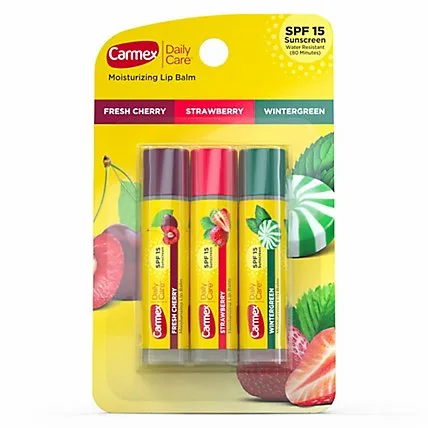
Unlike the Classic medicated formula with its camphor-menthol tingle, Daily Care is Carmex's gentle daily-driver lip balm — no medicated actives, just SPF protection and moisture in a variety of flavors. It's the Carmex for people who want the brand's occlusive protection without the medicinal experience.
A budget-friendly daily SPF lip balm that delivers reliable moisture and passable sun protection, but the inclusion of oxybenzone — increasingly avoided in modern formulations — and limited UVA coverage make it feel like a product that hasn't quite caught up with the times.
Strong choicefor DrynessIn your profileYou chose · Petrolatum is an approved or monograph active for dryness; this stick carries it high in the ingredient list.Moderate evidenceGentleNo reviews collected yet
The case for it
Petrolatum is a first-line active — approved, monograph-listed or named in current guidelines — for this concern.
It is present at an effective concentration, declared or high in the ingredient list.
The formula carries none of the triggers this concern is sensitive to.
Same rule for everyone. “Strong choice” is the verdict on 1,459 of 45,024 concern verdicts across the catalog; rule R2 decided 892 of them.
Unchanged since September 5, 2026, engine 5.1.1.
Strong choicefor Sun DamageIn your profileYou chose · Octinoxate is an approved or monograph active for sun damage; this stick carries it at 7.5%.Moderate evidenceGentleNo reviews collected yet
The case for it
Octinoxate 7.50% is a first-line active — approved, monograph-listed or named in current guidelines — for this concern.
It is present at an effective concentration, declared or high in the ingredient list.
The formula carries none of the triggers this concern is sensitive to.
Same rule for everyone. “Strong choice” is the verdict on 1,459 of 45,024 concern verdicts across the catalog; rule R2 decided 892 of them.
Unchanged since September 5, 2026, engine 5.1.1.
R2 — A regulator- or guideline-recognised first-line active, declared at an effective strength, in a form the claim supports. · the full register
Carrying active
Octinoxate 7.50%
Standing
first line — a regulator recognises it for this use; trials support it · per 21 CFR § 352.10 Sunscreen active ingredients (US FDA — 21 CFR Part 352 (Sunscreen Drug Products for Over-the-Counter Human Use), via Cornell Legal Information Institute; part heading marked [STAYED INDEFINITELY], effective date stayed at 66 FR 67485), opened September 1, 2026
Form
adequate (declared 7.5%) — studied range up to 7.5%, from the OTC monograph or label; needs leave-on contact
Tolerability
gentle
Row checked
against its sources on September 1, 2026 (evidence table ev-2026.09-r228)
21 CFR § 352.10 Sunscreen active ingredients — US FDA — 21 CFR Part 352 (Sunscreen Drug Products for Over-the-Counter Human Use), via Cornell Legal Information Institute; part heading marked [STAYED INDEFINITELY], effective date stayed at 66 FR 67485, opened September 1, 2026
As a lip balmNot judged: what a lip balm is for — seals and protects, sun protection where it matters — cannot yet be measured from the ingredient list (only no sting-and-repeat ingredients, low allergen load can).
A verdict is DermApproved’s assessment of how well a product’s ingredients fit a concern — never a claim about what the product treats. Evidence dots and collected reviews sit beside it and are never blended in.
Rules 0.5.1 · evidence table ev-2026.09-r228 · how we decide
Assessment
Pros & Cons
Pros
✓ Affordable SPF lip protection at roughly $3 per stick
✓ Smooth, comfortable texture without the medicated tingle of Classic Carmex
✓ Petrolatum and lanolin base provides proven occlusive moisture protection
✓ Water resistant for up to 80 minutes during outdoor activities
✓ Available in multiple pleasant flavors for all-day comfortable wear
✓ Widely available at virtually every drugstore and grocery chain
Cons
✗ Contains oxybenzone, a controversial UV filter banned in several jurisdictions
✗ SPF 15 provides only moderate protection with limited UVA coverage
✗ Lanolin may cause allergic reactions in sensitive individuals
✗ Not reef-safe due to oxybenzone and octinoxate content
✗ Artificial flavors may irritate those with flavor sensitivities
Review
Full Review
For decades, Carmex was one thing: the tingling, medicinal yellow-capped lip balm your grandmother kept in her purse. The Daily Care line, launched in 2016, was the brand's bid to broaden its identity — to offer an everyday lip balm that could hold its own on the non-medicated SPF lip care shelf. The result is a product that gets the basics right but stumbles on a formulation choice that's become increasingly difficult to defend.
The good news first. The base formula is solid Carmex territory: petrolatum leads the inactive ingredients, providing the same proven occlusive protection that has made the brand a pharmacist favorite for decades. Lanolin adds its characteristic deep conditioning, cocoa butter provides richness, and meadowfoam seed oil offers a modern touch of plant-based emolliency. The texture is noticeably different from Classic Carmex — smoother, lighter, and designed for comfortable all-day wear rather than intensive treatment. There's no camphor tingle, no menthol cooling, no medicinal scent. It's lip balm, not lip medicine.
Behind those four is a wax matrix doing the structural work: ceresin, yellow wax, cetyl esters wax, and paraffin, softened with isopropyl palmitate so the stick glides rather than drags across dry lips. That combination is why this melts on contact instead of skidding, and why it holds its shape in a jacket pocket in August. Meadowfoam seed oil earns its place for a second reason beyond conditioning — it is unusually resistant to oxidation, which keeps the whole balm from turning waxy and stale toward the end of the tube. Stevia extract rounds the flavor out with a touch of sweetness that isn't sugar.
The flavors — Strawberry, Wintergreen, Fresh Cherry, and rotating seasonal options — are pleasant without being cloying. If you're the kind of person who applies lip balm ten times a day (and research suggests that SPF lip balm users should be reapplying at least that often), a flavor you don't mind tasting repeatedly matters. The twist-up stick makes that easy and hygienic, and multi-flavor packs mean one lives in the car, one in the bag, one on the desk — which is genuinely how sun protection on lips ends up happening or not happening.
Now the elephant in the room: oxybenzone. At 4%, it's the secondary UV filter behind octinoxate at 7.50%. Together, they provide SPF 15 broad-spectrum protection. But oxybenzone has become one of the most controversial ingredients in sunscreen formulation. It's been banned from sunscreens in Hawaii, Key West, Palau, and the U.S. Virgin Islands due to demonstrated coral reef toxicity. A 2020 FDA study showed it was absorbed systemically at levels exceeding the agency's safety threshold after body-wide application. And — uniquely relevant for a lip product — it's a product you will inevitably ingest in small amounts every time you eat, drink, or lick your lips.
To be clear: the evidence of harm from oxybenzone at the exposure levels typical of lip balm use is not established. The systemic absorption studies involved generous full-body application. The endocrine disruption data is mostly from animal studies at higher concentrations. But the trend in the industry is decisively away from oxybenzone, and consumers increasingly seek it out on ingredient lists to avoid it. For a product launched in 2016 — not 2006 — the choice to include oxybenzone rather than a newer UV filter or a mineral alternative feels like a missed opportunity.
The SPF 15 rating itself is worth examining. SPF 15 blocks roughly 93% of UVB rays, compared to SPF 30's 97%. For a lip balm used during regular daily activities — commuting, errands, desk work near a window — it's adequate. But lips are particularly vulnerable to UV damage (lip cancer accounts for approximately 0.6% of all cancers in the United States, with the lower lip being 12 times more likely to develop cancer than the upper lip due to sun exposure), and the limited UVA coverage of this particular filter combination means you're getting partial protection at best. It's worth naming the assumption this invites: a number on the tube does not license longer exposure. SPF 15 is a floor for incidental daylight, not a pass for an afternoon on the water, and anyone planning that afternoon should be reaching for something stronger.
The water resistance rating of 80 minutes is genuinely useful for outdoor activities, though the practical durability of any lip product is limited by eating and drinking. In real-world use, expect to reapply every hour or so during active outdoor time. The rest of the routine is undemanding — it goes on last, over bare lips or under color, and it plays badly with nothing.
The allergen picture deserves a plain reading, because it is the other half of why this formula scores the way it does. Lanolin is a well-known contact sensitizer for a minority of people, and it is doing real conditioning work here rather than sitting at the bottom of the list as a token. The flavor system, likewise, is a common irritant for anyone whose lips react to scented balms with the tight, chapped feeling that sends them reaching for more balm — the loop that keeps lip products selling. Isopropyl palmitate is comedogenic enough to matter if you tend to break out around the mouth. None of these are disqualifying for most people, and thousands of users clearly tolerate the formula fine; they simply describe a product that has a narrower comfort zone than a plain petrolatum stick.
With several thousand reviews behind it, the sentiment pattern is stable and easy to read: buyers reliably praise the price, the glide, and the flavors, and they reliably flag the same two things reviewers of any oxybenzone product now flag — the filter itself and the reef question. That is a rare case where the crowd and the ingredient list agree on exactly where the weakness sits. Moisture-wise, the balm performs from the first swipe and lips read as softer and less flaky within a few days of consistent use; a stick lasts a month or two at daily-driver frequency.
At roughly $3 for a stick, with multi-pack deals bringing the per-unit cost even lower, Carmex Daily Care is one of the cheapest SPF lip products available. It exists in the same price bracket as plain lip balm, which means the SPF is essentially free. If you're choosing between this and an unprotected lip balm at the same price point, the SPF lip balm wins every time — even imperfect sun protection beats none.
But if you're specifically shopping for SPF lip protection and willing to spend a few dollars more, the market has moved on. Mineral SPF lip balms using zinc oxide or titanium dioxide are now widely available, offer broader UV protection, and avoid the oxybenzone controversy entirely. Carmex Daily Care does what it promises — it moisturizes and provides SPF 15 — but it does so with a formulation that already felt slightly behind the curve when it launched, and feels more so now.
Formula
Key Ingredients
The hero actives that drive this product's performance.
The primary UVB-absorbing chemical sunscreen filter in this formula, providing the bulk of the SPF 15 protection. Works by absorbing UV radiation and converting it to heat, offering lighter-feeling protection than mineral filters on the thin lip tissue.
Regulator-approvedfor Sun Damage · emerging certainty
Oxybenzone 4.00% (4.00%)
A broad-spectrum chemical UV filter that absorbs both UVA and UVB rays, extending the protection range beyond what octinoxate alone provides. Also acts as a photostabilizer for the octinoxate in this formula, though oxybenzone has come under scrutiny for potential endocrine disruption and reef toxicity.
The primary emollient and occlusive base of this lip balm, forming a protective barrier that prevents moisture loss from lip tissue. Listed first among inactive ingredients, it provides the core moisturizing function while serving as the vehicle for the chemical sunscreen actives.
Regulator-approvedfor Dryness · established mechanism
A rich emollient derived from sheep's wool that closely mimics the lipid composition of human skin, providing deep conditioning to lips. In this formula, lanolin adds suppleness and moisture retention beyond what petrolatum alone delivers.
Regulator-approvedfor Dryness · established mechanism
A lightweight plant oil with exceptional oxidative stability that helps condition lips and maintain the formula's texture over time. Its long-chain fatty acids complement the petrolatum and lanolin to provide a layered moisture system.
Not yet assessed
Ingredient standings describe the active at treatment-level doses and
vehicles; this product's own condition grades weigh its actual formula.
Apply as the final lip care step before sun exposure. Can be worn alone or under lip color. Reapply every two hours and after eating, drinking, or towel-drying for maintained sun protection.
Results Timeline
Immediate moisture and sun protection upon application. Lips feel softer and more conditioned within the first few days of regular use. Consistent daily SPF application helps prevent sun-related lip damage over time.
The UV filter combination of octinoxate (7.50%) and oxybenzone (4.00%) provides SPF 15 broad-spectrum protection through chemical absorption of UV radiation. Octinoxate primarily absorbs UVB (280-320 nm), while oxybenzone absorbs across both UVB and UVA2 (320-340 nm) ranges. However, neither filter provides substantial UVA1 (340-400 nm) protection, which is responsible for deeper skin damage, photoaging, and contributes to melanoma risk.
Oxybenzone has been the subject of increasing regulatory and scientific scrutiny. A 2020 FDA maximal usage trial published in JAMA demonstrated systemic absorption of oxybenzone at concentrations exceeding the FDA's 0.5 ng/mL threshold after a single application, with plasma concentrations remaining elevated for days. While these studies involved generous body-wide application rather than lip balm use, they prompted the FDA to request additional safety data for oxybenzone.
The environmental profile of oxybenzone has been more definitively established. Research reported in Archives of Environmental Contamination and Toxicology (2016) by Downs et al. demonstrated that oxybenzone induces coral bleaching, damages coral DNA, and disrupts coral reproduction at concentrations found in coastal waters — findings that led to legislative bans in Hawaii (effective 2021) and other reef-adjacent jurisdictions.
For lip products specifically, the exposure pathway differs from body sunscreen: in addition to dermal absorption, lip balm is routinely ingested through eating, drinking, and habitual lip-licking. While the total quantity ingested is small, this oral exposure route is unique to lip products and is not fully captured by existing dermal safety studies.
Clinical dermatologists increasingly steer patients away from oxybenzone-containing products, particularly for vulnerable populations including children and pregnant individuals. While the lip balm application area is small and the systemic exposure correspondingly low, many dermatologists note that effective oxybenzone-free alternatives are now widely available, making the risk-benefit calculus less favorable for formulations that still include it. Dermatologists also emphasize that lips are a high-risk site for actinic damage and squamous cell carcinoma, particularly the lower lip, and recommend SPF 30+ lip protection for patients with a history of sun exposure or lip lesions.
Guidance
Usage & Recommendations
How to Use
Apply liberally to lips 15 minutes before sun exposure. Reapply at least every two hours, and immediately after eating, drinking, swimming, or toweling off. For extended outdoor activities, consider a lip product with higher SPF. The twist-up stick format allows hygienic, mess-free application. Store at room temperature to maintain optimal texture.
Value Assessment
At approximately $3 per stick, with multi-packs available for even less, Carmex Daily Care offers the cheapest SPF lip protection on the market. The cost difference between this and an unprotected lip balm is negligible, making it an easy recommendation for anyone who wants some sun protection on their lips without thinking about it. However, mineral SPF lip balms from brands like Sun Bum and Burt's Bees are available in the $4-6 range and avoid the oxybenzone concerns — a modest premium for a cleaner UV filter profile.
Who Should Buy
Budget-conscious consumers who want basic daily SPF lip protection without the medicinal tingle of Classic Carmex. Good for anyone who wants a flavored, comfortable-wearing lip balm with some sun protection built in for regular daily activities.
Who Should Skip
Anyone avoiding oxybenzone for environmental or health concerns, individuals with lanolin or fragrance allergies, pregnant individuals who prefer to err on the side of caution with chemical UV filters, and anyone seeking robust UVA protection for high-exposure activities.
Smooth, waxy stick with a slightly softer feel than the Classic medicated formula. Glides on easily without tugging. Less thick and coating than the jar version — designed for everyday comfortable wear rather than intensive treatment.
Scent
Available in multiple flavors including Strawberry, Wintergreen, Fresh Cherry, and seasonal varieties. Lightly scented and flavored — present but not overwhelming.
Packaging
Standard twist-up lip balm stick in Carmex's signature branding. Available individually and in multi-flavor packs. Compact and pocket-friendly.
Finish
satinnatural
What to Expect on First Use
Smooth application with a light, pleasant flavor. No medicated tingle — this formula lacks the camphor and menthol of the Classic version. Lips feel immediately moisturized with a comfortable, non-greasy coating. The difference from Classic Carmex is noticeable immediately.
Launched in 2016, the Daily Care line represents Carmex's first major expansion beyond its iconic medicated formula. Recognizing that many consumers wanted everyday SPF lip protection without the camphor and menthol tingle, Carmex developed a gentler formula in flavored varieties that could serve as daily-wear lip balm rather than a treatment product.
About Carmex Legacy Brand (20+ years)
Carmex was founded in 1937 by Alfred Woelbing in Wauwatosa, Wisconsin and has been family-owned for nearly 90 years. The Daily Care line launched in 2016 to complement the classic medicated formula with everyday SPF protection and flavored options.
Brand founded: 1937 · Product launched: 2016
Myth vs. Reality
Common Myths
Myth
SPF 15 on lips is enough for extended sun exposure.
Reality
SPF 15 blocks about 93% of UVB rays and is adequate for incidental daily exposure. For extended outdoor time, dermatologists recommend SPF 30+ for lip and facial protection. Additionally, this formula's UVA coverage is limited, meaning protection against photoaging and deeper UV damage is incomplete.
Myth
Chemical sunscreens in lip balm are absorbed into the body at dangerous levels.
Reality
While a 2019 JAMA study showed chemical UV filters can be absorbed systemically when applied to large skin areas, lip balm application covers a very small surface area. However, lip balm is frequently ingested in small amounts through eating and drinking, which is a unique exposure pathway not shared by body sunscreens.
FAQ
Frequently Asked Questions
Does Carmex Daily Care have the same tingle as Classic Carmex?
No — Daily Care does not contain camphor, menthol, phenol, or salicylic acid, the ingredients responsible for Classic Carmex's medicated tingle. It's formulated as a gentler, everyday lip moisturizer with SPF rather than a medicated treatment.
Is Carmex Daily Care reef-safe?
No — this formula contains oxybenzone at 4%, which is one of the chemical UV filters most commonly linked to coral reef damage and has been banned from sunscreen products in Hawaii and Key West. If reef safety is a concern, look for mineral (zinc oxide or titanium dioxide) lip balms.
Can I use Carmex Daily Care SPF 15 during pregnancy?
Oxybenzone has been flagged for potential endocrine-disrupting properties in some studies, which leads some healthcare providers to recommend avoiding it during pregnancy. While the lip balm application area is very small, pregnant individuals concerned about chemical UV filters may prefer mineral-based SPF lip products. Consult your healthcare provider for personalized guidance.
How often should I reapply Carmex Daily Care SPF 15?
Reapply at least every two hours during continuous sun exposure, and immediately after eating, drinking, swimming, or toweling off. The formula is water-resistant for up to 80 minutes, but lip balm wears off faster than body sunscreen due to eating and talking.
Is SPF 15 enough for lip protection?
SPF 15 blocks approximately 93% of UVB rays and is considered adequate for incidental daily exposure by the Skin Cancer Foundation. For extended outdoor activities, beach days, or high-altitude sun exposure, dermatologists recommend SPF 30+ protection for lips as well as skin.
Reviews
What Reviewers Tend to Say
Recurring themes our editors read across retailer reviews of this product — summaries in our words, not quotations, and not a substitute for your own patch test.
Common Praise
Affordable daily lip protection with SPF
Smooth, non-waxy texture
Pleasant flavors without being overpowering
Water resistant for outdoor activities
Easy twist-up stick application
Common Complaints
Contains oxybenzone which many users prefer to avoid
Limited UVA protection
Flavors contain artificial ingredients
Not reef-safe due to oxybenzone
Lanolin can cause reactions in allergic individuals
Occupational hand dermatitis is one of the most common work-related diseases on earth, it follows a script, and the cheapest fix works only if you start it before the skin splits.
Every post that dismantles a home remedy owes the reader a replacement. The honest replacement list is embarrassingly cheap, and one item on it is cheaper still — it is a bath.
Products, answers, therapy guides, tools and articles in one search. Brand names,
slang and abbreviations all work — accutane finds isotretinoin, bacne finds truncal acne.