It packs an unusually high disclosed tea tree dose (38% extract) plus LHA exfoliation, soothing cica, and a dual-textured pad into a vegan, 90-count tub at a budget price — a genuinely clarifying, sebum-controlling pad for oily, troubled skin that undercuts pricier options. That high disclosed potency and value set it apart.
Bring Green Tea Tree Cica Trouble Soothing Toner Pad Review
High-Tea-Tree Clarifying Pad
tonerpadk beautyParaben FreeCruelty FreeVegan
A heavily clarifying toner pad that packs an unusually high disclosed tea tree dose (38% extract), LHA exfoliation, and a textured swipe, soothed by a generous cica dose — vegan, 90 pads, at a budget price. It controls sebum and clears congestion genuinely well for oily, troubled skin. The catches are real: the strong tea tree (with oil), 4-terpineol, and LHA make it too clarifying for dry or sensitive skin, and it isn't fungal-acne safe.
Strong choicefor AcneIn your profileYou chose · Salicylic Acid is an approved or monograph active for acne; this pad carries it, though the concentration is not declared.Moderate evidenceStandard tolerabilityNo reviews collected yet
The case for it
Capryloyl Salicylic Acid is a first-line active — approved, monograph-listed or named in current guidelines — for this concern.
It is plausibly present at a working level, though the concentration is not declared.
The formula carries no trigger this concern is sensitive to, with the cautions noted.
Cautions: fragrance; fungal-acne triggers.
What would change this: A declared concentration would move this to a firmer reading of the dose.
Same rule for everyone. “Strong choice” is the verdict on 1,459 of 45,024 concern verdicts across the catalog; rule R3 decided 567 of them.
Unchanged since September 5, 2026, engine 5.1.1.
R3 — Undeclared but plausibly dosed (top-third INCI position, or a potent sub-1% active) — the verdict stands, and the sentence says what disclosure would add. A declared figure below range would have been sub-threshold. · the full register
Carrying active
Capryloyl Salicylic Acid
Standing
first line — a regulator recognises it for this use; trials support it · per § 333.310 Acne active ingredients. (U.S. Food and Drug Administration — 21 CFR Part 333 Subpart D (Topical Acne Drug Products), Code of Federal Regulations via GovInfo), opened July 27, 2026
Form
plausible — studied range 0.5–2%, from the OTC monograph or label; judge it after ~6 weeks
Tolerability
standard — fragrance load, fungal triggers
Row checked
against its sources on July 27, 2026 (evidence table ev-2026.09-r228)
Unprovenfor Excess OilinessIn your profileYou chose · Salicylic Acid has early or mechanistic evidence for excess oiliness — a reasonable bet, not a recommendation; the other actives here are not yet assessed for it.Moderate evidenceStandard tolerabilityNo reviews collected yet
The case for it
Capryloyl Salicylic Acid has early or mechanistic evidence for this concern, not trial-backed standing.
It is present below the studied range.
The formula carries no trigger this concern is sensitive to, with the cautions noted.
Cautions: fungal-acne triggers.
What would change this: A concentration inside the studied range would raise this a step.
Same rule for everyone. “Unproven” is the verdict on 1,111 of 45,024 concern verdicts across the catalog; rule R9 decided 1,111 of them.
Unchanged since September 5, 2026, engine 5.1.1.
R9 — Plausible-tier actives alone do not earn a recommendation, and 'not for this' would overstate the case against them. 'Unproven' with the evidence dots lets the reader judge the bet (added 0.2.0 after the first shadow run put a 10% niacinamide serum at 'not for this' for hyperpigmentation). 0.5.0: the closing clause reads the other heroes — "nothing else here addresses it" only when every other active has a researched 'none' row; "not yet assessed" when that is the truth. Rows whose dots read moderate or better now reach R9p first. · the full register
Carrying active
Capryloyl Salicylic Acid
Standing
plausible — trials support it
Form
sub threshold — studied range 30%, from the trials on the row; needs leave-on contact; judge it after ~6 weeks
Tolerability
standard — fungal triggers
Row checked
against its sources on July 17, 2026 (evidence table ev-2026.09-r228)
Strong choicefor BlackheadsIn your profileYou chose · Salicylic Acid is an approved or monograph active for blackheads; this pad carries it, though the concentration is not declared.Moderate evidenceStandard tolerabilityNo reviews collected yet
The case for it
Capryloyl Salicylic Acid is a first-line active — approved, monograph-listed or named in current guidelines — for this concern.
It is plausibly present at a working level, though the concentration is not declared.
The formula carries no trigger this concern is sensitive to, with the cautions noted.
Cautions: fungal-acne triggers.
What would change this: A declared concentration would move this to a firmer reading of the dose.
Same rule for everyone. “Strong choice” is the verdict on 1,459 of 45,024 concern verdicts across the catalog; rule R3 decided 567 of them.
Unchanged since September 5, 2026, engine 5.1.1.
R3 — Undeclared but plausibly dosed (top-third INCI position, or a potent sub-1% active) — the verdict stands, and the sentence says what disclosure would add. A declared figure below range would have been sub-threshold. · the full register
Carrying active
Capryloyl Salicylic Acid
Standing
first line — a regulator recognises it for this use; trials support it · per 21 CFR § 333.350 - Labeling of acne drug products. (US Code of Federal Regulations (Legal Information Institute, Cornell Law School)), opened July 27, 2026
Form
plausible — studied range 0.5–2%, from the OTC monograph or label; judge it after ~6 weeks
Tolerability
standard — fungal triggers
Row checked
against its sources on July 27, 2026 (evidence table ev-2026.09-r228)
The studies behind the evidence row
OTC monograph, Topical Acne Drug Products — salicylic acid 0.5–2% recognized as an acne treatment active — US Food and Drug Administration
Not for thisfor Large PoresIn your profileYou chose · The actives here have been researched for large pores and the evidence does not support the claim.Not yet assessedStandard tolerabilityNo reviews collected yet
The case for it
Capryloyl Salicylic Acid has been researched for this concern and the evidence does not support it.
It is plausibly present at a working level, though the concentration is not declared.
The formula carries no trigger this concern is sensitive to, with the cautions noted.
What would change this: A declared concentration would move this to a firmer reading of the dose.
Same rule for everyone. “Not for this” is the verdict on 488 of 45,024 concern verdicts across the catalog; rule R10 decided 488 of them.
Unchanged since September 5, 2026, engine 5.1.1.
Good choicefor Rough TextureIn your profileYou chose · Salicylic Acid is a reference standard by mechanism for rough texture; this pad carries it.Moderate evidenceStandard tolerabilityNo reviews collected yet
The case for it
Capryloyl Salicylic Acid has trial-supported standing for this concern.
It is plausibly present at a working level, though the concentration is not declared.
The formula carries no trigger this concern is sensitive to, with the cautions noted.
What would change this: A declared concentration would move this to a firmer reading of the dose.
Same rule for everyone. “Good choice” is the verdict on 9,564 of 45,024 concern verdicts across the catalog; rule R5 decided 9,072 of them.
Unchanged since September 5, 2026, engine 5.1.1.
Does the jobDoes what a toner is for: adds something real, not alcohol-driven. Not measured from the label: restores skin pH, plays well with what follows.
A verdict is DermApproved’s assessment of how well a product’s ingredients fit a concern — never a claim about what the product treats. Evidence dots and collected reviews sit beside it and are never blended in.
Rules 0.5.1 · evidence table ev-2026.09-r228 · how we decide
Assessment
Pros & Cons
Pros
✓ Unusually high disclosed tea tree dose for strong sebum control
✓ High disclosed cica (9.8%) soothes alongside the tea tree
✓ LHA plus a textured pad refine texture and clear blackheads
✓ Genuinely clarifying for oily, congested skin
✓ Dual-textured pad for targeted and delicate areas
✓ Excellent value — 90 pads at a budget price
✓ Vegan and percentage-transparent formula
Cons
✗ Strong tea tree, 4-terpineol, oil, and LHA can dry or irritate
✗ Not validated as fungal-acne safe
✗ Too clarifying for dry or sensitive skin
✗ Potent medicinal tea tree scent
✗ LHA requires diligent daily sunscreen
Review
Full Review
Bring Green doesn't hide the tea tree. Where most brands tuck a modest extract into the back of an ingredient list, these pads put tea tree extract first at a disclosed 38%, then pile on leaf water, whole-plant extract, isolated 4-terpineol, and a small dose of leaf oil. It's one of the more aggressively tea-tree-forward products you'll find, and that single fact tells you almost everything about who it's for. For genuinely oily, congested, breakout-prone skin that loves the medicinal bite of tea tree, this is a feature. For dry or sensitive skin, it's a warning. There's very little middle ground, and the honest review starts by sorting you into one camp or the other before getting to anything else.
A clarification on that 38%, because it sounds alarming: it refers to tea tree extract, which is water-based, not the potent essential oil — the oil itself is present at just 520ppm. So this is a high but not reckless dose; it's potent, not corrosive. And Bring Green sensibly pairs it with a genuinely high disclosed dose of centella asiatica (9.8%, third on the list) to soothe the inflamed skin tea tree is meant to treat, plus panthenol, allantoin, and betaine for comfort. The 'cica' isn't an afterthought here; it's doing real work to keep a heavy clarifying formula tolerable.
The exfoliation is where the pads differ most from the brand's liquid toner. They contain capryloyl salicylic acid — LHA, a lipophilic salicylic acid derivative that gently loosens dead cells and clears pores — and the pads themselves are dual-textured, with an embossed side for a gentle physical sweep and a smooth side for delicate areas. The real exfoliation comes from the LHA, not the texture, so light pressure is the right approach; over-scrubbing just invites irritation. Together they refine texture and clear blackheads more assertively than a plain toner would.
In use, the experience is bracing in a way oily skin tends to enjoy. The pad swipes on cool and cleansing, with a strong, distinctly medicinal tea tree scent, and leaves skin noticeably less oily, cleaner, and matte. Over a few weeks of sensible, few-times-a-week use, congestion-prone skin looks clearer and smoother as the tea tree and LHA keep sebum and blackheads in check, with fewer of the small bumps and clogged pores that oily skin battles. It's a satisfying, results-oriented pad for the right skin. There's a particular appeal to the format, too: a pre-soaked pad you can swipe in seconds is lower-effort than decanting a liquid toner onto cotton, and the physical sweep gives a sense of having actually cleaned the skin that a pat-on toner doesn't. That tactile satisfaction is part of why toner pads have become so popular, and these deliver it while carrying genuinely active ingredients rather than just refreshing essence.
The caveats are simply the flip side of that potency. The strong tea tree, the 4-terpineol, the leaf oil, and the LHA together make this too clarifying for dry, sensitive, or reactive skin, which may find it drying or irritating — start a few times a week, not daily, and follow with hydration regardless of skin type. It isn't fungal-acne safe, given the tea tree oil, so Malassezia sufferers should skip it. And the LHA increases sun sensitivity, so diligent daytime sunscreen is non-negotiable. The potent tea tree scent, while fragrance-free in the no-added-parfum sense, is strong enough that it won't suit everyone.
Value, as with the rest of the Bring Green line, is excellent. Ninety pads in a tub at a budget price means a very low per-pad cost, and used a few times a week — which is the sensible cadence for something this clarifying — a tub lasts a long time. You're getting genuinely high disclosed actives, LHA exfoliation, and a dual-textured pad for a fraction of what comparable pads cost — many exfoliating toner pads from better-known brands charge two or three times as much for lower or undisclosed active levels. For oily, troubled skin, that's a lot of clarifying power per dollar.
The recommendation is clear and camp-dependent. If you have oily or combination, resilient skin and you want a strongly clarifying, sebum-controlling, gently exfoliating pad with high tea tree and soothing cica — and you'll use it a few times a week with sunscreen — this is a high-value, genuinely effective pick that does more than its price suggests. Dry, sensitive, or rosacea-prone skin should choose the brand's gentler liquid toner or a milder pad, those managing fungal acne should skip it, and anyone who dislikes a strong tea tree scent should look elsewhere. But for oily, congested skin that wants tea tree turned up loud, this delivers exactly that — and at a price that makes it easy to find out whether your skin is in the camp that loves it.
Formula
Key Ingredients
The hero actives that drive this product's performance.
An unusually high disclosed tea tree load — extract at 38% leading the list, plus leaf water, whole-plant extract, leaf oil, and isolated 4-terpineol. That concentrated antibacterial, sebum-balancing tea tree is the pads' clarifying core, pitched at genuinely oily, congested, breakout-prone skin.
A high disclosed dose of centella, third on the list, to soothe the inflamed skin around blemishes and offset the strong tea tree and acid — the 'cica' that keeps a heavily clarifying pad from leaving troubled skin raw.
A lipophilic salicylic acid derivative (LHA) that gently exfoliates and clears pores, working with the textured pad's physical sweep to refine texture and clear blackheads — the exfoliating edge that distinguishes the pad from the brand's liquid toner.
Established mechanismfor Rough Texture · established mechanism
Soothing humectants that hydrate and calm, balancing the high tea tree and LHA so oily skin can use the pads without excessive dryness — the comfort layer in an otherwise assertive clarifying formula.
Not yet assessed
Ingredient standings describe the active at treatment-level doses and
vehicles; this product's own condition grades weigh its actual formula.
Swipe a pad over cleansed skin, focusing on oily, congested areas like the nose and chin; the textured side adds a gentle physical sweep. Use the smooth side for delicate areas. Because of the strong tea tree and LHA, start a few times a week, follow with hydration, and wear sunscreen.
Results Timeline
Skin feels cooled, cleaner, and less oily after a swipe. Over 2-4 weeks of regular use, oily and congestion-prone skin tends to look clearer, smoother, and less shiny as the high tea tree and LHA keep sebum and blackheads in check.
Bring Green Tea Tree Cica Trouble Soothing Toner Pad
Serum
Oil-free moisturizer
Sunscreen SPF 30+
Sample PM Routine
Cleanser
Bring Green Tea Tree Cica Trouble Soothing Toner Pad
Treatment serum
Moisturizer
Evidence
Science & Expert Perspective
The Science
These pads deliver genuinely high disclosed actives, and the science is reasonable if the dosing is assertive. Tea tree oil (Melaleuca alternifolia) has clinical support for mild-to-moderate acne via antibacterial activity, and 4-terpineol (terpinen-4-ol) is its principal active antimicrobial component; here tea tree is delivered mostly as water-based extracts (extract at a disclosed 38%) with only 520ppm of the potent leaf oil, giving a high but not aggressive dose, alongside isolated 4-terpineol. Tea tree is a recognized contact sensitizer, the main irritation consideration. Capryloyl salicylic acid (LHA) is a lipophilic salicylic acid derivative with evidence for gentle, targeted exfoliation and pore-clearing, milder and more even than glycolic acid but genuinely exfoliating, and it increases photosensitivity. Centella asiatica, at a high disclosed 9.8%, provides well-evidenced soothing that appropriately offsets the clarifying actives, with panthenol and allantoin adding established humectant comfort.
The dual-textured pad adds mild physical exfoliation, though the meaningful exfoliation is chemical (the LHA), so light pressure is advisable to avoid mechanical irritation. The realistic caveats: the combined high tea tree, 4-terpineol, leaf oil, and LHA make the pads strongly clarifying and potentially drying, best for oilier, resilient skin, and the tea tree oil renders the formula non-Malassezia-safe. The honest synthesis: a high-disclosed-active, well-soothed clarifying-and-exfoliating pad whose tea tree, LHA, and cica do real, evidence-aligned work for oily and congested skin, with the essential-oil content, LHA photosensitivity, and assertive potency as the key considerations.
Dermatologist Perspective
High-tea-tree, salicylic-acid-derivative toner pads are clarifying tools well-suited to oily and congestion-prone skin, combining antibacterial and gently exfoliating action, and pairing them with a high dose of soothing centella is a sensible way to temper the irritation potential. Clinically, the considerations are notable: tea tree (and its component 4-terpineol) is a recognized contact sensitizer, LHA increases photosensitivity, and the combined potency can be drying, so dermatologists would advise starting at a low frequency, using light pressure with the textured side, following with hydration, and wearing daily sunscreen — and would steer dry, sensitive, or rosacea-prone patients toward gentler options. The tea tree oil makes the pads unsuitable for fungal-acne-prone skin. For resilient, oily, blackhead-prone skin, they are regarded as an effective, high-value clarifying step, framed as supportive sebum-and-texture care rather than a standalone acne treatment.
Guidance
Usage & Recommendations
How to Use
Swipe a pad over cleansed skin, focusing on oily, congested areas like the nose and chin, using the embossed textured side with light pressure and the smooth side for delicate areas. Because the pads combine high tea tree with LHA exfoliation, start a few times a week and build up as tolerated rather than using them daily. Follow with hydrating serums and an oil-free moisturizer to offset dryness, and always wear sunscreen in the daytime, since the LHA increases sun sensitivity. Don't layer them with other strong acids or retinoids in the same session, and patch test if your skin is reactive.
Value Assessment
At a budget price for 90 pads, this offers a very low per-pad cost, and used a few times a week — the sensible cadence for something this clarifying — a tub lasts a long time. You're getting genuinely high disclosed actives (tea tree, cica), LHA exfoliation, and a dual-textured pad for a fraction of what comparable exfoliating pads cost, where price typically reflects branding more than ingredient quality. The value is strongest for oily, congested skin, the formula's clear target; it's poorly suited to dry or sensitive skin, so value depends on fit. For resilient oily skin wanting strong, affordable clarifying-and-exfoliating care, the price-to-quality ratio is excellent, and the percentage-transparent formula makes it easy to judge what you're getting.
Who Should Buy
Oily or combination, resilient skin wanting a strongly clarifying, sebum-controlling, gently exfoliating pad with a high tea tree dose, LHA, and soothing cica, at an excellent value. It's a great pick for blackhead- and congestion-prone skin that enjoys the medicinal bite of tea tree and will use the pads a few times a week with sunscreen.
Who Should Skip
Skin that's dry, sensitive, or rosacea-prone should choose the brand's gentler liquid toner or a milder pad, given the strong tea tree, 4-terpineol, oil, and LHA. Those managing fungal acne should skip these (tea tree oil), and anyone who dislikes a potent medicinal tea tree scent, or wants a pure hydrating pad, should look elsewhere.
Ready to try Bring Green Tea Tree Cica Trouble Soothing Toner Pad?
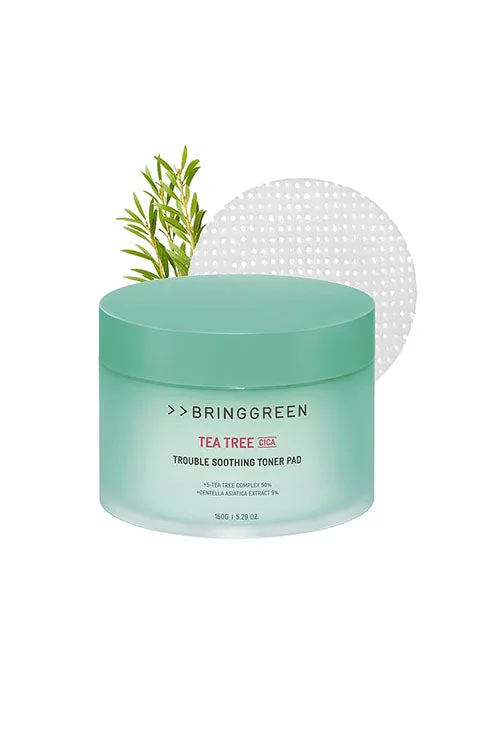
Embossed dual-textured pads soaked in a clarifying, lightly viscous essence — the textured side gives a gentle physical sweep, the smooth side a softer wipe, leaving skin cleaner and refreshed rather than hydrated.
Scent
No added fragrance, but a strong, distinctly medicinal tea tree scent from the high tea tree content that lingers briefly before fading.
Packaging
A 90-pad tub; seal the lid firmly so the lower pads stay saturated, and good value for the count.
Finish
non-greasymattelightweight
What to Expect on First Use
The dual-textured pad swipes on cool and cleansing, with a potent medicinal tea tree scent, leaving skin noticeably less oily and cleaner. The strong tea tree and LHA give a clarifying edge oily skin likes; dry or reactive skin may find it drying, so start slowly and follow with hydration.
How Long It Lasts
Around 1.5-3 months depending on frequency; 90 pads last a while if used a few times a week rather than daily.
Bring Green's Tea Tree Cica line targets oily, troubled skin with high-disclosed-percentage, vegan formulas at low prices. These toner pads are the line's clarifying, exfoliating step, pairing a heavy tea tree dose with LHA and cica on a dual-textured pad to control sebum and clear congestion affordably.
About Bring Green Established Brand (5–20 years)
Bring Green, a Korean clean-beauty brand launched around 2019, focuses on vegan, plant-based formulas at accessible prices, with its Tea Tree Cica line a popular pick for oily, troubled skin. These toner pads carry the brand's transparent, high-disclosed-percentage approach; the brand is younger and less clinically backed than legacy names but has broad retail reach and a strong value reputation.
Brand founded: 2019
Myth vs. Reality
Common Myths
Myth
38% tea tree means this pad is dangerously strong.
Reality
The 38% refers to tea tree extract (a water-based extract), not the potent essential oil, which is present at just 520ppm. So it's a high but not aggressive dose; combined with soothing cica and humectants, oily skin generally tolerates it, though dry and sensitive skin should still be cautious given the LHA and oil.
Myth
A toner pad's textured side is what does the exfoliating.
Reality
The embossed texture adds a gentle physical sweep, but the real exfoliation comes from the capryloyl salicylic acid (an LHA) in the essence, which chemically loosens dead cells and clears pores. Use light pressure with the textured side; over-scrubbing can irritate, while the LHA does the meaningful work.
FAQ
Frequently Asked Questions
How strong is the tea tree in these pads?
Very high by disclosure — tea tree extract leads the list at 38%, with leaf water, whole-plant extract, isolated 4-terpineol, and a small amount of leaf oil (520ppm). That's a concentrated antibacterial, sebum-balancing dose. It's the water-based extract, not mostly essential oil, so it's potent but not aggressive, and cica soothes alongside it.
Do these toner pads exfoliate?
Yes — they contain capryloyl salicylic acid (an LHA), a lipophilic salicylic acid that gently loosens dead cells and clears pores, plus a textured pad side for a gentle physical sweep. Together they refine texture and clear blackheads, making the pads more exfoliating than the brand's liquid toner.
Are these pads good for oily, acne-prone skin?
Yes — the high tea tree dose controls sebum and bacteria, the LHA clears congestion, and cica soothes, making them well suited to oily, blackhead-prone, troubled skin. They aren't fungal-acne safe, though, so anyone managing Malassezia should choose a different pad.
Are the pads too harsh for sensitive skin?
They can be — the strong tea tree (including a little oil), 4-terpineol, and LHA give a clarifying edge that dry, sensitive, or reactive skin may find drying or irritating. Start a few times a week, use light pressure, follow with hydration, and patch test; sensitive skin may prefer a gentler pad.
How often should I use these toner pads?
Because they combine a high tea tree dose with LHA exfoliation, start a few times a week rather than daily, building up as tolerated. Swipe focusing on oily, congested areas, use light pressure with the textured side, and always follow with hydration and daytime sunscreen, since LHA increases sun sensitivity.
Are these toner pads fungal-acne safe?
No — they contain tea tree oil among ingredients that can be problematic for Malassezia, so they aren't fungal-acne safe. If your breakouts are fungal acne, choose a Malassezia-safe option; for bacterial acne and oil control on resilient skin, these are a high-value clarifying pad.
Reviews
What Reviewers Tend to Say
Recurring themes our editors read across retailer reviews of this product — summaries in our words, not quotations, and not a substitute for your own patch test.
The whole case for salicylic acid rests on one unglamorous fact of chemistry: it dissolves in oil. Understand that, and you know exactly when it beats a glycolic acid — and when it's overkill.
The strongest counterexample to blanket botanical scepticism is also one of the more common contact allergens — and holding both facts at once is the only honest way to read it.
Essential oils are declared by botanical name rather than as fragrance, which is why the most heavily perfumed products in the natural aisle can carry the reassuring word — and why the bottle gets more sensitising the longer you own it.
Aug 28, 2026· 11 min
Questions people ask about Acne
Verified answers from our questions library — the nuance a product page cannot carry.
Products, answers, therapy guides, tools and articles in one search. Brand names,
slang and abbreviations all work — accutane finds isotretinoin, bacne finds truncal acne.