Most centella spot treatments lean on a token extract; this one is built around a disclosed 42% centella plus all four isolated cica actives and a hefty 10% calamine, in a sub-$15 tube. The pairing of a high cica dose for repair with calamine for instant settling is an unusually complete two-speed approach for a budget spot cream.
A genuinely concentrated cica spot treatment: 42% centella with all four isolated actives, plus 10% calamine for instant settling, in a tube under fifteen dollars. It calms an angry spot fast and repairs underneath, making it a smart, cheap addition to a breakout-prone routine. The catch is the tea tree and peppermint, which keep it strictly a targeted treatment rather than an allover cream.
A few hundred reviews gathered across iHerb and other retailers over several years on the market inform this assessment — enough to read the product's strengths and its sensitivity caveats with reasonable confidence, but short of the large-scale feedback that would fully settle long-term consistency. The scoring also weighs the disclosed, well-studied actives and Benton's formulation record alongside that user feedback.
Verdicts
How well it fits each concern
Verdict by concern tap a concern for the case
Avoidfor RosaceaIn your profileYou chose · This formula carries fragrance — a known trigger for rosacea — so it is not a fit however good its actives are.Moderate evidenceCarries a triggerNo reviews collected yet
The case for it
Centella Asiatica Extract has early or mechanistic evidence for this concern, not trial-backed standing.
It is present at an effective concentration, declared or high in the ingredient list.
The formula carries a known trigger for this concern, which decides the verdict before any efficacy question.
Cautions: known irritants.
What would change this: Removing the trigger named above would let the actives be judged on their own.
Same rule for everyone. “Avoid” is the verdict on 1,909 of 45,024 concern verdicts across the catalog; rule R1 decided 1,304 of them.
Unchanged since September 5, 2026, engine 5.1.1.
R1 — Safety outranks praise (MASTER-PLAN §1.7). A condition-weighted trigger (multiplier ≥ 2 in condition-fit-matrix) decides the verdict before any efficacy question. · the full register
Carrying active
Centella Asiatica Extract
Standing
plausible — trials support it
Form
adequate (declared 42%)
Tolerability
harsh — fragrance load
Row checked
against its sources on July 17, 2026 (evidence table ev-2026.09-r228)
Avoidfor SensitivityIn your profileYou chose · This formula carries fragrance — the kind of thing reactive skin flags first.Not yet assessedCarries a triggerNo reviews collected yet
The case for it
Centella Asiatica Extract has been researched for this concern and the evidence does not support it.
It is present at an effective concentration, declared or high in the ingredient list.
The formula carries a known trigger for this concern, which decides the verdict before any efficacy question.
Cautions: known irritants.
What would change this: Removing the trigger named above would let the actives be judged on their own.
Same rule for everyone. “Avoid” is the verdict on 1,909 of 45,024 concern verdicts across the catalog; rule F1 decided 605 of them.
Unchanged since September 5, 2026, engine 5.1.1.
Avoidfor Post-ProcedureIn your profileYou chose · This formula carries fragrance — a known trigger for post procedure — so it is not a fit however good its actives are.Moderate evidenceCarries a triggerNo reviews collected yet
The case for it
Centella Asiatica Extract has early or mechanistic evidence for this concern, not trial-backed standing.
It is present at an effective concentration, declared or high in the ingredient list.
The formula carries a known trigger for this concern, which decides the verdict before any efficacy question.
Cautions: known irritants.
What would change this: Removing the trigger named above would let the actives be judged on their own.
Same rule for everyone. “Avoid” is the verdict on 1,909 of 45,024 concern verdicts across the catalog; rule R1 decided 1,304 of them.
Unchanged since September 5, 2026, engine 5.1.1.
R1 — Safety outranks praise (MASTER-PLAN §1.7). A condition-weighted trigger (multiplier ≥ 2 in condition-fit-matrix) decides the verdict before any efficacy question. · the full register
Carrying active
Centella Asiatica Extract
Standing
plausible — trials support it
Form
adequate (declared 42%) — studied range 0.05%, from the OTC monograph or label; needs leave-on contact
Tolerability
harsh — fragrance load
Row checked
against its sources on July 17, 2026 (evidence table ev-2026.09-r228)
Avoidfor Compromised Skin BarrierIn your profileYou chose · This formula carries fragrance — a known trigger for compromised skin barrier — so it is not a fit however good its actives are.Not yet assessedCarries a triggerNo reviews collected yet
The case for it
Centella Asiatica Extract has no evidence row yet for this concern — it is in the research queue.
The formula carries a known trigger for this concern, which decides the verdict before any efficacy question.
Cautions: known irritants.
What would change this: Removing the trigger named above would let the actives be judged on their own.
Same rule for everyone. “Avoid” is the verdict on 1,909 of 45,024 concern verdicts across the catalog; rule R1 decided 1,304 of them.
Unchanged since September 5, 2026, engine 5.1.1.
R1 — Safety outranks praise (MASTER-PLAN §1.7). A condition-weighted trigger (multiplier ≥ 2 in condition-fit-matrix) decides the verdict before any efficacy question. · the full register
Also listed for Acne — the actives here (Centella Asiatica, Calamine, Houttuynia Cordata (Heartleaf) are in our research queue for that concern; there is no verdict until their evidence rows are written. That is a gap in our table, not a mark against the product.
A verdict is DermApproved’s assessment of how well a product’s ingredients fit a concern — never a claim about what the product treats. Evidence dots and collected reviews sit beside it and are never blended in.
Rules 0.5.1 · evidence table ev-2026.09-r228 · how we decide
Assessment
Pros & Cons
Pros
✓ Discloses a high 42% centella with all four isolated cica actives
✓ 10% calamine settles spot redness quickly on application
✓ Two-speed action: fast cosmetic calm plus slower repair
✓ Tea tree adds a mild antibacterial angle for blemishes
✓ Cooling, non-greasy feel that sinks in fast
✓ Very long-lasting and cheap per use as a spot treatment
✓ Fragrance-free with transparent, fully-spec'd actives
Cons
✗ Tea tree and peppermint oils sting sensitive or broken skin
✗ Strictly a spot treatment — not safe to use all over
✗ Pale calamine cast shows on application
✗ Can feel slightly chalky as it dries down
✗ Not a substitute for dedicated acne medication
✗ Pregnancy safety unclear given the essential oils
Review
Full Review
Spot treatments usually pick a lane. Either they're fast and slightly brutal — a dab of something drying that flattens a pimple and leaves a scaly patch behind — or they're gentle and slow, soothing the area over days while you wait. Benton's centella spot cream is interesting because it runs on two clocks at once. The 10% calamine works on the fast clock, settling the angry redness of a fresh spot within the hour the way calamine lotion has calmed itchy, inflamed skin for generations. Underneath it, a serious 42% dose of centella asiatica works the slow clock, doing the soothing and barrier-supporting repair that actually helps the spot resolve. You get the immediate cosmetic calm and the longer-term skin support in one small tube, which is not how most budget spot treatments are built.
The centella here deserves specific credit because Benton didn't cut corners on it. The label discloses 42% whole centella extract, and then the four isolated cica actives — asiaticoside, madecassoside, asiatic acid, and madecassic acid — appear separately further down the list. That's the full quartet, the same compounds the centella research actually studies, rather than a vague 'centella extract' sprinkle near the bottom. Add houttuynia cordata, a traditional Korean calming herb, and dipotassium glycyrrhizate from licorice root, and the soothing side of this formula is genuinely well-built. The calamine at 10% sitting third on the list is equally honest — a real, functional amount, not a trace. For a tube that costs less than a sandwich in some cities, the formulation discipline is genuinely impressive.
In the hand, it's a soft, pale cream with a faint chalkiness from the calamine. It goes on cool, with a mild minty-medicinal scent from the tea tree and peppermint that signals 'treatment' and fades within a minute. It sinks in reasonably fast and leaves a barely-there matte veil over the spot — that pale cast is the calamine, and it's doing its job, not failing to absorb. On a fresh, inflamed blemish, the visible payoff comes quickly: the redness looks calmer within the hour, and over the next day or two of dabbing, the spot tends to settle and shrink rather than dry out into a flaky crust. Reviewers consistently describe that cooling, non-greasy feel and the quick knockdown of redness, including the diffuse flush from things like mask-wearing.
The tea tree oil earns its place as a mild antibacterial for blemish-prone skin, giving the cream a light anti-acne angle on top of the soothing. But the tea tree and peppermint together are also the formula's defining limitation, and it's worth being clear-eyed about it. These are the reason this is a spot treatment and not an allover cream. On the small area of a blemish, most skin tolerates them fine — but spread across the whole face, or applied to broken, very sensitive, or eczema-prone skin, they can sting and provoke exactly the redness you're trying to fix. The product name almost invites the mistake: 'Goodbye Redness' sounds like something you'd slather everywhere, when in fact the smart use is precise and targeted. Treat it as a localized tool and it's excellent; treat it as a moisturizer and sensitive skin may regret it.
That targeting also makes it remarkably economical. Because each application is a dab, a 15g tube lasts most people many months — often close to a year — which makes the sub-fifteen-dollar price look even better on a cost-per-use basis. For a treatment built around a disclosed high concentration of well-studied actives, that's strong value; comparable cica spot treatments from Western brands routinely cost more for less centella and no calamine. You're not paying for fancy packaging or marketing here — it's a plain squeeze tube doing a specific job well.
Where it fits is a breakout-prone or redness-prone routine that needs a targeted calmer. It pairs naturally with gentler centella products — including Benton's own Goodbye Redness gel, which handles the allover soothing this spot cream deliberately doesn't — and sits comfortably alongside niacinamide and ceramide moisturizers. It's less suited to anyone whose skin reacts to tea tree or mint, and it isn't a replacement for a dedicated acne medication if you have persistent, widespread breakouts; think of it as the thing you reach for when a specific spot flares up. With a few hundred reviews accumulated over several years at a solid average, it has enough of a track record to trust for that role.
The recommendation: if you get the occasional angry, red blemish and want something cheap that both calms it visibly and supports it healing, this is one of the better-formulated options at the price, as long as you respect the 'spot' in spot cream. Dab it where you need it, keep it off broken or hypersensitive skin, and let the calamine and centella split the work between them.
Formula
Key Ingredients
The hero actives that drive this product's performance.
The spine of the formula — 42% whole centella extract plus the four isolated cica actives (asiaticoside, madecassoside, asiatic and madecassic acids) named separately further down. Together they drive the soothing, redness-calming, and wound-supporting work this spot cream is built for, going beyond a generic centella mention to a genuinely concentrated, fully-spec'd cica dose.
The third ingredient at a substantial 10%, calamine gives the cream its pale, slightly chalky finish and its classic skin-settling, itch-relieving action — the reason a dab on an angry spot looks and feels calmer quickly, complementing the slower centella repair.
Included low in the list as a targeted antibacterial for blemish-prone spots, giving the cream a mild anti-acne angle on top of its soothing brief — though its presence, with peppermint oil, is also what makes this a spot-not-allover product for sensitive skin.
A traditional Korean skin-calming herb layered in to reinforce the centella's anti-inflammatory action, helping the formula settle the diffuse redness around a breakout rather than just the spot itself.
Not yet assessed
Ingredient standings describe the active at treatment-level doses and
vehicles; this product's own condition grades weigh its actual formula.
Apply as a targeted spot step after toner and serum, before your moisturizer, dabbing only onto redness or blemishes rather than all over. Its tea tree and peppermint content means it layers best as a localized treatment; let it settle before sealing with moisturizer.
Results Timeline
Redness and the angry look of a fresh spot often calm within 30 minutes to a few hours of the first application. Active blemishes typically settle over 1-3 days of dabbing; the broader soothing benefit on reactive skin builds over a week or two of targeted use.
The formula leans on one of the better-evidenced botanical complexes in skincare. Centella asiatica's activity comes chiefly from its triterpenes — asiaticoside, madecassoside, and the corresponding asiatic and madecassic acids — and Benton lists all four explicitly alongside the 42% whole extract. The evidence base for these compounds is unusually solid for a plant active: studies have documented anti-inflammatory effects and support for collagen synthesis and wound healing, which is why centella ('cica') became a clinical-adjacent standard for soothing irritated and post-procedure skin. Having the isolated actives named, rather than only a generic extract, is a meaningful sign the soothing claims rest on the studied molecules.
Calamine, at 10%, is a long-established over-the-counter skin protectant — a zinc-oxide-and-iron-oxide blend with recognized mild antipruritic and skin-settling properties, which accounts for the rapid visible calming of an inflamed spot. The tea tree oil contributes the formula's antibacterial angle: Melaleuca alternifolia oil has clinical data supporting modest efficacy against mild-to-moderate acne, though typically slower-acting and gentler than benzoyl peroxide, and it carries its own sensitization risk. Houttuynia cordata and licorice-derived dipotassium glycyrrhizate round out the anti-inflammatory support with reasonable, if less extensive, backing. The honest synthesis is that this is a well-evidenced soothing-and-calming formula — strong on the centella and calamine front — whose anti-acne effect from tea tree is real but mild, and whose essential-oil content is the predictable trade-off for that antibacterial benefit.
Dermatologist Perspective
Centella-based treatments are widely referenced in clinical and cosmetic dermatology for calming inflammation, supporting barrier repair, and aiding recovery in irritated or post-procedure skin, and a formula disclosing 42% extract with the isolated triterpenes is regarded as a substantive dose. Calamine is a familiar over-the-counter skin protectant frequently suggested for soothing itchy, inflamed areas. For a spot product like this, the standard clinical caution centers on the tea tree and peppermint oils: tea tree has supportive evidence for mild acne but is also a recognized contact sensitizer, so targeted, sparing application is the prudent approach and broken or highly reactive skin is generally advised to avoid it. It is typically positioned as a soothing adjunct for occasional inflamed spots rather than a primary therapy for moderate-to-severe acne, which usually calls for established medical actives.
Guidance
Usage & Recommendations
How to Use
Use it as a targeted step, not an allover cream. After cleansing, toner, and any serum, dab a small amount directly onto blemishes or patches of redness, then let it settle for a minute before applying moisturizer over the rest of the face. It works morning or night; in the daytime, follow with sunscreen. Keep it off broken skin and away from the eye area, and apply sparingly if your skin is sensitive to tea tree or peppermint. Patch test first if you're prone to reacting to essential oils, and don't layer it on the same spot as strong acids or benzoyl peroxide, which can compound irritation.
Value Assessment
At around $14 for 15g — and often discounted toward $8 — this is strong value for what's inside. The price buys a disclosed 42% centella with the full set of cica actives plus 10% calamine, a more complete formula than many pricier Western cica spot treatments offer. Because it's used as a dab on targeted areas, a single tube stretches for many months to a year, making the real cost per use very low. There's only one size, so no bulk-saving option, but at this price that hardly matters. Benton's established track record and full ingredient transparency add credibility — you can see exactly what you're paying for, and it isn't brand markup. For an occasional-spot user, it's one of the more cost-effective targeted treatments available.
Who Should Buy
Anyone with combination, oily, or normal skin who gets occasional angry, red blemishes and wants an affordable treatment that calms the redness fast and supports healing underneath. It's especially good value for breakout-prone routines that already use gentle centella products and need a targeted spot calmer, and for fans of transparent, high-percentage Korean formulations.
Who Should Skip
Skip it if your skin reacts to tea tree or peppermint, or if you have eczema, broken, or highly sensitive skin where those oils are likely to sting. It's also not the right tool for widespread, persistent acne that needs dedicated medication, and anyone wanting a soothing product they can apply all over should choose a fragrance-free allover cream instead.
Ready to try Benton Goodbye Redness Centella Spot Cream?
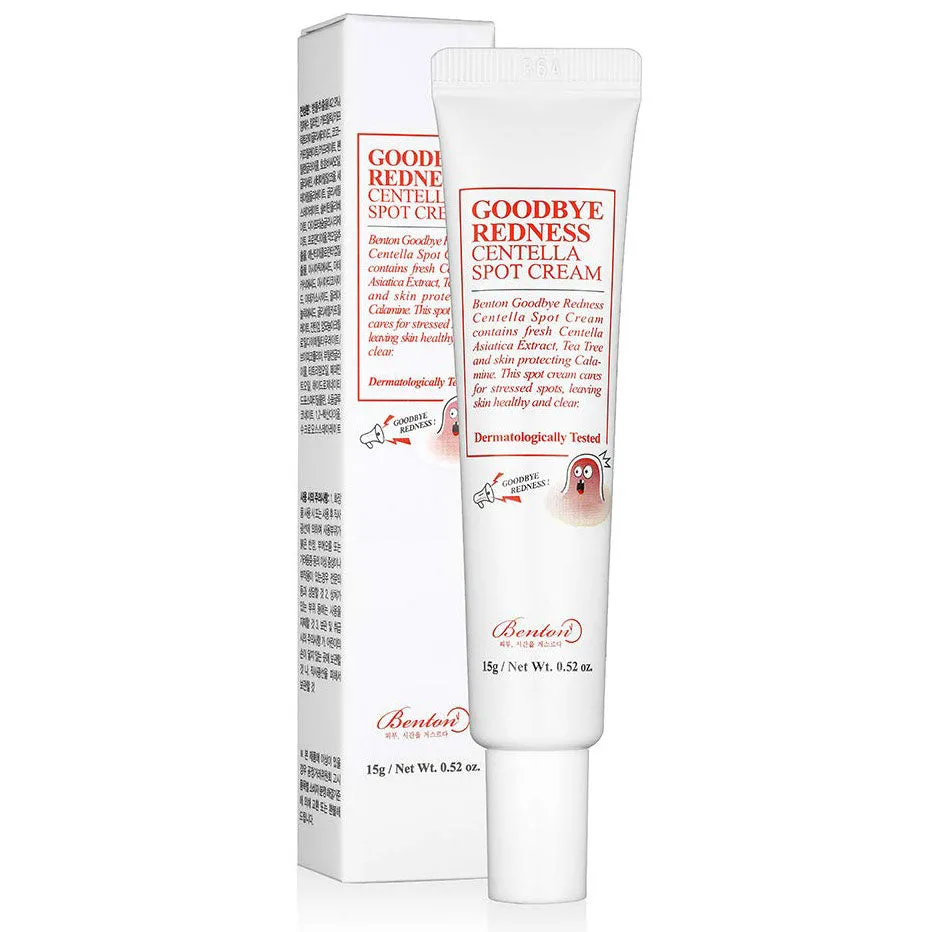
A soft, pale-toned cream with a faintly chalky body from the calamine — it goes on cool and light, sinks in fairly quickly, and leaves a barely-there matte veil over the spot rather than a glossy film.
Scent
No added fragrance, but the tea tree and peppermint oils give it a mild medicinal, minty-herbal smell that reads as 'treatment' and fades within a minute.
Packaging
A small 15g squeeze tube, practical and hygienic for a spot product and easy to apply precisely to targeted areas.
Finish
mattenon-greasylightweight
What to Expect on First Use
Expect a cool, faintly minty sensation on application and a pale cast that settles into the skin within a minute or two. On a fresh, angry spot the redness often looks calmer within the hour; there's no purge, but the tea tree and peppermint mean a brief tingle is normal and a sting on broken or very sensitive skin is the cue to use it more sparingly.
How Long It Lasts
Several months to a year as a targeted spot treatment, since each application uses only a dab; far less if used over larger areas.
Benton's Goodbye Redness centella range grew from the brand's soothing-skincare focus, and this spot cream is the targeted member of that family — built to put a high concentration of cica and calamine exactly where a breakout or patch of redness needs it, rather than diluting those actives across a full-face product.
About Benton Established Brand (5–20 years)
Benton, established in 2011, earned its reputation on transparent, soothing Korean formulations and the Goodbye Redness centella line is among its longest-running and most-reviewed franchises. This spot cream has been on the market for several years with a steady base of user feedback, reflecting the brand's consistent, no-fragrance-added formulating style.
Brand founded: 2011
Myth vs. Reality
Common Myths
Myth
A spot cream with 42% centella and tea tree must be gentle enough to use all over the face.
Reality
The centella is gentle, but the tea tree and peppermint oils make this a targeted treatment, not an allover moisturizer. Spreading it across the whole face raises the odds of irritation, especially on sensitive skin — it's formulated to be dabbed on spots and patches of redness.
Myth
The pale, chalky cast means the cream isn't absorbing.
Reality
That light tone comes from the 10% calamine, a deliberate skin-settling ingredient, not a sign the cream is sitting on top. The veil it leaves is normal and part of how calamine calms a spot; it softens as the cream settles and is easily covered if needed.
FAQ
Frequently Asked Questions
Can I use the Benton Goodbye Redness Spot Cream all over my face?
It's designed as a targeted spot treatment, not an allover moisturizer. While the 42% centella is gentle, the tea tree and peppermint oils make full-face use more likely to irritate, especially on sensitive skin — dab it onto blemishes and patches of redness instead.
Why does this spot cream leave a pale, chalky cast?
The light tone comes from the 10% calamine, a classic skin-settling and itch-relieving ingredient. The faint veil it leaves is intentional and part of how calamine calms an angry spot; it softens as the cream settles into the skin.
How is this different from the Benton Goodbye Redness Centella Gel?
The gel is a lightweight allover soothing moisturizer, while this spot cream concentrates a higher dose of centella and adds 10% calamine and tea tree for targeted use on individual blemishes and red patches. They're complementary — gel for general calm, spot cream for problem areas.
Does the Benton spot cream help with active acne?
It can settle the redness and inflammation around a breakout thanks to its high centella and calamine content, and the tea tree oil adds a mild antibacterial angle. It's a soothing-and-calming spot treatment rather than a strong acne medication, so it pairs well with, but doesn't replace, dedicated acne actives.
Is the tea tree and peppermint in this cream a problem for sensitive skin?
Those essential oils are why it's a spot treatment rather than an allover product. Many people tolerate them fine on small areas, but sensitive or broken skin may feel a sting, so patch test and apply sparingly — or skip it if your skin reacts to tea tree or mint.
How long does a tube of this spot cream last?
Because each use is just a dab on targeted spots, a 15g tube typically lasts many months to a year. Using it over larger areas will deplete it much faster, but as intended it's a very long-lasting, low-cost-per-use treatment.
Reviews
What Reviewers Tend to Say
Recurring themes our editors read across retailer reviews of this product — summaries in our words, not quotations, and not a substitute for your own patch test.
Common Praise
Visibly calms redness on spots quickly
Cooling, non-greasy feel on application
High, transparent centella and calamine percentages
The strongest counterexample to blanket botanical scepticism is also one of the more common contact allergens — and holding both facts at once is the only honest way to read it.
Essential oils are declared by botanical name rather than as fragrance, which is why the most heavily perfumed products in the natural aisle can carry the reassuring word — and why the bottle gets more sensitising the longer you own it.
The K-beauty buzzword slaps a green leaf on half the shelf — but centella is one of the rare botanicals with genuine wound-healing data. The trick is knowing which molecule is doing the job.
Cutting a beard hair takes about a twentieth of a newton. You press with two and stretch your skin by a fifth — which is why almost every shaving problem is a technique problem wearing a hardware costume.
Aug 28, 2026· 10 min
Questions people ask about Acne
Verified answers from our questions library — the nuance a product page cannot carry.
Products, answers, therapy guides, tools and articles in one search. Brand names,
slang and abbreviations all work — accutane finds isotretinoin, bacne finds truncal acne.