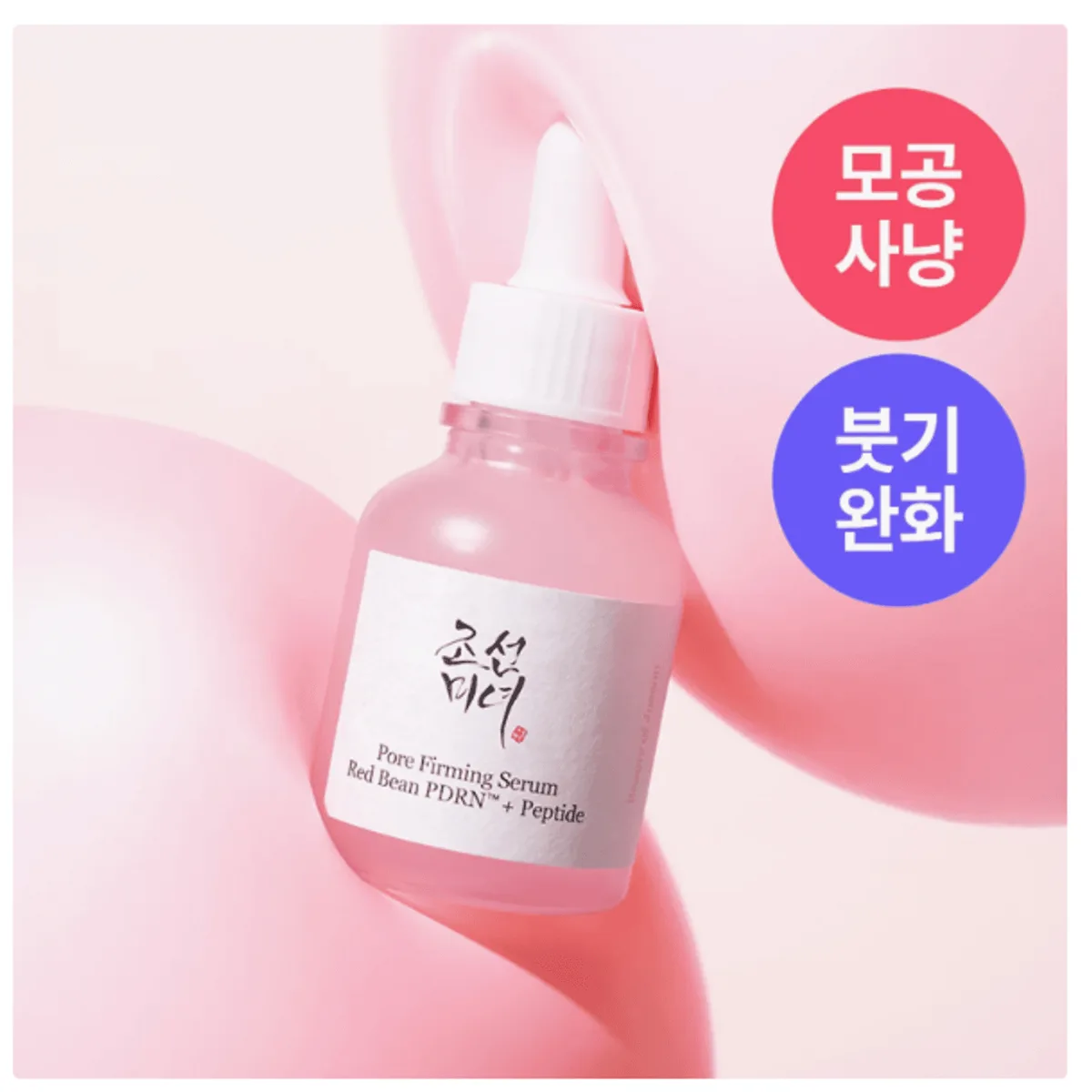
It swaps the salmon-derived PDRN found in most renewal serums for a vegan red-bean DNA version, then pairs it with a Syn-Ake peptide and niacinamide specifically for pore refining and firming. Few budget serums combine PDRN, a neuropeptide, and a full soothing barrier complex in one fragrance-free formula.
Beauty of Joseon Pore Firming Serum: Red Bean PDRN + Peptide Review
Vegan PDRN Pore Refiner
serumserumk beautyParaben FreeCruelty FreeVegan
Beauty of Joseon's Pore Firming Serum makes PDRN vegan, swapping salmon DNA for a red-bean version and pairing it with a Syn-Ake peptide and niacinamide for pore refining and firming. It's a remarkably well-rounded, fragrance-free serum on a soothing barrier base for $17. The main caveats are its newness and that plant-PDRN is less studied than the salmon original.
As a recent launch with only early reviews available, this score relies on the disclosed active list — vegan PDRN, Syn-Ake peptide, niacinamide, and a soothing barrier complex — and Beauty of Joseon's established formulating reputation rather than long-term user data. The real-world performance of its plant-derived PDRN in particular remains to be confirmed as independent feedback accumulates.
Verdicts
How well it fits each concern
Verdict by concern tap a concern for the case
Promisingfor Large PoresIn your profileYou chose · Niacinamide has trial-level evidence for large pores but no guideline or regulatory standing yet — promising, short of a recommendation; the other actives here are not yet assessed for it.Moderate evidenceGentleNo reviews collected yet
The case for it
Niacinamide has trial-level evidence for this concern but no guideline or regulatory standing yet.
It is plausibly present at a working level, though the concentration is not declared.
The formula carries none of the triggers this concern is sensitive to.
What would change this: A declared concentration would move this to a firmer reading of the dose.
Same rule for everyone. “Promising” is the verdict on 7,858 of 45,024 concern verdicts across the catalog; rule R9p decided 7,858 of them.
Unchanged since September 5, 2026, engine 5.1.1.
R9p — 0.5.0: 'Unproven' beside three filled dots read as one question answered twice with opposite words (7,018 rows). The chip measures standing, the dots measure trial volume; where the row carries at least one RCT or a tier-2 source (moderate dots) and the active is present at a working level, the honest word is Promising. Unproven is reserved for plausible-standing rows with limited or weak evidence, or an under-dosed form. Same rank as Unproven — a bet either way; the dots order them. · the full register
Carrying active
Niacinamide
Standing
plausible — trials support it
Form
plausible — studied range 4%, from the trials on the row; needs leave-on contact; judge it after ~8 weeks
Tolerability
gentle
Row checked
against its sources on July 17, 2026 (evidence table ev-2026.09-r228)
Promisingfor Excess OilinessIn your profileYou chose · Niacinamide has trial-level evidence for excess oiliness but no guideline or regulatory standing yet — promising, short of a recommendation; the other actives here are not yet assessed for it.Moderate evidenceStandard tolerabilityNo reviews collected yet
The case for it
Niacinamide has trial-level evidence for this concern but no guideline or regulatory standing yet.
It is plausibly present at a working level, though the concentration is not declared.
The formula carries no trigger this concern is sensitive to, with the cautions noted.
Cautions: fungal-acne triggers.
What would change this: A declared concentration would move this to a firmer reading of the dose.
Same rule for everyone. “Promising” is the verdict on 7,858 of 45,024 concern verdicts across the catalog; rule R9p decided 7,858 of them.
Unchanged since September 5, 2026, engine 5.1.1.
R9p — 0.5.0: 'Unproven' beside three filled dots read as one question answered twice with opposite words (7,018 rows). The chip measures standing, the dots measure trial volume; where the row carries at least one RCT or a tier-2 source (moderate dots) and the active is present at a working level, the honest word is Promising. Unproven is reserved for plausible-standing rows with limited or weak evidence, or an under-dosed form. Same rank as Unproven — a bet either way; the dots order them. · the full register
Carrying active
Niacinamide
Standing
plausible — trials support it
Form
plausible — studied range 2%, from the trials on the row; needs leave-on contact; judge it after ~8 weeks
Tolerability
standard — fungal triggers
Row checked
against its sources on July 17, 2026 (evidence table ev-2026.09-r228)
Promisingfor AgingIn your profileYou chose · Niacinamide has trial-level evidence for aging but no guideline or regulatory standing yet — promising, short of a recommendation; the other actives here are not yet assessed for it.Moderate evidenceGentleNo reviews collected yet
The case for it
Niacinamide has trial-level evidence for this concern but no guideline or regulatory standing yet.
It is plausibly present at a working level, though the concentration is not declared.
The formula carries none of the triggers this concern is sensitive to.
What would change this: A declared concentration would move this to a firmer reading of the dose.
Same rule for everyone. “Promising” is the verdict on 7,858 of 45,024 concern verdicts across the catalog; rule R9p decided 7,858 of them.
Unchanged since September 5, 2026, engine 5.1.1.
R9p — 0.5.0: 'Unproven' beside three filled dots read as one question answered twice with opposite words (7,018 rows). The chip measures standing, the dots measure trial volume; where the row carries at least one RCT or a tier-2 source (moderate dots) and the active is present at a working level, the honest word is Promising. Unproven is reserved for plausible-standing rows with limited or weak evidence, or an under-dosed form. Same rank as Unproven — a bet either way; the dots order them. · the full register
Carrying active
Niacinamide
Standing
plausible — trials support it
Form
plausible — studied range 4–5%, from the trials on the row; needs leave-on contact; judge it after ~8 weeks
Tolerability
gentle
Row checked
against its sources on July 17, 2026 (evidence table ev-2026.09-r228)
Also listed for Rough Texture and Dullness — the actives here (Niacinamide, Centella Asiatica, Ceramides, Peptides) are in our research queue for those concerns; there is no verdict until their evidence rows are written. That is a gap in our table, not a mark against the product.
A verdict is DermApproved’s assessment of how well a product’s ingredients fit a concern — never a claim about what the product treats. Evidence dots and collected reviews sit beside it and are never blended in.
Rules 0.5.1 · evidence table ev-2026.09-r228 · how we decide
Assessment
Pros & Cons
Pros
✓ Vegan red-bean PDRN, a plant-based alternative to salmon DNA
✓ Pairs PDRN with a Syn-Ake firming peptide and niacinamide
✓ Niacinamide placed high for genuine pore and oil benefits
✓ Soothing ceramide, centella, and beta-glucan barrier base
✓ Fragrance-free, alcohol-free, and gentle for sensitive skin
✓ Excellent active density for a $17 serum
Cons
✗ Plant-derived PDRN is far less studied than salmon PDRN
✗ Small 30ml bottle limits total quantity
✗ Pore-refining and firming results take weeks of consistency
✗ Newer launch with limited independent reviews
✗ Strongest-evidence actives aren't the headline ingredient
Review
Full Review
Red bean has been a Korean skincare staple for centuries — ground adzuki was a traditional clarifying scrub long before anyone wrote an INCI list. Beauty of Joseon has built a whole pore-care line on that heritage, and its Pore Firming Serum pulls off a genuinely clever trick: it takes the PDRN trend currently sweeping K-beauty — those skin-renewal serums built on DNA fragments, almost always derived from salmon — and makes it vegan by sourcing the DNA from red bean instead. That single swap is the serum's reason for existing, and it's a smart one, because it lets plant-based shoppers join a category that had effectively excluded them.
But a gimmick swap would be forgettable, and this serum isn't, because the formula around the red-bean PDRN is legitimately thoughtful. The headline pairs that vegan PDRN (listed as sodium DNA alongside Phaseolus angularis, the adzuki bean) with a peptide — dipeptide diaminobutyroyl benzylamide diacetate, better known as Syn-Ake, a neuropeptide designed to relax and smooth the skin surface. Together they form the 'pore firming' premise: PDRN for renewal and refining, the peptide for firmness. Then comes niacinamide, sitting high in the ingredient list where it can actually work, doing the real heavy lifting of pore care — regulating oil, refining pore appearance, evening tone. This isn't niacinamide as a label flourish; it's a core active, and its prominent placement is part of why the pore claims are credible.
What genuinely impresses me is the supporting cast, because it shows the formula was built by people who understand that active serums fail when they wreck the barrier. Centella asiatica, Coptis japonica root, and fig extract handle soothing. Ceramide NP and beta-glucan reinforce and hydrate the barrier. Squalane adds lightweight moisture, adenosine contributes its own anti-aging signal. The result is a serum that's loaded with actives yet stays fragrance-free, alcohol-free, and gentle enough that the brand pitches it for sensitive skin — and the ingredient list backs that up. For a $17 serum, the density of well-chosen ingredients here is genuinely above its price class.
The experience matches. It's a light, slightly slippery gel-serum that sinks in fast and leaves skin smooth rather than tacky, layering cleanly under moisturizer morning or night. There's nothing to dislike about how it feels, and the frosted glass dropper is a nicer presentation than the price suggests.
Now for The main drawbacks, which are about evidence and expectations more than flaws. The big one: vegan red-bean PDRN is the marketing hook, but it's also the least-proven part of the formula. Salmon-derived PDRN has a real, if still-developing, body of research behind it; plant-derived DNA-fragment ingredients are a newer, much-less-studied proposition. The renewal claims tied specifically to the red-bean PDRN should be read as promising rather than clinically settled — and notably, the parts of this serum with the strongest evidence (niacinamide, ceramides, centella) aren't the parts on the front of the box. Second, it's a small 30ml bottle, so the value, while excellent per milliliter, comes in a modest quantity. And third, as with any pore-and-firming serum, this is a slow burn: hydration and smoothness arrive in days, but the refining and firming benefits need four to eight weeks of consistency, and pores never truly 'shrink' — they look smoother, not gone.
It's worth separating what this serum will reliably do from what the marketing hopes it does, because the gap matters for a satisfied purchase. Reliably, you get a gentle, well-formulated niacinamide serum on a soothing barrier base — that alone, at $17, is a solid buy, and the niacinamide is the part with decades of evidence behind refining pore appearance and regulating oil. Hopefully, the red-bean PDRN and Syn-Ake peptide add renewal and firming on top, and they might — but these are the trendy, less-proven elements, and the firming in particular is the kind of subtle, cumulative effect that's notoriously hard to attribute to any single product. The smart way to buy this is to want the niacinamide-and-barrier foundation for certain, and to treat the PDRN-and-peptide story as an interesting upside you're not paying a premium for. Bought on those terms, it's almost impossible to be disappointed; bought expecting a dramatic pore-erasing or skin-tightening transformation from the buzzy actives, it will underwhelm, as nearly any serum at this concentration and price would. The vegan angle is a real bonus on top of all this: shoppers who avoid animal-derived ingredients have largely been shut out of the PDRN trend, which is overwhelmingly salmon-based, so a plant-derived alternative that performs at least as well as a gentle niacinamide serum gives them a genuine entry point into the category rather than a compromise.
Set against realistic expectations, though, it's an easy serum to recommend. If you have combination, oily, or normal skin, want a gentle, fragrance-free pore-refining serum, and like the idea of a vegan PDRN, you're getting a thoughtfully built, active-dense formula for budget money. Just buy it for the proven niacinamide-and-barrier foundation and treat the trendy red-bean PDRN as a promising bonus rather than the main event, and you won't be disappointed.
Formula
Key Ingredients
The hero actives that drive this product's performance.
Beauty of Joseon's vegan, red-bean-derived take on PDRN, replacing the usual salmon-DNA source with purified plant DNA fragments. It anchors the serum's renewal-and-refining angle, working with the peptide to make pores look smoother while keeping the formula vegan.
A neuropeptide modeled on snake-venom action, paired with the PDRN to support firmness and a smoother, more relaxed-looking surface — the 'firming' half of the pore-firming promise, working alongside adenosine for an anti-aging effect.
Sits high in the formula to regulate oil, refine the look of pores, and even tone — a core pore-care active here that reinforces the PDRN-and-peptide refining effect rather than just riding along.
The familiar cica soother, included with Coptis japonica and fig extracts to calm and support the barrier so this active-rich serum stays gentle enough for sensitive, congested skin.
Pair to reinforce the moisture barrier and deliver soothing hydration, ensuring the pore-refining actives work on a supported, comfortable barrier rather than a stripped one.
Not yet assessed
Ingredient standings describe the active at treatment-level doses and
vehicles; this product's own condition grades weigh its actual formula.
Apply after toner and before moisturizer, on cleansed skin. It layers well with other water-based serums; if using actives like retinol or strong exfoliants, alternate nights to keep the routine gentle.
Results Timeline
Hydration and a smoother surface feel are noticeable within days. Pore-refining and firming benefits build gradually over 4-8 weeks of consistent twice-daily use.
Beauty of Joseon Pore Firming Serum: Red Bean PDRN + Peptide
Moisturizer
Sunscreen
Sample PM Routine
Oil cleanser
Water cleanser
Toner
Beauty of Joseon Pore Firming Serum: Red Bean PDRN + Peptide
Moisturizer
Evidence
Science & Expert Perspective
The Science
This serum's evidence base is strongest in its supporting cast and thinnest in its headline. Niacinamide is among the best-studied cosmetic actives, with solid clinical support for regulating sebum, improving the appearance of pores, and evening tone at typical serum concentrations — its prominent placement here is the most scientifically grounded reason the pore claims hold up. Ceramide NP has robust evidence for barrier repair, and beta-glucan and centella asiatica have credible data for soothing and supporting barrier function, which underpins the formula's gentleness. The peptide, dipeptide diaminobutyroyl benzylamide diacetate (Syn-Ake), has cosmetic-study support for a smoothing, expression-relaxing effect, though the data is modest and largely industry-sourced. The headline red-bean PDRN is the most speculative element: PDRN (polydeoxyribonucleotide) derived from salmon has a developing body of research for tissue renewal and is used clinically in injectable forms, but topical efficacy is itself debated, and a vegan, plant-DNA-derived version has substantially less independent validation than the salmon original. The honest read is that this is a well-formulated serum whose most proven benefits come from niacinamide and its barrier-support complex, while the trendy red-bean PDRN is an interesting, plausible, but under-studied addition — promising rather than established, and best not treated as the primary reason to expect results.
Dermatologist Perspective
Pore appearance is influenced by oil production, skin laxity, and surface texture, and ingredients like niacinamide are commonly recommended for refining the look of pores and regulating sebum, which makes its prominent inclusion here clinically sensible. PDRN has drawn growing interest in skin renewal discussions, primarily in injectable and salmon-derived forms; topical and plant-derived versions are newer and less validated, so they are generally regarded as promising rather than proven in clinical contexts. The serum's fragrance-free, ceramide-and-centella base aligns with standard guidance for supporting the barrier while using active ingredients, and its gentleness suits a wide range of skin types. Realistic expectations matter: pores are minimized in appearance, not eliminated, and consistent use over several weeks is typically needed before visible refining becomes apparent.
Guidance
Usage & Recommendations
How to Use
After cleansing and toner, dispense a few drops and press the serum evenly over the face, focusing on areas where pores look enlarged. Follow with moisturizer, and in the morning always finish with sunscreen. Use it twice daily for best results; the lightweight texture layers well with other water-based serums. If you also use strong actives like retinol or acids, alternate them on different nights to keep the routine gentle, and give the serum four to eight weeks of consistent use before judging the pore-refining and firming benefits.
Value Assessment
At around $17 for 30 ml, this serum offers excellent value on a per-ingredient basis: the active density — vegan PDRN, a Syn-Ake peptide, prominent niacinamide, ceramide NP, centella, and beta-glucan — exceeds what most budget serums deliver, and the fragrance-free, vegan formulation broadens its appeal. The main value caveat is quantity: 30 ml is a modest bottle that lasts roughly two months at twice-daily use, so the per-use cost is higher than a larger format. From an established K-beauty brand with a strong formulating reputation, the price reflects accessible quality rather than hype, though shoppers should weight the proven niacinamide-and-barrier foundation over the trendy but less-studied red-bean PDRN when judging whether it's worth it.
Who Should Buy
This suits combination, oily, or normal skin wanting a gentle, fragrance-free serum to refine the look of pores and support firmness, and anyone drawn to a vegan, plant-based take on the PDRN trend. Its soothing barrier base also makes it a reasonable option for sensitive skin seeking active care without irritation.
Who Should Skip
Those expecting dramatic, fast pore-shrinking or clinically proven PDRN renewal should temper expectations or look to better-studied actives, since plant-derived PDRN is unproven and pores refine only gradually. Anyone wanting a larger-format serum for the price, or who already gets strong pore results from a dedicated niacinamide serum, may not need this one.
Ready to try Beauty of Joseon Pore Firming Serum: Red Bean PDRN + Peptide?
A lightweight, slightly slippery gel-serum that spreads easily and absorbs quickly without stickiness.
Scent
Fragrance-free, with only a faint neutral note from the botanical extracts.
Packaging
A frosted glass dropper bottle that meters the serum precisely and shields the actives from light.
Finish
lightweightfast-absorbingnon-greasy
What to Expect on First Use
On first use it feels like a light, watery gel that sinks in fast and leaves skin smooth and comfortable, not tacky. There's no fragrance or sting; visible pore-refining is a gradual, weeks-long process rather than an instant effect.
How Long It Lasts
About 2 months applied morning and evening facial application from the 30ml bottle.
Beauty of Joseon built the Red Bean Pore Care line around adzuki bean, a traditional Korean ingredient long used for clarifying skin. This serum modernizes that heritage by deriving a vegan PDRN from red bean DNA, positioning it as a plant-based answer to the salmon-PDRN trend sweeping K-beauty.
About Beauty of Joseon Established Brand (5–20 years)
Beauty of Joseon, launched in 2016 under Goodai Global, has become one of the most recognized K-beauty brands worldwide, known for blending hanbang (traditional Korean herbal) ingredients with modern actives at accessible prices. It has a strong track record and large global following, though specific newer products like this PDRN serum rely on ingredient pedigree more than long-term independent data.
Brand founded: 2016 · Product launched: 2025
Myth vs. Reality
Common Myths
Myth
Vegan red-bean PDRN works exactly like salmon PDRN.
Reality
Both are DNA-fragment ingredients aimed at skin renewal, and the red-bean version makes the formula vegan, but salmon-derived PDRN has the larger body of research behind it. The plant alternative is promising but less studied, so treat the renewal claims as encouraging rather than clinically settled.
FAQ
Frequently Asked Questions
What is the Red Bean PDRN in Beauty of Joseon's Pore Firming Serum?
It's a vegan form of PDRN made from purified red bean (adzuki) DNA fragments rather than the salmon DNA used in most PDRN products. It's aimed at supporting skin renewal and refining the look of pores while keeping the formula plant-based.
How is this different from salmon PDRN serums?
The active goal is similar — DNA-fragment-driven renewal — but this version is vegan and red-bean-derived. The trade-off is that salmon PDRN has more research behind it, so the plant-based alternative is promising but less clinically established.
Is the Pore Firming Serum good for oily, large-pore skin?
Yes. Niacinamide helps regulate oil and refine pore appearance, the PDRN and peptide target smoothing and firming, and the lightweight, fragrance-free base suits oily and combination skin well without feeling heavy.
Can sensitive skin use this serum?
Generally yes. It's fragrance-free and alcohol-free, with soothing centella, ceramide NP, and beta-glucan to support the barrier, which makes it gentle enough for most sensitive skin. As always, patch test if you're highly reactive.
How long until I see results from the Beauty of Joseon Pore Firming Serum?
Hydration and a smoother surface feel come within days, but the pore-refining and firming benefits from PDRN, peptide, and niacinamide build gradually over four to eight weeks of consistent twice-daily use.
Reviews
What Reviewers Tend to Say
Recurring themes our editors read across retailer reviews of this product — summaries in our words, not quotations, and not a substitute for your own patch test.
Common Praise
Lightweight, fast-absorbing texture
Gentle and fragrance-free
Visibly smoother-looking pores over time
Common Complaints
Small 30ml size
PDRN benefits take time and consistency
Plant-PDRN efficacy less studied than salmon PDRN
Notable Endorsements
Part of Beauty of Joseon's Red Bean Pore Care lineHighlighted as a vegan alternative to salmon-derived PDRN serums
The language of regenerative medicine has flooded the serum aisle — but most of these molecules are far too big to get through intact skin, and the fine print knows it.
Pore size is mostly genetic and you can't permanently shrink it — but you can dramatically change how visible pores look, and the products that do it aren't the ones labeled 'pore-minimizing.'
Products, answers, therapy guides, tools and articles in one search. Brand names,
slang and abbreviations all work — accutane finds isotretinoin, bacne finds truncal acne.