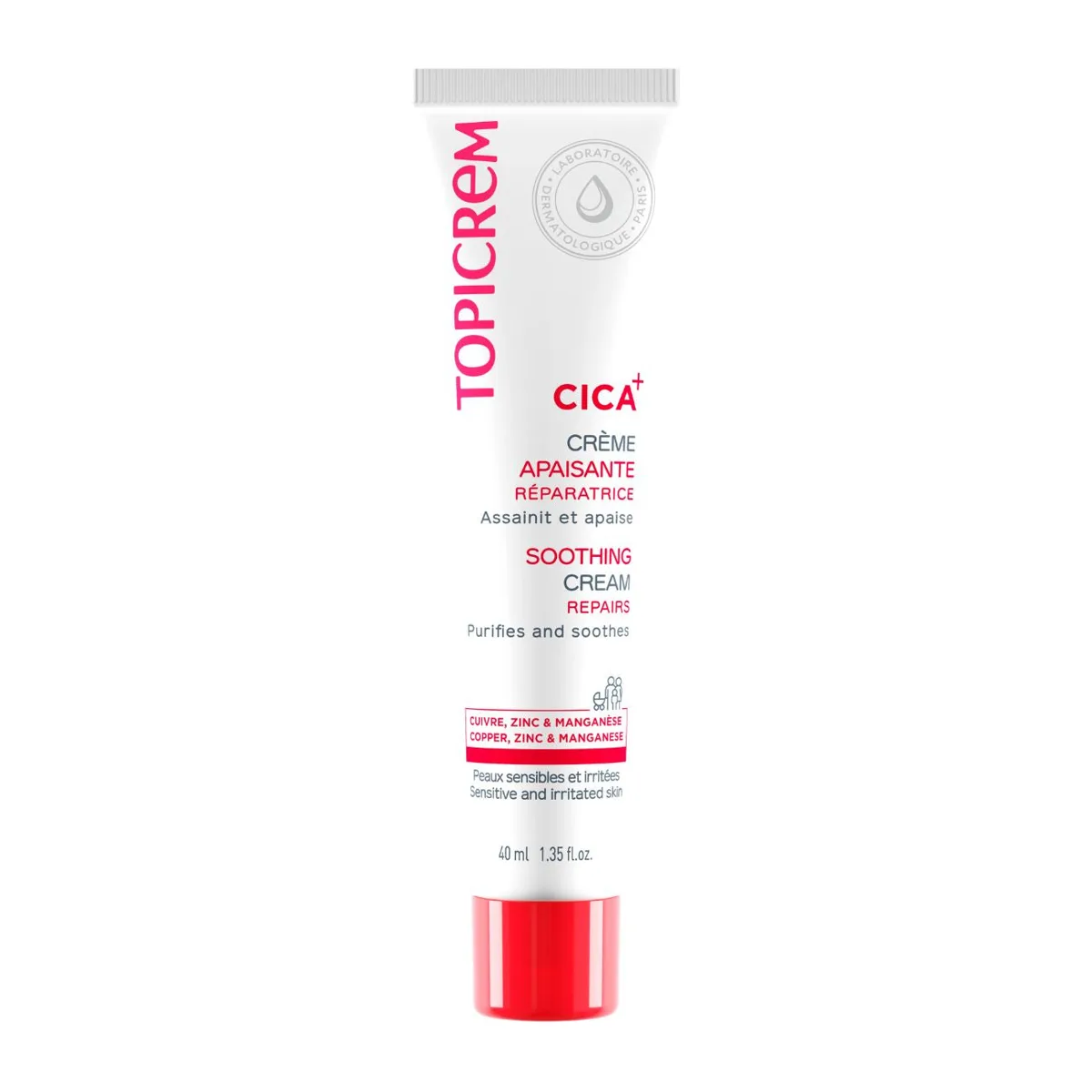
Most 'cica' products lean on centella asiatica as the central soothing active. Topicrem's CICA+ uses copper-zinc-manganese gluconates instead — a metal-cofactor approach to skin repair that targets enzymatic pathways involved in collagen synthesis, antibacterial defense and antioxidant function. The mechanism is different from typical centella products, and the result is more comparable to La Roche-Posay's Cicaplast Baume B5 (which uses copper-zinc-manganese plus panthenol) than to K-beauty cica creams.
A clinically-positioned French pharmacy barrier-repair balm with the brand's signature copper-zinc-manganese gluconate trio plus bisabolol for genuine anti-inflammatory work. Direct competitor to La Roche-Posay Cicaplast Baume B5 at similar pricing and mechanism. Heavy occlusive base targets compromised skin specifically rather than daily full-face use. Fragrance-free and unusually fungal-acne-safe for the category. Beeswax excludes vegan use; the mineral oil base will alienate natural-skincare-purists.
Strong choicefor DrynessIn your profileYou chose · Mineral Oil is an approved or monograph active for dryness; this balm carries it.Moderate evidenceGentleNo reviews collected yet
The case for it
Mineral Oil + Beeswax + Hydrogenated Castor Oil is a first-line active — approved, monograph-listed or named in current guidelines — for this concern.
It is plausibly present at a working level, though the concentration is not declared.
The formula carries none of the triggers this concern is sensitive to.
What would change this: A declared concentration would move this to a firmer reading of the dose.
Same rule for everyone. “Strong choice” is the verdict on 1,459 of 45,024 concern verdicts across the catalog; rule R3 decided 567 of them.
Unchanged since September 5, 2026, engine 5.1.1.
R3 — Undeclared but plausibly dosed (top-third INCI position, or a potent sub-1% active) — the verdict stands, and the sentence says what disclosure would add. A declared figure below range would have been sub-threshold. · the full register
Good choicefor SensitivityIn your profileYou chose · No fragrance, drying alcohol, declarable allergens or sensitising preservatives in this balm — the profile sensitive skin looks for.Not yet assessedGentleNo reviews collected yet
The case for it
Mineral Oil + Beeswax + Hydrogenated Castor Oil has no evidence row yet for this concern — it is in the research queue.
The formula carries none of the triggers this concern is sensitive to.
What would change this: A researched evidence row for the lead active would replace this with a verdict.
Same rule for everyone. “Good choice” is the verdict on 1,938 of 45,024 concern verdicts across the catalog; rule F2 decided 1,938 of them.
Unchanged since September 5, 2026, engine 5.1.1.
Also listed for Compromised Skin Barrier, Post-Procedure, Eczema and Rosacea — the actives here (Mineral Oil, Starches & Absorbent Powders, Bisabolol, Hyaluronic Acid) are in our research queue for those concerns; there is no verdict until their evidence rows are written. That is a gap in our table, not a mark against the product.
A verdict is DermApproved’s assessment of how well a product’s ingredients fit a concern — never a claim about what the product treats. Evidence dots and collected reviews sit beside it and are never blended in.
Rules 0.5.1 · evidence table ev-2026.09-r228 · how we decide
Assessment
Pros & Cons
Pros
✓ Copper-zinc-manganese gluconate metal-cofactor active complex
✓ Bisabolol provides clinically-supported anti-inflammatory work
✓ Heavy occlusive lipid base for serious barrier protection
✓ Fragrance-free and well-tolerated
✓ Unusually fungal-acne-safe for the cica balm category
✓ Affordable French pharmacy pricing
Cons
✗ Heavy occlusive base limits use to spot treatment rather than full-face
✗ Mineral oil base alienates natural-skincare-purists
✗ Smaller 40 mL size may run out quickly for extensive use
Review
Full Review
La Roche-Posay's Cicaplast Baume B5 has been the default dermatologist recommendation for compromised skin barrier recovery for years. The formula — copper-zinc-manganese gluconates plus 5% panthenol in a substantial occlusive base — became the benchmark for the French pharmacy cica category. Topicrem's CICA+ Soothing Cream is the brand's direct competitor in this niche, with a similar mechanism approach and similar clinical positioning at similar pricing.
The similarities are real. Both use the copper-zinc-manganese gluconate trio as the central active mechanism — metal cofactors that support specific enzymes involved in skin repair. Copper gluconate supports lysyl oxidase (collagen and elastin cross-linking). Zinc gluconate provides antibacterial activity relevant for compromised skin where infection risk increases. Manganese gluconate supports SOD (superoxide dismutase) antioxidant defense. The mechanism is enzymatic-cofactor support rather than direct active delivery, and it's the foundation of why these formulas work for barrier repair rather than typical moisturizing.
The difference is in the supporting anti-inflammatory active. Cicaplast Baume B5 uses 5% panthenol (provitamin B5) — a well-evidenced humectant and barrier-supportive ingredient. Topicrem CICA+ uses bisabolol — a chamomile-derived compound with substantial anti-inflammatory evidence through inhibition of inflammatory mediator release. Both work, with somewhat different profiles. Panthenol contributes more to surface hydration and barrier function; bisabolol contributes more to anti-inflammatory soothing. For acutely irritated skin, the bisabolol approach may feel more immediately calming; for dry-and-damaged skin needing both barrier and hydration, the panthenol approach may feel more comprehensively moisturizing.
The rest of the formulation parallels Cicaplast closely. Mineral oil sits in slot two as the substantial occlusive base — what makes the cream a true repair balm rather than a lighter moisturizer. Hydrogenated polydecene, beeswax, hydrogenated castor oil, glyceryl behenate, and other lipid components build the heavy emollient chassis. Talc at slot six provides texture modification. Glycerin and sodium hyaluronate provide the humectant layer. The whole structure is engineered for barrier compromise rather than daily healthy-skin moisturizing.
In use the cream behaves like a serious barrier-repair balm. Thick, slightly waxy texture that requires deliberate spreading. Once warmed by skin contact, the texture softens and applies with more ease. The fragrance-free composition is genuinely scentless. Compromised or irritated skin typically feels immediately more comfortable post-application — the barrier protection from the occlusive lipid layer is real and rapid. Cumulative repair benefits from the metal-gluconate mechanism build over 3-7 days of consistent targeted use on compromised areas.
The right use case is specific. This cream is for compromised skin — post-procedure recovery zones (post-laser, post-chemical-peel, post-microneedling), retinoid-irritated patches, eczema flares, severely chapped or windburned areas, dry seasonal patches on sensitive skin. It's not designed as a daily full-face moisturizer for healthy skin, where the heavy occlusive base would be inappropriate and likely uncomfortable. The brand's HYDRA+ Radiance Cream is the daily full-face moisturizer option; CICA+ is the targeted spot treatment.
The limitations are honest. The beeswax content rules out vegan use — La Roche-Posay's Cicaplast Baume B5 is similarly not vegan; Avène Cicalfate+ uses zinc/copper sulfates without beeswax for vegan-compatible alternatives. The mineral oil base will alienate natural-skincare-purists, though cosmetic-grade mineral oil has extensive dermatology safety data despite the marketing-driven concerns. The talc content is similarly safety-evidenced for cosmetic use but is a sticking point for some users. The 40 mL size is small relative to typical moisturizer expectations, though appropriate for spot-treatment use.
The value calculation is fair. Eighteen dollars for 40 mL puts the per-application cost in the affordable French pharmacy tier for occasional spot-treatment use. Direct comparison: La Roche-Posay Cicaplast Baume B5 at $20 for 40 mL is nearly identical pricing. Avène Cicalfate+ at $22 for 40 mL sits at slightly higher pricing. The larger 100 mL Topicrem size offers proportionally better value at $30 for users needing extensive use. The Topicrem pricing is firmly competitive within the French pharmacy cica balm category.
Buy this cream if you have compromised skin (post-procedure, retinoid-irritated, eczema, severely dry patches) and want a clinically-positioned French pharmacy barrier-repair balm. The fungal-acne-safe composition is unusual for the category and makes the cream a particularly useful option for fungal-acne-prone users dealing with simultaneous barrier compromise. Skip if you want a daily full-face moisturizer (the brand's HYDRA+ Radiance Cream is more appropriate), if you are vegan (beeswax content), or if you object to mineral oil on principle. As a French pharmacy barrier-repair balm with a slightly different active profile from the dominant Cicaplast Baume B5, Topicrem CICA+ earns its position as a credible alternative — the choice between the two largely comes down to whether you prefer the panthenol or bisabolol soothing approach.
Formula
Key Ingredients
The hero actives that drive this product's performance.
Ingredient
Function
Evidence
Copper-Zinc-Manganese Gluconate Trio
The signature active complex sitting in slots ten through twelve. Copper gluconate supports collagen and elastin synthesis through its role as cofactor in lysyl oxidase enzyme. Zinc gluconate provides antibacterial activity (relevant for compromised skin barrier where infection risk increases). Manganese gluconate supports skin antioxidant defense through SOD (superoxide dismutase) enzyme function. Together they target multiple skin repair pathways through enzymatic cofactor mechanisms rather than direct active delivery.
Derived from chamomile, bisabolol has substantial documented evidence for anti-inflammatory activity through inhibition of inflammatory mediator release. Provides the formula's soothing core that justifies the 'soothing cream' positioning. The clinically supported active component beyond the metal-gluconate complex.
Hyaluronic acid sodium salt at slot fourteen provides surface hydration; glycerin at slot three provides humectant work. Together they ensure the heavy occlusive base doesn't feel suffocating and that the formula delivers genuine moisture alongside the barrier-protective lipid layer.
The substantial occlusive lipid base — mineral oil in slot two, beeswax in slot seven, hydrogenated castor oil in slot eight. The combination creates a protective barrier film that slows transepidermal water loss and physically protects compromised skin from environmental irritation. The mineral oil base is what makes this a true repair balm rather than a lighter moisturizer.
Regulator-approvedfor Dryness · established mechanism
Sits in slot six providing mild absorption that prevents the heavy occlusive base from feeling sticky on application. Talc has been controversial in cosmetic safety discussions, though cosmetic-grade asbestos-free talc has substantial safety data when used appropriately. Used in this formula for texture rather than function.
Not yet assessed
Ingredient standings describe the active at treatment-level doses and
vehicles; this product's own condition grades weigh its actual formula.
Apply as a targeted treatment on irritated, compromised or post-procedure skin patches. Use as a spot treatment rather than a full-face moisturizer for most users — the heavy occlusive base is designed for skin that needs maximum barrier protection. For nightly use on dry patches, retinoid-irritated skin, or post-procedure recovery, apply a thin layer as the final routine step.
Results Timeline
Immediate: visible barrier protection and soothing within minutes of application. Compromised skin patches typically feel immediately more comfortable. Over 3-7 days of consistent targeted use, the metal-gluconate trio supports cumulative skin repair on damaged areas. The bisabolol provides ongoing anti-inflammatory cover during recovery.
Pairs Well With
Any gentle moisturizer (apply CICA+ on top as occlusive sealant)Post-procedure recovery routinesRetinoid-irritation rescue useHydrating toner
THIS PRODUCT (spot treatment on compromised areas)
Sunscreen SPF 30+
Sample PM Routine
Gentle cleanser
Hydrating toner
Regular moisturizer or treatment serum
THIS PRODUCT (spot or whole-face for compromised barrier recovery)
Evidence
Science & Expert Perspective
The Science
The barrier-repair mechanism here combines metal-cofactor enzymatic support with occlusive lipid protection. Copper gluconate provides copper as a cofactor for lysyl oxidase, the enzyme responsible for cross-linking collagen and elastin fibers — a critical step in skin repair after barrier damage. Zinc gluconate provides zinc with documented antibacterial activity (relevant where compromised barriers increase infection risk) and supports several skin-related enzymes. Manganese gluconate provides manganese as a cofactor for manganese-dependent superoxide dismutase (MnSOD), an antioxidant enzyme that protects skin cells from reactive oxygen species damage.
The combination targets multiple skin repair pathways through enzymatic mechanisms — different from direct active delivery used by most cosmetic actives. The clinical evidence for the metal-gluconate trio in skin repair is most established for the combination as used in La Roche-Posay's Cicaplast Baume B5, with substantial dermatology recommendation backing.
Bisabolol (alpha-bisabolol) is a sesquiterpene alcohol derived from chamomile with substantial published evidence for anti-inflammatory activity. The mechanism involves inhibition of leukotriene synthesis and reduction of inflammatory mediator release. Topical bisabolol is well-documented for soothing irritated and compromised skin.
The occlusive lipid base (mineral oil, beeswax, hydrogenated castor oil, hydrogenated polydecene, glyceryl behenate) provides barrier protection by physically slowing transepidermal water loss and shielding compromised skin from environmental irritants. Mineral oil is one of the most extensively studied moisturizing ingredients in cosmetic dermatology, with established safety and non-comedogenic ratings.
Glycerin and sodium hyaluronate provide standard humectant support. Talc provides texture modification — cosmetic-grade asbestos-free talc has substantial safety evidence at typical cosmetic concentrations.
The absence of fragrance, essential oils, alcohol and ester-based lipids places the formula in the fungal-acne-safe category — unusual for a barrier-repair balm and a meaningful differentiation from many alternative cica formulations.
Dermatologist Perspective
French pharmacy cica balms occupy a well-established position in dermatology, with brands like La Roche-Posay Cicaplast Baume B5, Avène Cicalfate+ and Topicrem CICA+ frequently recommended for compromised skin barrier recovery. The Topicrem formulation aligns with the standard dermatology approach — copper-zinc-manganese gluconate trio for repair mechanism, bisabolol for anti-inflammatory soothing, substantial occlusive lipid base for barrier protection. Skin-care professionals would view this as a clinically defensible alternative to La Roche-Posay's iconic Cicaplast Baume B5 with similar use cases. The fungal-acne-safe composition is particularly valuable for the dermatology audience managing both fungal acne and barrier compromise. Clinical caveats are minimal — the formula is well-tolerated, fragrance-free, and broadly appropriate for compromised skin recovery. For severe atopic dermatitis flares specifically, dermatologists may recommend prescription-tier alternatives or specialized atopic creams.
Guidance
Usage & Recommendations
How to Use
Apply as a targeted treatment on compromised, irritated, or post-procedure skin patches. Use a small amount (rice-grain to pea-sized) on affected areas, pat gently rather than rubbing, and allow 30-60 seconds to absorb. For nightly use on dry patches or retinoid-irritated zones, apply as the final routine step over your regular moisturizer. For post-procedure recovery, follow your treating dermatologist's specific aftercare protocol. Not designed as a daily full-face moisturizer for healthy skin.
Value Assessment
At about $18 for 40 mL, the pricing puts CICA+ at the affordable French pharmacy cica tier. Direct comparison: La Roche-Posay Cicaplast Baume B5 at $20 for 40 mL is nearly identical pricing. Avène Cicalfate+ at $22 for 40 mL sits at slightly higher pricing. The larger 100 mL Topicrem size at $30 offers proportionally better value. K-beauty cica alternatives (Skin1004 Madagascar Centella at $20 for 50 mL, COSRX Centella Blemish Cream at $20 for 30 mL) sit at similar pricing with centella-based mechanism instead. The Topicrem pricing is firmly competitive within the French pharmacy cica balm category — fair for the dermatologist-developed credentials.
Who Should Buy
Anyone with compromised skin needing targeted barrier repair — post-procedure recovery, retinoid irritation, eczema patches, severely chapped or windburned areas, seasonal dryness on sensitive skin. Particularly suited to fungal-acne-prone users who need a fungal-acne-safe barrier balm option, and to fans of French pharmacy clinical formulations as an alternative to the dominant La Roche-Posay Cicaplast Baume B5.
Who Should Skip
Anyone wanting a daily full-face moisturizer should use the brand's HYDRA+ Radiance Cream instead. Strict vegans should skip due to beeswax content. Skip too if you object to mineral oil on principle (though cosmetic-grade mineral oil has strong dermatology safety evidence) or if you prefer centella-based cica products where K-beauty alternatives deliver the more botanical approach.
A thick, slightly waxy balm-cream that scoops with firm resistance and spreads with deliberate work. Once warmed by skin, the texture softens and spreads more readily. Leaves a soft satin-rich finish with a slight visible barrier film.
Scent
Genuinely fragrance-free with no perceptible scent.
Packaging
A 40 mL squeeze tube in Topicrem's clinical blue-and-white French pharmacy design. A larger 100 mL size is also available for users wanting whole-face use.
Finish
satinnon-greasy
What to Expect on First Use
First use centers on the thick balm-like texture that requires deliberate warming to spread, and the immediate sensation of barrier protection on application. The fragrance-free composition is genuinely scentless. Compromised or irritated skin typically feels immediately more comfortable post-application.
How Long It Lasts
About 3-6 months as a spot treatment, less as full-face moisturizer
Launched in 2016 as Topicrem's entry into the cica/barrier-repair category dominated by La Roche-Posay Cicaplast Baume B5. The metal-gluconate mechanism reflects the brand's preference for clinical, dermatologist-developed approaches over the more botanically-positioned K-beauty cica alternatives. The 'CICA' in the name refers to the skin-repair function rather than centella asiatica content (which is not in this formula).
About Topicrem Established Brand (5–20 years)
Topicrem's CICA+ line targets damaged, irritated and compromised skin barriers — the brand's clinical answer to the K-beauty cica category and a direct competitor to La Roche-Posay's iconic Cicaplast Baume B5. Built around copper-zinc-manganese gluconates rather than centella asiatica (despite the 'cica' name), the formula takes a metal-gluconate approach to skin repair.
Brand founded: 1992 · Product launched: 2016
Myth vs. Reality
Common Myths
Myth
All 'cica' products contain centella asiatica.
Reality
The 'cica' in skincare naming derives from the Latin 'cicatrisant' (wound-healing). Many products in the category — particularly K-beauty options — do use centella asiatica as the central active. But French pharmacy 'cica' formulations like Topicrem's CICA+ and La Roche-Posay's Cicaplast Baume B5 use different active complexes (typically copper-zinc-manganese gluconates plus panthenol or bisabolol) without centella. Both approaches deliver skin-repair work through different mechanisms; the 'cica' name describes the function, not necessarily the active.
Myth
Mineral oil suffocates skin and causes breakouts.
Reality
Cosmetic-grade mineral oil is one of the most-studied moisturizing ingredients in dermatology, with extensive safety data and documented evidence for barrier protection without comedogenic concerns. The 'mineral oil clogs pores' claim is a common misconception largely driven by marketing from natural-skincare brands. Mineral oil has a non-comedogenic rating in standardized testing. The Topicrem formula's mineral oil base is what makes the cream genuinely effective for compromised skin barrier protection.
FAQ
Frequently Asked Questions
How does Topicrem CICA+ compare to La Roche-Posay Cicaplast Baume B5?
Very similar positioning and mechanism. Both are French pharmacy brand barrier-repair balms built around copper-zinc-manganese gluconates. Cicaplast Baume B5 adds 5% panthenol; Topicrem CICA+ uses bisabolol for the anti-inflammatory layer. Cicaplast is more widely distributed globally and has the higher brand recognition; Topicrem CICA+ is similarly priced and similarly effective with a slightly different active profile. Both work well for the same use cases — compromised skin barrier, post-procedure recovery, retinoid irritation.
Does this cream contain centella asiatica despite the 'CICA' name?
No. The 'CICA' in French pharmacy naming refers to the cicatrisant (wound-healing) function rather than the centella asiatica plant. Topicrem CICA+ uses copper-zinc-manganese gluconates plus bisabolol as the active complex. For centella-based cica formulations, look at K-beauty alternatives like Skin1004 Madagascar Centella Asiatica products or COSRX Centella Blemish Cream.
Is this cream good for everyday full-face moisturizer use?
Generally not — the heavy occlusive base is designed for compromised skin patches rather than healthy daily-use skin. Most users find the cream too rich for daily full-face application; better suited as a targeted spot treatment on irritated areas, post-procedure recovery zones, or seasonal-dryness patches. For daily full-face moisturizing, the brand's HYDRA+ Radiance Cream is the more appropriate product.
Is this cream fungal-acne safe?
Yes — the formula contains no esters or oils that malassezia can metabolize. The mineral oil, beeswax, and hydrogenated castor oil base are all fungal-acne-safe options, and the metal gluconates and hyaluronic acid don't trigger malassezia growth. This is unusual for a barrier-repair balm and makes the cream a particularly useful option for fungal-acne-prone users dealing with simultaneous barrier compromise.
Is this cream vegan?
No. The formula contains beeswax (Cera Alba) which is animal-derived. For vegan French pharmacy barrier-repair alternatives, La Roche-Posay's Cicaplast Baume B5 is technically not vegan due to similar concerns; look at Avène Cicalfate+ (which uses zinc/copper sulfates without beeswax) or plant-based alternatives instead.
Reviews
What Reviewers Tend to Say
Recurring themes our editors read across retailer reviews of this product — summaries in our words, not quotations, and not a substitute for your own patch test.
Common Praise
Genuinely soothing for irritated and compromised skin
Copper-zinc-manganese gluconate trio is differentiated active approach
Bisabolol provides clinically-supported anti-inflammatory work
Fragrance-free and broadly tolerable
Affordable French pharmacy pricing
Common Complaints
Heavy occlusive base is not for daily full-face moisturizer use
Beeswax excludes vegan use
Mineral oil base is a sticking point for natural-skincare-conscious users
Smaller 40 mL size may run out quickly for full-face use
Notable Endorsements
Dermatologist-developed French pharmacy brandDirect competitor to La Roche-Posay Cicaplast Baume B5Frequently recommended for post-procedure recovery
Chamomile's active fraction inhibits the same inflammatory pathways a steroid does, at a fraction of the strength — and the version that works best is grubbed out of Brazilian cerrado, while the synthetic substitute is half inactive by construction.
The internet's favorite hydrator has a counterintuitive dark side — in dry air, a humectant with nothing to seal it can pull water out of your skin instead of into it.
Occupational hand dermatitis is one of the most common work-related diseases on earth, it follows a script, and the cheapest fix works only if you start it before the skin splits.
Every post that dismantles a home remedy owes the reader a replacement. The honest replacement list is embarrassingly cheap, and one item on it is cheaper still — it is a bath.
Aug 28, 2026· 9 min
Questions people ask about sensitive skin
Verified answers from our questions library — the nuance a product page cannot carry.
Products, answers, therapy guides, tools and articles in one search. Brand names,
slang and abbreviations all work — accutane finds isotretinoin, bacne finds truncal acne.