Unusually for a blemish-and-oil-focused toner, it builds in barrier support — a ceramide, squalane and lecithin alongside the expected cica, spirulina and green tea. That soothe-and-strengthen combination aims to calm breakout-prone skin without the stripping a typical 'oily skin' toner brings.
A smarter-than-average toner for oily, blemish-prone skin that calms instead of strips — centella and spirulina for soothing, plus a ceramide and squalane for genuine barrier support. It balances congested skin without the tightness of a typical astringent toner. The catches are alcohol mid-list and lavender oil, which give sensitive or essential-oil-reactive skin reason to patch test.
Pricing aside, this toner comes from a newer line with a few years on the market and a moderate, growing review base, so the assessment leans partly on that feedback and partly on an ingredient-level read of its cica-spirulina-ceramide formula. Because the current US price couldn't be confirmed, the value rating reflects formulation and the line's typical budget positioning rather than a verified figure.
Verdicts
How well it fits each concern
Verdict by concern tap a concern for the case
Promisingfor Excess OilinessIn your profileYou chose · Green Tea Extract has trial-level evidence for excess oiliness but no guideline or regulatory standing yet — promising, short of a recommendation; the other actives here are not yet assessed for it.Moderate evidenceStandard tolerabilityNo reviews collected yet
The case for it
Green Tea Complex has trial-level evidence for this concern but no guideline or regulatory standing yet.
It is plausibly present at a working level, though the concentration is not declared.
The formula carries no trigger this concern is sensitive to, with the cautions noted.
Cautions: fungal-acne triggers.
What would change this: A declared concentration would move this to a firmer reading of the dose.
Same rule for everyone. “Promising” is the verdict on 7,858 of 45,024 concern verdicts across the catalog; rule R9p decided 7,858 of them.
Unchanged since September 5, 2026, engine 5.1.1.
R9p — 0.5.0: 'Unproven' beside three filled dots read as one question answered twice with opposite words (7,018 rows). The chip measures standing, the dots measure trial volume; where the row carries at least one RCT or a tier-2 source (moderate dots) and the active is present at a working level, the honest word is Promising. Unproven is reserved for plausible-standing rows with limited or weak evidence, or an under-dosed form. Same rank as Unproven — a bet either way; the dots order them. · the full register
Carrying active
Green Tea Complex
Standing
plausible — trials support it
Form
plausible — studied range 3–5%, from the OTC monograph or label; needs leave-on contact
Tolerability
standard — fungal triggers
Row checked
against its sources on July 17, 2026 (evidence table ev-2026.09-r228)
Avoidfor SensitivityIn your profileYou chose · This formula carries fragrance — the kind of thing reactive skin flags first.Not yet assessedCarries a triggerNo reviews collected yet
The case for it
Centella Asiatica Extract has been researched for this concern and the evidence does not support it.
It is plausibly present at a working level, though the concentration is not declared.
The formula carries a known trigger for this concern, which decides the verdict before any efficacy question.
Cautions: known irritants.
What would change this: Removing the trigger named above would let the actives be judged on their own.
Same rule for everyone. “Avoid” is the verdict on 1,909 of 45,024 concern verdicts across the catalog; rule F1 decided 605 of them.
Unchanged since September 5, 2026, engine 5.1.1.
Avoidfor Compromised Skin BarrierIn your profileYou chose · This formula carries fragrance — a known trigger for compromised skin barrier — so it is not a fit however good its actives are.Moderate evidenceCarries a triggerNo reviews collected yet
The case for it
Ceramide NP has trial-supported standing for this concern.
It is plausibly present at a working level, though the concentration is not declared.
The formula carries a known trigger for this concern, which decides the verdict before any efficacy question.
Cautions: known irritants.
What would change this: Removing the trigger named above would let the actives be judged on their own.
Same rule for everyone. “Avoid” is the verdict on 1,909 of 45,024 concern verdicts across the catalog; rule R1 decided 1,304 of them.
Unchanged since September 5, 2026, engine 5.1.1.
R1 — Safety outranks praise (MASTER-PLAN §1.7). A condition-weighted trigger (multiplier ≥ 2 in condition-fit-matrix) decides the verdict before any efficacy question. · the full register
Carrying active
Ceramide NP
Standing
supported — its mechanism is established
Form
plausible — studied range 0.5–1%, from the trials on the row; needs leave-on contact; judge it after ~4 weeks
Tolerability
harsh — fragrance load
Row checked
against its sources on July 17, 2026 (evidence table ev-2026.09-r228)
The studies behind the evidence row
Elias PM, Skin Barrier / Coderch et al., ceramides and skin barrier function — ceramides ~50% of SC intercellular lipid mass, essential to the permeability barrier — reference work
Also listed for Acne and Dullness — the actives here (Ceramides, Spirulina, Centella Asiatica, Green Tea Extract) are in our research queue for those concerns; there is no verdict until their evidence rows are written. That is a gap in our table, not a mark against the product.
Does the jobDoes what a toner is for: adds something real, not alcohol-driven. Not measured from the label: restores skin pH, plays well with what follows.
A verdict is DermApproved’s assessment of how well a product’s ingredients fit a concern — never a claim about what the product treats. Evidence dots and collected reviews sit beside it and are never blended in.
Rules 0.5.1 · evidence table ev-2026.09-r228 · how we decide
Assessment
Pros & Cons
Pros
✓ Soothes with centella and spirulina instead of stripping oil
✓ Includes Ceramide NP and squalane for real barrier support
✓ Double green tea extracts add antioxidant, sebum-friendly benefits
✓ Light, fast-absorbing texture that balances without tightness
✓ Hydrating base of glycerin, hyaluronic acid and glycoproteins
✓ Affordable line from an established parent brand
✓ Cruelty-free formulation
Cons
✗ Alcohol sits mid-list, less ideal for dry skin
✗ Lavender oil is a potential sensitizer in a soothing product
✗ Not fungal-acne-safe due to lipids and triglycerides
✗ Light scent won't suit fragrance-avoidant users
✗ Current US price could not be verified
✗ Watery texture won't replace a moisturizer on its own
Review
Full Review
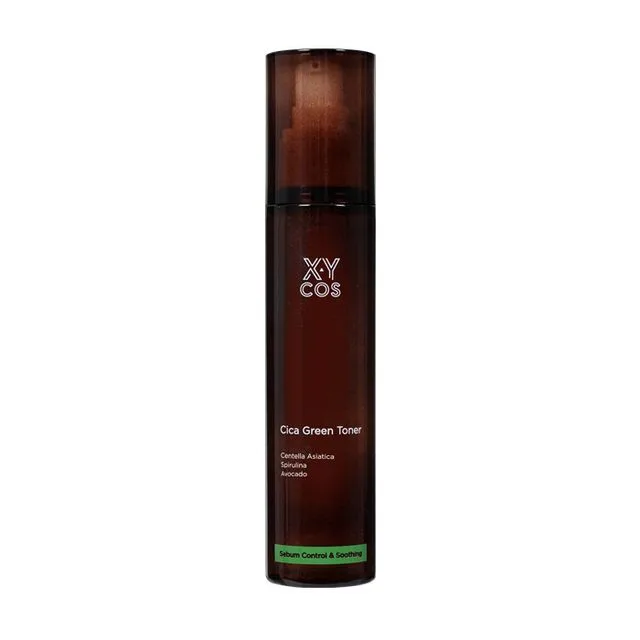
For decades, the conventional toner for oily, acne-prone skin worked on a simple, punishing logic: if oil is the problem, strip it away. The harsher and more drying the toner, the better — astringents, high alcohol, that tight squeaky finish. We now know this often backfires, because aggressively de-greasing the skin can trigger it to pump out even more oil and leave the barrier irritated and reactive. The XYCOS Cica Green Toner is built on the opposite, more modern premise: that the way to better-behaved oily skin runs through calming and strengthening it, not punishing it.
The name lays out the strategy. 'Cica' refers to centella asiatica, the celebrated soothing botanical that sits in the formula to quiet redness and support skin stressed by breakouts. 'Green' nods to the plant-forward roster — spirulina, the antioxidant blue-green algae; both a callus culture and a leaf extract of green tea; avocado; edelweiss. Together they form a calming, antioxidant-rich base aimed squarely at congested, blemish-prone skin that's tired of being stripped. So far, so on-trend for a cica toner.
What genuinely sets it apart is something you don't expect in a toner pitched at oily skin: barrier support. Tucked into the ingredient list are Ceramide NP — a skin-identical lipid — along with squalane and hydrogenated lecithin. Oily and acne-prone skin is frequently barrier-compromised, ironically often because of over-treatment, and building these lipids into a daily toner is a thoughtful way to rebuild resilience while calming inflammation. It's the soothe-and-strengthen combination that defines the better cica products, and it's the main reason this toner earns its keep. Add glycerin, sodium hyaluronate, betaine and glycoproteins for hydration, plus licorice-derived dipotassium glycyrrhizate for extra soothing and brightening, and you have a formula that reads as genuinely supportive rather than merely astringent.
In use, it's a light, watery toner that absorbs fast and leaves skin feeling calm and balanced rather than tight. The ceramide and squalane give it enough substance to act as a light first layer of hydration, though it's not a substitute for a proper moisturizer. There's a soft herbal-floral scent on application that fades quickly.
Now Its caveats, because this isn't a flawless formula. Two ingredients temper the enthusiasm. First, alcohol sits about midway down the list — not at the top, so it's far from the harshest astringent toner, but present enough to add a quick-drying feel and to make this less ideal for genuinely dry skin. Second, and more notably for a product that markets itself on soothing, it contains lavender oil. Lavender oil is a fragrant essential oil and a recognized potential sensitizer, which sits slightly at odds with the calming, sensitive-skin positioning. Most skin tolerates it fine, but anyone whose skin reacts to essential oils should patch test before committing — there's a mild irony in a cica toner including a common irritant. The formula also isn't fungal-acne-safe, given the lecithin, squalane, and triglyceride content.
One more note worth flagging for the ethically-minded shopper: the ingredient list as documented includes honey, a bee-derived ingredient, so despite the plant-forward 'green' branding, this particular formulation isn't vegan by that list. If that matters to you, verify the current formula against the packaging, as brands sometimes reformulate.
Using it is straightforward — press it on after cleansing, before serums, morning and night, and follow with a moisturizer. It's best understood as a daily calming-and-balancing step for oily and combination skin that's prone to redness and breakouts, not a treatment toner doing heavy lifting on its own.
It helps to read this toner as one piece of a coordinated 'Cica Green' system rather than a standalone product. The line is built so the toner preps, the serum concentrates, and the cream seals — all sharing the same centella-spirulina-ceramide philosophy. On its own the toner is a light, calming hydration-and-prep step; its real value emerges when it's the first layer of that soothing routine. If you're cherry-picking a single product from the range, the serum does more heavy lifting, but as the gateway step the toner sets a calm, balanced tone for everything that follows.
The lavender oil deserves one more honest beat, because it's the formula's central tension. There's a genuine philosophical wrinkle in marketing a product to sensitive, reactive skin and then including a fragrant essential oil that is one of the more commonly flagged contact sensitizers. It's not a dealbreaker — the dose is small, it's near the end of the list, and the majority of users never notice an issue — but it's the kind of choice that makes a careful reader raise an eyebrow. If your skin is genuinely reactive, this single ingredient is the reason to patch test rather than dive in, and it's fair to wish the brand had left it out of an otherwise calming-focused formula.
On value, the XYCOS line has typically been affordable, in keeping with the parent brand's budget positioning, though the current US price couldn't be confirmed at writing. For oily, blemish-prone skin that's been burned by stripping toners and wants something that calms while it balances, this is a well-conceived, sensibly-priced option — provided the alcohol and lavender oil don't clash with your skin. Patch test, confirm it agrees with you, and it's a quietly good daily toner that respects the principle that calm skin is better-behaved skin.
Formula
Key Ingredients
The hero actives that drive this product's performance.
The 'Cica' of the name and the toner's soothing anchor, included to calm redness and support a stressed or blemish-irritated barrier. It works alongside spirulina and a green tea pair to give the toner its sensitive-skin, balancing-rather-than-stripping personality.
A blue-green algae extract rich in amino acids and antioxidants, part of the 'green' identity that gives this line its character. It complements the centella's calming action with antioxidant nourishment aimed at dull, congested skin.
A skin-identical lipid woven into a watery toner — an unusual, welcome addition — supported by squalane and hydrogenated lecithin to reinforce the barrier as the toner hydrates. It's what lets a toner aimed at oily, breakout-prone skin still claim a barrier-supportive angle.
Established mechanismfor Compromised Skin Barrier · established mechanism
Both a callus culture extract and standard leaf extract appear, layering antioxidant polyphenols and sebum-friendly support into the formula. The double form reinforces the toner's blemish-and-oil focus while keeping the soothing-green theme consistent.
Limitedfor Excess Oiliness
Ingredient standings describe the active at treatment-level doses and
vehicles; this product's own condition grades weigh its actual formula.
Press it on after cleansing and before serums to prep skin with hydration and calming actives. Its ceramide and squalane content help it double as a light first hydration step, but follow with a moisturizer, especially if your skin is on the drier side.
Results Timeline
Skin feels calmer and more balanced from the first uses; reduced look of redness and a steadier, less oily complexion build over a few weeks of consistent use.
The toner's soothe-and-strengthen approach is well aligned with current thinking on barrier-compromised, acne-prone skin. Centella asiatica is one of the better-studied botanical actives for calming, with its triterpenes (asiaticoside, madecassoside) supporting wound healing and anti-inflammatory effects relevant to irritated, blemish-prone skin. The inclusion of Ceramide NP is mechanistically sound: ceramides are core components of the stratum corneum's lipid matrix, and supplementing them supports barrier repair — valuable for oily skin that is frequently over-treated and barrier-impaired. Squalane adds a well-tolerated, skin-identical emollient. Spirulina contributes amino acids and antioxidant pigments with preliminary supportive evidence, and green tea polyphenols (here in both callus culture and leaf forms) have antioxidant and sebum-relevant data. The countervailing considerations are the alcohol content, which in moderation aids penetration and a light finish but can dry or irritate with overuse, and lavender oil, a fragrant component with documented sensitization potential that sits somewhat at odds with the calming intent. The honest read: a genuinely thoughtful, barrier-supportive soothing toner whose two questionable inclusions (alcohol and lavender oil) are the main reasons it isn't a clean fit for the most sensitive skin it otherwise courts.
Dermatologist Perspective
Calming, barrier-supportive approaches are increasingly favored in clinical management of acne-prone and sensitized skin, on the understanding that over-stripping can worsen oil production and impair the barrier. Centella asiatica and ceramides are both well regarded in this context — centella for its anti-inflammatory triterpenes and ceramides for restoring barrier lipids — making their combination in a daily toner a sensible choice for congested skin. Dermatological commentary does flag two common formulation pitfalls present here: alcohol, which is acceptable in moderation but can dry or irritate sensitive skin, and fragrant essential oils such as lavender, which are recognized sensitizers and are often advised against for reactive or compromised skin. Patch testing is the standard recommendation when essential oils are present, and pairing any toner with adequate moisturization and sun protection remains routine guidance.
Guidance
Usage & Recommendations
How to Use
After cleansing, dispense a few drops onto your palms or a cotton pad and press evenly over the face, then let it absorb before applying serums. Use morning and night. Its ceramide and squalane let it act as a light first hydration layer, but always follow with a moisturizer, particularly if your skin leans dry. If your skin reacts to essential oils, patch test on the inner arm or jaw first and discontinue if redness or itching develops.
Value Assessment
The XYCOS line has generally been priced in the affordable K-beauty tier consistent with the parent brand, offering a fairly ingredient-rich toner — cica, spirulina, a ceramide and squalane — for a modest outlay. The current US price couldn't be confirmed at the time of writing, so value is assessed on formulation and the line's typical budget positioning rather than a verified figure; check the live price before buying. A 120ml bottle lasts a couple of months with daily use. On a cost-per-ingredient basis the formula is generous for its tier, with the main value caveat being fit: the alcohol and lavender oil mean it won't suit everyone the soothing branding might attract.
Who Should Buy
This suits oily, combination, or blemish-prone skin that's tired of stripping astringent toners and wants a calming, balancing step with genuine barrier support. It's a good fit for those drawn to cica and antioxidant botanicals who can tolerate a lightly scented, mildly alcohol-containing formula.
Who Should Skip
Very dry skin and anyone reactive to essential oils or alcohol should be cautious, as the lavender oil and alcohol can irritate or dry, and a fragrance-free hydrating toner would serve them better. Those managing fungal acne, or who require a strictly vegan product, should also look elsewhere given the lipids and the honey content.
Ready to try The Skin House XYCOS Cica Green Toner?
Thin, watery toner with a slight slip; absorbs quickly and leaves a fresh, balanced feel rather than a heavy one.
Scent
Lightly scented from lavender oil and the botanical extracts — a soft herbal-floral note rather than fragrance-free.
Packaging
120ml bottle for daily application by hand or cotton pad.
Finish
lightweightfast-absorbingfresh
What to Expect on First Use
Goes on light and watery, leaving skin feeling calm and freshly balanced rather than tight; the lavender-and-herbal scent is noticeable on application and fades quickly. Patch test if essential oils tend to bother your skin.
It anchors The Skin House's XYCOS line, a more recent, plant-forward range built around the 'Cica Green' concept of calming sensitive, congested skin with centella, spirulina and avocado. The line leans into a green, botanical identity distinct from the parent brand's older ranges.
About The Skin House Established Brand (5–20 years)
XYCOS is a more recent line from The Skin House, a South Korean brand active since around 2009, positioned around plant-forward 'cica' soothing for sensitive and blemish-prone skin. The parent brand has a long market presence, though this particular sub-line has a shorter track record.
Brand founded: 2003 · Product launched: 2021
Myth vs. Reality
Common Myths
Myth
Toners for oily, blemish-prone skin should always be drying astringents.
Reality
Stripping oily skin often backfires, triggering more oil and irritation. This toner takes the opposite approach — calming with cica and supporting the barrier with a ceramide — on the logic that balanced, comfortable skin behaves better than punished skin.
FAQ
Frequently Asked Questions
What does the XYCOS Cica Green Toner do?
It's a soothing, balancing toner built around centella (cica), spirulina and green tea to calm redness and support blemish-prone, oily skin, with a ceramide and squalane added for barrier support. It hydrates and steadies the skin rather than stripping oil away.
Is this cica toner good for acne-prone skin?
Yes — it's aimed at congested, blemish-prone skin, using calming and antioxidant botanicals plus light barrier support rather than harsh astringents. It helps keep skin balanced, though it works best alongside dedicated acne treatments rather than as a standalone cure.
Does the XYCOS Cica Green Toner contain alcohol or fragrance?
Yes to both in a sense — alcohol sits midway down the list, and it contains lavender oil, which adds scent and is a potential irritant. Most skin tolerates it, but very sensitive or essential-oil-reactive skin should patch test first.
Can dry skin use this toner?
It's geared more toward oily and combination skin, and the alcohol content makes it less ideal for very dry skin. Dry skin can use it but should follow with a richer moisturizer, or choose a more emollient hydrating toner instead.
Is the toner suitable for sensitive skin?
It's soothing-focused with cica and a ceramide, which helps, but the lavender oil and alcohol are potential sensitizers. Reactive skin should patch test and watch for any irritation before regular use.
Reviews
What Reviewers Tend to Say
Recurring themes our editors read across retailer reviews of this product — summaries in our words, not quotations, and not a substitute for your own patch test.
Topically, the molecule the argument tells you to avoid is one the stratum corneum is structurally built from — and in acne-prone skin the documented finding is a shortage of it.
Western sensitive skincare works by subtraction — remove the fragrance, remove the alcohol, shorten the list. Japan's answer adds a designed molecule back in, and one of the two bets has a trial literature.
A wrecked barrier is the most common self-inflicted skin condition and the one with the clearest fix — the difficulty is that the routine which caused it feels productive and the one that repairs it feels like giving up.
'Barrier damage' has become the internet's all-purpose diagnosis. It's also a real, specific condition with a specific and slightly boring cure: mostly, stop doing things.
May 15, 2026· 5 min
Questions people ask about Acne
Verified answers from our questions library — the nuance a product page cannot carry.
Products, answers, therapy guides, tools and articles in one search. Brand names,
slang and abbreviations all work — accutane finds isotretinoin, bacne finds truncal acne.