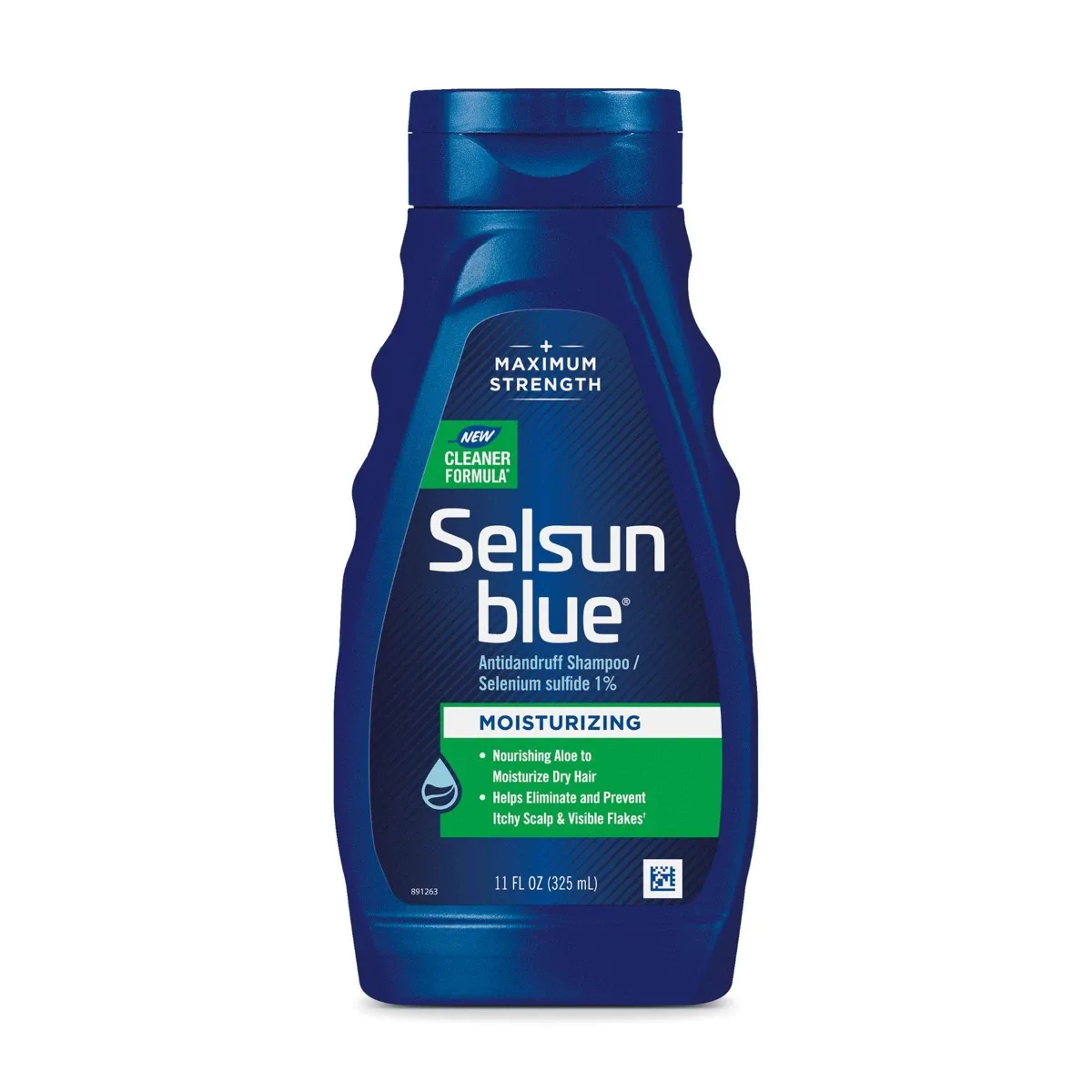
It carries exactly the same one percent selenium sulfide as the variant marketed as Medicated and Maximum Strength, but wraps it in a better vehicle — a mild taurate co-surfactant, glyceryl caprylate/caprate, and actual silicone conditioning that the flagship omits entirely. The differences that sell the two bottles apart are menthol, fragrance and a word on the label, none of which are the drug.
Identical drug to the bottle beside it marked Maximum Strength, in a distinctly better vehicle — taurate co-surfactant, silicone conditioning, no menthol. That makes this the sensible pick in the range, and the one most shoppers walk past because its name sounds like the weaker option. Fragrance, a dye and a sulfate base keep it from being the gentlest thing available.
Strong choicefor DandruffIn your profileYou chose · Selenium Sulfide is an approved or monograph active for dandruff; this liquid carries it at 1%.Strong evidenceStandard tolerabilityNo reviews collected yet
The case for it
Selenium Sulfide 1% is a first-line active — approved, monograph-listed or named in current guidelines — for this concern.
It is present at an effective concentration, declared or high in the ingredient list.
The formula carries no trigger this concern is sensitive to, with the cautions noted.
Cautions: fragrance.
Same rule for everyone. “Strong choice” is the verdict on 1,459 of 45,024 concern verdicts across the catalog; rule R2 decided 892 of them.
Unchanged since September 5, 2026, engine 5.1.1.
Supporting rolefor DrynessIn your profileYou chose · Rinse-off liquid: Dimethicone gets seconds of contact, so this supports a routine for dryness rather than treating it.Moderate evidenceStandard tolerabilityNo reviews collected yet
The case for it
Dimethicone is a first-line active — approved, monograph-listed or named in current guidelines — for this concern.
It is in a rinse-off product, so it gets seconds of contact rather than the leave-on exposure the evidence assumes.
The formula carries no trigger this concern is sensitive to, with the cautions noted.
Cautions: fragrance.
What would change this: The same active in a leave-on form would be judged on its evidence rather than its contact time.
Same rule for everyone. “Supporting role” is the verdict on 8,197 of 45,024 concern verdicts across the catalog; rule R6 decided 2,017 of them.
Unchanged since September 5, 2026, engine 5.1.1.
R6 — Contact time cannot deliver a leave-on claim; the product is judged on its job (cleansing without aggravating). Explicit exceptions (BPO wash, SA cleanser, medicated shampoos) never reach this rule because their rows set rinse_off_ok. · the full register
A verdict is DermApproved’s assessment of how well a product’s ingredients fit a concern — never a claim about what the product treats. Evidence dots and collected reviews sit beside it and are never blended in.
Rules 0.5.1 · evidence table ev-2026.09-r228 · how we decide
Assessment
Pros & Cons
Pros
✓ Same one percent selenium sulfide as the range's Maximum Strength bottle
✓ Contains dimethicone conditioning that the flagship omits entirely
✓ No menthol, so nothing stings on an already-irritated scalp
✓ Mild taurate co-surfactant softens the ammonium sulfate base
✓ Among the cheapest full-strength selenium sulfide options available
✓ Most ordinary-smelling product in a range known for medicinal scent
✓ Complete formula published on an FDA Drug Facts panel
Cons
✗ Aloe sits fifteenth of sixteen ingredients, doing label work
✗ Conditions hair rather than scalp, despite the moisturising name
✗ Still contains fragrance and a synthetic dye
✗ Can turn colour-treated hair brassy over repeated washes
✗ No sensation at all, making the dwell time easy to cut short
✗ 325 ml bottle is smaller than the 400 ml category standard
Review
Full Review
Two bottles, same shelf, same brand, same blue, both carrying an identical Maximum Strength banner across the top. One then says Medicated. The other says Moisturizing, and reads to almost every shopper walking past like the version for people who are not serious. Both contain one percent selenium sulfide — the maximum concentration permitted over the counter — printed on the same kind of federal Drug Facts panel. The word Medicated is not describing a stronger drug. It is describing menthol, a scent, and a marketing position.
What actually separates them is worth knowing, because it runs the other way from the implication. The flagship contains no conditioning ingredient whatsoever — no silicone, no cationic polymer, nothing that softens hair after a sulfate-plus-selenium wash. This one contains dimethicone. It also swaps in more of the mild taurate surfactant, adds glyceryl caprylate/caprate, and drops the menthol entirely. Read the two ingredient lists together and the moisturising variant is straightforwardly the better-built product: same medicine, less abrasion, nothing lost.
The moisturising story itself is a little softer than the front of the bottle suggests, and it is worth being precise about where the softness comes from. Aloe barbadensis leaf juice sits fifteenth of sixteen inactive ingredients, one place above the dye — trace territory, doing label work rather than formulation work. Titanium dioxide appears mid-list as an opacifier, turning a clear liquid into an opaque cream-coloured one, which communicates richness before you have washed anything at all. The genuine conditioning is the dimethicone on the hair shaft and the gentler surfactant blend underneath. Unglamorous ingredients doing the work while the photogenic one takes the billing is an old pattern, and it is at play here.
Credit where it is due, though: the front of the bottle is more careful than the shorthand suggests. It promises nourishing aloe to moisturise dry hair — hair, not scalp — which is exactly what dimethicone and a softened surfactant blend deliver. The overpromise lives in the one-word variant name rather than in the claim underneath it.
It also means the name overpromises in a specific direction. This conditions hair; it does not moisturise scalp. There is no humectant and no occlusive aimed at scalp skin anywhere in the formula, and dimethicone deposits on the shaft rather than the surface underneath it. If your scalp is genuinely dry as well as flaking, this will treat the flaking and leave your lengths softer, and you will still want a separate leave-on scalp product on the days between washes.
What it does do, it does well and cheaply. Selenium sulfide at full strength works on two fronts against seborrhoeic dermatitis — suppressing the Malassezia yeast driving the inflammation, and independently slowing the accelerated skin turnover that produces visible flakes. Around 450 reviewers averaging 4.4 stars describe a scalp that gets properly clean without hair that feels stripped, which is precisely the profile the ingredient list predicts.
There is one recurring complaint worth taking seriously, and it is not a formulation flaw. Reviewers with colour-treated hair report it turning brassy over repeated washes. Selenium sulfide is documented to shift tone on bleached, tinted and grey hair, which is why every drug label in this class carries a rinse instruction for those hair types. It is a property of the active rather than of this particular bottle, and it applies equally to the flagship. Keeping the lather on the scalp instead of working it through the lengths, and rinsing longer than feels necessary, reduces it substantially. Anyone with expensive blonde or fashion colour should weigh a different active entirely.
The absence of menthol turns out to matter more than it sounds. In the flagship, cooling arrives within a minute, feels like something is happening, and then fades — and people rinse when it does, throwing away most of the drug. Here there is nothing to feel at all. That is a small psychological disadvantage and a real practical one, because contact time is what determines whether a medicated shampoo works, and without a sensation to mark it you have to use the clock deliberately. Several minutes at the scalp, while you finish the rest of your shower.
The things keeping this from a higher score are the ones it inherits from the range. Ammonium lauryl sulfate leads the cleansing, which is a thorough degreaser rather than a gentle one — defensible, since sebum is what the yeast lives on, but not kind. Fragrance is present. And Blue 1 remains, a synthetic dye contributing nothing but colour to a product applied to inflamed skin twice a week indefinitely. Dye-free, fragrance-free medicated shampoos exist for a couple of dollars more, and for a reactive scalp that premium is worth paying.
It is also worth noticing what this bottle tells you about reading a medicated shelf generally. Two products, same brand, same active, same strength, same price — and the differences that actually affect your experience (a silicone, a milder co-surfactant, the presence or absence of menthol) appear nowhere on the front of either package, while the differences that affect nothing (the words Medicated and Maximum Strength) are printed in the largest type available. The Drug Facts panel is where the comparison is decided, and it takes about twenty seconds to read.
At $7.99 for 11 fluid ounces it remains among the cheapest routes to full-strength selenium sulfide, with the caveat that 325 ml is smaller than the 400 ml standard elsewhere, so a bottle runs about two months rather than three at the labelled cadence.
Buy this one over its louder sibling. If you have dandruff and want maximum-strength selenium sulfide without wrecking your hair, this is the version to reach for, and the only thing you give up is a cooling sensation that was never treating anything. Look elsewhere if your scalp is reactive enough to object to fragrance and dye, or if your hair colour is too expensive to gamble on.
Formula
Key Ingredients
The hero actives that drive this product's performance.
The identical monograph active, at the identical maximum over-the-counter strength, as the variant in this range labelled Medicated — a fact worth sitting with, because the word Medicated is a marketing differentiator here rather than a pharmacological one. It suppresses Malassezia and slows the epidermal turnover producing flakes.
The genuine difference between this formula and the range's flagship, which contains no conditioning ingredient whatsoever. A light silicone deposit on the hair shaft is what stops a sulfate-plus-selenium wash finishing rough and tangled, and it is the single reason this version feels kinder despite delivering the same drug.
Regulator-approvedfor Dryness · established mechanism
A mild taurate surfactant placed fifth, sharing the cleansing load with the ammonium sulfate above it and softening the overall system's edge. Paired with glyceryl caprylate/caprate two slots down, it does more for the moisturising claim on the front of the bottle than the aloe everyone reads it for.
An opacifier, present to turn a clear liquid into an opaque creamy one. It contributes nothing to hair or scalp; its entire role is to make the shampoo look rich and lotion-like, which is a real part of how a moisturising claim gets communicated before anyone has washed anything.
Fifteenth of sixteen inactive ingredients, one place above the colourant, which places it firmly in trace territory. Aloe has genuine soothing credentials at meaningful concentrations; at this position it is a label ingredient supporting the front-of-pack story rather than a functional part of the formula.
Not yet assessed
Ingredient standings describe the active at treatment-level doses and
vehicles; this product's own condition grades weigh its actual formula.
Shake first, then work it into the scalp and leave it several minutes — with no menthol in this version there is no sensation at all to mark the time, so use the clock. The dimethicone means hair tolerates it better than the range's flagship, though conditioner on mid-lengths and ends is still worth applying, kept away from the roots.
Results Timeline
Flaking and itch typically ease over one to two weeks of twice-weekly use, on the same schedule as any other one percent selenium sulfide product — the softer feel arrives from the first wash but the treatment works at its own pace. Symptoms return within weeks of stopping, since the drug suppresses the yeast rather than clearing it.
Pairs Well With
conditioner on mid-lengths and endsa gentle shampoo on non-treatment daysleave-on scalp moisturisers for genuinely dry scalps
THIS PRODUCT — massage into the scalp, leave several minutes
Rinse well, extending the rinse on colour-treated hair
Condition mid-lengths and ends only
Sample PM Routine
Non-treatment days: any gentle shampoo
Leave-on scalp moisturiser if the scalp is genuinely dry
Evidence
Science & Expert Perspective
The Science
The pharmacology here is identical to every other one percent selenium sulfide product, which is exactly the point worth making. Selenium sulfide acts against seborrhoeic dermatitis on two fronts: it is fungistatic against Malassezia species, the lipophilic yeasts whose hydrolysis of sebum releases irritant free fatty acids and drives the inflammatory cascade, and it exerts a cytostatic effect that slows epidermal proliferation directly. One percent is the ceiling set by the FDA monograph for dandruff, seborrheic dermatitis and psoriasis products, so no over-the-counter selenium sulfide shampoo is stronger than another regardless of the language on the front.
Where formulations genuinely differ is in the vehicle, and vehicle determines adherence. The substitution that matters most in this version is the inclusion of dimethicone. Sulfate surfactants combined with selenium sulfide leave the hair cuticle rough, and cyclic or linear silicones deposit a thin hydrophobic film that restores slip and reduces combing friction — well-characterised behaviour in hair-science literature and the reason silicones remain ubiquitous in the category. Sodium methyl cocoyl taurate and glyceryl caprylate/caprate further moderate the anionic surfactant load. None of these alter drug delivery; they alter whether the user keeps using it, which for a condition requiring indefinite maintenance is not a trivial variable.
The discoloration reported by users with treated hair is a documented property of the active rather than an artefact of this formula. Selenium sulfide can deposit on and interact with the hair shaft, and every drug label in this class carries a specific rinse instruction for bleached, tinted, grey and permed hair for that reason. Risk scales with contact time on the lengths, which is why concentrating application on the scalp is the practical mitigation.
The aloe and titanium dioxide warrant a note on interpretation rather than pharmacology. Aloe barbadensis leaf juice has documented soothing and humectant activity at meaningful concentrations, but its position second-to-last on the inactive list places it well below any level at which such effects have been demonstrated. Titanium dioxide functions purely as an opacifier in this context. Neither is problematic; both illustrate that the front-of-pack narrative and the functional formulation are describing different things.
Dermatologist Perspective
Where seborrhoeic dermatitis requires indefinite maintenance, clinicians tend to weigh tolerability alongside potency, since the treatment that gets used beats the one that gets abandoned. Between two products carrying identical monograph actives, guidance generally favours whichever vehicle the patient finds least objectionable — a point that often surprises patients who assume the harsher-feeling product is the more effective one. Practical counselling for a formula of this construction covers three things. Contact time governs the result, and the absence of a cooling agent removes the cue that prompts patients to wait, so an explicit instruction to leave it several minutes is more necessary here rather than less. Discoloration of grey, bleached or chemically treated hair is a known effect of selenium sulfide and is managed by restricting application to the scalp and rinsing thoroughly, though patients with high-maintenance colour are often better served by pyrithione zinc or ketoconazole. And the maintenance framing needs stating plainly, since relapse within weeks of stopping is the expected course rather than evidence the product failed. Persistent scaling despite several weeks of correct use warrants reassessment rather than escalation.
Guidance
Usage & Recommendations
How to Use
Rock the bottle a few times before pouring, since selenium sulfide settles rather than dissolving. Wet hair thoroughly and concentrate the lather at the scalp with your fingertips instead of drawing it through the lengths — this both improves delivery and limits how much the active contacts coloured hair. Leave it in place for several minutes; with no menthol in this version there is nothing to feel, so time it deliberately rather than rinsing on instinct. Rinse well, extending the rinse if your hair is bleached, tinted, grey or permed. Follow with conditioner on mid-lengths and ends, keeping it off the roots so it does not redeposit the lipids the yeast feeds on. Twice weekly is the labelled minimum and the right cadence for most people.
Value Assessment
At $7.99 for 11 fluid ounces this matches the range's flagship exactly on price while offering a better-constructed formula, which makes the choice between them straightforward on value grounds alone — you are getting silicone conditioning and a gentler surfactant blend for the same money and the same drug. The qualification that applies across this brand is bottle size: 325 ml against the 400 ml that is standard elsewhere in the category means roughly two months at twice-weekly use rather than three, so the per-ounce advantage is smaller than the shelf price suggests. Against dye-free and fragrance-free medicated alternatives costing a few dollars more, the calculation shifts for anyone with a reactive scalp, since a formula you tolerate indefinitely is worth more than one you cycle off. For an ordinary scalp with no particular sensitivities, this is close to the best value in the category.
Who Should Buy
Anyone who wants maximum-strength selenium sulfide without the hair damage the range's flagship inflicts — which is most people buying a selenium sulfide shampoo. It suits drier hair particularly well, and anyone who has previously found medicated shampoos left their lengths tangled and straw-like will notice the difference immediately.
Who Should Skip
Reactive scalps that object to fragrance or synthetic dye have better-constructed options for a few dollars more. Anyone with expensive blonde, grey or fashion-coloured hair should weigh a different active altogether, since the brassiness reports are consistent and the effect belongs to the drug rather than this formula. And a genuinely dry scalp will need a separate leave-on product regardless of what the name promises.
Ready to try Selsun Blue Moisturizing Antidandruff Shampoo?
An opaque, faintly blue-tinted cream-liquid — considerably richer-looking than the range's clear formulas thanks to the titanium dioxide, with enough body to sit in the palm before it spreads into a soft, even lather.
Scent
A soft clean fragrance carrying the faint sulfurous undertone selenium sulfide always brings, without the sharp mentholated edge the flagship has. It is the most ordinary-smelling shampoo in this range, which for a medicated product counts as an achievement.
Packaging
The brand's ribbed blue flip-cap bottle, carrying the same MAXIMUM STRENGTH banner as its siblings with a green MOISTURIZING band as the only real differentiator. Shaking before each use is genuinely required, since the active is suspended rather than dissolved.
Finish
lightweightnon-greasysatin
What to Expect on First Use
The first wash is unremarkable in the best way — no cooling, no sting, no drama, and hair that finishes noticeably softer than a medicated shampoo usually leaves it. That absence of sensation makes it easy to assume nothing is working, but the drug load is identical to the strongest thing in the range. Flaking starts easing over the first week or two, and some people with colour-treated hair notice a warmer tone developing after several washes.
How Long It Lasts
About two months at the labelled twice-weekly cadence on shoulder-length hair — the 325 ml bottle sits below the 400 ml that is standard elsewhere in the category.
Antidandruff shampoos spent decades being unpleasant on the theory that unpleasantness signalled potency, and the moisturising variants that emerged across the category were the industry conceding that people abandon treatments which wreck their hair. This is that concession applied to a long-established formula: same drug, softer surroundings, and a name that unfortunately reads as the gentler and therefore weaker choice on a shelf where it is neither.
About Selsun Blue Legacy Brand (20+ years)
Selsun Blue has been a fixture of the US drugstore antidandruff aisle for decades and is currently marketed by Chattem, Inc. Its products are regulated as over-the-counter monograph drugs rather than cosmetics, so actives and strengths appear on federally mandated Drug Facts panels. The brand publishes no independent clinical research of its own; the evidence supporting it belongs to the actives rather than to the formulations.
Myth vs. Reality
Common Myths
Myth
The Medicated version is stronger than the Moisturizing one.
Reality
Both carry one percent selenium sulfide, the maximum permitted over the counter, on the same federal Drug Facts panel. What differs is menthol, fragrance, conditioning and the word on the front. Choosing between them on implied potency is choosing on a difference that does not exist.
Myth
The aloe in this formula is moisturising your scalp.
Reality
Aloe sits fifteenth of sixteen inactive ingredients, one place above the colourant, which is trace territory. The formula's actual softening comes from dimethicone, the taurate surfactant and glyceryl caprylate/caprate — unglamorous ingredients that do the work while the aloe carries the story.
Myth
A moisturising dandruff shampoo will fix a dry scalp.
Reality
It will treat the seborrhoeic dermatitis that most people mistake for dryness, and it will leave hair softer while doing so. But there is no humectant or occlusive here aimed at scalp skin — the dimethicone conditions the hair shaft. A genuinely dry scalp still needs a separate leave-on product.
FAQ
Frequently Asked Questions
What is the difference between Selsun Blue Moisturizing and Medicated?
Not the drug. Both contain one percent selenium sulfide, the maximum over-the-counter strength, on the same Drug Facts panel. The Medicated version adds menthol and contains no conditioning agent at all; this one drops the menthol and adds dimethicone, aloe and an opacifier. You are choosing a vehicle, not a potency.
Will this shampoo make my coloured hair brassy?
It can, and reviewers report exactly that. Selenium sulfide is known to shift tone on bleached, tinted and grey hair, warming it over repeated washes. Concentrating the lather on the scalp rather than pulling it through the lengths, and rinsing thoroughly, both reduce the effect meaningfully.
Is the aloe in this formula doing anything?
Very little. It is fifteenth of sixteen inactive ingredients, sitting just above the dye, which puts it at trace level. The formula does feel gentler than the range's flagship, but that comes from the dimethicone, the taurate surfactant and glyceryl caprylate/caprate rather than from the aloe on the front of the bottle.
How long should this stay on the scalp before rinsing?
Several minutes. There is no menthol in this version, so nothing signals the passage of time — use the clock rather than a sensation. Contact between the selenium sulfide and scalp skin is what determines whether flaking improves, and a quick lather-and-rinse wastes most of the dose.
Does it actually moisturise a dry scalp?
It conditions hair rather than scalp. Dimethicone deposits on the shaft, which is why lengths finish softer, but there is no humectant or occlusive here aimed at scalp skin. If your scalp is genuinely dry as well as flaking, add a separate leave-on scalp product on non-wash days.
Can I use this every day?
The label calls for at least twice weekly, and twice is right for most people. Because this version has no menthol and includes conditioning, it tolerates more frequent use than the flagship does — but there is no benefit to daily washing with a suppressive antifungal, and the extra sulfate exposure works against you.
Is Selsun Blue Moisturizing safe during pregnancy?
Topical selenium sulfide in a rinse-off shampoo involves minimal systemic exposure and is generally regarded as acceptable in pregnancy, and seborrhoeic flares are common then. The fragrance is the more usual objection during pregnancy rather than the active, so a fragrance-free medicated option may suit better if scent sensitivity is an issue.
Reviews
What Reviewers Tend to Say
Recurring themes our editors read across retailer reviews of this product — summaries in our words, not quotations, and not a substitute for your own patch test.
Common Praise
Cleans the scalp thoroughly without leaving hair stripped
Noticeably kinder to hair than the range's flagship formula
A small amount covers a full head
No menthol, so nothing stings on an irritated scalp
Common Complaints
Can leave colour-treated hair looking brassy
Medicinal sulfur note still comes through the fragrance
Aloe sits near the bottom of the ingredient list
Name reads as the weaker option when the drug is identical
Notable Endorsements
FDA monograph antidandruff drug at maximum over-the-counter strength
The burn trials are real and the skeptics who dismiss aloe as folklore are wrong — but the same substance has delayed healing in other wounds, and none of it says anything about what a soothing gel does to intact skin.
Occupational hand dermatitis is one of the most common work-related diseases on earth, it follows a script, and the cheapest fix works only if you start it before the skin splits.
Every post that dismantles a home remedy owes the reader a replacement. The honest replacement list is embarrassingly cheap, and one item on it is cheaper still — it is a bath.
Aug 28, 2026· 9 min
Questions people ask about Dandruff
Verified answers from our questions library — the nuance a product page cannot carry.
Products, answers, therapy guides, tools and articles in one search. Brand names,
slang and abbreviations all work — accutane finds isotretinoin, bacne finds truncal acne.