Four next-generation UV filters (DHHB, Ethylhexyl Triazone, Tinosorb M, Iscotrizinol) that are unavailable in most US-formulated sunscreens provide photostable broad-spectrum protection with zero white cast. The addition of niacinamide at a meaningful concentration, dual HA, birch sap, and allantoin transforms what could be a basic SPF into a skincare-sunscreen hybrid that genuinely replaces a moisturizer for many users.
Korea's bestselling sunscreen earned that title honestly: next-generation UV filters with zero white cast, a moisturizer-like texture that many users use to replace their AM cream, and niacinamide for cumulative brightening. It's the sunscreen that makes you actually want to wear sunscreen every day — the only catch is the small tube that runs out too quickly at $28.
Full protectionfor Sun DamageIn your profileYou chose · Broad-spectrum SPF 50 with Uvinul A Plus, bisoctrizole (Tinosorb M), iscotrizinol (Uvasorb HEB): the protection sun damage calls for.Moderate evidenceGentleNo reviews collected yet
The case for it
DHHB is a first-line active — approved, monograph-listed or named in current guidelines — for this concern.
It is plausibly present at a working level, though the concentration is not declared.
The formula carries none of the triggers this concern is sensitive to.
What would change this: A declared concentration would move this to a firmer reading of the dose.
Same rule for everyone. “Full protection” is the verdict on 2,288 of 45,024 concern verdicts across the catalog; rule P1 decided 2,232 of them.
Unchanged since September 5, 2026, engine 5.1.1.
P1 — Photoprotection standing is regulatory (M020 / Annex VI filters; 21 CFR 201.327 attaches the early-skin-aging claim to tested broad-spectrum SPF 15+). SPF 30 is the AAD daily-use bar. · the full register
Full protectionfor HyperpigmentationIn your profileYou chose · Broad-spectrum SPF 50 with Uvinul A Plus, bisoctrizole (Tinosorb M), iscotrizinol (Uvasorb HEB): the protection hyperpigmentation calls for.Moderate evidenceGentleNo reviews collected yet
The case for it
Niacinamide has trial-supported standing for this concern.
It is plausibly present at a working level, though the concentration is not declared.
The formula carries none of the triggers this concern is sensitive to.
What would change this: A declared concentration would move this to a firmer reading of the dose.
Same rule for everyone. “Full protection” is the verdict on 2,288 of 45,024 concern verdicts across the catalog; rule P1 decided 2,232 of them.
Unchanged since September 5, 2026, engine 5.1.1.
P1 — Photoprotection standing is regulatory (M020 / Annex VI filters; 21 CFR 201.327 attaches the early-skin-aging claim to tested broad-spectrum SPF 15+). SPF 30 is the AAD daily-use bar. · the full register
Carrying active
Niacinamide
Standing
supported — trials support it
Form
plausible — studied range 2–5%, from the trials on the row; needs leave-on contact; judge it after ~8 weeks
Tolerability
gentle
Row checked
against its sources on July 17, 2026 (evidence table ev-2026.09-r228)
Promisingfor DullnessIn your profileYou chose · Hyaluronic Acid has trial-level evidence for dullness but no guideline or regulatory standing yet — promising, short of a recommendation; the other actives here are not yet assessed for it.Moderate evidenceGentleNo reviews collected yet
The case for it
Dual Hyaluronic Acid has trial-level evidence for this concern but no guideline or regulatory standing yet.
It is plausibly present at a working level, though the concentration is not declared.
The formula carries none of the triggers this concern is sensitive to.
What would change this: A declared concentration would move this to a firmer reading of the dose.
Same rule for everyone. “Promising” is the verdict on 7,858 of 45,024 concern verdicts across the catalog; rule R9p decided 7,858 of them.
Unchanged since September 5, 2026, engine 5.1.1.
R9p — 0.5.0: 'Unproven' beside three filled dots read as one question answered twice with opposite words (7,018 rows). The chip measures standing, the dots measure trial volume; where the row carries at least one RCT or a tier-2 source (moderate dots) and the active is present at a working level, the honest word is Promising. Unproven is reserved for plausible-standing rows with limited or weak evidence, or an under-dosed form. Same rank as Unproven — a bet either way; the dots order them. · the full register
Carrying active
Dual Hyaluronic Acid
Standing
plausible — trials support it
Form
plausible
Tolerability
gentle
Row checked
against its sources on July 17, 2026 (evidence table ev-2026.09-r228)
Good choicefor DehydrationIn your profileYou chose · Hyaluronic Acid is a reference standard by mechanism for dehydration; this cream carries it.Moderate evidenceGentleNo reviews collected yet
The case for it
Dual Hyaluronic Acid has trial-supported standing for this concern.
It is plausibly present at a working level, though the concentration is not declared.
The formula carries none of the triggers this concern is sensitive to.
What would change this: A declared concentration would move this to a firmer reading of the dose.
Same rule for everyone. “Good choice” is the verdict on 9,564 of 45,024 concern verdicts across the catalog; rule R5 decided 9,072 of them.
Unchanged since September 5, 2026, engine 5.1.1.
R5 — Trial-supported or guideline-supported active, adequately or plausibly dosed. · the full register
Carrying active
Dual Hyaluronic Acid
Standing
supported — its mechanism is established
Form
plausible — studied range 0.1%, from the trials on the row; needs leave-on contact; judge it after ~1 weeks
Tolerability
gentle
Row checked
against its sources on July 17, 2026 (evidence table ev-2026.09-r228)
The studies behind the evidence row
Draelos ZD, Cosmetic Dermatology: Products and Procedures — hyaluronic acid classified as a humectant water-binding agent holding many times its weight in water — reference work
Full protectionfor AgingIn your profileYou chose · Broad-spectrum SPF 50 with Uvinul A Plus, bisoctrizole (Tinosorb M), iscotrizinol (Uvasorb HEB): the protection aging calls for.Moderate evidenceGentleNo reviews collected yet
The case for it
Niacinamide has early or mechanistic evidence for this concern, not trial-backed standing.
It is plausibly present at a working level, though the concentration is not declared.
The formula carries none of the triggers this concern is sensitive to.
What would change this: A declared concentration would move this to a firmer reading of the dose.
Same rule for everyone. “Full protection” is the verdict on 2,288 of 45,024 concern verdicts across the catalog; rule P1 decided 2,232 of them.
Unchanged since September 5, 2026, engine 5.1.1.
P1 — Photoprotection standing is regulatory (M020 / Annex VI filters; 21 CFR 201.327 attaches the early-skin-aging claim to tested broad-spectrum SPF 15+). SPF 30 is the AAD daily-use bar. · the full register
Carrying active
Niacinamide
Standing
plausible — trials support it
Form
plausible — studied range 4–5%, from the trials on the row; needs leave-on contact; judge it after ~8 weeks
Tolerability
gentle
Row checked
against its sources on July 17, 2026 (evidence table ev-2026.09-r228)
Does the jobDoes what a sunscreen is for: UVA coverage, kind to the skin wearing it. Not measured from the label: pleasant enough to actually use.
A verdict is DermApproved’s assessment of how well a product’s ingredients fit a concern — never a claim about what the product treats. Evidence dots and collected reviews sit beside it and are never blended in.
Rules 0.5.1 · evidence table ev-2026.09-r228 · how we decide
Assessment
Pros & Cons
Pros
✓ Next-generation UV filters (DHHB, Tinosorb M, Ethylhexyl Triazone, Iscotrizinol) provide photostable broad-spectrum protection
✓ Absolutely zero white cast — completely transparent on all skin tones
✓ Niacinamide at meaningful concentration provides cumulative brightening and barrier-strengthening
✓ Moisturizer-like hydration from birch sap, dual HA, panthenol, and allantoin — many users skip separate moisturizer
✓ Lightweight essence texture absorbs in seconds with no greasy or sticky residue
✓ Fragrance-free and gentle enough for daily use on sensitive skin
✓ Beautiful dewy glow finish that works as a primer under makeup
Cons
✗ Small 50ml tube runs out in 4-6 weeks with proper application — expensive for daily sunscreen
✗ Chemical UV filters can sting eyes when mixed with sweat on hot days
✗ Not water-resistant — requires frequent reapplication during swimming or heavy sweating
✗ Dewy finish may feel too glowy or moisturizing for very oily skin types
✗ Some users report breakouts despite the overall gentle formula
✗ US-market version (UV LOCK SPF 45) may differ from the Korean SPF 50+ PA++++ original
Review
Full Review
The Korean sunscreen market is, without exaggeration, the most competitive category in global beauty. In a country where UV protection is a non-negotiable daily ritual for virtually the entire population, hundreds of sunscreens compete for shelf space by offering increasingly elegant textures, sophisticated UV filter combinations, and skincare benefits that blur the line between sun protection and treatment. To become the bestselling sunscreen in that market is not a matter of marketing spend. It is a matter of being genuinely, measurably better than the alternatives. The ROUND LAB Birch Juice Moisturizing Sunscreen earned that position, and after using it, the reasons are obvious.
The UV filter system is the foundation, and it is excellent. Four next-generation filters — DHHB (Uvinul A Plus) for UVA, Ethylhexyl Triazone (Uvinul T 150) for UVB, Tinosorb M for broad-spectrum coverage, and Iscotrizinol for additional UVB protection — create a comprehensive shield that addresses the full UV spectrum. These are filters that most American sunscreens cannot use because the FDA has not yet approved them, despite decades of safe use in Europe and Asia. They are photostable, elegant in texture, and effective at concentrations that don't require the heavy, greasy vehicle that older filters demand. DHHB in particular absorbs deeper into the UVA range than the workhorse filter most Western formulas rely on, and unlike that filter it doesn't need a chaperone to keep it from falling apart in sunlight. Tinosorb M is odder still — an organic absorber that also physically scatters UV, and one that stabilizes its neighbors in the bottle. The PA++++ rating, the highest possible grade in the Korean system, confirms robust UVA protection: the wavelengths most responsible for photoaging and hyperpigmentation.
But the UV filters are just the entry ticket. What makes this sunscreen special is everything else in the formula. Niacinamide sits seventh in the INCI list — a high position indicating a meaningful concentration, likely in the 2-5% range. In a sunscreen, niacinamide does double duty: it provides its well-documented brightening, barrier-strengthening, and sebum-regulating benefits with every application, and it supports the skin's own photoprotective mechanisms, with published work showing it reduces UV-induced immunosuppression and aids DNA repair. Filters block the radiation from outside; niacinamide helps the cells cope with whatever gets through. Over weeks and months of daily use, it accumulates real skincare results that go beyond mere UV blocking.
Birch sap, dual hyaluronic acid, glycerin, glyceryl glucoside, panthenol, allantoin, and dipotassium glycyrrhizate create a hydration and soothing system that would be impressive in a standalone moisturizer. Adenosine and ascorbyl glucoside sit further down, adding a quiet anti-wrinkle and antioxidant note. In a sunscreen, all of this is remarkable. It is the ingredient list that allows thousands of users to report — credibly — that they skip moisturizer entirely when wearing this product. The sunscreen does not just protect; it treats.
The texture is the product's most seductive quality. It applies like a lightweight essence — thin, fluid, almost watery — and absorbs within seconds. There is no white cast. Not a trace, not a hint, not even a temporary flashback in photography. It disappears into the skin completely, leaving behind a natural, dewy glow that looks like healthy skin rather than sunscreen. For darker skin tones that have been failed by mineral formulas leaving an ashy or purple tint, this level of transparency is not just convenient — it is meaningful representation from a category that has historically ignored non-light skin.
And if the featherweight feel makes you suspicious that the protection must be similarly thin, it shouldn't. Elegance and efficacy live in different parts of the formula. The protection comes from the filters; the feel comes from the vehicle carrying them. Modern filters simply happen to be less greasy than the ones they replaced.
The finish is dewy rather than matte, which makes it ideal for dry, normal, and combination skin but potentially too glowy for very oily types. Under makeup, it functions as a smooth, hydrating primer. Without makeup, it gives skin a lit-from-within quality that looks intentional rather than greasy. The fragrance-free formula means no competing scents with your other products, and no sensitization risk from perfume compounds — though pine leaf oil does appear low on the list, which is worth knowing if you're genuinely reactive.
Application discipline still matters, and the elegance can seduce you into skimping. Roughly a quarter teaspoon for the face, plus neck and ears, as the closing step of the morning routine. Give it ten to fifteen minutes before you meet real sun, since chemical filters need to bind. Reapply every couple of hours outdoors.
The complaints are minor but legitimate. The 50ml tube is small — with proper SPF application it lasts four to six weeks, and at twenty-eight dollars a tube the annual cost of daily sunscreen use adds up faster than with larger-format competitors. The formula can sting eyes on hot days when sweat carries it downward, a common issue with chemical UV filters rather than a defect unique to this one. It is not water-resistant, so swimming or heavy exertion demands a different product. A minority of users report breakouts despite the otherwise gentle formula, and it is not a fungal-acne-safe pick. There's also a wrinkle for American buyers: the US-market version carries a different SPF rating and may not be formulated identically to the Korean original.
ROUND LAB remains an emerging brand — founded in 2017, with a growing but still limited body of clinical validation for its specific formulations. But the UV filters it employs are among the most extensively studied in cosmetic chemistry, the supporting ingredients have robust evidence bases, and the real-world validation from millions of Korean consumers and independent international reviewers provides confidence that the laboratory data translates to the bathroom mirror.
At the end of the day, the best sunscreen is the one you actually wear every day. Most people skip sunscreen because it feels unpleasant — heavy, white, greasy, fragranced, or some combination of all four. This product eliminates every one of those objections. It feels good. It looks good. It protects well. And it treats your skin while it does it. That is why it became Korea's number one, and that is why it deserves to be on your bathroom shelf regardless of where you live.
Formula
Key Ingredients
The hero actives that drive this product's performance.
A next-generation UVA filter (also known as Uvinul A Plus) that provides superior UVA protection compared to avobenzone, with excellent photostability. In this formula, it works alongside Tinosorb M and two UVB filters to create comprehensive broad-spectrum protection without the white cast or instability issues of older UV filter systems.
Regulator-approvedfor Sun Damage · limited certainty
Listed seventh in the INCI — a high position indicating meaningful concentration. Beyond its well-documented brightening and barrier-strengthening properties, niacinamide in a sunscreen provides synergistic photoprotection by supporting the skin's own defense mechanisms against UV-induced damage, complementing the chemical UV filters.
The signature ROUND LAB ingredient provides lightweight hydration and antioxidant support within the sunscreen matrix. The birch sap's natural amino acids and minerals contribute to the moisturizing feel that allows some users to skip a separate moisturizer when wearing this sunscreen.
Two forms of hyaluronic acid provide hydration within the sunscreen, preventing the dry, tight feeling that many chemical sunscreens cause. This hydrating component is what makes the sunscreen feel more like a moisturizer than a traditional SPF product.
Established mechanismfor Dehydration · established mechanism
A broad-spectrum UV filter that absorbs both UVA and UVB radiation with exceptional photostability. As a particulate organic filter, Tinosorb M also provides some physical scattering of UV light. It serves as the broadest-spectrum component in this four-filter UV system.
Regulator-approvedfor Sun Damage · limited certainty
Ingredient standings describe the active at treatment-level doses and
vehicles; this product's own condition grades weigh its actual formula.
Save this for the last step of your morning skincare routine. Apply generously (approximately a nickel-sized amount for the face) and allow 10-15 minutes before sun exposure. Reapply every 2 hours with extended sun exposure. The moisturizing formula may allow you to skip a separate moisturizer on humid days.
Results Timeline
Immediate: skin feels hydrated and protected with a natural, dewy glow — no white cast. Short-term (daily use): niacinamide provides cumulative brightening and barrier-strengthening benefits. Long-term (months of consistent use): prevention of UV-induced photoaging, hyperpigmentation, and sun damage.
Pairs Well With
lightweight moisturizer (underneath)vitamin C serum (underneath)makeup (on top)
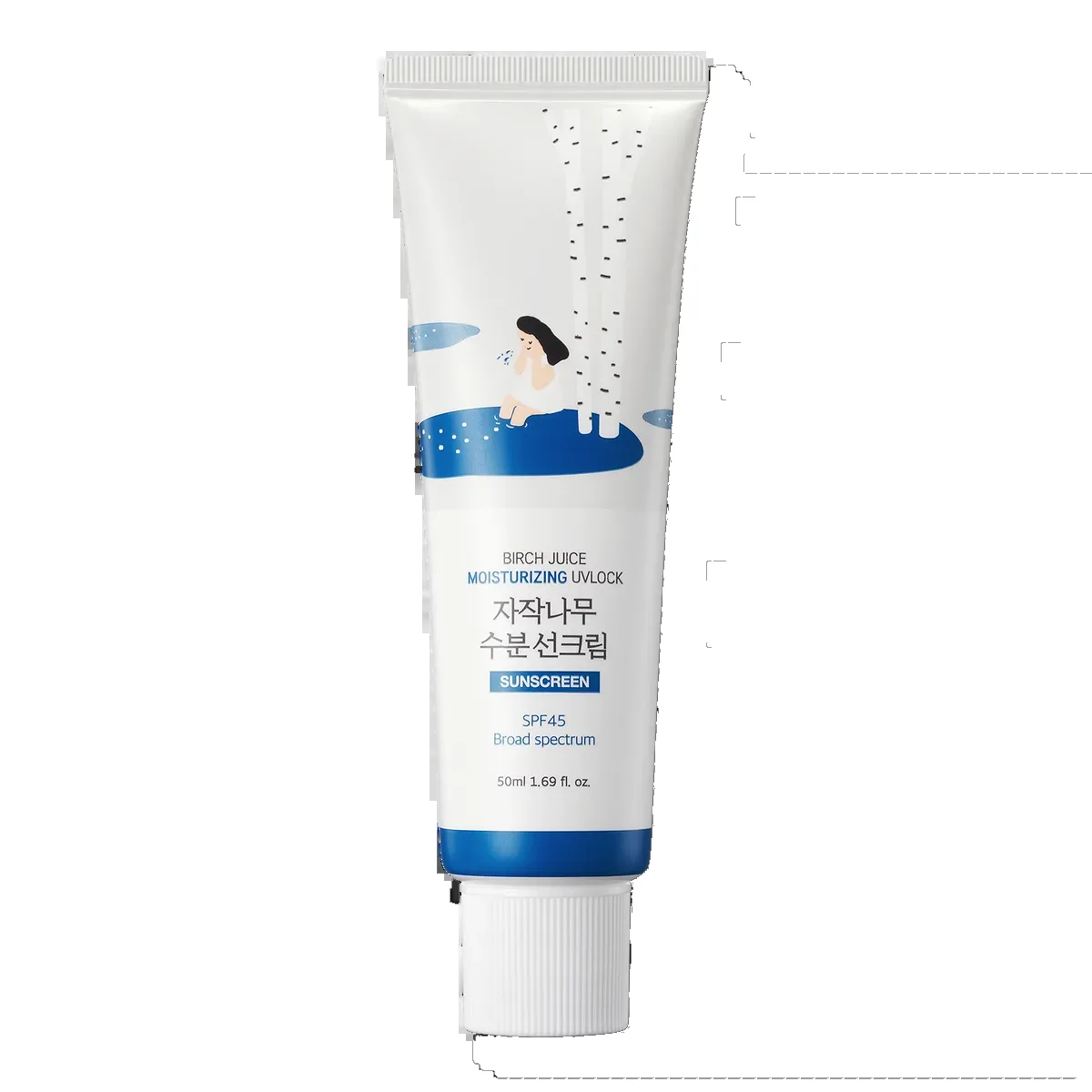
ROUND LAB Birch Juice Moisturizing Sunscreen SPF 50+
Sample PM Routine
Oil cleanser (to remove sunscreen)
Water-based cleanser
Toner
Serum
Moisturizer
Evidence
Science & Expert Perspective
The Science
The four-filter UV system in this sunscreen represents the current state of the art in chemical UV protection. Diethylamino Hydroxybenzoyl Hexyl Benzoate (DHHB/Uvinul A Plus) is a UVA filter with peak absorption at 354nm — deeper into the UVA spectrum than avobenzone (357nm) — with superior photostability. Unlike avobenzone, which degrades rapidly under UV exposure and requires stabilizers like octocrylene, DHHB maintains its protective capacity throughout sun exposure.
Methylene Bis-Benzotriazolyl Tetramethylbutylphenol (Tinosorb M/Bisoctrizole) is unique among UV filters as both an organic absorber and a physical scatterer of UV light. It provides broad-spectrum protection across both UVA and UVB ranges, with peak absorptions at 303nm and 360nm. Its photostability is excellent and it has been shown to stabilize other UV filters in the same formulation.
Ethylhexyl Triazone (Uvinul T 150) is a UVB filter with one of the highest extinction coefficients in its class, meaning excellent UV absorption per unit concentration. Diethylhexyl Butamido Triazone (Iscotrizinol) provides additional UVB protection with exceptional photostability.
Niacinamide's role extends beyond basic skincare. A study reported in the British Journal of Dermatology (Chen et al., 2003) demonstrated that topical niacinamide reduced UV-induced immunosuppression and enhanced DNA repair in human skin, providing a mechanistic complement to UV filter-based protection. This dual approach — blocking UV radiation externally while supporting cellular defense internally — represents a more comprehensive photoprotection strategy than UV filters alone.
The moisturizing components address a practical aspect of sun protection: compliance. Studies consistently show that the sensory characteristics of a sunscreen are the primary determinant of consistent daily use, which is itself the most important factor in long-term photoprotection outcomes.
Dermatologist Perspective
Dermatologists widely praise the new generation of Korean sunscreens like this one for solving the compliance problem that has long plagued sun protection. Practicing dermatologists often find that the UV filter combination used here — particularly DHHB and Tinosorb M — provides excellent photostable protection that does not degrade during normal daily wear. The addition of niacinamide is viewed as a meaningful skincare benefit that makes the product therapeutic rather than merely protective. Dermatologists recommend this sunscreen particularly for patients with hyperpigmentation concerns, as consistent daily UV protection combined with niacinamide addresses the condition from both the prevention and treatment sides simultaneously.
Guidance
Usage & Recommendations
How to Use
Apply as the final step of your morning skincare routine. Squeeze a generous amount (approximately 1/4 teaspoon for the face alone) and spread evenly across the face, neck, and ears. Allow 10-15 minutes before sun exposure for the chemical filters to fully bind to skin. Reapply every 2 hours during extended sun exposure or after sweating, toweling, or swimming. For office workers, a morning application with one midday reapplication is generally adequate.
Value Assessment
At $28 for 50ml, this is not the cheapest sunscreen available — and the small tube means you will go through it quickly with proper daily application. The annual cost for daily use works out to approximately $180-200. However, the value calculation must factor in the moisturizer-replacing hydration, the niacinamide skincare benefits, and the elegance of a formula that eliminates the need for a separate primer. When viewed as a combined sunscreen-moisturizer-primer with treatment benefits, the per-use value improves significantly. For comparison, achieving this level of UV filter sophistication in a Western market sunscreen is essentially impossible, as these specific filters are not FDA-approved.
Who Should Buy
Anyone who has been searching for a daily sunscreen that feels like skincare rather than sunscreen. Particularly ideal for those with dry, normal, or combination skin who want hydrating UV protection, for people with hyperpigmentation who need consistent SPF with brightening benefits, and for anyone who has given up on sunscreen because every one they've tried felt too heavy, white, or greasy.
Who Should Skip
Those with very oily skin who need a matte-finish sunscreen may find this too dewy. Anyone who needs water-resistant protection for swimming or heavy outdoor activity should choose a sport sunscreen instead. If you're extremely sensitive to chemical UV filters (stinging, burning), a mineral sunscreen may be a better fit.
Ready to try ROUND LAB Birch Juice Moisturizing Sunscreen SPF 50+?
Lightweight, lotion-like essence texture that is significantly thinner than traditional sunscreens. It applies like a fluid moisturizer and absorbs within seconds, leaving no greasy or sticky residue. The polymethylsilsesquioxane provides a smooth, velvety application feel.
Scent
Fragrance-free. Very faint clean/neutral scent from the base ingredients that is essentially undetectable once applied.
Packaging
Slim squeeze tube (50 ml) with a flip-cap. The compact size is travel-friendly but means the product doesn't last long with proper daily application. The opaque tube protects UV filter stability.
Finish
dewyglowynaturallightweight
What to Expect on First Use
First application is a revelation for anyone accustomed to thick, white-cast sunscreens. The cream-essence applies translucently, absorbs in seconds, and leaves skin looking naturally dewy and healthy. No heavy film, no pilling, no interference with makeup. The moisturizing effect is immediately noticeable.
How Long It Lasts
4-6 weeks with daily use at proper SPF application amount (1/4 teaspoon for face)
ROUND LAB's Birch Juice Sunscreen became a phenomenon in the Korean sunscreen market — a category that is arguably the most competitive in global beauty. In a country where sunscreen elegance is non-negotiable and consumers are exposed to hundreds of SPF options, this product rose to become the bestselling sunscreen. Its success is built on solving the fundamental tension between adequate UV protection and pleasant daily-wear experience — a problem that most Western sunscreens still haven't fully cracked.
About ROUND LAB Established Brand (5–20 years)
ROUND LAB was founded in 2017 in South Korea and has built a strong following through its nature-derived ingredient philosophy. This sunscreen became Korea's bestselling sunscreen and was ranked No. 1 out of 100+ sunscreens tested by NBC Select editors, establishing the brand's credibility in sun protection.
Brand founded: 2017 · Product launched: 2021
Myth vs. Reality
Common Myths
Myth
Korean sunscreens with high SPF ratings don't actually protect as well as they claim.
Reality
Korean sunscreen testing follows stringent KFDA standards that are comparable to or stricter than FDA testing for SPF claims. The PA++++ rating indicates the highest possible UVA protection grade. The UV filters in this product — DHHB, Tinosorb M, and Ethylhexyl Triazone — are extensively validated in European and Asian clinical literature.
Myth
If a sunscreen feels like a moisturizer, it can't be providing real protection.
Reality
The elegance of a sunscreen formula has no bearing on its protective efficacy. This product's lightweight feel comes from the choice of modern UV filters that are inherently less greasy than older filters, combined with formulation science that uses lightweight emollients and silicone alternatives. The protection comes from the UV filters; the feel comes from the vehicle.
FAQ
Frequently Asked Questions
Does the ROUND LAB Birch Juice Sunscreen leave a white cast?
No. This sunscreen uses exclusively chemical (organic) UV filters — DHHB, Ethylhexyl Triazone, Tinosorb M, and Iscotrizinol — that absorb into the skin completely. It applies translucently and works on all skin tones without any white or gray cast.
Can I skip moisturizer when using this sunscreen?
Many users do, especially in warmer months. The formula contains birch sap, dual hyaluronic acid, glycerin, panthenol, and allantoin — a hydration lineup equivalent to many standalone moisturizers. If you have dry skin or live in a harsh climate, you may still want a lightweight moisturizer underneath.
Is this sunscreen safe during pregnancy?
Yes. This sunscreen contains no retinoids and no ingredients flagged as pregnancy concerns. The chemical UV filters used (DHHB, Tinosorb M, Ethylhexyl Triazone) are considered safe for use during pregnancy by dermatological guidance. However, consult your OB-GYN with any specific concerns.
How often should I reapply this sunscreen?
Reapply every 2 hours with continuous sun exposure, or after sweating or toweling off. This is not a water-resistant formula, so it needs more frequent reapplication during swimming or heavy activity. For office workers with minimal direct sun exposure, a morning application with one midday reapplication is generally sufficient.
Is this the same as the ROUND LAB Birch Juice UV LOCK SPF 45?
The UV LOCK SPF 45 is the version sold through ROUND LAB's US channels, which may have a slightly different UV filter formulation to comply with FDA regulations. The SPF 50+ PA++++ version is the Korean-market original with the full complement of next-generation UV filters. Check your specific product's INCI list to confirm which version you have.
Will this sunscreen break me out?
The formula is fragrance-free and designed to be gentle, but individual reactions vary. Some users with very oily or acne-prone skin report breakouts, possibly from the moisturizing ingredients or the coco-caprylate emollient. Patch test on a small area for a few days if you're breakout-prone.
Reviews
What Reviewers Tend to Say
Recurring themes our editors read across retailer reviews of this product — summaries in our words, not quotations, and not a substitute for your own patch test.
Common Praise
Absorbs immediately with zero white cast — works on all skin tones
Feels like a lightweight moisturizer rather than a sunscreen
So hydrating that many users skip separate moisturizer underneath
Natural, dewy glow finish that looks beautiful under or without makeup
Fragrance-free and gentle enough for sensitive and acne-prone skin
Niacinamide provides cumulative brightening benefits with daily use
Common Complaints
Small 50ml tube runs out quickly with proper SPF application — expensive per ounce
Can sting eyes on hot days when mixed with sweat — common with chemical UV filters
May feel too moisturizing or dewy for very oily skin types
Some users report breakouts despite the gentle formula
Not water-resistant — needs reapplication after sweating or swimming
Notable Endorsements
Korea's bestselling sunscreen for multiple yearsRanked No. 1 out of 100+ sunscreens by NBC Select editorsWidely recommended in K-beauty and skincare communities
The blocker isn't chemistry — it's a classification. In the US a sunscreen is a drug, and that single word explains the empty shelf, the relabelled bottles, and what finally changed in June 2026.
Five brands that own the feed, judged on their ingredient lists rather than their view counts — including the one active all five suddenly added at once, and what that tells you.
Protection does not scale linearly with how much you apply. It scales as a root — which means the difference between a proper layer and your usual one is not a few points of SPF.
Products, answers, therapy guides, tools and articles in one search. Brand names,
slang and abbreviations all work — accutane finds isotretinoin, bacne finds truncal acne.