Glycolic Is the Fastest Acid. That's Its Design Flaw.
The smallest AHA gets deepest and shows results soonest — which is precisely why routines built around it overshoot, and why the people who do best with it use it least.
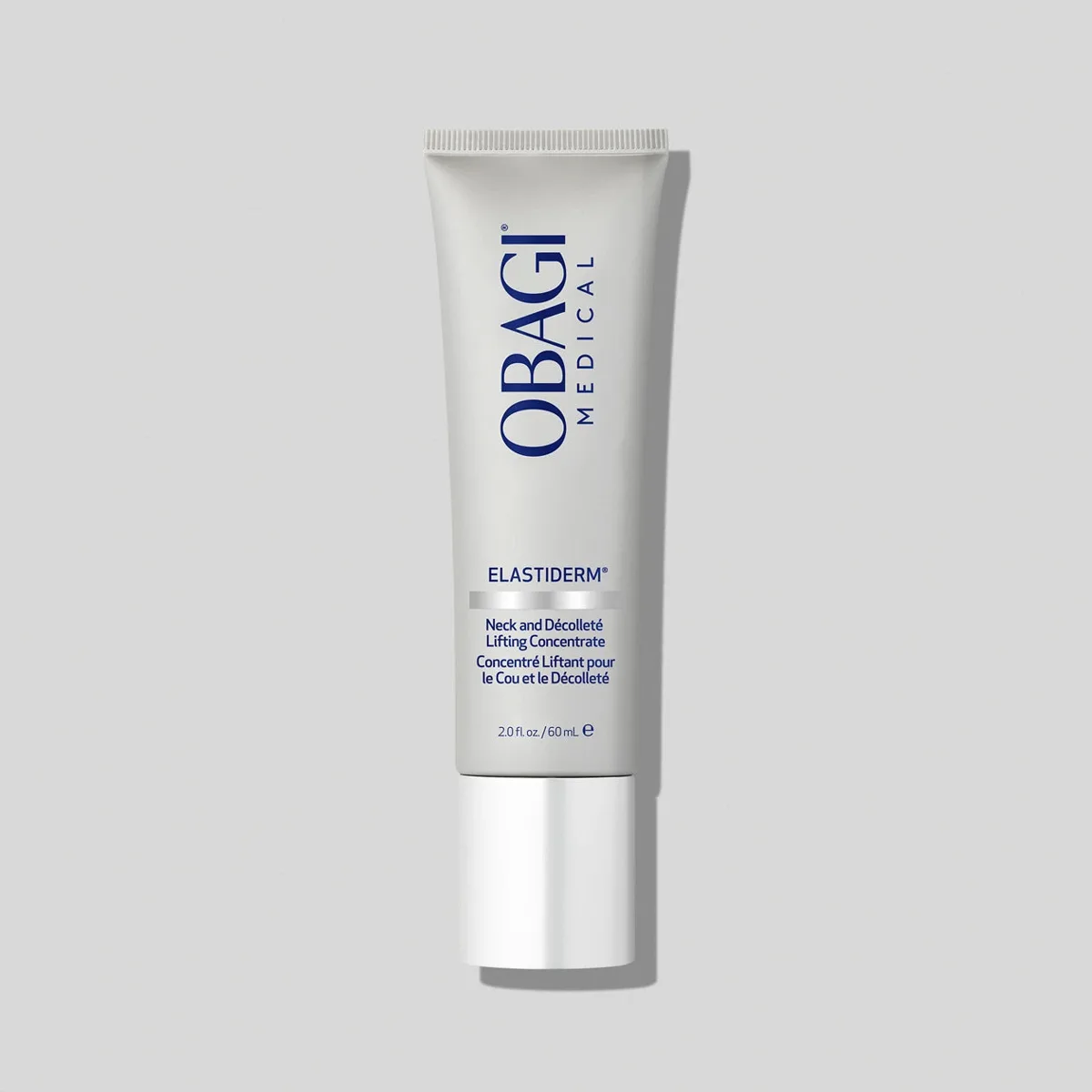
It treats the neck and chest as three problems at once, pigment, texture and elastin loss, and stacks a brightener with real tolerability data, a mild retinoid ester and the ELASTIderm copper-zinc malonate that has a human biopsy study, in a weightless alcohol-based serum with a body applicator. Most neck creams are face moisturisers in a bigger tube; this is a formula built for a sun-mottled, crepey décolleté specifically.
A smartly targeted neck-and-chest serum that treats the décolleté as a pigment problem as well as a texture one, stacking alpha-arbutin and niacinamide high with a mild retinoid ester and the ELASTIderm mineral complex that has real biopsy data. It brightens a mottled chest and softens crepiness over three months; alcohol sits fourth and there is fragrance where none was needed, sagging barely moves, and two hundred and sixty dollars is the highest price anyone charges for these ingredients.
Four years of sales have produced only a few dozen reviews on Obagi's site and a modest pool at clinical retailers, and the twelve-week blinded study the serum's claims rest on was run by the brand in 2021 and has not been published with subject numbers or methods. The assessment draws on that thin record, the disclosed formula, and peer-reviewed work on alpha-arbutin, niacinamide and the copper-zinc malonate compound, the last of which was studied on the face at a concentration this serum does not disclose; how it performs on neck and chest skin across a range of tones and over a year of use is not on record.
The case for it
What would change this: A declared concentration would move this to a firmer reading of the dose.
Same rule for everyone. “Promising” is the verdict on 7,858 of 45,024 concern verdicts across the catalog; rule R9p decided 7,858 of them. As of September 25, 2026, engine 5.1.1.
Brand or formulator? Disclose a concentration or correct a fact →
The studies behind the evidence row
The case for it
What would change this: A declared concentration would move this to a firmer reading of the dose.
Same rule for everyone. “Promising” is the verdict on 7,858 of 45,024 concern verdicts across the catalog; rule R9p decided 7,858 of them. As of September 25, 2026, engine 5.1.1.
Brand or formulator? Disclose a concentration or correct a fact →
The studies behind the evidence row
The case for it
What would change this: A declared concentration would move this to a firmer reading of the dose.
Same rule for everyone. “Good choice” is the verdict on 9,564 of 45,024 concern verdicts across the catalog; rule R5 decided 9,072 of them. As of September 25, 2026, engine 5.1.1.
Brand or formulator? Disclose a concentration or correct a fact →
The studies behind the evidence row
The case for it
What would change this: A declared concentration would move this to a firmer reading of the dose.
Same rule for everyone. “Unproven” is the verdict on 1,111 of 45,024 concern verdicts across the catalog; rule R9 decided 1,111 of them. As of September 25, 2026, engine 5.1.1.
Brand or formulator? Disclose a concentration or correct a fact →
The studies behind the evidence row
Also listed for Rough Texture — the actives here (Alcohol Denat., Alpha Arbutin, Niacinamide, Retinyl Palmitate) are in our research queue for that concern; there is no verdict until their evidence rows are written. That is a gap in our table, not a mark against the product.
Where our review and the verdict differ. The review below was written on the formulation and the published trials; the verdicts above apply the stricter standing test in our methodology — an active earns a recommendation only with guideline or regulatory standing for the concern. Where the two disagree, the verdict is DermApproved’s position.
A verdict is DermApproved’s assessment of how well a product’s ingredients fit a concern — never a claim about what the product treats. Evidence dots and collected reviews sit beside it and are never blended in. Rules 0.5.1 · evidence table ev-2026.09-r228 · how we decide
Ask a dermatologist what the chest of a fifty-year-old patient looks like and the answer is rarely 'saggy'; it is mottled. Decades of sunscreen applied to the face and stopped at the jaw produce a décolleté that is freckled, reddened and criss-crossed with fine horizontal lines, and the pigment is usually what people notice before the crepiness. Obagi's ELASTIderm Neck and Décolleté Concentrate, launched in 2022, is unusual among neck products for having read the situation that way. Its two highest-placed actives are alpha-arbutin and niacinamide, brighteners, and its firming ingredient, the copper-zinc malonate complex the line is built on, comes after them. The retinoid is the mild ester retinyl palmitate. It is a serum designed for a sun-damaged chest specifically, which is more thought than most neck creams, face moisturisers in larger tubes, ever receive.
The formula reads like a quick-dry body serum. Glycerin leads, then water, methyl propanediol and, fourth, denatured alcohol; dimethicone and three light esters follow for slip; alpha-arbutin at nine and niacinamide at ten are the actives at working positions; pentylene glycol and phenoxyethanol preserve; the polymers set a light gel; then malonic acid, retinyl palmitate, zinc carbonate, a second polymer, sunflower oil, cupric carbonate, amodimethicone, t-butyl alcohol, vitamin E and fragrance close it out. The three mineral components are the Bi-Mineral Contour Complex from the ELASTIderm eye cream, and Obagi does not disclose their concentration here any more than it does in the face products. No parabens, no mineral oil, a vegan formula, and an alcohol content high enough to define the texture.
The evidence divides by ingredient and the brand's twelve-week blinded study, held on file since 2021, ties it together only loosely. Alpha-arbutin is the best-supported of the three ideas: a glycosylated relative of hydroquinone that inhibits tyrosinase without hydroquinone's toxicity to melanocytes, it showed modest enzyme inhibition and no effect on melanocyte viability even at high concentrations in a 2023 comparative study of depigmenting agents, and it was classified as non-photoreactive, which matters on a chest that will see sun. Niacinamide's pigment-transfer and barrier effects are well established at the two to five percent range its list position suggests. The copper-zinc malonate has a small human biopsy study showing new elastin in photoaged facial skin after six weeks, carried over from the eye cream; whether it does the same at whatever concentration sits in this serum, on the neck, is inferred rather than shown. Retinyl palmitate is the weakest link, an ester that converts twice before it acts and that appears in this formula at an undisclosed level, contributing gentle turnover rather than resurfacing. Obagi's study reported that everyone improved in crepiness and nearly everyone in horizontal lines at eight weeks, and that sagging improved least, which is the honest number in the set: no topical lifts the neck, and the brand's own data agrees.
In use, it is quick and mostly pleasant. The applicator head glides the serum from chest to jaw in a few upward strokes, it dries in under a minute to a faintly tightened satin, and it leaves nothing on a collar, which is the practical reason for the alcohol. That same alcohol, with t-butyl alcohol and the fragrance further down, is what makes the first week uncomfortable for some: a tingle that becomes a sting on freshly shaved or sun-exposed skin, and a little flaking on dry necks as the retinoid ester joins in. A moisturiser over the dried serum settles most of it. By the third week the chest looks a touch more even, by the second month the horizontal lines soften, and at twelve weeks, on the thirty-odd reviewers who stuck with it on Obagi's site, the verdict is a firmer-feeling, brighter décolleté and a jawline that looks about as it did. Those reviewers average four stars, which is low for the brand and reflects two complaints, the sting and the price, more than any doubt about the brightening.
The suitability is narrower than the marketing. Neck skin is thin and dry, and a formula with alcohol fourth, fragrance and a retinoid is not the obvious choice for it; normal, combination and oily necks will be fine, dry ones will need moisturiser over it, and sensitive, eczema-prone or reactive skin should look for an unscented, alcohol-free alternative. The retinyl palmitate makes it one to set aside in pregnancy. Sunscreen on the chest every morning is part of the product, not an accessory, because arbutin's work is undone by ultraviolet and so is new elastin.
And the price. Two hundred and sixty dollars for two ounces is the highest figure in this review and among the highest in the neck category, and it buys about three months of twice-daily use, or well over a thousand dollars a year. Every active in the tube, arbutin, niacinamide, a retinoid ester and even copper and zinc salts, is available in well-made products for a small fraction of that; the ELASTIderm complex with its biopsy study is the one thing that is not, and it sits at an undisclosed concentration behind a fragrance on the list. Obagi's legacy in physician-dispensed skincare is real, and the formulation logic here is better than most, but the number is set by the dermatology-office channel and not by the chemistry.
This serum is for someone with a sun-mottled, crepey chest and a tolerant neck who wants one product to brighten and smooth it, values the ELASTIderm complex and Obagi's clinic pedigree, and can absorb the cost without wincing. It is not for anyone hoping to lift a jawline, for reactive or very dry necks, for pregnancy, or for anyone who would rather buy the same actives three times over for the same money and keep the change.
The hero actives that drive this product's performance.
| Ingredient | Function | Evidence |
|---|---|---|
| Alpha-Arbutin | Ninth on the list, above niacinamide, which makes this the highest-placed active in the serum and the reason it is aimed at the chest as much as the neck: sun-mottled décolleté is as much a pigment problem as a texture one, and alpha-arbutin's tyrosinase inhibition, without hydroquinone's toxicity to melanocytes, is what the brightening claim rests on. | Limited for Hyperpigmentation |
| Niacinamide | Tenth, just below the arbutin and at what is likely a working dose, niacinamide slows the transfer of pigment into the surface and supports the barrier on a body area that is thin, dry and prone to reacting to retinoids and alcohol; it is the second brightener and the buffer that lets the rest of the formula be tolerated twice a day. | Emerging for Hyperpigmentation |
| Copper-Zinc Malonate (Bi-Mineral Complex) | Malonic acid, zinc carbonate and cupric carbonate, split across the lower half of the list, are the three parts of Obagi's patented chelate, the firming ingredient carried over from the ELASTIderm eye cream and its human biopsy study on elastin synthesis; on the neck, where elastic fibre loss shows as horizontal lines and crepiness, it is the ingredient the 'lifting' in the name actually refers to. | Not yet assessed |
| Retinyl Palmitate | The gentlest retinoid ester, placed mid-list with no declared percentage; it has to be converted twice in the skin before it does anything, which makes it a mild texture-and-turnover contributor that neck skin can tolerate daily, and a much weaker one than the retinol Obagi sells for the face. The brand's 'smoothing retinoid' claim should be read at that strength. | Not yet assessed |
| Alcohol Denat. | Fourth on the list, ahead of every emollient, denatured alcohol is why the serum dries fast and feels weightless under a shirt collar and why it can sting a freshly shaved or sun-exposed chest; with t-butyl alcohol further down, it is the formula's main tolerability trade-off and the ingredient dry, reactive neck skin will notice first. | Not yet assessed |
Ingredient standings describe the active at treatment-level doses and vehicles; this product's own condition grades weigh its actual formula.
Glycerin, Water (Aqua), Methyl Propanediol, Alcohol Denat., Dimethicone, Isocetyl Stearoyl Stearate, Coco-Caprylate/Caprate, Isononyl Isononanoate, Alpha-Arbutin, Niacinamide, Pentylene Glycol, Phenoxyethanol, Polyacrylate Crosspolymer-6, Malonic Acid, Sodium Hydroxide, Carbomer, Retinyl Palmitate, Zinc Carbonate, Acrylates/C10-30 Alkyl Acrylate Crosspolymer, Disodium EDTA, Helianthus Annuus Seed Oil, Cupric Carbonate, Amodimethicone, T-Butyl Alcohol, Tocopherol, Parfum
serum
AM & PM
Glide the applicator from the chest up to the jawline on clean, dry skin morning and evening, let it dry fully before clothing or moisturiser, and follow in the morning with a broad-spectrum SPF 30 or higher on the same area, which matters as much as the serum for both the pigment and the elastin claims. Skip any other retinoid or acid on the neck while using it, and moisturise over it if the alcohol leaves the skin tight.
The serum dries to a faint tightening within a minute and the chest looks a little more even by the second or third week as niacinamide and arbutin begin on surface pigment; the brand's blinded study put visible improvement in crepiness and horizontal lines at eight weeks and full results at twelve, which matches the six-week elastin timeline for the mineral complex plus the slow pace of body skin. Sagging changes least, and last.
The serum bundles three mechanisms for three complaints, and their evidence quality runs from solid to inferred. The brightening pair is the best supported. Alpha-arbutin is the alpha-glucoside of hydroquinone; it competes with tyrosine at the active site of tyrosinase and reduces melanin synthesis without hydroquinone's cytotoxicity. A 2023 comparative study in Pharmaceuticals tested a panel of depigmenting agents for photoreactivity, tyrosinase inhibition and melanocyte toxicity and found alpha-arbutin non-photoreactive, a moderate tyrosinase inhibitor at 150 micromolar, and free of any effect on B16 melanocyte viability up to 1,000 micromolar, in contrast to hydroquinone, which suppressed cell growth at far lower concentrations; the authors noted only that its singlet-oxygen generation sat near the cut-off, warranting caution under intense radiation, which on a chest translates into the sunscreen the label already demands. Niacinamide, positioned directly below the arbutin, reduces melanosome transfer from melanocytes to keratinocytes and improves barrier lipid synthesis at two to five percent, with several controlled facial trials behind it; on the décolleté its barrier role also offsets the alcohol and retinoid.
The firming claim rests on the copper-zinc malonate complex, listed as malonic acid, zinc carbonate and cupric carbonate. A small 2009 biopsy study of a 0.1 percent copper-zinc malonate test cream on photoaged facial skin found a significant increase in newly synthesised tropoelastin and desmosine cross-links after six weeks, which is the basis for the elastin claims across the ELASTIderm range. Two caveats apply here: the concentration in this serum is undisclosed, and the study concerned the face, whereas neck and chest skin is thinner, more sun-damaged and slower to respond. Retinyl palmitate is the ester of retinol and palmitic acid, requiring hydrolysis to retinol and two oxidations to retinoic acid before it acts on gene expression; at cosmetic levels its effect on turnover and texture is mild and its evidence base is thin, though its tolerability is the reason it can be used twice daily on the neck. Denatured alcohol at fourth position speeds drying and improves penetration of the actives at some cost to barrier lipids, and the fragrance and t-butyl alcohol add irritant potential without benefit. Obagi's 2021 twelve-week blinded study, with undisclosed subject numbers, reported near-universal improvement in crepiness and horizontal lines and the smallest response in sagging, which is consistent with what surface brightening, mild turnover and papillary-dermis elastin support can and cannot do.
The neck and chest come up in clinic as a package of pigment, redness and crepiness far more often than as sagging, and the clinical response tends to mirror this serum's priorities: a non-hydroquinone brightener and niacinamide for the mottling, a gentle retinoid the area can tolerate, and, above all, daily sunscreen extended below the jaw, without which nothing else holds. Physicians who dispense Obagi generally present the ELASTIderm complex as a reasonable adjunct with some dermal evidence, and are candid that lifting in the surgical sense is not on offer from any topical; where a patient's concern is platysmal bands or submental fullness, the conversation moves to procedures. The formulation choices that draw clinical reservations are the denatured alcohol and fragrance, since neck skin is thin and prone to irritant and contact dermatitis, and the standard advice is to introduce the serum once daily, moisturise over it, avoid application immediately after shaving, and pause it in pregnancy on account of the retinoid ester. For patients with a sun-damaged chest who want a single targeted product and can afford it, clinicians tend to regard it as sensible if expensive; for reactive skin, an alcohol-free, unscented alternative is usually suggested instead.
Cleanse and dry the neck and chest, then twist the applicator head to open it and, squeezing the tube gently, glide the serum from the décolleté up to the jawline in upward strokes, covering the sides of the neck as well as the front. Let it dry completely, about a minute, before dressing or applying moisturiser over it, and in the morning finish with a broad-spectrum SPF 30 or higher on the whole area, which the pigment and elastin benefits depend on. Use twice daily, but start once daily in the evening for the first week if the neck is dry or reactive, do not apply straight after shaving, and moisturise over it if any tightness or flaking appears. Set it aside during pregnancy because of the retinoid ester, keep it out of the eyes, and allow twelve weeks before judging lines and crepiness.
Two hundred and sixty dollars for two ounces makes this one of the most expensive neck products sold in the United States, and with no larger size and a twice-daily chest-to-jaw application, a tube lasts about three months, so the annual cost exceeds a thousand dollars. What the money buys is a well-reasoned combination for a sun-damaged décolleté, a convenient applicator, the ELASTIderm mineral complex with its small biopsy study, and Obagi's physician-dispensed standing, which is genuine in its vitamin C and Nu-Derm lines and rests here on a 2021 brand-held study. What it does not buy is exclusivity, because alpha-arbutin, niacinamide and retinyl palmitate are available in inexpensive serums that would treat the same chest for a tenth of the outlay, and the mineral complex sits at an undisclosed concentration behind a fragrance on the list. For a committed ELASTIderm user it is a coherent if painful purchase; for anyone else the value is poor.
Someone with a sun-damaged, mottled and crepey chest who wants one twice-daily product to brighten and smooth it, has normal, combination or oily neck skin that tolerates alcohol and a mild retinoid, wears sunscreen below the jaw already, and values the ELASTIderm complex and Obagi's clinic pedigree enough to pay for them. Existing users of the ELASTIderm eye cream will find the same logic applied to the neck.
Anyone with sensitive, dry, eczema-prone or reactive neck skin should avoid a formula with alcohol fourth, fragrance and a retinoid, and anyone pregnant or trying should set it aside for the retinyl palmitate. It is the wrong purchase for someone whose concern is a sagging jawline or neck bands, which only procedures address, and for anyone who can buy arbutin, niacinamide and a retinoid ester separately for a fraction of the price and would rather.
Ready to try Obagi Neck and Décolleté Lifting Concentrate?
Buy at Amazon ♥A thin, weightless, faintly opalescent serum with a quick-drying alcohol lift and a trace of silicone slip, that spreads in a few strokes from the applicator, sets within a minute to a soft, slightly tightened matte-satin finish and leaves nothing on a collar.
A light, clean fragrance with an alcohol edge on application, fading within a minute or two; not unscented.
A grey 2 oz tube with a twist-to-open applicator head that glides the serum onto the skin, in the ELASTIderm livery; it keeps fingers out of the product and suits a body area, though it can dispense unevenly if squeezed hard, and the grey redesign replaced an older silver pack.
The first application is cool and quick: a few strokes of the applicator from chest to jaw, a faint alcohol tingle that turns into a sting only on freshly shaved or sunburnt skin, and a light tightening as it dries in under a minute. Nothing changes visibly for the first two weeks beyond a slightly smoother feel; some users see mild dryness or flaking on the neck from the retinyl palmitate and alcohol and should moisturise over it. The chest tone begins to look more even around week three, and the lines and crepiness the name promises are an eight-to-twelve-week wait.
About three months applied twice daily from chest to jawline; nearer five months on the neck alone.
All Year
Obagi's ELASTIderm range started with the eye and extended downward: the Neck and Décolleté Concentrate arrived in 2022 as the line's second application of its copper-zinc malonate, aimed at the chest that dermatology patients so often present with, sun-damaged and horizontally lined, after years of protecting only their face. It ran a twelve-week blinded study in 2021, collected a 'best neck serum' nod from a trade magazine the following year, and received a grey packaging refresh in 2025 when the Lift Up & Sculpt face products joined the family.
Obagi has been a dermatology-office brand since 1988, founded by dermatologist Zein Obagi and best known for its clinically studied Nu-Derm and vitamin C lines. This neck serum belongs to the ELASTIderm range, whose copper-zinc malonate has a small published biopsy study behind it; the serum's own twelve-week results come from a 2021 brand-held blinded study rather than a peer-reviewed paper.
A neck serum can lift sagging skin under the chin.
Sagging below the jaw comes from loosened ligaments, descended fat and lost bone support, which no topical reaches; what this serum can do is thicken and smooth the skin surface, brighten sun-mottled pigment and, through the mineral complex, support new elastin in the upper dermis over months, so the neck looks firmer and less crepey without changing its shape. The brand's own study found sagging the least improved measure.
Because it contains a retinoid, it is as active as a retinol for the face.
The retinoid here is retinyl palmitate, the mildest ester in the family, with no declared percentage; it must be converted to retinol and then to retinoic acid in the skin, losing potency at each step. It contributes gentle turnover neck skin can tolerate daily, not the resurfacing a 0.5 or 1 percent retinol delivers.
Three things on three timelines: alpha-arbutin and niacinamide even out sun-mottled pigment on the chest over weeks, retinyl palmitate gently smooths texture, and the copper-zinc malonate complex supports new elastin in the upper dermis over two to three months, which the brand's twelve-week study measured as improved crepiness and horizontal lines. It does not lift sagging below the jaw.
Twist the applicator open and glide it from the décolleté up to the jawline in upward strokes on clean, dry skin, morning and evening, then let it dry completely before clothing or moisturiser; in the morning follow with an SPF 30 or higher on the same area, which Obagi recommends and the pigment and elastin claims depend on.
It contains retinyl palmitate, the mildest retinoid ester, at an undisclosed level, rather than retinol; it converts to active retinoic acid slowly in the skin, which makes it tolerable on thin neck skin twice a day and considerably weaker than the retinol in Obagi's face products.
It contains a retinoid ester, retinyl palmitate, and most obstetric guidance advises avoiding topical retinoids of any strength during pregnancy as a precaution, so it is best set aside until after; the arbutin, niacinamide and mineral complex are not the concern, the retinoid is.
Denatured alcohol is fourth on the ingredient list, with t-butyl alcohol and fragrance further down, and retinyl palmitate adds mild turnover; on thin, dry or freshly shaved neck skin that combination can tingle and cause flaking in the first weeks. Applying a moisturiser over the dried serum and avoiding use right after shaving usually settles it.
It is a well-targeted formula with a mineral complex that has human biopsy evidence, and the two-ounce tube lasts about three months, but every one of its actives can be bought far more cheaply, the alcohol and fragrance are avoidable, and its own reviews average four stars. It is worth it to someone who wants the ELASTIderm complex on the chest and can absorb the price; on value alone it is hard to recommend.
Recurring themes our editors read across retailer reviews of this product — summaries in our words, not quotations, and not a substitute for your own patch test.
Chest looks more even and less mottled after a couple of months
Horizontal neck lines soften with consistent use
Weightless texture that dries fast under clothing
Rollerball-style applicator makes twice-daily use easy
Does not stain collars once dry
Two hundred and sixty dollars is hard to justify
Alcohol stings and dries the neck for some
Lifting effect on sagging is minimal
Fragrance in a product for delicate skin
Applicator can dispense unevenly